Key takeaways
- Northern Virginia clay goes to mud from November to March because dormant fescue stops drinking, evaporation nearly stops, and freeze-thaw churns the surface.
- Turf earns its price in four zones: the dog's route along the fence, the side yard, the ground under play equipment, and shaded strips where grass thins every year.
- A pet base is an open-graded stone layer 3 to 4 inches deep over geotextile, sloped to drain, with a drain line to daylight wherever the clay beneath cannot take the water.
- Deodorizing infill, a fully permeable backing and a rinse every week or two keep a dog area from smelling in humid weather. Skip any of the three and it will.
- As of 2026, typical Northern Virginia planning ranges run about $12 to $22 per sq ft installed, with pet drainage, pads and borders moving the number up.
Planning this work? See our artificial turf installation service in Northern Virginia and the HOA Design Guidelines.
On this page
- Why does a Northern Virginia yard turn to mud from November to March?
- Where does artificial turf actually earn its keep?
- Which turf, base and drainage fit each high-traffic zone?
- How is the base and drainage built for a pet yard on clay?
- Which infill and turf work for dogs, and how do you keep a dog area from smelling?
- How do you finish the edges against patios, beds and fences?
- Can artificial turf be installed in winter in Northern Virginia?
- How does artificial turf coexist with a real lawn on the same lot?
- What does turf need from November to March?
- What does artificial turf for a pet yard or play area cost in Northern Virginia?
- What should you ask an artificial turf installer before signing?
- Where does mud season hit hardest across Fairfax, Loudoun, Prince William and Arlington?
- Frequently asked questions
Why does a Northern Virginia yard turn to mud from November to March?
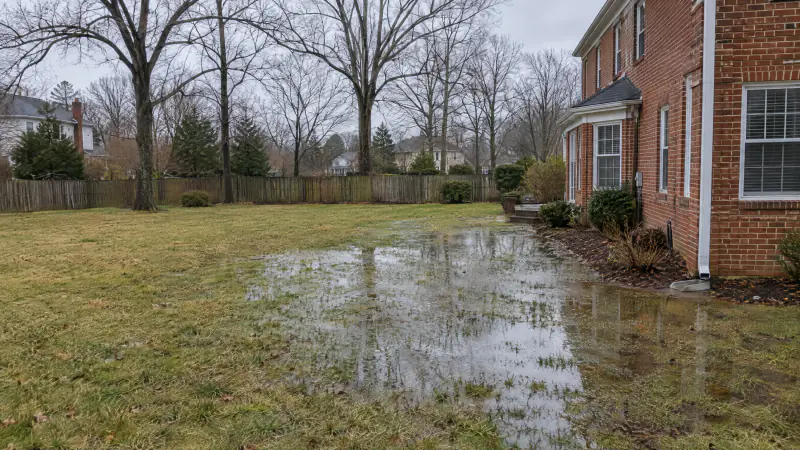
Because the clay stops draining, the grass stops drinking, and the weather stops drying anything out. From spring to early fall a tall fescue lawn pulls a surprising amount of water out of the top foot of soil every day, and warm air evaporates what the grass leaves behind. In November both of those pumps shut off. The fescue goes dormant, the sun sits low, the air is cool and damp, and every inch of rain that lands on compacted clay sits in the top few inches for days. Add leaf fall smothering the thin spots, freeze-thaw cycles that churn the surface, and a dog making the same loop along the fence twice a day, and by Thanksgiving the route is bare. By February it is a trench.
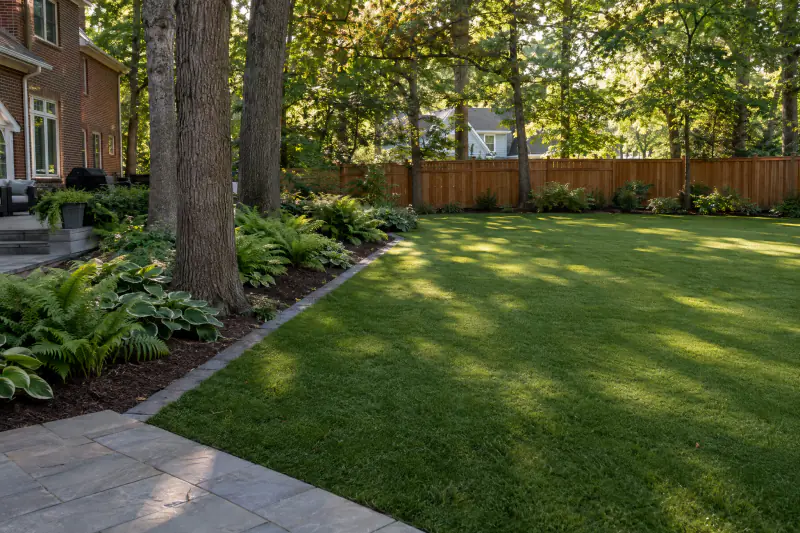
That is the problem artificial turf solves, and it is worth being clear about where it solves it. Turf is not a replacement for a healthy lawn in an open, sunny yard; sod costs a fraction as much and stays cooler in July. Turf is the honest answer in the places where grass has no real chance: the dog run, the shaded side yard, the ground under the play set, the strip along the back fence under the neighbor's oaks. Those zones are where this article lives.
We are writing this at the end of October because the next three weeks are the last comfortable installation window before the holidays, and because a dog owner who has watched the yard dissolve for the last two winters usually decides in November. Our earlier article on where artificial turf makes sense covers the broad case. This one goes into mud season specifically: the zones, the base and drainage built for pets, the infill, the edges, winter installation, and how turf lives beside a real lawn on the same lot.
Where does artificial turf actually earn its keep?
In four places, and most Northern Virginia yards have at least two of them. The first is the dog's route. Dogs do not use a yard evenly; they patrol the fence line, run to the gate when someone passes, and circle the same spot by the back door. On a quarter-acre lot that route is often a strip 4 to 8 feet wide and 60 to 100 feet long, and it is the only part of the lawn that dies. Turf on the route, lawn everywhere else, keeps the dog clean and the rest of the grass alive.
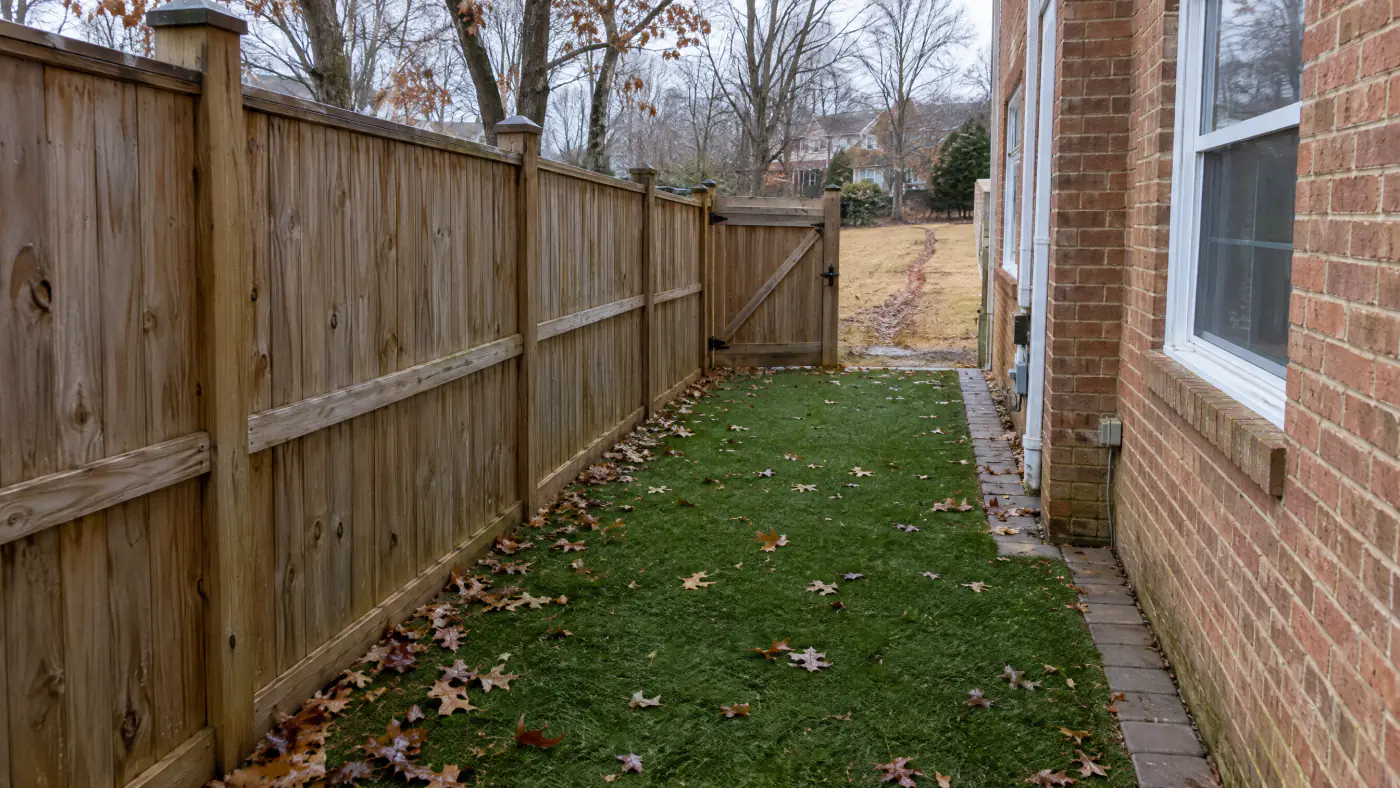
The second is the side yard. The 8 to 15 foot strip between the house and the fence gets a few hours of sun in June and none in December, carries the roof water from one side of the house, and takes every wheelbarrow and trash can trip of the year. Fescue there thins to moss and mud within two seasons of each reseeding. Turf makes it a clean path and a dry place for the dog to go out in the rain.
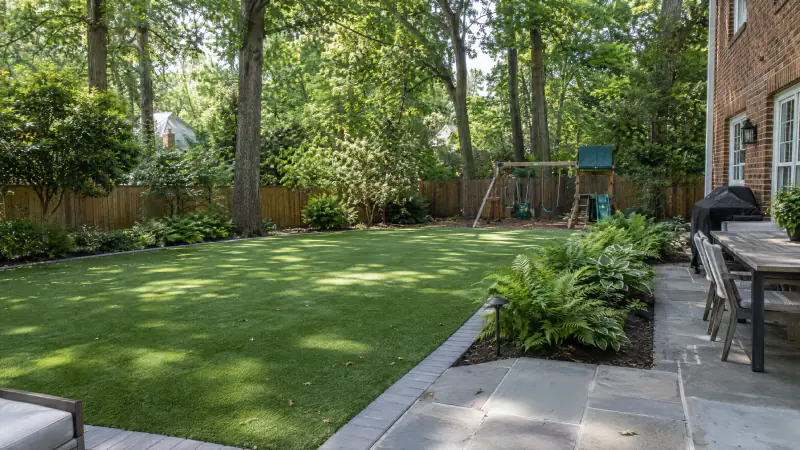
The third is under and around play equipment. Grass under a swing set is gone by the second summer, mulch scatters and tracks indoors, and bare clay under a slide becomes a puddle in November. Turf over a shock-absorbing pad gives a level, clean, resilient surface that does not need raking back into place. Where equipment has a fall height, the pad and base depth are chosen to suit it.
The fourth is the shaded strip. The back 15 feet of lots in Vienna, Burke, Oakton and older Arlington neighborhoods are often under the canopy of the neighbor's oaks and maples. Fescue needs about four hours of sun, and it does not get them. Owners reseed every fall and lose it every July. Turf there, or a shade planting bed from a planting plan, ends the cycle. Which one depends on whether the space needs to be walked on; if it is the dog's route, it is turf.
Which turf, base and drainage fit each high-traffic zone?
The product and the base change with the use. One specification does not fit every zone on the same lot.
| Zone | Why grass fails there | Turf and infill | Base and drainage |
|---|---|---|---|
| Dog run along the fence | Daily pacing, urine, shade from the fence | Dense short pile, 1 to 1.5 in., fully permeable backing, deodorizing infill | 3 to 4 in. open-graded stone, 1 to 2 percent slope, drain line at the low edge |
| Pad by the back door | Concentrated traffic, roof water nearby | Same as dog run, often a slightly softer face | Base sloped away from the house, downspout rerouted first |
| Side yard path | Deep winter shade, wheelbarrow traffic, roof runoff | Landscape turf with tan thatch, moderate pile | Open-graded base, channel or French drain if water crosses it |
| Under play equipment | Wear under swings, scattered mulch, puddles | Soft resilient turf over a shock pad sized to fall height | Level compacted base, pad drainage holes aligned, border to contain it |
| Shaded back strip | Under four hours of sun under mature trees | Multi-tone landscape turf that reads as lawn | Standard base; leaf blowing is the main upkeep |
| Narrow townhome yard | No sun, fence on three sides, one dog, one door | Pet turf throughout, pile matched to use | Often the whole yard; drainage to a dry well or the rear swale |
Shock pads, deodorizing infill and drain lines add cost per square foot. Order them where they are needed, not everywhere.
How is the base and drainage built for a pet yard on clay?
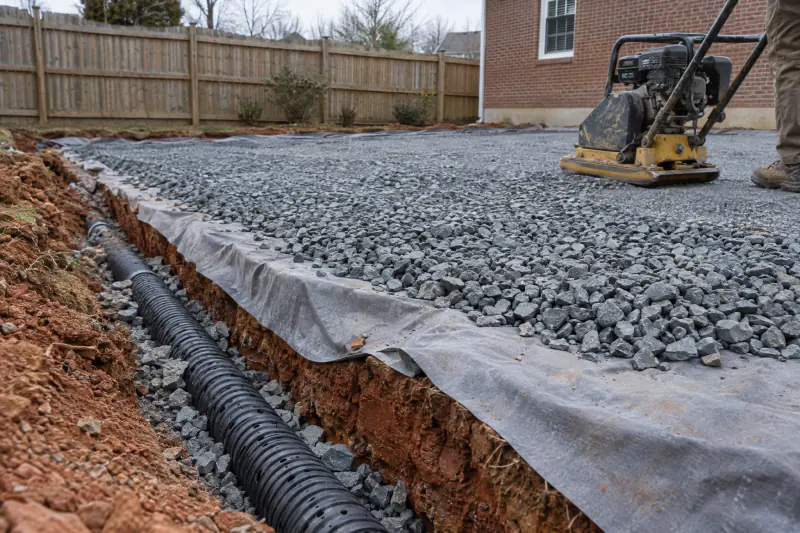
The turf is the least important layer in a pet installation. What makes a dog area stay dry, flat and fresh is what sits under it, and on Northern Virginia clay that means a base designed to move water sideways to somewhere it can go, because the clay beneath will not take it. The sequence we use is excavation, geotextile, open-graded stone, slope, and an outlet.
Excavation first: the existing turf, the mud and several inches of soil come out, usually to about 4 to 5 inches below the finished height, more where a shock pad will be added. The subgrade is shaped so it falls 1 to 2 percent toward the low edge. Then geotextile fabric goes over the clay. It keeps the stone from sinking into the clay over the years and the clay from pumping up into the stone, which is the failure that leaves an old installation lumpy. On top of it goes 3 to 4 inches of open-graded crushed stone, the kind with no fines, placed in lifts and compacted with a plate compactor. Open-graded matters for pets. A dense-graded base like the one under a patio packs tight and holds urine; an open-graded base has voids that let liquid pass straight through to the fabric and run along the slope.
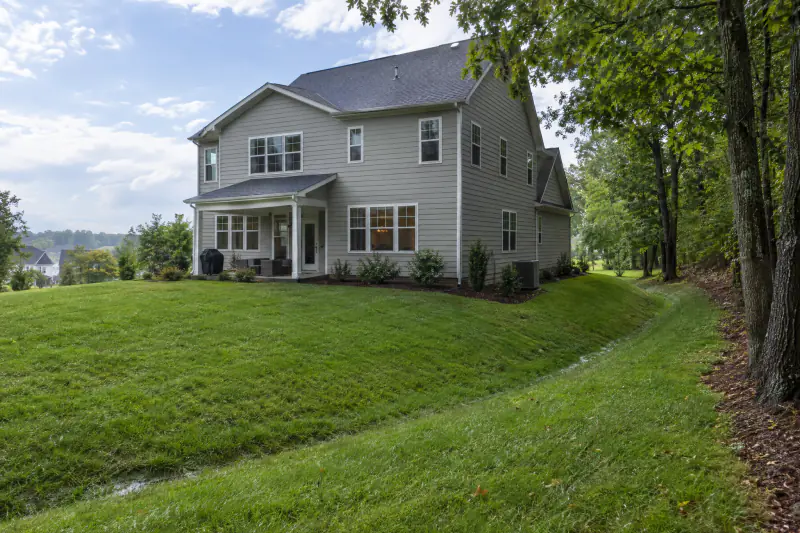
The outlet is where flat clay lots get expensive. Water reaching the bottom of the base has to leave. On a sloped lot it runs to the low edge and out through a perforated pipe to daylight. On a flat lot in a new subdivision it may need a perforated collector pipe along the low edge feeding a solid pipe to a dry well, a swale or an existing storm drain connection where the county allows it. If there is nowhere for the water to go, the base becomes a bathtub and the dog run smells by August. That is the point at which we bring in the yard drainage side of the business, and sometimes the honest advice is that the downspouts have to be rerouted before any turf goes down. Our article on why Northern Virginia backyards stay wet explains the clay in more detail.
Above the stone, the turf backing finishes the drainage story. Standard landscape turf has drainage holes punched through a latex backing every few inches. Pet turf should have a fully permeable backing that drains across its whole surface, so urine does not pool between the holes. The difference is not visible from above and it is the first thing to ask about.
Which infill and turf work for dogs, and how do you keep a dog area from smelling?
Smell is the question every dog owner asks, and the honest answer is that a pet area built with the right base, backing and infill and rinsed regularly does not smell, while one missing any of those will, especially in a humid Northern Virginia July. The infill is the part people underestimate. It is the granular material brushed into the turf to hold the fibers up and weigh the turf down, and for pets it also has to manage ammonia. Plain silica sand holds urine and bacteria and is the wrong choice. The infills made for pet areas are either a natural zeolite, a volcanic mineral that captures ammonia until rain or a rinse flushes it, or a coated sand with an antimicrobial treatment. Both work; zeolite is the more common recommendation for a dog run, often used alone or over a sand layer. Crumb rubber holds heat and odor and is not something we put in a pet area.
The turf itself for dogs is shorter and denser than lawn-look turf, usually a pile around 1 to 1.5 inches, because long fibers mat under paws and trap waste. A medium-firm face is easier to pick up from and rinses cleaner. Multi-tone fibers with a tan thatch layer still read as lawn from the house. For play areas the pile is often a little longer and softer, and the pad beneath does the cushioning.
Then the routine. Solids are picked up as on a lawn. The area gets a hose rinse every week or two, more in hot weather and after heavy use, so the infill is flushed through to the base. An enzyme cleaner made for pet turf goes on monthly in summer or whenever there is a hint of odor, and it is the enzyme, not a perfume, that breaks the ammonia compounds down. Rain does much of this for free from November to March, which is a small consolation for mud season. If a dog area smells despite that routine, the problem is almost always under the turf: a base that is holding water because it has no outlet, or a dense-graded base that should have been open-graded.
How do you finish the edges against patios, beds and fences?
Edges are where turf installations fail first, because a loose edge lifts, a dog digs at it, infill migrates out of it and weeds grow into it. The rule is that every edge of the turf is fastened to something firm, and that something is set before the base is placed, not after. There are four edge conditions on a typical lot and each gets its own detail.
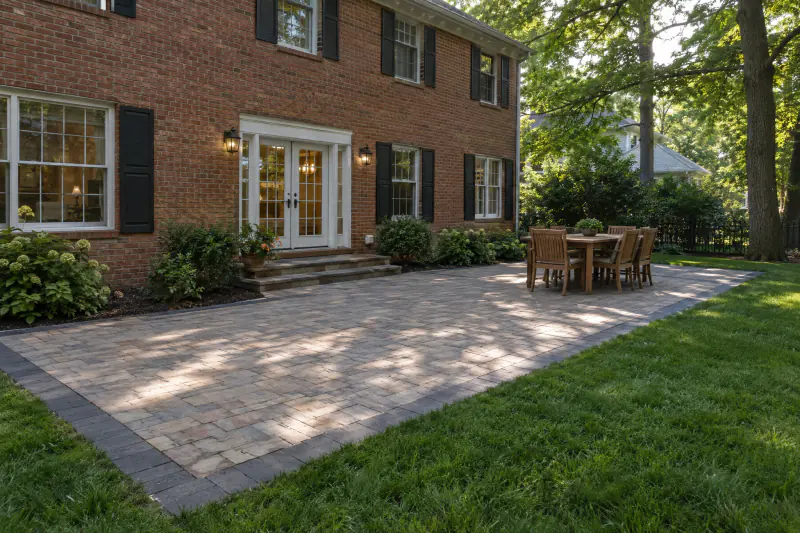
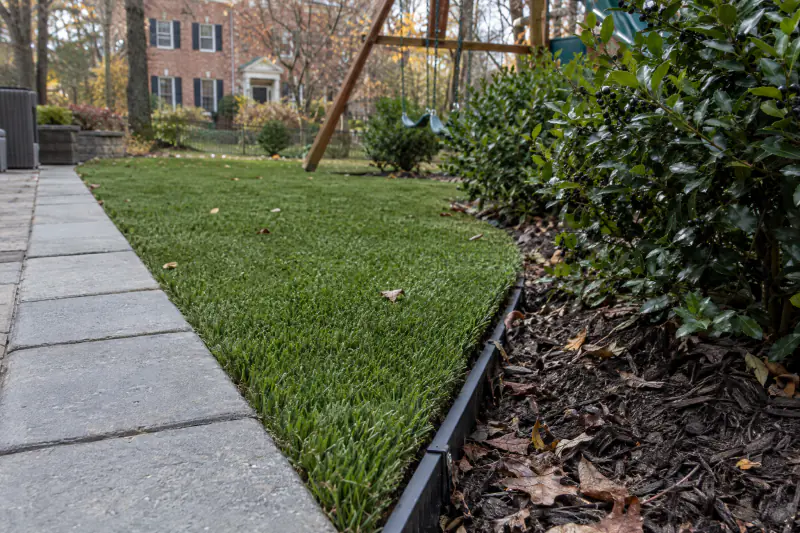
Against a paver patio or walk, the turf is trimmed tight to the paver edge and fastened to a concealed nailer board or a bender board set just below the paver surface along the border. The paver's own edge restraint holds the board. Where a patio is being built at the same time, a soldier course of pavers between the patio and the turf is the cleanest finish and doubles as a visual line. Against a planting bed, steel edging set with its top about half an inch above the turf keeps mulch off the turf and turf infill out of the bed; the turf is nailed to a board on its own side of the steel. Plastic roll edging heaves and is not worth installing.
Along a fence, the turf runs to within an inch or so of the fence boards and is fastened to a treated nailer board set at the base of the fence. Leaving a wider gap invites the dog to dig the edge up; running the turf under the fence traps leaves and water. At a gate, a paver or concrete threshold takes the wear. Against an existing lawn, the hardest edge, there has to be a hard break: a paver soldier course, a steel edge or a concrete mower strip. Turf butted straight to grass creeps, catches the mower and lets the fescue grow into the infill within a season.
Where the turf meets a wall or the house, the base is sloped away from the foundation and the turf is held back from siding so water does not wick up. And where a downspout discharges anywhere near the turf, it is extended underground past the area first. A downspout dumping onto turf washes the infill out and floods the base every storm.
Can artificial turf be installed in winter in Northern Virginia?
Mostly yes, with two limits that are about the ground and the glue rather than the calendar. The base cannot be compacted properly over frozen or saturated clay. A plate compactor on frozen subgrade produces a surface that settles when it thaws, and on mud it simply pumps. In a typical Northern Virginia winter the ground freezes hard for stretches of days rather than weeks, and there are usually enough workable days in December, January and February to build a base, so winter installations happen; they just move around the weather. November and early December are the most reliable late-season weeks, and that is why we suggest deciding now.
The second limit is the seam adhesive. Turf seams are joined with seaming tape and an adhesive that has a minimum application temperature, often somewhere between about 40 and 60 degrees Fahrenheit depending on the product, and it cures slowly in the cold. Seams glued on a 35-degree afternoon can fail. The turf rolls themselves also stiffen in the cold and want an hour in the sun to relax before they lie flat. The practical answer is that base work proceeds on any workable day and the turf is laid and seamed on a mild one, which December and January in this region usually provide every week or two.
Infill is not weather-sensitive but it should go into dry turf, and a dry day after the seams have cured is needed. In a wet stretch that can add a week to a job. None of this makes winter a bad time to install; a dog run finished in December is in use for the whole of mud season rather than the last month of it. What it does mean is that a winter schedule carries a few flexible days, and a homeowner should expect that rather than a fixed three-day block. Material lead times are the other winter consideration: pet turf and shock pads are stocked, but a specific product in a specific width may take a couple of weeks to arrive, which is why ordering in November pays.
How does artificial turf coexist with a real lawn on the same lot?
Well, if the boundary is designed and the irrigation is adjusted. The best Northern Virginia yards we build with turf are mostly grass. Turf covers the dog's route, the side yard and the play area, perhaps 300 to 800 square feet, and the open sunny lawn remains tall fescue. The dog gets a clean loop, the children get a clean play surface, and the rest of the family gets a living lawn that stays cool in July and does not need replacing in fifteen years.
The boundary is the first design question. A hard edge, a paver soldier course or a concrete mower strip, is essential, and it should follow a line that makes sense from the house: a gentle curve that reads as a path, or a rectangle that reads as a room, rather than an outline of exactly where the mud was. A planting bed between turf and lawn, with the turf edged in steel on one side and the lawn spade-cut on the other, hides the transition entirely.
Irrigation is the second. Sprinkler heads that used to cover the dog run should be capped or relocated so they do not spray the turf; wet turf is not harmful but it is pointless and it keeps a pet area from drying between rinses. A head at the boundary is often swapped for one with a different arc. If the lawn side is being rebuilt at the same time, the sequence is base and turf first, then sod up to the edge, because sodding first and then wheeling stone across it ruins the sod. The sod vs. seed guide and our article on this fall's sod or seed decision cover the lawn side.
Finally, the dog. A dog that has been using the whole lawn will keep doing so until the fence line and the gate are the easy route. Most settle onto the turf within a couple of weeks because it is dry and the lawn is not, and the lawn recovers once the daily traffic moves. In spring, the thinned grass next to the turf gets overseeded, and after that first season the two surfaces generally stay in balance.
What does turf need from November to March?
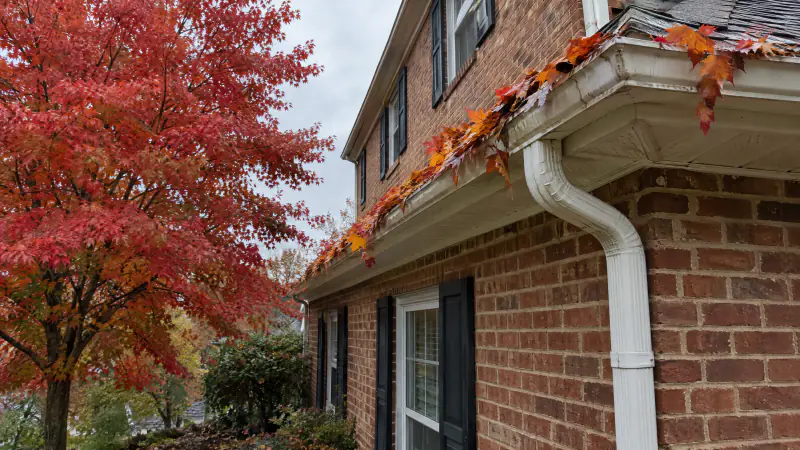
Less than a lawn, but mud season is also leaf season, and that is the one chore that matters. Oak and maple leaves left on turf through a wet winter mat down, hold water against the fibers, and break down into a layer of fine organic matter that works into the infill and eventually grows moss and weeds. A leaf blower pass every week or two in November and December, and again after the late oak drop in January, keeps the surface clean. A plastic leaf rake works; a metal one pulls fibers. Leaves also clog the drainage holes in a perforated backing, which is another reason a fully permeable backing is worth having in a treed yard.
Snow and ice are easy. Turf tolerates snow sitting on it and is better left to melt, but a plastic shovel or a push broom clears a dog path without harm. Metal shovels and blades cut fibers. Ice-melt products are generally safe on turf in moderation, and the safest are the calcium or magnesium chloride types rather than rock salt, which is harsher on the dog's paws than on the turf; whatever is used should be rinsed through when the weather allows. Do not use a snow blower with a metal auger over turf.
Rinsing continues through winter on mild days, less often than in summer because rain does most of it, and the enzyme treatment can usually pause from December to February. In March, before the first warm week, a thorough rinse, an enzyme application and a pass with a stiff broom to stand the fibers up and redistribute infill sets the area up for the season. That is also the time to check edges after a winter of freeze-thaw and renail any that have lifted. The maintenance guide lists these tasks alongside the rest of the yard.
What does artificial turf for a pet yard or play area cost in Northern Virginia?
As typical Northern Virginia market planning ranges as of 2026, professionally installed artificial turf for lawn, pet and play areas runs about $12 to $22 per square foot, including excavation, base, turf, seaming, edging and infill. Pet-specific upgrades, meaning a fully permeable backing, deodorizing infill and a drain line, tend to push a dog run toward the upper half of that range. A shock pad under a play area adds several dollars per square foot on top. In practice a 300 square foot dog run along a fence often lands somewhere between $4,000 and $7,000, a 500 square foot side-yard-plus-door-pad between $6,000 and $11,000, and a play area of similar size with a pad somewhat more. A drain line or dry well on a flat clay lot is priced separately and can add from several hundred dollars to a few thousand depending on the distance to an outlet. These are general market ranges, not myYardPros prices.
Turf is several times the cost of sod per square foot, and it will need replacing in roughly 12 to 20 years while the stone base stays. The comparison only makes sense in the zones where sod would fail, which is the argument of this whole article. Where grass would grow, we say so and recommend sod.
What moves the number:
- Access. A rear yard reached through a 36-inch gate means stone and spoil travel by wheelbarrow.
- Excavation depth and the volume of clay to haul away.
- Drainage. A sloped lot with a daylight outlet is far cheaper than a flat one needing a dry well.
- Turf grade, pile height, backing type and infill. Pet and play specifications cost more than landscape turf.
- Shape. Curves and narrow strips mean more seams and more waste from a 15-foot-wide roll.
- Edges. Paver soldier courses and steel edging add linear-foot costs; nailer boards are cheaper.
- Shock pads, thresholds at gates and any sprinkler relocation.
The cost guide sets these figures next to the rest of the yard. The number for your dog run comes from a written on-site estimate after we have measured the route, found the low point and confirmed where the water can go.
What should you ask an artificial turf installer before signing?
Good answers to these separate a dog run that stays flat, dry and fresh from one that ripples, puddles and smells by its second summer.
- How deep will you excavate, and how thick is the compacted base under the turf?
- Is the base open-graded stone with no fines, or dense-graded like a patio base?
- Where exactly does the water go after it passes through the turf and the stone on my clay?
- Does the turf have a fully permeable backing or only punched drainage holes?
- Which infill do you recommend for my dog, and is it zeolite, coated sand or something else?
- Are seams glued over seaming tape, and what is the minimum temperature for the adhesive you use?
- How is every edge fastened, and what is the detail against my patio, my beds and my fence?
- Will you move or cap the sprinkler heads that currently cover this area?
- Have you looked at the windows facing this spot for reflected sunlight that can melt fibers?
- Can I see a sample of the exact product, and will the HOA need it with an application?
Where does mud season hit hardest across Fairfax, Loudoun, Prince William and Arlington?
Everywhere in our service area has the clay, but the shape of the problem changes with the neighborhood. The newer subdivisions in eastern Loudoun and western Prince William, in Ashburn, Brambleton, South Riding, Aldie, Gainesville and Bristow, have the flattest lots, the thinnest topsoil over compacted fill and the most downspouts dumping straight into the back yard. Mud season there is a whole-yard event, and a pet turf installation almost always needs a drainage outlet designed with it, often a dry well because there is no slope to use. Those communities also have active HOAs, so the application goes in before the turf is ordered.
Townhome rows in Sterling, Herndon, Reston, Chantilly, Centreville and Woodbridge have the opposite geometry: a small fenced yard, often 15 by 25 feet, with a fence on three sides, a single door and one dog. Grass has no chance there in winter, and turf across the whole yard with a paver pad at the door is the usual answer. Drainage goes to the rear swale that most of these rows were built with, or to a small dry well.
In the older, treed parts of Fairfax County and Arlington, in McLean, Vienna, Oakton, Burke, Annandale and Falls Church, the mud comes from shade as much as from clay, and it concentrates under the canopy along the back fence and in the side yards. Leaf management is the main winter chore for turf there, and the drainage is usually easier because the lots have some fall. Great Falls and Clifton add deer, which do not bother turf, and larger lots where a dog run can be generous. Along the Potomac in Alexandria, Lorton and Dumfries, high water tables and flat ground make the base outlet the critical decision, and we sometimes recommend raising the finished turf height a few inches above the surrounding grade so the base is never sitting in groundwater.
Everywhere, Virginia 811 marks public utilities before we excavate, and the irrigation and lighting lines that 811 does not mark are located by hand. The lawn and landscape pillar shows how turf, sod, planting and drainage fit together on one property.
Frequently asked questions
Will artificial turf stop my dog from tracking mud into the house?
Yes, if the turf covers the route the dog actually uses, including the pad by the door and the path to the gate, and the base drains so the surface dries between rains. Dogs still cross grass and beds, so a turf zone that leaves a muddy gap between the run and the door only moves the problem. Map the route before deciding the shape.
Does artificial turf smell when dogs use it?
A properly built pet area does not. It needs three things: an open-graded base with an outlet so urine drains through, a fully permeable backing rather than punched holes, and a deodorizing infill such as zeolite. Add a hose rinse every week or two and an enzyme cleaner in warm weather. When a pet area smells, the usual cause is a base that holds water with nowhere to drain.
How much base is needed under turf on clay soil?
Typically 3 to 4 inches of compacted open-graded crushed stone over a geotextile fabric, on a subgrade shaped to fall 1 to 2 percent toward a drain line or a low edge. Clay beneath the base absorbs water very slowly, so the stone layer is there to carry water sideways to an outlet, not to soak it into the ground.
Can turf go under a swing set or play structure?
Yes, and it is one of the best uses for it. The turf goes over a shock-absorbing pad whose thickness is chosen to suit the fall height of the equipment, on a level compacted base. It stays clean, does not scatter like mulch, and drains instead of puddling. Check the equipment manufacturer's surfacing guidance for the fall height involved.
Is it too late in the year to install artificial turf?
No. Base work can proceed on any day the ground is neither frozen nor saturated, and seams are glued on a mild day above the adhesive's minimum temperature. November and early December are reliable; January and February work around the weather. A dog run finished before Christmas is in use for the whole of mud season.
Will turf along my fence affect the rest of my lawn?
It usually helps it. Once the dog's daily loop moves onto turf, the grass beside it stops being trampled and recovers with a spring overseeding. The boundary needs a hard edge such as a paver course or steel edging so the lawn does not grow into the infill, and any sprinkler heads that sprayed the run are capped or relocated.
Does my HOA have to approve artificial turf for a dog run?
Often, yes. Many Northern Virginia associations restrict synthetic turf visible from the street and some review back yards, especially in newer communities in Loudoun and Prince William. Apply with a product sample and a simple plan before material is ordered. A fenced side-yard run is rarely a problem; a front yard frequently is.
Book the work
Put the plan in writing with a crew that builds this every week.
One visit to measure and talk through options, then a written scope and price. No pressure, no vague numbers. Ask about the Heroes Discount if you serve.
Sources and further reading
Published October 29, 2026. Reviewed and updated November 13, 2026.