
  • Serving the Northern Virginia area
Call (571) 200-9600 Get an Estimate
Water Management

Downspout Drainage & Sump Discharge Lines in Northern Virginia

Downspout drainage is buried solid pipe that carries roof water from each downspout, and the discharge from a sump pump, to a pop-up emitter or other outlet well away from the house. Northern Virginia homes need it when splash blocks dump roof runoff onto clay soil beside the foundation, causing damp basements, eroded beds and icy walks.

  • Roof water released well away from walls
  • Smooth solid pipe on a measured slope
  • Cleanouts at every downspout connection
  • Licensed & insured in Virginia
  • Based in Sterling, VA
  • Residential projects only
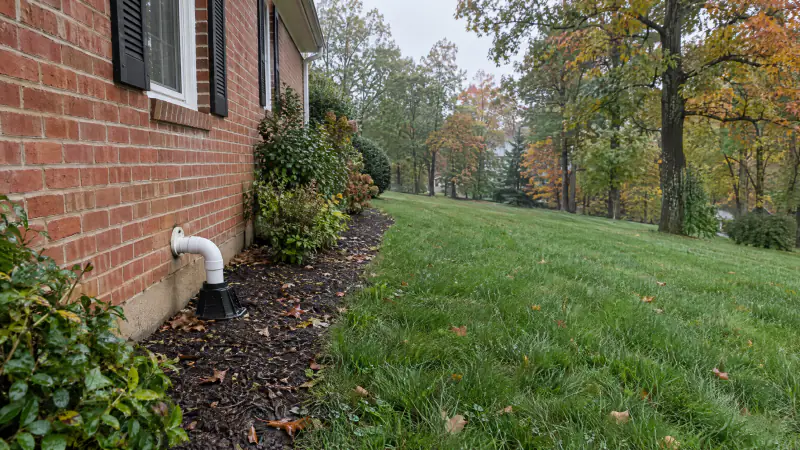
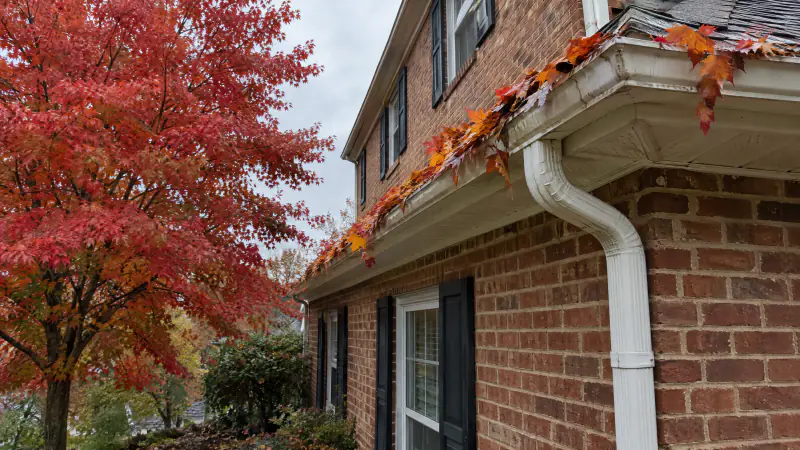
Downspout drainage connection at a brick home with a pop-up emitter in the lawn
Downspout piped underground to an emitter out in the lawn
Typical timeline
1-2 days for most homes
Permit
Not usually; curb work differs
Discharge distance
10 ft or more from the house
Maintenance
Clean gutters, flush yearly

Why bury downspout and sump pump discharge lines?

Because a roof concentrates rain. One inch of rainfall on 1,000 square feet of roof produces roughly 620 gallons, and gutters deliver all of it to a handful of points right beside the foundation. On clay, that water does not soak away. It collects in the looser backfill against the wall, where damp basements and overworked sump pumps start.

Buried lines solve it permanently, if they are built well. The common shortcuts are thin corrugated pipe laid shallow with no measured slope, no way to clean it, and an outlet in a low spot that holds water.

Our standard is 4-inch smooth-wall solid pipe with sealed joints, a fall of at least 1/8 inch per foot, a cleanout at each downspout, and an outlet that sits lower than the house. For water already in the soil see French drains; for ponding lawns see yard drainage.

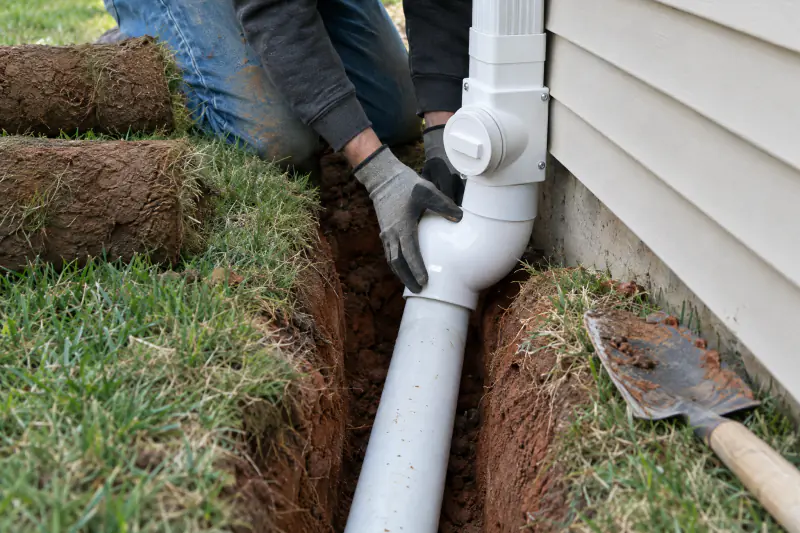
Solid PVC pipe and cleanout fitting in a trench during downspout drainage installation
Solid PVC with a cleanout at the downspout connection

What does a downspout drainage system include?

Each line is a chain of parts, and every link has to be right.

  • Downspout connection and cleanout

    An adapter joins the downspout to the buried pipe, with a cleanout or debris filter at grade so leaves and shingle grit can be removed.

  • Buried solid pipe

    Smooth-wall solid PVC carries water without leaking it back into the soil. It is bedded so it cannot sag, and sized up where two or more downspouts share one run.

  • Pop-up emitters

    A spring-loaded cap sits flush with the lawn, lifts under flow and closes afterward to keep out debris and animals. We set it where the ground keeps falling away.

  • Sump pump discharge lines

    The pump's outlet pipe is extended underground to a safe release point, with a freeze-relief fitting at the house so the pump can still discharge if the buried section ices up.

  • Alternative outlets

    Where a pop-up will not suit, lines can end at daylight on a slope, in a catch basin, in a dry well with an overflow, or at a curb where that is permitted.

How are downspout lines installed?

Most homes take a day or two, and the lawn is put back as we go.

  1. Roof and grade review

    We count downspouts, estimate the roof area each serves, and measure the fall across the yard to find outlet points that sit lower than the house.

  2. Route plan and estimate

    You receive a sketch of every run, showing which downspouts combine, pipe sizes, cleanouts, crossings under walks and each outlet, along with a written price.

  3. Utility marking

    Virginia 811 marks public utilities before we dig. With your help we also locate private lines such as irrigation pipe, lighting wire and pet fences.

  4. Trenching and pipe

    Sod is cut and set aside, a narrow trench is dug to a measured slope, and pipe is bedded and joined. Under walks, we tunnel or lift and reset pavers where possible.

  5. Flow test and walkthrough

    We run a hose into each downspout and watch the outlet open and flow. Trenches are backfilled and compacted, sod is replaced, and we show you each cleanout.

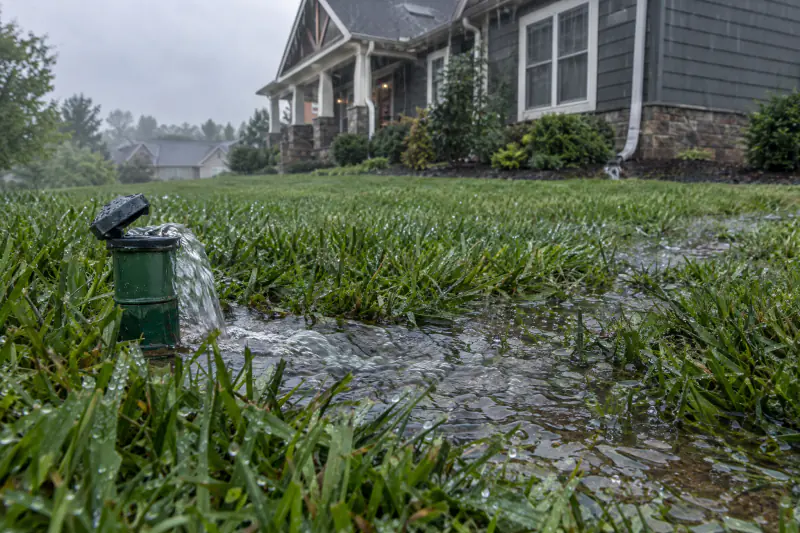
Pop-up emitter discharging roof water in the rain

A short clip at lawn level of a pop-up emitter opening under flow during rain and releasing roof water onto grass that slopes away from the house.

PVC or corrugated pipe: which is better for buried downspouts?

Roof water carries leaves and grit, so the inside of the pipe matters.

Smooth-wall solid PVCSolid corrugated pipeAbove-ground extension
Debris handlingSmooth bore flushes cleanRidges catch leaves and gritEasy to see and clear
Holding slopeRigid, stays on gradeCan sag between supportsNot applicable
CleaningCan be snaked or jettedTools can tear the wallLift and shake out
SuitsPermanent buried linesShort, shallow, low-budget runsTemporary use

How much does it cost to bury downspouts in Northern Virginia?

As of 2026, typical Northern Virginia market ranges for buried downspout drainage run roughly $400 to $1,500 per downspout, or about $2,500 to $7,500 for a whole house with four to six downspouts. A buried sump pump discharge line typically falls between $800 and $3,000. These are planning figures, not a quote.

The factors that move the number:

  • Distance to the outlet, the largest single driver.
  • Pipe material and whether runs are combined into larger pipe.
  • Crossings under walks, driveways or patios.
  • Roots, utilities and access that force hand digging.
  • Outlet type and the amount of lawn or bed restoration.

This is usually the least expensive drainage improvement a home can make. Request an on-site estimate for a price based on your roof and yard.

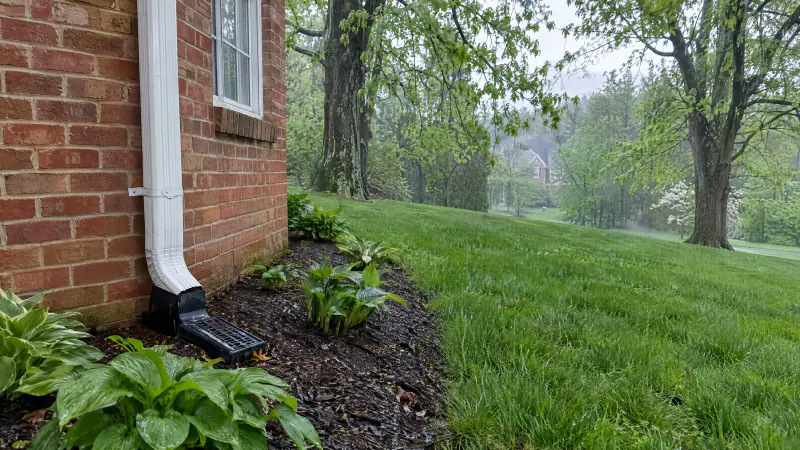
Pop-up emitter releasing roof water in the lawn, the outlet of a downspout drainage line
Pop-up emitter releasing roof water downhill of the house

What are the signs your downspouts need buried drain lines?

Look at each downspout during a hard rain, then check the basement wall behind it.

  • Splash blocks have carved trenches or exposed the foundation below.
  • Basement or crawl space dampness is worst near a downspout corner.
  • The sump pump empties beside the house and cycles constantly.
  • Flexible extensions get moved for mowing and never put back.
  • Old buried lines back up and overflow at the downspout in storms.
  • Ice forms on a walk or driveway where a downspout empties.

Not sure what you need?

Tell us what you are seeing. We will look at the site, explain the options in plain terms and give you a written estimate.

Downspout and sump discharge rules in Fairfax, Loudoun, Prince William and Arlington

Burying downspouts on your own lot does not usually require a permit in Northern Virginia, but where the water ends up is regulated. Sump pumps and downspouts generally may not discharge into the sanitary sewer. Cutting a curb or connecting to a public storm drain typically needs approval from the county, city, VDOT or your HOA. Outlets should not send concentrated flow onto a neighbor's lot or across a sidewalk, where it freezes in winter.

Local conditions shape the details. Mature oaks and maples drop heavy leaf loads, so cleanouts matter. Freeze-thaw cycles mean lines must be pitched to drain empty between storms, and sump lines need freeze relief at the house.

Basements with sump pumps are common from Herndon, Chantilly and Centreville to Manassas and Lorton. If a line must pass under a walkway you plan to replace, install the pipe first.

Frequently asked questions about downspout & sump discharge lines

How far from the house should downspouts drain?

At least 10 feet is the common recommendation, and farther is better on flat clay lots. The outlet must also sit where the ground continues to slope away, so released water keeps moving instead of flowing back toward the foundation.

How deep are downspout drain lines buried?

Typically about 10 to 18 inches at the house, getting deeper or shallower as the pipe follows its slope to the outlet. They do not need to be below the frost line, because a correctly pitched line empties after each storm and holds no standing water to freeze.

Do buried downspouts freeze in winter?

A line with continuous slope and an open outlet drains itself and rarely causes trouble. Problems come from low spots that hold water, or an emitter buried under ice and snow. Keeping the outlet clear in winter and correcting any sags prevents most freeze-ups.

Can a sump pump discharge into the same pipe as a downspout?

It can if the pipe is sized for both flows and the sump connection has freeze relief, but separate lines are often safer. In a heavy storm the roof can fill a shared pipe at the moment the pump most needs to empty.

Do pop-up emitters clog?

They can collect grit and grass over time, which is why the cap lifts off for cleaning. Most clogs start upstream, with leaves entering at the gutter. Clean gutters, a debris filter at the downspout and a yearly flush from the cleanout keep an emitter working.

How often should buried downspout lines be cleaned?

Check them once a year, usually after leaf fall. Run a hose into each cleanout and confirm strong flow at the outlet. Homes under large trees may need it twice a year, and gutters should be cleaned on the same schedule.

From the field notes

Long-form guides on downspout & sump discharge lines from the crew that does the work, with Northern Virginia costs, timing and permit detail.

All guides in this category  ·  Planning guides  ·  Glossary  ·  FAQ

Ready to talk about your downspout and sump discharge lines project?

Tell us about your property and what you want to fix or build. We will visit, measure and send a clear written estimate. We serve Fairfax, Loudoun, Prince William and Arlington counties.

Serving Fairfax, Loudoun, Prince William and Arlington counties and the cities inside them. Check your address. Military, veterans, first responders, healthcare workers and teachers: ask about the Heroes Discount.