Key takeaways
- Red and sugar maples drop mostly in October; white, red and pin oaks keep dropping into December and some hold leaves until spring. One gutter cleaning in October does not cover the season.
- Leaves that pass the gutter ride the downspout into the buried line and settle at the first elbow or sag. A half-blocked line in November is fully blocked by the February thaw.
- A hose test at each downspout and a flush from the cleanout take minutes and tell you whether the line is open. A line without a cleanout can usually have one added.
- Gutter guards reduce large-leaf debris but not needles, seed pods, pollen or shingle grit, and clogged guards shed water over the edge. They reduce cleaning; they do not end it.
- Lines that clog every year, back up at the downspout, or are thin corrugated pipe with no slope are candidates for replacement with smooth-wall PVC and cleanouts, not another flush.
On this page
- Why does leaf season decide whether your buried drain lines work this winter?
- When do oaks and maples drop their leaves in Northern Virginia?
- Which trees drop when, and what do they do to a drain line?
- How do leaves get from the roof into a buried pipe?
- How do you flush a buried downspout line, and what if it has no cleanout?
- What is the step-by-step fall flush?
- Do gutter guards actually work?
- Why do pop-up emitters clog, and how do you keep them open?
- What happens to a half-blocked line in January?
- What is the fall checklist for gutters, downspouts and buried lines?
- When does a line need to be replaced rather than cleared?
- What does clearing or replacing drain lines cost in Northern Virginia?
- Where in Fairfax, Loudoun, Prince William and Arlington is leaf load worst?
- Frequently asked questions
Why does leaf season decide whether your buried drain lines work this winter?
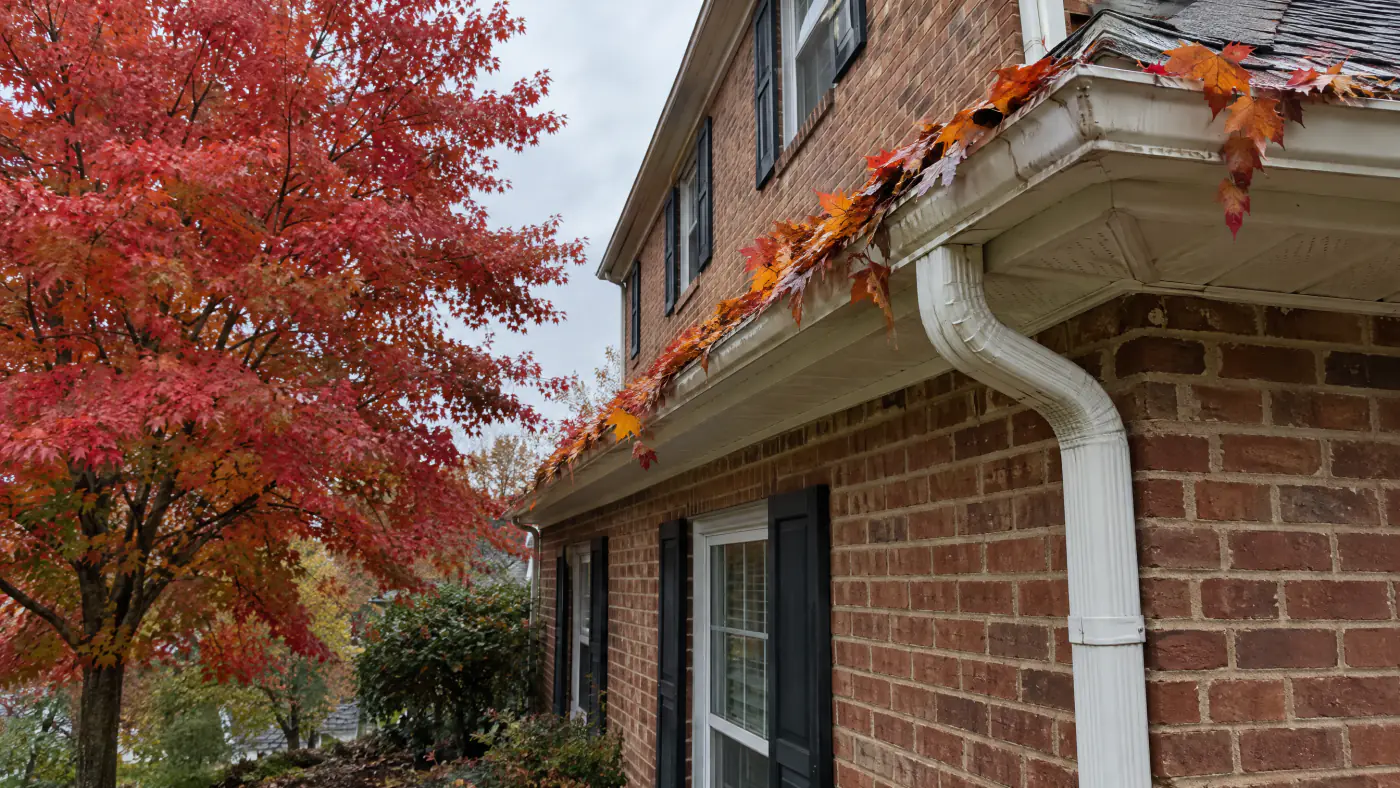
Because the buried line that carries roof water away from the house has exactly one season of real exposure to debris, and it is the six or eight weeks between the first maples turning and the last oaks letting go. All summer the gutters catch pollen, a few twigs and shingle grit. Then, from early October into December, a mature oak or maple over a Northern Virginia roof drops a volume of leaves that fills the gutter several times over. What the gutter does not hold goes down the downspout. What the downspout delivers goes into the buried pipe, where it has nowhere to go but the first elbow, the first sag, or the emitter at the end.
The consequences arrive later, which is why they are easy to miss. A line that is half blocked in November still passes water in a light rain. It backs up a little in a December storm, and the water that cannot get through comes out at the downspout adapter and runs down the foundation, in exactly the spot the buried line was installed to protect. In January the standing water in the blocked section freezes. By the February thaw, when the snowmelt and the rain arrive together and the ground is still frozen and cannot absorb anything, the line is a solid plug and the basement corner below that downspout is wet.
This article is about preventing that sequence. It covers when each tree species drops here, how leaves actually travel through the system, how to test and flush a line, what gutter guards can and cannot do, why pop-up emitters clog and how to keep them open, a fall checklist, and the signs that a line is past clearing and needs rebuilding. The pipe itself, and how a line should be built with cleanouts and a measured slope, is described on our downspout drainage page; the broader question of where roof water should go is in where your gutters should actually send the water.
When do oaks and maples drop their leaves in Northern Virginia?
Maples mostly in October, oaks mostly in November, and some oaks never quite finish until spring. The order is fairly consistent across the region even though the exact weeks shift with the weather and with elevation. Tulip poplars go first, often starting in late September, and their large leaves clog a gutter fast. Red maples and sugar maples color in the first half of October and drop through the second half, usually finished by the first week of November. Silver maples and the Norway maples common in older Fairfax and Arlington neighborhoods run a week or two behind. Sycamores and river birches drop large leaves over a long stretch of October and November.
Oaks are the problem trees for drain lines, and they are the dominant large tree over most of our area. White oaks and red oaks color late, in late October and early November, and drop through November into December. Pin oaks, willow oaks and many young red and white oaks hold a large share of their brown leaves through the winter, a habit called marcescence, and shed them in gusts during January and February storms and in the spring when new buds push them off. That is why a gutter cleaned in late October under an oak is full again by Thanksgiving, and why a clean line in December can still clog in March.
Elevation and location matter. Western Loudoun around Purcellville and Leesburg runs a week or so ahead of Alexandria and Arlington in fall color and leaf drop, because it is higher and cooler. Street trees in close-in neighborhoods, surrounded by pavement, often hang on a little longer. Pines and other conifers drop needles year-round with a heavier shed in fall; needles pass a gutter guard easily and mat in the downspout. The practical result is that one cleaning in late October is the right first pass and the wrong last one. A second pass in late November or early December, after the oaks, is what keeps a buried line clear through the winter.
Which trees drop when, and what do they do to a drain line?
Typical timing for a Northern Virginia fall. Western Loudoun runs a week or so earlier; the inner suburbs a few days later.
| Tree | Typical leaf drop here | What reaches the buried line | What to do |
|---|---|---|---|
| Tulip poplar | Late September through October | Large leaves that mat in the gutter and fold into the downspout | Clean early, before the maples |
| Red and sugar maple | Mid to late October | Heavy volume over a short window; leaves pass mesh guards when wet | First full cleaning right after peak drop |
| Silver and Norway maple | Late October into early November | Same as other maples, a week later; samaras in spring | Include in the first pass; check again in spring |
| Sycamore and river birch | October through November, gradually | Big curled leaves and bark flakes that bridge a downspout opening | Check downspout tops during rain |
| White and red oak | November into December | Leathery leaves that do not break down; acorn caps that jam emitters | Second cleaning after the oaks, flush lines |
| Pin and willow oak | November, then gusts through winter and spring | Small leaves that pass guards and collect at elbows all winter | Flush again after a windy February thaw |
| Pines and other conifers | Year-round, heaviest in fall | Needles that pass every guard and mat in the pipe | Debris filter at the downspout, flush yearly |
| Bradford pear and crape myrtle | Late November into December | Late small leaves that arrive after most people stop looking | Part of the second pass |
How do leaves get from the roof into a buried pipe?
They are carried by the same water the system exists to move, and they stop wherever that water slows down or changes direction. A roof sheds leaves into the gutter. In a heavy rain the gutter becomes a channel moving leaves toward the downspout opening, and anything small enough to fit, which includes most wet maple leaves folded in half and nearly all oak leaves, goes down. A downspout is a vertical pipe; the water falls fast and the leaves fall with it. At the bottom the downspout meets an adapter and an elbow that turn the flow toward the buried line. That is the first stop. Leaves that make it past the elbow move along the buried pipe at a walking pace and settle at the next fitting, in the first sag, or at the emitter.
The pipe type decides how much settles. Corrugated pipe, the black flexible ribbed kind, has ridges every half inch along its inner wall, and each ridge is a shelf for grit and leaf fragments. It also sags between high points when it is laid shallow without bedding, and every sag holds water and debris. Smooth-wall PVC has no shelves; what the water carries in, the water carries through, as long as the pipe holds its slope. This is the reason we build lines in 4-inch smooth-wall solid pipe with sealed joints and a fall of at least an eighth of an inch per foot, and why we put a cleanout at the base of each downspout: the first stop is also the first place anyone can reach.
Shingle grit deserves a mention. Asphalt roofs shed mineral granules constantly, more as they age, and the grit washes into the line and settles in the low points like sand. It does not clog a line by itself, but it packs around leaves and turns a loose blockage into a solid one. A debris filter or leaf catcher at the top of the buried line, where it can be opened and emptied, keeps most of both out, and it is the single cheapest improvement to a line that was built without one. For the problems that start when roof water never gets into the line at all, see water in the basement: exterior drainage fixes.
How do you flush a buried downspout line, and what if it has no cleanout?
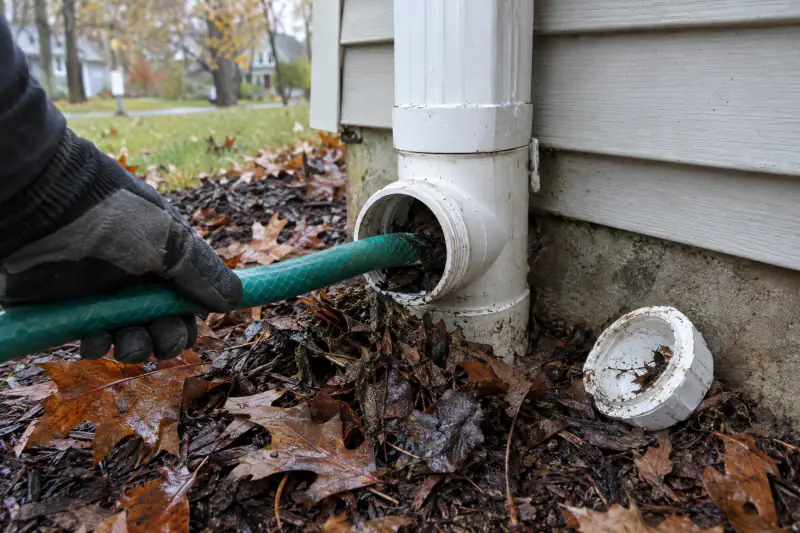
With a garden hose at full flow, in at the house end and out at the outlet, timed. The test is simple and tells you nearly everything. Disconnect or lift the downspout from its adapter, or open the cleanout cap if there is one, and run the hose into the line. Walk to the pop-up emitter or the daylight outlet. Water should appear within a minute or so on a typical run and should keep flowing at roughly the rate it is going in. If it arrives as a trickle, or arrives late and then surges, the line has a partial blockage or a sag holding water. If water backs up and overflows at the house end, the line is blocked. If water never appears at the outlet but never backs up either, the pipe is broken or disconnected somewhere and is dumping into the soil.
A flush is the same thing with intent. Run the hose for several minutes at full flow, and if the line passes water but slowly, a jet nozzle on the hose or a plumber's drain bladder pushed into the cleanout will usually move a loose leaf plug to the outlet, where it can be pulled out of the emitter. Lines that resist that need a mechanical approach: a small drain auger or a jetter from a drain company, which works well in smooth-wall pipe and can tear corrugated pipe. Never use a pressure washer wand blind in a line; it can punch through a corrugated wall or blow a joint apart.
Many lines have no cleanout because builders rarely install them. That is fixable without replacing the pipe. A cleanout tee with a capped riser to grade can be cut into the line at the base of the downspout, or a downspout adapter with a built-in debris filter and removable top can replace the plain adapter. Either gives you a place to put the hose and a place to reach the first elbow. It is a small job that often rides along with other drainage work, and once it is there the yearly flush is ten minutes instead of a shovel. Our yard drainage page covers catch basins and other inlets that need the same seasonal attention.
What is the step-by-step fall flush?
One downspout at a time, after the maples are down and again after the oaks.
Clear the gutter above it first
Scoop the gutter and check that water runs to the downspout opening, not around it. Pull any leaf mat out of the opening. There is no point flushing a line while the gutter is still feeding it debris.
Open the cleanout or lift the downspout
Remove the cleanout cap at the base of the downspout, or open the debris filter and empty it. If there is neither, pull the downspout out of the adapter so you can see into the elbow, and clear anything you can reach by hand.
Run the hose and time the outlet
Put the hose in at full flow and walk to the emitter or outlet. Note how long water takes to arrive and whether it keeps up with the hose. Write it down; next year's number tells you whether the line is slowly closing.
Push a slow line with a jet or bladder
If flow is weak, fit a jet nozzle or a drain bladder and work it from the cleanout. Loose plugs move to the outlet. Pull the emitter cap and remove what arrives. Stop and reassess if the line will not move the plug.
Check the outlet and the emitter
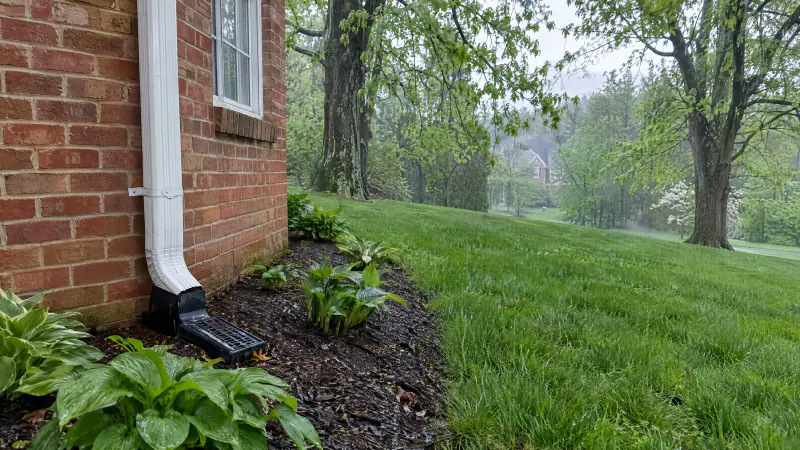
Lift the pop-up cap, clear grit and grass, make sure the spring lets it rise and close, and check the ground beyond it still falls away. For daylight outlets on a slope, clear leaves and soil from the pipe end.
Reconnect and repeat after the oaks
Seat the downspout, close the cleanout, and put the date in your phone. Do the gutters and the hose test again in late November or early December, and once more after any windy February thaw if the house is under oaks.
Do gutter guards actually work?
They reduce the amount of large-leaf debris that enters a gutter, which is real and useful under maples and poplars, and they do not end gutter maintenance, which is the claim that disappoints people. Gutter and guard installation is not work we do, so we have no product to sell here; what follows is what we see from the downspout end. Guards come in a few families. Screens and perforated covers block big leaves and let smaller debris and all the water through. Micro-mesh covers block nearly everything down to grit, but the mesh itself clogs with pollen, pine needles and roof granules and has to be brushed. Reverse-curve covers shed leaves over the edge by surface tension and work well in light rain, but in the cloudbursts we get in summer the water can follow the leaves over the edge and miss the gutter entirely. Foam inserts fill the gutter and decay within a few seasons.
Under oaks, guards help less than expected. Oak leaves are small, leathery and slow to break down, and they lie flat on a screen; acorns and their caps roll into any open downspout. Pin oak and willow oak leaves pass most screens edge-on. Pine needles pass almost everything. What a guard does reliably is keep the gutter itself from filling and overflowing, which protects the fascia and the foundation below from the roof-water waterfall. What it does not do is keep fine debris out of the downspout and the buried line, and in some cases it makes line maintenance harder because the gutter looks clean from the ground while the pipe is filling.
Our honest advice for a house with buried lines: a guard is worth considering if the trees are mostly maple, poplar or sycamore, if the gutters are high enough that cleaning is dangerous, or if the roof is steep. Under oaks and pines, spend the money first on a debris filter at the top of each buried line and a cleanout at the base of each downspout, and keep a two-pass cleaning schedule. A guard can be added later. Washing the outside of guttered eaves is part of a fall house wash, which we cover in house washing before winter and on our soft washing page.
Why do pop-up emitters clog, and how do you keep them open?
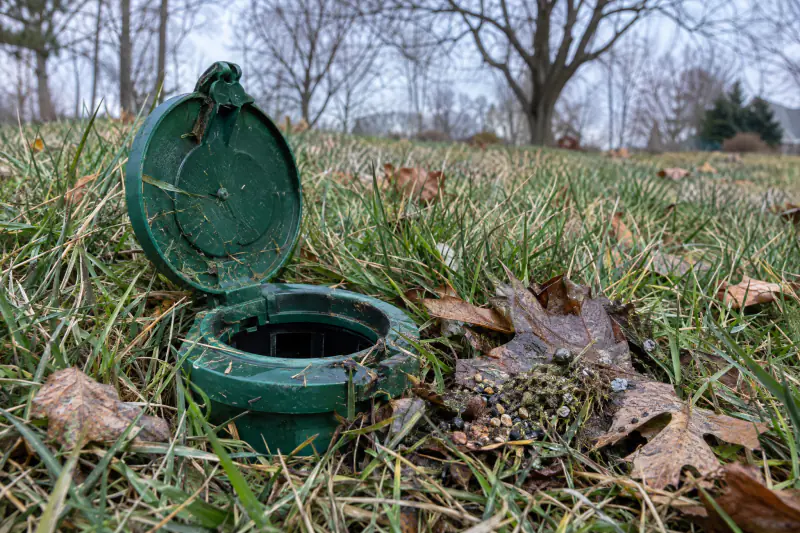
They clog from both ends, and the end that matters most is the one you cannot see. A pop-up emitter is a spring-loaded cap on the end of the buried line, set flush with the lawn. When water comes down the pipe, the pressure lifts the cap and the water spills out onto the turf; when the flow stops, the spring closes it against debris and animals. From the lawn side, grass clippings, mulch and silt build up around the rim until the cap cannot rise fully, and a mower deck can knock it askew. From the pipe side, every leaf fragment and acorn cap that made it past the elbows arrives here, and the emitter is the one place in the line where the pipe narrows to an opening. A handful of oak leaves against the cap, with grit packed behind them, holds it shut.
Keeping an emitter open is a five-minute habit. Lift the cap off, pull out what has collected in the body below it, check that the spring moves freely, and set the cap back. Trim the grass around the rim so clippings do not bury it, and keep mulch and leaf piles off it in fall; a leaf blower that pushes the lawn's leaves into a pile on top of the emitter has buried the outlet for the winter. In snow, an emitter under a plowed pile or a drift cannot open, which is why a line should have continuous fall so it drains empty between storms even when the outlet is briefly covered.
Position matters more than most people realize. An emitter set in a low spot sits in standing water, silts in, and feeds the lawn right back into the pipe. It should be set where the ground keeps falling away beyond it, so the water released keeps moving. If a yard has no such place, the outlet should be something else, a catch basin, daylight on a slope or a dry well with overflow, which is a design decision rather than a cleaning one. Emitters on sump pump discharge lines get the same attention, with the added issue that they open in winter, when the pump runs during thaws; those lines need a freeze-relief fitting at the house, which our downspout and sump discharge page describes.
What happens to a half-blocked line in January?
It becomes a fully blocked line, and the failure happens on the day the house can least afford it. Here is the sequence on a typical Northern Virginia winter. In early December the partial plug at the first elbow lets most of a light rain through. A steady storm in mid-December backs the line up briefly; water overflows at the adapter for an hour, soaks into the mulch, and nobody notices. The water that could not get past the plug stays in the pipe behind it, because the blocked section no longer drains. Then a cold stretch arrives, several nights in the teens, and the standing water in the pipe freezes solid. Ice is not a leaf plug; it fills the pipe wall to wall.
The thaw is the problem. A February warm-up brings rain on top of snowmelt, with the ground still frozen a few inches down. The roof sheds everything to the downspouts, the downspouts deliver it to a line that is ice from the elbow to wherever the plug sat, and the entire roof's runoff comes out at the base of the downspout and runs across frozen ground toward the lowest point, which is the backfill beside the foundation. Frozen soil absorbs nothing. The basement corner below that downspout gets wet in a single afternoon. The homeowner, reasonably, assumes a foundation problem, when the cause was a handful of oak leaves in November.
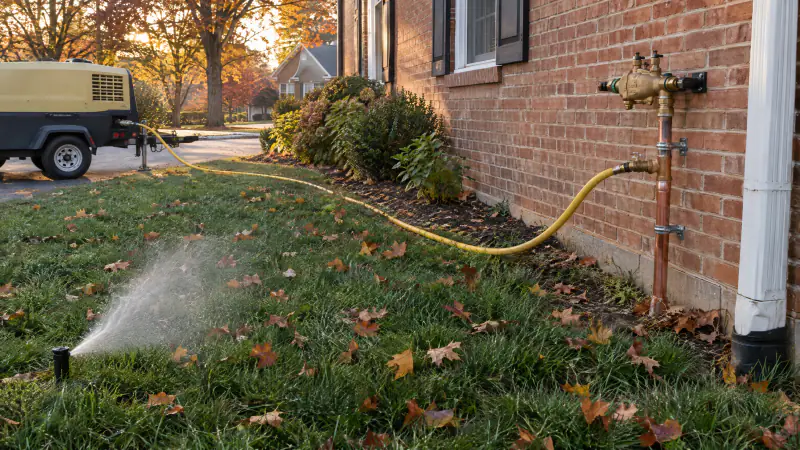
The same sequence plays out on sump pump discharge lines, with higher stakes, because the pump runs hardest during exactly those thaws. A frozen discharge line with no freeze relief at the house means the pump runs against a closed pipe until it burns out or the basin overflows. The pre-winter drainage walkthrough covers the sump line and the rest of the house in a stop-by-stop route, and sprinkler winterization covers the other outdoor pipe that needs attention in the same weeks. Both jobs are about the same idea: no standing water in a pipe when the cold arrives.
What is the fall checklist for gutters, downspouts and buried lines?
In order, with the two-pass timing built in.
- Early October: clear tulip poplar and early maple leaves from gutters; check downspout openings during a rain.
- Late October: first full gutter cleaning after the maples drop; hose-test every buried line and time the outlet.
- Late October: empty every debris filter and cleanout; clear and reseat every pop-up emitter.
- Any time: fit a debris filter and a cleanout on any line that has neither, before the oaks come down.
- November: keep leaf piles, blown leaves and mulch away from emitters, grates and daylight outlets.
- Late November or early December: second gutter cleaning after the oaks; repeat the hose test on every line.
- Before the first hard freeze: confirm every line drains empty; disconnect and extend above ground any line that will not.
- Winter: after a windy thaw under oaks, glance at the downspout bases for overflow stains and check emitters.
- Sump discharge: confirm the freeze-relief fitting or air gap at the house works and the outlet is clear.
- March: one more flush before spring storms, and note any line that was slow all winter for repair.
When does a line need to be replaced rather than cleared?
When clearing it has become an annual emergency rather than a ten-minute check, when the pipe itself is the problem, or when it was never built to a slope and an outlet in the first place. Some signs are visible from above ground. A line that backs up at the downspout in every moderate rain even after a flush has either a collapsed section or a belly holding water and silt that no hose will move. A soft, sunken strip of lawn along the pipe route means the corrugated pipe has crushed or the trench has settled and the pipe with it. A wet patch in the lawn partway along the run, with no outlet flow, means a separated joint dumping roof water into the soil. Tree roots that follow the water into a corrugated pipe's joints fill it from the inside and will return after any clearing.
Other signs come from the hose test. Water that never reaches the outlet is leaving the pipe somewhere. Water that reaches the outlet only after a long delay, then surges, is passing a belly. A line where the emitter sits higher than the downspout base, which happens more often than it should on flat lots, cannot drain by gravity and holds water full-time. A camera inspection, which drain companies and some irrigation contractors offer, settles the question for lines that are long or cross under a walk or driveway, and it costs far less than digging in the wrong place.
Replacement means rebuilding the line the way it should have been built: 4-inch smooth-wall solid PVC with sealed joints, bedded so it cannot sag, on a measured fall of at least an eighth of an inch per foot, with a cleanout at the base of each downspout, a debris filter at the top, and an outlet that sits lower than the house on ground that keeps falling away. In most yards it is a one or two day job per house. Where the old line crosses under a walk or patio, we tunnel or lift and reset pavers rather than cut concrete when we can. If the yard also has surface ponding or a lawn that stays spongy for days, which are different problems with different fixes, the French drain page and the water management overview sort out which is which.
What does clearing or replacing drain lines cost in Northern Virginia?
As of 2026, typical Northern Virginia market ranges run from a few hundred dollars for seasonal cleaning and flushing to several thousand for rebuilding a whole house's lines, and the gap between those numbers is the argument for the fall checklist. Treat them as market planning figures rather than our pricing. Gutter cleaning by a gutter or exterior company is commonly $100 to $350 for a typical two-story house, more for steep roofs, long runs or guards that have to be lifted. Flushing or jetting buried downspout lines is often $150 to $500 depending on how many lines and whether a jetter is needed. A camera inspection of a line commonly runs $150 to $400. Adding a cleanout tee or a debris-filter adapter to an existing line is frequently $150 to $400 each when done alone, and less per unit when several are done at once or alongside other drainage work.
Replacement follows the ranges on our downspout drainage page: roughly $400 to $1,500 per downspout rebuilt in smooth-wall pipe to a proper outlet, or about $2,500 to $7,500 for a whole house with four to six downspouts. A buried sump pump discharge line with freeze relief typically falls between $800 and $3,000. Gutter guards, for homeowners weighing them, span a very wide range by type, from a few dollars per foot for simple screens to well over twenty dollars per foot installed for micro-mesh and reverse-curve systems, so a whole-house figure can run from a few hundred dollars to several thousand.
What moves the number: the number of downspouts and lines, the distance to a usable outlet, crossings under walks and driveways, tree roots and utilities that force hand digging, whether the old pipe can be pulled or must be abandoned in place, the type of outlet, and the amount of lawn or bed to restore. Leaf load itself is a cost factor over time: a house under large oaks that does two cleanings and a flush every year spends a few hundred dollars annually to protect a foundation, which is a good trade. The cost guide places these figures alongside other drainage work, and for your own lines the only reliable number is a written estimate after someone has hose-tested each one and walked the route to the outlet; the how it works page describes that visit.
Where in Fairfax, Loudoun, Prince William and Arlington is leaf load worst?
Wherever the trees are oldest, which means the inner suburbs and the older neighborhoods first. Arlington, Alexandria, Falls Church and the close-in parts of Fairfax County such as McLean, Vienna, Annandale and Burke sit under a mature canopy of oaks, maples and tulip poplars that was planted or left standing fifty to eighty years ago. Reston and Great Falls were built around their woods on purpose. Roofs in those places collect leaf loads that fill gutters several times a season, and the buried lines, many of them original corrugated pipe from the 1970s and 1980s, have been catching that debris for decades. Two cleanings and a flush are the minimum there, and a line that has never been opened is usually due for a camera and a cleanout at least.
The newer communities tell a different story. Ashburn, Brambleton, South Riding and Aldie in Loudoun, and Gainesville, Bristow and Haymarket in Prince William, were built with young trees and tight lots. Leaf load is lighter, but the builder-installed lines are the thin corrugated kind laid shallow with no cleanouts, and the trees are now big enough to matter. Those lines tend to fail by crushing or silting before they fail by leaves, and the fix is usually a rebuild rather than a flush. Sump pumps are common across the region, from Herndon, Chantilly and Centreville to Manassas, Woodbridge and Lorton, and their discharge lines deserve the same hose test and freeze check as the roof lines.
Rules are consistent: roof and sump water may not go into the sanitary sewer, outlets may not be aimed at a neighbor or across a public sidewalk where they freeze, and connecting to a curb or storm drain needs approval from the county, city, VDOT or HOA. Fairfax County, Loudoun County and Prince William County all publish homeowner guidance on drainage and stormwater, and Arlington publishes its own. We build and rebuild downspout and sump lines across Fairfax, Loudoun, Prince William and Arlington counties and the cities of Alexandria, Fairfax, Falls Church, Manassas and Manassas Park; the service areas page has the full list, and the maintenance guide keeps the seasonal version of the checklist above.
Frequently asked questions
How often should buried downspout lines be flushed?
At least once a year after leaf fall, and twice on a house under oaks: once after the maples in late October and once after the oaks in late November or early December. Run a hose into each cleanout and confirm strong flow at the outlet within a minute or so. Homes with pines, or with lines that have been slow before, benefit from an extra check after a windy winter thaw and again in March.
Can leaves really clog a pipe that is buried underground?
Yes, and they do it every fall. Leaves ride roof water down the downspout and into the buried line, then stop at the first elbow, in the ridges of corrugated pipe, or in any sag. Shingle grit packs around them and turns a loose plug into a solid one. A line with a debris filter at the top, smooth-wall pipe and a cleanout at the base of each downspout is far more resistant, but still needs a yearly flush.
Should I disconnect my downspouts from the buried lines for the winter?
Only if a line is blocked and cannot be cleared before the freeze. A clear, properly sloped line drains empty after every storm and holds nothing to freeze, so it is safer in winter than an above-ground extension that ices over. If a line fails the hose test and the cold is coming, disconnect that one downspout, fit a temporary extension to at least 10 feet, and repair the line in a mild week.
Why is water coming out at the bottom of my downspout instead of the pop-up emitter?
Because the buried line is blocked or broken somewhere between the two, and the water is taking the only exit it has. Start at the cleanout or the elbow below the downspout, where most leaf plugs sit. If a hose flush from there does not restore flow at the emitter, the blockage is farther along, at a sag or a fitting, and a jetter or a camera is the next step. Water that neither overflows nor reaches the outlet points to a separated joint.
Are gutter guards worth it on a house under oaks?
They help less under oaks than under maples. Oak leaves are small and leathery, lie flat on screens, and pass many guards edge-on, while acorns and caps roll into any open downspout. A guard keeps the gutter itself from overflowing but does little for the buried line. Under oaks, a debris filter at the top of each line, a cleanout at each downspout and a two-pass cleaning schedule usually do more per dollar than guards.
What is a downspout debris filter and do I need one?
It is an adapter at the base of the downspout, or a basket at the top of the buried line, with a removable screen that catches leaves, acorns and grit before they enter the pipe. It is cheap, it empties by hand in a minute, and it is the single most useful addition to a line that was built without one. Most homes with buried lines benefit from one at every downspout, especially under oaks and pines.
How do I know if my downspout drain pipe is corrugated or PVC?
Look at the fitting at the base of the downspout. Corrugated pipe is black, ribbed and flexible, and it usually shows a ridged collar at the adapter; PVC is white or green, smooth and rigid. The pop-up emitter end often shows the pipe too. Corrugated lines clog and sag more, cannot be jetted hard, and are the usual builder install; smooth-wall PVC flushes clean and holds its slope.
Book the work
Put the plan in writing with a crew that builds this every week.
One visit to measure and talk through options, then a written scope and price. No pressure, no vague numbers. Ask about the Heroes Discount if you serve.
Sources and further reading
- Virginia Cooperative Extension: trees, shrubs and home landscape publications
- Fairfax County Department of Public Works and Environmental Services: stormwater and drainage
- Arlington County: stormwater and drainage for homeowners
- Virginia 811 (Miss Utility): call before you dig
- NOAA National Centers for Environmental Information: U.S. Climate Normals
Published October 8, 2026. Reviewed and updated October 9, 2026.