Key takeaways
- Fall is the second washing window here. Removing a summer of algae, webs and mildew before the house is closed up keeps growth from sitting on the walls all winter.
- Vinyl, fiber cement, brick, stucco and painted wood each take a different mix strength and rinse. The method changes with the wall, and washing will not fix oxidation or peeling paint.
- Black tiger stripes on gutter faces are bonded grime on oxidized paint. They need a dedicated cleaner and hand work, and the worst of them may not come out fully.
- Soft washing works down to roughly 40 degrees. In Northern Virginia that usually means through October, with the first freezes arriving late in the month around Dulles.
- As of 2026, typical Northern Virginia market ranges are about $350 to $900 for a house wash and $500 to $1,500 or more for a roof. Gutter brightening is often an add-on.
On this page
- Why wash the house before winter instead of waiting for spring?
- What has a Northern Virginia summer left on the house by September?
- How is each siding type washed?
- What are the black tiger stripes on gutters, and do they come off?
- How are soffits, fascia, window frames and glass handled?
- In what order should a fall house wash happen?
- Should roof moss and algae be treated in the fall?
- How cold is too cold for a house wash in October?
- Should gutter clearing and the house wash be scheduled together?
- What is the fall exterior checklist for a Northern Virginia home?
- How much does a fall house wash cost in Northern Virginia in 2026?
- What does a fall wash look like across Fairfax, Loudoun, Prince William and Arlington?
- Frequently asked questions
Why wash the house before winter instead of waiting for spring?
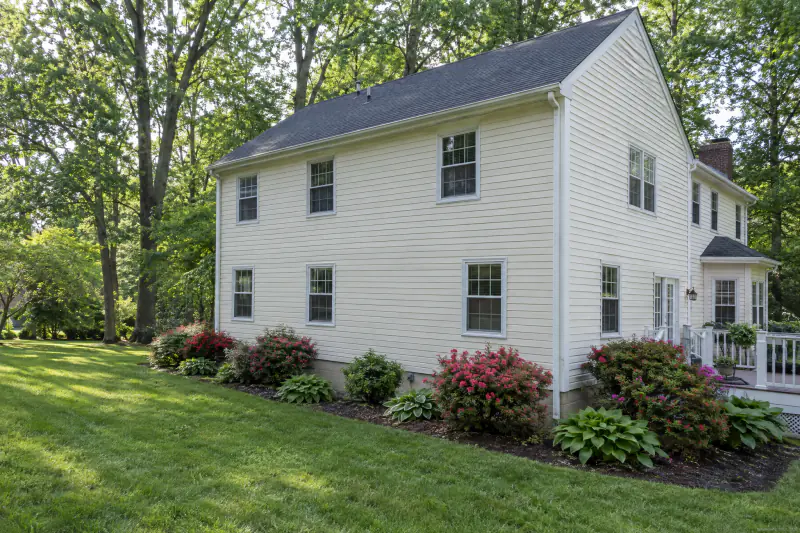
Because everything a Northern Virginia summer grew on the house is still alive on the walls in September, and leaving it there for six cold, damp months lets it keep working. Algae on the north siding holds moisture against the wall through every winter rain. Mildew under the soffits and around the window frames keeps spreading on mild days, and a house gets plenty of 50-degree days in a Virginia winter. Spider webs, wasp nests and the fine dust that drips off oaks all season sit in the siding texture until April. A wash in September or October removes all of it while the solution still works quickly and the walls still dry before dark.
There is a practical calendar reason too. The leaves have not come down yet. Gutters are about to fill, downspouts are about to clog and the roof is about to be covered, and a wash done before that happens is cleaner and simpler than one done after. The spring window in May is the other good time, and the two are not in competition: many homes are washed in one or the other, and the shaded ones benefit from both. We described the spring version, and the biology behind the green and black streaks, in our article on soft washing vs. pressure washing for green streaks. This one is about the fall job: what the summer left behind, how each siding type is handled, the gutters, the soffits, the roof, the temperature limit, and the order the work goes in.
The method is soft washing throughout. Nothing on the house itself is pressure washed. A diluted cleaning solution is applied at low pressure, allowed to work for a few minutes, and rinsed from the top down, with the plants soaked before and after.
What has a Northern Virginia summer left on the house by September?
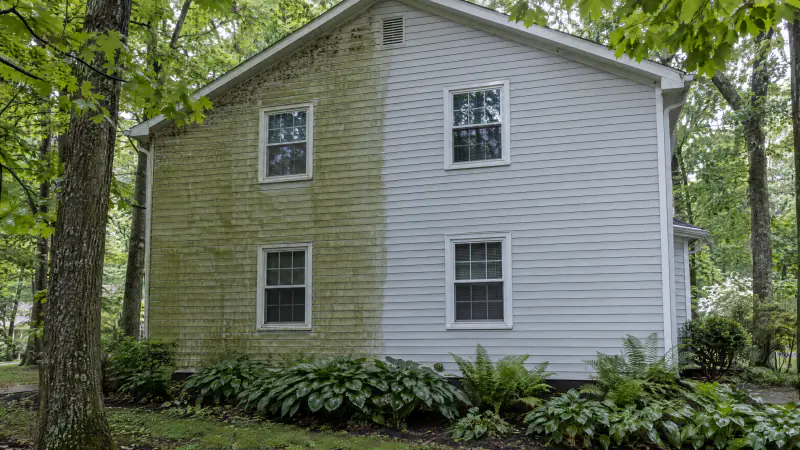
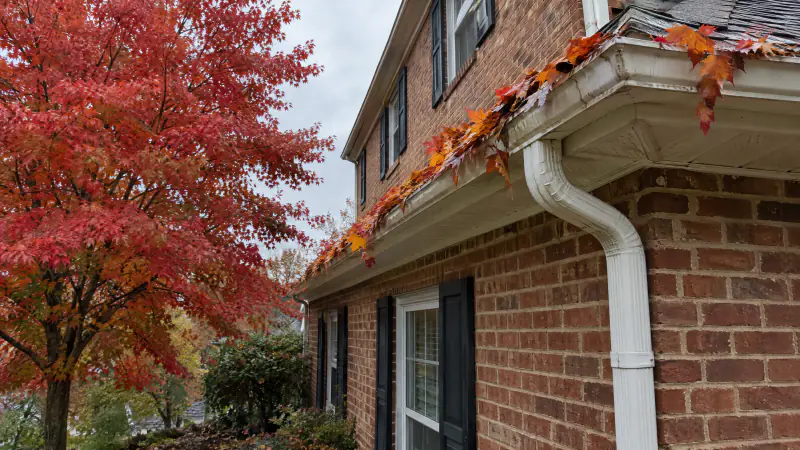
More than most homeowners notice, because it accumulated slowly. The obvious layer is the green algae film on the north and east walls and the black mildew speckling under the eaves, behind the downspouts and around any window that sits in shade. Beneath that is a gray film of organic dust that oaks, maples and tulip poplars shed all summer, glued to the siding by dew and by the pollen that was never fully rinsed off in spring. Spiders have built in every corner of the soffits, under the deck ledger and behind the shutters, and the webs collect dirt into dark smudges. Mud daubers and paper wasps have left nests under the eaves and porch ceilings.
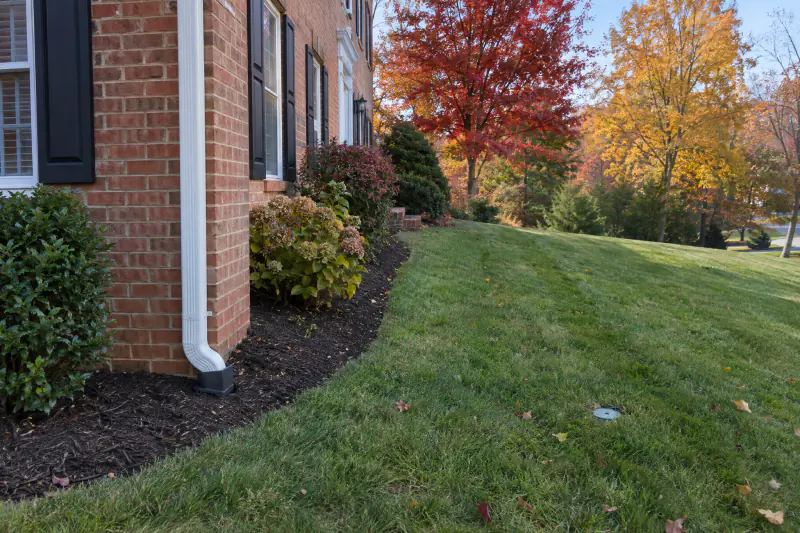
Lower down, lawn equipment has thrown grass clippings and red clay onto the bottom courses of siding, sprinkler heads have left mineral spotting on brick and glass, and the splash zone behind every downspout that discharges at the foundation has grown a dark fan of algae. Mulch beds near light-colored siding may have thrown artillery fungus, the tiny black dots that bond hard and resist every cleaner. On the roof, a summer of humidity has lengthened last year's streaks on the north slope and thickened any moss under the trees.
None of that is dangerous to the house in a single season. The Centers for Disease Control and Prevention describe outdoor mold and mildew as a moisture signal rather than a hazard, and that is the right way to read it. The reason to remove it before winter is that moisture is exactly what winter supplies, and growth that enters the cold months alive is growth that is thicker in April. A September wash resets the house to clean before that happens.
How is each siding type washed?
The mix strength, the rinse and what washing can and cannot fix all change with the wall.
| Siding | Mix strength | Rinse | Watch for | What washing will not fix |
|---|---|---|---|---|
| Vinyl | Mild | Low pressure, top down, never aimed up under the laps | Loose panels, open J-channel at windows, oxidized chalk | Chalky oxidation on older vinyl, faded color |
| Fiber cement | Mild, short dwell | Gentle rinse, manufacturer guidance generally calls for low pressure | Chipped paint at cut edges, failed caulk at butt joints | Peeling or faded factory finish |
| Brick | Moderate, longer dwell | Thorough rinse, pressure kept off the mortar joints | Soft lime mortar on older homes, spalled faces | White mineral deposits and rust, which need a different cleaner |
| Stucco and synthetic stucco | Light | Very low pressure, minimal water | Cracks, failed sealant, soft spots that mean trapped water | Deep stains that need a second application, cracks |
| Painted wood | Mild, short dwell | Gentle rinse along the boards | Peeling paint, bare wood, possible lead paint before 1978 | Peeling, chalking or bare paint |
| Aluminum | Mild | Low pressure, rinsed quickly | Dents from pressure, chalking finish | Oxidation, which a wash can streak if rushed |
Every wall is tested in a small area first. Age and condition change the approach more than the material does.
What are the black tiger stripes on gutters, and do they come off?
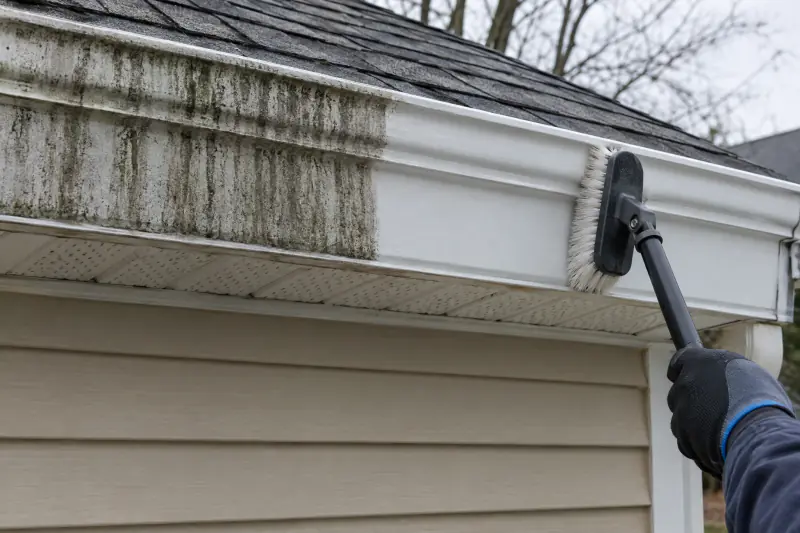
Tiger stripes are the dark vertical streaks that run down the face of white or light-colored aluminum gutters, and they are the most asked-about part of a fall wash. They form when rainwater overflows or wicks over the front lip of the gutter and runs down the face, carrying fine grime, the asphalt and carbon dust that wash off a shingle roof, and tannins from leaves. As the painted aluminum ages, its finish oxidizes slightly and becomes porous, and the dirt bonds to that oxidized surface electrostatically. That bond is why a house wash that leaves the siding spotless often leaves the gutter stripes exactly where they were.
They do come off, but not with the siding solution. The gutter faces are treated with a dedicated gutter cleaner, often a stronger degreasing product made for oxidized paint, applied by hand and worked with a soft brush on a pole, then rinsed. It is slow work compared with the rest of the house, which is why it is commonly priced as an add-on to a house wash. On gutters that have been striped for many years, the stripes have etched into the oxidation itself and lighten considerably without disappearing. We say so beforehand and test a section so you can see the result.
Stripes also tell you something. Heavy striping below one section of roof usually means the gutter there overflows regularly, which points to a clog, a sag or an undersized downspout rather than a cleaning problem. Clearing the gutter and checking its pitch stops the stripes from returning as fast. If the downspout at that corner dumps at the foundation, a buried discharge line solves two problems at once.
How are soffits, fascia, window frames and glass handled?
Carefully, because they are where water does the most harm if it goes in the wrong direction. Soffits on most Northern Virginia homes are vented, either as perforated aluminum or vinyl panels or as continuous strip vents, and those openings lead straight into the attic. The solution is applied to the soffit from below at low pressure and rinsed gently along the panels, never driven up into the vents. Mildew on soffits is common on the shaded sides, and the mix handles it, but a soffit that is heavily blackened on one section often has an attic moisture problem or a bathroom fan venting into it, and that is worth a look from inside.
Fascia boards, the vertical trim behind the gutters, are washed with the gutters, and this is where peeling paint and soft wood show up. Washing does not fix either. We note them for the homeowner, because a fascia board that is rotting behind a gutter is a roofing and carpentry issue, and winter is hard on it. Shutters are washed in place, and the wall behind them, which is usually the greenest spot on the house, is reached with the applicator rather than by removing them.
Window frames and glass get the mildest attention. Solution that dries on glass can leave spotting and can dull the finish on aluminum frames, so windows are rinsed promptly and thoroughly as the wash moves down the wall. Screens are rinsed from the inside out where they can be reached. The seals on insulated glass are never hit with pressure. Hard-water spots from a sprinkler that hits the windows every morning are mineral, not dirt, and need a separate treatment, so we point out the sprinkler head instead. Our page on irrigation upgrades covers adjusting or replacing heads that spray the house.
In what order should a fall house wash happen?
Top down and dirty before clean, so nothing that comes off lands on something already finished.
Gutters cleared first
If the gutters are being cleared this fall, that happens before the wash, because clearing dumps debris and black sludge down the fascia and siding. A second light clearing after leaf drop is often needed anyway.
Walk the house and protect it
We identify every siding and trim material, note loose panels, open seams, peeling paint and outlets, close windows, cover fixtures and sensitive plants, and soak the beds and lawn along the walls.
Roof treatment where needed
If the roof is being treated, it goes first so the runoff lands on walls that have not been washed yet. Downspouts are diverted or bagged so concentrated runoff does not pour into one bed.
Siding, soffits and fascia
Solution is applied to the walls from the bottom up so it wets evenly, allowed to work for several minutes without drying, and rinsed from the top down at low pressure, soffits and fascia included.
Gutter faces and shutters
Tiger stripes get their dedicated cleaner and hand work while the walls are still wet. Shutters and the wall behind them are treated and rinsed in the same pass.
Windows, flatwork and final rinse
Glass and frames are rinsed clean, the stoop and walk below the walls are rinsed of whatever came down, and the plants get a long final rinse. We walk the house with you as the walls dry.
Should roof moss and algae be treated in the fall?
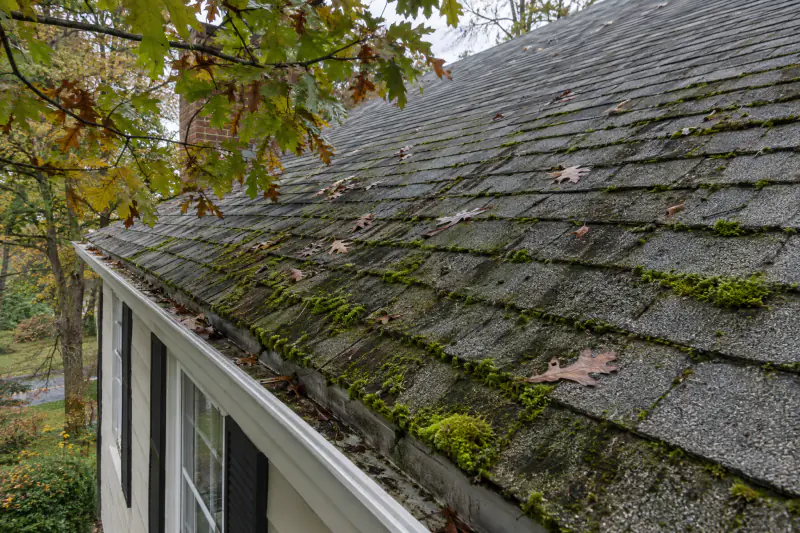
Yes, while daytime temperatures are still comfortably above the limit, and ideally before the leaves land. Moss on a north-facing slope is a winter problem waiting to happen. It holds water like a sponge against the shingles, lifts their edges as it thickens, and freezes in place, and a slope that goes into December with living moss comes out of March with more of it. Treating it in September or early October kills it while the solution still works quickly. It then dries out, turns brown and loosens through the fall and winter, and wind and rain carry it off by spring. Nothing is scraped, brushed or pressure washed, because every one of those removes granules along with the moss. The black algae streaks respond the same day.
The method follows the published guidance from the asphalt roofing industry, which describes a household bleach solution gently applied to the roof, allowed to sit, and rinsed gently with water, and which warns against power washing and scrubbing. Check the care guidance from your own shingle manufacturer, since products and any coverage conditions differ. On a sunny, cooler fall day the shingles are also firmer underfoot than in July, which reduces scuffing if anyone has to step onto the slope at all.
Leaves change the calculation once they start coming down in earnest, usually mid-October to mid-November depending on the trees. A roof covered in wet oak leaves cannot be treated well and should be cleared first. Gutters full of leaves will hold concentrated runoff instead of draining it, so they are cleared before a roof treatment or flushed afterward. If the roof is heavily shaded by branches close to the surface, trimming them back does more for the next five years than any treatment, and it is work for an arborist, not a cleaning crew.
How cold is too cold for a house wash in October?
Roughly 40 degrees is the practical floor, measured by the afternoon high on the day of the work and by whether the walls and walks will dry before nightfall. The solution is a chemical reaction, and like most reactions it slows as it cools, so a wall that cleans in five minutes at 70 degrees needs longer and a slightly stronger mix at 45, and at 35 it barely works at all. The rinse water is the second constraint. Siding sheds it, but stoops, steps and the walk along the foundation hold it, and a north-facing entry can glaze over on a clear, still evening when the temperature drops fast after sunset.
Northern Virginia gives a fairly reliable window. October afternoons across the region average in the 60s, and the National Weather Service forecast office that covers the area reports typical first freezes in late October at Dulles and into November closer to the city at Reagan National. That means washing is usually comfortable through the whole of October in Ashburn, Sterling, Herndon and Reston, a week or so longer in Arlington, Alexandria and Falls Church, and a week or so shorter in Leesburg, Purcellville and the higher ground of western Loudoun. By mid-November the days are short enough that even a warm afternoon leaves walls damp at dusk, and we stop scheduling full house washes until the spring.
Within the window, the hours matter. Fall washes start mid-morning once the dew has lifted and finish early enough for everything to dry. North walls, which never see the sun, are washed first so they have the longest drying time. If a cold snap moves into the forecast, the job moves, and a home that misses the fall window is simply washed in May. What should and should not be cleaned once winter sets in is covered in our guide to winter exterior cleaning.
Should gutter clearing and the house wash be scheduled together?
In the same week, in the right order, yes. Gutters that are cleared before the wash send their sludge down the fascia and siding where the wash removes it. Gutters cleared after the wash undo some of the work. So if the gutters are getting their first fall clearing, it goes before the wash, and the heavy clearing after the oaks finish dropping in November happens on its own later. Whoever clears them, the sequence is the same, and it is worth coordinating the two visits rather than letting them land in the wrong order. The full fall gutter and downspout routine, including the buried lines that clog at the first bend, is in our guide to leaf season: gutters, downspouts and buried drain lines.
Washing the flatwork in the same visit is the other common bundle, and it makes sense for the same reason. The house is washed first so whatever comes off the walls lands on a driveway, walk and stoop that have not been cleaned yet, then the flatwork gets a pressure washing pass. One setup, one round of plant protection, one rinse. Fall is a good time for the driveway too, because leaf and acorn tannin stains have not yet set over winter and the algae on the shaded walk is at its thickest.
What does not bundle well in fall is anything that needs a coating. Deck staining and paver sealing both want warm, dry surfaces and mild nights, and by the time a fall house wash is scheduled in October the reliable sealing window is closing. If the deck or the patio also needs attention, September is the month to do all of it, and the wash goes first. Our exterior cleaning page lays out how each of those services fits together.
What is the fall exterior checklist for a Northern Virginia home?
Work from the top of the house down and from September toward the first freeze.
- Walk the north and east walls and note green film, mildew under the soffits and the fan of algae behind each downspout.
- Look at the gutter faces for tiger stripes and at the fascia behind them for peeling paint or soft wood.
- Check the roof slopes under trees for moss and streaks while the leaves are still up.
- Have the gutters cleared before the wash, and again after the leaves finish falling.
- Schedule the house wash for a mild day in September or October, mid-morning start, before the leaf drop.
- Wash the driveway, walk and stoop in the same visit, after the house.
- Finish any deck staining or paver sealing in September while nights are still warm enough.
- Flush buried downspout lines after leaf fall and confirm each one runs clear at the outlet.
- Photograph the clean walls and roof for any HOA inspection record and for comparison next spring.
How much does a fall house wash cost in Northern Virginia in 2026?
As of 2026, a soft-wash house wash on a typical single-family home in Northern Virginia falls in a market planning range of about $350 to $900, and a roof treatment commonly runs $500 to $1,500 or more. Gutter face brightening to remove tiger stripes is often an add-on priced by the linear foot or as a flat addition to the wash. Large homes, three-story rear elevations on walkout lots and steep or complex roofs sit at the top of those ranges or above them, and townhomes usually sit below. These are typical market figures, not myYardPros prices, and they are wide by design.
The factors that move the number are wall area and stories, roof pitch and access, how heavy the summer growth is, the amount of landscaping against the house that needs protecting, the siding type, since stucco and chalky old siding are washed more slowly, and how striped and oxidized the gutters are. Fall adds one more: the window is short and the schedule is tight in late September and October, so booking early in September gets the choice of days. Bundling the flatwork with the wash in one visit is usually less than two trips.
We look at every wall, the roof slopes and the gutters before putting a number on paper. Book early in the fall window: request a written on-site estimate or call (571) 200-9600. Our cost guide places the house wash alongside the other fall projects if you are planning the season as a whole.
What does a fall wash look like across Fairfax, Loudoun, Prince William and Arlington?
The wooded neighborhoods need it most and have the shortest window. Reston, Burke, Springfield, Annandale, Vienna, Oakton, Great Falls and Clifton in Fairfax County sit under mature canopy, so their north walls are the greenest in September and their roofs carry the most moss, and the same trees drop leaves early enough that a wash there belongs in late September or the first half of October. Arlington, Alexandria and Falls Church add older brick with soft mortar and painted wood trim that need the gentlest handling, and they stay warm a little longer into November. In Loudoun County, Leesburg, Purcellville and the older parts of Sterling and Herndon are shaded enough to need the fall wash, while Ashburn, Brambleton and South Riding are newer and sunnier and are often fine with spring alone, apart from the north roof slope.
In Prince William County, Woodbridge, Lorton and Dumfries along the Potomac run humid and shaded, and Gainesville, Haymarket and Bristow are newer and turn more slowly. Manassas and Manassas Park sit in between. Everywhere in the region, the storm drains flow untreated to local streams, so rinse water is directed onto lawn and beds and the mix is kept as mild as the wall allows. No permit is needed for exterior cleaning, and homeowners associations across Fairfax and Loudoun often run a fall inspection, so a clean house in October tends to mean a quiet winter.
We soft wash siding, roofs, gutters, trim, brick and stucco across Fairfax, Loudoun, Prince William and Arlington counties and the cities of Alexandria, Fairfax, Falls Church, Manassas and Manassas Park. See our service areas page for the towns and neighborhoods we reach.
Frequently asked questions
Will the house stay clean through the winter if it is washed in October?
Almost always. Algae and mildew grow slowly in cold weather, and a wall that was properly treated rather than rinsed starts the spring clean. Winter rain and snow do not add growth, they add moisture, and a wall with nothing alive on it has nothing to feed. The exceptions are a wall under a leaking gutter or a splashing downspout, which can show a green patch by March regardless of the wash.
Is it too late to wash the house in November?
Often, but not always. A mild November week with afternoon highs in the 50s and nights above freezing can work for a single-story home or a south-facing wall that dries quickly. Shaded north walls, stoops and walks that stay wet into the evening are the problem. We assess by the forecast rather than the calendar, and if the week does not cooperate the wash simply moves to May without any harm done.
Does a house wash remove spider webs and wasp nests?
Webs, yes. The solution and rinse clear them from soffits, corners and behind shutters along with the dirt they collected. Wasp and mud dauber nests are removed by hand before the wash, and fall is a reasonable time for it because the colonies are winding down after the first cool nights. Active nests in warm September weather are handled carefully or left for a pest service if they are large.
Should I wash the house before painting next spring?
Yes, and a fall wash is a good first step, but it is not the final prep. Paint manufacturers generally want a surface free of mildew, chalk, dust and loose paint. The wash takes care of the mildew and dirt, and the winter shows you which spots regrow. In spring the painter will still scrape, sand, remove chalk by hand and spot-prime bare wood. A clean house in October also makes the spring estimate more accurate.
Will the cleaning solution hurt my new fall seeding or new sod?
It can if runoff is allowed to pool on it, so we plan around it. Lawns in Northern Virginia are aerated and overseeded from late August to mid-October, which overlaps the washing season, and new seedlings are tender. Beds and lawn edges are soaked beforehand, the mix is kept mild, rinse water is directed away from fresh seed where possible, and everything gets a heavy rinse afterward. Tell us where the new seed is.
Can the chalky white residue on old siding be washed off?
Not by a soft wash. That residue is oxidation, the weathered top layer of aging vinyl or painted aluminum, and it is part of the surface rather than something sitting on it. The wash removes the algae and grime on top and the siding looks far better, but still weathered. Removing oxidation is a separate, slow hand treatment, and high pressure makes it worse by cutting bright streaks into the chalk.
Can the house be washed while the leaves are still falling?
The siding, yes. Falling leaves do not affect walls, and a few on the lawn do not matter. The roof and gutters are the issue: a roof under a layer of wet leaves cannot be treated well, and full gutters hold concentrated runoff. We wash walls any time the temperature allows, treat roofs before the heavy drop, and leave the final gutter clearing for after the oaks finish, usually mid to late November.
Book the work
Put the plan in writing with a crew that builds this every week.
One visit to measure and talk through options, then a written scope and price. No pressure, no vague numbers. Ask about the Heroes Discount if you serve.
Sources and further reading
- National Weather Service, Baltimore/Washington forecast office: climate data and first freeze information
- Asphalt Roofing Manufacturers Association: cleaning algae and moss from asphalt shingle roofs
- Polymeric Exterior Products Association (formerly the Vinyl Siding Institute): vinyl siding care
- James Hardie: fiber cement siding care and cleaning guidance
- Centers for Disease Control and Prevention: mold and moisture basics
Published September 3, 2026. Reviewed and updated October 9, 2026.