Key takeaways
- Northern Virginia soil stays warm enough for root growth into December, so a tree planted in October grows roots for two months while its top is dormant.
- Plant trees, shrubs and most hardy perennials from September through November. Hold crape myrtle, warm-season grasses and tender perennials for spring.
- On clay, dig the hole two to three times as wide as the root ball and no deeper, keep the root flare visible, and do not fill the hole with bagged soil.
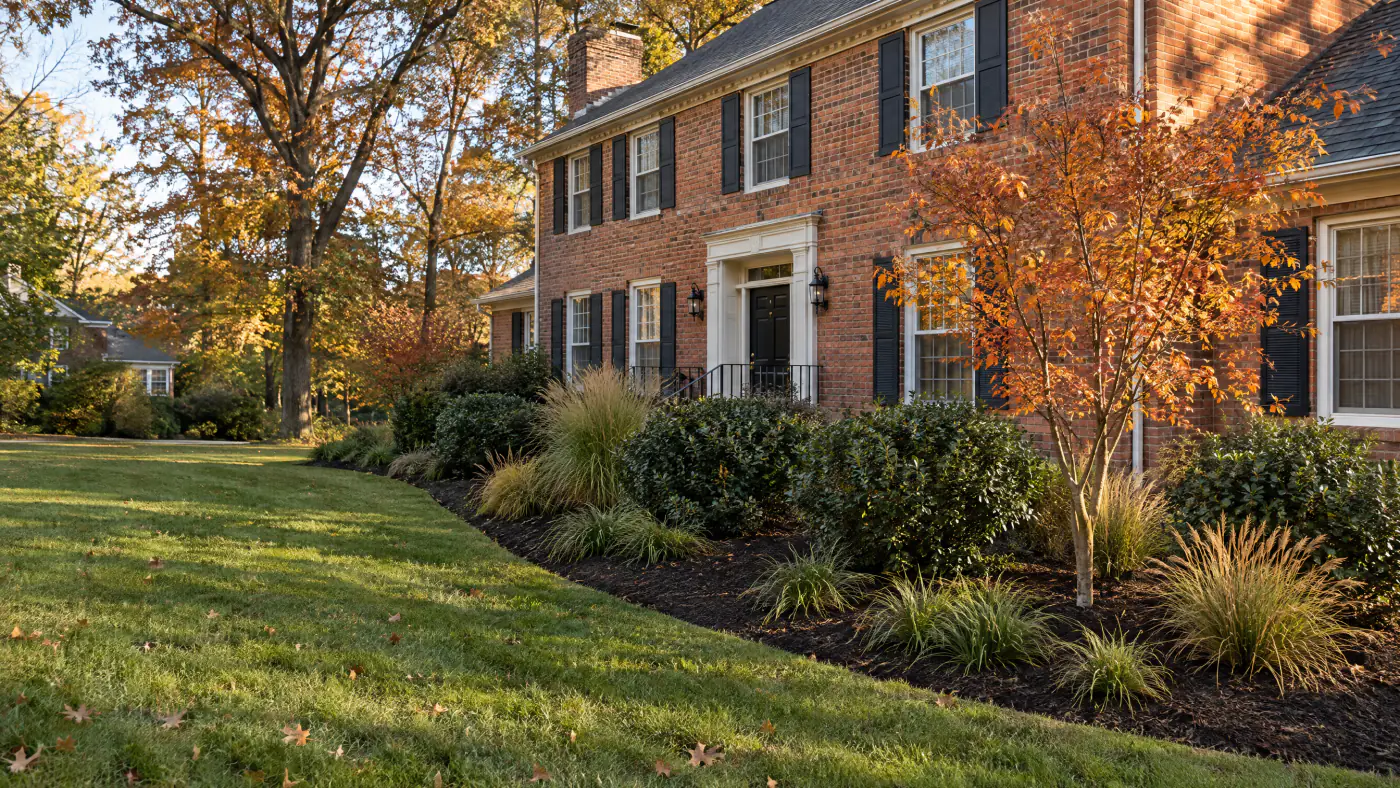
- Mulch 2 to 3 inches deep over the bed and pull it 3 to 6 inches back from every trunk and stem. A mulch volcano is a slow way to kill a tree.
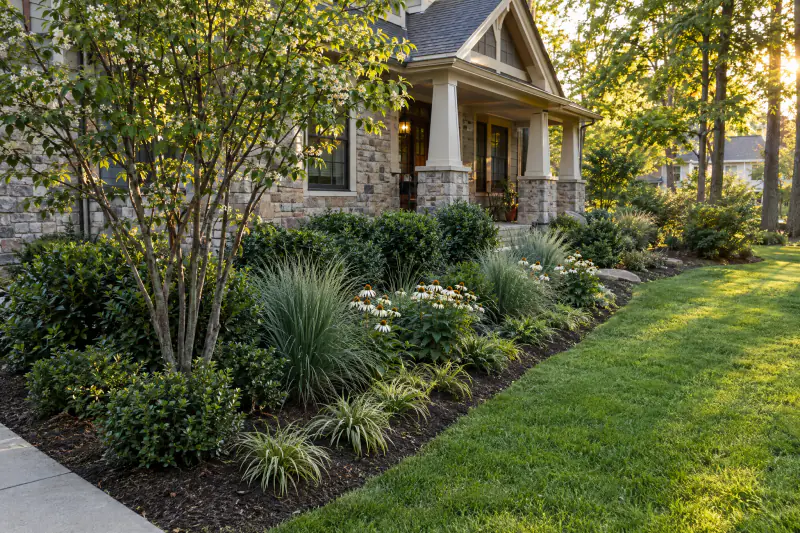
- As of 2026, typical Northern Virginia planning ranges run about $4,000 to $12,000 for a front foundation planting and $15,000 to $50,000 or more for a full property.
On this page
- Why is fall the best time to plant in Northern Virginia?
- What happens to roots after the leaves drop?
- What should you plant in fall, and what should wait for spring?
- When should each plant group go in the ground in Northern Virginia?
- How do you plant a tree or shrub in Northern Virginia clay?
- How should beds be edged and drained?
- Which plants will the deer leave alone?
- How do you water new plants through the first winter?
- What does fall landscape installation cost in Northern Virginia?
- Why install beds after the hardscape and before the lawn?
- What is on the fall planting checklist for a Northern Virginia yard?
- What is different about fall planting in Fairfax, Loudoun, Prince William and Arlington?
- Frequently asked questions
Why is fall the best time to plant in Northern Virginia?
Fall is the best planting season in Northern Virginia because the soil is warm, the air is cool, and roots keep growing for weeks after the leaves come down. A tree or shrub planted in late September goes into ground that is still in the 60s, sheds its leaves in late October, and then spends November and most of December putting out new roots while the top of the plant asks nothing of them. By the time the same plant faces its first July, it has eight or nine months of root in your soil. A spring-planted tree gets eight or nine weeks before the same heat arrives, and it has to grow leaves and roots at the same time on water it cannot yet reach.
That is the whole argument, and it holds for almost everything woody we plant here: shade and flowering trees, evergreen screens, foundation shrubs, hedges and most hardy perennials. It does not hold for everything, which is why the second half of this article sorts plants into fall and spring lists. It also depends on planting technique, because fall planting on Northern Virginia clay goes wrong in the same three ways spring planting does: too deep, too narrow, and buried in mulch.
We are writing this in the last week of August because the fall installation season starts in about two weeks and runs until the ground freezes, usually some time in December. Planting plans, HOA applications, soil work and plant orders all take lead time, so the decisions for an October installation are made now. If you are still at the idea stage, our article on landscape design for Northern Virginia homes covers how a plan comes together, and this one picks up where it leaves off: the planting itself.
What happens to roots after the leaves drop?
Roots do not go dormant when leaves do. Root growth in most temperate trees and shrubs continues as long as soil temperatures stay above roughly 40 degrees Fahrenheit, and Northern Virginia soil at planting depth stays above that line well into December in a typical year. The air can be below freezing on a November morning while the soil a foot down is still in the upper 40s. Through that whole stretch, a fall-planted tree is quietly extending roots into the loosened soil around it, with no leaves to feed and no heat to fight.
Spring reverses the order. The air warms before the soil does, the buds break, and the plant has to push leaves on roots that have barely started to move. Transplant shock is mostly that imbalance: a top that transpires water faster than a disturbed root system can supply it. Fall planting avoids it almost completely for deciduous plants. By the time the leaves open in April, the root system that grew over the winter is ready for them.
There are two practical limits. First, the plant needs enough warm weeks to get started, which is why mid-September to early November is the heart of the season for most things and why broadleaf evergreens, which keep transpiring all winter, want the early end of it. Second, the soil has to be workable. A wet November on clay can turn a planting bed into a smear, and compacting it with boots and wheelbarrows undoes the preparation. We watch the forecast and move planting days around rain, which is one more reason the fall schedule works better with a plan already in hand.
What should you plant in fall, and what should wait for spring?
Plant in fall: deciduous shade trees such as oak, maple, river birch and blackgum; flowering trees such as redbud, serviceberry, dogwood and fringe tree; deciduous shrubs such as hydrangea, viburnum, sweetspire, winterberry and spicebush; needled evergreens such as spruce, pine and arborvitae; and the great majority of hardy perennials, including coneflower, black-eyed Susan, hellebore, ferns and sedges. Spring-flowering bulbs go in from October into early December. Trees sold balled-and-burlapped, which are dug in the field with a ball of soil, are often at their peak in fall when nurseries dig fresh stock.
Plant in early fall, by about the second week of October: broadleaf evergreens. Hollies, boxwood, cherry laurel, southern and sweetbay magnolia, osmanthus and the big-leaf rhododendrons all keep their leaves and keep losing water through them on sunny, windy winter days. They need enough rooted time before the first hard freeze to replace that water, and a late-November broadleaf evergreen on an exposed site can brown out by February. Plant them first, water them through December, and consider an anti-desiccant spray on an exposed site in a dry winter.
Wait for spring: crape myrtle, vitex, fig and other plants that are marginally hardy here or that die back to the ground, warm-season ornamental grasses such as muhly grass, and tender perennials and anything you would treat as an annual. These establish best when the soil warms in April and May and have a full season to harden before their first winter. Roses are a toss-up; container roses do well in fall if planted early, bare-root roses are a late-winter job.
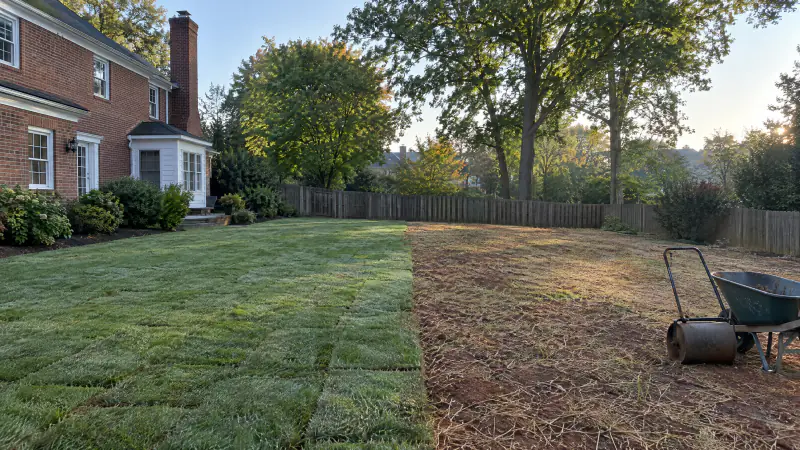
Spring is also the better time for a lawn seeded from scratch in a yard that missed the fall window, which is covered in our sod-or-seed guide. Fall planting of beds and spring seeding of lawn is a common and sensible pairing, and it keeps the two trades out of each other's way.
When should each plant group go in the ground in Northern Virginia?
Typical windows for the region. Western Loudoun runs a week or two earlier at the cold end, Arlington and Alexandria a week or two later.
| Plant group | Best fall window | Spring alternative | Watch for |
|---|---|---|---|
| Deciduous shade and flowering trees | Late September to early December | March to early May | Plant depth; the root flare must show |
| Broadleaf evergreens (holly, boxwood, laurel, magnolia) | Mid-September to mid-October | March to April | Winter wind burn if planted late |
| Needled evergreens (arborvitae, spruce, pine) | Mid-September to early November | March to April | Deer on arborvitae; wet feet on spruce |
| Deciduous shrubs (hydrangea, viburnum, sweetspire) | Late September to early December | March to May | Mulch against the stems |
| Hardy perennials, ferns, sedges | September to mid-October | April to May | Frost heave on late plantings; mulch after the ground cools |
| Spring bulbs | October to early December | None | Voles and squirrels; plant deep |
| Crape myrtle, vitex, warm-season grasses | Spring is safer | April to June | Winter loss when planted in fall |
| Balled-and-burlapped trees | October to December, fresh dug | March to April | Remove wire and burlap from the top third |
The ground usually stays workable into December here, so a late start is better than skipping fall entirely for woody plants.
How do you plant a tree or shrub in Northern Virginia clay?
Clay punishes a hole dug like a bucket. The method below is how we plant everything from a one-gallon perennial to a two-inch-caliper tree.
Find the root flare before you dig
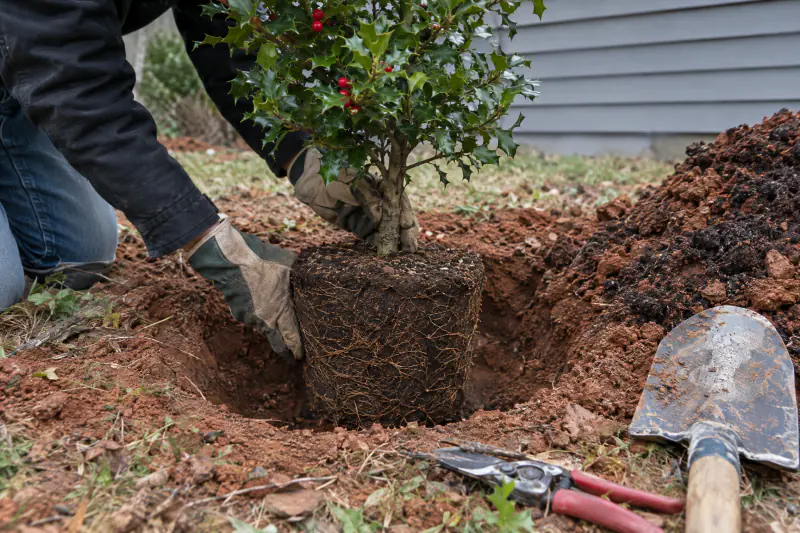
Scrape the top of the root ball until the first roots and the widening of the trunk are visible. Nursery stock is often potted an inch or two too deep. The flare, not the top of the soil in the pot, sets the planting depth.
Dig wide and shallow
Make the hole two to three times the width of the root ball and no deeper than the distance from the flare to the bottom of the ball. Slope the sides outward like a saucer. On clay, rough up the sides with the spade so they do not glaze into a smooth bowl.
Set the flare high
Place the ball on firm, undisturbed soil so it cannot settle, with the flare an inch or two above the surrounding grade. On wet or heavy clay, two to three inches high is better. A tree planted deep in clay sits in a sump and suffocates slowly.
Deal with the roots and the wrapping
Cut or tease out any circling roots on container stock. On balled-and-burlapped trees, remove the wire basket and burlap from at least the top third of the ball once it is in the hole, and cut away all twine from the trunk.
Backfill with the native soil
Return the clay you dug out, broken up, with no more than about a quarter compost by volume if any. A hole full of bagged mix holds water like a bathtub and gives roots no reason to leave it. The whole bed, not the hole, is where compost belongs.
Water, then mulch properly
Soak the backfill to settle it, add soil where it sinks, then spread 2 to 3 inches of shredded hardwood mulch over the bed and pull it 3 to 6 inches back from every trunk and stem. Stake a tree only if it cannot stand on its own, and remove stakes within a year.
How should beds be edged and drained?
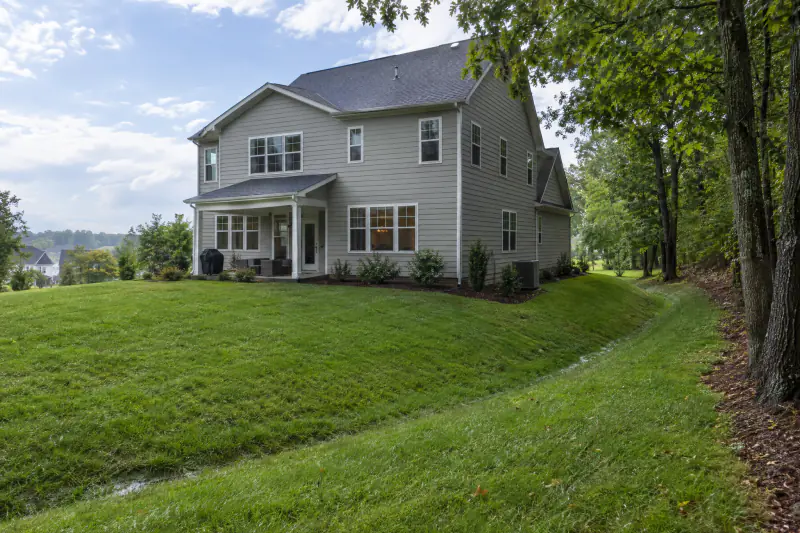
A bed on clay needs an edge that holds and a grade that sheds, and both are decided before the first plant goes in. The grade comes first. Every bed against the house should fall away from the foundation, at least a few inches over the first several feet, so roof water and irrigation move toward the lawn and not into the basement. Beds that have been topped up with mulch every spring for fifteen years often sit above the siding line and slope toward the house; part of a renovation is cutting that buildup out and resetting the grade. Where a yard has a chronic wet spot, the answer is drainage or regrading before planting, not a plant that is supposed to tolerate wet feet. Very few ornamentals tolerate standing water in clay for days, and the ones that do are not the ones most people want by the front door.
Raising the bed is the other tool. On flat, heavy clay we often build beds up four to eight inches with a blend of topsoil and compost, which lifts the root zone out of the saturated layer and gives the plants the drainage the native soil cannot. Raised beds need a defined edge or the soil migrates into the lawn.
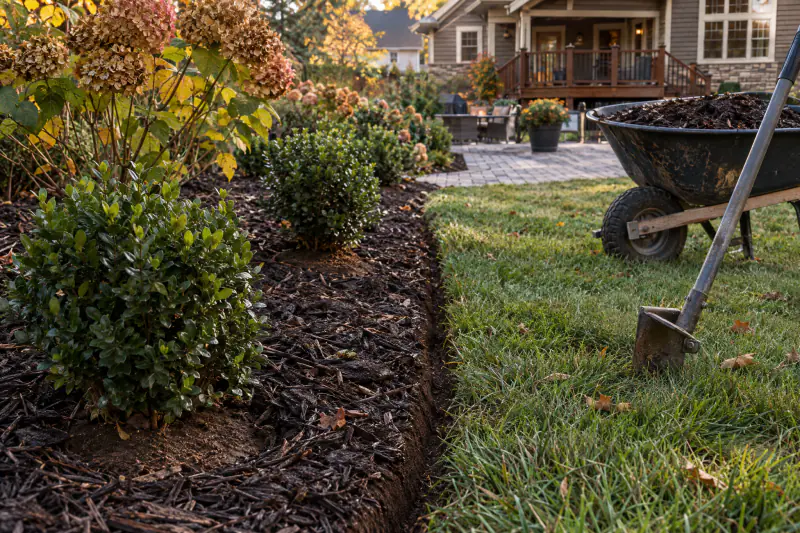
For the edge itself there are three good options. A spade-cut edge, a clean vertical trench recut once or twice a year, costs nothing but labor and gives the cleanest line; it suits sweeping curves and is what we use on most beds. Steel edging, set so the top sits just above grade, holds a line permanently and keeps mulch off the lawn on slopes. A paver or stone soldier course doubles as a mower strip and suits beds that meet a patio or walk. Plastic roll edging heaves in our freeze-thaw cycles and rarely lasts; we do not install it.
One more drainage detail: where downspouts discharge into a bed, extend them underground past the planting and out to daylight or a drain line. A downspout dumping into fresh mulch washes it out with the first storm and keeps the nearest shrub permanently wet.
Which plants will the deer leave alone?
No plant is deer-proof in Northern Virginia, and a hungry herd in February in Great Falls or Clifton will sample almost anything. But deer have strong preferences, and a plant list built around what they usually avoid loses far less. The reliable group includes inkberry and American holly, boxwood, spicebush, pieris, osmanthus, most viburnums, bayberry, Virginia sweetspire, fothergilla, and among perennials and grasses hellebore, ferns, catmint, mountain mint, salvia, Russian sage, lavender, switchgrass, little bluestem and most sedges. Daffodils and alliums are the bulbs to plant if deer and voles are both a problem; tulips are a salad bar.
The plants that get eaten first are the ones that get planted most. Hosta, daylily, yew, azalea, Emerald Green arborvitae, hydrangea in a bad winter, and the new growth on almost any fruit tree. Where a client wants one of those, we talk about placement near the house, physical protection for the first few years, or repellents, and we say plainly when a plant is likely to be browsed to the ground.
Fall planting raises the stakes a little. Deer pressure peaks in late fall and winter when wild food thins out, which is exactly when a new planting is tender and unfamiliar. Newly planted arborvitae in an Oakton or Reston back yard can be stripped to the trunk in a single December. A loose cage of welded wire for the first winter, or a spray repellent applied every few weeks through the cold months, gets a vulnerable plant past its first year. For screens in heavy-deer neighborhoods, we lean toward hollies, Green Giant arborvitae, which deer generally browse much less than the smaller Emerald Green, and mixed layered plantings instead of a single row of one species. The landscape design and installation page covers how we build those palettes.
How do you water new plants through the first winter?
Water until the ground freezes, then water on mild days when it thaws. That is the rule most fall plantings miss, because once the leaves are down it feels like the job is over. It is not. The roots are still growing, the soil can still dry out in a windy November, and broadleaf evergreens keep transpiring on every sunny winter afternoon. A dry December is as hard on a new holly as a dry July.
The amounts are modest. For the first month after planting, a new tree or shrub wants a slow, deep soak two or three times a week, roughly the volume of the root ball each time, delivered by a hose trickling at the base for several minutes rather than a sprinkler passing over the top. From about week five until the ground freezes, once a week in the absence of an inch of rain. After a freeze, check every few weeks during thaws; if the soil under the mulch is dry a few inches down, water. Trees take longer than shrubs, and the watering schedule we leave with every installation runs for two growing seasons for trees and one for most shrubs and perennials.
If the property has a sprinkler system, a drip zone for the beds solves most of this, but note that the system will be winterized in late October or November, after which the beds go back to hoses or watering cans. We schedule the blow-out around the planting rather than the other way round, and we tell homeowners which plants need the hose after the system is off. Perennials planted late need one extra step: after the ground has cooled in late November, a light top-up of mulch over the crowns reduces frost heave, which can push a shallow-rooted plant up and out of the ground over a winter of freeze-thaw cycles.
What does fall landscape installation cost in Northern Virginia?
As typical Northern Virginia market planning ranges as of 2026, a new front foundation planting with bed preparation, a mix of shrubs, perennials and a small ornamental tree, edging and mulch commonly runs about $4,000 to $12,000. A full-property installation with shade trees, an evergreen screen, several beds and the soil work to match runs roughly $15,000 to $50,000, and larger lots or mature specimen trees push well past that. Installed evergreen screening trees in the 6 to 8 foot range are often $250 to $700 each. Shrubs in 3-gallon containers often land around $50 to $200 installed depending on species and size, perennials and grasses roughly $15 to $50 each installed, and bulk hardwood mulch delivered and spread roughly $75 to $150 per cubic yard. These are general market ranges, not myYardPros prices.
Fall does not change the price of plants much. What it changes is the odds, and the odds are the real cost. A spring planting that loses a fifth of its shrubs to the first August drought has to be partly replanted, and the replacement is often done in the heat with worse results. A fall planting with the same budget tends to keep its plants.
What moves the number:
- Plant size. A 2-inch-caliper tree costs several times a 1-inch tree, and a 10-foot holly many times a 4-foot one. Smaller stock often catches up within a few seasons.
- Bed area. Preparation, edging and mulch scale with square footage, not plant count.
- Demolition. Old shrubs with large roots, buried landscape fabric, river rock and old edging all take time to remove.
- Drainage and grading, which are priced separately and should come first.
- Access and slope. A back yard reached through a 36-inch gate is hand work.
- Deer protection, drip irrigation and lighting conduit added at the same time.
A tight budget is better spent on whole-bed soil preparation and younger plants than on a few large specimens dropped into unamended clay. Our cost guide sets these figures beside the rest of the yard, and the number for your property comes from a written on-site estimate with a plant list, sizes and quantities, after we have walked the beds and probed the soil.
Why install beds after the hardscape and before the lawn?
Because beds are shaped against finished edges and lawns are the last thing anyone wants to drive a wheelbarrow across. The order we recommend on any property doing more than one thing is drainage, then hardscape, then irrigation and lighting, then planting, then lawn. Beds sit fourth for good reasons. A patio, walkway or wall defines where a bed starts and how high its soil can sit; a bed built before the hardscape gets cut, re-graded and half dug up when the base stone goes in. Irrigation lines and lighting cable run through beds, so they are laid before the compost is tilled and the plants placed, not slit through finished roots afterward. And a lawn, whether sod or seed, is wrecked by the foot and machine traffic of a planting crew, so it goes in after the last plant is watered.
Fall is where that sequence lands naturally. Hardscape built through summer is finished by September. Planting fills late September through November. A lawn seeded in mid-September around new beds, or sodded in October after them, closes the project in the same season. Where a whole property is being redone over two or three years, planting usually falls in the autumn of the hardscape year, and we lay out that longer schedule in our article on sequencing a whole-property renovation.
Two exceptions are worth knowing. Large trees sometimes go in first, before hardscape, when they are the fixed points a patio or path will be designed around, and when access for a tree spade or a crane will be blocked later. And if the lawn is already established and in good shape, we protect it with plywood tracks and ground mats and plant around it rather than waiting for a lawn that does not need replacing. The how it works page shows where each of these steps sits in a project.
What is on the fall planting checklist for a Northern Virginia yard?
Run through this before the first hole is dug. Most of it happens in late August and September.
- Planting plan drawn with bed lines, plant list, sizes and spacing, and submitted to the HOA if front-yard changes need approval.
- Virginia 811 called to mark public utilities, and private sprinkler, lighting and gas lines flagged by hand.
- Wet spots fixed or scheduled: downspouts extended, drainage installed, beds graded to fall away from the house.
- Soil test submitted in August so lime and nutrients can be worked into the beds before planting.
- Broadleaf evergreens and the privacy screen scheduled for the first planting days, by mid-October.
- Hole width, planting depth and root flare checked on every tree and shrub before backfilling.
- Native soil used for backfill, with compost tilled across the whole bed instead.
- Mulch spread 2 to 3 inches deep and pulled back from every trunk and stem.
- Deer protection in place on arborvitae, young trees and anything on the browse list before December.
- Written watering schedule in hand, with hose access confirmed for after the sprinkler system is blown out.
What is different about fall planting in Fairfax, Loudoun, Prince William and Arlington?
Across our service area the calendar shifts by a week or two and the soil, shade and deer shift much more. Western Loudoun, from Leesburg to Purcellville and out around Aldie, gets its first hard freeze earlier and sits on everything from heavy red clay to shaley ridges that drain too fast. Broadleaf evergreens there want to be in the ground by early October, and screens along open farm-edge lots take the full force of winter wind, so we favor hollies and mixed plantings over a single row of arborvitae. Deer pressure in western Loudoun is heavy.
The newer subdivisions in eastern Loudoun and western Prince William, in Ashburn, Brambleton, South Riding, Gainesville and Bristow, share a different problem: graded lots with little topsoil, compacted subsoil a few inches down, and HOAs that review nearly everything visible from the street. Beds there are almost always built up with imported soil and compost, downspouts are usually dumping into the foundation beds, and the HOA application should go in with the planting plan in September if the installation is to happen in October. Our article on HOA approval for exterior projects covers the paperwork.
Inside the Beltway and in the older parts of Fairfax County, in Arlington, Alexandria, Falls Church, McLean, Vienna, Annandale and Burke, the soil is often better and the shade is often deep. Fall planting there is as much about shade-tolerant choices, hellebores, ferns, oakleaf hydrangea, sweetspire, native azalea under oaks, as about clay technique, and tree roots make bed preparation a hand-tool job in many yards. Lots near streams in any of these counties may sit in a Chesapeake Bay Resource Protection Area, where clearing existing vegetation is restricted; check with your county before removing anything near a stream bank. Down the Route 1 corridor in Springfield, Lorton and Woodbridge the ground tends to be flatter and wetter, and drainage decides more plantings than the plant list does. Everywhere, Bradford pear, Japanese barberry, burning bush, nandina, butterfly bush and English ivy are on Virginia's invasive plant list, and we do not plant them.
Frequently asked questions
How late in the fall can I plant trees in Northern Virginia?
Deciduous trees and shrubs can go in until the ground freezes, which is usually some time in December here, and balled-and-burlapped stock is often freshest in November. Broadleaf evergreens such as hollies and boxwood should be planted earlier, by about mid-October, so they have rooted before winter wind dries their leaves. Later than that, wait for March.
Should I amend the soil in the planting hole with compost or topsoil?
Not much, and not only in the hole. Backfill with the native clay broken up, with at most a quarter compost by volume. A hole filled with rich bagged soil in a clay yard holds water like a bathtub and roots circle inside it instead of spreading. Amend the whole bed with compost tilled across it before planting; that is where organic matter does its work.
How deep should mulch be around new plants?
Two to three inches over the bed, pulled back 3 to 6 inches from every trunk and stem so the root flare stays visible. Deeper than that suffocates roots and keeps bark wet; shallower dries out and lets weeds through. Refresh with an inch in spring rather than piling a fresh three inches on top of last year's layer every year.
Do new plants need watering after the leaves drop?
Yes. Roots keep growing while the soil is above about 40 degrees, which lasts into December in Northern Virginia, and they need moisture to do it. Water deeply once a week until the ground freezes, then check during winter thaws. Broadleaf evergreens lose water all winter and are the first to suffer in a dry December.
Which evergreens make a good privacy screen in a deer area?
Hollies such as Nellie Stevens and American holly are the most dependable, and Green Giant arborvitae is browsed far less than the smaller Emerald Green, though no plant is immune. A mixed screen of hollies, viburnums, bayberry and a few conifers resists both deer and disease better than a single row of one species, and it looks less like a wall.
Can I plant a bed this fall and seed the lawn next spring?
Yes, and that order works well. Beds planted in October are established by the time a spring lawn goes in, and the seeding crew is not driving wheelbarrows over new turf. If you can, seed the lawn in September around the beds in the same fall, because fall is also the strongest seeding season for tall fescue here.
Do I need a permit or HOA approval to install landscaping?
A building permit is rarely required for planting alone, though retaining walls, drainage tie-ins and work near streams can trigger county review. HOA approval is common for anything visible from the street, including new beds, trees and screens, and many associations in Loudoun and Prince William publish plant rules. Apply in September for an October installation.
Is it better to plant large trees or small ones?
Smaller trees establish faster and often catch up to larger stock within a few seasons, because a big transplanted tree loses most of its roots in the digging and spends years rebuilding them. For a screen you need now, larger stock is worth the cost. For a shade tree you want in twenty years, a 1-inch-caliper tree planted well in October is the better buy.
Book the work
Put the plan in writing with a crew that builds this every week.
One visit to measure and talk through options, then a written scope and price. No pressure, no vague numbers. Ask about the Heroes Discount if you serve.
Sources and further reading
Published August 27, 2026. Reviewed and updated October 9, 2026.