Key takeaways
- If more than about half the lawn is weeds or bare soil, start over. Below that, aeration and overseeding usually wins on both cost and result.
- Slopes, swales and the strip along the street get sod even in seeding season, because one August thunderstorm can carry seed and topsoil downhill.
- Seed needs the September window and six to ten weeks before it takes normal use. Sod is usable in about three to four weeks and can go in through November.
- As of 2026, Northern Virginia planning ranges run about $0.50 to $1.50 per sq ft for a seed renovation and $2 to $4 per sq ft for installed sod.
- Most yards do best with a hybrid: sod the front and the slopes, seed the flat back yard, and finish all the grading, drainage and compost before either goes down.
On this page
- Should you sod or seed your lawn this fall in Northern Virginia?
- How much of the lawn is weeds or bare soil?
- Does the slope decide it for you?
- How soon do you need a usable lawn?
- Which factors point to sod and which to seed?
- Can you actually keep it watered?
- What does shade change about the decision?
- What does each outcome cost in Northern Virginia?
- Should you sod the front and seed the back?
- What preparation do sod and seed share?
- What does the mid-August to October calendar look like?
- Your fall lawn decision checklist
- How does the sod or seed decision change across Fairfax, Loudoun, Prince William and Arlington?
- Frequently asked questions
Should you sod or seed your lawn this fall in Northern Virginia?
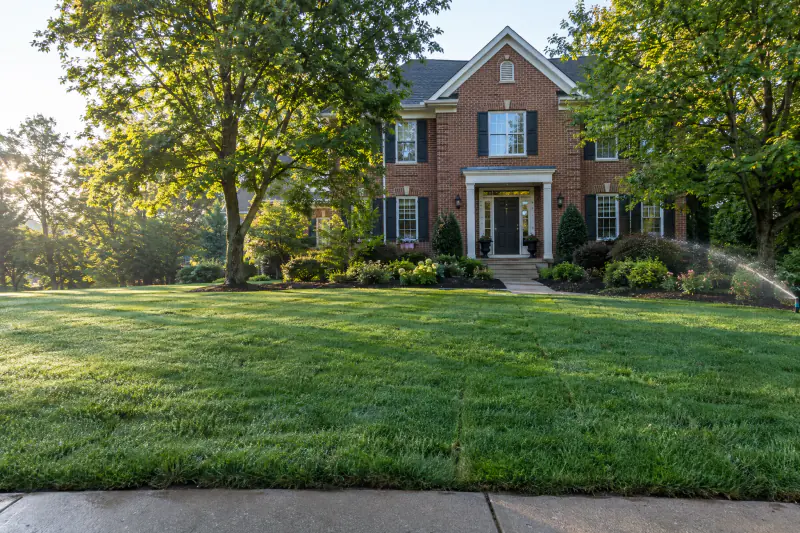
Seed if it is between late August and mid-October, the ground is reasonably flat, the lawn is more than half gone, and you can keep the surface moist for three weeks and wait until spring for a full lawn. Sod if the yard slopes, if you need a usable lawn within a month, if the calendar has slipped past mid-October, or if the lawn in question is the one the whole street sees. Most Northern Virginia yards we walk in August fall somewhere in between, and the right answer is often a mix of the two on the same property.
That is the short version. The longer version is a set of six questions we ask on every site visit before anyone talks about square footage: how much of the lawn is weeds or bare soil, how steep it is, how soon you need to use it, what the budget will bear, whether you can water, and how much shade falls on it. Each one pushes the decision one way or the other. Work through them in order and the answer usually becomes obvious before you reach the end.
If you want the general comparison first, our sod vs. seed guide covers the basics. This article is the next step: the decision framework we actually use, the planning ranges for each outcome, the hybrid approaches that save money, the preparation both methods share, and a week-by-week calendar from mid-August through October. We are writing this in the second week of August because the seeding window opens in about two weeks, and the preparation for either path should be happening now.
How much of the lawn is weeds or bare soil?
Count before you decide anything else. Stand at one corner of the lawn and walk a straight line across it, looking down every few steps. Tally what is underfoot: desirable grass, weeds, or bare soil. Do it twice in different directions. The rough percentage you get is the single most useful number in this whole decision, and it sorts lawns into three groups.
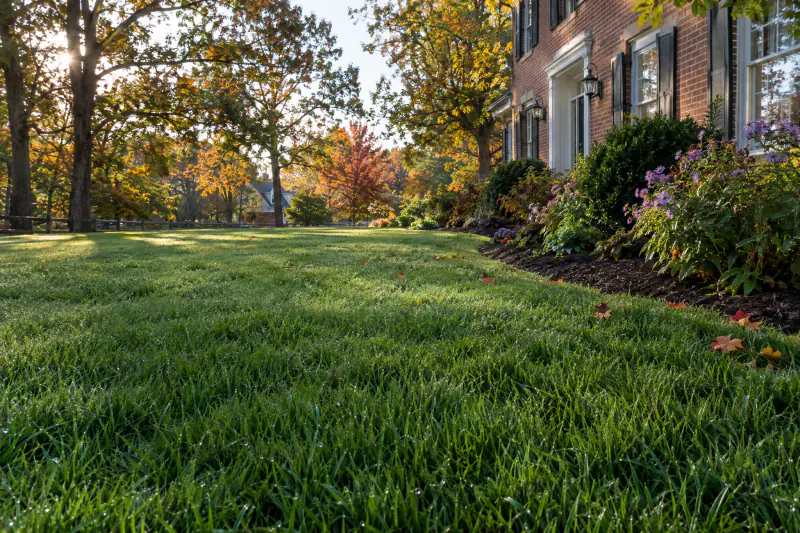
If more than about half of what you see is tall fescue that is simply thin, you do not need sod or a seed renovation. Core aeration and overseeding in September will thicken what is there for a fraction of the cost of starting over, and our fall lawn renovation article walks through that plan in detail. Be honest in the count, though. Nimblewill, bermuda grass creeping in from a neighbor and fine-bladed crabgrass can all pass for lawn from the porch. Get down and look.
If weeds and bare soil are between about a third and a half, you are in the gray zone. Overseeding can still work if the weeds are mostly annuals such as crabgrass, which die with the first frost and leave openings for fall seedlings. It works poorly if the weeds are perennial grasses or wild violet, which will be there in spring competing with young fescue.
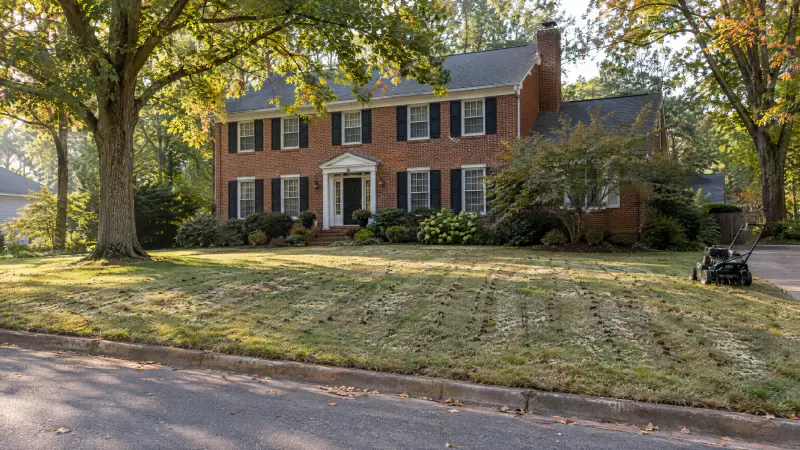
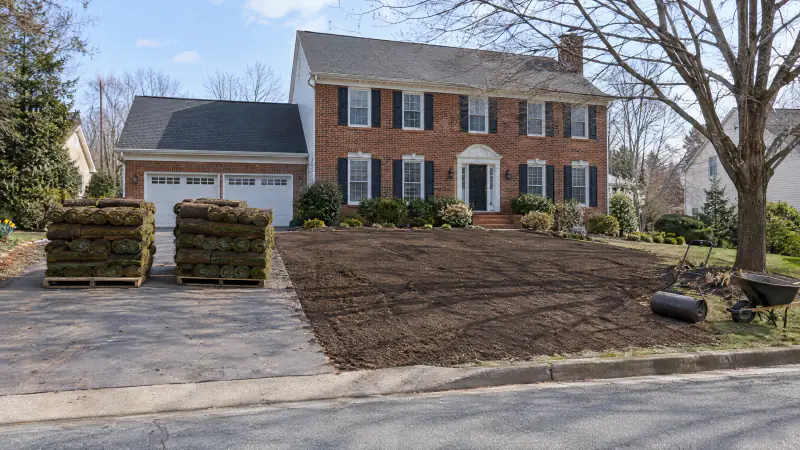
Past about half, start over. The old lawn is stripped, the soil is rebuilt, and you choose sod or seed to finish. That is the group this article is written for. Builder lawns in Ashburn, Aldie and Bristow that were laid over scraped subsoil often land here within five years of closing, and so do yards torn up by pool, utility or drainage construction.
Does the slope decide it for you?
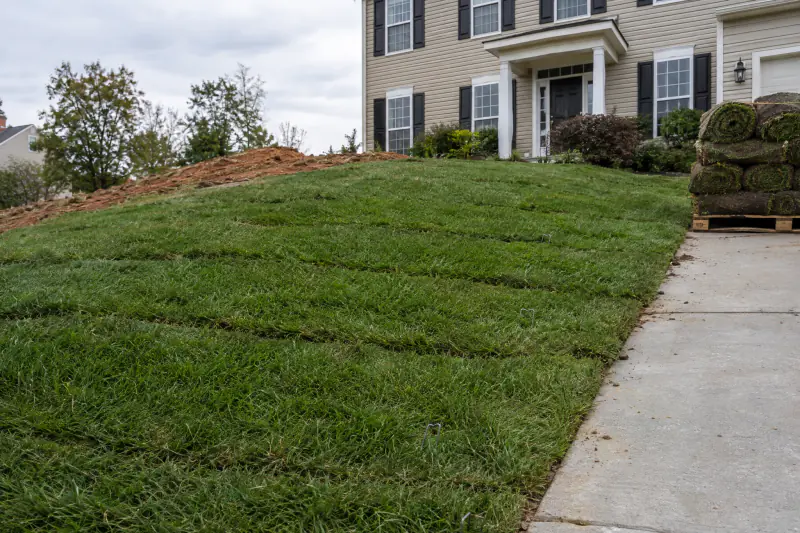
Often, yes. Grade is the one factor that can overrule the calendar, the budget and everything else, because seed on a slope has no way to hold the soil until it roots, and tall fescue takes two to three weeks to sprout and several more to anchor. One thunderstorm in that window, and Northern Virginia gets plenty of them in late August and September, can move the seed and the loosened topsoil to the bottom of the hill. You are left with a bare slope above a ridge of muddy seedlings, and the money is gone.
Sod holds the soil the day it is laid. The roots are already there, the mat weighs enough to resist sheet flow, and on steeper ground it can be staked with biodegradable staples until it knits. That is why we sod slopes even in the middle of seeding season. The rule of thumb we use is simple: any grade where water visibly runs rather than soaks during a hard rain, any swale that carries runoff across the lawn, and the strip between the sidewalk and the street where the ground drops to the curb all get sod. So does the ground just above a retaining wall, where washouts end up on the patio below.
Flat ground, or a grade gentle enough that rain soaks in, is open to seed. If you are not sure which you have, watch the yard during the next heavy storm or look for the evidence afterwards: little deltas of silt at the low end, exposed roots, a washed line where mulch used to be. Where water is clearly the problem rather than the grass, the fix may be drainage or regrading first, and a lawn second. Seeding over an erosion problem only hides it until the next storm.
How soon do you need a usable lawn?
Sod is a lawn in about three to four weeks. Seed is a lawn next spring. That difference drives more sod decisions than anything except slope, so put a date on it. If a dog needs the yard by Halloween, if a house is going on the market in October, if a graduation party or a new baby or a swing set is on the calendar, sod. If none of those apply and you can look at straw and a green haze through October and a thin lawn through winter, seed will give you the same tall fescue for a fraction of the money.
Here is what the seed timeline really looks like in this region. Sown in the first half of September, tall fescue germinates in roughly seven to fourteen days with steady moisture. It can be mown for the first time around three to four weeks after sowing. It looks like a lawn, a thin one, by late October. Through winter it sits mostly still. In March and April it thickens quickly, and by the time it meets its first July it has eight months of root. Walking on it is fine from about six weeks. Dogs, soccer and a mower turning hard on it should wait until spring. Count on the yard being off limits for serious use for the whole of fall.
Sod compresses all of that. Laid in September, it is rooted enough to resist a tug in about two weeks and takes light foot traffic at three to four weeks. Laid in late October or November, rooting slows with the soil temperature and the lawn should be treated gently until spring, but it is green, it holds the soil, and it keeps mud out of the house all winter. That late-fall option is the reason sod remains the answer for anyone who misses the seeding window, which we cover in our sod timing article.
Which factors point to sod and which to seed?
Score your own lawn against each row. Three or more in one column is usually the answer, and a split often means a hybrid.
| Factor | Points to sod | Points to seed | Why it matters here |
|---|---|---|---|
| Weeds and bare soil | Over half, and you want it gone now | Over half, and you can wait for spring | Below half, overseed instead of either |
| Slope | Any grade where rain runs instead of soaking | Flat or gently sloped ground | Seed and topsoil wash out before roots form |
| Time to usable lawn | Needed within about a month | Spring is soon enough | Seed needs six to ten weeks of light use at most |
| Date | Any time ground is not frozen; easiest September to November | Late August to mid-October only | Fescue seedlings need weeks of growth before frost |
| Budget | Room for roughly two to four times the seed cost | Tight, or the area is large | Preparation costs the same under both |
| Water | Once or twice daily for two weeks | Light watering two to three times daily for three weeks | Seed is less forgiving of one missed hot afternoon |
| Shade | Partial shade is fine; deep shade fails either way | Partial shade is fine with a shade-tolerant blend | Neither grows under dense oak canopy |
| Visibility | Front yard, street side, the view from the kitchen | Back and side yards, behind fences | Hybrid yards sod what is seen and seed the rest |
A soil test and drainage check come before either path. Fix standing water first or the choice will not matter.
Can you actually keep it watered?
Both sod and seed die the same way in their first month: they dry out once. The difference is how much margin each gives you. Sod arrives with a root mat that holds water, so a missed afternoon in September is usually survivable. Seed has no reserve. A seedling that has just split its seed coat and sent out a hair-thin root dies in hours if the top half inch of soil goes dry on a warm day, and in Northern Virginia the first two weeks of September can still bring afternoons in the upper 80s. One hot, windy day with nobody home can cost a third of a seeding.
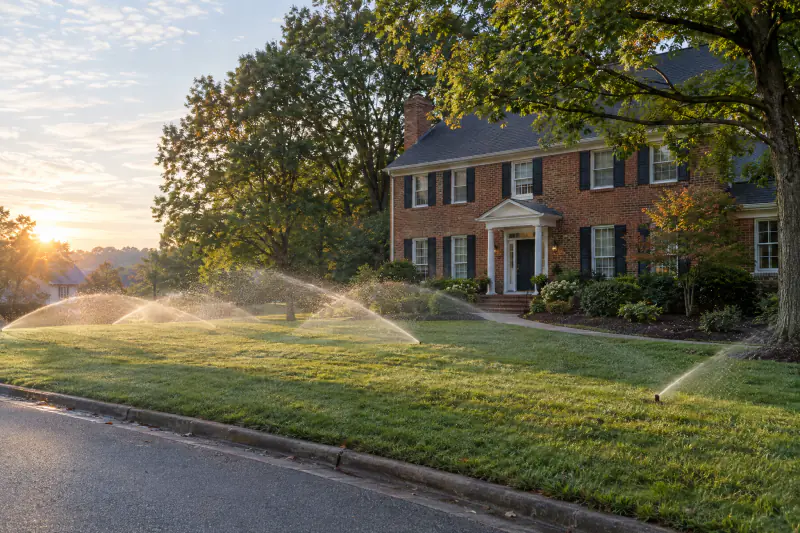
So the watering question is really a question about your life. Will someone be home to move hoses two or three times a day for three weeks? Is there a hose bib on every side of the house? Is the lawn bigger than a couple of oscillating sprinklers can cover in one pass? If the answers are no, seed becomes a gamble and sod becomes the safer bet, or you install the equipment to make seed reliable. A sprinkler system set to short cycles, several times a day, is the single biggest difference between a seeding that fills in and one that comes up patchy. If a system already exists, now is the time to have heads adjusted and zones tested, not after the seed is down.
Water rules deserve a mention. Public water customers in Fairfax, Loudoun and Prince William do not face routine fall watering restrictions in a normal year, but drought advisories can appear, and they tend to arrive in late summer. Watch for them before you commit to seed. Sod on a 10,000 sq ft lawn still needs water, but it needs it for two weeks rather than four, and that difference matters if an advisory lands in mid-September.
What does shade change about the decision?
Shade shrinks both options. Tall fescue is the most shade-tolerant of the grasses that survive our summers, but it still needs roughly four to six hours of sun, or bright dappled light all day, to stay dense. Under the mature white oaks of Vienna and Burke or the maples of older Arlington streets, neither sod nor seed will hold for more than a season or two, and sodding deep shade is the most expensive way to find that out.
In partial shade, the choice tilts slightly toward seed for one reason: you choose the blend. Sod farms grow the varieties that perform in full sun on a farm, because that is where sod is grown. A seed mix can be built with shade-tolerant tall fescue varieties and a share of fine fescue for the darkest edges. If you must sod a partly shaded area for timing or slope reasons, plan to overseed it with a shade blend the following fall to shift the population over time.
Shade also changes the watering math, usually for the better. Shaded soil dries more slowly, so seed in the dappled shade of a tree line is more forgiving than seed in the open. The trade is air movement and disease. Brown patch loves the warm, still, humid nights of early September, and a shaded seeding that stays wet overnight can lose seedlings to it. Water in the morning, not the evening, under trees.
Where shade is dense and the area is small, the honest answer is often not grass at all. A shade bed of ferns, hellebores and sedges from a planting plan, or artificial turf for a dog run under a canopy, saves you from re-seeding the same corner every fall.
What does each outcome cost in Northern Virginia?
As typical Northern Virginia market planning ranges as of 2026, a full seed renovation, meaning the old lawn stripped, the soil loosened and amended, the surface graded, then seeded with a quality tall fescue blend and starter fertilizer, runs roughly $0.50 to $1.50 per sq ft. Installed tall fescue sod with the same preparation runs roughly $2 to $4 per sq ft. On a 5,000 sq ft front yard that is about $2,500 to $7,500 by seed against $10,000 to $20,000 by sod. Core aeration and overseeding, the option for lawns that are still mostly grass, typically runs about $300 to $800 for a suburban lawn, and more if compost topdressing is added. These are general market ranges, not myYardPros prices.
The gap between the two full renovations looks large, and it is, but notice where the money goes. Preparation is a large share of a seed job and a smaller share of a sod job, because it costs the same either way. That is why a hybrid yard is so efficient: the crew, the equipment and the compost are already on site, and the only thing that changes from one zone to the next is the finish.
What moves the number, for both paths:
- Grading. A yard that needs topsoil brought in or clay hauled out can add thousands.
- Compost volume. A two-inch layer tilled into 5,000 sq ft is roughly 30 cubic yards of material.
- Access. A 36-inch gate means a smaller tiller, no skid steer and more hours.
- Slope, tree roots and the amount of trimming around beds and sprinkler heads.
- Size. Small lawns cost more per square foot; very large lawns favor seed.
- Irrigation and drainage work, which are priced separately.
Hidden costs favor sod less than the headline numbers suggest. A seeding that fails in a dry week has to be redone, and a second seeding in October has less time before frost. Budget for a sprinkler tune-up or a set of timers on the hose bibs as part of the seed price. Our cost guide puts these ranges next to the rest of the yard, and the only number that applies to your lawn comes from a written on-site estimate after we have measured, probed the soil and seen where the water goes.
Should you sod the front and seed the back?
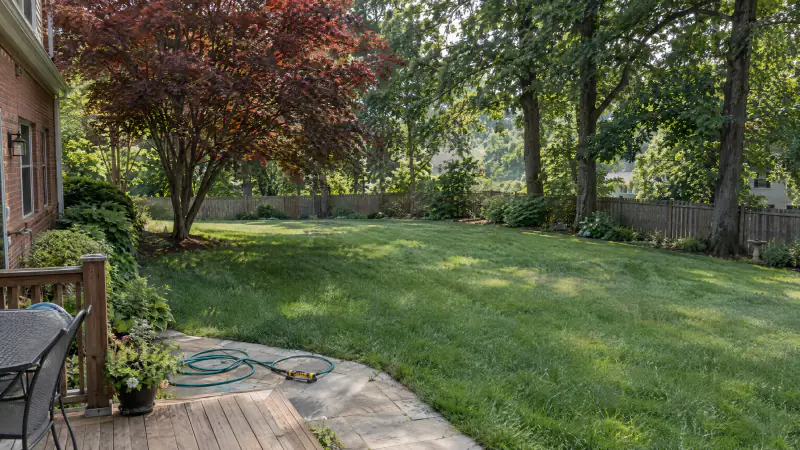
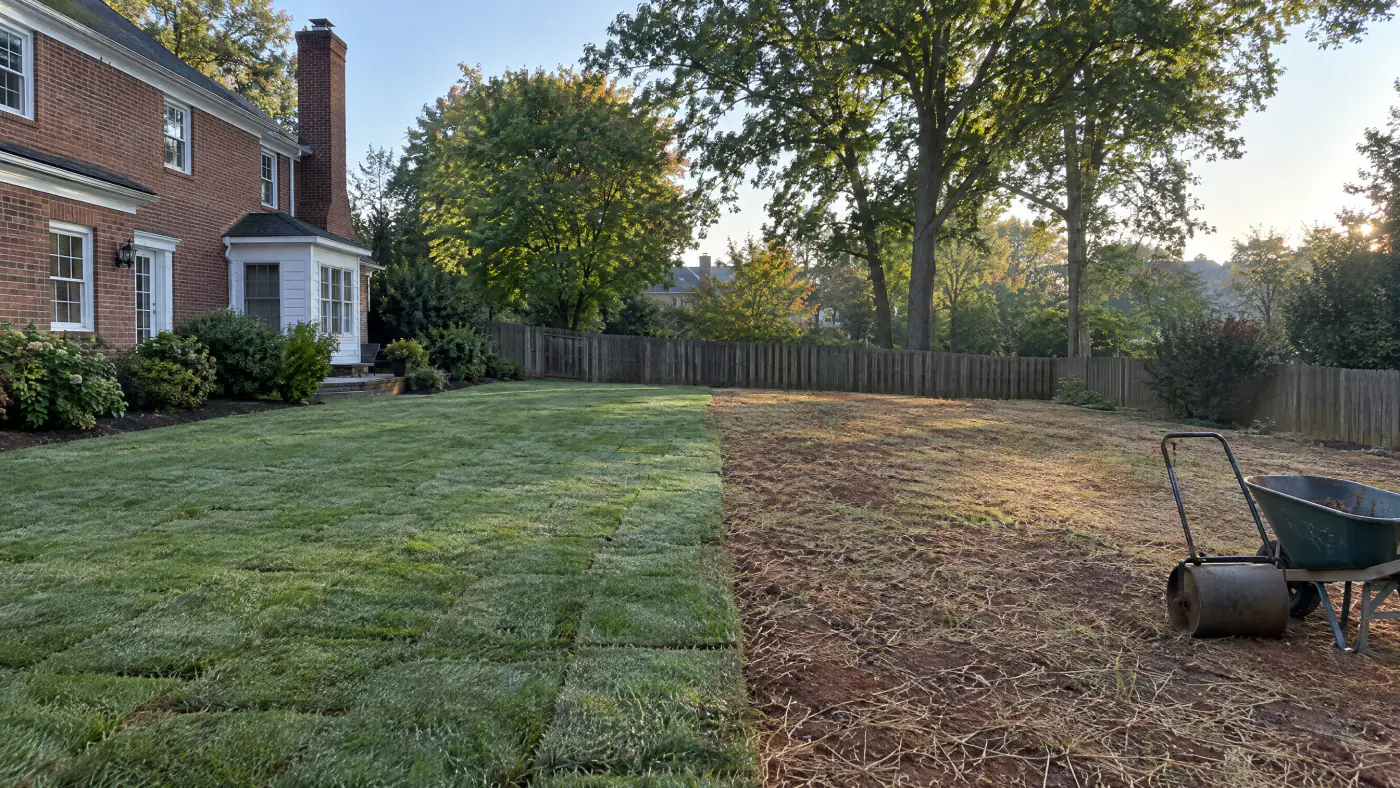
For most Northern Virginia lots, yes, and this is the recommendation we make more than any other. The front yard is small, visible, often sloped toward the street, and the part that affects how the house looks from the curb. The back yard is larger, flatter, fenced, and usually the place where a few months of thin grass bother no one. Sod the front and seed the back, and the total often lands closer to the seed price than the sod price while the view from the street is finished the same day.
The split can be finer than front and back. The sloped side yard along the driveway gets sod. The sunny, flat area beyond the patio gets seed. The strip along the fence that the dog runs every morning gets sod, or something tougher than grass. The soggy corner by the downspout gets a drain line and a swale and nothing else until it dries. We draw these zones on the measured plan during the site visit so the scope and the estimate match the yard rather than treating it as one rectangle.
Two details make a hybrid lawn look like one lawn. First, use sod and seed of the same type. Sod farms serving this region grow turf-type tall fescue, usually with a small share of Kentucky bluegrass to help it knit, and the seed blend should match. Second, cut the sod edge clean against the seeded area and seed right up to it. By the second spring the line disappears. Third, if we are allowed a third, set the sprinkler zones so the seeded area can be watered on a different schedule from the sodded area for the first month, because they want different things.
A hybrid also spreads risk. If the seeded back yard comes up patchy because of a dry week or a storm, it is the part of the lawn you can live with and overseed again next fall. The sodded front, the slope and the street strip are done.
What preparation do sod and seed share?
Everything up to the last step is identical whichever finish you choose. Skipping any of it is how both fail.
Test the soil in August
A soil test through Virginia Cooperative Extension tells you the pH and whether lime is needed. Much Northern Virginia clay runs acidic, and lime applied before tilling is worked into the root zone rather than sitting on top.
Fix drainage and mark utilities
Standing water kills both sod and seedlings. Downspout lines, swales or a French drain go in first. Virginia 811 marks public utilities before any tilling, and sprinkler lines and heads are flagged by hand.
Strip the old lawn
A sod cutter removes the existing turf and weeds rather than burying them. A dying layer under new sod or seed blocks root contact and heats up as it decays. Perennial weeds are dealt with before stripping, with enough lead time.
Loosen and amend
The top four to six inches of clay are tilled, and one to two inches of compost are worked in across the whole area. The goal is a root zone that drains and holds moisture, not a thin skin of good soil over hardpan.
Grade to drain
The surface is shaped so water moves away from the house at a gentle fall, low spots are filled, and the finished grade sits about an inch below walks and patio edges so sod lands flush and seed does not wash onto the pavement.
Finish: sod or seed
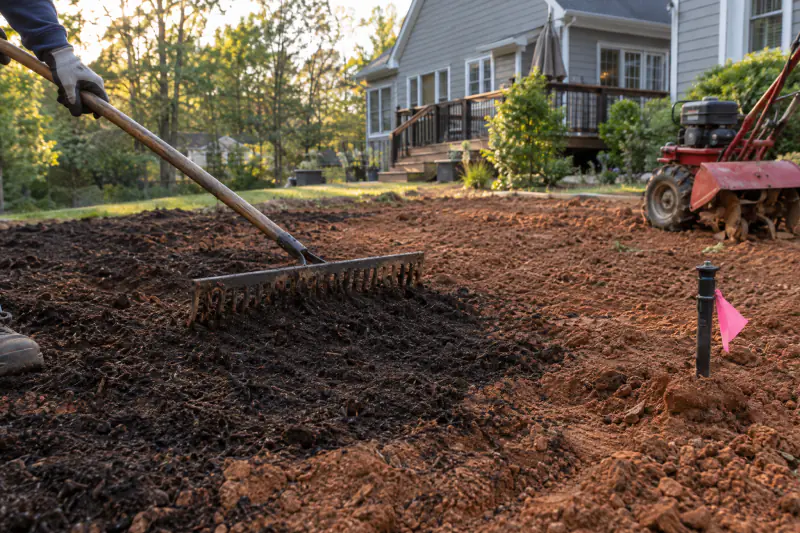
Sod is laid the day it arrives, staggered, butted tight, rolled and soaked. Seed is spread in two directions at the blend's rate, raked lightly, pressed in with a roller, covered with a thin layer of straw on any slope, and watered lightly several times a day.
What does the mid-August to October calendar look like?
The next ten weeks have a shape, and the decisions get easier if you know where you are in it. Right now, in the middle of August, soil temperatures are still in the 70s and the air is still hot. This is preparation time, not seeding time. Soil tests go out, drainage work happens, perennial weeds and bermuda grass are treated so they are dead before stripping, and sod is ordered for a delivery date. If a sprinkler system needs repair, this is the fortnight for it.
From the last week of August through the first three weeks of September, the seeding window is wide open. Soil is warm enough for fast germination, nights are starting to cool, and the seedlings get the longest possible run before frost. Sod goes in happily throughout. If we could choose one week for a seeding in Northern Virginia it would be the second week of September, after Labor Day and before the equinox, which in 2026 means seed in the ground by roughly September 10 to 15. Lawns in western Loudoun and out toward Haymarket lean a few days earlier; Arlington and Alexandria can run a week later.
Late September to mid-October is the back half of the window. Seed still works, but every week shaved off the fall shortens the root the seedlings carry into winter. By mid-October we stop recommending seed renovations in most of the region and shift the conversation to sod. Overseeding into an existing lawn is a little more forgiving and can run to about October 20 in a mild year.
From mid-October through November, sod is the only full-lawn option. Rooting slows as the soil cools, so the new lawn needs gentle treatment until spring, but it holds the soil, keeps mud down and is ready to grow the moment March warms. Seed sown now mostly waits for spring to germinate and faces summer with shallow roots, the problem described in our article on keeping tall fescue alive through summer. Sod can go down any time the ground is not frozen, so December installations are possible in a mild year.
Your fall lawn decision checklist
Walk the yard with this list in hand. The answers point to sod, seed, overseeding, or something other than grass.
- Walk-across count done on a dry day: desirable grass is above or below about half.
- Slopes, swales and the street strip identified and marked for sod regardless of season.
- A date written down for when the lawn must take normal use.
- Soil test submitted in August, with lime and starter fertilizer planned from the result.
- Standing water and downspout outlets fixed, or scheduled before any stripping.
- Sprinkler zones tested and heads flagged, or hose timers bought and tested on every side of the house.
- Hours of direct sun estimated for each zone; deep shade zones removed from the grass plan.
- Herbicide history for the year checked against reseeding intervals.
- Budget set for the hybrid: sod on what is seen and sloped, seed where there is room to wait.
- Sod delivery or seeding week booked for the first half of September, with preparation finished the week before.
How does the sod or seed decision change across Fairfax, Loudoun, Prince William and Arlington?
The framework is the same everywhere in our service area, but the typical answer shifts with the age of the neighborhood and the soil under it. In newer subdivisions across eastern Loudoun and western Prince William, in Ashburn, South Riding, Aldie, Gainesville and Bristow, lawns were often laid as thin sod over compacted subsoil at the time of construction. By the fifth or sixth year the count comes back below half, the soil underneath is hard enough to need a pick, and the yards are large and flat behind the house. These lots are the classic hybrid case: strip everything, sod the smaller front and the grade toward the street, seed the big flat back after the clay has been opened up and amended.
Older neighborhoods in Fairfax County and Arlington tell a different story. Vienna, McLean, Annandale, Burke and Falls Church have deeper topsoil and much more shade. The count there is often pulled down by shade rather than by soil, so the honest conversation is about how much lawn the trees will allow, how much of the shaded ground should become beds, and whether the sunny remainder deserves sod. Arlington and Alexandria lots are small enough that sodding the whole thing is often not much more than seeding, once the fixed costs of a crew and equipment are counted, and the extra few weeks of fall seeding window there make either choice easier.
Western Loudoun, from Leesburg out to Purcellville, runs cooler and gets its first frost earlier, so the seeding deadline there is closer to the start of October than the middle. Slopes are also more common, and the farm-edge soils range from heavy clay to shaley ground that drains too fast for seed to stay moist. Down along the Potomac in Woodbridge, Lorton and Dumfries, the lots are often flatter and wetter, and drainage decides more lawns than the sod-or-seed question does. Across all of it, HOA review rarely applies to sod or seed, but check your covenants before stripping a front yard in a managed community, and have the drainage conversation first wherever water sits. The lawn and landscape pillar lays out how these projects fit together.
Frequently asked questions
Can I lay sod and seed in the same yard at the same time?
Yes, and it is common. The preparation is identical, so a crew strips, amends and grades the whole lawn in one pass, then lays sod on the slopes and the front and spreads seed on the flat back. Use the same tall fescue type for both so the lawn matches by the second spring, and water the two zones on different schedules for the first month.
Is it too late to seed if I miss mid-October in Northern Virginia?
For a full renovation, usually yes. Seedlings need several weeks of growth before hard frosts, and seed sown in late October often sits until spring and then meets summer with shallow roots. Overseeding into an existing lawn can stretch a week later in a mild year. After that, sod is the reliable option through November and in mild winter weather.
How many weeks before I can walk on a seeded lawn?
Light foot traffic is fine about six weeks after sowing, once the grass has been mown two or three times. Hold off on dogs, play and sharp turns with the mower until spring, when the root system has had the winter to deepen. Sod takes light use at about three to four weeks and normal use after about a month.
Does sod need the same soil preparation as seed?
It needs exactly the same preparation. Sod laid on hard, unamended clay roots only into its own layer and lifts in the first hot spell, which is the most common sod failure we see. Strip the old lawn, loosen and amend the top several inches with compost, grade to drain, and only then lay sod or spread seed.
Will a soil test really change what I do?
Often, yes. Much of the clay in Northern Virginia runs acidic, and tall fescue prefers a slightly acidic pH in the low to mid 6s. A test from Virginia Cooperative Extension tells you how much lime to work in before tilling, when it can reach the root zone, and whether phosphorus is needed for seedlings. It costs little and takes a couple of weeks, which is why August is the time to send it.
Which parts of a yard should always be sodded?
Any slope where rain runs rather than soaks, swales that carry water across the lawn, the strip between sidewalk and street, the ground directly above a retaining wall, and any area you need to use within a month. Seed on those spots either washes out or gets trampled before it roots, and the money is lost.
Can I seed a lawn in spring instead if I am not ready this fall?
You can, and sometimes a spring seeding is the only option, but it is the weaker one here. Spring seedlings have about ten weeks of root before July heat, crabgrass preventer cannot be used where you seed, and summer disease thins young grass. If fall preparation cannot be finished, late-fall sod or a well-prepared spring sod job usually beats spring seed.
Book the work
Put the plan in writing with a crew that builds this every week.
One visit to measure and talk through options, then a written scope and price. No pressure, no vague numbers. Ask about the Heroes Discount if you serve.
Sources and further reading
Published August 13, 2026. Reviewed and updated October 9, 2026.