Key takeaways
- Tall fescue is a cool-season grass. Once soil warms past the upper 70s its roots stop growing, so the summer job is to lose as few plants as possible, not to improve it.
- Mow at 3 to 4 inches with a sharp blade, never removing more than a third of the blade, and leave the clippings. Tall grass shades its own roots and the crabgrass seed.
- Water deeply and seldom: about an inch a week including rain, in the early morning, in two or three sessions on clay so it soaks in instead of running off.
- Do not fertilize fescue in summer. Nitrogen feeds brown patch, which spreads on warm wet nights. Check for grubs before blaming drought for a brown patch that lifts like carpet.
- Summer seeding fails here because seedlings meet 95-degree afternoons with no roots. Spend the summer planning the fall renovation, fixing irrigation coverage and sending a soil test.
On this page
- What do heat and humidity do to tall fescue?
- How high should you mow tall fescue in summer?
- How should you water a fescue lawn in July?
- Is it drought, brown patch, grubs or dormancy?
- What is brown patch, and why should you not fertilize now?
- How do you know if grubs are the problem?
- Dormant or dead: how can you tell?
- Why does summer seeding fail in Northern Virginia?
- What should you do instead this summer?
- What is on the July to August lawn checklist?
- What does summer lawn care cost, and what is worth paying for?
- How does summer differ across Fairfax, Loudoun, Prince William, Arlington and Alexandria?
- Frequently asked questions
What do heat and humidity do to tall fescue?
Heat and humidity push tall fescue past the conditions it evolved for. It is a cool-season grass that grows best with air temperatures in the 60s and 70s and soil temperatures below the mid 70s. From late June through August in Northern Virginia, afternoon air routinely passes 90 and soil at root depth sits in the high 70s and 80s for weeks. Once soil temperatures pass the upper 70s the plant stops growing roots, and the roots it has begin to shrink. Blade growth slows, color dulls, and every plant lives on reserves until September. Humidity adds disease, since warm nights with wet leaves are exactly what brown patch fungus wants. Add a dry spell and the lawn goes dormant or, if it is thin and shallow-rooted to begin with, dies in patches.
The practical consequence is that the lawn you have on June 25 is the best it is going to look until the fall renovation. The summer job is to lose as few plants as possible. Every mistake, from mowing short to watering nightly to fertilizing in July, costs plants, and because tall fescue grows in bunches and does not spread, every plant lost is a gap that stays open for crabgrass until it is reseeded in September. That is the whole logic of this article: protect what is there, do not try to improve it, and get ready for the only season that can.
We do not mow lawns or sell maintenance programs. Our lawn work is project-based, mostly aeration and overseeding in the fall window and sod and lawn renovation in fall and spring. What follows is the advice we give homeowners in June so that the lawn we meet in September is still worth renovating.
How high should you mow tall fescue in summer?
Mow tall fescue at 3 to 4 inches from June through August, which on most residential mowers is the highest or second-highest setting. Tall blades shade the soil and the crowns, which keeps the root zone a few degrees cooler and slows evaporation. They also shade crabgrass seed, which needs light and warm bare soil to germinate; a dense lawn mowed at four inches has far less crabgrass by August than the same lawn mowed at two and a half. Longer blades mean more leaf area, which means more energy stored for the roots the plant is trying to keep alive. Nothing else you do in summer is as cheap or as effective as raising the mower deck.
Three rules go with the height. Never remove more than a third of the blade in one mow, so if the grass has reached six inches, mow to four, not three and a half. Keep the blade sharp; a dull blade shreds the leaf tip, which turns white and brown within a day and opens the plant to disease. Sharpen or replace it at the start of summer and again in August. And mow when the lawn is dry and the day is cool, in the morning or early evening, not at 2 p.m. on a 95-degree afternoon when the plants are already wilting. Mowing a stressed lawn in the heat is a reliable way to brown it.
Leave the clippings. Mulched clippings return nitrogen and moisture to the soil and do not cause thatch on tall fescue. The exception is a lawn with active brown patch, where bagging for a few weeks removes some of the fungus. If the lawn goes dormant and stops growing, stop mowing it; there is nothing to cut, and the mower wheels bruise dormant crowns. Resume when it greens up. All of this is the homeowner's work or a lawn service's, and it is the routine we lay out in the maintenance guide.
How should you water a fescue lawn in July?
Water deeply and seldom: about an inch a week including rain, delivered in one or two sessions rather than a little every day, in the early morning between about 4 and 8 a.m. Deep watering pushes moisture four to six inches down and keeps the roots there. Daily light watering keeps the top inch wet, trains roots to stay shallow, and leaves the leaves damp into the evening, which is how brown patch starts. A lawn watered for ten minutes every night is both drought-stressed and diseased, which is a hard combination to beat.
Northern Virginia clay complicates the schedule. Clay absorbs water slowly, so a sprinkler running for forty minutes straight on a slope in Reston or Clifton sends half of it down the driveway. The fix is cycle and soak: run each zone for fifteen or twenty minutes, move on, and come back for a second and third pass an hour later. Most irrigation controllers can do this, and a smart controller does it automatically, which is part of why we recommend an irrigation controller upgrade and explain the water bill side in smart irrigation controllers and your water bill. With a hose and an oscillating sprinkler the same rule applies: shorter sessions, repeated, rather than one long soak that runs off.
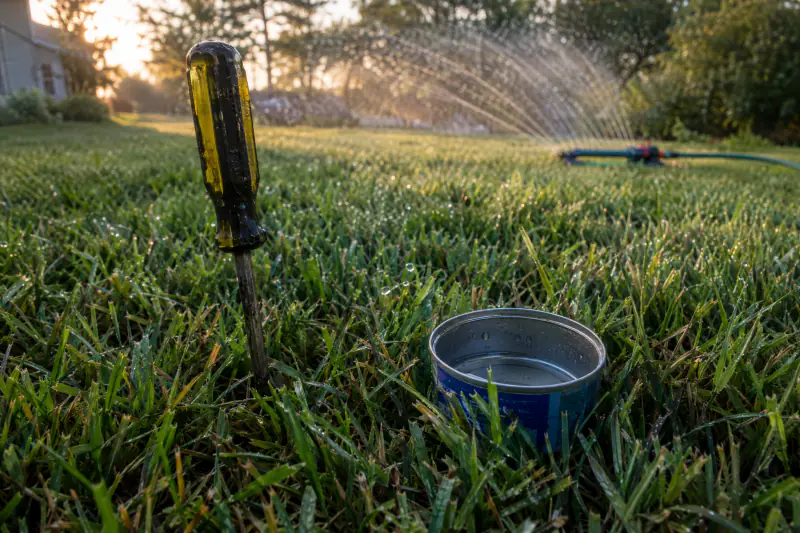
Measure instead of guessing. A tuna can or a rain gauge on the lawn tells you how long a sprinkler takes to deliver an inch; many systems need an hour or more per zone. A long screwdriver tells you where the water went: if it pushes easily six inches into the soil the next morning, the watering was deep enough. Footprints that stay pressed into the grass for more than a few seconds, and a blue-gray cast to the blades in the afternoon, are the signs of wilt and the signal to water the next morning. On a sprinkler system, this is also the month to find the dry corners. A zone with a tilted head, a clogged nozzle or a shrub blocking the spray shows up as a brown wedge in July, and fixing the coverage now is one of the most useful things you can do for the fall seeding.
Is it drought, brown patch, grubs or dormancy?
Brown lawn in July has at least four causes, and they need different responses. Check before acting.
| What you see | Likely cause | How to check | What to do now |
|---|---|---|---|
| Dull blue-gray color, footprints stay, whole lawn fading evenly | Drought stress | Screwdriver is hard to push in; soil dry at 3 in. | Deep morning watering, cycle and soak, raise mowing height |
| Uniform straw color, green at the crown when parted | Dormancy | Tug a plant; it resists. Crowns are pale green. | Half an inch of water every two to three weeks; stop mowing; wait for September |
| Irregular circular patches 1 to 3 ft across, tan with a darker outer ring in the morning | Brown patch disease | Blade lesions with tan centers and brown edges; worse after warm humid nights | Stop nitrogen, water only in early morning, bag clippings; fungicide only if severe |
| Brown areas that lift like carpet; birds, skunks or raccoons digging | White grubs | Cut a square foot of turf and count grubs in the top 3 in. | If above roughly 6 to 10 per sq ft, a curative product by a lawn service; otherwise water and wait |
| Brown wedge or strip in an otherwise green lawn | Irrigation coverage gap | Run the zone and watch; look for a tilted or blocked head | Fix the head or nozzle; hand-water the strip until then |
| Thin spots filling with coarse, light green spreading grass | Crabgrass in gaps | Wide blades, stems rooting at joints, no circular pattern | Mow high, do not seed now, note the spots for fall renovation |
| Brown spots the size of a dinner plate with a green center | Dog urine | Spots near where the dog goes; grass around the edge is lusher | Flush with water; the spot reseeds in fall |
Several of these overlap. A drought-stressed lawn is more vulnerable to grubs and disease, and a lawn with grubs browns faster in a dry spell.
What is brown patch, and why should you not fertilize now?
Brown patch is a fungal disease that attacks tall fescue when night temperatures stay above the mid 60s and the leaves remain wet for long stretches, which describes most Northern Virginia nights from mid-June into September. It shows up as roughly circular patches from one to several feet across, tan or brown, often with a darker smoky ring at the edge in the early morning while dew is on the grass. Individual blades show tan lesions with dark brown borders. The fungus is always present in the soil; what changes in summer is that the weather lets it grow faster than the grass can.
Nitrogen fertilizer makes it worse. Lush, soft, fast-growing leaves are exactly the tissue the fungus prefers, and a lawn fed in June or July grows brown patch rings instead of grass. Virginia Cooperative Extension guidance for tall fescue puts nearly all of the year's nitrogen in the fall, with at most a light application in spring and none in summer, and that is the rule we follow. If a lawn service applies a summer round, ask what is in it; iron for color is harmless, nitrogen is not. The same goes for the weed-and-feed bags on display at every garden center in June. Summer is for weed control at most, not feeding.
Managing brown patch without fungicide comes down to keeping leaves dry at night. Water only in the early morning so the lawn is dry by midday. Do not water in the evening. Mow when the grass is dry, bag clippings while the disease is active, and improve air movement where you can by thinning low shrub branches along the lawn edge. Fungicides work and are a reasonable choice for a lawn with severe, spreading damage, but they are preventive and need repeating through the season, which makes them a lawn service product rather than a one-time fix. On most home lawns the disease stops on its own when nights cool in September, and the thinned patches are filled by the fall overseeding.
How do you know if grubs are the problem?
Grubs are the problem when brown turf lifts from the soil like a loose carpet, because the C-shaped white larvae have eaten the roots that held it down. The confirming test is to cut a square foot of turf with a spade, fold it back and count the grubs in the top three inches of soil. A few are normal in any lawn. Virginia Cooperative Extension uses about six or more per square foot as the point where treatment is worth considering, and a lawn that is already stressed shows damage at the low end of that range. The other tell is wildlife: skunks, raccoons and crows tearing up patches of lawn in August are digging for grubs, and the damage they do is often worse than the feeding.
The calendar here is predictable. Japanese beetles and masked chafers fly and lay eggs in June and July, the eggs hatch into small grubs in late July, and the grubs feed hardest in August and September before moving deeper for winter. That is why grub damage appears in late summer and is often mistaken for drought. A drought-stressed lawn with a modest grub count can look dead; a well-watered one with the same count may show nothing, because the remaining roots keep up.
Control is a timing question and a lawn service's job, not ours. Preventive products are applied in June or early July, before the eggs hatch, and are the more reliable option on lawns with a history of damage. Curative products are applied in August or September when grubs are found above the threshold, and they work less well on larger grubs. Both are applied by the label, watered in, and chosen with the water downstream in mind. On a lawn without a history of damage and with no grubs in the test square, the right amount of grub control is none, and the money is better spent on the fall renovation.
Dormant or dead: how can you tell?
Dormant grass is brown above and alive at the crown, the pale knot of tissue where the blades meet the roots just above the soil. Part the brown blades and look: a greenish or white crown that is firm to the touch is dormant and will green up within a week or two of rain and cooler nights. A brown, dry, papery crown that crumbles is dead. The tug test gives the same answer faster. Dormant grass resists a gentle pull because the roots are still anchored; dead grass lifts out with no resistance, and if a whole patch lifts, suspect grubs.
Tall fescue is a reluctant sleeper. Unlike Kentucky bluegrass, which goes dormant readily and recovers reliably, fescue tries to stay green on its deep roots and only shuts down when the soil is dry well below the root zone. Once it does, it tolerates two to four weeks of dormancy fairly well, and longer periods thin it. The practical rule is that a dormant lawn still needs about half an inch of water every two to three weeks to keep the crowns alive, not to green it up. A dormant lawn should not be mowed, fertilized, treated for weeds or walked on more than necessary. Letting a lawn go dormant deliberately in a dry August, with that minimum watering, is a reasonable choice for an established lawn and a bad one for a lawn that was seeded or sodded this spring.
The decision to let a lawn go dormant or to keep it green depends on water. On public water in Fairfax, Loudoun or Prince William, keeping a 6,000 square foot lawn green through a dry August costs a noticeable amount, and some owners decide the brown weeks are acceptable. On a well in western Loudoun or around Clifton, the limit is the well. Either way, the lawn that is watered deeply once a week and the lawn that is allowed to go properly dormant both reach September in decent shape. The one that gets a little water every day reaches it shallow, diseased and thin.
Why does summer seeding fail in Northern Virginia?
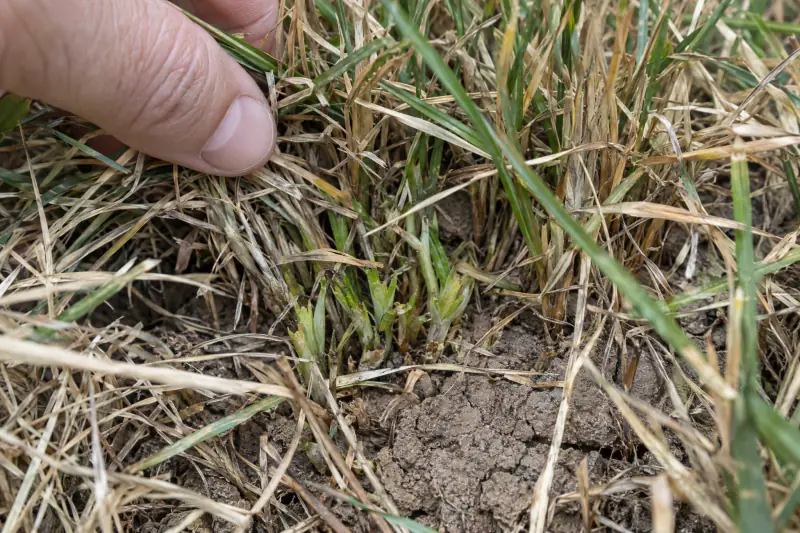
Summer seeding fails because tall fescue seedlings need six to eight weeks of mild weather to root deeply enough to survive heat, and a seed sown in July gets none. Germination is not the problem; seed sprouts fast on warm soil. Establishment is. A seedling's roots are a fraction of an inch long for the first two weeks and only a few inches long after a month. In July the top inch of a Northern Virginia lawn dries out by noon unless it is watered several times a day, and the soil at that depth is hotter than the air. Brown patch, which attacks young grass even more readily than mature grass, and crabgrass, which germinates in the same soil and outgrows fescue in the heat, finish the job.
Spring seeding fails for a slower version of the same reason, which is why we treat it as a repair tactic and not a plan. Seed sown in April gets about ten weeks before the heat, which is enough to look like a lawn in June and not enough to survive August without careful watering. Fall seeding, from the last week of August to mid-October, gets roughly eight months of growing weather before its first summer, and the difference shows in July of the following year. We put the whole fall sequence in the fall lawn renovation plan, and the sod-versus-seed decision for fall in sod or seed this fall.
There is one summer exception, and it is sod, not seed. Sod arrives with a year of root already grown and can be laid in summer with watering once or twice a day for two weeks, at real cost in water and effort and with real brown patch risk. It is the choice for a yard that is bare clay now and cannot wait until September, for example after construction, and we discuss it in our sod vs. seed guide. For a lawn that is thin but mostly grass, even sod is the wrong summer answer, and patience is the right one.
What should you do instead this summer?
Use the summer to prepare for the fall renovation, because the fall window is short and everything that has to happen before seed goes down takes weeks. Four things pay off most.
Send a soil test now. A routine test through Virginia Cooperative Extension, run by the Virginia Tech soil testing laboratory, costs a modest fee and takes a couple of weeks. It tells you whether the acidic clay needs lime and how much, which is applied in the fall renovation, and whether phosphorus is justified for the starter fertilizer. A test sent in July has results in hand by August, when the plan is made.
Fix the irrigation coverage. New seed needs light watering two or three times a day for two to three weeks, and the dry wedge you can see in July is the place the seed will fail in September. Run each zone, watch it, and have heads straightened, nozzles replaced and arcs adjusted now, when the crew is not racing the seeding calendar. If there is no system and the lawn is large, summer is when to decide about a sprinkler installation so it is in before the seed, as we lay out in installing a sprinkler system in Northern Virginia.
Diagnose the wet spots and the shade. If part of the lawn is thin because water stands there after rain, or because a maple closes over it by June, no amount of seed will change that, and the honest answer is drainage work before seeding or a shade bed instead of grass. Where a usable surface is needed under deep shade, artificial turf is the other honest option. Summer is when those problems are easiest to see and when there is time to fix them before the lawn is renovated.
Book the fall work. The seeding window is roughly six weeks, every crew in Northern Virginia is in it at once, and a renovation that needs lime, compost topdressing or a full strip-and-seed takes more planning than a simple aeration. Deciding in July what the lawn needs, and lining up a date in September, is the difference between a renovated lawn and a lawn that got aerated in late October when it was too late to matter.
What is on the July to August lawn checklist?
Ten things to do, or not do, between now and the last week of August.
- Raise the mower to 3 to 4 inches and sharpen the blade; mow in the cool of the day when the grass is dry.
- Water about an inch a week including rain, in the early morning, in two or three short cycles on clay.
- Put a tuna can and a screwdriver to work once to learn how long an inch takes and how deep it goes.
- Apply no nitrogen fertilizer to tall fescue until September, whatever the bag or the service says.
- Run every irrigation zone once in July and fix tilted heads, clogged nozzles and blocked arcs.
- Cut a square foot of turf in a brown area and count grubs before treating anything.
- Check brown patches in the morning for the smoky ring of brown patch and switch to morning-only watering.
- Send a soil test to Virginia Cooperative Extension in July so lime and starter fertilizer are decided by August.
- Photograph the thin, wet and shaded areas now, while they show, for the fall renovation plan.
- Book aeration and overseeding, or a full renovation, for September before the calendar fills.
What does summer lawn care cost, and what is worth paying for?
Most of what keeps a fescue lawn alive in summer costs little beyond water. As of 2026, typical Northern Virginia planning ranges look like this. A routine soil test through Virginia Cooperative Extension is a modest fee, usually under the cost of a bag of fertilizer. Sharpening or replacing a mower blade is a small one-time cost. Summer water for a typical 5,000 to 8,000 square foot lawn on public water, kept green at an inch a week through a dry stretch, commonly adds a noticeable amount to the bill over July and August, and the smart controller that trims that is often a few hundred dollars installed. A sprinkler repair visit to straighten heads and replace nozzles is commonly in the low hundreds; a full system is a separate project with its own range. A lawn service's preventive grub application or a fungicide round for brown patch is typically priced per application by lawn size and lands in the low hundreds each, repeated as the label requires.
Where the money is best spent is on the fall. Core aeration with overseeding for a suburban lawn typically runs $300 to $800 as of 2026, compost topdressing commonly brings a renovation to $1,000 to $2,500 or more, and full renovation by seed with the old lawn stripped and the soil amended commonly runs $0.50 to $1.50 per square foot. Sod with full preparation runs about $2 to $4 per square foot. All of these are general market ranges, not myYardPros prices, and they move with lawn area, how thin the lawn is, seed quality, slopes, gates and whether lime and compost are included.
Summer seed, summer fertilizer and summer sod on a lawn that only needed patience are the three purchases we see wasted most often. The cost guide lays the lawn ranges beside everything else. For a figure that fits your lawn, the only reliable number is a written estimate after a site visit, ideally in July or August when there is time to plan the September work properly.
How does summer differ across Fairfax, Loudoun, Prince William, Arlington and Alexandria?
Summer is hot everywhere in Northern Virginia, but the lawns face it differently. Inside the Beltway, in Arlington County, Alexandria, Falls Church and the close-in parts of Fairfax County such as Annandale and McLean, pavement, buildings and mature tree cover hold heat, so nights stay warmer and brown patch pressure is highest. The compensation is shade: a small lawn under street trees in Arlington is often in better shape in August than an open lawn in Ashburn, because it never sees the afternoon sun. Watering restrictions are rare outside a declared drought, but check with your county or city if one is in effect.
The newer communities of eastern Loudoun and western Prince William, including Ashburn, Sterling, South Riding, Gainesville, Haymarket and Bristow, have the hardest summer. Lawns sit on compacted builder subsoil with an inch or two of topsoil, trees are young, and the whole lawn is in full sun from ten until six. Roots are shallow because the soil below is dense, so these lawns go dormant first and recover slowest. Cycle-and-soak watering matters most here, since compacted clay sheds water fastest, and these are the lawns that benefit most from compost topdressing at the fall renovation. Western Loudoun around Leesburg and Purcellville runs a few degrees cooler at night and often sits on wells, which makes letting the lawn go dormant in August the common and sensible choice.
The wooded neighborhoods of Fairfax County, including Vienna, Burke, Springfield, Oakton, Great Falls and Reston, split between shade and sun on the same lot. The shaded half stays green and thin; the sunny half browns and recovers. Grub damage is often worst at the edge between them, where the soil is warmest and the roots shallowest. Lorton, Woodbridge and Dumfries along the Potomac see the highest humidity and the longest stretch of warm nights, which lengthens the brown patch season at both ends. We work across all of these counties and cities and nowhere else; our service areas page lists each one. For the full year's rhythm, including when summer ends for the lawn, see the 2026 Northern Virginia yard calendar, and for how our lawn projects fit together, the lawn and landscape pillar.
Frequently asked questions
Should I water my lawn every day in summer?
No. Daily light watering keeps the top inch wet, trains roots to stay shallow and leaves the grass damp overnight, which invites brown patch. Water deeply once or twice a week, about an inch in total including rain, in the early morning. On clay, split each session into two or three short cycles an hour apart so the water soaks in rather than running off. The exception is new sod or seed, which needs frequent light watering for its first two to three weeks.
Why is my lawn turning brown in July even though I water it?
Check four things in order. Push a screwdriver into the soil the morning after watering; if it stops at two inches, the watering is too shallow or running off the clay. Look for circular patches with a darker ring in the morning dew, which is brown patch. Lift a brown area; if it peels up like carpet, count grubs. And run the irrigation zone to look for a tilted head or a blocked arc leaving a dry wedge. Each has a different fix, and none of them is more fertilizer.
Is it too late to fertilize my fescue lawn?
Yes, until September. Tall fescue should receive most of its nitrogen in the fall and at most a light application in spring. Nitrogen in summer pushes soft growth that brown patch fungus attacks, and it feeds the weeds more than the grass. If a lawn service is scheduled for a summer round, ask what is in it. Iron for color is fine. A fall application alongside aeration and overseeding is where the fertilizer budget belongs.
Can I let my tall fescue lawn go dormant?
An established lawn, yes. Tall fescue tolerates two to four weeks of dormancy fairly well as long as the crowns get about half an inch of water every two to three weeks. Stop mowing, stop treating and stay off it. Longer dormancy thins the lawn, and a lawn seeded or sodded this spring should be kept green instead, because its roots are too shallow to survive a full shutdown. Dormant grass greens up within a week or two of cooler nights and rain.
What should I do about bare spots in my lawn right now?
Keep them watered enough to hold the soil in place, mow high around them so the grass at the edges shades the bare ground, pull or spot-treat any crabgrass that moves in, and mark them for the fall. Seed sown in July mostly dies in August, so the seed bag can wait. In the last week of August or in September, the spot is loosened, seeded and kept moist, and it fills in with the rest of the renovation. A spot that is bare because of shade or standing water needs that fixed first.
How do I know if my lawn has grubs?
Cut a square foot of turf with a spade in a brown area, fold it back and count the C-shaped white larvae in the top three inches of soil. A few are normal. Virginia Cooperative Extension treats about six or more per square foot as the point where treatment is worth considering, sooner on a stressed lawn. Turf that lifts freely with no roots, and skunks or raccoons digging up the lawn at night, are the other signs. If the count is low, water and wait; the brown is probably drought or disease instead.
Does mowing high really make a difference?
It is the single most effective summer practice. Grass mowed at 3 to 4 inches shades its own crowns and the soil, keeps the root zone cooler, holds moisture longer and blocks the light that crabgrass seed needs to germinate. Short grass does the opposite on every count. Pair the height with a sharp blade, never removing more than a third of the leaf, and mow when the grass is dry and the day is cool. The lawn looks a little shaggier and survives a lot better.
When does summer end for a Northern Virginia lawn?
In the last week of August, when soil temperatures begin to fall and nights cool into the 60s. That is when the seeding window opens, brown patch pressure eases, fertilizer becomes useful again and the lawn starts growing roots instead of merely surviving. Western Loudoun turns a few days earlier than Alexandria or Woodbridge. The work that has to be finished before then, including irrigation repairs, drainage fixes and the soil test, is the real summer lawn project.
Book the work
Put the plan in writing with a crew that builds this every week.
One visit to measure and talk through options, then a written scope and price. No pressure, no vague numbers. Ask about the Heroes Discount if you serve.
Sources and further reading
Published June 25, 2026. Reviewed and updated October 9, 2026.