Key takeaways
- Seed and aerate tall fescue from late August to mid-October. September is the heart of the window, and spring is a distant second choice.
- Lay sod in fall or spring, winterize the sprinkler system before the first hard freeze, and wash the house after the April pollen has dropped.
- Patios, walls, decks and drainage can be built most of the year. Frozen or saturated clay, not the calendar, is what stops the work.
- Permits and HOA reviews take weeks, so a deck or porch you want by June should start on paper in January or February.
- Western Loudoun runs a little cooler and later than Alexandria or Woodbridge, so shift every date by a week or so depending on where you live.
On this page
- Why does timing matter so much for yard projects in Northern Virginia?
- What should you do in your yard each month?
- What should you do in January and February?
- What belongs in March, April and May?
- What should you build, and what should you avoid, in June, July and August?
- Why is September the most important month for a Northern Virginia lawn?
- What has to happen before the first hard freeze?
- When is the ideal window for each kind of project?
- How far ahead should you plan a project?
- In what order should a multi-part project happen?
- How do conditions differ across Fairfax, Loudoun, Prince William and Arlington?
- What does the calendar mean for your budget?
- Which dates are worth putting on your calendar?
- Frequently asked questions
Why does timing matter so much for yard projects in Northern Virginia?
Because Northern Virginia sits in the transition zone, the band where cool-season grass is stressed by summer and warm-season grass is killed by winter, and because almost every yard here sits on heavy clay. Do the right job in the wrong month and you pay for it twice. Tall fescue seed sown in May sprouts, then dies in the July heat before its roots go deep. A sprinkler line left full in December can split when a hard freeze reaches the backflow assembly. Stain brushed onto damp deck boards in a humid week peels by the following summer. A patio base compacted over saturated clay settles and the pavers follow it.
The good news is that the calendar is predictable, and most of the year is open for building. Our crews work from a seasonal rhythm that has very little to do with the date on a package of seed and a great deal to do with soil temperature, soil moisture and how far away the first hard freeze is. This guide lays out that rhythm month by month, then sorts it by project so you can find your own job quickly.
Two things to keep in mind as you read. First, these are typical windows, not rules. A wet March pushes hardscaping back; a mild December opens it up. Second, the ground matters more than the air. Footings in this region go down roughly 24 inches to get below frost, drainage and patio work need workable soil, and seed needs warm soil more than warm days. For upkeep after a project is finished, see our maintenance and care guide. For budgets, the cost guide has planning ranges for every type of work.
What should you do in your yard each month?
A month-by-month view for a typical Northern Virginia year. Western Loudoun runs about a week later in spring and earlier in fall than Alexandria or Woodbridge.
| Month | Good time for | Plan ahead for |
|---|---|---|
| January | Design, HOA applications, permit drawings, drainage diagnosis after rain | Spring deck, porch and patio starts |
| February | Estimates and site visits, drainage and grading work when the ground is not frozen | Spring sod, planting beds, irrigation repairs |
| March | Sod season opens, patios and walls start as the ground dries, dormant pruning | Sprinkler start-up once hard freezes are past |
| April | Spring planting, hardscaping, deck building, sprinkler start-up and repairs | Exterior cleaning after tree pollen drops |
| May | House and driveway washing, deck staining, paver sealing, the last easy weeks for sod | Irrigation upgrades before summer heat |
| June | Decks, porches, patios, lighting, smart controller upgrades, pergolas | Shade for August: covered porches and pergolas |
| July | Construction continues. Hold off on seeding and most planting | Booking fall aeration and overseeding |
| August | Seeding window opens in the last week. Drainage fixes before fall rains | Lawn renovation, fall planting plans |
| September | Aeration, overseeding, seed renovation, sod, early fall staining and sealing | Sprinkler winterization date |
| October | Finish seeding by mid-month. Plant trees and shrubs, lay sod, seal pavers | Blow-out before the first hard freeze |
| November | Sprinkler blow-out, late sod, tree planting, flushing downspout lines after leaf fall | Winter design work for next year |
| December | Planning, lighting, drainage and hardscaping in mild, dry spells | Permits and approvals for spring |
Typical timing only. Weather, soil moisture and county review times shift every item by days or weeks.
What should you do in January and February?
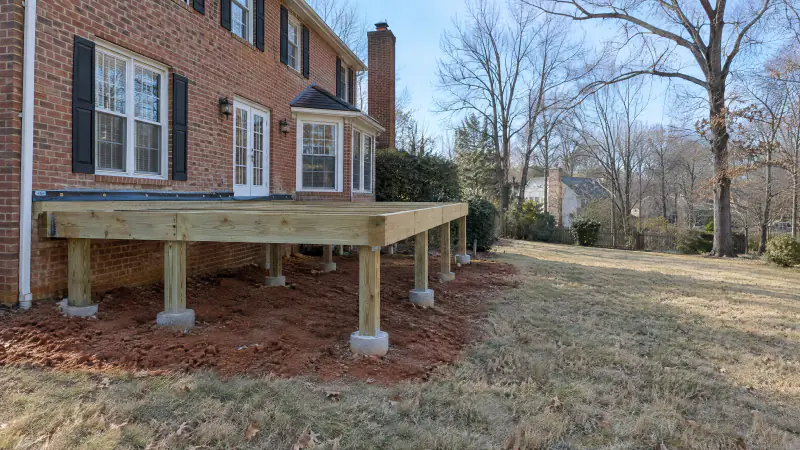
Winter is paperwork season, and it is the most undervalued part of the yard calendar. The work on site for a new deck or a screened porch might take two or three weeks. The drawings, the HOA architectural review and the county building permit that come before it can take longer than the build. If you want to be grilling on a new deck by Memorial Day, the application should be moving in January. We walk through the whole process, county by county, in our guide to deck permits in Northern Virginia.
Winter is also the best time to diagnose drainage, for a reason that surprises people: you can see it. Walk the property during or right after a heavy rain and note where water stands, where it runs toward the house and which downspouts dump onto the lawn. Clay holds water for days, so the evidence stays visible. A soggy strip along the foundation or a low spot that never dries in January tells us exactly where a drainage fix belongs, and drainage work itself can proceed any time the ground is not frozen solid.
On mild, dry stretches, which Northern Virginia gets most winters, hardscaping crews keep working. Base stone can be placed and compacted as long as the subgrade is not frozen or saturated, and retaining walls and patios built in February are ready for the first warm weekend. The limiting factor is not cold air but frozen or waterlogged clay. If a crew offers to compact a base over frozen ground, that is the project you will be calling someone else to fix in two years.
What belongs in March, April and May?
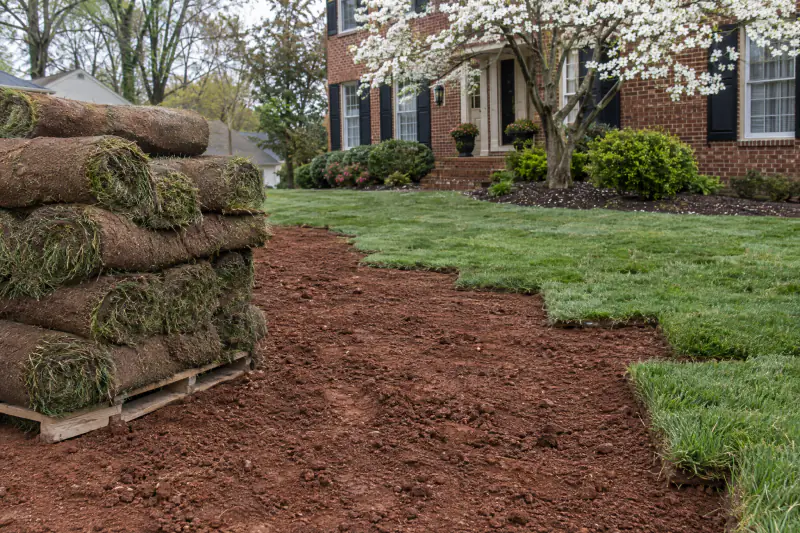
Spring is for sod, start-ups, planting and the first big construction push. Sod season opens in March as soon as the ground can be graded, and March through May is the second-best window of the year for sod installation. Spring sod has one job: root before the heat arrives. Laid in March or April on properly prepared soil and watered consistently, it usually does. Laid in late May, it needs daily attention through June and still carries more disease risk than fall sod.
Sprinkler start-up comes once hard freezes are behind us, typically late March or April depending on the year and how far west you are. A start-up is more than turning the valve: the backflow preventer is reconnected and checked, each zone is run and watched, heads that heaved or clogged over winter are adjusted or replaced, and the controller schedule is reset for spring rather than left on last August's settings. Our spring start-up checklist covers every step, and if the system is older, spring is the natural moment for irrigation upgrades such as a smart controller or pressure-regulated heads.
Then there is pollen. From roughly late March into early May, oak and pine pollen coats every horizontal surface in Fairfax, Loudoun and Prince William counties in yellow. Washing the house in the middle of it is a waste of money. We schedule pressure washing for driveways and walkways and soft washing for siding and roofs from early May onward, once the pollen has dropped and the rains have rinsed the worst of it away. May is also the first good month for deck staining and paver sealing, provided the surfaces have had several dry days.
Spring planting runs from April into May. Trees and shrubs planted now establish well as long as they are watered through their first summer, though fall remains the stronger season for most woody plants. Hardscaping, deck building and porch construction all run at full pace from April, which is why the permits mentioned above need to be in hand by then rather than just submitted.
What should you build, and what should you avoid, in June, July and August?
Summer is construction season and the worst possible time to seed a lawn. Those two facts shape the whole middle of the calendar. Decks, porches, patios, walls, lighting and outdoor kitchens are all built through June, July and August. Long days mean full shifts, soil is usually workable, and material deliveries are reliable. The heat is hard on crews but not on the work, with one exception: concrete and mortar need to be kept from drying too fast on the hottest afternoons, which is a matter of scheduling pours for the morning and curing properly.
Summer is also when the value of shade becomes obvious. A patio that is perfect in May can be unusable at 3 p.m. in July. If you are planning a covered porch or pergola, a seating wall and fire feature, or landscape lighting for long evenings, summer is when homeowners feel the need and fall is when the work is often done. Starting the design in June puts you in the fall queue rather than next spring's.
What not to do: seed, aerate or lay sod unless you have no choice. Tall fescue is a cool-season grass. Seedlings that germinate in June meet 95-degree afternoons and crabgrass pressure before they have any root depth, and most of them do not survive. Summer sod can be made to work with watering once or twice a day, but it is the most expensive and fragile way to get a lawn. The right summer lawn strategy is to keep the existing fescue alive, mow high, water deeply and infrequently, and spend the energy on booking September instead. We explain how in keeping tall fescue alive through a Northern Virginia summer.
Late August is the hinge. In the last week of the month, soil temperatures begin to fall, nights cool, and the seeding window opens. Any drainage or grading work that would disturb the lawn should be finished by then, so the new seed is the last thing to go down, not the first thing to be dug up.
Why is September the most important month for a Northern Virginia lawn?
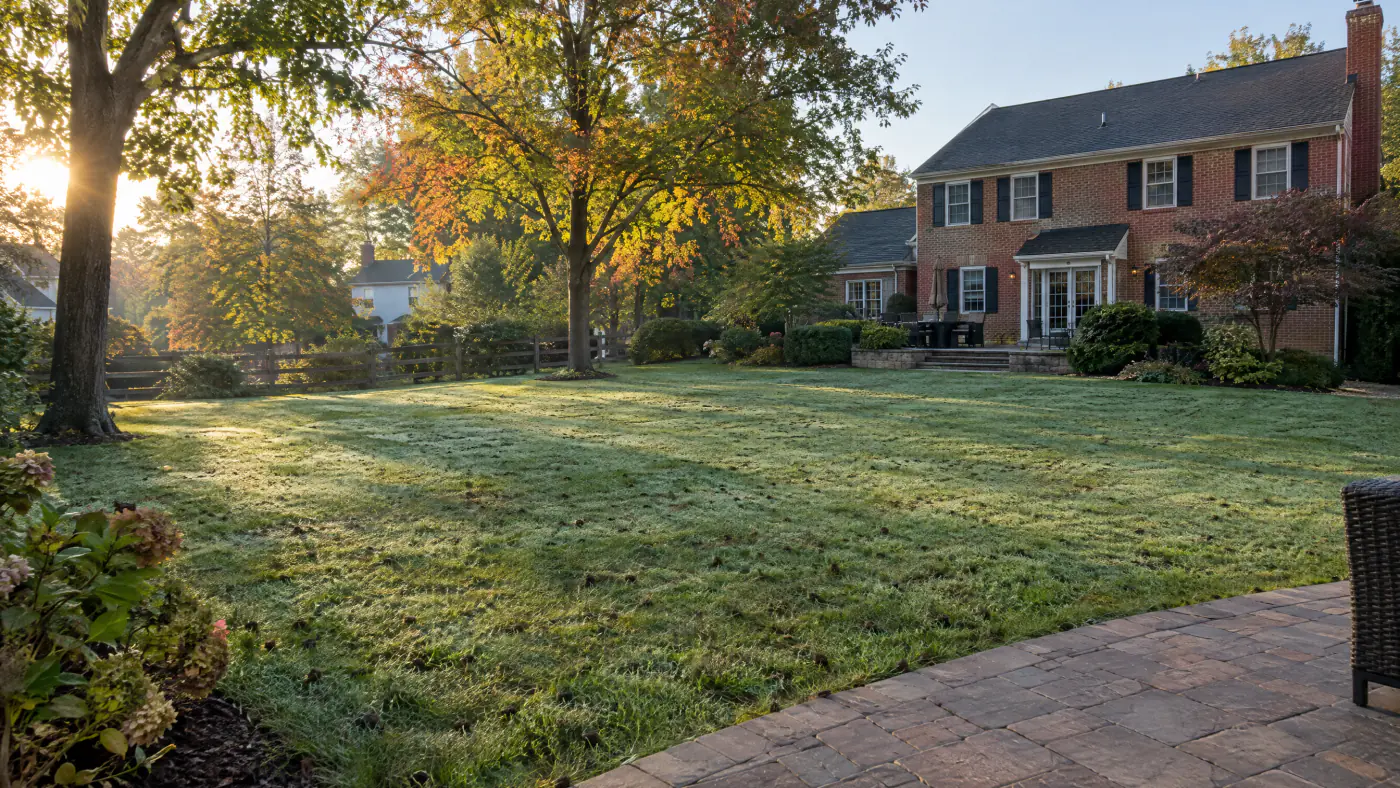
Because September gives tall fescue the only combination it really wants: warm soil, cooler air, fewer weeds and roughly eight months to root before the next summer. Seed sown in September typically germinates in one to two weeks, grows through a mild fall, slows over winter and then has the whole of spring to thicken before July tests it. Seed sown in April gets about ten weeks before the same test. That gap is the difference between a lawn that fills in and one that thins out again by August.
So September is when we do most aeration and overseeding. Core aeration pulls plugs of compacted clay out of the lawn, opens the surface for seed-to-soil contact and lets water and air reach the roots. Overseeding right behind it puts an improved tall fescue blend into those openings. Lawns that are more than half weeds or bare usually do better with a full renovation or with sod, and our sod vs. seed guide walks through that decision.
The window runs from the last week of August to about mid-October. Mid-October is the practical deadline because seedlings need several weeks of growth before the first frost slows them down. Fall rains help, but a new seeding still needs light, frequent watering for the first two to three weeks, so the irrigation system should be working and scheduled before the seed goes down. We put the whole plan, including what to do about leaves falling on new seed, in the fall lawn renovation plan.
September is also a strong month for sod, for tree and shrub planting, and for the early fall round of deck staining and paver sealing while days are still warm and dry. The calendar gets crowded in September for good reason, which is why July is the month to book it.
What has to happen before the first hard freeze?
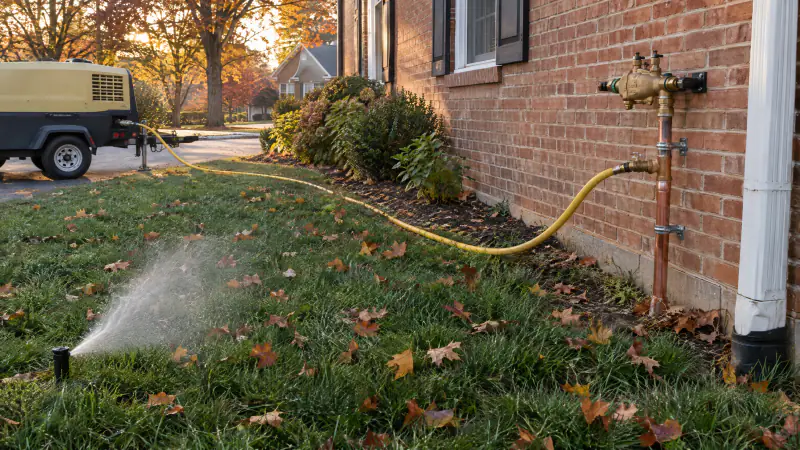
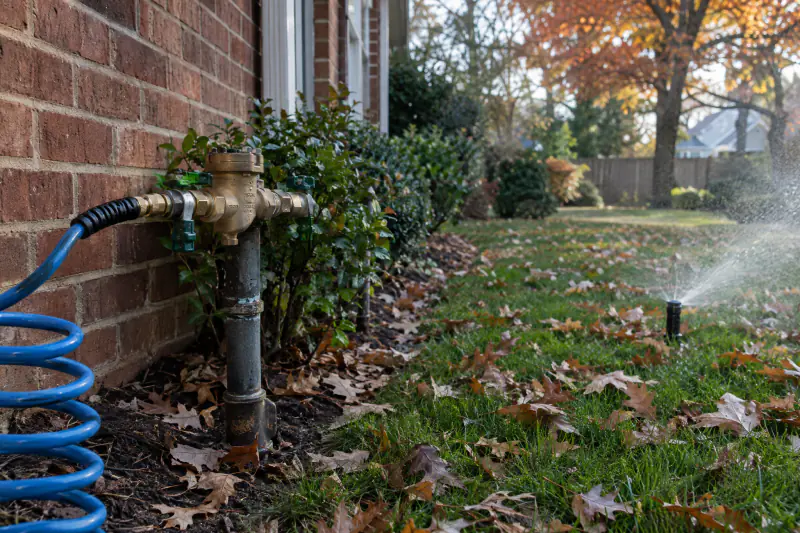
Three things, and one of them is expensive to skip. First, the irrigation system has to be winterized. A sprinkler system connected to the home's drinking water has a backflow preventer, usually mounted above ground near the house, and that assembly is the part a hard freeze cracks first. Winterizing shuts off the supply, drains the backflow and blows each zone out with compressed air so no standing water is left in the lines, heads or valves. In Northern Virginia that happens from late October through November, before the first stretch of nights well below freezing. The timing, methods and costs are in our guide to sprinkler winterization in Northern Virginia, and a properly installed system is designed from the start to drain cleanly.
Second, buried downspout and sump discharge lines should be flushed after the leaves come down. Oak and maple leaves wash into gutters, through the downspouts and into the underground pipe, where they settle at the first bend. A line that is half blocked in November is fully blocked by the February thaw, and the water backs up at the foundation exactly when the ground is too frozen to absorb it. Our downspout drainage page explains how these lines are built with cleanouts so this flush takes minutes, not a shovel.
Third, any sealing or staining that did not happen in spring needs to happen in the early fall dry spell. Paver sealer and deck stain both need surface temperatures well above freezing and several dry days to cure. By late October the nights are too cold for most products, so September and the first half of October are the last reliable chance before freeze-thaw cycles start working on unsealed joints.
When is the ideal window for each kind of project?
The same calendar, sorted by what you want done.
- Aeration and overseeding
- Late August to mid-October, with September the heart of it. Soil is warm, nights are cooler and summer weeds are fading. Spring is a weaker second choice because the seedlings face July before they are established.
- Sod
- September through November and March through May are easiest. Summer sod needs watering once or twice a day at first and carries more disease risk. Late fall sod roots slowly but holds the soil through winter.
- Trees, shrubs and planting beds
- Fall first, then spring. Fall-planted roots keep growing after the leaves drop, so plants meet their first summer already established. Avoid planting in July and August unless you can water daily.
- Sprinkler winterization and start-up
- Blow out before the first hard freeze, usually late October through November. Restart in spring once hard freezes are past, often late March or April, and reset the controller schedule at the same time.
- Patios, walkways, walls and driveways
- Spring through late fall, and in winter during mild, dry spells. Base stone cannot be compacted over frozen or saturated clay, so wet weeks cause delays. Fall often has the driest, most workable soil of the year.
- Decks and porches
- Built nearly year-round. Design, HOA review and the county permit add several weeks, so start on paper in winter for a deck you want by early summer. Footings still need to reach about 24 inches below grade in any season.
- Drainage and grading
- Any time the ground is workable. The ideal moment to diagnose it is right after heavy rain, when you can see where water stands. Finish drainage work before fall seeding so the new lawn is not dug up.
- Pressure washing and soft washing
- Early May through October. Most homeowners wait until the spring tree pollen has finished, so the house is not yellow again within a week. Fall washing removes a summer of algae before it winters over.
- Deck staining and paver sealing
- Late spring to early fall, in dry, mild weather. Wood and pavers must be fully dry, which rules out humid, rainy stretches. Check the product's minimum temperature before an October application.
- Landscape lighting
- Any time the ground is workable. Late fall and winter have a small advantage: long evenings make it easy to judge the result, and the installation can go in while planting beds are dormant.
How far ahead should you plan a project?
Plan one season ahead for anything that needs approval, and a few weeks ahead for everything else. The on-site work is often the short part of a project. A new deck or screened porch generally needs a county building permit, and most homeowners' associations want an architectural application approved before any exterior change. Review times vary by jurisdiction and by season, and spring is the busy period for both, so a February application moves faster than an April one. Our how it works page shows where each of those steps sits in the process.
Fall lawn work has the opposite problem: the window is fixed and short. If you want aeration and overseeding in September, arrange it in July. If the lawn needs replacing, decide between sod and seed in summer so the soil preparation and any irrigation repairs are done before Labor Day. Sprinkler blow-outs book up the same way in October, and the companies that do them well are the ones that are full by the time the first freeze is in the ten-day forecast.
Construction that does not need a permit, such as a small patio, a walkway or a drainage line, usually needs only a few weeks between estimate and start, longer in May and June when every crew in Northern Virginia is busy. If a project has any flexibility, late fall and winter starts often mean shorter waits and the same quality of work, because the limiting factor is soil condition, not the season.
In what order should a multi-part project happen?
If you are planning more than one thing, even across different years, sequence saves money. This is the order we recommend.
Drainage and grading first
Water has to leave the property correctly before anything is built on top of it. Downspout lines, French drains and regrading go in before patios, walls, lawns and planting beds, so nothing gets dug up later.
Structures and hardscape second
Decks, porches, patios, walls and walkways come next. Irrigation sleeves and conduit for lighting go under walkways and patios before they are built, not after. Footings and bases disturb the yard, which is why the lawn waits.
Irrigation and lighting third
With the hardscape in place, sprinkler zones can be laid out around it and lighting wire can run through the sleeves already installed. Heads and fixtures are positioned for the finished layout rather than guessed.
Planting beds and trees fourth
Beds are shaped against the finished edges, soil is amended and plants go in with the irrigation already reaching them. Fall is ideal for this step, which often means it lands in September or October of the project year.
Lawn last
Sod or seed goes down after every other trade has left, in the right season for it. A September seeding or a fall sod installation on top of a finished project is the cleanest possible ending, and the one that lasts.
How do conditions differ across Fairfax, Loudoun, Prince William and Arlington?
The calendar shifts by about a week across our service area, and the soil changes more than the weather. Western Loudoun towns such as Purcellville and Leesburg sit higher and run a little cooler than the inner suburbs. Their last spring frost is later and their first fall freeze is earlier, so sprinkler start-ups move toward mid-April and blow-outs toward late October. Ashburn, Sterling and Herndon are in between. Arlington, Alexandria and the inner parts of Fairfax County such as McLean and Falls Church are warmer, with more pavement and tree cover holding heat, so their windows stretch a few days at each end. Along the Potomac in Woodbridge and Dumfries, and out toward Gainesville, Haymarket and Manassas in Prince William County, conditions track closer to Loudoun than to Arlington.
Soil is the bigger variable. Much of Loudoun and western Fairfax sits on dense red clay that drains slowly and heaves in freeze-thaw cycles, which is why base depth and drainage matter so much for patios and walls there, and why newly built subdivisions in Ashburn, South Riding and Bristow so often have standing water: the topsoil was scraped off during construction and the lawn was laid over compacted subsoil. Older neighborhoods in Arlington, Vienna and Annandale often have better topsoil but more mature tree roots, which changes how drainage lines and footings are routed. Reston and Great Falls add slope and rock to the mix.
Permitting also varies. Fairfax County, Loudoun County, Prince William County, Arlington County and the independent cities of Alexandria, Fairfax, Falls Church, Manassas and Manassas Park each run their own building department with their own review times and submission requirements. Many HOAs in planned communities add a second review on top. We work in all of these jurisdictions and nowhere else; see our service areas page for the full list.
What does the calendar mean for your budget?
Doing a job in its proper season is usually the cheapest way to do it, because the work succeeds the first time. The clearest example is the lawn. As of 2026, typical Northern Virginia market ranges for core aeration and overseeding on an average suburban lot run from a few hundred dollars to somewhere above a thousand, depending on lawn size, seed quality and whether topdressing is included. Done in September, that money buys a thicker lawn. Done in May, much of it is spent on seed that will not survive August, and the September job still has to happen.
Sprinkler winterization is a small line item, typically well under two hundred dollars for a residential system as of 2026, measured against the cost of replacing a cracked backflow preventer or digging up split lateral lines in spring. Sod, by contrast, costs roughly the same in any season per square foot installed, but summer sod adds weeks of daily watering and a higher chance of replacing sections, so the real cost is lower in fall and spring.
Construction pricing moves less with the calendar than people expect. Material costs for pavers, lumber and composite decking do not drop in winter, and labor is the same skilled work in February as in June. What changes is availability: late fall and winter starts tend to come with shorter waits, and a crew that is not racing the spring backlog has time to do the base preparation properly. All of these figures are planning ranges, not quotes, and every one of them moves with site conditions, access, size and material choices. The cost guide has ranges for each project type, and a written estimate after a site visit is the only number worth planning around.
Which dates are worth putting on your calendar?
Eight reminders that cover most of what goes wrong in a Northern Virginia yard.
- January: submit HOA and permit paperwork for any spring deck, porch or patio.
- After the next heavy rain: walk the yard and photograph standing water for a drainage diagnosis.
- Late March or April: sprinkler start-up, once hard freezes are past, and reset the controller.
- Early May: wash the house, driveway and walkways after tree pollen season ends.
- July: book fall aeration and overseeding before the September schedule fills.
- Last week of August: seeding window opens; finish drainage and grading before it.
- Mid-October: last call for tall fescue seed to establish before frost.
- Late October through November: sprinkler blow-out before the first hard freeze, then flush downspout lines after leaf fall.
Frequently asked questions
When is the right time to aerate and overseed in Northern Virginia?
From the last week of August to about mid-October, with September ideal. The soil is still warm enough for tall fescue seed to sprout in one to two weeks, nights are cooler, and the seedlings get fall and spring to root before summer. Spring seeding conflicts with crabgrass preventer and leaves young grass facing July heat with shallow roots, so it is a second choice at best.
When should a sprinkler system be winterized in Northern Virginia?
Before the first hard freeze, which usually means late October through November. Winterizing shuts off the supply, drains the backflow assembly and blows each zone out with compressed air. A light frost will not hurt a buried system, but a hard freeze can crack the exposed backflow preventer and shallow fittings, which are the most expensive parts to replace.
Can you build a paver patio in winter in Northern Virginia?
Often, yes. The limit is the ground, not the air temperature. Base stone has to be placed and compacted over subgrade that is neither frozen nor saturated, and polymeric sand and sealers have minimum temperatures. In a mild, dry stretch in December or February, a patio can be built to the same standard as in June, and winter starts usually mean a shorter wait.
When is the best time to lay sod in Northern Virginia?
September through November is the easiest window, followed by March through May. Fall sod roots in warm soil with cool air and little weed pressure. Spring sod works when it goes down early and is watered consistently until summer. Summer sod can be made to survive with watering once or twice a day, but it carries the highest risk and the most effort.
When should I pressure wash or soft wash my house in Northern Virginia?
From early May, once the oak and pine pollen has dropped, through October. Washing during pollen season is wasted within a week. Siding and roofs are soft washed with low pressure and a cleaning solution; driveways and walkways are pressure washed. A fall wash removes a summer's growth of algae and mildew before it winters over on north-facing walls.
How long does a deck permit take in Fairfax or Loudoun County?
It varies with the county, the season and whether the drawings are complete, but homeowners should plan on several weeks from submission to approval, and longer in spring when building departments and HOA review boards are busiest. Add the HOA architectural review, which often has to happen first. Submitting in January or February is the most reliable way to build by early summer.
Is spring or fall better for planting trees and shrubs in Northern Virginia?
Fall, in most cases. Roots keep growing in warm soil after the leaves drop, so a tree planted in October meets its first summer already established. Spring planting works well with regular watering through July and August. Avoid planting in midsummer unless you can water daily, and plant after drainage and hardscape work so the beds are not disturbed later.
Book the work
Put the plan in writing with a crew that builds this every week.
One visit to measure and talk through options, then a written scope and price. No pressure, no vague numbers. Ask about the Heroes Discount if you serve.
Sources and further reading
Published January 1, 2026. Reviewed and updated October 9, 2026.