Key takeaways
- Wait for ten days of overnight lows comfortably above freezing: late March inside the Beltway, early to mid April across most of Loudoun and Prince William, late April in western Loudoun.
- Open the main irrigation supply a quarter turn at a time with the controller off. Fast filling causes water hammer that cracks fittings underground.
- Run every zone and walk it: heads rising and retracting, rotors completing their arc, head-to-head coverage, no spray on the house or street, no water welling at the base.
- Most Northern Virginia water utilities require periodic testing of the irrigation backflow preventer, often yearly, by a tester they recognize. Spring is the natural time.
- Set the controller light for spring, 40 to 60 percent on a standard timer, with cycle and soak and early-morning starts; fescue rarely needs irrigation before May.
On this page
- When is it safe to start up a sprinkler system in Northern Virginia?
- When does start-up season open across the region?
- How do you start up a sprinkler system step by step?
- What does the backflow preventer need in spring, and what does your water utility require?
- What should you look for as each zone runs?
- What is the head-by-head checklist?
- How should the controller be set for a Northern Virginia spring?
- How do you find leaks after winter?
- What does a professional start-up include?
- When should you upgrade heads or the controller instead of just restarting?
- What does a spring start-up, backflow test and common repairs cost in Northern Virginia?
- How does start-up differ across Fairfax, Loudoun, Prince William and Arlington?
- Frequently asked questions
When is it safe to start up a sprinkler system in Northern Virginia?
Once hard freezes are behind you, which in Northern Virginia means late March inside the Beltway and early to mid April across most of Loudoun and Prince William, with western Loudoun running a week or two later. The parts that crack are the above-ground ones: the backflow preventer and the pipe between it and the house. A system filled on a warm March afternoon and hit by a 24-degree night a week later can split a brass assembly that costs several hundred dollars to replace. So the rule is not a date on the calendar but a forecast: ten days of overnight lows comfortably above freezing, and a look at the extended outlook before the main valve opens.
There is no reason to hurry. Tall fescue, which is what most lawns here are, is barely growing in March and usually gets more rain than it needs through April. Most Northern Virginia lawns do not need irrigation until sometime in May, and many not until June. A start-up in the first half of April leaves time to find and fix winter damage before the system has to work. We treat this as the first job of the irrigation year, the counterpart to the fall blow-out, and the yard calendar we publish each January puts it in the same slot. If you skipped the blow-out last fall, read this whole article before you open anything, because the checks below are how you find out what the winter did.
When does start-up season open across the region?
Dates are typical, not promises. Watch the ten-day forecast before opening the supply.
| Area | Typical last hard freeze | Realistic start-up window | What to watch |
|---|---|---|---|
| Arlington, Alexandria, Falls Church, McLean | Late March | Early April | Pavement and tree cover hold heat, but a late cold snap still happens |
| Central Fairfax County: Vienna, Reston, Herndon, Burke, Springfield, Centreville | Late March to early April | Early to mid April | Shaded lots and open ground differ by several degrees on a clear night |
| Eastern Loudoun and Prince William: Sterling, Ashburn, South Riding, Gainesville, Woodbridge | Early April | Mid April | Newer subdivisions with little tree cover cool fast after dark |
| Western Loudoun and the Bull Run foothills: Leesburg, Purcellville, Haymarket | Mid to late April | Late April | Higher elevation and open fields; frost pockets in low ground |
| Any area, backflow assembly on the shaded north side of the house | Add a week | When lows stay above the mid 30s for ten days | The assembly sits in shade and freezes first |
Based on typical NOAA climate normals for the region; individual years vary by weeks.
How do you start up a sprinkler system step by step?
Do this in order, slowly, with the controller off. Allow about an hour for a six-zone system.
Walk the yard before touching anything
Look for heads snapped off by plows or shovels, settled trenches, standing water near the backflow and valve boxes, and anything built over the lawn since fall. Note what you find so the first run does not surprise you.
Check the backflow and the drains
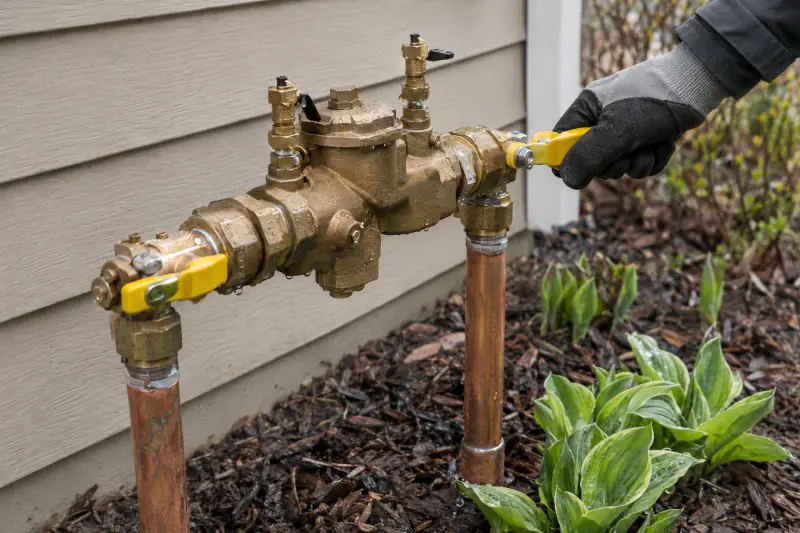
Confirm both shutoff valves on the backflow preventer are closed and the test cocks are closed. Close any drain valves opened in the fall. If the assembly was removed for winter, reinstall it with fresh union gaskets, hand tight plus a quarter turn.
Open the main irrigation supply a quarter turn at a time
Inside the house or at the meter, open the irrigation shutoff slowly over a minute or two. You will hear the mainline filling. Fast opening sends a pressure spike down empty pipe that can crack fittings and blow heads off their risers.
Open the backflow valves and watch for leaks
Open the inlet valve slowly, then the outlet valve. Watch the body, unions and test cocks for drips or spray. A cracked assembly shows itself here, before any zone runs.
Run each zone from the controller, one at a time
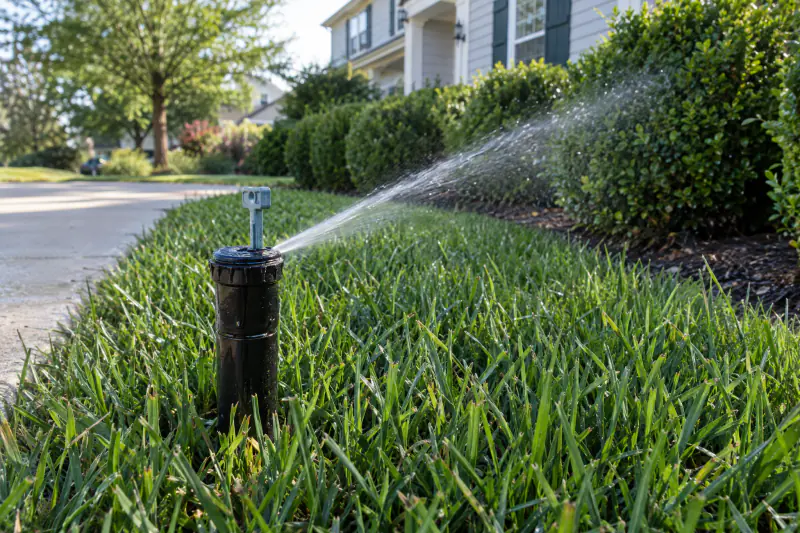
Start with the zone farthest from the valves. Air will spit from the heads for a minute, which is normal. Walk the zone while it runs and check every head for rise, rotation, pattern and leaks at the base.
Adjust heads and clear nozzles
Straighten tilted heads, raise sunken ones, clear grit from clogged nozzles, reset arcs that hit the house, fence or street, and replace anything broken. Match replacement nozzles to the ones already on the zone.
Open the valve boxes
Look for standing water, weeping valves, chewed wires and ant nests on the solenoids. A valve that will not fully close shows as a head that trickles after its zone ends.
Program the controller and test the sensors
Set the date and time, confirm each zone's run time and days, turn the seasonal adjustment down for April, and trigger the rain sensor by hand to confirm it interrupts watering. Replace the backup battery if the model has one.
What does the backflow preventer need in spring, and what does your water utility require?
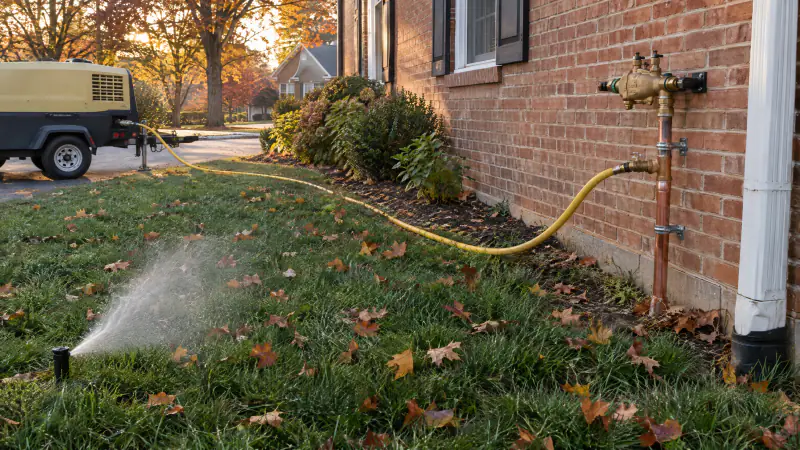
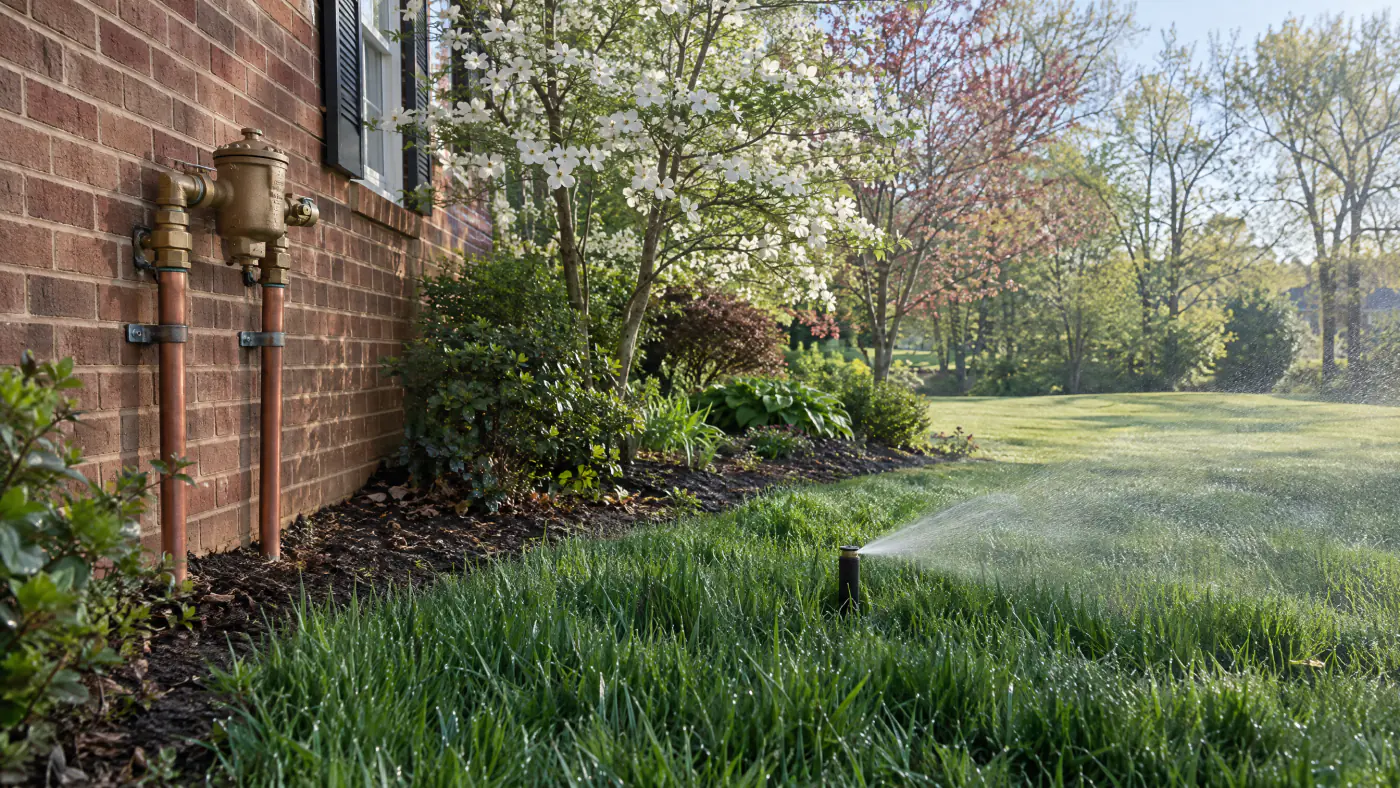
It needs to be refilled slowly, checked for cracks, and in most of Northern Virginia, tested by an approved tester with the result reported to the water utility. An irrigation system connected to the home's drinking water has a backflow preventer so that water sitting in the lines, along with fertilizer, soil bacteria and whatever a dog leaves on the lawn, cannot be siphoned back into the house or the public main if pressure drops. On most residential systems here it is a pressure vacuum breaker, a brass assembly on two risers mounted outdoors, typically at least 12 inches above the highest sprinkler head. Some homes have a reduced pressure assembly, which is larger and has a relief port that must be able to drain. The assembly is the part that freezes first in fall and leaks first in spring, which is why it gets its own step.
Testing is separate from the start-up. Water utilities across the region commonly require backflow assemblies on irrigation systems to be tested periodically, often every year, by a tester the utility recognizes, with the report filed with the utility. Fairfax Water together with Fairfax County, Loudoun Water, Prince William Water (formerly the Prince William County Service Authority), Arlington County and the towns that run their own systems, such as Leesburg, Herndon and Vienna, each have their own program and schedule, and the notice usually arrives by mail or email. Check with your utility rather than assuming. The test takes about 20 minutes with a gauge kit, and spring start-up is the natural time, because the assembly is already being refilled and inspected. If it fails, it is rebuilt with a repair kit or replaced, and replacement typically involves a plumbing permit in most counties.
If your system has no backflow preventer at all, which we do see on older installations in Annandale, Springfield and parts of Arlington, the start-up should wait until one is installed. That is not a nicety; it is a condition of being connected to the public water supply.
What should you look for as each zone runs?
Watch the whole zone run, not the first thirty seconds. The first minute is air and spitting; the useful information comes after the heads settle. Walk the zone and ask four questions. Is every head rising fully and dropping fully, or is one sitting proud of the turf where a mower will take it? Is every rotor turning through its full arc and returning, or is one stuck, pouring water on one spot? Is the spray reaching the next head, which is what head-to-head coverage means, or is there a dry crescent between them? And is anything spraying where it should not: the house, the fence, the driveway, the street, the neighbor's car?
Then look at the ground. A geyser means a broken head or riser. A head that bubbles at its base without spraying usually has a torn seal or a nozzle clogged with grit that came loose over winter. Water welling up between heads, or a soft spot in the lawn that was not there in fall, points to a cracked lateral. A zone that runs weakly across the board, with every head short of its radius, points to a leak upstream, a valve not fully open, or a mainline problem; if every zone is weak, suspect the backflow valves or the supply.
Zones that water beds deserve their own look. Drip tubing heaves and shifts with freeze-thaw, mulch gets raked over emitters, and a single chewed line can empty a zone into one corner. Lift the mulch at a few emitters and confirm water is arriving, then check the filter and pressure regulator at the zone valve. Spray zones in beds that have grown up since last year are often worth converting to drip; our irrigation upgrades page explains how that is done.
What is the head-by-head checklist?
Run through this at every head. It takes a few seconds per head once you know what to look for.
- Head rises fully and retracts fully; nothing stays up after the zone shuts off.
- Head sits flush with the turf and plumb; raise sunken ones and straighten tilted ones.
- Nozzle is clear: a steady fan or stream, not a dribble or a one-sided spray.
- Rotors complete the full arc and reverse; none are stuck or stuttering.
- Spray reaches the neighboring heads in the zone, with no dry gaps between.
- Arcs stop at the lawn edge; nothing hits siding, fences, windows, walks or the street.
- No water welling at the base of the head or bubbling up nearby in the lawn.
- Replacement nozzles match the others on the zone so precipitation rates stay even.
- Grass and mulch are trimmed back so nothing blocks the spray at grade.
- Drip emitters in beds are flowing, with the zone filter cleaned and the regulator intact.
How should the controller be set for a Northern Virginia spring?
Lightly, because April rain usually does the work. Tall fescue needs roughly an inch of water a week in summer, rain included, and in a typical Northern Virginia spring the sky supplies that through April and much of May. A controller left on last July's schedule in the first week of April will water a lawn that is already wet, run off clay that is already saturated, and feed the fungal problems that humid springs bring. We set spring programs one of two ways. On a standard timer, we set run times for the heads on each zone, then turn the seasonal adjustment down to around 40 to 60 percent and leave it there until late May, raising it as the weather dries. On a weather-based controller, we confirm the location, set the soil type to clay, match the sprinkler type for each zone to what is in the ground, and let it skip cycles on its own.
Two settings matter more than the rest on clay. The first is cycle and soak: instead of running a zone for 20 minutes straight, run it for 7 minutes three times with gaps between, so each pass soaks in before the next. Most controllers made in the last decade offer it, and it is the difference between water in the root zone and water in the gutter. The second is start time. Early morning, roughly 4 to 7 a.m., loses the least to evaporation and lets the grass dry by mid-morning, which limits disease. Evening watering leaves fescue wet all night and is the single most common schedule mistake we correct.
If you are wondering whether a smart controller is worth it for your water bill, we go through the arithmetic for Fairfax and Loudoun rates in our article on smart irrigation controllers and your water bill. The short version is that the savings come from the cycles it skips, and spring is when a fixed timer wastes the most.
How do you find leaks after winter?
Start at the water meter. With every faucet in the house off and the irrigation supply open but the controller idle, watch the small leak indicator on the meter. If it moves, water is leaving somewhere, and on a system that has just been refilled the mainline between the backflow and the valves is the usual suspect. Walk that route and look for a soft, green or soggy strip over the pipe. Then close the irrigation shutoff and watch the meter again: if it stops, the leak is on the irrigation side, not the house side.
Zone leaks show while the zone runs. A lateral cracked by frost heave shows as water rising from the lawn between heads, or as one head with a weak spray while the rest are fine. A head with a torn wiper seal spurts from its base. A weeping zone valve shows as a head, usually the lowest one on the zone, that keeps trickling after the zone shuts off, and the valve box may hold water. Valve boxes full of water in early spring are not always leaks; a high water table or poor drainage will do it too, and that is a drainage problem rather than an irrigation one.
Leaks you cannot see cost the most. A mainline leak under constant pressure runs around the clock, not just during a zone's run time, and on a clay lot it may never reach the surface; it simply raises the water bill and saturates the soil around a foundation. If the meter shows movement with the controller idle and no wet spot appears within a day, it is worth a service visit with a pressure test rather than waiting for the bill to explain it.
What does a professional start-up include?
Everything above, done faster, plus the measurements a homeowner cannot easily take. A professional start-up refills the system and checks the backflow the same way, then runs every zone and corrects heads, nozzles and arcs as it goes, replacing broken parts from the truck. The additions are a pressure reading at the backflow and at a head on each zone, which shows whether the supply has changed or a leak is stealing pressure; a flow check against what the system drew when it was new; a valve-by-valve electrical check at the controller, which catches a failing solenoid before it strands a zone in July; and a program written for spring rather than carried over from fall. Where the utility requires it, the backflow test can be done in the same visit by a tester the utility recognizes, which saves a second appointment.
The other thing a professional start-up produces is a list. By the end of the visit you should know which heads were replaced, which zones are marginal, whether the controller is worth keeping, and what the system will need before summer, with a price for each item so you can decide in your own time. That list is the start of an irrigation upgrade when one is warranted, and the reason to skip one when it is not. Our how it works page describes the written estimate that follows any recommendation.
A start-up is not a design. If a system has never watered the lawn evenly, no amount of spring adjustment will fix spacing that was wrong on the day it went in. That is when we talk about re-zoning, or about a new sprinkler system installation, and we explain which one the system needs rather than selling both.
When should you upgrade heads or the controller instead of just restarting?
A spring start-up often shows that a part is not worth restarting. These are the usual candidates.
Heads that mist instead of spray
Fog hanging over a zone means pressure at the head is far above what the nozzle wants. Pressure-regulating spray bodies, or a regulator on the zone, fix it and typically cut that zone's water use noticeably.
Fixed sprays on a slope or heavy clay
Sprays apply water faster than clay can absorb, so it runs off. Swapping to rotary nozzles on the same bodies applies it two to three times slower and usually evens out coverage.
A mechanical or basic timer
If the controller cannot skip a cycle after rain or adjust by season, replacing it is the most cost-effective upgrade on the list. Look for a WaterSense-labeled weather-based model with a rain sensor wired in.
Spray heads in planting beds
Beds that have grown in since installation block spray and water unevenly. Converting the zone to drip tubing puts water at the roots, keeps foliage dry and ends overspray onto mulch and siding.
Zones that mix head types
A valve feeding both rotors and sprays cannot water either correctly, because they apply water at different rates. Re-zoning, or at least nozzling the zone to a matched precipitation rate, fixes a problem no schedule can.
Valves that stick or weep
Diaphragms and solenoids wear. A valve that is slow to close or trickles afterward is cheaper to replace in April than to chase all summer, and the parts are inexpensive relative to the labor of a second visit.
What does a spring start-up, backflow test and common repairs cost in Northern Virginia?
As of 2026, typical Northern Virginia market planning ranges for spring irrigation work look like this. They are regional figures, not our prices and not a quote.
- Professional spring start-up: roughly $75 to $175 for a typical residential system, more for large zone counts.
- Backflow assembly test with the report filed: roughly $75 to $175, often less when combined with the start-up.
- Backflow rebuild or replacement: roughly $150 to $400 for a rebuild kit installed, and $400 to $1,200 to replace an assembly, more where a permit and inspection are required.
- Head or nozzle replacement: roughly $20 to $60 per head installed, depending on type.
- Valve replacement: roughly $150 to $450 each.
- Rain or freeze sensor, wired: roughly $100 to $250.
- Weather-based smart controller, installed and programmed: roughly $300 to $800.
What moves the number: zone count and how far apart the valves sit, how many heads need replacing and whether they are sprays or rotors, whether the backflow is accessible or buried in shrubs, the type of assembly, whether a permit is involved, and how much digging a leak repair needs. A start-up that turns into a lateral repair under a driveway is a different visit. The yearly cost of owning a system, start-up plus blow-out plus the backflow test where required, belongs in the budget alongside the water itself; our cost guide covers the larger irrigation numbers. For repairs or upgrades found during a start-up, the only reliable figure is a written on-site estimate. Request one here or call (571) 200-9600.
How does start-up differ across Fairfax, Loudoun, Prince William and Arlington?
The calendar shifts by a couple of weeks across our service area, and the utilities differ more than the weather. Inside the Beltway, in Arlington, Alexandria, Falls Church and McLean, systems can usually be refilled in early April, and the backflow program belongs to Arlington County, the water company serving Alexandria, or Fairfax Water, depending on the address. Across central Fairfax County, from Vienna and Oakton to Burke, Springfield and Centreville, Fairfax Water serves most homes, and the backflow testing program there is run jointly by Fairfax County Land Development Services and Fairfax Water, so the test-due notice comes from the county. Loudoun Water covers most of eastern Loudoun, including Sterling, Ashburn, South Riding and Brambleton, while Leesburg and Purcellville run their own systems; start-ups there wait until mid or late April. In Prince William, Prince William Water serves most of Gainesville, Bristow, Woodbridge and Dumfries, and Manassas and Manassas Park operate their own utilities.
Wells change the picture in Great Falls, Clifton and much of western Loudoun. A well system still needs a backflow preventer to protect the house plumbing, but the utility testing program does not apply, and spring is the time to check that the pump and pressure tank can keep up with the largest zone. Older neighborhoods in Reston, Annandale and Springfield are where we most often find systems with no backflow at all, or an assembly that has never been tested. Newer HOA communities in Ashburn and Haymarket rarely have that problem, but their builder-grade systems are often zoned for the lawn as it was sodded, not the landscape that grew in since.
Rules are set by the utility and the county together: the utility runs the testing program, jointly with the county in Fairfax County, and the county issues the permit when an assembly is replaced. Check with both before replacing a backflow. We start up, test and upgrade systems on residential properties throughout the counties, cities and towns on our service areas page, and the maintenance guide lists the rest of the year's irrigation tasks. If you are weighing a brand-new system instead, our guide to installing a sprinkler system in Northern Virginia covers design, backflow and cost from the start.
Frequently asked questions
When should I turn my sprinklers on in Northern Virginia?
When the ten-day forecast shows overnight lows staying comfortably above freezing, which usually means early April inside the Beltway, mid April in most of Loudoun and Prince William, and late April in western Loudoun. There is no benefit to being early. Tall fescue rarely needs irrigation before May, and the backflow preventer is the first thing a late freeze cracks. If in doubt, wait another week.
Do I need to have my backflow preventer tested every year?
In most of Northern Virginia, yes, or on whatever schedule your water utility sets. Fairfax Water with Fairfax County, Loudoun Water, Prince William Water, Arlington County and the towns with their own systems commonly require periodic testing of irrigation backflow assemblies by a tester they recognize, with the report filed with the utility. Notices usually arrive by mail. Check with your utility for the exact interval, because programs differ.
Can I start up my sprinkler system myself?
Yes, if you go slowly and in order: backflow valves closed, main supply opened a quarter turn at a time, backflow valves opened and checked for leaks, then one zone at a time from the controller. Most homeowners can handle head adjustment and nozzle cleaning. The parts to hand off are the backflow test, which must be done by an approved tester where the utility requires it, and any leak that needs digging.
Why are my sprinkler heads spitting air and sputtering after start-up?
Because the lines were empty, and the first run pushes that air out through the heads. Sputtering for a minute or two per zone is normal on the first cycle of the year. If a zone keeps spitting air on later runs, or one head keeps sputtering while the rest settle, suspect a leak letting air in, a cracked lateral, or a valve that is not opening fully. Run the zone again and watch that head.
How often should I water my lawn in April and May?
Usually not at all in April, and lightly in May. Northern Virginia springs typically deliver the inch of water a week that tall fescue wants, and watering on top of rain invites disease and runoff on clay. Set the seasonal adjustment low, leave the rain sensor active, and let the controller run only in dry stretches of a week or more. Summer schedules of two or three deep waterings a week start in June in most years.
What if my sprinkler system was never winterized last fall?
Start up with extra care and expect to find damage. Open the supply even more slowly than usual, watch the backflow assembly closely because it is the part most likely to have split, and check every valve box for standing water and cracked valve bodies. Run each zone and look for geysers and wet spots between heads from cracked laterals. Many systems survive a mild winter unharmed; a cold one usually leaves at least one repair.
My sprinkler valve box is full of water. Is that a leak?
Not necessarily. Valve boxes sit below grade, and in early spring on clay soil they often fill from the surrounding ground, especially on lots with poor drainage or a high water table. The test is to pump or bail the box, close the irrigation supply, and see whether it refills with the system off. If it refills, the water is coming from the ground. If it only refills with the supply on, a valve, union or fitting is leaking.
Book the work
Put the plan in writing with a crew that builds this every week.
One visit to measure and talk through options, then a written scope and price. No pressure, no vague numbers. Ask about the Heroes Discount if you serve.
Sources and further reading
- Virginia Cooperative Extension, lawn watering and turfgrass publications
- EPA WaterSense: irrigation controllers and outdoor water use
- Fairfax Water: cross-connection control and backflow prevention
- Loudoun Water: backflow prevention program
- NOAA National Centers for Environmental Information: U.S. Climate Normals
- Rain Bird: residential irrigation product and support literature
Published March 5, 2026. Reviewed and updated October 9, 2026.