Key takeaways
- Design starts with two measured numbers, static pressure and available flow, which decide how many heads a zone can run and therefore how many zones the yard needs.
- Group the yard into hydrozones by sun, slope and plant type, space heads head-to-head, keep sprays, rotors and drip on separate valves, and favor low-rate heads on clay.
- Every system connected to drinking water needs a backflow preventer; most jurisdictions require a permit and inspection for the connection, and water utilities commonly require periodic testing.
- As of 2026, Northern Virginia planning ranges run roughly $3,500 to $8,000 for a four to seven zone suburban lot and $8,000 to $15,000 or more for large properties.
- Fall is the season we recommend: workable soil, the September seeding window right after, and a dormant winter for the system to settle before its first summer.
On this page
- What does installing a sprinkler system in Northern Virginia involve?
- How is a sprinkler system designed for a Northern Virginia yard?
- Which head belongs in which hydrozone?
- Why do pressure and flow decide how many zones you need?
- What do the county and the water utility require?
- Is a smart controller worth including from the start?
- What is the installation sequence?
- What should a sprinkler installation quote list?
- How much does a sprinkler system cost in Northern Virginia in 2026?
- Why is fall a good season to install a sprinkler system?
- What mistakes do builder-grade systems make?
- How do pressure, water source and rules differ across Fairfax, Loudoun, Prince William and Arlington?
- Frequently asked questions
What does installing a sprinkler system in Northern Virginia involve?
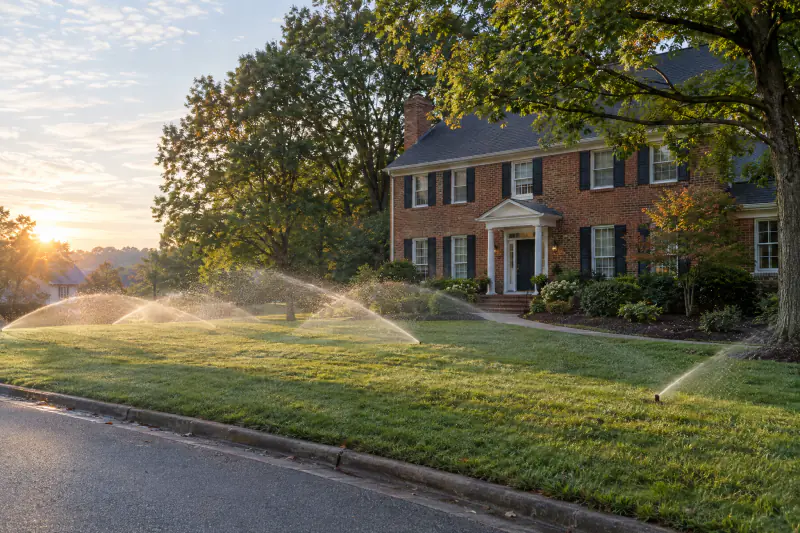
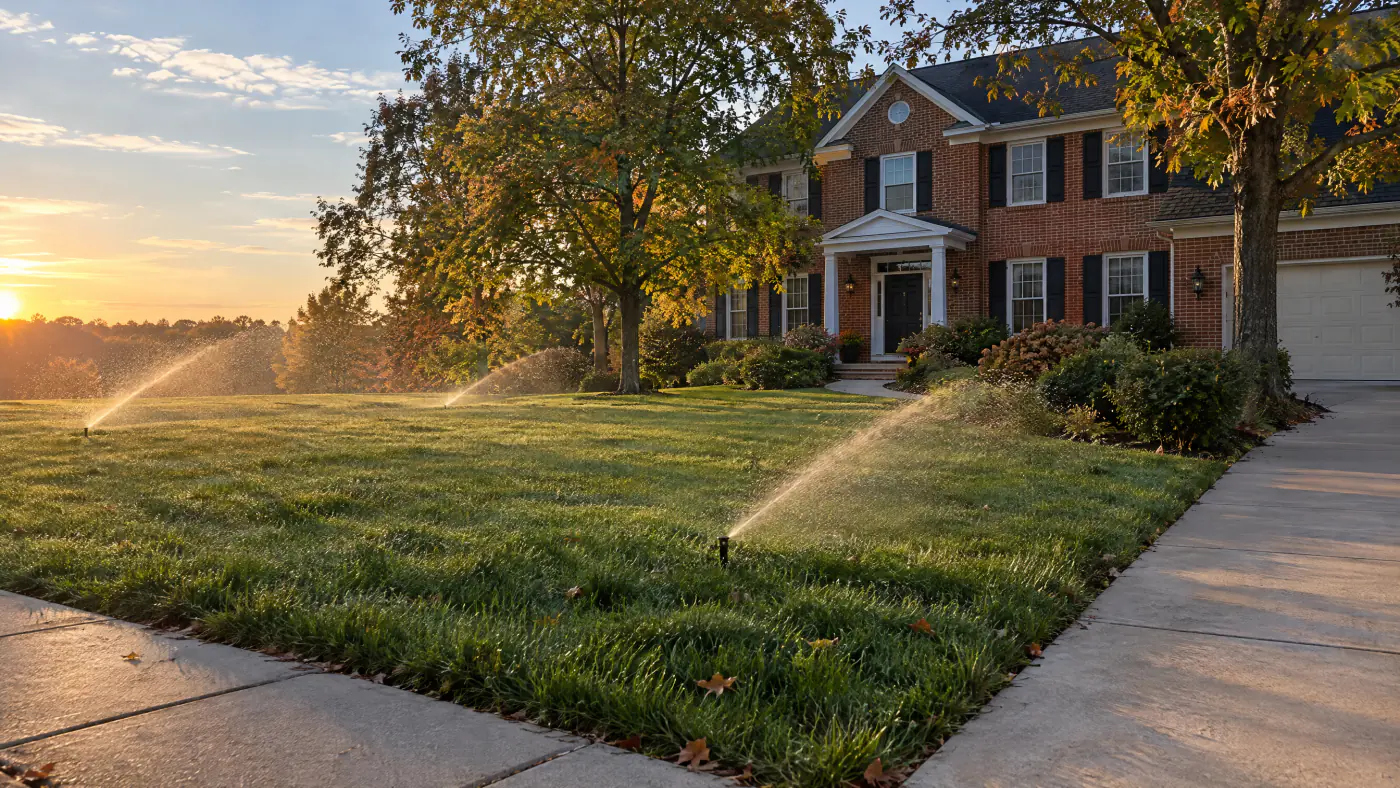
A design based on measured pressure and flow, a backflow preventer at the connection to the house supply, a mainline under constant pressure feeding valves in boxes, lateral pipe to heads grouped in zones, wiring back to a controller, and a program written for clay soil and tall fescue. In Northern Virginia the work takes one to three days on most lots once Virginia 811 has marked utilities and any plumbing permit is in hand, and the permitting often takes longer than the digging. The system is then blown out every fall before the first hard freeze and restarted every spring, so the installation is also the start of a yearly routine.
What makes a system here different from one in a drier or sandier place is the soil and the grass. Clay takes water slowly, so heads that apply it fast send most of it down the driveway; the design favors low-rate nozzles and schedules split into short cycles. Tall fescue, the lawn most of us have, wants roughly an inch to an inch and a half of water a week in summer and almost nothing through most of the spring, so the controller matters as much as the pipe. This article goes through design, the rules set by counties and water utilities, the installation sequence, what a quote should list, and what the work costs as of 2026. It assumes a new system; if you already own one that underperforms, our irrigation upgrades page and our spring start-up checklist cover that case. The service itself is described on our sprinkler system installation page.
How is a sprinkler system designed for a Northern Virginia yard?
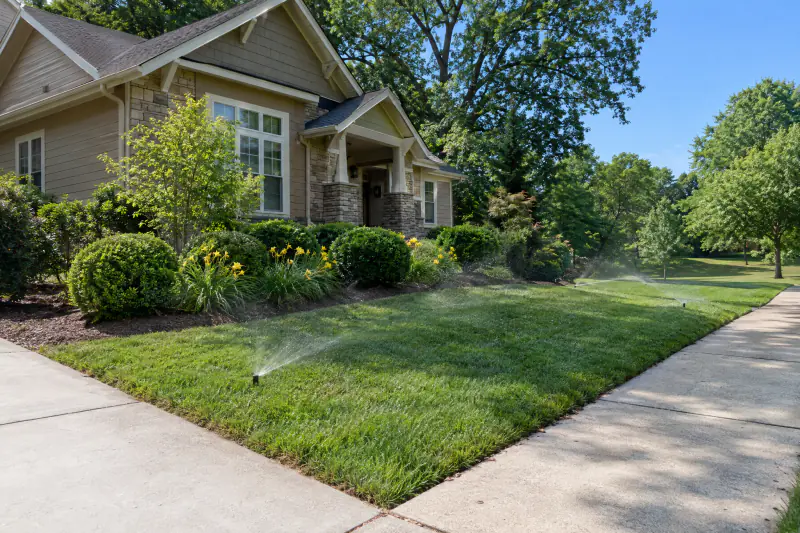
By dividing the property into hydrozones, areas that share the same water needs, and giving each one its own valve and the right kind of head. Sunny open lawn, shaded lawn under the oaks, a sloped strip beside the driveway, a foundation bed of shrubs, a vegetable garden: each wants a different amount of water on a different schedule, and a system that puts them on one valve waters all of them wrong. On a typical quarter-acre lot in Centreville or Ashburn that produces four to eight zones. Larger lots in Great Falls or Haymarket may need twelve or more.
Within a zone, three rules govern the layout. The first is head-to-head coverage: each head throws water far enough to reach the next head, so every point in the zone is covered by at least two heads and the weak spot at the edge of one spray is filled by its neighbor. Spacing a 15-foot spray at 15 feet, not 20, is what that means in practice. The second is matched precipitation: every head on a zone applies water at the same rate per hour, which means a quarter-circle nozzle flows a quarter of what the full-circle nozzle beside it does, and sprays, rotors and drip never share a valve. The third is the application rate against the soil. Fixed sprays put down roughly 1.5 inches an hour, which clay cannot absorb; rotary nozzles and gear-driven rotors apply closer to half an inch, and drip far less, which is why they dominate our designs here.
Slope, wind and the shape of the lawn finish the design. Heads at the top of a slope throw downhill; the bottom of the slope gets a zone of its own with shorter run times. Narrow strips beside walks get strip nozzles rather than sprays that wet the concrete. Corners get quarter-circle heads, not full-circle heads that water the street. None of this is complicated, and all of it is routinely skipped.
Which head belongs in which hydrozone?
Rates are typical for residential products and vary by model and operating pressure.
| Hydrozone | Head type | Typical application rate | How it runs on clay |
|---|---|---|---|
| Open lawn, sunny, 25 ft or wider | Gear-driven rotors, 25 to 45 ft throw | About 0.5 to 1 in. per hour | Two or three cycles per watering day, early morning |
| Lawn strips and small areas, 8 to 25 ft | Rotary nozzles on spray bodies | About 0.4 to 0.6 in. per hour | Longer run times than sprays, little runoff |
| Narrow strips under 8 ft, odd corners | Fixed sprays or strip nozzles, pressure-regulated | About 1.5 in. per hour | Short cycles only, 4 or 5 minutes, repeated |
| Shaded lawn under trees | Same head as the adjacent lawn, separate valve | Same as the head type | Roughly half the run time of sunny zones |
| Shrub and perennial beds | Drip tubing with inline emitters | About 0.5 to 1 gallon per hour per emitter | Longer, less frequent runs; filter and regulator at the valve |
| Slopes steeper than about 4 to 1 | Rotary nozzles or rotors, bottom of slope on its own valve | Low rate | Cycle and soak is mandatory, not optional |
A zone that mixes two rows of this table cannot be scheduled correctly, whatever the controller.
Why do pressure and flow decide how many zones you need?
Because a zone can only run as many heads as the supply can feed at once. Every head has a flow rating in gallons per minute at its working pressure. Add up the heads on a valve and the total has to stay under what the service line delivers, with a margin, or the last heads on the run sputter and the first ones mist. A 3/4-inch meter and service line delivering 12 gallons a minute can run about four rotors at 3 gallons each, or a dozen sprays at 1 gallon each, on one zone. A lawn that needs twenty rotors therefore needs five zones, no matter how the salesperson counts them.
Pressure sets the other limit. Spray heads work properly near 30 psi at the nozzle and rotors near 45 psi, and the water loses pressure on the way there: through the backflow preventer, through the valve, through every foot of pipe and every elbow. A house at 55 psi static can end up delivering 35 psi at a rotor 150 feet from the meter, which shortens its throw and breaks the head-to-head coverage the design counted on. That is why the layout uses pipe sized for the flow, keeps mainline runs short, and places valves near the zones they feed rather than in one convenient row by the garage. Where static pressure is high, which is common near larger mains, pressure-regulating heads keep sprays from misting.
Wells need the same math with a different limit. A well pump delivers a fixed flow and the pressure tank cycles, so zones are sized to run below the pump's output and the controller is set to rest between zones so the tank recovers. The result is often more, smaller zones than a city-water system on the same lot, and a longer total watering window.
What do the county and the water utility require?
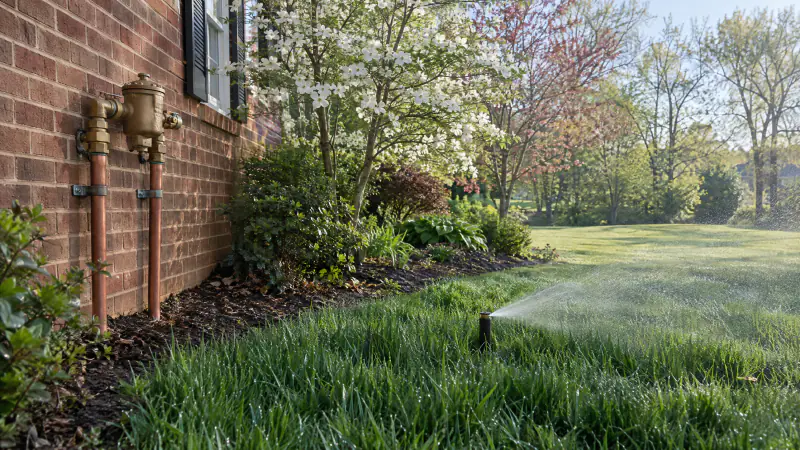
A backflow preventer, in every case, and in most counties a plumbing permit for the connection, with periodic testing afterward set by the water utility. Virginia's plumbing code treats a lawn irrigation system as a cross-connection hazard, so the point where it taps the house supply must be protected by an approved backflow assembly, usually a pressure vacuum breaker mounted outdoors at least 12 inches above the highest head, or a reduced pressure assembly where the utility or the site calls for it. Fairfax County and Arlington require a plumbing permit and an inspection for that connection, Prince William County issues a residential permit and inspection for the backflow device, and Loudoun and the independent cities have their own rules, so the details differ from one jurisdiction to the next. Check with your county's permit office, and ask the installer who pulls it.
The water utility sets the testing rule, jointly with the county in Fairfax County. Fairfax Water, Loudoun Water, Prince William Water (formerly the Prince William County Service Authority), Arlington County and the towns that run their own systems commonly require the assembly to be tested when it is installed and then periodically, often every year, by a tester the utility recognizes, with reports filed with the utility. Budget for that test as a yearly cost. Some utilities in the region also allow a separate irrigation meter, so that sewer charges are not applied to water that never enters a drain; the meter has its own installation cost, and whether it pays back depends on how much you water, so ask your utility before deciding.
Other rules are quieter. Virginia 811 must mark utilities before any trenching or plowing. During droughts, utilities and the state can impose voluntary or mandatory restrictions on outdoor watering, which a smart controller makes easy to follow. HOAs in Ashburn, South Riding, Brambleton, Gainesville and similar communities often want to approve the visible backflow assembly and any valve boxes in front yards. And nothing may be installed that discharges irrigation water onto a neighbor's lot or a public sidewalk, which is a design problem more than a legal one.
Is a smart controller worth including from the start?
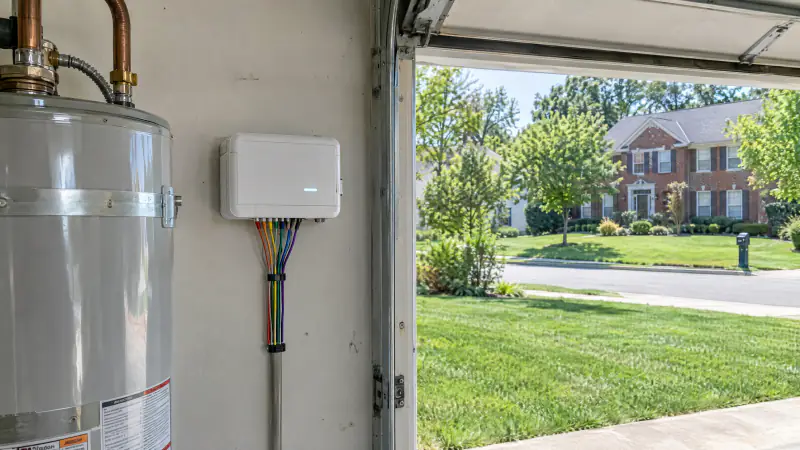
Yes, and the start is the cheap time to do it, because the controller is a small share of the project and the wiring is the same. A weather-based controller adjusts run times from local weather data, skips cycles when rain has fallen or is forecast, and lets you run any zone from a phone, which is useful during the first weeks when you are watching heads. EPA WaterSense labels controllers that meet its performance criteria, and the label is a reasonable shortlist. We pair the controller with a wired rain sensor, or a rain and freeze sensor, as a physical backstop that stops watering in a storm regardless of what the forecast said.
The settings that matter on clay are soil type, which changes how the controller splits cycles, and the sprinkler type for each zone, which sets the application rate it assumes. Set wrong, a smart controller waters as badly as a timer. Set right, it typically trims the summer schedule noticeably and ends the spring and fall waste entirely. A flow sensor is a worthwhile addition on larger systems: it learns each zone's normal flow and shuts the system down when a broken head or a cracked lateral sends the number up, which otherwise shows up as a water bill. We work through the savings against Fairfax and Loudoun water and sewer rates in our article on smart controllers and your water bill.
One practical check before choosing a model: Wi-Fi has to reach the mounting spot, which is usually a garage wall or utility room. A controller that cannot stay connected falls back to a basic schedule, which is the thing you paid to avoid.
What is the installation sequence?
One to three days on most lots. Each step is checked before the next begins.
Design and pressure test
Static pressure and flow are measured at the house, the lot is measured, and a zone-by-zone layout is drawn showing head types, valve locations, the backflow assembly and the controller. You approve the drawing and a written price before anything else happens.
Permit and Virginia 811 locate
The plumbing permit is pulled where the county requires it. Virginia 811 marks public utilities. Private lines, lighting, pet fence, gas to a grill, an old drain line, are located with you and flagged.
Point of connection and backflow
The irrigation supply is tapped at the house with its own shutoff and drain, and the backflow assembly is mounted outside at the required height, where it can be tested and drained for winter. This is the part the inspector looks at.
Mainline
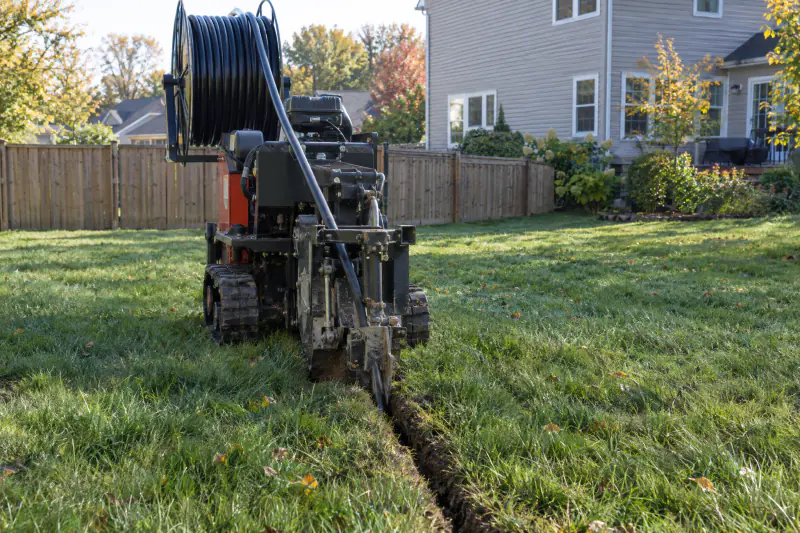
Pipe that stays under pressure runs from the backflow to each valve location, typically 1 inch, buried 8 to 12 inches, with sleeves under walks and driveways. Where soil allows it is pulled with a vibratory plow; elsewhere it is trenched.
Valves and wiring
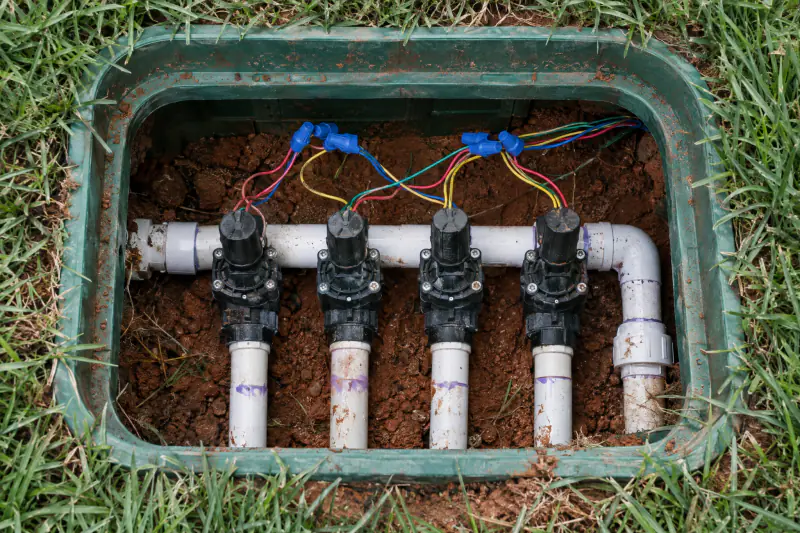
Zone valves are set in boxes at grade, grouped by area, with a master valve where a flow sensor is used. Direct-burial wire runs from each valve to the controller, with a common wire and spares for future zones, and waterproof connectors at every splice.
Laterals and heads
Lateral pipe runs from each valve to its heads, sized for the zone's flow. Heads are set on flexible swing joints so a mower strike moves the head instead of breaking the pipe, with tops flush to the finished grade.
Flush, pressurize and adjust
Lines are flushed before nozzles go on, so grit from the trench never reaches a head. The system is pressurized slowly, every joint is checked, and each head's arc and radius are set so water stays on the planting it serves.
Program, inspect and walk through
The controller is programmed for the season with cycle and soak, the sensor is tested, the county inspection is completed where required, and we walk the yard with you to show the shutoff, drain points, valve boxes and what to watch in the first month.
What should a sprinkler installation quote list?
Compare proposals on these points. A quote that is a zone count and a price has skipped the design.
- Static pressure and flow, measured at your house, written on the proposal.
- A drawing showing every zone, head type, valve box, the backflow assembly and the controller location.
- Head-to-head spacing and matched precipitation stated, with sprays, rotors and drip on separate zones.
- The backflow assembly type, who pulls the plumbing permit, and whether the inspection is included.
- Pipe sizes for mainline and laterals, burial depth, and sleeves under every walk and driveway.
- Swing joints at every head and pressure-regulating bodies where sprays are used.
- The controller model, a wired rain or rain-and-freeze sensor, and programming for clay soil.
- Virginia 811 locate and private line marking before any plowing or trenching.
- Lawn restoration after plowing or trenching, and who handles the first fall winterization.
- A walkthrough at completion showing shutoffs, drains and seasonal settings.
How much does a sprinkler system cost in Northern Virginia in 2026?
As of 2026, typical Northern Virginia market planning ranges for a professionally installed residential sprinkler system run roughly $3,500 to $8,000 for a suburban lot with four to seven zones, and $8,000 to $15,000 or more for large or complicated properties with a dozen zones, long mainlines or several drip areas. Per zone, planning figures of roughly $600 to $1,200 are common once the fixed costs of the connection, backflow and controller are spread across them. These are regional figures, not our prices and not a quote.
What moves the number:
- Zone count, which follows from lawn area and the flow your service delivers, not from lot size alone.
- The backflow assembly, its type, the distance from the connection to the yard, and the permit and inspection where required, typically $400 to $1,200 of the total.
- Drip zones for beds, roughly $400 to $1,200 each, which cost more per square foot than lawn zones but save water for decades.
- The controller: a weather-based model with a sensor adds roughly $300 to $800 over a basic timer.
- Crossings and obstacles: sleeves under driveways, tree roots, fences, steep grades, rock in western Loudoun, and tight access that rules out the plow.
- Restoration: plow slits knit in weeks during the growing season; open trenches may need seed or sod.
Plan for the yearly costs as well: winterization in fall, start-up in spring, the backflow test where the utility requires it, and the water itself, which for a typical lawn here adds noticeably to the summer bills. Our cost guide places irrigation beside the other outdoor projects it is usually paired with. For a number based on your pressure, your flow and your lot, the only reliable path is a written on-site estimate. Request one here or call (571) 200-9600.
Why is fall a good season to install a sprinkler system?
Because the soil is workable, the lawn is about to be renovated anyway, and the system has a whole dormant season to settle before it has to perform. September and October are when Northern Virginia lawns get aerated and overseeded, and a sprinkler system installed just before that work means the plow slits and valve boxes disappear under the new seed, and the new grass gets watered through its first critical weeks by the system rather than by a hose. Installing in April or May, by contrast, means plowing through a lawn you are trying to keep green and asking the system to perform in July before anyone has watched it through a full season. Our article on the fall lawn renovation plan explains the seeding window the system should be ready for, and aeration and overseeding is the work that follows.
Fall has practical advantages too. Demand for installers is lower than in spring, permit offices are less busy, and ground that was baked hard in August softens with the first fall rains. The system is winterized a few weeks after it goes in, which is a small cost, and it is restarted in spring having already been tested and adjusted. The one thing fall cannot give you is a summer of feedback on head coverage before the lawn is stressed, which is why the first spring start-up on a fall-installed system should be a careful one.
If you are reading this in late April and want a system this year, May and June installs work well, and a system in by early June will carry a fescue lawn through its first summer. The point is not that spring is wrong; it is that a lawn and a sprinkler system are best planned together, and in this region the lawn's year starts in September.
What mistakes do builder-grade systems make?
Most of the systems we are asked to fix were installed with the house. These are the faults we find again and again.
One zone for the whole front
Sunny lawn, the shaded strip by the house and the foundation bed share a valve. The lawn is dry, the bed is drowned, and no schedule can fix it. Re-zoning is the only cure.
Sprays and rotors together
A rotor puts down a third of what a spray does in the same minute. On a shared zone one of them is always wrong. Matched precipitation is the design rule that prevents it.
Heads spaced to save money
Sprays rated for 15 feet set 20 feet apart leave a dry crescent between every pair that shows up each July as brown arcs. Head-to-head spacing costs a few more heads and saves the lawn.
No sleeves under the driveway
Pipe and wire run around pavement instead of under it, or were cut through it and patched. Any future repair means more cutting. Sleeves are cheap on day one and impossible later.
Unregulated pressure
Sprays on a 75 psi supply with no regulation turn into fog that drifts onto the street. Pressure-regulating bodies or a regulator at the valve fix it and cut water use.
A timer with no sensor
The system waters at 6 p.m. on Tuesday whether it rained on Monday or not. A weather-based controller and a wired rain sensor are the two cheapest fixes on this list.
How do pressure, water source and rules differ across Fairfax, Loudoun, Prince William and Arlington?
Pressure, water source and rules shift across the region more than the design principles do. Inside the Beltway, in Arlington, Alexandria, Falls Church and McLean, lots are small, mature trees shade much of the lawn, and the usual system is four to six zones with a heavy share of drip and shaded-lawn zones; older service lines there can limit flow, which the pressure test catches. Across central Fairfax County, from Vienna and Oakton to Burke, Springfield and Centreville, supply pressure is often generous and pressure regulation at the heads is routine; permits run through Fairfax County Land Development Services. Loudoun Water serves most of eastern Loudoun, from Sterling and Ashburn to South Riding and Brambleton, where newer HOA communities review visible equipment, while Leesburg and Purcellville run their own utilities and much of western Loudoun is on wells. In Prince William, Prince William Water covers most of Gainesville, Bristow, Woodbridge and Dumfries, and Manassas and Manassas Park have their own systems.
Wells in Great Falls, Clifton and western Loudoun change the zone math and remove the utility testing program, though a backflow preventer is still required to protect the house plumbing. Rock near the surface in parts of Leesburg, Haymarket and Chantilly can rule out the plow and push the work to trenching. Heavy clay is everywhere, which is why low-rate heads and cycle-and-soak programming are standard in every one of these places, and why a yard that stays wet without any irrigation is a drainage job first.
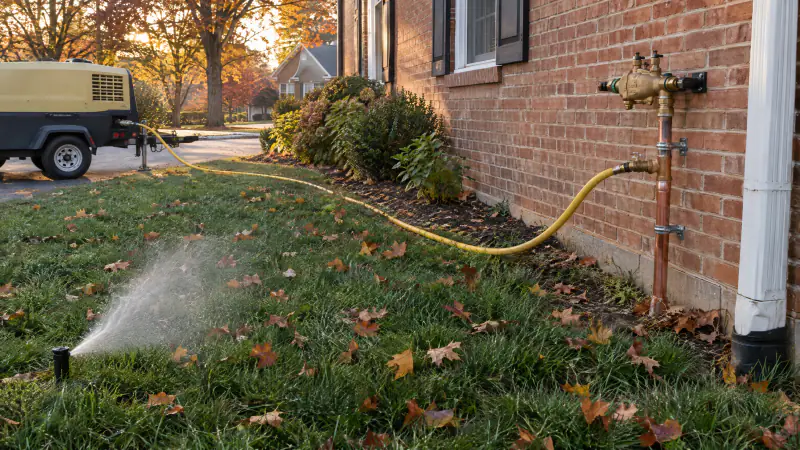
Every system here is winterized before the first hard freeze, usually late October through November, and restarted in spring; our article on sprinkler winterization explains the blow-out and what it costs. Rules differ in detail from one county and utility to the next, so check with yours, and ask any installer which permit they will pull. We design and install systems on residential properties throughout the counties, cities and towns listed on our service areas page, and the water management page shows how irrigation fits beside drainage on the same lot.
Frequently asked questions
Can a sprinkler system be installed on a well in Northern Virginia?
Yes, with the design built around the pump. A well delivers a fixed flow, often less than a public supply, so zones are kept small enough to run below that output and the controller rests between zones so the pressure tank recovers. A backflow preventer is still needed to protect the house plumbing, though the utility testing program does not apply. Homes in Great Falls, Clifton and western Loudoun are the usual cases.
Do I need a permit to install a sprinkler system in Fairfax or Loudoun County?
Usually a plumbing permit, because the connection to the drinking water supply and the backflow preventer are regulated under the plumbing code, and an inspection follows. The details differ by county and some jurisdictions include the irrigation piping in the permit. Confirm with your county's permit office before work starts and ask the installer who will pull it. HOAs often want to approve the visible backflow assembly as well.
What is matched precipitation, and why does it matter?
It means every head on a zone applies water at the same rate per hour, so one run time waters the whole zone evenly. A quarter-circle nozzle has to flow a quarter of a full-circle nozzle, and sprays, rotors and drip, which apply water at very different rates, must sit on separate valves. Without it, one part of a zone is always too wet by the time another part is right, and no schedule can fix the difference.
Should planting beds be on drip or spray heads?
Drip, in nearly every case. Spray heads in beds hit foliage, overspray onto mulch and siding, and get blocked as shrubs grow in. Drip tubing with inline emitters puts water at the roots slowly, keeps leaves dry, which limits fungal problems in humid summers, and runs on its own valve with a filter and pressure regulator. It costs more per square foot to install than a lawn zone and uses far less water for decades.
Will a sprinkler system raise my sewer bill?
On most Northern Virginia utilities, sewer charges are calculated from water use, so irrigation water can be billed as if it went down the drain. Some utilities allow a separate irrigation-only meter so that sewer charges are not applied to that water. The meter has an installation cost of its own, so whether it pays back depends on how much you water. Ask your utility about availability and cost before the system is designed.
Can a sprinkler system be installed before new sod or seed?
Yes, and that is the ideal order. Drainage first, then irrigation, then sod or seed, so nothing new gets dug up. A system installed just before fall overseeding or spring sod waters the new grass through its first critical weeks on a schedule rather than by hose, and the plow slits and valve boxes disappear under the new lawn. Tell the installer the lawn plan so heads are set to the finished grade.
How deep are sprinkler pipes buried, and will they freeze?
Typically 8 to 12 inches for residential mainline and laterals, which is above the frost line. They do not need to be deeper, because the system is winterized before the first hard freeze: the supply is shut off, the backflow is drained, and compressed air blows the water out of every zone. A system left full through a Northern Virginia winter can crack heads, valves and the backflow assembly, so the fall blow-out is not optional.
Book the work
Put the plan in writing with a crew that builds this every week.
One visit to measure and talk through options, then a written scope and price. No pressure, no vague numbers. Ask about the Heroes Discount if you serve.
Sources and further reading
- EPA WaterSense: irrigation controllers, sprinkler heads and outdoor water use
- Virginia Cooperative Extension, turfgrass irrigation and lawn care publications
- Virginia 811 (Miss Utility): call before you dig
- Fairfax County Land Development Services: plumbing permits
- Hunter Industries: residential irrigation design and product literature
- Rain Bird: residential irrigation design and product literature
Published April 30, 2026. Reviewed and updated October 9, 2026.