Key takeaways
- The windows that work are late May through June, after pollen and before the worst humidity, and September into early October. July and August dew points make stain misbehave.
- Wood must read about 15 percent moisture or less on a meter, usually two to three dry days after washing, and longer on shaded decks.
- Clean with a sodium percarbonate wood cleaner at low pressure along the grain, then an oxalic acid brightener. Chlorine bleach and high pressure both damage the wood.
- Semi-transparent stain is the forgiving choice here: two to three years on floors, easy to recoat. Solid stain lasts longer but peels and must be stripped.
- As of 2026, typical Northern Virginia market ranges run about $2 to $5 per square foot, so many decks land between $1,000 and $3,000. Stripping a failed finish adds to that.
On this page
- When is the deck staining window in Northern Virginia that actually works?
- What is the dry-day rule, and how do you know the wood is ready?
- How should a deck be cleaned and brightened before stain?
- Why should a wood deck never be cleaned at high pressure or with chlorine bleach?
- Which stain type lasts longest in Northern Virginia humidity?
- Oil-based or water-based: which holds up better in humid summers?
- What are the temperature and dew point limits for staining?
- How often does a deck need to be re-stained in Northern Virginia?
- What do you do with a solid stain that is already peeling?
- What are the mistakes that make deck stain fail by the next summer?
- How much does deck cleaning and staining cost in Northern Virginia in 2026?
- How does the staining window shift across Fairfax, Loudoun, Prince William and Arlington?
- Frequently asked questions
When is the deck staining window in Northern Virginia that actually works?
Late May through June, and again from September into early October. Those are the weeks when four conditions line up at once: the wood is dry inside, the air is dry enough for the stain to cure, the boards are between about 50 and 90 degrees, and there are two rain-free days behind the job and two ahead of it. April is too wet and too full of pollen. July and August bring afternoon storms and dew points in the 70s that leave stain tacky overnight. Late October nights turn cold and wet. The two windows are short, and that is why decks get stained in the wrong week so often.
The humidity is the part people underestimate. Stain cures by giving up solvent or water to the air, and air that is already nearly saturated takes it slowly. A deck stained on a 90-degree afternoon in July with a dew point of 72 can still be soft at midnight, when the boards cool, the dew falls and the finish blushes white or holds every footprint. The same product applied in the first week of June, with a dew point in the 50s, is dry to the touch by dinner.
This guide covers how to read the wood with a moisture meter, how to clean and brighten without harming the grain, which stain types age best here, the temperature and dew point limits, and what to do when a solid stain is already peeling. The service itself is described on our deck and fence cleaning and staining page, and the spring order of exterior work, wash first and stain after, is in our guide to pressure washing after pollen season.
What is the dry-day rule, and how do you know the wood is ready?
The dry-day rule is simple: stain goes on wood that reads about 15 percent moisture or less on a pin meter, and in Northern Virginia that usually means two to three dry days after the deck was washed. Most stain manufacturers publish a maximum moisture content for application, and 15 percent is a common figure. Some water-based products tolerate slightly more, and some penetrating oils want less. Check the can, then check the wood.
A meter is the only honest way to know. Boards look dry within hours of washing because the surface dries first, while the center of a 2-by-6 can hold water for days. Stain brushed onto a board that is dry on top and wet inside traps that water under the finish, and the first hot afternoon pushes it back out as blisters and peeling. We read the meter at the shaded end of the deck, at board ends near the stairs, at the bottom of the posts and under the railing cap, because those are the last spots to dry. A sunny deck with good airflow can be ready in two days. A deck on the north side under a maple, with a lawn that stays wet, can take four or five.
Without a meter, the sprinkle test gives a rough answer. Flick a little water on the boards: if it soaks in within a minute or two, the wood is thirsty and the surface is ready. If it beads or sits, the wood is either still wet or still sealed by old finish, and either way it is not ready. Morning dew counts as water too, so on a staining day the boards are left to dry until mid-morning before anything goes on.
How should a deck be cleaned and brightened before stain?
Two working visits separated by drying time, weather permitting. The cleaning is gentler than most people expect.
Inspect and probe
We identify the wood, whatever finish is on it, soft or rotted boards, loose balusters, raised nails and popped screws. Rot is flagged for repair first, because stain does not fix it. Siding, plants and hardware are noted for masking.
Apply a wood cleaner
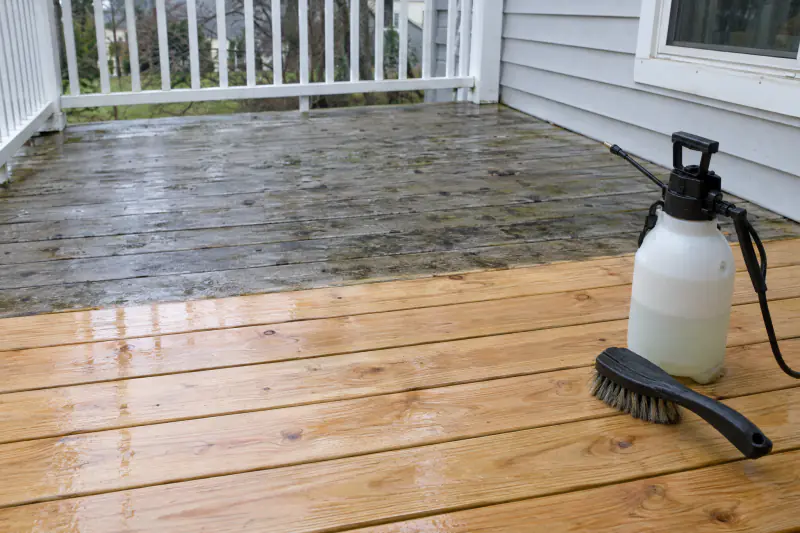
A sodium percarbonate cleaner, often called oxygen bleach, is applied to wet boards and allowed to work for ten to fifteen minutes without drying. It loosens gray dead fibers, dirt and mildew. Old finish that must come off gets a stripper at this stage instead.
Rinse at low pressure along the grain
A wide fan tip at low pressure, held well off the boards and moved with the grain, carries the loosened fibers and cleaner away. The machine supplies a controlled rinse, not force. Stairs and balusters are rinsed by hand where needed.
Brighten while the wood is wet
An oxalic or citric acid brightener is applied, left briefly and rinsed. It neutralizes the alkaline cleaner, lifts tannin and iron stains, and returns the wood to a lighter, even tone so the stain color reads true.
Dry and verify
The deck dries for two to three days in dry weather, longer in shade. We meter the wood before returning, sand raised grain and rough spots, set fasteners, and mask siding, posts and hardware.
Stain in the right hours
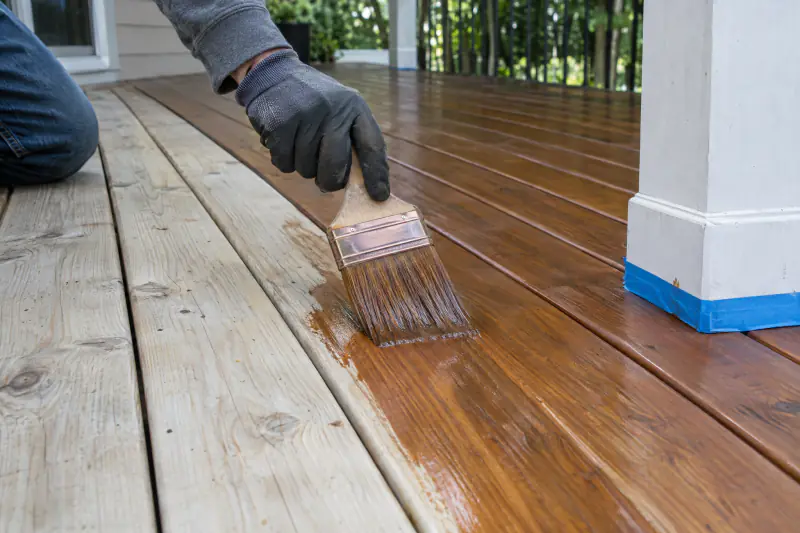
Stain goes on mid-morning to mid-afternoon on a dry day with mild temperatures, applied to full board lengths and back-brushed so it soaks in evenly. Excess is wiped where the product calls for it, and the deck rests before furniture returns.
Why should a wood deck never be cleaned at high pressure or with chlorine bleach?
Because both destroy the surface the stain needs to grip. Softwood decking is made of alternating bands of soft spring growth and harder summer growth. A pressure washer held close tears out the soft bands and leaves the hard ones standing, which is the fuzzy, ridged texture you can feel on a badly washed deck. Stain soaks unevenly into that surface, dark in the furrows and thin on the ridges, and the wand marks show through as curved shadows. Sanding fixes some of it and costs more than the washing saved. Low pressure with a wide tip along the grain cleans the same board without cutting it.
Chlorine bleach is the other common shortcut. It kills mildew, which is why people reach for it, but it also attacks lignin, the natural glue that holds wood fibers together, and leaves the surface weak and whitish. It pulls color unevenly, corrodes fasteners over time and burns the plants under the deck. A sodium percarbonate cleaner does the cleaning job without the damage, and the brightener afterward restores the tone. Chlorine-based solutions belong on siding and roofs, which we cover in our guide to removing green streaks from siding and roofs, not on wood that is about to be stained.
Fences follow the same rules with one difference. Vertical boards shed water and gray more slowly, so a fence usually needs a lighter cleaning and goes longer between coats. Composite decking is a different material entirely. It is cleaned with a suitable cleaner and a soft brush, never stained, and the board manufacturer's care instructions govern. Our page on composite and PVC decks explains why.
Which stain type lasts longest in Northern Virginia humidity?
More pigment means more sun protection and less visible grain, and it changes how the finish fails when it finally does.
| Stain type | Look | Typical life on deck floors here | How it fails in this climate | Recoat |
|---|---|---|---|---|
| Transparent or toner | Natural wood with a light tint | About one year | Fades and grays in sun, mildew finds it quickly in shade | Clean and recoat yearly, no stripping |
| Semi-transparent | Color with grain showing through | About two to three years | Wears thin in traffic lanes, fades evenly | Clean, brighten and recoat, no stripping |
| Semi-solid | Deeper color, faint grain | About three to four years | Wears and can flake where coats built up | Clean and recoat, light sanding where flaking |
| Solid | Opaque, like paint | About three to five years | Peels in sheets once water gets under it | Strip or sand to sound film, then recoat |
Railings, balusters and fence boards are vertical and usually last longer than floors with the same product.
Oil-based or water-based: which holds up better in humid summers?
Both can last, and each has a weakness this climate finds. Oil-based penetrating stains soak into the wood rather than sitting on it, which makes them forgiving to apply and easy to recoat without stripping. They dry slowly, though, and in a humid week that slowness is a problem. A penetrating oil that stays open overnight collects dew, and oil itself is food for mildew, so an oil stain without an effective mildewcide can show black spotting in shade within a year. In full sun on a deck that dries fast, oil is a comfortable choice.
Water-based acrylic and hybrid stains dry quickly, hold color well against ultraviolet light and clean up with water. They form more of a film, so they demand cleaner, drier, better-prepared wood to bond, and they are less tolerant of being applied over an old oil finish. In shade and humidity, their fast dry is an advantage, because the finish is set before the dew falls. The tradeoff is that a film can peel if the prep was rushed, where a penetrating oil would simply wear.
One local note. Northern Virginia is in a region where Virginia limits the volatile organic compound content of architectural coatings, so the oil-based deck stains sold here are formulated to lower solvent levels than older versions, and some behave differently from what a homeowner remembers using a decade ago. Follow the current label on dry time and recoat time, and check the manufacturer's guidance on applying one type over another. Whichever base you choose, the wood preparation and the week you pick matter more than the chemistry in the can.
What are the temperature and dew point limits for staining?
Most stain manufacturers call for air and surface temperatures between about 50 and 90 degrees during application and for the first several hours afterward, no rain for 24 to 48 hours, and a surface that is dry and above the dew point. Those numbers vary by product, so the label governs. In practice, the surface temperature matters more than the air temperature. A dark deck board in May sun can read 20 or 30 degrees hotter than the air, and a shaded board on a cool morning can be colder and wetter than the forecast suggests.
Dew point is the number that explains most summer failures. It is the temperature at which the air becomes saturated and moisture condenses on surfaces. In a typical Northern Virginia July and August, the National Weather Service forecast office that covers the region regularly reports afternoon dew points in the upper 60s and 70s, and overnight lows that drop close to them. A deck stained that afternoon is still curing when the boards reach the dew point after dark, and the moisture that forms on a partly cured finish turns it cloudy, soft or spotted. In late May, June and September the dew points are usually lower, with many days in the 50s and low 60s, the overnight lows stay above them, and the stain cures cleanly.
The last limit is rain. Water on an uncured water-based stain washes it off in streaks. Water on an uncured oil can leave white blushing that sometimes fades and sometimes does not. We want two dry days in the forecast after the stain goes on, and if the forecast changes on the morning of the job, the job moves. A deck stained on the wrong day looks fine that evening and wrong by the following spring.
How often does a deck need to be re-stained in Northern Virginia?
Deck floors here typically need a fresh coat every two to three years with a semi-transparent stain, and railings, balusters and fences go three to five years because water runs off vertical surfaces instead of sitting on them. Full sun shortens the interval on floors, because ultraviolet light breaks down the pigment and the resin. Deep shade shortens it for a different reason, because mildew colonizes a finish that stays damp. A deck that gets morning sun and afternoon shade often lasts longest.
The test is the same one used before staining. Sprinkle water on the boards in the main traffic lane. If it beads and sits, the finish is still shedding water and can wait. If it darkens the wood and soaks in within a couple of minutes, the stain has worn through and the wood is taking on water with every rain. Re-staining at that point is a maintenance coat: clean, brighten, dry, apply. Waiting two more years turns it into a restoration, with gray wood to remove and often a few boards to replace.
Maintenance coats are the economical rhythm, and they are only possible with finishes that wear rather than peel. That is the practical argument for semi-transparent and penetrating products on a deck floor: every recoat is a wash and a coat, never a strip. Our maintenance and care guide lays out the annual checks that keep a deck between coats, including clearing the gaps between boards so water drains and keeping planters off the floor.
What do you do with a solid stain that is already peeling?
You take it back to a sound surface, and there are three honest ways to do that. The first is to strip it. A sodium hydroxide based stripper softens most solid stains and paints so they can be rinsed off at low pressure, followed by a brightener to neutralize the stripper and lift the color. Stripping is slow, messy and priced accordingly, but it is the only route back to a semi-transparent finish, because a transparent product cannot hide the ghost of a solid one.
The second is to sand and recoat with solid. Where the peeling is confined to traffic lanes and the rest of the film is bonded, loose material is scraped and sanded to a feathered edge, the whole deck is cleaned, bare wood is spot-primed where the product calls for it, and a new solid coat goes over everything. This is cheaper than stripping and looks right, with the understanding that solid stain on a deck floor will peel again in time and the cycle repeats every few years. Railings and fences take solid stain far better than floors do, and on those surfaces this is often the sensible choice.
The third is to stop staining the floor. If the boards under the peeling finish are cupped, cracked or soft, the stain was hiding a deck that needs more than a coating. Replacing the walking surface with composite boards on the existing frame removes staining from the routine for good, and our guide to deck repair or replace walks through when that math works. The deck repair and resurfacing service covers the structural checks that come first.
What are the mistakes that make deck stain fail by the next summer?
Nearly every peeling deck we see had at least two of these in its history.
- Staining over gray, weathered wood without cleaning and brightening it first.
- Staining boards that look dry but still read above 15 percent moisture inside.
- Cleaning with high pressure or a narrow tip, leaving raised grain for the stain to sit on.
- Using chlorine bleach as the cleaner and skipping the brightener afterward.
- Staining in April with pollen still falling, or in July with a dew point in the 70s.
- Applying stain to boards in hot direct sun so it flashes before it penetrates.
- Putting a second coat on a penetrating oil that the wood cannot absorb, leaving a sticky film.
- Applying a water-based film over an old oil finish without the manufacturer's blessing.
- Ignoring soft boards and loose posts and expecting the finish to hold them together.
How much does deck cleaning and staining cost in Northern Virginia in 2026?
As of 2026, cleaning and staining a wood deck in Northern Virginia falls in a typical market planning range of about $2 to $5 per square foot of surface, which puts many decks between roughly $1,000 and $3,000. Fence cleaning and staining commonly runs about $1.50 to $4 per square foot of fence face, and cleaning a composite deck without staining it often lands between $200 and $500. These are market planning figures, not myYardPros prices, and they are wide on purpose.
Railings move the number more than anything else. A deck with long runs of balusters takes far more brush time than the same square footage of open floor. After that come height and stairs, because a second-story deck with two flights adds ladder work and more vertical surface. Stripping a failed solid stain can add as much as the staining itself. The product matters too: premium stains cost more per gallon, and solid stains often need two coats where a penetrating oil needs one. Fences stained on both faces cost roughly twice what one face does. Finally, rot repair and board replacement are priced as repair work, separately from the finish.
We meter the wood, measure the surfaces and look at what is under the old finish before writing a number. To get a figure for your deck, request a written on-site estimate or call (571) 200-9600. The cost guide shows how deck staining compares with other exterior work if you are planning a season of projects.
How does the staining window shift across Fairfax, Loudoun, Prince William and Arlington?
By a week or so at each end, and more by shade than by map. Western Loudoun around Leesburg and Purcellville runs a little cooler, so its spring window opens closer to June and its fall window closes earlier in October. Arlington, Alexandria and Falls Church sit warmer and open in mid-May. Sterling, Ashburn, Herndon and Reston fall in between, and so do Centreville, Chantilly and the Prince William communities of Gainesville, Haymarket, Woodbridge and Lorton. Manassas and Manassas Park track close to western Fairfax.
Shade matters more than any of that. A deck on a wooded lot in Great Falls, Clifton, Burke or Vienna can need five dry days to meter at 15 percent where a sunny Ashburn deck needs two, and the shaded deck will want a stain with a strong mildewcide and a schedule that favors the fall window, when the canopy has thinned slightly and the air is drier. Newer subdivisions in South Riding, Bristow and Brambleton often have decks of pressure-treated lumber that are only a few years old and still soaking up their first real coat, which is the easiest job in the trade when the wood is dry.
Staining an existing deck does not require a permit anywhere in the region, but many homeowners associations in Fairfax and Loudoun publish approved stain colors and require an application before a color change. Check your guidelines before choosing a tone. We clean and stain decks and fences across Fairfax, Loudoun, Prince William and Arlington counties and the cities of Alexandria, Fairfax, Falls Church, Manassas and Manassas Park, and the neighborhoods we work in are listed on our service areas page.
Frequently asked questions
Can I stain the deck the day after it rains?
Usually not. Surface boards dry in hours, but the interior of the wood takes two to three dry days to return to about 15 percent moisture, and longer in shade. Staining too soon traps water under the finish and leads to blistering and peeling the following summer. A pin moisture meter gives a definite answer. Without one, wait at least two full dry days and test with a sprinkle of water.
Does pollen affect deck staining?
Yes. Oak and pine pollen in April settle on wet boards and bond into the surface, and stain applied over that layer sticks to the pollen instead of the wood. It also leaves a yellow cast in light stain colors. The spring window opens once the pollen has stopped, typically early to mid-May, and the deck is cleaned after that point, not before.
Can I put a new semi-transparent stain over an old one without stripping?
Often, if the old finish is the same type and has worn thin rather than peeled. The deck is cleaned and brightened, the sprinkle test confirms the wood is absorbing water, and the new coat goes on. If the old finish is still beading water, a film is still there and the new stain will not penetrate. Changing from oil to water-based or from solid to semi-transparent generally requires stripping.
Should railings get the same stain as the floor?
They can, and matching is the usual choice, but they do not need to. Railings and balusters are vertical and last longer with any product, so a solid stain on the rails and a semi-transparent on the floor is a sensible pairing. The rails get long-lasting opaque color that hides mismatched wood, and the floor gets a finish that wears instead of peeling and can be recoated without stripping.
How long after staining can furniture go back and can it rain?
Most stains want light foot traffic held off for about 24 hours and furniture, planters and rugs kept off for two to three days, longer in cool or humid weather. Rain is the bigger risk: most products need 24 to 48 rain-free hours to cure, and an early shower can streak a water-based finish or blush an oil. Check the label for the specific product, since times vary.
Will a stain with mildewcide stop the green from coming back?
It slows it, and on a shaded deck that matters. Mildewcide in a stain resists fungal growth on the finish itself for a period, but it does not change the shade, the dew or the leaf litter that feed mildew, and it wears with the finish. Keeping gaps between boards clear, trimming branches and sweeping debris does as much. On a north-side deck under trees, expect to clean lightly each spring regardless.
Do the undersides of the boards or the gaps between them need stain?
The gaps should be clear, not stained. Debris packed between boards holds water against the edges and starts rot there, so it is cleared during cleaning and the stain is allowed to coat the edges as it is brushed on. The undersides are normally left unfinished unless the deck is low to the ground with poor airflow. Stain applied to the top and edges gives the boards most of their protection.
Book the work
Put the plan in writing with a crew that builds this every week.
One visit to measure and talk through options, then a written scope and price. No pressure, no vague numbers. Ask about the Heroes Discount if you serve.
Sources and further reading
- National Weather Service, Baltimore/Washington forecast office: local forecasts and dew point data
- Virginia Cooperative Extension publications on wood, decks and home grounds
- Virginia Administrative Code, 9VAC5-45 Article 5: VOC limits for architectural coatings in the Northern Virginia emissions control area
- Cabot: exterior wood stain product and application guidance
- NOAA National Centers for Environmental Information: U.S. Climate Normals
Published May 7, 2026. Reviewed and updated October 9, 2026.