Key takeaways
- The sequence is clean, treat, dry, sand, seal, cure, spread over several days. Every shortcut shows up later as cloudy sealer, hazed pavers or empty joints.
- Efflorescence is mineral salt rising out of the concrete. It is cleaned with a product made for pavers and never sealed over, because it keeps rising underneath.
- Polymeric sand goes into dry joints, is compacted and topped up, blown completely off the surface and then misted in light stages. Flooding it or leaving dust on the faces causes haze.
- Penetrating sealers keep the natural look and breathe. Film-forming sealers add color and gloss, stabilize joint sand and need more care about moisture underneath.
- As of 2026, typical Northern Virginia market ranges are about $1.50 to $4 per square foot for cleaning, re-sanding and sealing, so many patios land between $600 and $2,500.
On this page
- What does paver cleaning and sealing involve, and how often is it needed?
- What is efflorescence on pavers, and how is it treated?
- How do you clean pavers without blasting out the joints?
- How is polymeric sand installed so it does not haze or fail?
- Which paver sealer type fits which patio?
- Film-forming or penetrating, wet look or natural: how do you choose?
- What are the cure times and weather windows for sand and sealer?
- How often should pavers be resealed in Northern Virginia?
- Which mistakes trap moisture under a paver sealer?
- What should be repaired before pavers are sealed?
- How much does paver cleaning and sealing cost in Northern Virginia in 2026?
- What is different about sealing pavers in Fairfax, Loudoun, Prince William and Arlington?
- Frequently asked questions
What does paver cleaning and sealing involve, and how often is it needed?
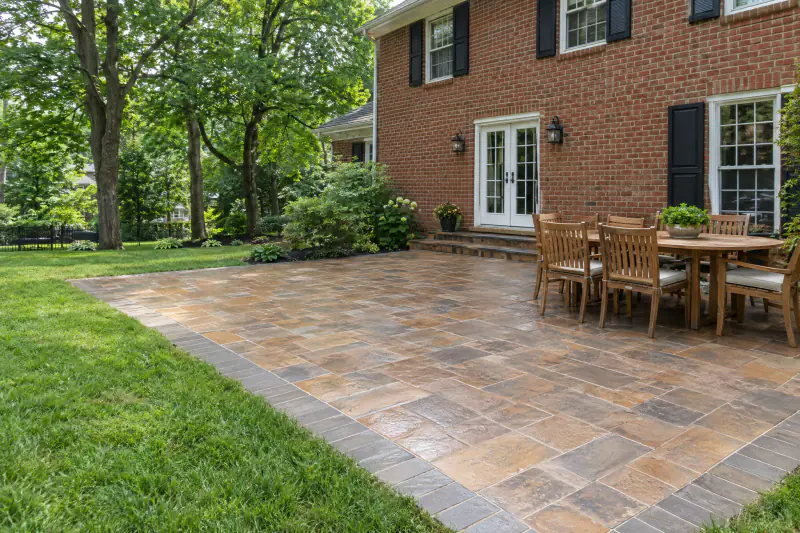
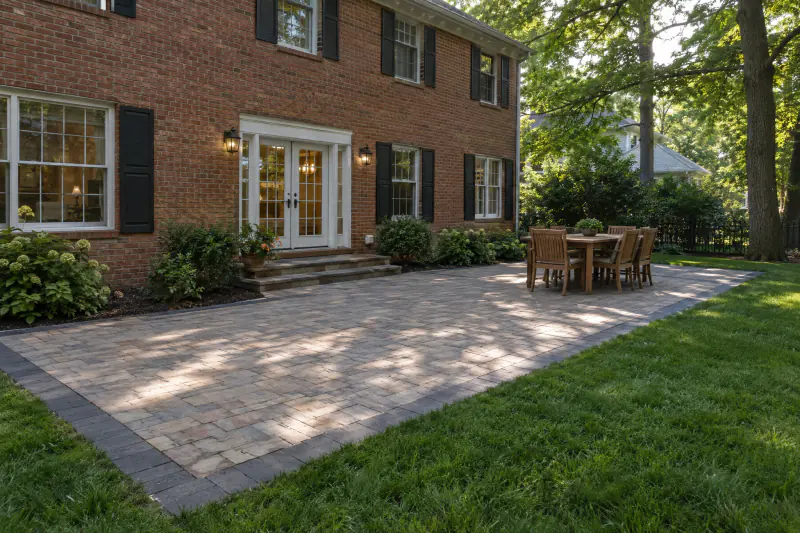
It is a six-step sequence spread over several days: clean the surface and flush the joints, treat stains and efflorescence, let everything dry, refill the joints with polymeric sand, apply sealer to dry pavers, and let it cure. Most sealed paver surfaces in Northern Virginia are resealed every two to four years, with joint sand topped up at the same time. Unsealed pavers simply need their joints kept full. The point of the work is not the shine. It is that full joints keep the pavers locked together and sealer slows the fading, staining and sand erosion that undo a patio one season at a time.
The reason the sequence matters is that every step depends on the one before it being finished and dry. Sand swept into damp joints clumps and never bonds. Sealer applied over efflorescence locks a white haze under a clear film. Sealer applied over moisture turns cloudy. Polymeric dust left on the paver faces hardens into a residue that can take a specialized cleaner to remove. Nearly every paver complaint we are asked to fix is a step that was rushed, skipped or done in the wrong weather.
This guide goes through each step in the order it happens, then covers sealer selection, cure times, how often to repeat it and the mistakes that trap moisture. The service page for paver cleaning and sealing gives the short version. If the patio has sunk, heaved or lost its edge, that is a base problem to fix before any of this, and our article on why patios fail on clay explains what is happening underneath.
What is efflorescence on pavers, and how is it treated?
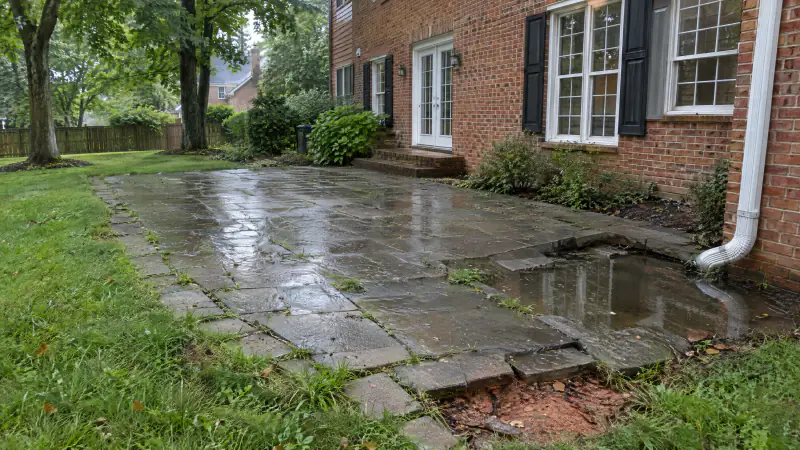
Efflorescence is the white, powdery or crusty haze that appears on concrete pavers as they dry. It comes from inside the paver. Water moving through the concrete dissolves calcium hydroxide left over from the cement curing, carries it to the surface, and leaves it behind as the water evaporates. There it reacts with carbon dioxide in the air to form calcium carbonate, which is the chalky deposit you see. It is most common in the first year or two after installation, when the pavers still hold the most free lime, and it is heaviest on surfaces that stay damp underneath, such as a patio over poorly drained clay or beside a downspout. Paver manufacturers describe it as a natural, cosmetic process that does not weaken the paver, and some of them suggest waiting at least two to three months after installation before sealing, and others a full year, so it has a chance to surface and be removed.
Treatment is a cleaner formulated for efflorescence on concrete pavers, applied to a wet surface, allowed to work briefly and rinsed thoroughly. These products are acidic, and the strength and dwell matter: a strong acid such as muriatic acid can etch the paver face, burn the color and leave a different kind of damage, so we use a paver-specific product, test a small area first and keep the plants soaked. Clay brick pavers get their own kind of efflorescence from soluble salts in the clay and are treated more gently.
The rule that follows is absolute. Efflorescence is never sealed over. A film-forming sealer applied on top of it traps the deposit and the next round rises beneath the film as a white cloud that cannot be rinsed off. If a surface shows haze after cleaning and drying, it gets another treatment and another dry period before any sealer is opened.
How do you clean pavers without blasting out the joints?
By separating two jobs that a careless wash does at once. The paver faces are cleaned with a rotating surface cleaner at moderate pressure, lower than a concrete driveway would get, which lifts algae, moss, dirt and most of the old sand haze evenly without cutting into the joints. The joints are then addressed deliberately with a wand held at an angle, flushing out weeds, moss roots and failed sand to the depth the new polymeric sand will need. That depth is intentional. Most polymeric sand manufacturers want the joint cleared well down, commonly at least an inch to an inch and a half, so the new sand has enough body to bond and resist washout. A wand aimed straight down at full pressure does this uncontrollably and also lifts the bedding sand beneath the pavers, which is the one thing that must stay put.
Stains are handled before the general wash so the machine does not spread them. Grease from a grill, rust from furniture or fertilizer, leaf and acorn tannins, red clay tracked from the lawn and black mildew in shaded corners each respond to a different cleaner. Chewing gum and candle wax are scraped cold. The order is stains first, efflorescence treatment, surface cleaning, joint flushing, then a thorough rinse that carries the debris off the patio and onto the lawn rather than into a storm drain, since drains in Fairfax, Loudoun, Prince William and Arlington flow untreated to local streams.
Loose, rocking or sunken pavers are found during cleaning, and this is the moment to lift and reset them on fresh bedding sand before the joints are filled. Weeds are pulled or treated and allowed to die before sanding. Then the patio dries, which is the step most often shortchanged. Joints need one to two full dry days, more in shade or after heavy rain, before polymeric sand can go in. We cover the cleaning rules for concrete and other hard surfaces in our guide to pressure washing after pollen season.
How is polymeric sand installed so it does not haze or fail?
Polymeric sand is ordinary jointing sand blended with binders that set when wetted. The binders are also what cause haze when the sequence is wrong.
Start with dry pavers and dry joints
The surface, the joints and the forecast all have to be dry. Sand swept into damp joints clumps on contact and never settles to the bottom. Most products also want temperatures above freezing and dry weather, and the label governs, since some call for warmer surfaces.
Sweep in and work it down
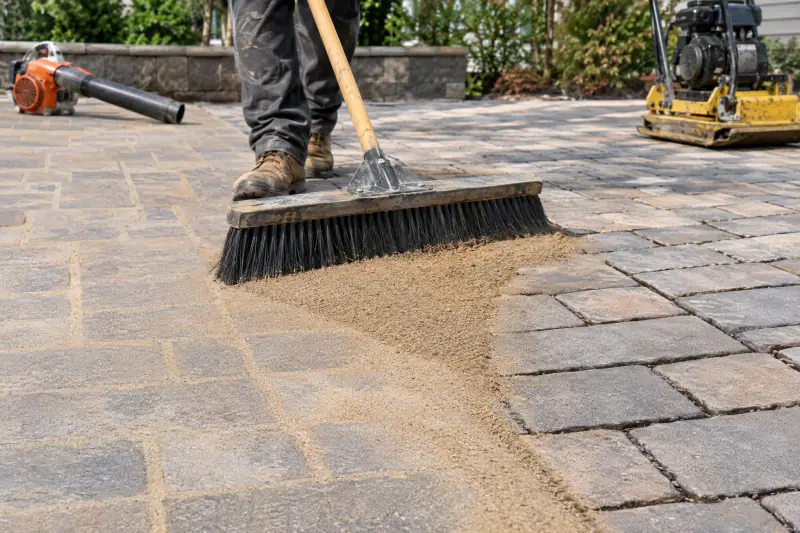
Sand is spread and swept diagonally across the joints with a stiff broom so it fills from the bottom up rather than bridging at the top. Wide joints and tumbled pavers take more than people expect.
Compact and top up
A plate compactor with a protective pad vibrates the sand down into the joints and settles it. The joints drop noticeably, so they are swept again and topped up. Compacting is what gives the sand its density and strength.
Leave the joints slightly low
The final level sits just below the paver edge, at about the bottom of the chamfer. Sand mounded above the edge is the first to scuff and wash out, and it holds water on the faces.
Blow every grain off the faces
A leaf blower held low and at a shallow angle clears sand and dust from the paver surfaces and the chamfers without lifting it out of the joints. Any polymer dust left on the faces sets into haze when it is wetted.
Mist in stages, never flood
The surface is misted lightly, enough to darken the sand, in two or three passes a few minutes apart, working in sections so no area dries before it is wet. Flooding floats the binders onto the faces and washes sand out. Then it needs the hours the product specifies with no rain and no sprinklers.
Which paver sealer type fits which patio?
Sealers differ in what they do to the look, whether they breathe, and how much moisture they can tolerate underneath.
| Sealer type | Look | Breathes? | Joint sand | Typical reseal | Where it fits |
|---|---|---|---|---|---|
| Penetrating silane or siloxane | No visible change, water beads | Yes | Not stabilized | About 3 to 5 years | Natural stone, driveways with salt exposure, anyone who wants no sheen |
| Water-based acrylic film, matte to satin | Mild color enhancement, low sheen | Partly | Most products stabilize sand | About 2 to 4 years | Most patios and walkways, shaded or damp sites |
| Solvent-based acrylic, wet look | Dark, rich color with gloss | Little | Some bind the surface | About 2 to 3 years | Sunny, well-drained patios where a wet look is wanted |
| Urethane or hybrid film | Satin to gloss, very durable | Little | Usually stabilized | About 3 to 5 years | High-traffic surfaces, pool surrounds with a grip additive |
| Joint-stabilizing sealer | Matte to satin | Partly | Designed to bind sand | About 2 to 4 years | Patios where joint erosion is the main complaint |
Reseal intervals are typical ranges for Northern Virginia sun, shade and freeze-thaw. Check the manufacturer's guidance for the product used.
Film-forming or penetrating, wet look or natural: how do you choose?
Start with moisture, then with the look. A penetrating sealer soaks into the top of the paver and reacts there, leaving nothing on the surface. It keeps the natural color, does not change traction, lets water vapor pass through freely, and cannot peel or cloud because there is no film to do either. Its limits are that it does not bind joint sand and does nothing for faded color. On a patio that stays damp, over clay that drains slowly, beside a downspout or on natural stone such as travertine or bluestone that needs to breathe, penetrating is the safe choice.
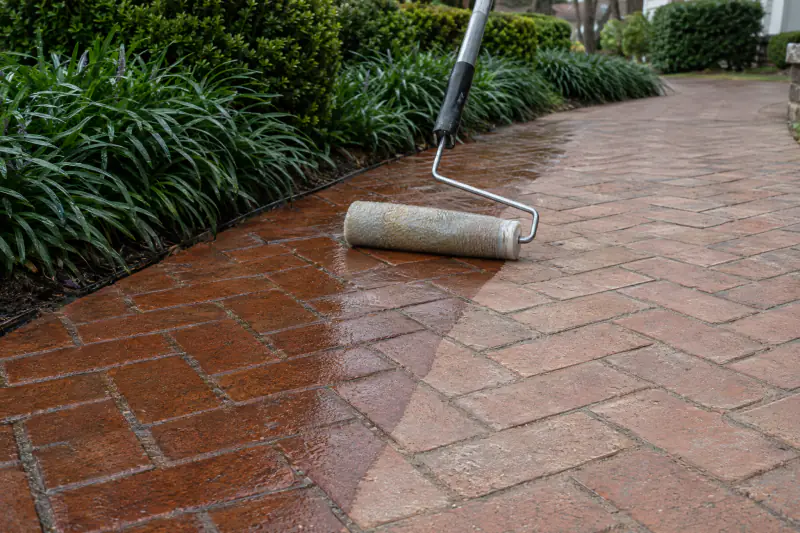
A film-forming sealer sits on the surface as a thin coat. Water-based acrylics give a mild color boost and a matte or satin finish, most of them stabilize the joint sand, and they tolerate a little residual moisture because they breathe somewhat. Solvent-based acrylics give the deep wet look and the gloss, enhance faded color dramatically, and are less forgiving: they can trap moisture and whiten, build up with repeated coats until they need stripping, and turn slick when wet on smooth pavers. A grip additive in the final coat helps around pools and on steps.
Two compatibility rules save a lot of trouble. Water-based over an old solvent-based film often will not bond, and solvent-based over an old water-based film can lift it, so an unknown old sealer is tested or stripped before anything new goes on. And sealer always goes on in thin, even coats with puddles back-rolled out, because excess sealer is the most common cause of the white, peeling patches people describe as a bad product. The pavers also play a part: tumbled and textured pavers hide a satin finish well, while smooth, dense pavers show every lap and benefit from a sprayer and a back-roll. Northern Virginia sits in a region where Virginia limits solvent content in coatings, so the solvent-based products sold here are reformulated versions, and the label governs on recoat and cure.
What are the cure times and weather windows for sand and sealer?
Most sealers want surface temperatures between about 50 and 90 degrees, a surface that has been dry for 24 to 48 hours, and no rain for roughly 24 hours after application. Foot traffic is typically fine after about 24 hours and vehicles after 48 to 72, with planters, rugs and furniture kept off for a few days so nothing imprints or traps moisture. Polymeric sand has its own clock: a rain-free period after activation, often 24 hours, before the joints are strong enough to shrug off a downpour. Every product publishes its own numbers, and they vary enough that the can is the authority, not the general rule.
In Northern Virginia that translates to a working season from late May, once the pollen has finished and the nights are mild, through early October. The spring and fall shoulders need care because a sunny 70-degree day can be followed by a 45-degree night with heavy dew, and sealer that is still curing at dusk can blush. Midsummer is possible on well-drained, sunny patios, but afternoon storms come up fast, and a shaded patio in July is often still damp at noon from the previous night's dew. The fall version of this calendar, with the last reliable window before freezing nights, is in our guide to sealing pavers before freeze-thaw season.
Shade stretches every one of these times. A patio under oaks on the north side of a house in Reston, Burke or Great Falls can take twice as long to dry between steps as a sunny patio in Ashburn, and the schedule is written around the patio, not the calendar. Sprinklers are turned off for the duration, because one zone running at 5 a.m. onto curing sealer is the end of the job.
How often should pavers be resealed in Northern Virginia?
Every two to four years for most film-forming sealers and three to five for penetrating ones, with the real answer coming from a water test rather than a calendar. Pour a cup of water on the pavers in a sunny, high-traffic spot. If it beads and sits, the sealer is still working. If it darkens the pavers and soaks in within a minute, the sealer has worn through and the surface is absorbing water, dirt and stains again. Check the shaded end and the sunny end separately, because they wear at different rates.
What shortens the interval is sun, vehicles, pool chemicals and de-icing salt, which is why a south-facing driveway or a pool surround sits at the short end of the range and a covered, lightly used patio at the long end. What makes resealing too often a problem is buildup. Each coat of a film-forming sealer adds to the last, and after several rounds the film gets thick enough to trap moisture, whiten and peel, at which point it has to be stripped to bare paver, which is slow and expensive. Resealing when the water test says to, in thin coats, avoids that cycle. Joint sand is inspected on the same visit and topped up wherever it sits below the chamfer.
We do not sell recurring maintenance plans, so each resealing is scheduled as its own project when the patio asks for it. Between visits, the upkeep is light: sweep, rinse, keep leaves from sitting through fall, use a plastic shovel in winter and go easy on de-icers. Our maintenance and care guide covers that routine for pavers alongside decks, drains and lawns.
Which mistakes trap moisture under a paver sealer?
Cloudy, white or peeling sealer almost always comes back to water that had nowhere to go.
- Sealing pavers that were washed yesterday and still hold water below the surface.
- Sealing a patio with visible efflorescence, so the next round rises under the film.
- Applying sealer in the evening or on a day when dew will form before it cures.
- Laying it on thick or leaving puddles instead of back-rolling thin, even coats.
- Using a solvent-based wet look sealer on a shaded patio over slow-draining clay.
- Sealing a brand-new installation before the pavers have had 60 to 90 days to settle and shed efflorescence.
- Resealing every year with a film-forming product until the buildup whitens and peels.
- Sealing while a downspout or sprinkler keeps one section of the patio permanently damp.
- Sealing over polymeric sand that was activated the same day and is still wet inside the joints.
What should be repaired before pavers are sealed?
Anything that moves water the wrong way or lets the pavers move. Sealing is a surface treatment, and it cannot hold a patio together from the top. A sunken section beside the house usually means a downspout has been washing the bedding sand out of the base for years. A heaved ridge across a walkway means water under the pavers froze and lifted them. Rocking pavers along an edge mean the edge restraint has failed and the field is spreading. Each of those is fixed by lifting the affected pavers, correcting the base or the restraint, relaying on fresh bedding sand and then re-sanding the joints, and that work happens before cleaning and sealing, not after.
Water is the common thread. If a patio stays damp at one end, the sealer there will cloud and the joints will fail first no matter what product is used. Redirecting a downspout through a buried discharge line, adding a channel drain where a slope meets the patio, or regrading the lawn beside it are the kinds of fixes that make a sealing job last. Our yard drainage solutions page describes the options, and the base and drainage principles behind a patio that stays flat are laid out on the paver patios page.
A worn, patchy old sealer is the last thing to deal with. If the water test shows some areas beading and others soaking, the old film is failing unevenly and a new coat over it will fail the same way. Stripping is a job of its own, with its own cleaners and its own dry time, and it is priced separately. When the old sealer has mostly worn away evenly, a thorough cleaning and a compatible product are often enough. The site visit is where that call gets made.
How much does paver cleaning and sealing cost in Northern Virginia in 2026?
As of 2026, cleaning, polymeric re-sanding and sealing a paver surface in Northern Virginia typically falls in a market planning range of about $1.50 to $4 per square foot, which puts many patios and walkways between roughly $600 and $2,500 and larger driveways and pool surrounds above that. Cleaning alone, without sand or sealer, is the smallest version of the job. Cleaning and re-sanding without sealer sits in the middle. These are market figures, not myYardPros prices, and the range is wide because the work varies so much from one patio to the next.
What moves the number: total square footage, how much failed sand has to be flushed and replaced, joint width and paver style, since tumbled pavers with wide joints take far more sand, the amount of efflorescence and staining to treat, the sealer type and number of coats, and access for equipment. Stripping a failed old sealer can add as much as the sealing itself. Lifting and resetting sunken or heaved pavers is repair work and is priced separately, as is any drainage correction. A penetrating sealer and a premium urethane sit at different price points per gallon, and a wet look solvent-based product usually wants two coats where a water-based matte needs one.
We measure the surface, check the joints, test the old sealer and look at the drainage before writing a number. When you are ready, request a written on-site estimate or call (571) 200-9600 and we will walk the patio with you. The cost guide places paver sealing alongside other exterior cleaning and hardscape work if you are planning more than one project.
What is different about sealing pavers in Fairfax, Loudoun, Prince William and Arlington?
Clay, shade and salt, in roughly that order. Most of the region sits on dense red clay that drains slowly, so a paver patio built without enough base or without a way for water to leave stays damp underneath, grows efflorescence and resists sealing. Newer neighborhoods in Ashburn, South Riding, Gainesville and Bristow often have patios installed during construction on compacted subsoil, and those are the ones that show white haze along the house and sunken corners within a few years. Older, wooded lots in Reston, Burke, Springfield, Vienna, Oakton and Great Falls have the opposite problem: deep shade that keeps pavers damp and mossy, where a breathable sealer and a longer dry time are the rule.
Salt is the winter factor. Paver driveways and front walks in Leesburg, Purcellville, Haymarket and other communities that see more snow collect more de-icer, and the sealer on those surfaces wears faster and matters more, since it reduces how much salt the pavers absorb. Arlington, Alexandria and Falls Church add more clay brick walks and older installations with sand-set brick in narrow joints, which take polymeric sand differently and sometimes not at all. Manassas, Manassas Park, Woodbridge and Lorton see a mix of all of it.
Sealing does not require a permit anywhere in the region, and most homeowners associations have no rule about it, though a dramatic wet look change on a front walk in a strict community is worth a quick check. We clean, re-sand and seal pavers across Fairfax, Loudoun, Prince William and Arlington counties and the cities of Alexandria, Fairfax, Falls Church, Manassas and Manassas Park. Our service areas page lists each community by county.
Frequently asked questions
Can pavers be cleaned, sanded and sealed in one visit?
No, and a crew that offers to is skipping the drying. Joints need one to two dry days after washing before polymeric sand will settle and bond, and the sand then needs its own curing period before sealer goes over it. The pavers must be dry below the surface, not just on top, or the sealer clouds. A proper job is two or three visits over several days, weather permitting.
Does sealing stop weeds in the paver joints?
It helps, but the polymeric sand does more of that work than the sealer. Hardened sand resists seeds rooting from below and ants tunneling up. Over time, windblown dirt settles on top of the joints and seeds sprout in that thin layer, which is cosmetic and easy to rinse out. A joint-stabilizing sealer adds a crust that slows this further. Empty or crumbling joints are what let real weeds take hold.
Can new sealer go over an old sealer?
Only if the two are compatible and the old film is sound. Water-based over solvent-based often will not bond, and solvent over water-based can lift the old coat. If the existing product is unknown, a test patch tells us. An old sealer that is peeling, cloudy or built up thick has to be stripped first, which is a separate job. A sealer that has simply worn thin and even can usually be cleaned and recoated with a matching type.
Why did my paver sealer turn white or cloudy?
Moisture, almost always. Either the pavers were still damp when sealed, dew formed before the sealer cured, or water later migrated up through the pavers and could not escape through the film. Efflorescence trapped under the sealer looks similar. Some solvent-based clouding can be reversed by reactivating the film with the right solvent, but water-based clouding generally means stripping and resealing once the surface is truly dry.
Is polymeric sand suitable for driveways and pool decks?
Yes, within the joint widths the product allows, commonly up to about an inch for standard sand and wider for products made for larger gaps. Driveways benefit from the washout resistance under tires. Pool decks benefit because the sand resists chlorinated splash. Both need the same dry installation and careful activation. Around a pool, a matte sealer with a grip additive is a better pairing than a gloss finish.
Do natural stone, travertine or clay brick pavers get the same treatment?
Not quite. Natural stone and travertine are more absorbent and need a breathable penetrating sealer rather than a heavy film, which can trap moisture and spall the stone in freeze-thaw. Clay brick pavers have narrower joints that may not take polymeric sand and a different efflorescence chemistry. Each is cleaned at lower pressure after a test spot. We identify the material on the site visit and match the products to it.
Will sealing change the color of my pavers?
A penetrating sealer will not, apart from making water bead. A water-based film gives a mild, slightly deeper tone with a matte or satin finish. A solvent-based wet look sealer darkens and enriches the color noticeably and adds gloss, which is the point of it. Faded pavers gain the most from an enhancing sealer. We apply a test patch in an inconspicuous spot so you can see the finish before the whole patio is coated.
Book the work
Put the plan in writing with a crew that builds this every week.
One visit to measure and talk through options, then a written scope and price. No pressure, no vague numbers. Ask about the Heroes Discount if you serve.
Sources and further reading
- Belgard: paver care, efflorescence and sealing guidance
- Unilock: paver maintenance and sealing technical information
- Alliance Designer Products: polymeric sand installation instructions
- Fairfax County Department of Public Works and Environmental Services: stormwater management
- Virginia Administrative Code, 9VAC5-45 Article 5: VOC limits for architectural coatings in the Northern Virginia emissions control area
Published May 14, 2026. Reviewed and updated October 9, 2026.