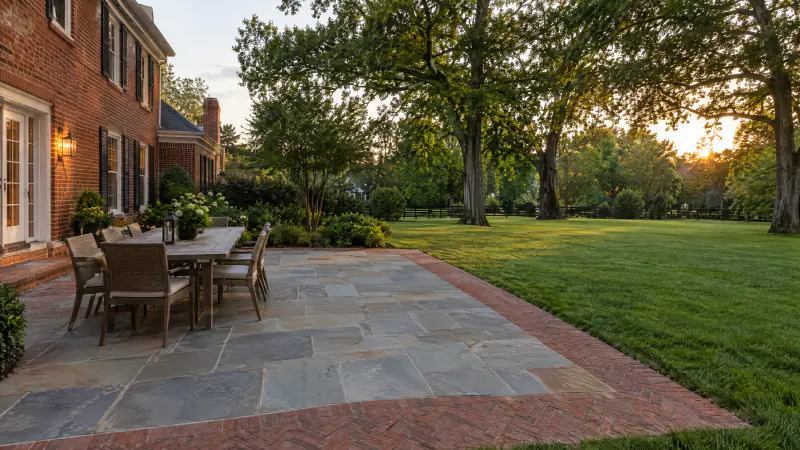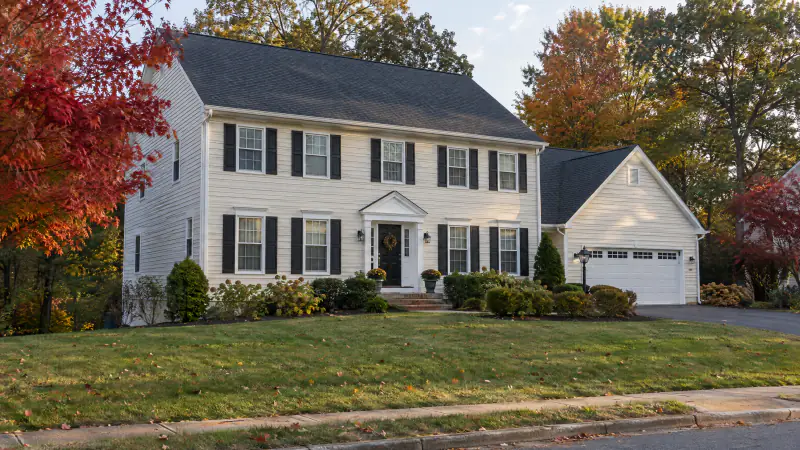
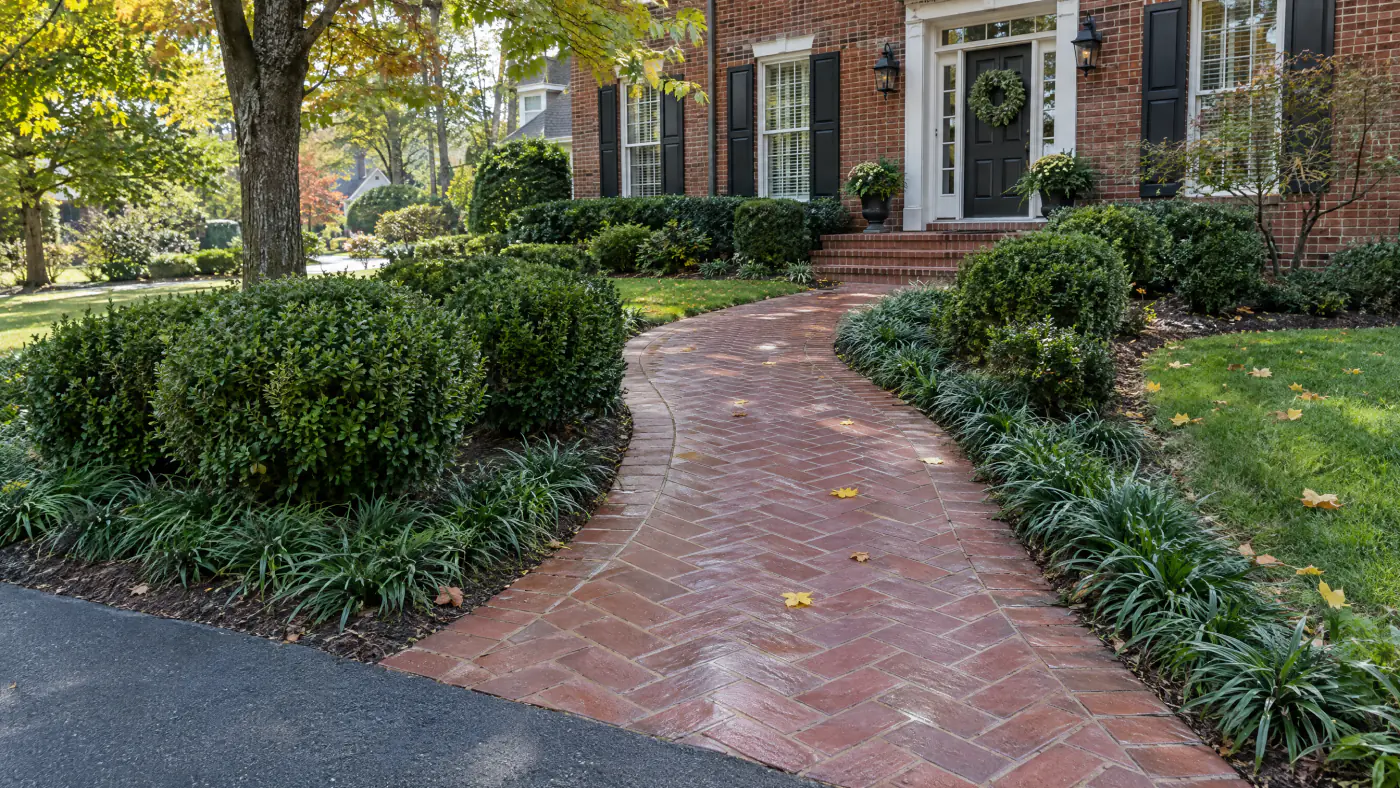
Key takeaways
- The reliable fall window runs from September to about mid-October, and it closes when nights drop below roughly 50 degrees, not when the days do.
- Freeze-thaw works on the joints and the bedding beneath the pavers more than on the pavers themselves. Full, stabilized joints and a sealed surface keep the water out.
- Rock salt and most chloride deicers accelerate the damage and leave residue. Sealed pavers absorb less of it, and sand gives traction without the chemistry.
- Fall prep means leaves off daily, tannin stains treated, a longer dry time than spring, and sealing in the middle of a mild day with a dry forecast.
- As of 2026, typical Northern Virginia market ranges run about $1.50 to $4 per square foot for cleaning, re-sanding and sealing, with cleaning and sealing alone toward the lower end.
On this page
- When is the last reliable window to seal pavers before freeze-thaw season?
- What does freeze-thaw do to unsealed pavers and joints?
- Which deicers damage pavers, and what should you use instead?
- Why do night temperatures decide the sealing date, not daytime highs?
- How is a paver surface prepared for sealing in the fall?
- Which sealer protects best through a Northern Virginia winter?
- How does joint sand stabilization help in winter?
- What should not be sealed this fall?
- Do concrete walks, stoops and steps need sealing before winter too?
- How should sealed pavers be treated through the winter?
- How much does fall paver sealing cost in Northern Virginia in 2026?
- How does the sealing deadline shift across Fairfax, Loudoun, Prince William and Arlington?
- Frequently asked questions
When is the last reliable window to seal pavers before freeze-thaw season?
From now until about the middle of October, and the deadline is set by the nights. Most paver sealers want surface temperatures above roughly 50 degrees during application and for a day or so afterward while they cure, polymeric sand needs dry joints and mild weather of its own, and in Northern Virginia the overnight lows start dipping into the 40s regularly by mid-October. A 68-degree afternoon in late October looks fine on the forecast, but the sealer applied at noon is still curing at midnight when the pavers are 44 degrees and wet with dew. Around Dulles the first freeze typically arrives in late October, a little later closer to the city. After that the work waits for May.
September is the comfortable month. Days are warm, nights are mild, humidity has dropped from August, and the pollen that complicates spring sealing is long gone. The first half of October is still good on most properties, with the shaded ones needing the most care. We write about the full cleaning, re-sanding and sealing sequence in our paver cleaning and sealing guide. This article is about the fall-specific questions: what winter does to pavers that are not sealed, how deicers make it worse, how the surface is prepared when leaves are falling, which sealer protects best through a freeze, and what should not be sealed at all this late in the year.
The service itself is on our paver cleaning and sealing page. Scheduling runs tight in October, so a patio or walkway that needs sealing this year is best booked in September.
What does freeze-thaw do to unsealed pavers and joints?
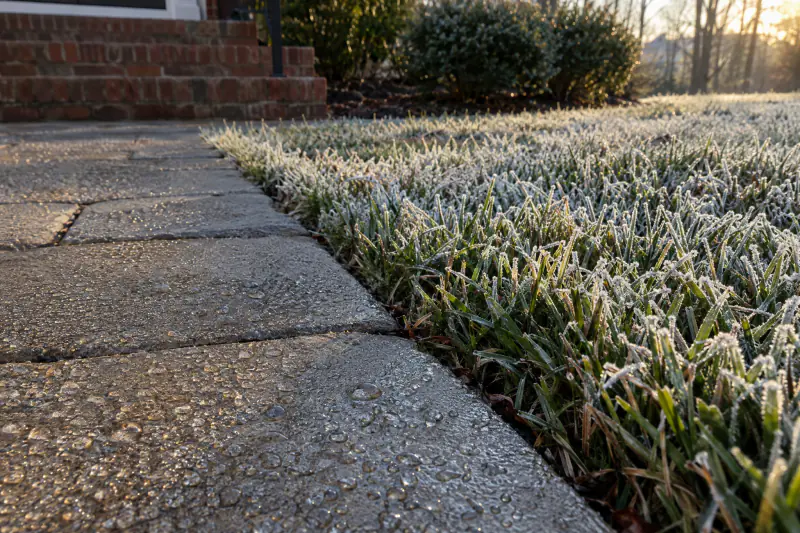
It works on the water, and the water is in the joints and the bedding sand more than in the pavers. Water expands by about nine percent when it freezes. A good concrete paver is dense enough to shrug that off: the standard most manufacturers build to limits water absorption to a few percent and calls for high compressive strength, which is why pavers outlast poured concrete in this climate. The joints are the weak point. When joint sand has washed out, every rain and every snowmelt runs straight down between the pavers into the bedding layer. That water freezes, lifts the pavers above it a fraction of an inch, thaws and lets them settle slightly differently, and repeats the cycle dozens of times in a Northern Virginia winter. By March the walkway has a ridge, a dip or a paver that rocks.
Clay soil makes the cycle worse. Most of the region sits on dense red clay that holds water instead of draining it, so a base that is saturated in November stays saturated through the freeze and heaves more. A patio built with enough compacted base and a way for water to leave rides out winter well; one built on scraped subsoil does not, and sealing the surface will not change that. Our article on choosing pavers for freeze-thaw covers what a patio built for this climate looks like underneath.
The pavers themselves are not immune. Lower-grade or older pavers, some natural stones such as softer sandstone and limestone, and the mortar on brick or stone steps all absorb more water, and water that freezes inside them pops the surface off in flakes, which is called spalling. Sealing reduces how much water those materials take on, and that is the direct benefit of doing it before the first freeze rather than after the first flake.
Which deicers damage pavers, and what should you use instead?
Every chloride deicer increases the number of freeze-thaw cycles a surface goes through and leaves a residue behind. Some are worse than others.
| Product | Works down to roughly | Effect on pavers and concrete | Effect on plants, pets and metal | Our view |
|---|---|---|---|---|
| Rock salt (sodium chloride) | About 15 to 20 degrees | Increases freeze-thaw cycles, leaves white residue, spalls weak surfaces | Burns turf and shrubs along the edge, corrodes railings | Use sparingly, only after shoveling |
| Calcium chloride | Well below zero | Works fast but drives more melt-refreeze cycles, can leave an oily film | Irritates paws, corrosive to metal | Small amounts on steps only |
| Magnesium chloride | About zero | Reported to attack the cement paste in concrete over time | Milder on plants than rock salt | Avoid on concrete and pavers |
| Potassium chloride or urea blends | About 20 to 25 degrees | Less surface damage, but weak and slow | Fertilizer runoff into streams | Not worth it on walks |
| Calcium magnesium acetate | About 20 degrees | Among the gentlest on concrete surfaces | Low plant and pet toxicity | Good choice near beds, more costly |
| Sand or fine grit | Any temperature | No chemical effect, adds traction | Tracks indoors, sweeps up in spring | First choice on sealed pavers |
Check the guidance from your paver manufacturer, since many advise against any deicer during the first winter after installation.
Why do night temperatures decide the sealing date, not daytime highs?
Because sealer cures over hours, not minutes, and the hours after dark are when the surface gets cold and wet. Water-based film sealers need the water to leave the film and the resin to fuse before they are durable, and that process slows sharply as the pavers cool. Solvent-based sealers need their solvent to evaporate, and cold, humid air holds it in the film. Penetrating sealers react with the paver and need time and mild conditions to do it. Dew is the other factor: on a clear October night the pavers cool below the dew point and water condenses on a film that is not finished, which turns it cloudy or leaves it soft enough to hold the imprint of a leaf.
Fall adds a wrinkle that spring does not have. The sun is lower and the days are shorter, so a shaded walkway that dried by noon in June may not dry until mid-afternoon in October, which leaves only a few warm hours before evening. The same patio under oaks on the north side of a house in Reston, Burke or Great Falls may be sealable on a sunny September Saturday and not sealable at all two weeks later. That is why we schedule fall sealing around the specific surface and the ten-day forecast rather than a date.
The rule we use is simple. The sealer goes on in the middle of a mild day, the forecast low that night is well above 50, and no rain is expected for 24 hours. The product label governs, because the limits vary, and a few sealers are formulated to go on at lower temperatures. When the nights no longer cooperate, the job waits for spring. Sealer applied in November on a warm afternoon is one of the most common reasons we are asked to strip and redo a patio the following year.
How is a paver surface prepared for sealing in the fall?
The sequence is the same as spring, with leaves, tannin and slower drying added to it.
Clear and inspect
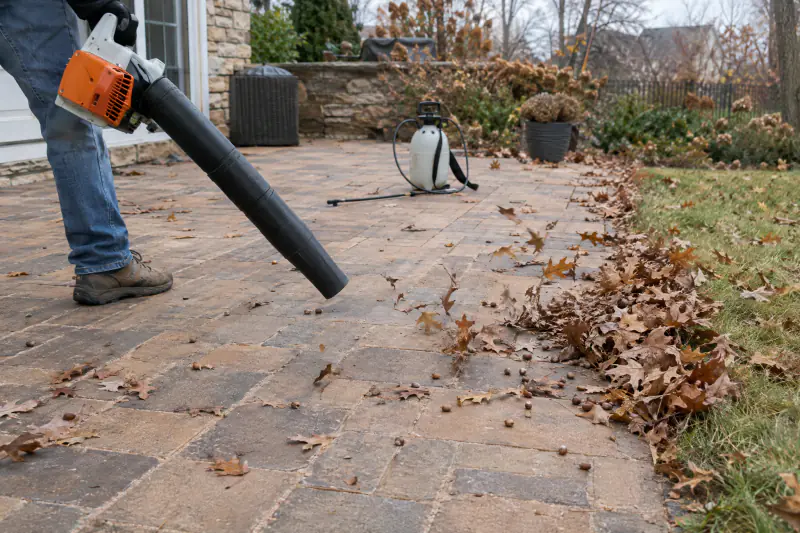
Leaves, acorns and debris come off, and the surface is checked for sunken or heaved sections, rocking pavers, empty joints, old sealer and the first signs of salt flaking near the entry. Repairs are done before any cleaning.
Treat the fall stains
Brown tannin shadows from leaf piles, black stains from walnut hulls, rust from furniture moved for the season and moss in the shaded corners each get their own cleaner before the general wash.
Clean the surface and flush the joints
A surface cleaner at moderate pressure lifts the summer's algae and dirt. Failed joint sand is flushed to the depth new sand needs, and efflorescence is treated if present.
Dry longer than you think
Fall drying is slower. Two to three dry days is typical, and a shaded surface can take more. The joints and the pavers must be dry below the surface before sand or sealer goes on.
Re-sand and keep the leaves off
Polymeric sand is swept in, compacted, topped up, blown clean and misted lightly. Leaves that land during curing are blown off daily so they do not stain or hold moisture.
Seal mid-day and protect the cure
Sealer goes on in thin, even coats in the warmest part of a dry day with a mild night ahead. Sprinklers stay off, foot traffic waits about a day and vehicles two to three, per the product.
Which sealer protects best through a Northern Virginia winter?
For a driveway, front walk or steps that will see salt and shovels, a penetrating silane or siloxane sealer is usually the right choice. It soaks into the paver and reduces water absorption without leaving a film on the surface, so there is nothing to peel under a plow blade, nothing to turn slick under frost, and nothing to trap moisture and cloud. Water and the salt dissolved in it bead on the surface instead of soaking in, which is exactly the protection freeze-thaw and deicers call for. It leaves the color alone, which some homeowners count as a drawback and others as the point.
For a patio or a walkway that gets less salt, a water-based film sealer with joint stabilization is the common choice. It gives a mild color boost and a matte or satin finish, most products bind the top of the joint sand so it resists washout, and water-based films breathe enough to tolerate the slight moisture that a fall surface carries. The wet look solvent-based sealers are the ones we steer away from in fall: they are the least breathable, the most likely to cloud if dew catches them, and the slickest under a skim of ice on steps. If a homeowner wants that finish, spring is the season for it.
Natural stone and clay brick are treated with the breathable penetrating products, because a film on an absorbent stone is how spalling starts. Whatever the product, the compatibility rule holds: an old sealer of unknown type is tested or stripped before a new one goes on. Our pavers vs. stamped concrete guide explains why pavers come through winter better than a poured slab, and sealing is a large part of keeping that advantage.
How does joint sand stabilization help in winter?
Full joints are the first line of defense against freeze-thaw, and stabilized joints stay full. A paver surface is designed so that the sand between the pavers locks them against each other and sheds most rain across the top. When the joints are full, water has to work its way through sand to reach the bedding layer, and most of it runs off instead. When the joints are empty, the surface drains like a grate straight into the base, and winter does the rest. Polymeric sand, which hardens when wetted, holds up to rain, snowmelt and the plow far better than loose sand, and a joint-stabilizing sealer applied over it binds the top of the joint into a crust that resists both erosion and the ants that mine joints in spring.
The fall details matter. Polymeric sand needs the same dry joints and mild temperatures as sealer, and most products want a rain-free period after activation, so it is installed on the same mild days and given its curing time before the sealer goes over it. The joints are left slightly below the paver edge, at about the bottom of the chamfer, so a shovel or plow blade rides on the pavers and not on the sand. Joints that are mounded above the edge are scraped out by the first snow removal.
On a surface where the sand is mostly intact, topping up the low joints and stabilizing them with the sealer is often enough, and it is the lower-cost version of the fall job. On a surface where half the joints are empty, a full re-sand is the only honest fix, and it is better done this fall than after a winter of water in the base. A walkway that is already heaving or has lost its edge restraint needs the pavers lifted and the base corrected, which is walkway repair rather than sealing, and it comes first.
What should not be sealed this fall?
Sealing the wrong surface at the wrong time causes more work in spring than leaving it alone.
- Pavers installed within the last 60 to 90 days, which are still settling and shedding efflorescence.
- Any surface showing white efflorescence haze after cleaning and drying, until it is treated again.
- Pavers that are damp below the surface, which in fall can mean three or more days after washing.
- A surface with a failing old sealer that is cloudy, peeling or built up, until it is stripped.
- Sections that have sunk, heaved or lost their edge restraint, until the base is corrected.
- Any patio or walk once the forecast low drops below about 50 degrees or rain is due within a day.
- Natural stone or clay brick with a solvent-based film sealer, which can trap moisture and spall.
- Polymeric sand joints that were activated the same day and are still wet inside.
Do concrete walks, stoops and steps need sealing before winter too?
They benefit from it more than pavers do, because poured concrete is more absorbent and has no joints to drain through. The flaking and pitting on the front steps of so many Northern Virginia homes is salt-driven freeze-thaw damage: the surface absorbs salt water, the water freezes and expands in the top layer, and the surface pops off in thin scales. Once it starts it accelerates, because the rough surface absorbs more. A penetrating sealer applied to clean, dry concrete in September or early October slows that cycle considerably. It is applied after a pressure washing has removed the summer algae and the surface has dried for a day or two, in the same mild-day, dry-night conditions as paver sealer.
Steps deserve particular attention. They are shaded by the house, they are shoveled and salted hardest, and a slick step in January is a real hazard. Penetrating sealers do not change traction, which is why they are the right product there. Brick and stone steps with mortar joints get a breathable sealer and a careful look at the mortar, since cracked or missing mortar lets water straight into the step and no sealer fixes that. Repointing is masonry work and belongs before winter if the joints are open.
Stamped and colored concrete is the exception that wants a film sealer, usually a water-based or solvent-based acrylic that protects the color, and it is resealed on the same schedule as pavers. Asphalt driveways are a different material with their own sealcoating products and are not part of this work. If a concrete walk has sunk against the house and holds water at the foundation, the sealing conversation turns into a drainage one, and our yard drainage solutions page describes the fixes.
How should sealed pavers be treated through the winter?
Shovel first, salt last and lightly, and never chip ice. A plastic shovel or a plow with a rubber or polyurethane edge clears snow without scuffing the sealer or catching a paver edge. Snow that is removed promptly does not melt into the joints and refreeze. Where traction is needed on steps and the entry walk, sand or fine grit works at any temperature and has no chemistry, and it sweeps up in spring. If a deicer must be used, the gentler products in the table above, applied sparingly after shoveling, do far less harm than a broadcast of rock salt before the snow. Most paver makers also ask that no deicer touch a new installation in its first winter, so read the care sheet that came with yours.
Ice chipping is the habit that does the most damage. A metal scraper or a hammer on a frozen paver chips the edge, and a chipped edge absorbs water and salt and spalls from there. Let the sun and a light application of a gentle deicer do the work, or spread sand for traction and wait. Keep downspouts discharging away from the walk, because a downspout that dumps across a front path builds the same sheet of ice every night for a week. Sealer also makes spring easier: the leaf, salt and winter grime rinse off a sealed surface with a hose, where an unsealed one needs a cleaning.
We put the full set of winter habits for paver driveways, including plow settings and which products to keep off a new driveway, in our guide to snow, salt and pavers, and the year-round routine is in our maintenance and care guide.
How much does fall paver sealing cost in Northern Virginia in 2026?
As of 2026, cleaning, polymeric re-sanding and sealing a paver surface in Northern Virginia falls in a typical market planning range of about $1.50 to $4 per square foot, which puts many patios and walkways between roughly $600 and $2,500 and larger driveways above that. Cleaning and sealing without a full re-sand, where the joints are mostly sound and only need topping up, sits toward the lower end of that range. Sealing a plain concrete walk and steps with a penetrating product is usually a smaller line than the pavers. These are market figures, not myYardPros prices, and they are wide because the condition of the surface drives the work.
What moves the number in fall: square footage, how much joint sand has washed out and has to be replaced, the amount of tannin, moss and efflorescence to treat, the sealer type, since penetrating products and premium urethanes sit at different price points per gallon, and whether an old sealer has to be stripped. Lifting and resetting heaved or sunken pavers is repair work and is priced separately, as is any drainage correction. The fall schedule is the other factor: the window is short, drying is slow, and the surfaces that need several dry days in a row are harder to fit in late October than in September.
We check the joints, test the old sealer, probe for movement and look at where water goes before writing a number. Before the window closes, request a written on-site estimate or call (571) 200-9600. The cost guide places paver sealing alongside the other fall projects if you are planning the season as a whole.
How does the sealing deadline shift across Fairfax, Loudoun, Prince William and Arlington?
By about two weeks from west to east, and by more than that from shade to sun. Western Loudoun around Leesburg, Purcellville and Aldie sits higher and cools earlier, so its nights fall below 50 degrees by early October and its first freeze arrives near the end of the month. Ashburn, Sterling, Herndon and Chantilly follow a few days behind. Arlington, Alexandria, Falls Church and the inner parts of Fairfax County such as McLean hold warmth longer, with pavement and tree cover keeping nights milder, and their window often runs to mid or late October. In Prince William County, Gainesville, Haymarket and Bristow track closer to Loudoun, while Woodbridge, Lorton and Dumfries along the Potomac stay a little milder. Manassas and Manassas Park sit in between.
Shade is the bigger variable. A sunny paver driveway in South Riding or Brambleton may be sealable into the third week of October, while a patio under oaks in Vienna, Burke, Springfield or Clifton is a September job, because it will not dry fast enough once the sun drops. Salt exposure also varies: communities with more snow and steeper driveways in western Loudoun and Prince William use more deicer, and sealing matters more there. Older brick walks in Arlington and Alexandria get breathable penetrating products and a look at the mortar.
Sealing does not require a permit anywhere in the region, and homeowners associations rarely have rules about it. We clean, re-sand and seal pavers and seal concrete walks across Fairfax, Loudoun, Prince William and Arlington counties and the cities of Alexandria, Fairfax, Falls Church, Manassas and Manassas Park. The communities we serve are listed on our service areas page.
Frequently asked questions
Can pavers be sealed in November if we get a warm week?
Rarely, and we usually advise against it. A warm November afternoon is still followed by a long, cold, damp night, and the sealer is curing through all of it. Shaded surfaces may not dry out at all between rains. A few products are formulated for lower temperatures, and a sunny, well-drained walk might qualify, but the risk of a cloudy or soft finish is high. Spring is the safer answer.
Will sealing stop salt damage completely?
No, but it reduces it a great deal. A sealed paver absorbs far less salt water, so fewer freeze-thaw cycles happen inside it and less residue is left behind. The joints and the base are still vulnerable if they are empty or saturated, and heavy, repeated salting will wear any sealer faster. Sealing plus full joints plus a light hand with deicer is the combination that gets a surface through winter unharmed.
Should I seal a paver driveway that was installed this summer?
Usually not this fall. Paver manufacturers commonly suggest waiting at least 60 to 90 days, and some a full year, so the pavers can settle and shed their first efflorescence, and a driveway installed in July or August may be right at that line as the window closes. Many homeowners wait for the following spring, which also lets the surface show any settling or base issues first. Keep deicer off it this first winter.
Does sealer make a walkway slippery under frost or ice?
A penetrating sealer does not change traction at all, which is why it is the choice for steps and entry walks. Film-forming sealers add some sheen and can be slicker when wet or frosted, especially gloss finishes on smooth pavers. A grip additive in the final coat offsets that. Ice is slippery on any surface, so sand for traction and prompt shoveling matter more than the sealer choice.
If the joints have already washed out, is it too late to re-sand this year?
Not if the nights are still mild. Polymeric sand needs dry joints, temperatures above freezing and a dry forecast, and a rain-free period after activation, with the product label setting the exact limits. In September and early October that is usually available. Empty joints going into winter are the single biggest cause of heaved pavers in spring, so re-sanding is the fall task to prioritize even if sealing has to wait.
Can a sealed paver driveway be plowed?
Yes, with the blade set up for it. A plow with a rubber or polyurethane edge, or shoes that hold the steel blade slightly above the surface, clears snow without scraping the sealer or catching a paver edge. Tell whoever plows that the driveway is pavers. A metal blade dragged flat across the surface chips edges and scuffs the finish, and that damage is the same whether the pavers are sealed or not.
Does sealer applied in the fall last as long as sealer applied in spring?
When it goes on in the right conditions, yes. The sealer does not know the month, only the temperature, the moisture in the pavers and the hours it had to cure. Fall-applied sealer that cured cleanly on dry pavers typically protects for the same two to four years as a spring application. Sealer that was rushed onto a damp, cooling surface in late October is the one that fails early, in either season.
Book the work
Put the plan in writing with a crew that builds this every week.
One visit to measure and talk through options, then a written scope and price. No pressure, no vague numbers. Ask about the Heroes Discount if you serve.
Sources and further reading
- National Weather Service, Baltimore/Washington forecast office: first freeze dates and climate data
- Belgard: paver sealing, winter care and deicer guidance
- Unilock: paver maintenance, sealing and winter care technical information
- Virginia Cooperative Extension publications on deicing salts and landscape plants
- NOAA National Centers for Environmental Information: U.S. Climate Normals
Published September 24, 2026. Reviewed and updated October 9, 2026.