Key takeaways
- Four sets of rules apply: the state fire code as enforced by your county or city fire marshal, building and gas permits, HOA covenants and the manufacturer's clearances for any insert or appliance.
- Model fire code language commonly keeps wood recreational fires about 25 ft from structures and portable outdoor fireplaces about 15 ft, but counties and HOAs vary. Check before you build.
- Gas features need a permit, a licensed gas fitter, a vented enclosure and a shutoff valve. Wood features need firebrick or a steel insert so flame never touches wall block.
- Seating sits about 6 to 7 ft from the edge of the fire, with a 3 ft path behind it, and the fire's back faces the prevailing wind so smoke leaves the patio.
- As of 2026, typical Northern Virginia ranges run from about $2,500 to $7,000 for a built-in wood pit, more for gas, and $8,000 to $30,000 for a masonry fireplace.
On this page
- What rules apply to a fire pit or outdoor fireplace in Northern Virginia?
- Gas or wood: which fire feature fits your yard and your rules?
- Built-in or portable: does it change the rules?
- What clearance guidance is typical for each kind of fire feature?
- What do open-burning rules mean for a backyard fire?
- Do you need a permit for a gas fire pit?
- Why do fire pits need firebrick, refractory mortar or a steel insert?
- How does an outdoor fireplace draw smoke, and why do some smoke?
- How do we lay out a fire feature and the seating around it?
- Which materials survive freeze-thaw around a fire feature?
- How much do fire pits and outdoor fireplaces cost in Northern Virginia?
- Why is fall the fire-feature season in Northern Virginia, and when should you build?
- What should you confirm before building a fire feature?
- How do fire feature rules differ across Fairfax, Loudoun, Prince William and Arlington?
- Frequently asked questions
What rules apply to a fire pit or outdoor fireplace in Northern Virginia?
Four, and they stack. The first is the Virginia Statewide Fire Prevention Code, which is based on the International Fire Code and is enforced locally by each county or city fire marshal. It is where the clearances for recreational fires, the limits on fire size, the rule that a fire must be attended and the authority to ban burning in dry weather come from. The second is the building side: a gas line to a fire feature needs a gas or mechanical permit and inspection, a masonry fireplace with a chimney may need a building permit, and a roof over any of it certainly does. The third is your homeowners association, which can be stricter than the county and often prohibits wood fires outright near townhomes. The fourth is the manufacturer: any steel insert, gas burner, portable bowl or prefabricated fireplace comes with listed clearances that a fire marshal will expect you to follow.
None of these rules stops a well-planned fire feature. They decide where it goes, what it burns and how it is built. The mistakes we see are almost always placement mistakes: a pit tucked against the house for convenience, a fireplace under the deck, a bowl on a wood deck, a wood fire in a community whose covenants forbid it. Each one is expensive to undo after the pavers are laid.
Because counties, cities and HOAs differ and change their rules, this guide gives the typical framework and typical numbers, and says plainly where you must confirm locally. Our fire pits and outdoor living page describes the structures we build; this article is about getting the rules, the layout and the materials right first.
Gas or wood: which fire feature fits your yard and your rules?
Wood gives heat, crackle and the smell of a campfire, and it brings smoke, sparks, ash and the strictest rules. Gas gives a clean flame at the turn of a valve, no ash, no sparks and far fewer restrictions, and it costs more to build because of the burner and the gas line. On a large lot in Great Falls, Clifton or western Loudoun with 25 ft of clear space in every direction, wood is a real option. On a townhome lot in Ashburn, Reston or Woodbridge, or in any community whose HOA bans open flame, gas is usually the only option, and often the better one anyway.
Rules push the decision. Fire code treats a wood fire as a recreational fire with distance, size and attendance requirements and the possibility of a burn ban. It treats a gas feature as an appliance with manufacturer clearances, which are generally shorter, and gas is exempt from open-burning restrictions because nothing is being burned in the open-air sense. Smoke drift is the other practical limit: a wood fire 20 ft from a neighbor's bedroom window on a still October night is a complaint waiting to happen, and most jurisdictions have a nuisance provision that lets the fire marshal order a fire out.
Fuel logistics matter too. Natural gas from the house meter is the most convenient and needs a licensed gas fitter to tap the line. Propane from a buried or concealed tank works where there is no gas service, with its own tank clearances. Wood needs seasoned, dry hardwood stored somewhere dry and a plan for ash. Most families who choose wood use the fire a handful of times each fall; most who choose gas use it weekly, and that frequency difference is worth weighing against the price gap. We covered how a fire feature fits into the larger plan for a patio in designing an outdoor room in Northern Virginia.
Built-in or portable: does it change the rules?
It does, in model fire code language, and it is the distinction most homeowners do not know exists. A built-in wood-burning pit, or any fire burning on the ground, is a recreational fire. The International Fire Code, which Virginia's code is based on, commonly limits a recreational fire to a pile about 3 ft across and 2 ft high and keeps it at least 25 ft from a structure or combustible material. A portable outdoor fireplace, which is the term for a store-bought steel bowl, chiminea or similar manufactured unit, is treated separately: it is to be used according to the manufacturer's instructions and kept about 15 ft from a structure, and the model code includes an exception to that distance for one- and two-family homes. Virginia adopts the model code with its own amendments, and counties enforce it with their own interpretations, so treat these as the starting point and confirm with your fire marshal's office.
Gas features are generally governed by their listing and manufacturer clearances rather than by the recreational fire distances, which is one reason a gas fire table can sit closer to a house than a wood pit can. The clearances still exist. Most gas fire pits specify a distance to combustible walls, a minimum overhead clearance to any roof or pergola, and a prohibition on use under a cover unless the unit is listed for it.
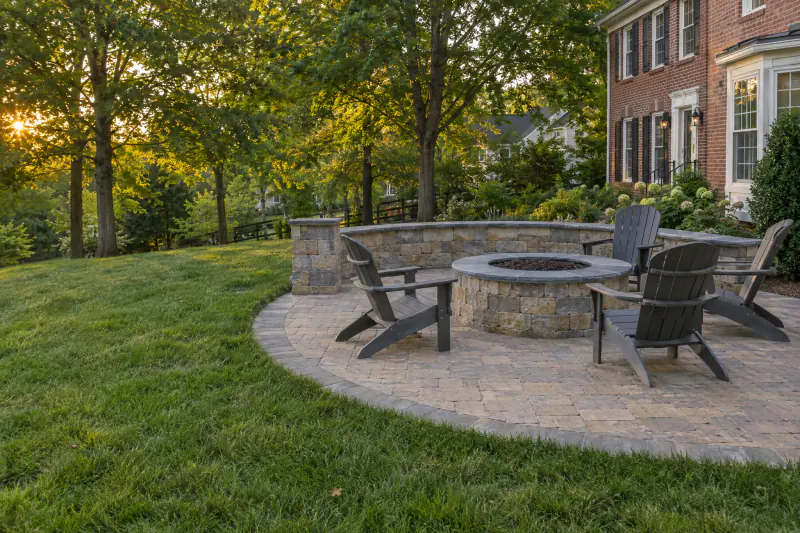
Nothing in the code makes a wood fire pit safe on a wood deck or under a deck, and nothing makes it a good idea. Built-in masonry fire features go on compacted base or a concrete footing on the ground, with hard surface around them, and if you want fire on a deck, it is a gas appliance listed for that use, set on a non-combustible pad, with the overhead clearance the maker requires.
What clearance guidance is typical for each kind of fire feature?
Typical figures drawn from model fire code language and common manufacturer instructions. Your county, city, HOA and product may differ, so confirm every number before building.
| Feature | Typical guidance | Who sets it | What to confirm |
|---|---|---|---|
| Built-in wood fire pit | About 25 ft from structures and combustibles; fire about 3 ft across and 2 ft high at most; attended at all times | State fire code via county or city fire marshal | Local amendments, burn bans, nuisance rules |
| Portable wood fireplace or bowl | About 15 ft from structures in model code, with a one- and two-family exception; use per manufacturer | Fire code and manufacturer | Whether your locality applies the exception; never on a wood deck |
| Gas fire pit or fire table | Manufacturer clearance to combustible walls, often several feet; overhead clearance to any roof; not under a cover unless listed | Manufacturer listing, gas permit | Vent openings, shutoff valve location, tank rules for propane |
| Masonry outdoor fireplace | Firebox opening faces away from the house; chimney clear of overhanging limbs and roofs; often a building permit | Building department and fire marshal | Permit trigger, footing, chimney height, spark arrestor |
| Overhead | No tree limbs, pergola rafters or deck above a wood fire; gas appliances need the listed overhead clearance | Fire code and manufacturer | Trim limbs or move the feature |
| Property line | Fire code usually measures to structures and combustibles, not lot lines; zoning accessory-structure setbacks and HOA rules may apply | Zoning office and HOA | Setback for a masonry fireplace; neighbor smoke |
| Seating | About 6 to 7 ft from the fire edge to the back of the seating; 3 ft walking path behind | Design practice | Room for chairs to slide back from the heat |
These are planning figures, not legal advice. The fire marshal's office for your jurisdiction has the final word.
What do open-burning rules mean for a backyard fire?
Open-burning rules were written for trash, leaves and brush, and a recreational fire of clean, seasoned firewood is usually allowed under them, with conditions. Virginia's air regulations, administered by the Department of Environmental Quality, prohibit burning household waste, treated or painted wood, plastics and similar materials anywhere, and local ordinances in Fairfax, Loudoun, Prince William and Arlington generally forbid burning leaves and yard debris in residential areas. A fire pit is for firewood. The moment someone tosses in a pizza box or a pressure-treated offcut, it is an illegal fire and a nuisance to the neighbors.
Virginia also has a spring burning law, enforced by the Department of Forestry, that restricts open-air burning before 4 p.m. from mid-February through the end of April in areas within a few hundred feet of woodland, brush or dry grass, because that is wildfire season here. The Department of Forestry says the law covers campfires and warming fires as well as brush piles, so on a wooded lot in Clifton, Purcellville or along the Occoquan keep spring fires to after 4 p.m. and check the county's current guidance. Separately, any fire marshal can issue a burn ban during drought, which happens most years for at least a few weeks, and a ban covers recreational wood fires too.
The rules that apply every time are simpler: an adult present until the fire is out, a hose or extinguisher within reach, no burning when it is windy, and a fire small enough to control. We tell homeowners that the code distance is the minimum, not the design distance. A fire 25 ft from the house that is 10 ft from a cedar fence or a dry pampas grass is legal and still a bad idea.
Do you need a permit for a gas fire pit?
Yes, for the gas line. Extending a natural gas line from the meter or a propane line from a tank to a fire feature is regulated work that requires a gas or mechanical permit from your county or city, a licensed gas fitter to do it, a pressure test and an inspection before the line is covered and connected. If the feature has electronic ignition, a lighting circuit or an outlet, that is an electrical permit and a licensed electrician. We build the masonry and place the sleeves and conduit under the patio during base work so the licensed trades can run their lines without lifting finished pavers, and we coordinate the inspections so the enclosure is not capped before the inspector has seen the connection.
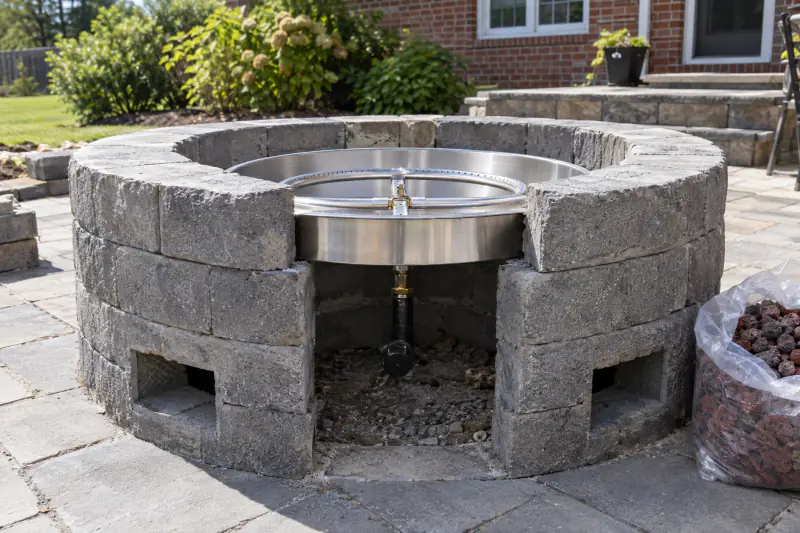
Three construction details come up on every gas feature. First, the enclosure has to be vented, with openings low on opposite sides, because propane in particular is heavier than air and will pool inside a sealed pit until it finds a spark. Second, the burner sits in a pan with lava rock or fire glass over it, never sand or gravel that traps gas and never a lid that closes while the burner is warm. Third, there is a shutoff valve, usually a key valve set in the patio within sight of the fire, and the line is sized for the burner. A typical fire pit burner draws on the order of 90,000 BTU per hour or more, and large ring burners considerably more, which is more than a kitchen range, and an undersized line gives a weak, yellow flame.
Distance from the meter drives the cost of the gas run, which is why fire features on the far side of a large yard in Oakton or Haymarket cost more than the same feature next to the house. Propane avoids a long trench but adds a tank with its own clearance rules and refills. The whole sequence, from layout through the trades' inspections, is on our how it works page.
Why do fire pits need firebrick, refractory mortar or a steel insert?
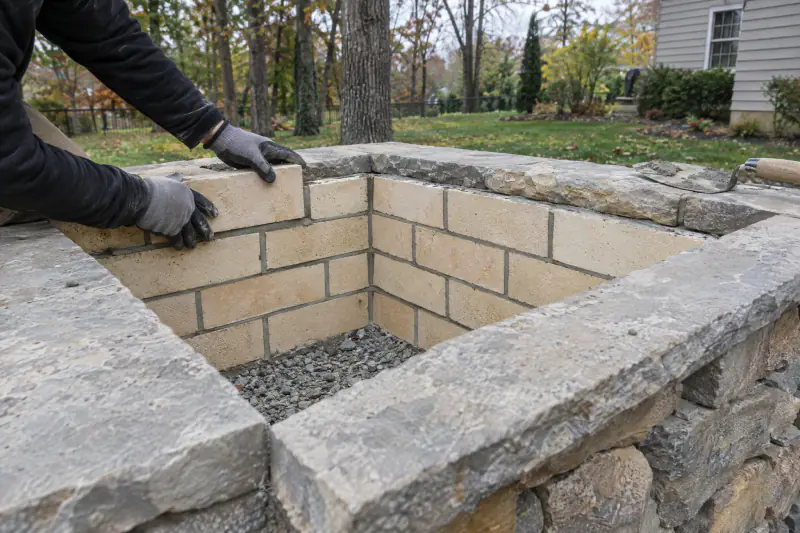
Because ordinary wall block and natural stone are not made for direct flame. A wood fire burns at well over 1,000 degrees at the fuel bed, and concrete block exposed to that heat, then rain, then heat again, cracks and spalls within a season or two. Moisture inside porous stone can turn to steam and pop a face off the stone. The solution used in every masonry fireplace for a century is a liner of firebrick, a dense fire clay brick rated for temperatures above 2,000 degrees, set in refractory mortar, a high-temperature mortar that does not crumble when it is heated. The firebrick takes the flame; the wall block or stone behind it takes the weather and the look.
In a round or square fire pit the simpler alternative is a steel insert, a heavy ring or box that sits inside the block and keeps the fire off the walls. Inserts are the common choice for wall-block pit kits, and the better ones are thick enough not to warp. We leave a small gap between the insert and the block so the steel can expand without pushing the top course out, and we set the cap with masonry adhesive rather than mortar so it can be lifted if the insert ever needs replacing. The pit floor is compacted gravel that drains, never a sealed slab that turns the pit into a bathtub.
Gas features do not need firebrick because the flame is above the burner pan, but they do need a non-combustible enclosure, a heat shield under any wood or composite cap, and the vents described above. Prefabricated outdoor fireplace kits are built from refractory concrete panels for the same reason, and their firebox should not be lined with anything the maker did not specify.
How does an outdoor fireplace draw smoke, and why do some smoke?
A fireplace draws because hot gases rise up the flue and pull room air in through the firebox opening behind them, and outdoors there is no room to speak of, so the draft depends entirely on proportions and wind. The rule of thumb masons have used for generations is that the flue area should be roughly one tenth of the firebox opening area for a chimney of normal height, and closer to one eighth for a short one. A firebox opening of 36 by 30 in., which is 1,080 square inches, wants a flue of about 108 square inches, which is roughly a 12 by 12 in. clay flue liner or its round equivalent. A flue that is too small, or a chimney that is too short, cannot carry the gases fast enough and smoke rolls out the front.
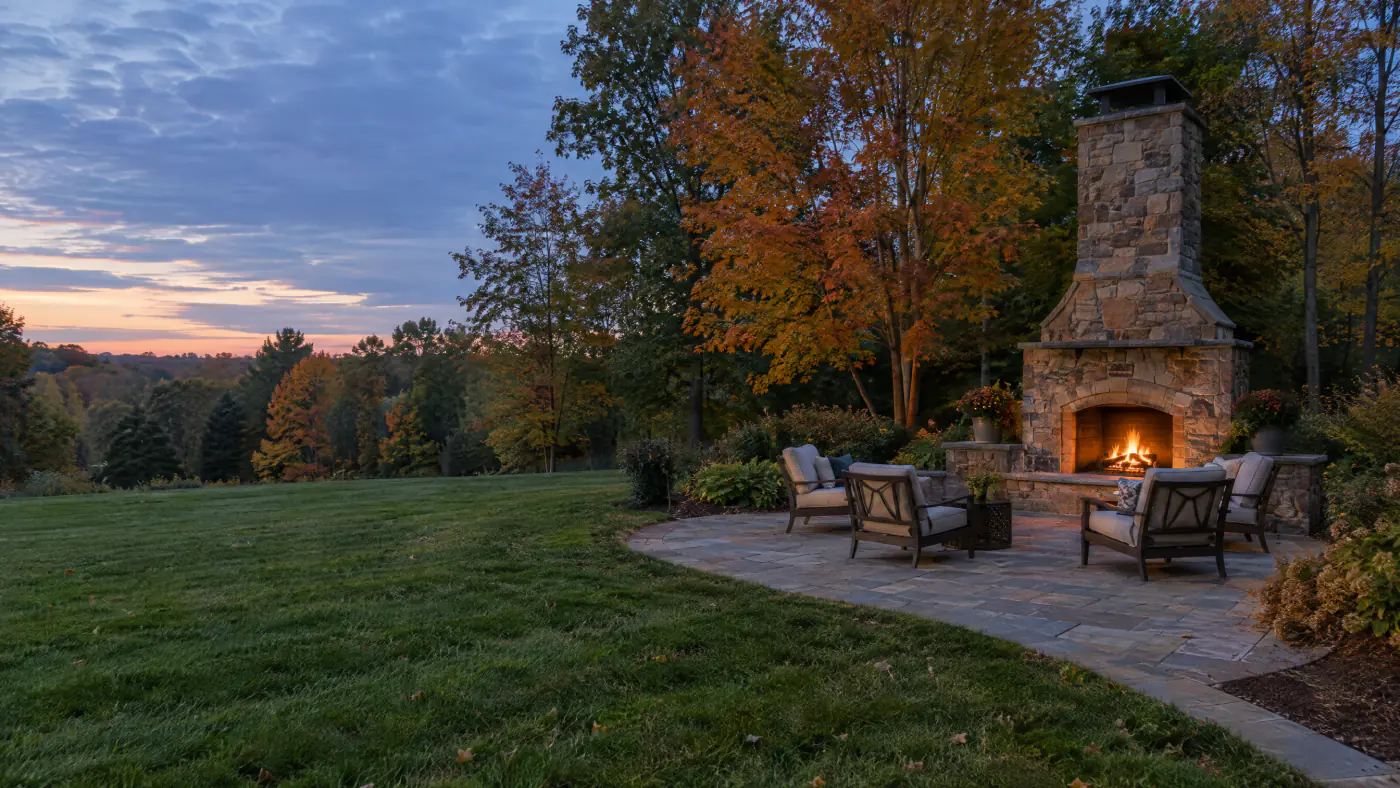
The firebox shape matters as much as the flue. Angled side walls and a sloped back wall reflect heat forward and funnel gases up through a narrow throat, above which a smoke shelf and smoke chamber smooth the flow into the flue. Prefabricated outdoor fireplace kits have these proportions engineered in, which is why we recommend them for most homeowners over a mason building a firebox from scratch, and why a kit should never be modified to make the opening bigger without checking the flue.
Wind is the outdoor variable. We orient the back of the fireplace toward the prevailing wind, which in Northern Virginia is generally from the northwest in fall and winter and the south or southwest in summer, so that wind pushes smoke up the flue rather than down it. A chimney that ends below a nearby roof, deck or tree canopy sits in turbulence and smokes on gusty evenings. A cap keeps rain out and a spark arrestor keeps embers in, and both are expected by most fire marshals for a wood-burning fireplace.
How do we lay out a fire feature and the seating around it?
The order matters because each decision fixes the next one, and everything happens before the patio base is built.
Fix the location by the rules
We measure from the house, the fence, the shed, the deck and the nearest tree limbs, check the fire marshal's distances and the HOA covenants, and mark the spot. Then we check wind direction and sight lines to neighbors' windows before we commit.
Size the fire
A round pit with an inside diameter of about 36 to 44 in. serves six to eight people and keeps the flame small enough to control. The wall top sits roughly 12 to 18 in. above the patio. Fireplaces are sized by firebox opening, usually 30 to 42 in. wide.
Set the seating distance
Chairs sit about 6 to 7 ft from the edge of the fire to the back of the seat, close enough to feel the heat and far enough to slide back. A seating wall is built 18 to 22 in. high with a 12 in. cap and a drained base of its own.
Leave room to move
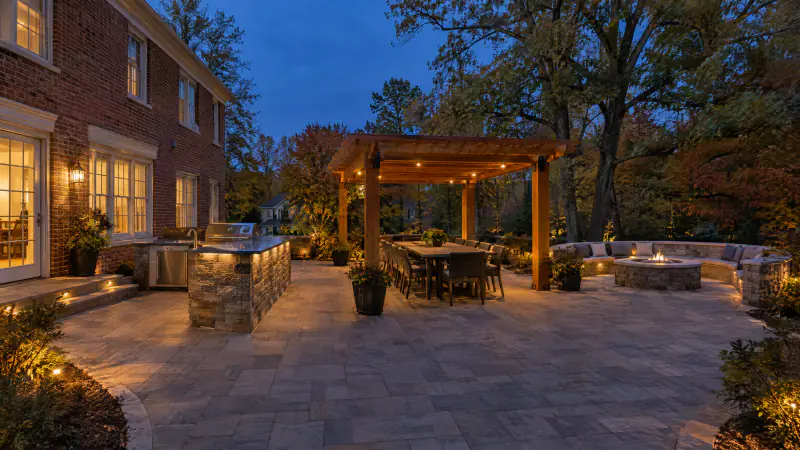
A 3 ft path behind the seating lets people reach a chair without stepping over legs. The patio around a fire feature usually ends up 16 to 20 ft across, which is larger than most homeowners expect and the main reason a fire pit should be in the first drawing, not added later.
Plan the services
Gas and electrical sleeves, a shutoff valve location and low-voltage lighting conduit are placed under the base before any paver is laid. Landscape lighting on the path to the fire is the detail that gets used most, and our lighting team sets it in the same trench.
Which materials survive freeze-thaw around a fire feature?
The ones that handle water, because freeze-thaw, not heat, is what ages an outdoor fire feature in Northern Virginia. A fire pit is a short masonry wall that gets rained on, snowed on, frozen and thawed thirty or forty times a winter, and then heated in spring. Segmental concrete wall block made for freeze-thaw, assembled with exterior masonry adhesive, flexes slightly with the cycles and is the most common and most forgiving material. Natural stone veneer over a concrete block core, set in mortar, gives the look of a solid stone fireplace; the mortar joints are the weak point, and they are built with proper mortar, tooled to shed water, and the whole structure sits on a concrete footing below frost depth, about 24 in. in this region, so it does not heave. Full natural stone, dry stacked or mortared, is the most durable and the most expensive.
Two materials to avoid near flame are river rock and any porous, wet stone. Rounded river stones hold moisture, and when heated the trapped water turns to steam and can split the stone with force. The same is true of some sandstones and of concrete that has soaked all winter. Cast concrete bowls and tables, popular in catalogs, can crack from freeze-thaw if water pools in them, so they need a drain hole and a winter cover. Caps on any fire feature get a small expansion gap or a flexible adhesive, because a cap mortared tight across a heated steel insert will crack.
Inside the pit, the floor is compacted gravel that drains through to the base, never a slab. Steel inserts rust to a stable patina and last many years; thin stamped steel bowls last a few. For winter, a cover over a gas burner keeps water out of the pan and the valve, and a cover over a wood pit keeps it from filling with leaves and ice. Materials for the surrounding paver patio follow the same freeze-thaw logic, and a dense paver with full joints near the fire takes the ash cleanup and the foot traffic.
How much do fire pits and outdoor fireplaces cost in Northern Virginia?
As of 2026, typical Northern Virginia market planning ranges, not myYardPros prices, look like this. A built-in wood-burning fire pit in block or stone with a steel insert or firebrick lining commonly runs about $2,500 to $7,000. A built-in gas fire pit, including the burner, the enclosure and the gas line, runs roughly $5,000 to $14,000 or more, with the gas run from the meter commonly adding several hundred to a few thousand dollars depending on its length and whether a patio has to be crossed. A masonry outdoor fireplace built from a refractory kit with stone or block veneer, on a frost-depth footing, commonly runs about $8,000 to $30,000 or more, with full natural stone, a raised hearth, wood boxes and a taller chimney at the top of that range. Seating walls run around $100 to $250 per linear foot. A good portable steel bowl or gas fire table costs a few hundred to a couple of thousand dollars and needs none of the masonry.
What moves the number: material, from manufactured block to full stone; the size of the feature and the patio it needs around it; the distance to the gas meter or electrical panel; foundation type, since a mortared fireplace needs a concrete footing and a block pit needs only a compacted pad; whether the patio is built at the same time; and the permits and inspections the trades carry. Appliances, countertops and gas and electrical permits are usually priced separately from the masonry.
Fire features are priced per feature rather than per square foot, which is why the ranges are wide. The cost guide puts them beside patio, wall and lighting ranges so you can see the whole outdoor room, and the number worth planning around is a written estimate after we have measured the yard and checked the distances with you.
Why is fall the fire-feature season in Northern Virginia, and when should you build?
Because the evenings are finally worth sitting in. From late September through November the air drops into the 40s and 50s after dark, the humidity that made July patios unusable is gone, the mosquitoes thin out after the first cool nights, and the leaves on the oaks and maples turn. That is when a fire feature pays for itself, and it is also the season that sells the most of them, which has a scheduling consequence: a fire pit decided on in mid-October is usually built in November or in the spring queue, while one decided on now, in September, can be built in time for the best weeks of the year.
Construction has its own calendar. Adhesive-set block pits can be built any time the base can be compacted, which rules out frozen or saturated clay but little else. Mortared stone fireplaces need temperatures that stay above about 40 degrees for the mortar to cure properly, so mortar work is most reliable from spring through October and needs protection or a pause in a cold snap. Gas lines need an inspection date, and inspectors are busiest in fall too. Lighting, which turns a fire feature from a weekend thing into a Tuesday-night thing, goes in while the trenches are open; see our landscape lighting service.
The other fall question is cover. A pergola or roof over the seating, never over a wood fire, extends the season into the rain and makes a gas feature usable almost year-round, and we take that up in hosting outdoors in every season. On a sloped lot, the level ground a fire feature needs sometimes comes from a retaining wall first, which is one more reason to start the design in September rather than the week before Thanksgiving.
What should you confirm before building a fire feature?
Nine items, in roughly the order they come up.
- The fire marshal's distance rules for your county or city, and any local amendments.
- Whether your HOA allows wood fires, gas fires or neither, and what it wants to review.
- Measured distances from the proposed spot to the house, fences, sheds, decks and tree limbs.
- Which way the wind usually blows across the patio and where the neighbors' windows are.
- For gas: who holds the gas permit, where the shutoff goes, and how the enclosure vents.
- For wood: firebrick or a steel insert, a drained gravel floor and a cap that can be lifted.
- For a fireplace: flue size against the firebox opening, chimney height, cap and spark arrestor.
- A Virginia 811 request before any trench for gas, electrical or the footing.
- Seating at 6 to 7 ft from the fire edge and a 3 ft path behind it on the drawing.
How do fire feature rules differ across Fairfax, Loudoun, Prince William and Arlington?
The fire code is statewide, but enforcement, amendments and the surrounding rules are local, and the differences are real. Fairfax County's fire marshal's office publishes guidance on recreational fires, and the county's many planned communities from Reston to Burke add HOA layers on top. Loudoun County has large lots in the west, around Leesburg, Purcellville and Aldie, where a wood fireplace 40 ft from anything is easy, and dense communities in Ashburn, Brambleton and South Riding where covenants often limit open flame near townhomes and gas is the practical path. Prince William County and the cities of Manassas and Manassas Park follow the same statewide code with their own fire marshals, and wooded lots around Haymarket, Gainesville and Dumfries are where the spring burning hours and drought bans matter most. Arlington County and the City of Alexandria have the smallest lots and the closest neighbors, where a 25 ft wood-fire distance is often impossible and gas fire tables on a patio are the norm. Falls Church and the City of Fairfax sit in between.
Zoning adds a layer that surprises people: a masonry fireplace with a chimney may count as an accessory structure for setback purposes, which is a question for the zoning office rather than the fire marshal. Chesapeake Bay Resource Protection Areas near streams restrict new hard surface, which includes the patio around a fire pit. And because every exterior change in a covenanted community goes through architectural review, the HOA application should be filed before a block color is chosen; our guide to HOA approval for exterior projects walks through that process.
Soil and weather are the constants. Clay under a fire pit holds water, so the base is compacted aggregate that drains; a mortared fireplace gets a footing to about 24 in. for frost; and every feature is built to freeze-thaw rather than to heat. We build fire features only within the jurisdictions on our service areas page, and everything we build sits on the base and drainage principles described on our hardscaping page.
Frequently asked questions
How far does a fire pit have to be from a house in Virginia?
Model fire code language that Virginia's Statewide Fire Prevention Code is based on keeps a wood-burning recreational fire about 25 ft from structures and combustible materials, and a portable outdoor fireplace about 15 ft, with an exception for one- and two-family homes that localities may or may not apply. Gas features follow the manufacturer's listed clearances. Counties enforce and amend these rules, so confirm the figure with your fire marshal's office before building.
Do I need a permit for a wood-burning fire pit in Fairfax County?
A simple block fire pit on a patio typically does not require a building permit in most Northern Virginia jurisdictions, but it must follow the fire code distances and open-burning rules enforced by the fire marshal, and zoning setbacks or an HOA review may apply. A masonry outdoor fireplace with a chimney, or any gas or electrical connection, generally does require permits. Check with Fairfax County's permit office for your specific design.
Can I put a fire pit on my deck?
Not a wood-burning one. Open flame on a combustible deck violates most fire code readings and manufacturer instructions, and embers drop between boards. Gas fire tables and pits that are specifically listed for deck use can be placed on a deck on a non-combustible pad with the overhead clearance the maker requires and no roof above unless the unit is listed for it. Built-in masonry features belong on the ground on a compacted base or footing.
What is the best lining for a fire pit?
Firebrick set in refractory mortar is the traditional lining for any masonry firebox and handles temperatures above 2,000 degrees. For a round or square block pit, a thick steel insert does the same job more simply, keeping flame off the block. Either way the pit needs a drained gravel floor rather than a slab and a cap that can be lifted. Ordinary wall block or stone exposed to direct flame cracks and spalls within a season or two.
Why does my outdoor fireplace smoke into the patio?
Usually because the flue is too small for the firebox opening or the chimney is too short. The rule of thumb is a flue area of about one tenth of the opening area for a normal chimney, and the firebox needs a proper throat and smoke chamber above it. Wind is the other cause: a fireplace facing into the prevailing wind, or a chimney ending below a nearby roof or tree canopy, pushes smoke back out. Burning wet wood makes all of it worse.
Are gas fire pits allowed where wood fires are banned?
Often, yes. Gas fire features are generally treated as appliances rather than open burning, so county burn bans and open-burning restrictions usually do not apply to them, and many HOAs that prohibit wood fires allow gas. They still have manufacturer clearances and need a permitted gas line. Read your community's covenants specifically, because some ban all open flame on townhome lots regardless of fuel.
How big should a fire pit be for six to eight people?
An inside diameter of about 36 to 44 in. is the sweet spot, with the wall top 12 to 18 in. above the patio so it can double as a footrest. Larger pits burn more wood, throw more heat than anyone wants in October and push seating farther back. Allow 6 to 7 ft from the fire edge to the back of the chairs and a 3 ft path behind them, which makes the surrounding patio roughly 16 to 20 ft across.
Book the work
Put the plan in writing with a crew that builds this every week.
One visit to measure and talk through options, then a written scope and price. No pressure, no vague numbers. Ask about the Heroes Discount if you serve.
Sources and further reading
- Fairfax County Fire and Rescue Department, Fire Marshal's Office: recreational fire guidelines
- Loudoun County Government: Fire Marshal and building permits
- Prince William County Government: Fire Marshal's Office and permits
- Virginia Department of Environmental Quality: open burning regulations
- Virginia Department of Forestry: spring burning law
- Virginia 811 (Miss Utility): call before you dig
Published September 17, 2026. Reviewed and updated October 9, 2026.