  • Serving the Northern Virginia area
Call (571) 200-9600 Get an Estimate
Pavers vs. Stamped Concrete: a Northern Virginia home and yard

Comparison guide

Pavers vs. stamped concrete: which lasts longer?

On Northern Virginia clay, a properly built paver patio usually stays good-looking longer, because it flexes with freeze-thaw movement and any settled or stained area can be lifted and relaid. Stamped concrete can also last decades, but it is one rigid slab: when the ground moves it cracks, and cracks and faded color are hard to repair invisibly.

Do pavers or stamped concrete last longer in Northern Virginia?

Pavers generally hold up longer here, with one condition: the base has to be right. You want a patio that still looks good in fifteen years. What decides that is how each surface responds when clay soil swells, shrinks and freezes underneath it.

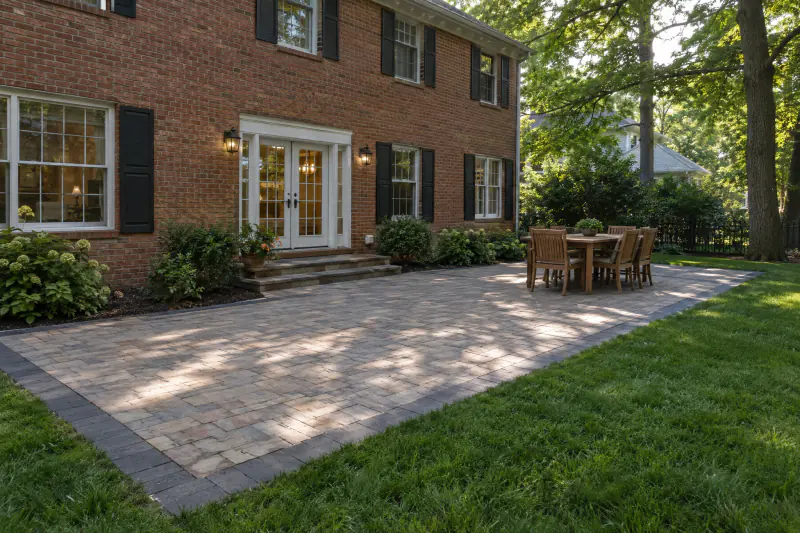
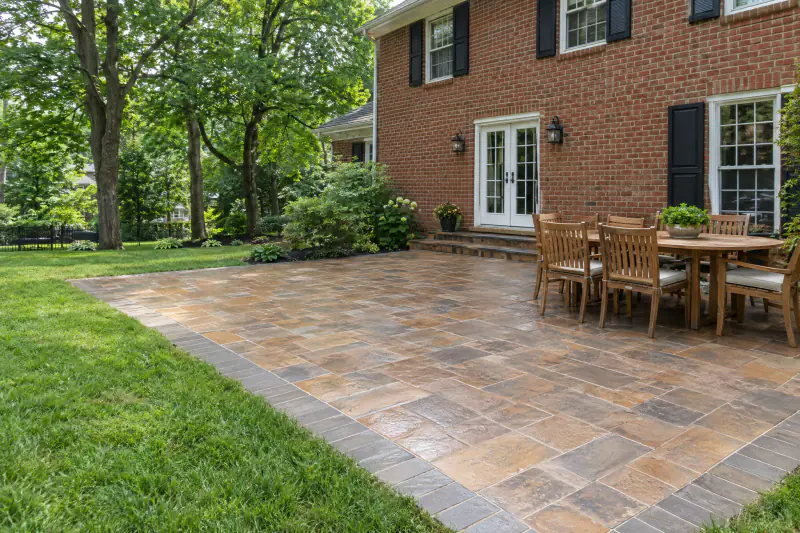
A paver patio is hundreds of small units locked together over compacted stone. When the ground shifts a little, the joints absorb it. If one corner does settle, those pavers are lifted, the base is corrected and the same pavers go back down. Stamped concrete is a single poured slab, colored and pressed with a pattern while wet. Control joints steer where it cracks, but they cannot always prevent a crack across the pattern, and a patched crack or a re-colored section rarely matches the rest.

To be fair to concrete: a stamped slab on a well-prepared base, resealed on schedule, can serve for decades. And pavers laid on a thin base will dip and spread within a few winters. Method matters more than material. Our paver patio page shows what proper base work looks like.

Pavers vs. stamped concrete compared

The two surfaces differ most in how they age and how they are repaired.

PaversStamped concrete
StructureIndividual units on a flexible stone baseOne rigid slab with control joints
Response to clay movementJoints absorb small movementTends to show up as cracks
RepairsLift, fix the base, relay the same unitsPatch or replace a section, color rarely matches
Surface upkeepTop up joint sand, sealing optionalReseal every few years to protect color
WeedsCan sprout in joints from aboveNone, apart from cracks and joints
Traction when wetTextured, good gripCan be slick when sealed, grip additive helps
Up-front costUsually higherOften lower for simple patterns
Use after installationReady as soon as it is finishedNeeds curing time first

Generalizations for typical residential work. Site conditions and workmanship change the outcome for both.

When does each one make sense?

Neither is wrong. They suit different yards and different priorities.

  • Pavers suit you if

    your yard has soft or wet clay, tree roots nearby or utilities under the patio area. Being able to open the surface and close it again without a scar is worth real money over the life of the patio.

  • Stamped concrete suits you if

    the site is stable and well drained, the up-front budget is the main limit, you like a continuous surface with no joints to maintain, and you are comfortable resealing it and living with a hairline crack if one appears.

  • Pavers suit driveways especially

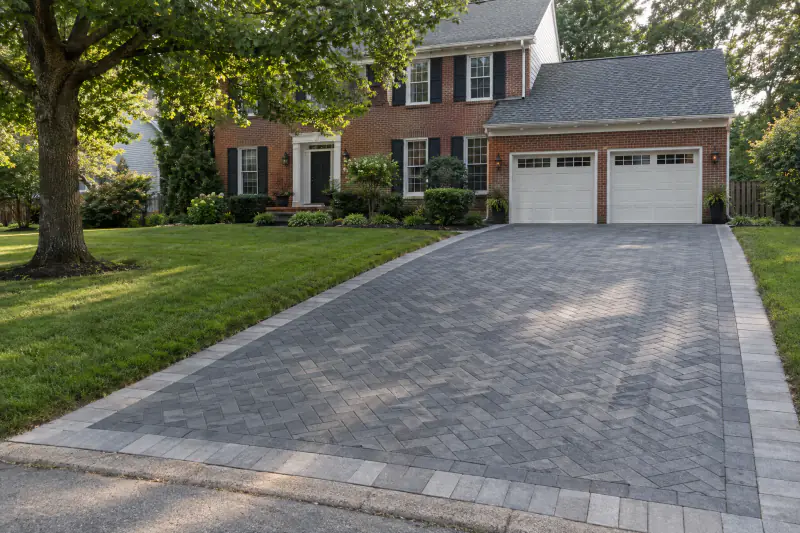
    because vehicle loads and de-icing salt are hard on a decorative slab surface. Driveway pavers are thicker and sit on a deeper base.

  • Either one needs drainage first

    If water sits where the patio will go, no surface will stay level for long. Downspouts and wet soil should be dealt with before any base stone or concrete is placed.

How do pavers and stamped concrete compare on cost?

Stamped concrete usually costs less on installation day, and pavers usually cost less to keep looking right. As typical Northern Virginia market ranges as of 2026, a professionally installed paver patio runs about $20 to $35 per sq ft for concrete pavers and roughly $30 to $55 or more for porcelain or natural stone, so a 350 sq ft patio often lands between $7,000 and $19,000. These are regional planning ranges, not myYardPros prices.

We build with pavers and natural stone and do not pour stamped concrete, so we do not publish a range for it. As a general rule it comes in below pavers for a simple pattern in one color, and the gap narrows with borders, multiple colors and hand-detailed textures. Ask a concrete contractor for a written quote and compare like for like: base depth, slab thickness, reinforcement, joints and sealer.

Then look past the first invoice. Optional paver cleaning, re-sanding and sealing typically costs about $1.50 to $4 per sq ft. A cracked decorative slab has no equivalent small repair. For a number based on your yard, request an on-site estimate.

What mistakes shorten the life of either patio?

  • Choosing on surface price alone and never asking how deep the base will be.
  • Building over soft fill or topsoil instead of excavating to firm ground.
  • Pitching the surface toward the house, or leaving a downspout to empty onto it.
  • Skipping edge restraint on pavers, which lets the border creep outward.
  • Letting the sealer on stamped concrete wear through, so color fades and water soaks in.
  • Using de-icing salt freely in the first winters, which is hard on concrete surfaces.

Which should you choose: pavers or stamped concrete?

Choose pavers if you plan to stay, if your soil is typical Northern Virginia clay, or if the thought of a crack running through a patterned slab would bother you every time you step outside. You pay more at the start and get a surface that can be repaired, extended or reopened for a future gas or drain line without visible damage.

Choose stamped concrete if the site is firm and dry, the budget is tight this year, and a single unbroken surface matters more to you than repairability. Go in knowing it needs resealing and that a crack, if it comes, is permanent.

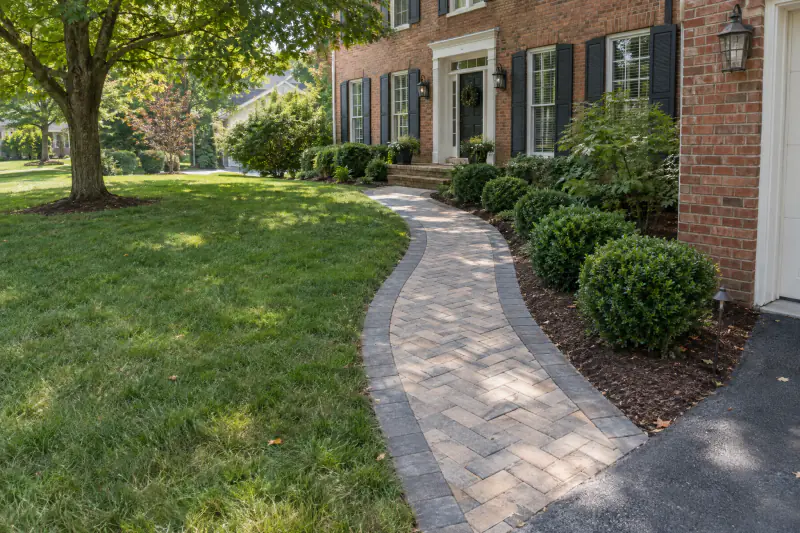
If you are still undecided, look at how each ages. Ask any contractor for the address of a patio that is at least five winters old, not a photograph from the day it was finished. Related reading: walkways and garden paths, paver driveways and our other comparison guides.

Common questions

Does stamped concrete always crack?

Not always, but concrete shrinks as it cures and moves with the soil, so some cracking over the years is normal. Control joints are cut or tooled into the slab so cracks follow those lines instead of crossing the pattern. On clay with freeze-thaw cycles, plan for the possibility and ask how joints will be laid out.

Do pavers shift or sink over time?

They can if the base is thin, poorly compacted or sitting in water. On 4 to 6 in. of compacted aggregate with solid edge restraint and a slope away from the house, movement is minor. When a spot does settle, the pavers in that area are lifted, the base is corrected and the same pavers are relaid.

Which is easier to maintain?

Day to day, they are similar: sweep and rinse. Over years they differ. Pavers may need joint sand topped up and can be sealed if you like the look. Stamped concrete depends on its sealer to protect the color, so resealing every few years is part of owning it.

Can pavers go over an existing concrete slab?

Sometimes. The slab has to be sound, drain away from the house and leave enough height at the door threshold for the new surface. Thin pavers or porcelain can then go over it. A slab that is cracked, heaved or tilted toward the foundation should come out first.

Which one adds more to resale value?

We cannot give you an honest number for that, and we would be wary of anyone who does. Buyers respond to condition. A level, clean patio with no cracks or sunken spots shows well in either material, and a failing one hurts in either material.

Let's talk about your yard.

Tell us what you have in mind. We will walk the property with you, explain your options plainly and put the scope and price in writing.

Serving Fairfax, Loudoun, Prince William and Arlington counties and the cities inside them. Check your address. Military, veterans, first responders, healthcare workers and teachers: ask about the Heroes Discount.