  • Licensed & Insured VA Licensed Contractor
  • Serving the Northern Virginia area
Call (571) 200-9600 Get an Estimate
Lawn & Landscape

Landscape Lighting Installation in Northern Virginia

Landscape lighting is a low-voltage LED system of path lights, uplights and step, wall and patio fixtures, powered by a transformer and run by a timer or smart control. It suits Northern Virginia homeowners who want safer steps, a welcoming front of house and a patio usable after dark. myYardPros designs and installs these systems.

  • Warm LED light, aimed without glare
  • Sized transformers and buried cable
  • Timers and smart controls set up
  • Licensed & insured in Virginia
  • Based in Sterling, VA
  • Residential projects only
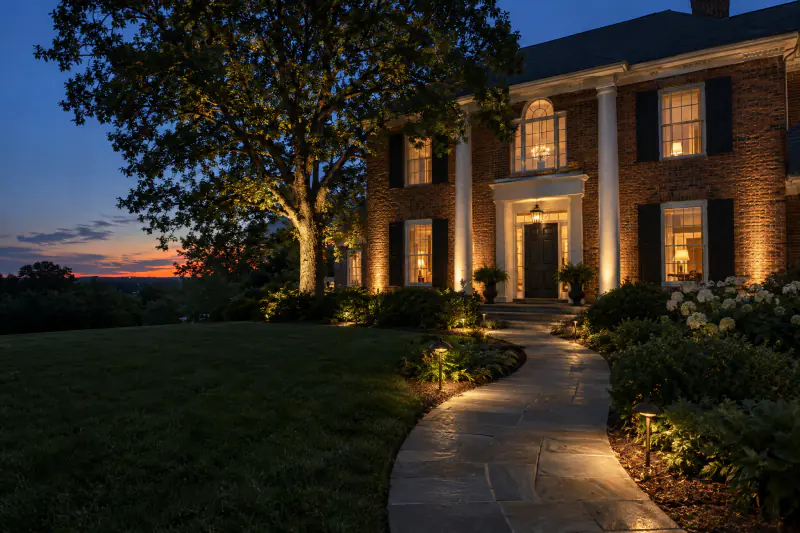
Brick colonial home at dusk with landscape lighting on walkway, facade and oak tree
Path lights and uplighting at dusk, with the sources hidden
Typical timeline
Often 1-3 days on site
System voltage
Low voltage, typically 12-15 V
Permit
Usually none for low voltage
Best season
Any time the ground is workable

Why does landscape lighting look bad or fail, and what does a good system look like?

Landscape lighting looks bad or fails when fixtures are placed without a plan and wired without regard to voltage. The familiar results: a runway of path lights down both sides of a walk, glare in your eyes from the driveway, cold bluish light, dim fixtures at the end of a long run, and thin aluminum stakes that corrode and lean. Clip-on connectors let moisture in, and lights drop out one at a time.

A good system is designed around what you should see, not around the fixtures. Light lands on the walk, the steps, the tree canopy and the stone of the house, while the sources stay shielded or hidden. We use warm white LED, typically around 2700K, in solid brass or copper fixtures. Cable is sized so every fixture receives voltage within its rated range, splices are sealed against water, and wire is buried rather than tucked under mulch.
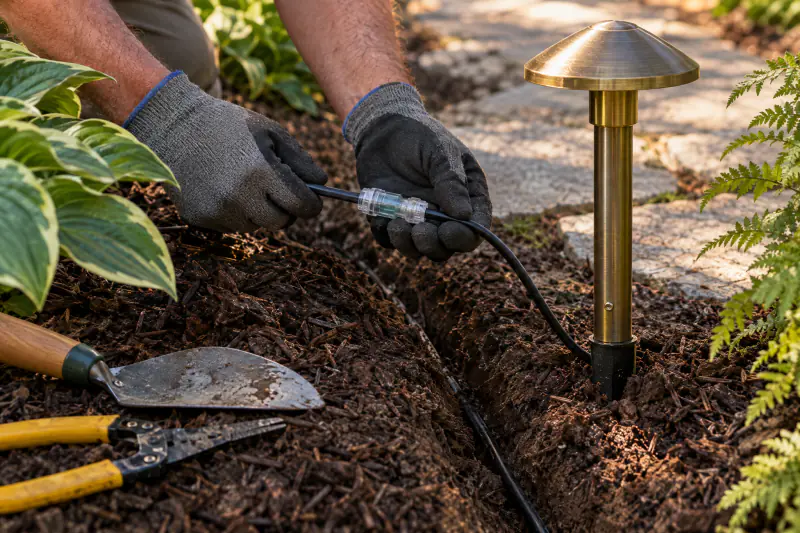
Hands sealing a low-voltage cable splice beside a brass landscape lighting fixture
Sealed splice and buried cable at a brass path light

What types of landscape lighting do we install?

Most designs combine several of these, each doing a different job.

  • Path and walkway lights

    Shielded fixtures that throw soft pools of light down onto walks and bed edges, staggered and spaced so the path reads clearly without looking like a landing strip.

  • Tree and architectural uplighting

    Spot and flood fixtures that graze brick and stone, light columns and gables, or reach into the canopy of a mature oak. Beam spread is matched to each subject.

  • Step, wall and patio lighting

    Slim fixtures under wall caps, stair treads and seating walls, plus downlights on pergolas and deck posts, so level changes are visible and the patio stays usable.

  • Downlighting from trees

    Fixtures mounted high in a tree and aimed down through the branches cast a soft, moonlight-like pattern. Wiring is attached so the tree can keep growing.

  • Transformers

    A weather-rated, multi-tap transformer steps household current down to low voltage and plugs into a GFCI-protected outdoor outlet. Extra taps keep fixtures on long runs bright.

  • Timers and smart controls

    Astronomical timers follow sunset through the year without resetting. Smart controls add phone scheduling, zones and dimming, and photocells remain a simple, reliable option.

How does landscape lighting installation work?

Design comes before any fixture is ordered, and aiming after dark finishes the job.

  1. Site visit, ideally near dusk

    We walk the property with you and note what deserves light, where footing is unsafe, what you see from indoors and where an outlet exists for the transformer.

  2. Lighting plan and written scope

    You receive a plan showing each fixture and its purpose, transformer size and location, and the control method. It doubles as the drawing many HOAs request.

  3. Layout and utility marking

    Virginia 811 marks public utilities before trenching. We flag fixture positions, locate sprinkler lines where possible and route cable away from major tree roots.

  4. Installation and wiring

    Fixtures are set on stable stakes or mounts, cable is buried about 6 in. deep, splices get sealed connectors, and the transformer is loaded within its rated capacity.

  5. Night aiming and walkthrough

    After dark we aim and shield each fixture, check voltage at the ends of runs, set the timer or app, and adjust anything you want changed on the spot.

A patio and garden lit by low-voltage LED lighting

A short clip approaching a softly lit patio at nightfall, showing wall and step lights, uplit trees and a small group gathered around a fire pit.

Low-voltage LED, solar or line-voltage lighting: which is right for a yard?

The three ways to light a landscape differ in output, reliability and who is allowed to install them.

Low-voltage LEDSolar stake lightsLine voltage (120 V)
Light outputStrong, consistent, dimmableWeak, fades through the nightStrongest
Power sourceTransformer on a GFCI outletBuilt-in panel and batteryDedicated household circuit
Works in shadeYesPoorly under treesYes
InstallationShallow buried cablePush into the groundConduit or deep burial, permit
Who installsLandscape lighting installerHomeownerLicensed electrician
Typical useMost residential landscapesTemporary accentsPost lamps, floodlights

How much does landscape lighting cost in Northern Virginia?

Professionally installed low-voltage LED landscape lighting in Northern Virginia typically costs about $250 to $450 per fixture, including cable, connections and a share of the transformer. A system of 10 to 20 fixtures therefore often lands between $3,500 and $8,000. These are general market ranges as of 2026, not myYardPros prices.

What moves the number:

  • Fixture material and type. Brass and copper cost more than aluminum.
  • Cable distance, and runs that pass under a walk or driveway.
  • Transformer size, zones, smart controls and dimming.
  • Lights mounted in trees.
  • A new outdoor outlet, if none exists, installed by a licensed electrician.

A system can be built in phases if the transformer is sized for it from the start. For a figure based on your property, request an on-site estimate.
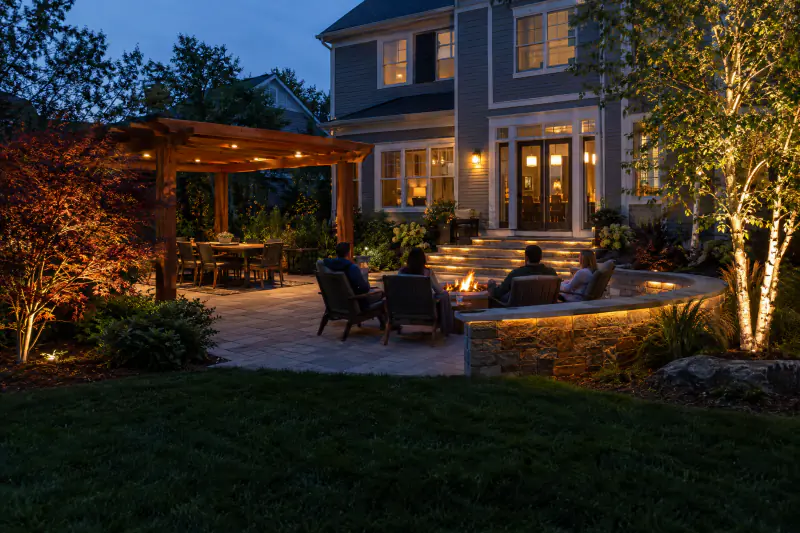
Patio with step, wall and tree landscape lighting where friends gather at night
Wall, step and tree lighting extend the evening

What should you ask any landscape lighting installer before hiring?

These questions reveal whether a system is designed to last or simply to light up on the first night.

  • Are the fixtures solid brass or copper, or coated aluminum?
  • What color temperature are the LEDs, and can lamps be replaced later?
  • How do you size the transformer, and how much spare capacity remains?
  • How deep is the cable buried, and what connectors seal the splices?
  • Will you return after dark to aim and adjust the lights?
  • Who handles any new outlet or line-voltage wiring that is needed?

Not sure what you need?

Tell us what you are seeing. We will look at the site, explain the options in plain terms and give you a written estimate.

What rules apply to landscape lighting in Fairfax, Loudoun, Prince William and Arlington?

Low-voltage landscape lighting that plugs into an existing GFCI-protected outlet generally does not require an electrical permit in Northern Virginia, though you should confirm with your county. Line voltage is different. A new outdoor outlet, a new circuit or 120 V fixtures must be installed by a licensed electrician and typically need a permit and inspection. We do not perform that work ourselves, and we coordinate it where a project needs it.

Many HOAs in Reston, Ashburn, South Riding and Burke review exterior lighting and may limit fixture style, brightness or light crossing a property line. Shielded, downward-aimed, warm fixtures satisfy most such rules and are kinder to neighbors.

Lighting is easiest to install alongside other work: wall lights go in while a paver patio or fire pit and seating wall is built, and cable is laid before new beds from a landscape installation are mulched.

Frequently asked questions about landscape lighting

Does landscape lighting need an electrician?

Not for the low-voltage system itself. The transformer plugs into a GFCI-protected outdoor outlet and everything beyond it runs at low voltage. If you have no suitable outlet, or want 120 V fixtures, a licensed electrician must do that work, usually with a permit.

How much electricity does LED landscape lighting use?

Very little. Most LED landscape fixtures draw roughly 3 to 7 watts each, so a 15-fixture system uses about as much power as one or two old incandescent bulbs. Run from dusk to late evening, that typically adds only a few dollars a month.

Are solar landscape lights good enough?

For marking a path edge, they can be. For lighting steps safely or showing off a house and trees, they fall short. Solar lights are dim, fade overnight and charge poorly under the mature tree cover common in Northern Virginia.

How long do LED landscape lights last?

Quality LED lamps and integrated fixtures are commonly rated for tens of thousands of hours, which is many years of nightly use. Brass and copper housings outlast the electronics. Systems still need occasional re-aiming, lens cleaning and plant trimming.

Can lighting be added to an existing patio, deck or landscape?

Yes. Path lights and uplights go into existing beds with little disturbance, and cable can be slit into turf through a narrow trench that closes quickly. Lights under existing wall caps or stair treads are possible but take more labor.

What color temperature is best for outdoor lighting?

Warm white, around 2700K, suits most homes. It flatters brick, stone and wood and feels like incandescent light. Slightly cooler light near 3000K can suit blue-green foliage or a moonlight effect. Light at 4000K and above tends to look harsh.

Ready to talk about your landscape lighting project?

Tell us about your property and what you want to fix or build. We will visit, measure and send a clear written estimate. We serve Fairfax, Loudoun, Prince William and Arlington counties.

Page updated . Photos and video on this page are illustrative.