  • Serving the Northern Virginia area
Call (571) 200-9600 Get an Estimate
Hardscaping

Sunken Paver & Patio Repair in Northern Virginia

Sunken paver repair means lifting settled, heaved or shifting pavers, correcting the base or water problem that moved them, and relaying the same units level and tight. It suits Northern Virginia homeowners whose patio, walkway or driveway holds puddles, rocks underfoot or catches toes, but whose pavers are still sound. We also tell you plainly when rebuilding makes more sense.

  • Cause found before any paver goes back
  • Base rebuilt and compacted in lifts
  • Original pavers reused wherever sound
  • Licensed & insured in Virginia
  • Based in Sterling, VA
  • Residential projects only
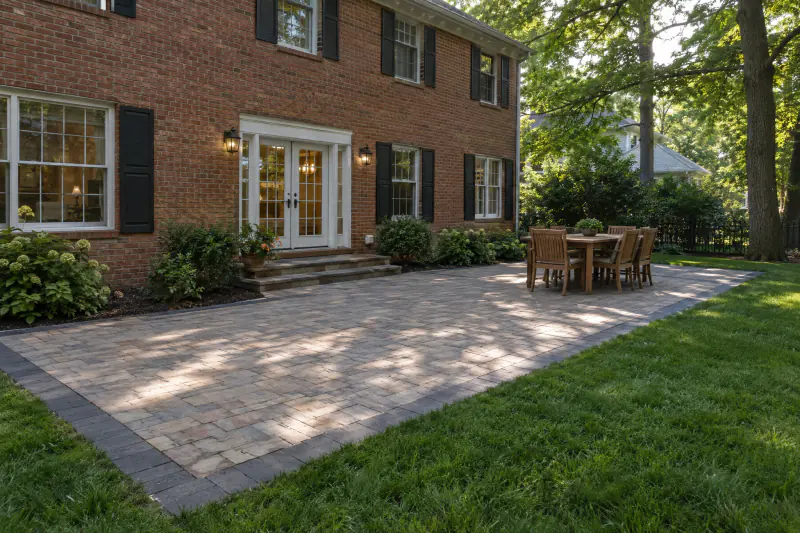
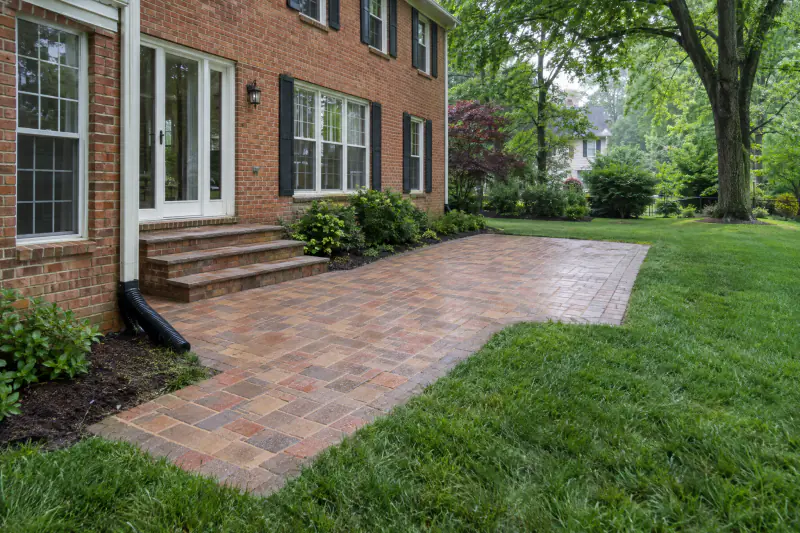
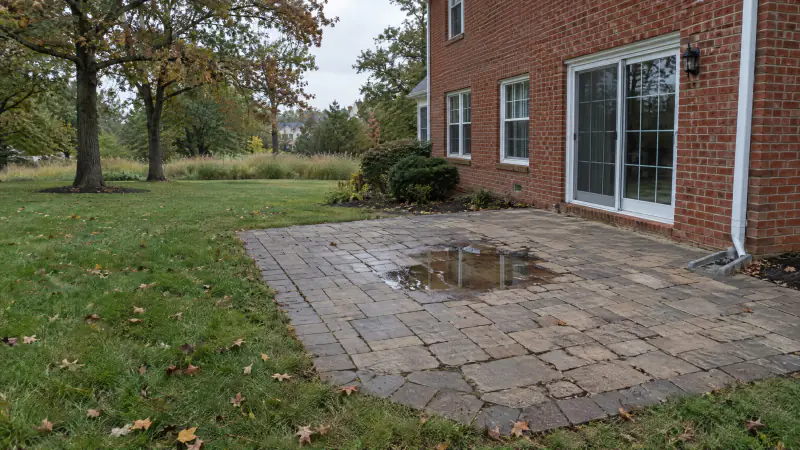
Repaired concrete paver patio lying flat and dry after rain behind a brick colonial
A relaid section near the foundation, level again after rain
Typical timeline
Often 1-4 working days
Permit
Rarely needed at grade
Best season
Spring through late fall
Pavers reused
Most units, if uncracked

Why do pavers sink, heave or shift?

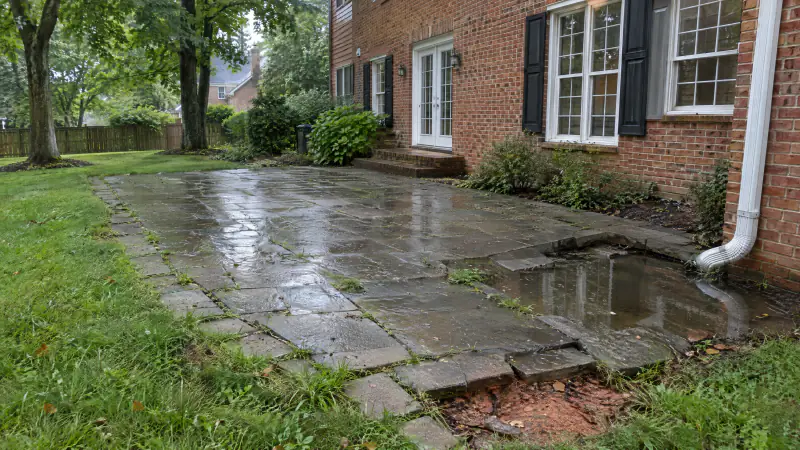
Pavers sink, heave or shift because something below them changed: the bedding sand washed out, the base was too thin or never compacted, water kept soaking one spot, or the edge gave way. Resetting the pavers without fixing that cause usually buys a season or two before the same dip returns.

In Northern Virginia yards a few causes repeat. A downspout emptying beside the patio saturates the clay until the base squeezes out sideways. Backfill against a foundation can keep settling for years, so paving sags next to the house. Unspiked edging lets the border drift, roots lift corners, and loosely refilled utility trenches sink in a line.

A lasting repair opens the surface past the damage, removes failed base and dirty sand, corrects the water source and rebuilds in compacted lifts before the pavers go back.

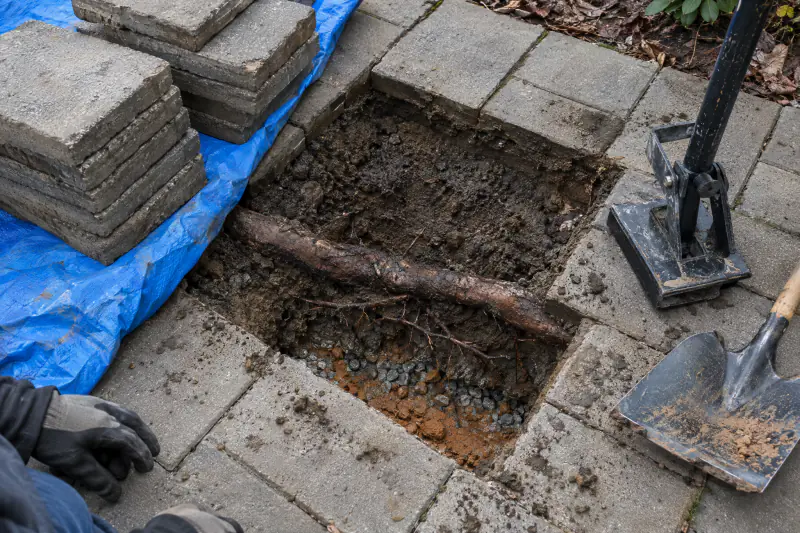
Lifted pavers revealing washed-out bedding sand and tree root during paver repair
Lifting pavers exposes a thin base and an intruding root

What kinds of paver repair do we handle?

Most problems fall into one of these repairs, and many jobs combine several.

  • Sunken area resets

    A settled section is lifted, contaminated bedding removed, the base recompacted or replaced, and the original pavers relaid so the surface flows level into the paving around it.

  • Heaved and root-lifted pavers

    Raised corners and humps are taken up to see what pushed them. Large roots may need an arborist's opinion before cutting, then the area is rebuilt flush.

  • Edge and border rebuilds

    When the border has crept outward, we pull the soldier course, extend the base past the edge, spike new edge restraint into compacted stone and close the joints.

  • Driveway and walkway sections

    Tire ruts, sunken aprons and walk segments over old trenches. Driveway repairs need a deeper base and heavier compaction because vehicle loads are far greater.

  • Drainage corrections

    Rerouting a downspout, adding a drain at a low corner or adjusting pitch, so water runs off the paving instead of soaking the new base.

How does a paver repair work, from diagnosis to walkthrough?

Diagnosis comes first, because the cause decides how far the repair goes.

  1. Site visit and diagnosis

    We walk the paving with you, check pitch with a level, note where water collects and downspouts discharge, and often lift a few pavers to inspect the bedding and base.

  2. Repair or rebuild recommendation

    You receive a written scope naming the cause, the area to lift and the materials, or a clear note that replacement is the better value. Virginia 811 is called before excavation.

  3. Lifting and excavation

    Pavers are pulled with an extractor and stacked in order. Wet sand and failed base are dug out to firm soil, and the cause, such as a root or downspout, is dealt with.

  4. Base rebuild and relaying

    Dense-graded aggregate goes back in compacted lifts to the correct pitch, fresh bedding sand is screeded and the pavers are relaid in their pattern, with close matches for cracked units.

  5. Joints, compaction and walkthrough

    Fresh jointing sand fills the gaps and a plate compactor settles the units, with polymeric sand activated per the maker's directions. We review the repair with you and explain what to watch after heavy rain.

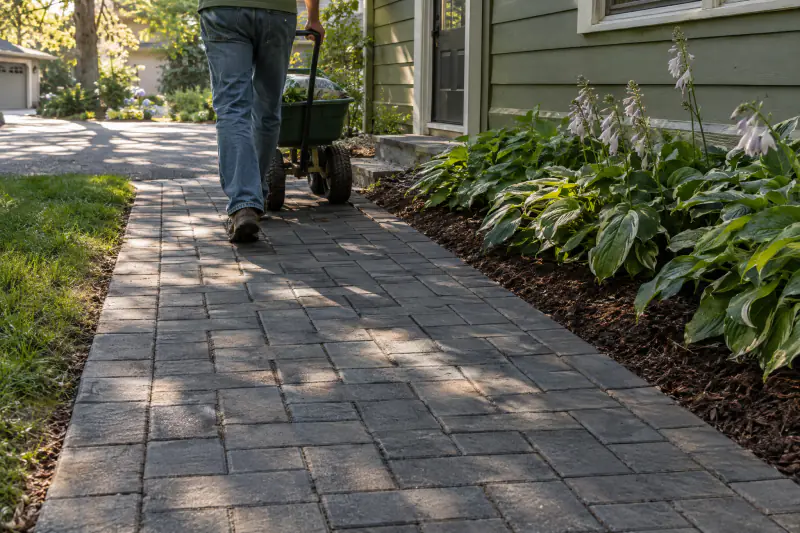
A relaid paver walkway, level and in use

A short clip following a garden cart along a repaired basket-weave paver walkway, its wheels rolling smoothly over flush joints beside a hosta bed in late afternoon light.

Should you repair or replace a sunken paver patio?

How much base has failed, and the condition of the pavers, usually decide it.

Spot repairLift and relayFull replacement
Best whenOne or two small dips or a lifted cornerBase failed over a large area, pavers soundPavers broken or worn, base failed everywhere
What is reusedPavers and most of the basePaversUsually only the subgrade
Base workLocal dig-out and recompactionNew compacted base throughoutNew excavation and base
Appearance afterClose match, joint sand may differ at firstOriginal pavers, straighter linesNew material and pattern
Relative costLowestModerateHighest

How much does paver repair cost in Northern Virginia?

Paver repair in Northern Virginia typically costs about $500 to $2,500 for a small sunken area or lifted corner, and roughly $15 to $30 per sq ft to lift and relay a larger section on a rebuilt base. These are typical Northern Virginia market ranges as of 2026, not myYardPros prices. Full replacement tends to approach new-construction pricing, which our paver patio page outlines.

What moves the number:

  • How deep the failed base goes and how much spoil is hauled away.
  • Whether the cause is drainage, roots or a buried trench.
  • Pattern complexity and border cuts.
  • Replacement pavers for cracked or discontinued units.
  • Driveway loads, which need a thicker base.

Small repairs cost more per square foot because setup stays the same. For a figure based on what is under your pavers, request an on-site estimate.

Repaired basket-weave paver walkway with flush joints beside a hosta bed
A basket-weave walkway relaid flush on a rebuilt base

What are the signs your pavers need repair?

Each of these points to the base or drainage, not the surface.

  • Puddles that stay on the paving a full day after rain stops.
  • Pavers that rock or click underfoot when you step on them.
  • A trip edge where one paver sits higher than its neighbor.
  • Joints wider than the rest, or bedding sand washing onto the lawn.
  • A dip near the house, beside a downspout or along a trench line.
  • Paving that now slopes toward the foundation instead of away from it.

Not sure what you need?

Tell us what you are seeing. We will look at the site, explain the options in plain terms and give you a written estimate.

What affects paver repair in Fairfax, Loudoun, Prince William and Arlington?

Repairing an existing at-grade patio or walkway in Northern Virginia generally does not need a building permit, with exceptions. Work on a driveway apron inside the public right of way can require a permit from VDOT or the locality, and drainage changes that push water toward a neighbor can raise grading questions, so check with your county first. HOAs around Ashburn, South Riding, Reston and Haymarket usually allow repair in kind but may review color or pattern changes.

Soil matters more. Our clay holds water and weakens when saturated, so most failures trace back to water. Lasting fixes often include downspout drain lines or yard grading. Settled natural stone is covered under flagstone and natural stone patios.

Frequently asked questions about sunken paver & patio repair

Can sunken pavers be fixed without replacing them?

Usually, yes. Concrete pavers are individual units, so a sunken section can be lifted, the base corrected and the same pavers relaid. Only cracked, spalled or badly worn units need replacing. Fixing the reason the area sank matters most, or it settles again.

Why do pavers sink right next to the house?

Soil within a few feet of a foundation is usually backfill placed after the basement walls went up, and it often keeps settling for years. Downspouts discharging there make it worse. A repair in that zone typically needs deeper excavation and a carefully compacted base.

Should I use polymeric sand or regular sand when re-sanding pavers?

Polymeric sand hardens once misted with water, so it resists washout, ants and weeds, but it needs dry pavers, the joint depth its maker specifies and careful cleanup to avoid haze. Regular jointing sand is simpler to top up later. Permeable pavers use small, clean crushed stone instead of sand.

Will repaired pavers match the rest of my patio?

Relaid original pavers match because they are the same units. Replacements for cracked pieces may differ, since colors fade and product lines change. We find the closest current blend, or borrow pavers from a hidden spot under a grill and fill that spot with new ones.

How long does a paver repair last?

A repair that corrects the cause and rebuilds the base can last as long as the surrounding paving. One that only packs sand under a dip often settles again within a few seasons, especially where water keeps reaching the base.

When is replacing a paver patio better than repairing it?

Replacement usually makes more sense when most of the field has sunk or heaved, the base is thin throughout, many pavers are cracked or crumbling, or you want a new layout. Then relaying everything costs nearly as much as building new.

From the field notes

Long-form guides on sunken paver & patio repair from the crew that does the work, with Northern Virginia costs, timing and permit detail.

All guides in this category  ·  Planning guides  ·  Glossary  ·  FAQ

Ready to talk about your sunken paver and patio repair project?

Tell us about your property and what you want to fix or build. We will visit, measure and send a clear written estimate. We serve Fairfax, Loudoun, Prince William and Arlington counties.

Serving Fairfax, Loudoun, Prince William and Arlington counties and the cities inside them. Check your address. Military, veterans, first responders, healthcare workers and teachers: ask about the Heroes Discount.