Key takeaways
- After the clocks change on November 1, sunset in Northern Virginia falls to about 5 p.m. and reaches roughly 4:45 p.m. by early December.
- Light the arrival in order: the driveway apron, the front walk, every step and grade change, and the house numbers. Those four cover safety and most of the curb appeal.
- Security comes from even, low-level light that removes hiding places, not from a floodlight that blinds you and lights your neighbor's bedroom.
- Holiday decorations need line-voltage outlets, ideally on a dedicated GFCI-protected circuit installed by a licensed electrician with a permit where your county requires one.
- As of 2026, typical Northern Virginia planning ranges run about $250 to $450 per installed low-voltage fixture, with 10 to 20 fixtures commonly landing between $3,500 and $8,000.
Planning this work? See our landscape lighting service in Northern Virginia and the HOA Design Guidelines.
On this page
- Why plan landscape lighting before the dark months in Northern Virginia?
- How do you light the arrival: driveway, front walk, steps and house numbers?
- How do you make steps and grade changes safe after dark?
- Can you have security lighting without floodlight glare?
- Which fixtures belong in each zone for the dark months?
- What about outlets and a dedicated circuit for holiday decorations?
- Which timers and astronomic clocks make the system run itself?
- Should you upgrade old halogen fixtures to LED before winter?
- What does landscape lighting for the dark months cost in Northern Virginia?
- How do you plan a system now for installation in late fall?
- What should be on your dark-months lighting checklist?
- What should homeowners in Fairfax, Loudoun, Prince William and Arlington know about winter lighting?
- Frequently asked questions
Why plan landscape lighting before the dark months in Northern Virginia?
Because the dark months are long here and they start in ten days. Clocks fall back on Sunday, November 1, 2026, and from that evening sunset in Northern Virginia lands around 5 p.m. It keeps sliding to about 4:45 p.m. by the first week of December and does not climb back past 5:30 until early February. For roughly four months most of the people on your street will pull into the driveway, find the walk, climb the steps and locate the keyhole in full dark. A landscape lighting system planned now and installed in late fall, when the beds are dormant and easy to work in, changes every one of those evenings.
The job breaks into five parts, and this article takes them in order. Lighting the arrival: driveway, front walk, steps and house numbers. Making every step and grade change safe. Getting security without a floodlight that blinds everyone. Adding the outlets and the dedicated circuit that holiday decorations need, which is line-voltage work for a licensed electrician. And setting up timers and astronomic clocks so the system runs itself from November through February without anyone touching it. Along the way we cover the LED upgrade for anyone with an old halogen system and the planning ranges for each piece as of 2026.
If you want the design fundamentals first, our summer article on landscape lighting design covers fixture types, beam spreads and how a plan is drawn. This one is about the season in front of us, and about getting a system in the ground before the holidays rather than after them.
How do you light the arrival: driveway, front walk, steps and house numbers?
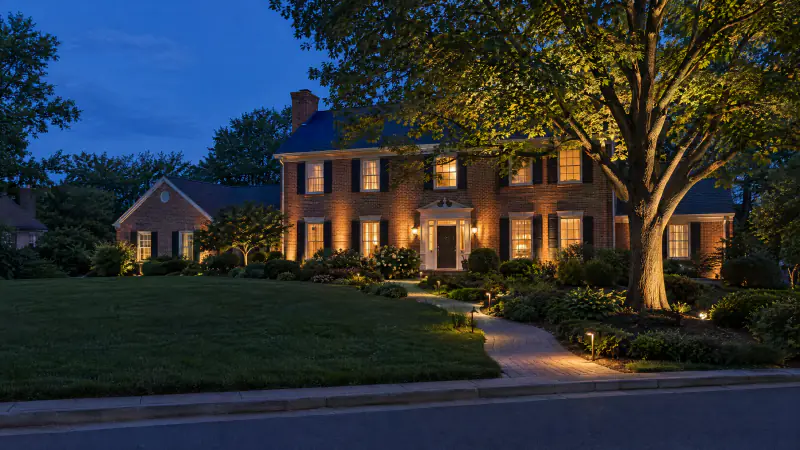
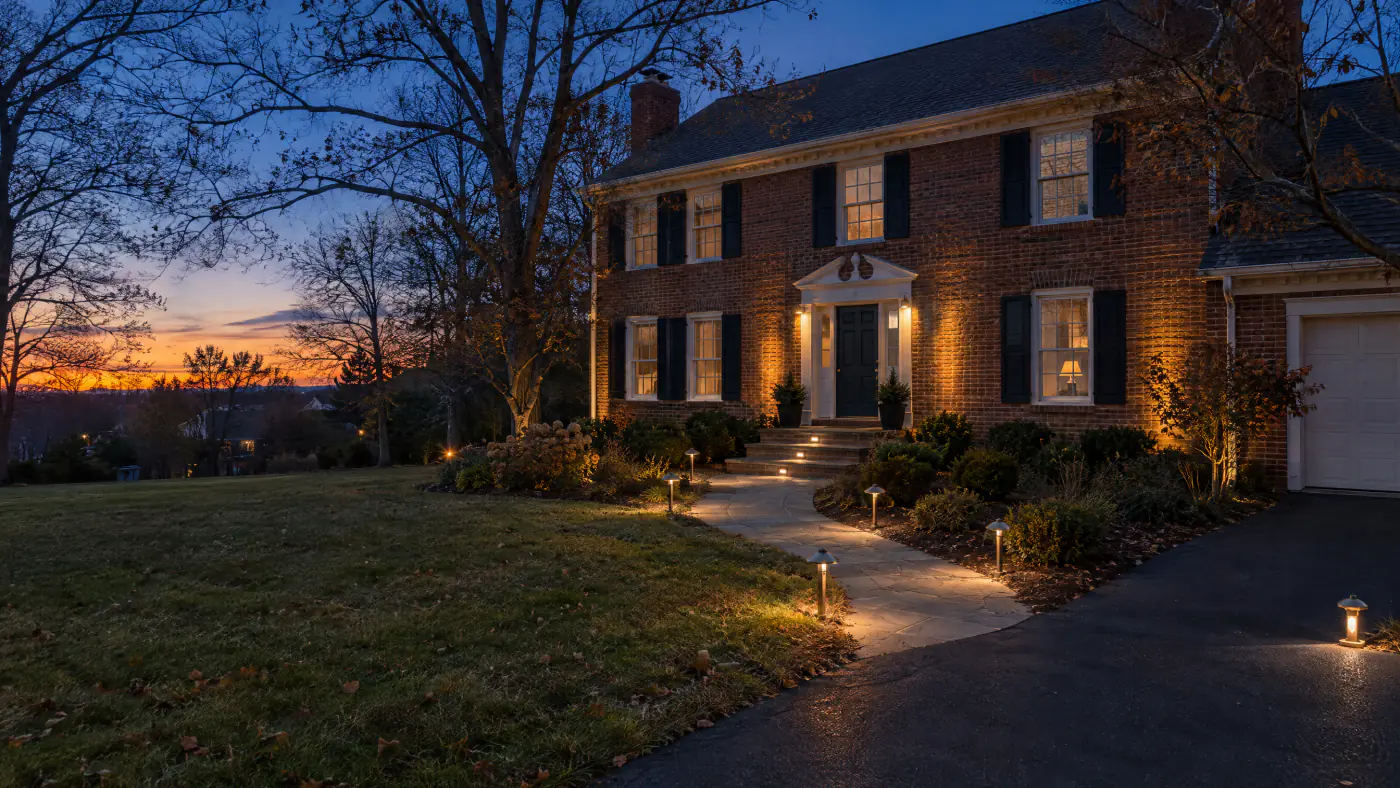
Light the path a person actually takes, in the order they take it, and nothing more. Start at the street. The driveway apron needs enough light to find the turn and to see the edge of the pavement, which on a Northern Virginia lot often drops off into a drainage swale. Two low, shielded fixtures at the apron, or a single downlight from a tree, do that job. Long driveways get one marker light every 20 to 30 feet on one side only, staggered if the drive curves, and never a matched runway down both sides.
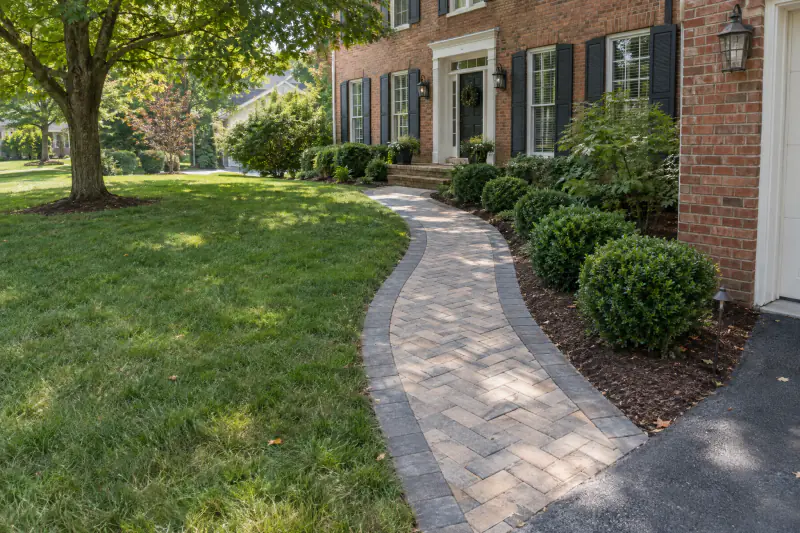
The front walk comes next. Shielded path lights, usually around 18 to 24 inches tall, throw a pool of light down onto the paving and keep the source out of your eyes. Spaced roughly 8 to 12 feet apart on alternating sides, the pools overlap just enough that there is no dark gap. On a paver or bluestone walk, light the surface, not the plants beside it; the texture of the paving tells the eye where the edge is. Light every change of direction and every spot where the walk meets a step, a gate or the driveway.
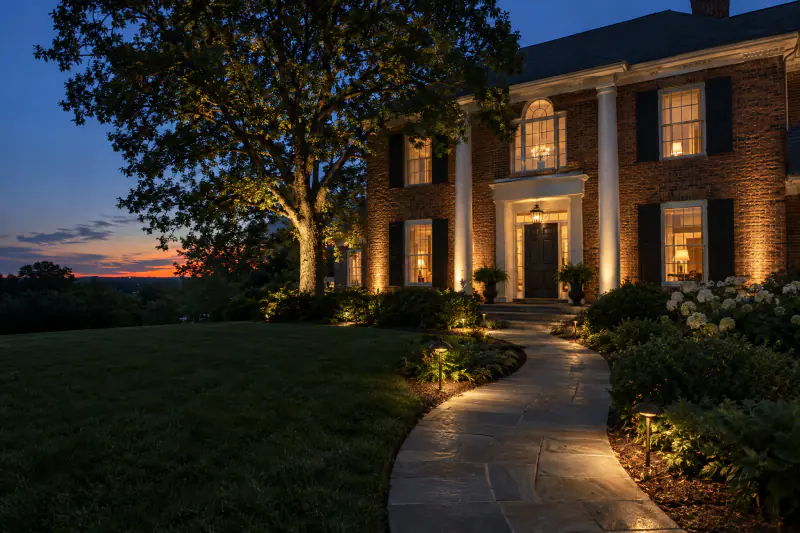
Then the steps, which get their own section below because they are where people fall. Last, the door. A warm downlight on the house numbers, a soft wash on the door and its surround, and a fixture that lights the keyhole side of the entry. That is what a delivery driver, a visitor and a tired homeowner at 6 p.m. in December all need. Everything else, the uplit oak, the grazed brick, the wall wash on the garage, is pleasure rather than function, and it is worth having, but it comes after the arrival is covered and it should be dimmer than the path so the path still reads as the brightest line in the picture.
One principle holds the whole arrival together: you should see the light, not the fixture. Warm white around 2700K, aimed down, shielded and in solid brass or copper so it looks as good by day as it does by night.
How do you make steps and grade changes safe after dark?
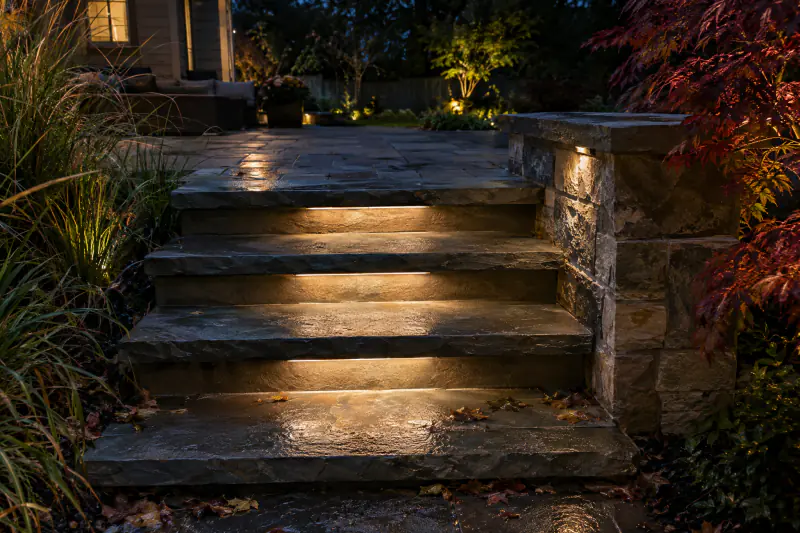
Light the edge of every tread so the change in level is visible from several paces away, and do it without glare, because a bright source at eye height on a stair is worse than no light at all. There are three reliable ways. The first is a slim fixture recessed under the cap or overhang of the step above, washing the tread below. On a stone or paver stair with a cheek wall, fixtures go under the wall cap at every second step. The second is a hardscape light set into the riser itself, a small louvered fixture that throws light across the tread. The third, for a short run of steps on a path, is a shielded path light placed at the top and bottom so both the first and the last step are lit from the side.
The errors to avoid are consistent. A single bright fixture at the top of a flight casts the shadow of the person descending onto the steps they are trying to see. Fixtures spaced too far apart produce stripes of light and dark that make the treads look uneven. Unshielded fixtures aimed up a stair blind anyone coming down. Cold, bluish light flattens the surface and hides the edge of a bluestone tread; warm light and a slight angle across the surface pick the edge out.
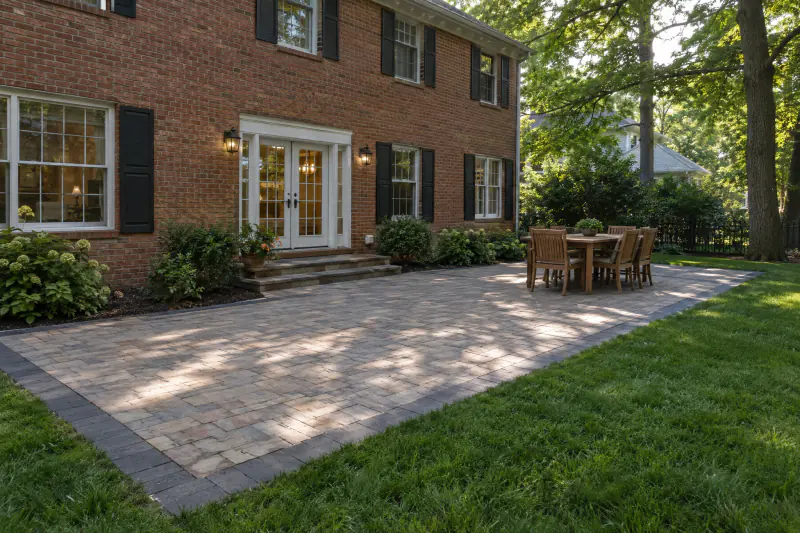
Grade changes without steps need the same care. The spot where a patio drops to lawn, a seating wall that doubles as a step, the edge of a raised deck, a slope on the side-yard path to the trash cans. Each one gets a fixture that shows the drop. On decks and porches, recessed post lights and under-rail strips do this quietly. Where a retaining wall borders a walk, a light under the cap every six to eight feet lights both the wall face and the path at its foot.
In the dark months two more factors matter. Wet leaves on stone steps are slippery, and lighting that shows the leaves is lighting that prevents a fall. And ice, in a Northern Virginia January, forms first on the north-facing step that never sees sun, so that step gets a fixture even if the others are borderline.
Can you have security lighting without floodlight glare?
Yes, and the result is better security, not worse. A single floodlight on a garage corner creates a bright blob and a ring of deep shadow around it, and anyone standing in the shadow is invisible to someone standing in the light. It also lights your neighbor's bedroom, draws complaints in HOA communities, and is the fixture most likely to be the subject of a dark-sky rule. What actually makes a property hard to approach unseen is low, even light across the whole frontage and along the side yards, with no dark pockets, so that movement anywhere is visible from the house and from the street.
That is what a well-designed landscape lighting system already does. Path lights along the walk, soft grazing light on the facade, a downlight from a tree over the driveway and a fixture at each side-yard gate cover the approaches at a few watts each. The light is at ground level and aimed down, so it does not spill past the property line. For the corners that need more, a motion-activated line-voltage fixture can be set to a low dusk-to-dawn level that brightens on movement, which gives the deterrent effect without a floodlight running all night. That is an electrician's fixture, not part of the low-voltage system, and we design around it rather than installing it ourselves.
Downlighting from trees deserves a special mention for security. A fixture mounted 20 to 25 feet up in a mature oak and aimed down through the branches lights a wide area of lawn and driveway with a soft, moonlight-like pattern. One such fixture can cover what three ground-mounted floods would, with no glare, and it is nearly invisible by day. Northern Virginia lots with mature trees are made for it.
Timing matters too. A lit house at 6 p.m. in December looks occupied, and that is most of what deters casual trouble. The astronomic timer covered below handles that automatically. A system that is off because someone forgot to reset a mechanical timer after the clocks changed is a system doing nothing.
Which fixtures belong in each zone for the dark months?
A typical front-of-house plan for a Northern Virginia single-family lot. Townhomes use a subset; large lots add driveway and tree lights.
| Zone | What to light | Fixture type | Typical count | Control |
|---|---|---|---|---|
| Driveway apron | Edge of pavement, the turn in | Low shielded markers or a tree downlight | 2 to 4 | Dusk to late evening, or dusk to dawn at low level |
| Front walk | The paving surface, direction changes | Shielded path lights, 18 to 24 in. tall | 4 to 8 | Dusk to late evening |
| Steps | Every tread edge | Under-cap, riser or hardscape lights | 1 per step or per second step | Dusk to dawn |
| Entry and house numbers | Numbers, door, keyhole side | Downlight on numbers, soft wall wash | 2 to 3 | Dusk to dawn |
| Facade and trees | Brick between windows, oak canopy | Uplights, grazers, tree downlights | 3 to 8 | Dusk to late evening, dimmable |
| Side yard and gates | Path to trash, gate latches, deck steps | Path lights, post lights | 2 to 4 | Dusk to dawn or motion |
| Holiday decorations | Roofline, shrubs, porch | Line-voltage outlets on a dedicated circuit | 2 to 6 receptacles | Plug-in timer or smart plug |
Low-voltage zones run from one transformer on an astronomic timer. Holiday outlets are separate line-voltage work by a licensed electrician.
What about outlets and a dedicated circuit for holiday decorations?
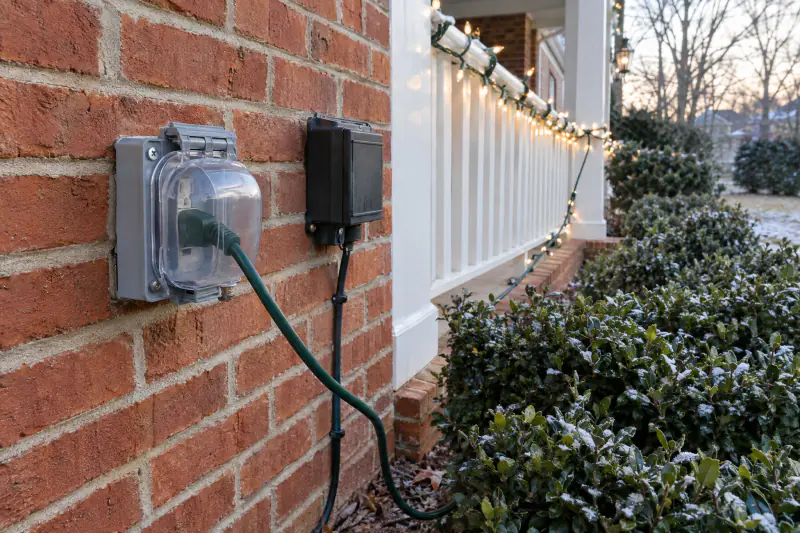
Holiday lights are the one thing covered here that the low-voltage landscape system does not handle, and the thing most likely to be done badly. Decorations run on household current, 120 volts, through extension cords plugged into whatever outlet is nearest. On many Northern Virginia homes that is a single outlet by the front door on the same circuit as the porch light and half the living room, so the breaker trips on the first cold night when the strings and the inflatable come on together. The fix is more outlets where the decorations actually are and a circuit that belongs to them.
Here is what that work typically involves, and it is work for a licensed electrician, not for us. Exterior receptacles are required to be GFCI protected and weather-resistant rated, with a cover that keeps the weather out while a cord is plugged in, the kind usually called an in-use or bubble cover. A dedicated 20-amp circuit from the panel, with two to six receptacles placed at the porch, the garage corner, the base of the big tree and the far end of the foundation bed, carries a normal house's worth of LED decorations with capacity to spare. Where the run crosses the yard to a tree or a post at the driveway, the conductor goes in conduit or is buried at the depth the electrical code requires for that wiring method, which is deeper than our low-voltage cable. Most jurisdictions in our area require an electrical permit and inspection for a new circuit or new outdoor receptacles; check with your county, because the details and the fees differ between Fairfax, Loudoun, Prince William, Arlington and the independent cities.
What we do is plan for it. During a lighting design we mark where outlets should go, so the electrician's trench and ours share the same route, the low-voltage transformer has its own GFCI outlet rather than sharing one with the inflatable snowman, and the holiday circuit is in before the beds are mulched. In a full landscape installation the electrical rough-in happens before planting, following the same sequence we describe for fall planting: drainage, hardscape, then wiring, then plants.
Two more holiday-specific points. LED decoration strings draw a small fraction of what incandescent strings did, so a dedicated 20-amp circuit is generous for all but the largest displays. And an outdoor-rated plug-in timer or smart plug at each receptacle, rather than a switch inside, is what keeps the display on a schedule when no one remembers to turn it off at midnight.
Which timers and astronomic clocks make the system run itself?
An astronomic timer is the control most landscape systems should have and the one most of them lack. A plain mechanical timer turns the lights on at a fixed clock time, which is wrong within a week as sunset moves, and wrong by an hour the day the clocks change. A photocell turns the lights on at dusk, which is right, but it also turns them on in a dark thunderstorm at 2 p.m. and leaves them running until dawn with no way to shut the facade lights off at bedtime. An astronomic timer knows the date and your location, calculates sunset and sunrise each day, and turns the system on at dusk and off at a time you choose, with no resetting through the year.
Set up properly for the dark months, it runs like this. The whole system comes on at sunset, which the timer tracks as it slides from 6:15 in mid-October to 4:45 in December. The facade and tree lights, on their own zone, go off at 11 p.m. or whenever the house goes quiet. The path, step and entry lights stay on until dawn, or until 1 a.m. with a second dusk-to-dawn zone for the steps only, depending on how early anyone leaves for work. The lights come on before the first commuter is home and go off in the morning without a thought from anyone.
Smart transformers and app-based controllers do the same arithmetic with more flexibility: zones, dimming, scenes for a party, a vacation mode that varies the off time, and a phone tap to bring everything up when you hear something outside. They cost more and depend on the home's Wi-Fi reaching the transformer, which on a detached garage or a far corner of the lot it sometimes does not. We install both. For a homeowner who wants it simple and reliable, a quality astronomic timer in the transformer is enough. For one who wants to dim the uplights for a dinner, the smart controller is worth it. Either way the transformer should be sized with spare capacity and extra taps for the fixtures you will add later, a point we make on the landscape lighting service page.
Should you upgrade old halogen fixtures to LED before winter?
If your system is more than about ten years old, the lamps are probably halogen and the answer is yes, for three reasons that matter most in the dark months. Halogen path lights typically draw 18 to 20 watts each; equivalent LED lamps draw roughly 3 to 7 watts. On a 15-fixture system running nine hours a night through winter, that cuts the power use by about three quarters. Halogen lamps also burn out, usually one at a time and usually in January, so a system that looked fine in October has three dark fixtures by New Year. LED lamps are rated for tens of thousands of hours. And the halogen load that left the far end of a long cable run dim can disappear when LEDs cut the current, so fixtures that were starved of voltage brighten up without rewiring.
There are two ways to do it. A drop-in LED lamp with the same base as the old halogen bulb goes into the existing fixture and takes minutes per light. It works well in good brass or copper fixtures with intact sockets and sealed splices. The second route is replacing the fixtures with integrated LED units, which is the right call when the old fixtures are corroded aluminum, the stakes are bent, the lenses are clouded or the connectors have been letting water in. A system that has been dropping fixtures for years usually has wiring problems that new lamps will not fix.
Watch the transformer. Old magnetic transformers run happily on LED loads in most cases, but very light loads on some models can cause flicker, and any electronic transformer or dimmer should be checked for LED compatibility. Match the color temperature across the system; a mix of 2700K and 4000K lamps looks like a mistake, and it is. Warm white around 2700K suits brick, stone and wood, which is most of Northern Virginia. The maintenance guide covers the small annual tasks, lens cleaning, re-aiming and trimming plants back from fixtures, that keep an upgraded system looking the way it did on the first night.
What does landscape lighting for the dark months cost in Northern Virginia?
As typical Northern Virginia market planning ranges as of 2026, professionally installed low-voltage LED landscape lighting runs about $250 to $450 per fixture, including cable, sealed connections and a share of the transformer and controls. A front-of-house arrival package of 10 to 20 fixtures, which is what most of this article describes, commonly lands between $3,500 and $8,000. Step and under-cap lights sit at the upper end per fixture because of the masonry work to set them. Tree-mounted downlights also cost more per fixture because of the climbing and the longer cable runs. Upgrading an existing system with drop-in LED lamps often runs in the low hundreds for the lamps plus a service visit; replacing corroded fixtures with new integrated LED units costs closer to a new installation for the fixtures involved. Adding an astronomic timer to an existing transformer is usually a small line item, and a smart controller a few hundred dollars more. These are general market ranges, not myYardPros prices.
The electrical side is priced by the electrician. For planning purposes, a new GFCI-protected exterior receptacle on an existing circuit, where the panel is nearby, is often a few hundred dollars, and a dedicated 20-amp outdoor circuit with several receptacles and a trench across the yard commonly runs from the high hundreds into the low thousands, plus permit fees that vary by county. Get that quoted separately and in writing.
What moves the number:
- Fixture material. Solid brass and copper cost more than coated aluminum and last decades longer.
- Distance from the transformer, and runs that pass under a driveway or walk.
- Steps and walls. Fixtures set into masonry take more labor than stake-mounted path lights.
- Zones, dimming and smart control.
- Whether an outdoor outlet already exists near the best transformer location.
- Phasing. A transformer sized for the full plan lets the back yard follow next year without rework.
Our cost guide puts these numbers alongside the rest of the yard. The figure for your house comes from a written on-site estimate with a fixture-by-fixture plan, ideally drawn after a walk at dusk.
How do you plan a system now for installation in late fall?
Late October to early December is a good installation window: the beds are dormant, the ground is workable, and the system is running before the holidays.
Walk the property at 5:30 p.m.
Do it this week, or right after the clocks change. Note where you cannot see the edge of the drive, which step you feel for with your foot, where the numbers are invisible and which corner of the yard is a black hole. That list is the design brief.
Decide what the system is for
Arrival and safety first, then security, then the view from inside. Rank them. A budget that cannot cover everything should cover the walk, steps and entry completely rather than spreading thin across the whole lot.
Get a fixture-by-fixture plan
The plan shows each fixture, its purpose, the transformer location and size, cable routes and the control method. It is also what most HOAs in Northern Virginia want attached to an exterior lighting application, so submit it early.
Book the electrician for the same week
If a new outlet or a holiday circuit is in the plan, the electrician's work goes in first or alongside ours so trenches are shared. Permits for that work take time, so the application goes in as soon as the plan is approved.
Install while the beds are dormant
Virginia 811 marks public utilities, we flag sprinkler lines, and cable is buried about 6 inches deep through beds and slit into turf. Dormant perennials and leafless shrubs make November the easiest month to work in a bed without damage.
Aim after dark, then set the clock
Every fixture is aimed and shielded at night, voltage is checked at the end of each run, the astronomic timer or app is programmed for the season, and we walk the lit property with you before the holidays, not after.
What should be on your dark-months lighting checklist?
Ten items, in roughly the order to deal with them between now and the first week of December.
- Walk the arrival after dark and list every spot where you cannot see an edge, a step or the house numbers.
- Check the existing timer: replace any fixed-time or mechanical timer with an astronomic timer before November 1.
- Count dead or dim fixtures and decide between drop-in LED lamps and replacing corroded units.
- Identify every step, wall edge and grade change on the walk, side yard and patio that needs its own light.
- Remove or re-aim any floodlight that shines across a property line or into your own eyes on the walk.
- Mark where holiday decorations plug in and have a licensed electrician quote outlets and a dedicated circuit.
- Confirm the low-voltage transformer has its own GFCI-protected outlet and spare capacity for added fixtures.
- Submit the lighting plan to the HOA if exterior lighting is reviewed in your community.
- Schedule installation for November, while beds are dormant and before decorations go up.
- Book a night aiming session and have the controls programmed for winter before you sign off.
What should homeowners in Fairfax, Loudoun, Prince William and Arlington know about winter lighting?
Across our service area the lighting itself is the same; the rules, the trees and the lot shapes are not. HOA review is the first local variable. Communities in Reston, Ashburn, Brambleton, South Riding, Burke and across much of Loudoun and Prince William review exterior lighting and commonly limit brightness, fixture style and light crossing a property line. Some have rules on holiday displays too, including dates and hours. Shielded, downward-aimed, warm fixtures on a timer satisfy nearly all of them, and a plan drawing attached to the application usually speeds the answer.
Permits are the second. Low-voltage lighting that plugs into an existing GFCI outlet generally does not require a permit in Northern Virginia, though you should confirm with your jurisdiction. New outlets and circuits do. Fairfax County, Loudoun County, Prince William County, Arlington County and the cities of Alexandria, Falls Church, Fairfax and Manassas each issue their own electrical permits with their own fees and inspection scheduling, and the electrician doing the work handles the application.
Trees and lot shape change the design. The mature oaks and tulip poplars of McLean, Great Falls, Vienna, Oakton and Clifton make tree downlighting the best security and driveway lighting on offer, and the long drives in those neighborhoods are where marker lights and apron lights earn their keep. Townhome rows in Herndon, Sterling, Centreville, Springfield and Woodbridge have a short front walk, two or three steps and a stoop, and a system there is often six to ten fixtures done well, with the step and number lights doing most of the work. Older streets in Arlington, Alexandria and Falls Church sit close to neighbors, so spill light and glare matter more and the fixtures get lower and more tightly shielded.
Finally, the ground. November and early December are usually workable on Northern Virginia clay, and cable goes in with little disturbance once the beds are dormant. A hard freeze or a saturated week pauses trenching, which is one more reason to plan in October and install early rather than hoping for a dry week between Christmas parties. Lighting installed alongside a fall planting or a late-season patio goes in before the mulch and the pavers, and costs less for it.
Frequently asked questions
When does it get dark in Northern Virginia in winter?
After daylight saving time ends on November 1, 2026, sunset is around 5 p.m. and falls to roughly 4:45 p.m. in early December, the earliest of the year. It does not pass 5:30 p.m. again until early February. Civil twilight adds about half an hour of usable light, so most commuters are home in full dark from mid-November to early February.
Can my landscape lighting transformer power holiday lights?
No. A low-voltage transformer supplies 12 to 15 volts to its own fixtures and is sized for them. Holiday strings, inflatables and projectors run on 120 volts and plug into line-voltage receptacles. Keep the transformer on its own GFCI outlet and have a licensed electrician add weather-resistant outlets, ideally on a dedicated circuit, for decorations.
Do I need a permit for a new outdoor outlet in Fairfax or Loudoun County?
Generally, yes. New outdoor receptacles and new circuits are electrical work that requires a licensed electrician and usually a permit and inspection in Fairfax, Loudoun, Prince William and Arlington counties and the independent cities. Fees and process vary, so check with your county. Low-voltage lighting plugged into an existing outlet typically does not require one.
What is an astronomic timer and do I need one?
It is a timer that calculates sunrise and sunset for your location every day and switches the lights accordingly, with an off time you choose. Unlike a fixed timer it never needs resetting as the days shorten or when the clocks change, and unlike a photocell it will not come on during a dark afternoon storm. For a system that should simply work all winter, it is the control to have.
Will landscape lighting raise my electricity bill much in winter?
Not noticeably with LED. Most LED landscape fixtures draw 3 to 7 watts, so a 15-fixture system running nine hours a night uses about as much electricity as a single old incandescent bulb left on, typically a few dollars a month. Old halogen fixtures at around 20 watts each cost several times that, which is one reason to upgrade before winter.
Can lighting be installed in November and December?
Yes, and it is a good window. The beds are dormant, cable can go in through them without damaging perennials, and the ground is usually workable until a hard freeze. Installation pauses during frozen or saturated weeks. Planning in October and installing in November gets the system running before holiday decorations go up and before the darkest weeks.
How do I light steps without creating glare?
Put the light below eye level and aim it at the tread. Fixtures recessed under the cap of the step above, small louvered riser lights, or a shielded path light at the top and bottom of a short flight all show the edge of each tread without a bright source in your face. Avoid one bright light at the top, which throws your own shadow down the stairs.
Book the work
Put the plan in writing with a crew that builds this every week.
One visit to measure and talk through options, then a written scope and price. No pressure, no vague numbers. Ask about the Heroes Discount if you serve.
Sources and further reading
Published October 22, 2026. Reviewed and updated November 13, 2026.