Key takeaways
- Lighting has three jobs, safety, security and beauty, and a good plan does each with a different technique rather than flooding the yard with one kind of fixture.
- The techniques that suit Northern Virginia homes are uplighting oaks and crape myrtles, shielded path lights, step lights, grazing brick and moonlighting from high in a tree.
- A low-voltage system is a transformer on a GFCI outlet, buried 12-gauge cable in short runs, sealed splices and LED fixtures, each receiving voltage within its rated range.
- Solid brass or copper fixtures with 2700K warm white LEDs, shielded and aimed away from windows and neighbors, satisfy most HOA and dark-sky concerns and last decades.
- As of 2026, typical Northern Virginia planning ranges run about $250 to $450 per installed fixture, so a 10 to 20 fixture system often lands between $3,500 and $8,000.
On this page
- What should landscape lighting do for a Northern Virginia home?
- Which lighting techniques work on brick colonials, oaks and crape myrtles?
- Which technique fits which feature in the yard?
- How does a low-voltage system work: transformers, wire runs and voltage drop?
- Brass or aluminum: which fixtures last in Northern Virginia weather?
- What color temperature should you choose?
- How do you avoid glare and keep the neighbors happy?
- What do HOAs and county rules say about outdoor lighting?
- Timers, photocells or smart control: which should run the system?
- How is a lighting design made and installed?
- How much does landscape lighting cost in Northern Virginia in 2026?
- What should you check at the night aiming walkthrough?
- How does lighting design change across Fairfax, Loudoun, Prince William, Arlington and Alexandria?
- Frequently asked questions
What should landscape lighting do for a Northern Virginia home?
Landscape lighting should do three things: make steps, walks and level changes safe to use after dark, make the property feel occupied and watched so it is a poorer target, and show the house and the trees at their best so the yard is still a place you want to be at nine on a June evening. A good design does each job with a different technique and a different amount of light. Safety lighting is low, soft and close to the ground. Security lighting is about eliminating dark pockets near doors and side yards, not about floodlights. Beauty is light on the oak canopy, the brick, the crape myrtle and the water feature, with every source hidden.
Most systems that disappoint fail because they did only one of those jobs with one kind of fixture. The runway of path lights down both sides of the front walk is the familiar version. It makes the walk visible, lights nothing else, and glares at anyone arriving. The other version is the pair of 120-volt floodlights on the garage, which make the driveway bright and everything beyond it black. Neither is a design.
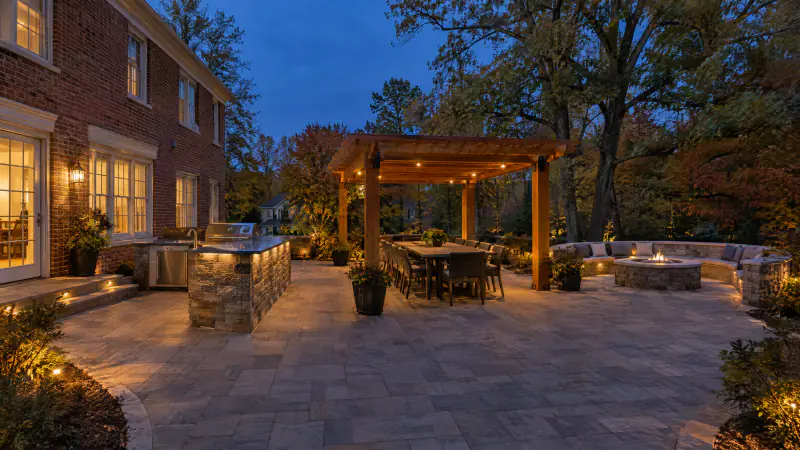
This article walks through how we design and build low-voltage LED lighting for the houses, trees and rules we work with across Fairfax, Loudoun, Prince William and Arlington: the techniques, the electrical side, the fixture materials, the color of the light, the neighbor and HOA questions, control options and planning ranges as of 2026. The scope of a typical installation is on our landscape lighting service page.
Which lighting techniques work on brick colonials, oaks and crape myrtles?
The techniques that work here are uplighting for trees and the house, wall grazing for brick and stone, shielded path lighting for walks, step and wall lighting for level changes, downlighting for patios and moonlighting from high in a tree for lawns and beds. Each is a fixture type, a beam spread and an aiming angle, and the skill is in matching them to the subject.
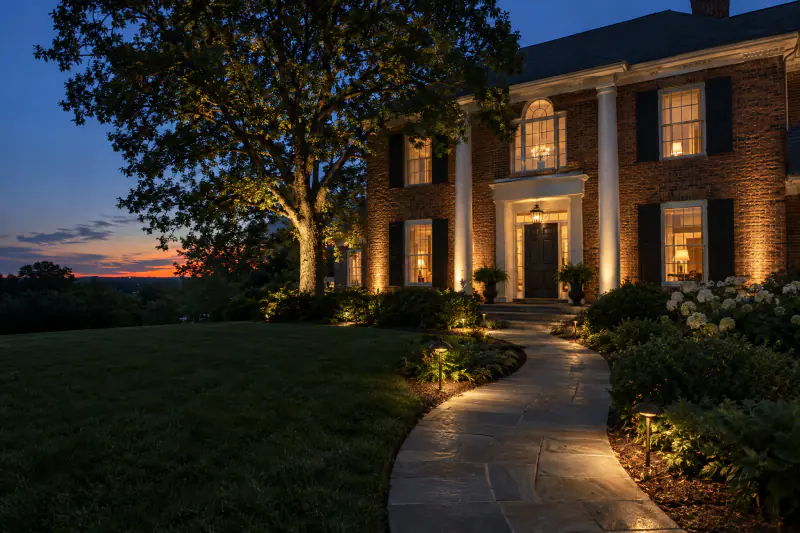
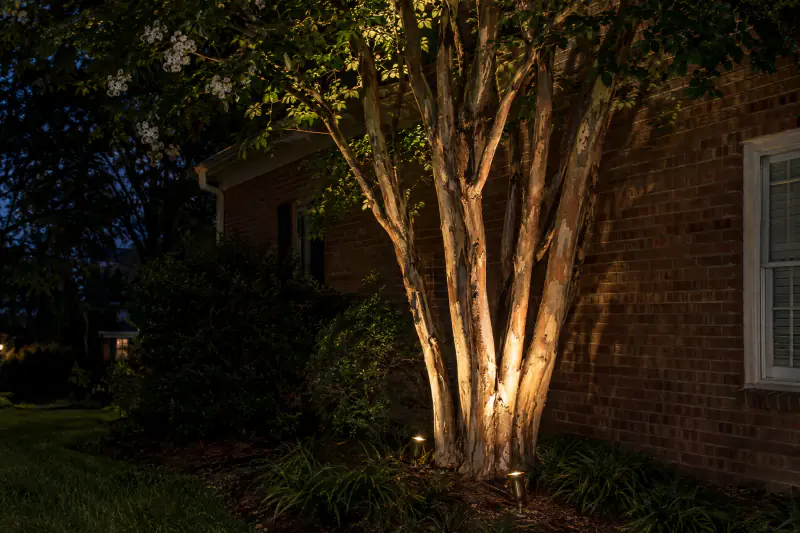
Uplighting trees. A mature oak in Vienna or McLean deserves two or three uplights at its base, one with a narrow beam to reach the canopy sixty feet up and one or two with wider beams to light the trunk and the lower limbs. Fixtures sit a few feet out from the trunk, aimed up and slightly in, and are staked rather than mounted to the tree. A multi-trunk crape myrtle, which nearly every Northern Virginia yard has, is best lit with two small narrow-beam fixtures on opposite sides, so the smooth mottled trunks and the summer bloom read as sculpture. River birch, Japanese maple and serviceberry take the same treatment with lower output. A dense evergreen such as a holly is lit from the front with a wide beam, not from underneath, because the light cannot get inside it.
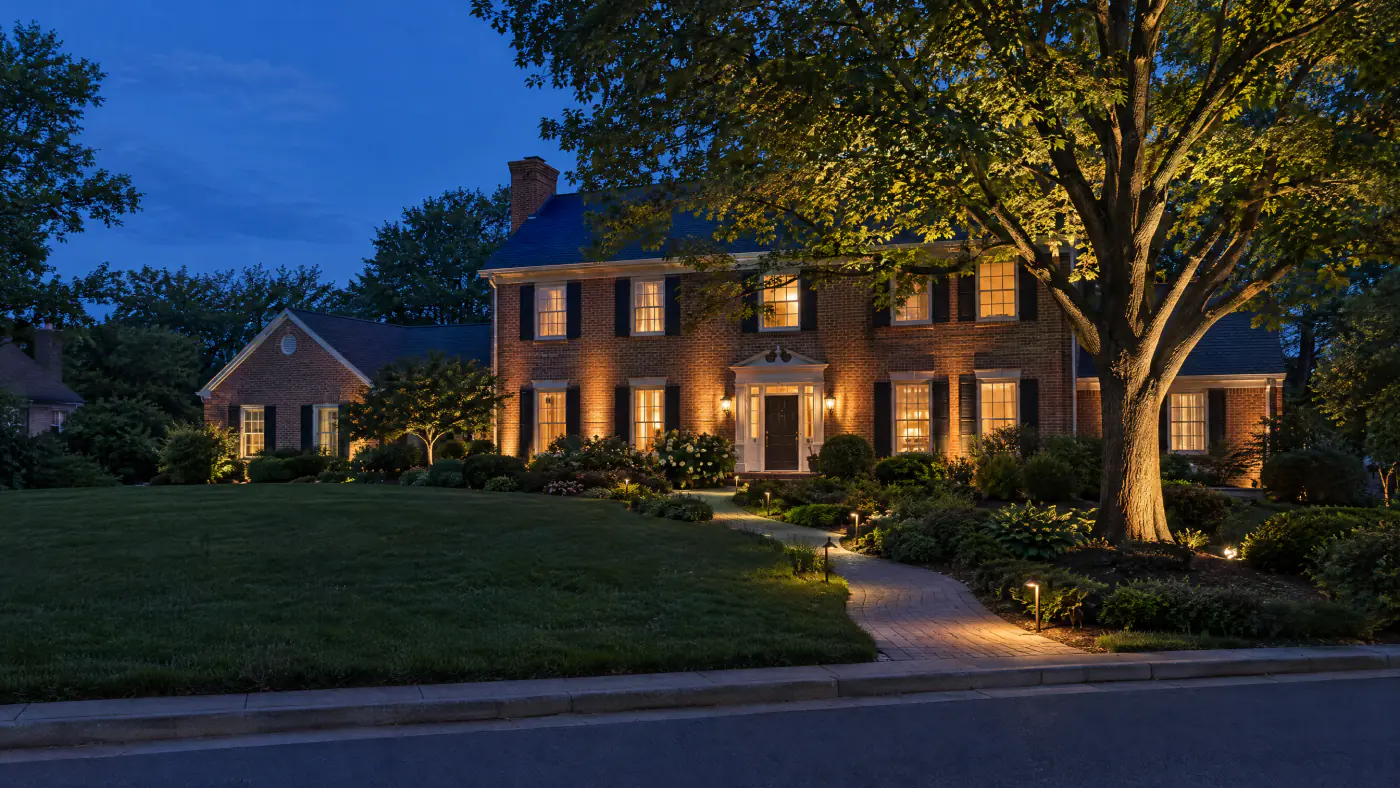
Grazing brick and stone. A fixture set close to a brick wall and aimed straight up rakes light across the surface so every mortar joint throws a tiny shadow. Brick, fieldstone and board-and-batten siding all look good grazed; smooth vinyl siding does not, and shows every dent. On a colonial we graze the panels between windows, never the windows themselves, and keep fixtures off the corners so the house has edges.
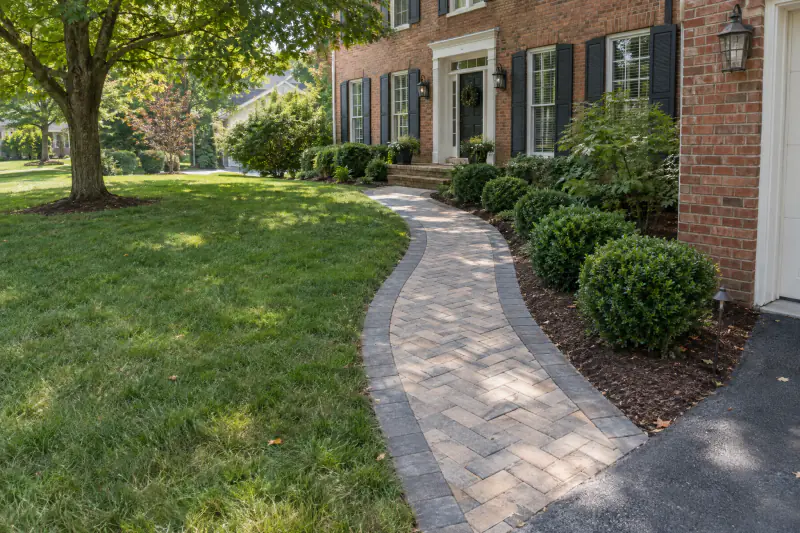
Path lighting. Shielded, hat-style or side-shielded path lights throw a pool of light down onto the walk and bed edge. They belong at turns, steps and intersections, staggered on alternate sides, spaced so pools just touch, typically eight to twelve feet apart. Three well-placed path lights do more for a front walk than twelve, and a walk with good grazing on the house behind it needs fewer still. We cover walk design itself in front walkways that add curb appeal.
Step and wall lighting. Slim fixtures recessed into risers or mounted under the cap of a seating wall light the tread without lighting the eyes of the person coming down. Every set of steps on the property gets this treatment before any decorative light is placed. It is the safety job, and it is the one that matters at 11 p.m. in January.
Downlighting and moonlighting. A fixture on a pergola beam, under a deck rail or on the house eave lights a dining table or a grill without a fixture in anyone's eye. Moonlighting takes the idea up into a tree: two or three fixtures mounted twenty to thirty feet up in an oak or maple, aimed down through the branches, cast a soft dappled pattern over the lawn and beds that looks like a full moon. It is the most natural effect in landscape lighting and the hardest to see the source of, which is why we use it on back yards in Great Falls and Oakton where the trees are big enough.
Which technique fits which feature in the yard?
A field guide to pairing subjects with techniques. Output figures are typical LED ranges, and beam spreads are the angles we reach for first.
| Feature | Technique | Fixture and beam | Typical output | Notes |
|---|---|---|---|---|
| Mature oak or maple, 40 to 80 ft | Uplighting, two or three fixtures | Brass spot, 15 and 35 degree beams | Higher, roughly 400 to 800 lumens per fixture | Stake off the trunk; aim up and slightly in |
| Crape myrtle, multi-trunk | Cross uplighting | Two small brass spots, 15 to 25 degrees | Low to moderate | Light the trunks; the bloom lights itself |
| Brick facade between windows | Grazing | Well or spot close to wall, 35 to 60 degrees | Moderate | Never aim at glass; skip the corners |
| Front walk with turns | Path lighting | Shielded hat or side-shield path light | Low, roughly 100 to 200 lumens | Stagger sides, 8 to 12 ft apart, at turns |
| Steps to a porch or patio | Step lighting | Recessed riser or under-tread fixture | Low | Every step run, before any decorative light |
| Seating wall or retaining wall | Under-cap wall light | Slim hardscape fixture set in the cap joint | Low | Installed when the wall is built where possible |
| Patio dining area | Downlighting | Pergola, eave or post downlight, 35 to 60 degrees | Moderate, dimmable | Light the table, not the people |
| Open lawn and beds under big trees | Moonlighting | Two or three tree-mounted downlights, 60 degrees | Moderate | Mounted 20 to 30 ft up with growth-friendly straps |
| Evergreen screen or holly | Front wash | Wide flood, 60 degrees or more | Moderate | Light from the front; uplighting disappears inside |
Fixture counts and outputs are starting points. Every system is aimed and adjusted after dark before it is finished.
How does a low-voltage system work: transformers, wire runs and voltage drop?
A low-voltage landscape lighting system is a transformer that steps household 120-volt power down to a nominal 12 volts, buried cable that carries it to the fixtures, sealed connections at each fixture and LED lamps that run on that low voltage. Because the current beyond the transformer is low voltage, the system can be installed by a landscape lighting contractor without an electrical permit in most Northern Virginia jurisdictions, as long as it plugs into an existing GFCI-protected outdoor outlet. Confirm that with your county. A new outlet, a new circuit or any 120-volt fixture is electrician work with a permit, and we coordinate it rather than do it.
The transformer is sized to the load with room to spare. We add up the wattage of every fixture, plan to load the transformer to no more than about eighty percent of its rating, and leave capacity for the fixtures that always get added a year later. Transformers are multi-tap, with outputs at 12, 13, 14 and 15 volts, which is how we deal with voltage drop: a long run loses voltage along the wire, and a fixture at the far end of a 150-foot run of 12-gauge cable would be dim and amber if it were fed from the 12-volt tap. We feed long runs from a higher tap, keep each run reasonably short, and split the system into several runs from the transformer rather than one long chain. LED fixtures tolerate a range of voltage, often somewhere around 10 to 15 volts depending on the lamp, so the goal is to land every fixture inside that range, and we measure it with a meter at the far fixture of every run during the night walkthrough.
Cable is direct-burial low-voltage wire, 12-gauge for most runs and heavier for very long ones, buried about six inches deep in beds and slit into turf. Connections are the part that fails first in our humid climate if done cheaply: pierce-type clip connectors let water into the copper and the fixture flickers out within a couple of years. We use gel-filled or heat-shrink waterproof connectors on every splice and keep them above the cable, not lying in the mulch. Runs are routed around major tree roots and away from sprinkler laterals, and sleeves go under any walk or driveway that is being built at the same time, which is one reason lighting is easiest to add alongside a walkway or patio project.
Brass or aluminum: which fixtures last in Northern Virginia weather?
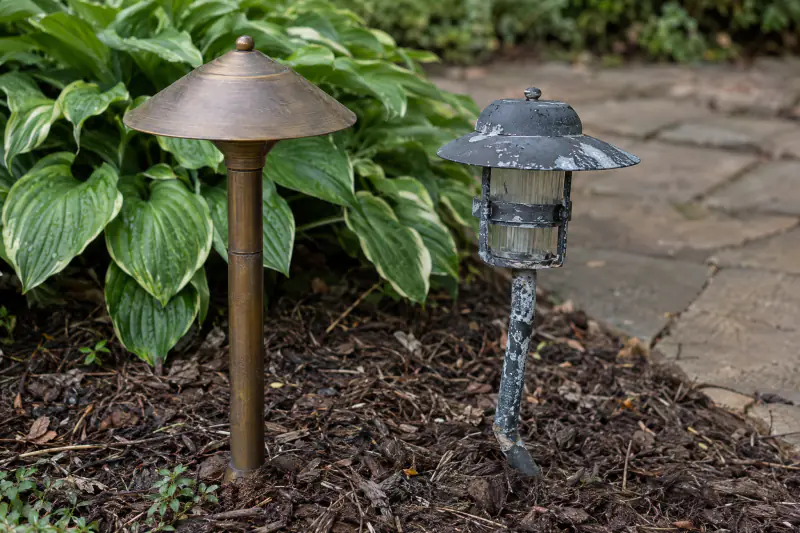
Solid brass and copper fixtures last decades in Northern Virginia; coated aluminum fixtures commonly fail within a few years. The difference is corrosion. Our summers are humid, our soils are acidic, lawn fertilizer and de-icing salt splash onto the beds, and sprinklers wet the fixtures nightly. Powder-coated aluminum resists that for a while, then the coating chips at the stake or the stem, moisture gets under it, and the metal pits and crumbles. The thin stakes bend when a mower or a child hits them. Brass simply darkens to a brown patina and keeps working. Copper does the same with a green cast. Stainless steel is fine for some step and wall fixtures but shows tea staining in our climate.
The price gap is real but smaller than it looks across a system's life. A brass path light may cost two or three times an aluminum one. Over fifteen years the aluminum fixture is replaced once or twice, and each replacement involves digging up a splice. The brass fixture is still there. For a system of ten to twenty fixtures that is why we specify brass as the default and treat aluminum as a budget option for fixtures that are hidden and dry.
Inside the fixture, the LED matters as much as the housing. We prefer fixtures that take a replaceable LED lamp, usually an MR16 or a G4 bi-pin form, over sealed integrated units, because a failed lamp is a two-minute swap rather than a fixture replacement and a new splice. Good lamps are rated for tens of thousands of hours and carry a color rendering index in the high 80s or above, which keeps brick looking like brick rather than orange. Lenses should be glass, not plastic, which clouds in the sun. Every fixture gets a shield, a glare guard or a hood sized to its beam, because a bare lens is a glare source whatever the fixture is made of.
What color temperature should you choose?
Warm white at about 2700K suits most Northern Virginia homes, and it is our default. It looks like the incandescent light people grew up with, it flatters brick, fieldstone, wood and the tan of a crape myrtle trunk, and it makes a house feel inhabited rather than lit. Slightly cooler light at 3000K is a reasonable choice for blue-green foliage, for a moonlighting effect through an oak canopy, or on a modern house with gray siding and black trim. Anything at 4000K or above reads as a parking lot. Mixing temperatures on one property is a common mistake; one 3000K fixture in a 2700K scheme stands out like a blue bulb in a chandelier.
Color temperature also carries a dark-sky and wildlife consideration. Warmer light, at 3000K or below, scatters less and disturbs insects, birds and neighbors less than cool white. Fireflies, which light up Northern Virginia lawns from late May into July, are easier to see and less disrupted around warm, shielded, low-level lighting than under cool floods. That is a small thing, but it is the kind of small thing a lighting plan should get right.
Brightness is the other half of the color decision. LED output has climbed so far that the risk today is too much light, not too little. A front walk needs pools you can see your feet by, not daylight. An oak needs enough to show the canopy, not enough to bleach it. A dimmable transformer or a dimming controller lets a scheme be tuned down after the first week, when the novelty of bright light has passed and the owners discover they prefer it softer. We design on the low side and leave the dimmer for adjustment.
How do you avoid glare and keep the neighbors happy?
Glare is avoided by shielding every fixture, aiming light at surfaces rather than into open space, keeping output modest and placing fixtures so that no lens is visible from the places people stand, walk or sit. The test is simple: walk the property at night and look for points of light. Every one you see is glare. A path light with a hat and a side shield throws light down and shows only a soft glow at the lens. An uplight with a glare guard shows nothing from the walk and lights the tree. A well light in the bed next to a window shows a lens from inside the house and has to move.
Neighbors are a design constraint, not an afterthought. On the typical quarter-acre lots in Herndon, Springfield, Chantilly or Centreville, an uplight aimed at a tree near the property line also lights the neighbor's bedroom ceiling. We aim uplights away from adjoining houses, use narrower beams near lines, mount moonlights so their spill stays on the owner's lawn, and never aim anything toward a neighbor's window. Trespass, the light that crosses a property line, is the complaint HOAs and counties hear most, and it is almost always fixable with a shield and a five-degree aiming change.
Timing helps too. A system on an astronomical timer that runs from dusk until about 11 p.m. and then switches off, or dims to a security level, gives neighbors a dark yard for sleeping and uses less power. Motion-activated zones near doors and side gates handle the security job after midnight without lighting the whole property all night. Leaving everything on until dawn is the quickest way to turn a nice installation into a dispute.
What do HOAs and county rules say about outdoor lighting?
Most Northern Virginia HOAs review exterior lighting as part of their architectural guidelines, and many set rules on fixture style, color temperature, brightness, light crossing property lines and whether fixtures may be mounted in trees. Reston, Ashburn, Brambleton, South Riding, Burke and the larger Prince William communities around Gainesville and Bristow tend to have written standards; many specify warm white light, shielded fixtures aimed downward or at the house, and no light trespass. Our lighting plan, which shows each fixture and its purpose, is drawn so it can be attached to the application, and the process is the same one we describe in HOA approval for exterior projects.
County rules are mainly about glare and trespass. Fairfax County and Loudoun County both include outdoor lighting standards in their zoning ordinances; most of the detailed requirements apply to commercial properties, but residential rules commonly limit light spilling onto neighboring lots and prohibit fixtures aimed to glare at streets and neighbors. Prince William County, Arlington County and the cities of Alexandria, Fairfax and Falls Church each handle this in their own ordinances. Low-voltage landscape lighting that is shielded, warm and aimed at surfaces complies with every version of these rules we have encountered, but the details change, so check with your county if a project is large or near a lot line.
Dark-sky practice is worth following whether or not anyone requires it. Its four rules are to light only what needs light, to use no more output than the task needs, to shield fixtures so light goes down or at a surface and not up into the sky, and to use warm color temperatures. A landscape system designed that way looks better than one that ignores the rules, because the contrast between lit and dark is what makes an oak or a brick wall dramatic. A yard where everything is lit has no drama at all.
Timers, photocells or smart control: which should run the system?
An astronomical timer is the dependable default. It knows the sunset time for Northern Virginia on every day of the year and switches the system on at dusk and off at a time you set, with no reset after a power outage and no seasonal adjustment. A photocell is simpler still, switching on when it gets dark and off when it gets light, which is fine for a security zone but leaves decorative lighting on all night. Many transformers combine both.
Smart control adds scheduling from a phone, separate zones for the front, the patio and the trees, dimming, scenes for a dinner party or a holiday and the ability to turn the patio lights on from the sofa. Smart transformers and plug-in controllers from several manufacturers make this straightforward, and the system can also tie into a home automation platform. The practical value is zones and dimming. Being able to run the path and step lights until midnight for safety while the tree uplights go off at eleven, and to dim the patio downlights from full for cooking to a third for conversation, is what makes a system feel designed rather than switched. The cost is a few hundred dollars more than a basic transformer.
Whatever the control, the system should be wired in zones from the start even if it is switched as one. Separate runs for the front, the back and any future phase mean that adding smart control later is a swap of the transformer rather than a rewiring. We also leave spare capacity and a labeled run for the holiday season, since a dedicated outlet or zone for seasonal lights is the single most requested addition in December. We cover that in landscape lighting for the dark months.
How is a lighting design made and installed?
Five stages. The first and last happen after dark, which is where most lighting jobs are decided.
Dusk site visit
We walk the property with you near dusk, note what you see from the main windows, where footing is unsafe, which trees and surfaces deserve light, where the neighbors' windows are and where an outdoor outlet exists for the transformer.
Lighting plan
A plan shows each fixture, its type, beam and purpose, the transformer size and location, cable routes, zones and the control method. It is the document for your review and for an HOA application. Fixture counts are usually lower than owners expect.
Utility marking and layout
Virginia 811 marks public utilities. We flag fixture positions and cable routes, locate sprinkler lines and dog fence wire where we can, and route around major roots. Sleeves are set under any walk or drive being built at the same time.
Installation
Fixtures are set on brass stakes or mounts, cable is buried about six inches deep, every splice gets a sealed waterproof connector, runs are balanced across transformer taps and the transformer is mounted on the house near the GFCI outlet.
Night aiming and walkthrough
After dark we aim and shield each fixture, check voltage at the end of every run, hunt for glare from the street, the walk and inside the house, set the timer or app and adjust anything you want changed. A system is not finished until this is done.
How much does landscape lighting cost in Northern Virginia in 2026?
As of 2026, typical Northern Virginia market planning ranges for professionally designed and installed low-voltage LED landscape lighting run about $250 to $450 per fixture, including a share of the transformer, cable, connectors and the night aiming. A front-of-house system of six to ten fixtures often lands between $2,000 and $4,500. A system of ten to twenty fixtures covering the front, a patio and a few trees often runs $3,500 to $8,000. Larger properties in Great Falls, Clifton or western Loudoun with multiple large trees uplit, moonlighting, several zones and smart control commonly reach $10,000 to $20,000 or more. These are general market ranges, not myYardPros prices.
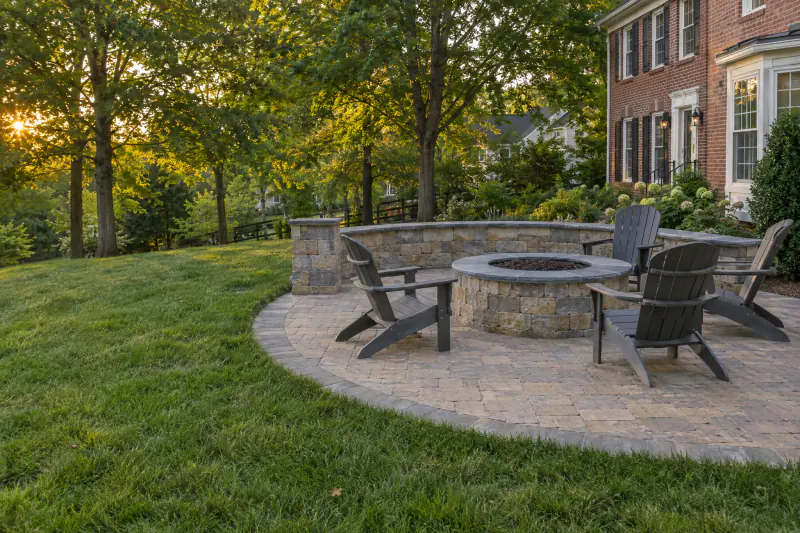
What moves the number: fixture material, since brass and copper cost more than aluminum but last far longer; the number of large trees, which need two or three fixtures each and longer runs; tree-mounted moonlighting, which involves climbing and growth-friendly mounting hardware; cable distance and any run that must pass under an existing walk or driveway; transformer size, zoning, dimming and smart control; and whether a new outdoor outlet is needed, which is a separate electrician's charge. Step and wall lights retrofitted into existing masonry cost more than the same fixtures installed while the wall or steps are built, which is a strong argument for planning lighting alongside a seating wall and fire pit or a paver patio rather than after it.
Operating cost is small. LED landscape fixtures draw roughly three to seven watts each, so a fifteen-fixture system running six hours a night adds a few dollars a month to the electric bill. The cost guide sets lighting alongside every other project type. For a figure that fits your property, the only reliable number is a written estimate after a dusk site visit, with the fixture list and transformer size spelled out.
What should you check at the night aiming walkthrough?
Ten things to look for before you sign off on a system, whoever installs it.
- Every step and level change is lit well enough to see the tread edge from above.
- No lens is visible from the front walk, the driveway or the street.
- No fixture shines into any window of your house or a neighbor's.
- Trees are lit into the canopy, not just a bright patch on the trunk.
- Brick and stone are grazed between windows, with the corners left dark.
- Light at the far fixture of each run is as warm and bright as at the first.
- All fixtures are the same color temperature, with no bluish or greenish odd one out.
- The timer or app is set, and you know how to change the off time and dim a zone.
- Splices are sealed and buried, not clipped and lying in the mulch.
- The transformer is mounted off the ground, on a GFCI outlet, with spare capacity noted.
How does lighting design change across Fairfax, Loudoun, Prince William, Arlington and Alexandria?
The design changes with the trees, the lot size and the neighbors. In the wooded older neighborhoods of Fairfax County, including Vienna, McLean, Great Falls, Oakton, Burke and Annandale, the mature oaks and maples are the stars, and the system is built around uplighting and moonlighting with the house as a supporting player. Lots are large enough that trespass is rarely an issue, but the canopies are big enough that narrow beams and higher-output fixtures are needed to reach them. Reston and Great Falls add slope and rock, so cable routes follow the beds rather than crossing the lawn.
In the newer communities of eastern Loudoun and western Prince William, such as Ashburn, Sterling, South Riding, Gainesville, Haymarket and Bristow, the trees are young and the houses are close together. There the design leans on the architecture: grazing brick and stone on the front, step and path lighting, patio downlights, and a few small uplights on the crape myrtles and ornamental trees that will grow into the plan. Trespass and HOA rules are the main constraints, and shielding and aiming carry the design. Western Loudoun around Leesburg and Purcellville has larger properties, darker skies and often no HOA, so dark-sky practice matters more, not less, because the contrast with a truly dark night is what makes the lighting work.
Arlington County, Alexandria and Falls Church bring small lots, rowhouses and bungalows, street trees that the city owns and neighbors a few feet away. Systems there are small and precise: a grazed facade, lit steps, a lit tree in the back garden and a couple of patio downlights, often a dozen fixtures or fewer, with every one shielded. A screened porch or a pergola is often the structure that carries the back-yard lighting, which we describe in designing an outdoor room. Lighting also pairs naturally with a new planting plan, since cable goes in before beds are mulched. We design and install lighting across all of these counties and cities and nowhere else; our service areas page lists each one, and the lawn and landscape pillar shows how lighting fits with our other work. Care of the system afterward, which is mostly lens cleaning, re-aiming and trimming plants that grow in front of fixtures, is in the maintenance guide.
Frequently asked questions
How many landscape lights does a typical house need?
Fewer than most people expect. A front-of-house scheme on a Northern Virginia colonial is often six to ten fixtures: three or four grazing the facade and lighting a tree, two or three shielded path lights at the turns of the walk, and step lights. Adding a patio and a couple of back-yard trees brings most properties to ten to twenty. A good plan is judged by what is lit, not by fixture count, and every fixture should have a job you can name.
Can landscape lighting be installed around an existing sprinkler system?
Yes, and it is routine. We ask for the controller zone map or any record of the lateral lines, run the system briefly to find heads, and probe before trenching in beds. Cable is slit into turf at about six inches, usually shallower than irrigation laterals, and routed to cross them rather than run alongside. Where a lateral is hit despite care, it is a quick repair, and we fix it before the day ends.
Should uplights be mounted in the tree or staked in the ground?
Uplights are staked in the ground a few feet from the trunk and aimed up; they are never screwed into the tree. Moonlighting fixtures, which aim down, are mounted in the tree twenty to thirty feet up, using stainless hardware and straps or standoff mounts designed to let the trunk grow without girdling. Cable up the trunk is attached loosely at intervals for the same reason, and the mounts are checked every few years.
Is 2700K or 3000K better for landscape lighting?
For most Northern Virginia homes, 2700K. It flatters brick, stone, wood and bark and feels like incandescent light. Choose 3000K for blue-green foliage, a moonlighting effect through a canopy or a modern house with gray and black finishes. Whatever you choose, use one temperature across the whole property. Light at 4000K and above looks harsh outdoors and is the first thing HOAs and neighbors object to.
Do landscape lights attract bugs?
Less than the old incandescent floodlights did. Warm white LEDs at 2700K to 3000K emit very little ultraviolet and blue light, which are the wavelengths most insects steer toward, and low-level, shielded fixtures aimed at surfaces attract far fewer than a bright cool-white flood aimed into the air. You will still see moths at a path light on a humid July night, but a well-designed system is noticeably quieter than the porch light.
Can a landscape lighting system be expanded later?
Yes, if it was planned for it. A transformer sized with spare capacity, a labeled spare run and a zone left for the future make adding a patio or a new tree a small job. A system loaded to the limit of its transformer or wired as one long chain has to be rebalanced or re-fed before anything is added. Ask about spare capacity when the system is designed, and say what you might want in a later phase.
How long do LED landscape lights last?
Quality LED lamps are commonly rated for tens of thousands of hours, which is well over a decade of nightly use at six hours a night. Brass and copper housings outlast the electronics. Systems still need light upkeep: lenses cleaned once or twice a year, fixtures re-aimed when plants grow, and the occasional lamp swap, which is why we prefer fixtures with replaceable lamps over sealed units that have to be dug up and replaced whole.
Book the work
Put the plan in writing with a crew that builds this every week.
One visit to measure and talk through options, then a written scope and price. No pressure, no vague numbers. Ask about the Heroes Discount if you serve.
Sources and further reading
Published June 11, 2026. Reviewed and updated October 9, 2026.