Key takeaways
- Artificial turf makes sense where tall fescue has a fair reason to fail: deep shade, a dog run worn to mud, a play area, a small walled townhome yard or a putting green.
- It makes less sense on a large, open, sunny lawn, against a south-facing wall, below energy-efficient windows that reflect sun, or in an HOA that prohibits it.
- The base is the job: soil out, geotextile down, 3 to 4 inches of compacted stone graded to drain, and on flat clay a real outlet for the water.
- Turf in full June sun runs far hotter than grass. Shade, lighter colors, cooling infill and a rinse help, but a sunny turf lawn will not be barefoot territory in July.
- As of 2026, typical Northern Virginia planning ranges run about $12 to $22 per square foot for lawn, pet and play turf and $18 to $35 for putting greens, installed.
On this page
- Where does artificial turf make sense in Northern Virginia?
- Which yards are good and poor candidates for artificial turf?
- Why does fescue fail in deep shade, and does turf fix it?
- Is artificial turf good for dogs, and how is odor managed?
- What about play areas, small townhome yards and putting greens?
- How hot does artificial turf get on a Northern Virginia summer afternoon?
- How is the base built on clay so it drains?
- Which infill should you choose?
- How long does artificial turf last, and what maintenance does it need?
- What do HOAs and counties say about artificial turf?
- How much does artificial turf cost in Northern Virginia in 2026?
- What should you ask before signing an artificial turf contract?
- Where in Fairfax, Loudoun, Prince William, Arlington and Alexandria does turf fit best?
- Frequently asked questions
Where does artificial turf make sense in Northern Virginia?
Artificial turf makes sense in Northern Virginia in five situations: deep shade under mature oaks and maples where tall fescue fails every year, dog runs worn to mud, play areas around swing sets, small walled townhome yards that are mostly shade and foot traffic, and backyard putting greens. In each of those, natural grass has a fair reason to lose, and the trade of high upfront cost and summer heat for a surface that stays green and clean is a reasonable one. It makes much less sense on a large, open, sunny lawn, where fescue grows well, turf gets hot, and the cost runs to tens of thousands of dollars for a surface that will eventually need replacing.
We install turf and we install sod, so we have no reason to push one over the other. What we have seen is that turf fails homeowners in two ways: it goes where grass would have grown, or it goes in over a base that was not built for clay. This article is about avoiding both. It covers the honest fit, the base construction and drainage that make turf last on our soil, the infill choices, how hot it really gets in June and July, how pet odor is handled, what to expect for lifespan, what HOAs and counties say, and planning ranges as of 2026. The scope of an installation itself is on our artificial turf service page.
Which yards are good and poor candidates for artificial turf?
A fit assessment for typical Northern Virginia situations. The alternative column is what we would suggest instead where turf is a poor fit.
| Situation | Fit | Why | Alternative if poor fit |
|---|---|---|---|
| Deep shade under mature oaks or maples | Good | Fescue needs several hours of sun and will not persist | Shade planting bed, mulched woodland floor |
| Dog run or fence-line pacing path | Good | Dogs destroy turfgrass in a strip; turf drains and rinses | Pea gravel run, mulch path |
| Play area under a swing set | Good | Mulch scatters, grass wears to dirt; turf with a pad stays level | Engineered wood fiber |
| Small walled townhome yard | Good | Shade from house and fences, heavy traffic per square foot | Paver patio with planting |
| Backyard putting green | Good | Only practical way to get a true surface at home | None |
| Side yard strip between houses | Fair | Often shaded and narrow; turf works but a path may serve better | Stepping stones in gravel |
| Large open sunny lawn | Poor | Fescue grows well, turf gets hot, cost is very high | Soil preparation and sod |
| Area below south- or west-facing windows | Poor | Reflected sun can melt or deform fibers | Planting bed, pavers |
| Low spot where water stands after rain | Poor until drained | Base will sit in water and heave or smell | Drainage first, then decide |
| Front yard in an HOA that prohibits turf | Not allowed | Guidelines commonly restrict synthetic turf visible from the street | Native groundcover, sod |
Many yards use both: turf where grass cannot grow, living lawn where it can.
Why does fescue fail in deep shade, and does turf fix it?
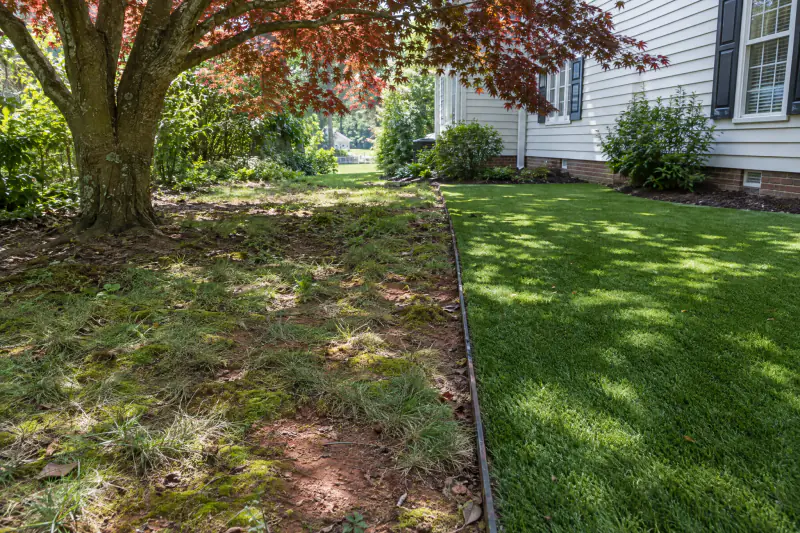
Tall fescue fails in deep shade because it needs roughly four or more hours of direct sun to make enough energy to replace the plants it loses every summer. Under a mature willow oak in Vienna, a red maple in Burke or the closed canopy of a Reston or Great Falls lot, the lawn gets filtered light for a few hours and nothing more. Each year the grass thins, moss and bare clay take the space, and fall overseeding buys a green winter followed by the same decline. Add a dog and the shade lawn becomes mud by March. We describe that cycle in keeping tall fescue alive through a Northern Virginia summer, and the short version is that no amount of seed changes the hours of sun.
Turf fixes the surface problem completely and changes nothing about the tree. That second point matters. Mature oaks and maples feed from roots in the top foot of soil that spread past the canopy edge, and a turf installation excavates three to five inches of that soil over the whole area. Near a large tree we keep the excavation shallow, avoid cutting roots larger than a thumb, and accept a slightly thinner base rather than damage a sixty-year-old oak to get a flat lawn beneath it. Where roots are too dense to excavate at all, a shade bed or a mulched path is the honest answer, and the landscape design for the yard works around the tree instead of under it.
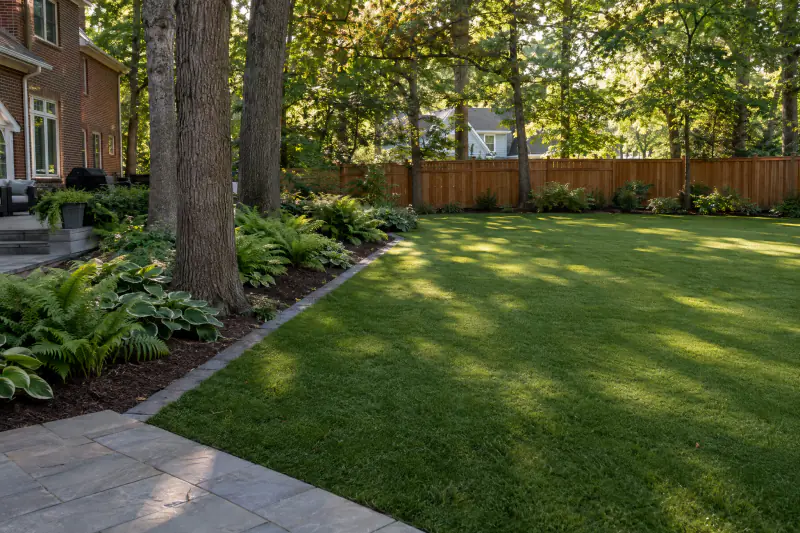
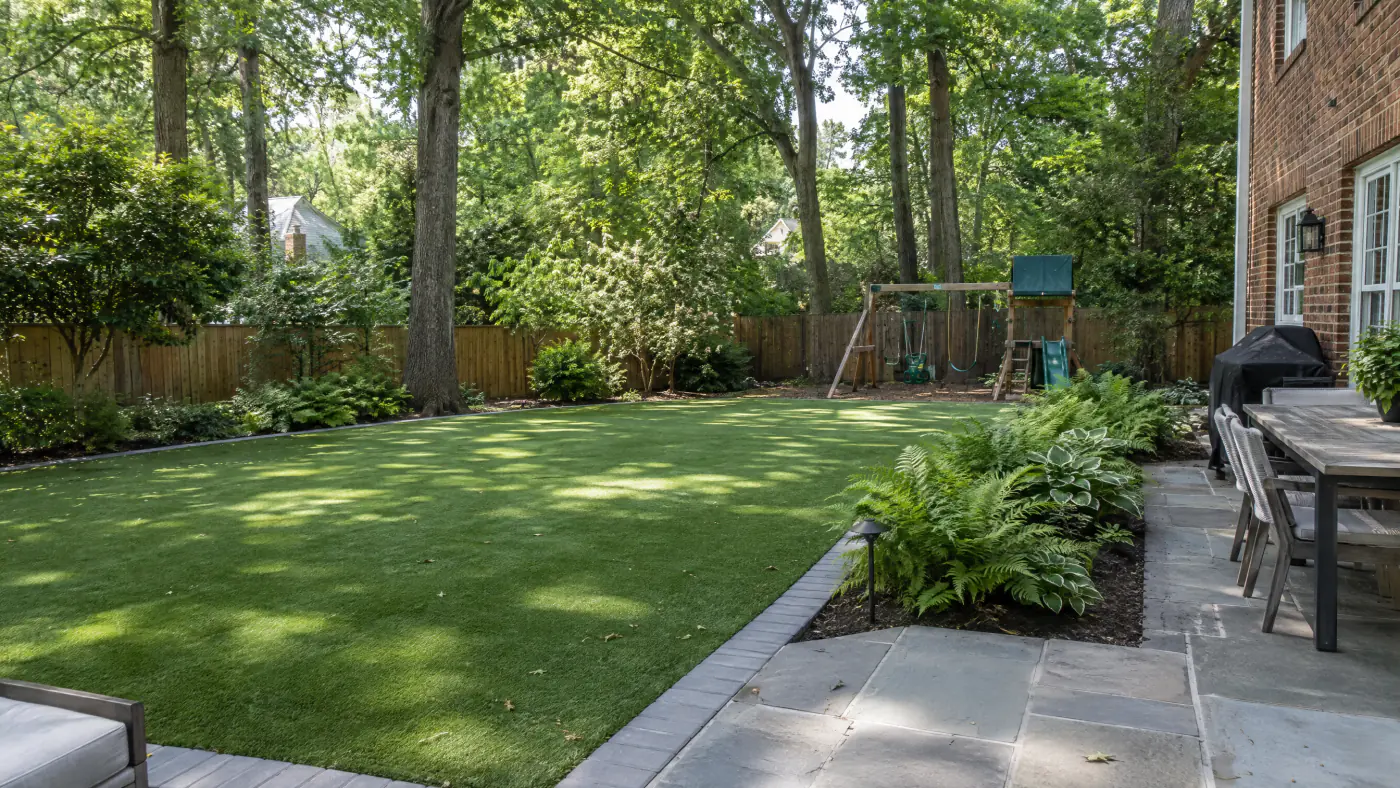
Shade is also where turf performs most comfortably in summer. Under a canopy the surface stays close to air temperature, leaves and acorns are the main maintenance, and the fiber color holds for years because it is not baking in direct sun. A shaded turf area in a Fairfax or Arlington yard is the easiest installation we do to be happy with. The same product in an open Loudoun back yard is a different experience, which the heat section below explains.
Is artificial turf good for dogs, and how is odor managed?
Artificial turf is good for dogs when it is built as pet turf: a shorter, dense fiber with a fully permeable backing, laid over an open-graded stone base that drains fast, with an infill that controls ammonia and a plan for rinsing. Built that way, urine passes through in seconds, solid waste lifts off a firm surface, paws stay clean, and the strip along the fence that used to be mud is simply green. Built as ordinary landscape turf over a dense base, the same yard smells by July.
Odor is a drainage and chemistry problem. Urine that sits in the backing or in a base that holds water breaks down into ammonia, and warm humid Northern Virginia nights make that fast. Four things keep it in check. The backing should be fully permeable rather than hole-punched, so there is nowhere for liquid to pool. The base should drain to a real outlet, not into a clay bowl. The infill should be a product designed to hold ammonia, such as a zeolite-based or antimicrobial-coated sand, rather than plain silica sand or crumb rubber. And the surface should be rinsed with a hose every week or two in summer, with an enzyme cleaner for the spots the dog favors. Most owners find that a monthly enzyme treatment in warm weather and plain water the rest of the year is enough.
A few design details help. The dog's favorite corner can be given a slightly steeper base slope so it drains faster. A paver or gravel strip along the fence line takes the hardest pacing wear. Turf should stop short of the house foundation by at least a foot of gravel or pavers so urine never collects against brick. And large dogs that dig will find a seam; glued and taped seams, with nails at close spacing along edges, hold up to digging far better than pinned ones. For the fall and winter case, when the dog yard becomes the mud yard, see artificial turf for pet yards and mud season.
What about play areas, small townhome yards and putting greens?
Play areas, townhome yards and putting greens are the three other places turf regularly makes sense, and each has its own build. Under a swing set or climbing frame, the issue is fall protection as much as grass. Mulch scatters and compacts, grass wears to hard clay under the swings, and turf alone over compacted stone is a firm surface. A shock-absorbing pad under the turf, chosen for the fall height of the equipment, gives a level, clean surface that stays put. The turf for play areas is a softer, mid-length fiber, and the infill is a rounded sand or coated sand rather than anything that heats up.
Townhome yards in Ashburn, South Riding, Centreville and Woodbridge are often two hundred to four hundred square feet of ground shaded by the house on one side and six-foot fences on the other three, with a gate as the only access. Grass there gets a few hours of sun, heavy use per square foot and no air movement. Turf is a fair answer, and so is a paver patio with planting around it; many of the best small yards combine a patio near the door with a turf panel beyond it for a child or a dog. Access shapes the cost: every yard of excavated clay and every bag of stone goes through the gate and often through the house, so a small yard costs more per square foot than its size suggests.
Putting greens are a specialty surface. The turf is a short, dense nylon or polypropylene pile, the base is graded with gentle breaks and compacted far more carefully than a lawn base, and a fringe of longer turf frames the green for chipping. A residential green of a few hundred square feet with two to four cups is common. Greens need an open area, since a canopy drops debris that affects the roll, and they need drainage, because a green that holds water is slow and spongy. They are also the most common turf feature an HOA will question, so the application goes in before the stone does.
How hot does artificial turf get on a Northern Virginia summer afternoon?
In direct sun on a 90-degree June or July afternoon, artificial turf surface temperatures commonly run 35 to 60 degrees hotter than natural grass, and readings of 140 degrees and above at the surface are routinely reported in field measurements. That is too hot for bare feet, for a dog's paws and for a toddler sitting on it. The fibers themselves are not harmed at those temperatures, but the people and pets using the yard are, and anyone selling turf for a sunny yard in Northern Virginia should say so plainly. In shade the same turf stays close to air temperature, which is the main reason the fit assessment above leans so hard toward shaded areas.
Several things reduce the heat without eliminating it. Lighter and multi-toned fiber colors absorb less than deep green. Some fibers are made with heat-reflecting pigments and are marketed as cooler; the difference is real but modest. Infill matters most: crumb rubber gets hottest, plain silica sand is better, and coated sands and some mineral infills marketed for cooling run noticeably lower. A quick rinse with a hose drops the surface temperature sharply for half an hour or so, which is a practical trick before children go out. Shade sails, a pergola or a planted tree on the south or west side do more than any product choice.
Reflected sun is a separate and more serious issue. Energy-efficient windows with low-emissivity coatings can focus reflected sunlight onto a strip of yard, and that concentrated beam has melted and deformed turf fibers in yards across the region, often in a crescent shape a few feet from the wall. We look at every window that faces the turf area during the site visit, note the sun angle for the afternoon, and either keep turf out of the reflection zone or recommend a screen for the window. A melted patch is not a product defect in the usual sense, and it is far cheaper to avoid than to repair.
How is the base built on clay so it drains?
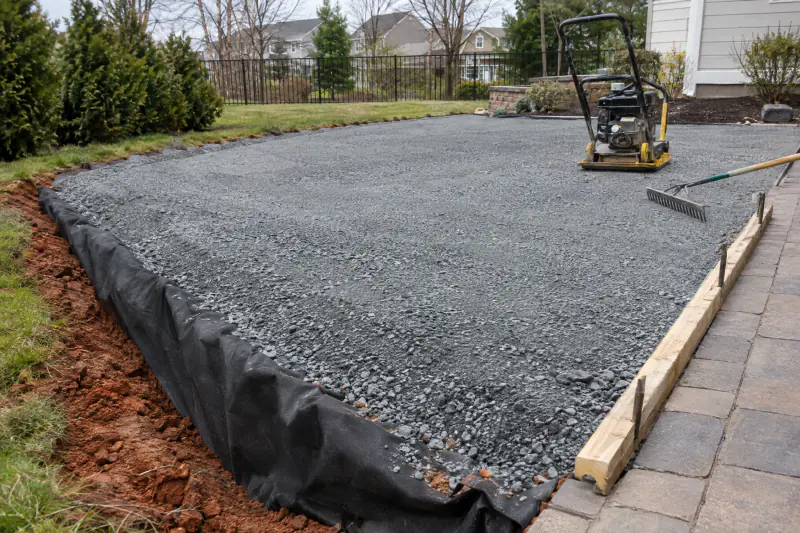
The turf is the visible part. The base is what decides whether the surface is flat, firm and dry in five years. This is how we build it on Northern Virginia clay.
Excavate and shape the subgrade
Sod and three to five inches of soil come out, more under pet areas, and are hauled away. The clay subgrade is shaped to fall toward the lowest edge at roughly one to two percent, because clay absorbs water slowly and the base will shed most of a storm sideways rather than down.
Decide where the water goes
On a sloped lot the base can drain to daylight along its low edge into a gravel strip or a bed. On a flat lot the low edge needs an outlet: a perforated pipe in a gravel trench tied to a dry well, a catch basin or an existing drain line. Skipping this step is the most common cause of a base that heaves, smells or squishes.
Lay geotextile fabric
A woven or non-woven separation fabric covers the subgrade and laps up the edges. It keeps the stone from being pushed down into soft clay over time and keeps clay from pumping up into the stone, which is what makes a base go soft and uneven.
Place and compact the stone in lifts
Three to four inches of crushed stone goes in, compacted with a plate compactor in two lifts rather than one. For pet areas we use a more open-graded stone for drainage, topped with a thin leveling layer of finer material that is screeded smooth and compacted again. The finished base is firm enough to walk on without marks.
Set the edges
The perimeter is held by a paver border, steel edging or a concealed treated nailer board set in the base. Turf fastened to a firm border stays tight; turf nailed into bare soil at the edge lifts within a season. Edges against the house are finished with a gravel or paver strip rather than turf.
Lay, seam, fasten and infill
Turf is rolled out with the fiber grain in one direction, trimmed, joined over seam tape with adhesive, and nailed along the perimeter at close spacing. Infill is spread in several passes and brushed in with a power broom until the fibers stand upright. A final check after a hose test confirms water leaves the surface and the edges.
Which infill should you choose?
Infill is the granular material brushed into the turf to weigh it down, support the fibers and, for pets, control odor. It is a larger decision than the turf color.
- Silica sand
- Rounded, kiln-dried sand is the basic infill for landscape turf. Inexpensive, stable and cooler than rubber. It does not control odor and can compact over years, so it suits shaded lawns and low-traffic areas rather than dog runs.
- Acrylic-coated sand
- Sand with a colored acrylic coating that resists compaction and some bacterial growth, and runs a little cooler than plain sand. A common all-round choice for family yards and play areas without heavy pet use.
- Zeolite-based infill
- A natural mineral that captures ammonia from urine and is flushed and restored by rain or a rinse, which keeps a dog yard from smelling in humid weather. Often used alone or blended with sand in pet areas. It is lighter than sand and may need topping up.
- Antimicrobial-coated infill
- Sand or mineral infill with a coating intended to slow bacterial growth. Usually paired with a permeable backing and regular enzyme cleaning in pet installations rather than used as the whole odor plan.
- Crumb rubber
- Recycled tire rubber, common on sports fields for resilience. It is the hottest infill in summer sun and is rarely the right choice for a Northern Virginia residence; most homeowners here prefer sand or mineral products.
- Thermoplastic or organic infills
- Rounded TPE or EPDM pellets and organic options such as cork or coconut fiber are softer and cooler but cost more and, for the organic types, break down over time. They suit play areas where softness matters more than longevity.
How long does artificial turf last, and what maintenance does it need?
Quality turf on a properly built base typically lasts twelve to twenty years in residential use in Northern Virginia, with the shorter end for full-sun, high-traffic and heavy-pet installations and the longer end for shaded family yards. Fibers slowly lose their upright memory and color under ultraviolet light, seams and edges show wear first, and infill settles. The stone base usually outlasts the surface, so replacement in year fifteen is a new turf layer and infill over the same base, not a full rebuild. That matters when you compare the cost with sod, which is replaced far more cheaply but demands yearly care.
Maintenance is light but not zero. Leaves, acorns and maple seeds are blown or raked off, which in a wooded Fairfax or Loudoun yard means weekly in fall. Traffic areas are brushed against the grain every month or two to stand the fibers up. The surface is rinsed in summer, and pet areas get the enzyme routine described above. Infill is topped up every few years in busy spots. Weeds appear at edges and in windblown debris on the surface, not from the soil, and are pulled by hand. Grills, fire pits and dropped cigarettes melt fibers, so cooking happens on the patio, not the turf. We put the full routine in the maintenance guide alongside care for lawns, beds and hardscape.
The turf itself comes in a wide range of quality. Face weight, which is the weight of fiber per square yard, pile height, fiber shape and backing type all affect how it looks in year ten. For a shaded lawn, a mid-weight landscape turf with a tan thatch layer and multi-toned fibers reads most like grass. Pet turf is shorter with a fully permeable backing. Putting greens are a different product entirely. Handling a sample under your own trees is worth more than any catalog photo, and it is part of our site visit.
What do HOAs and counties say about artificial turf?
Many Northern Virginia homeowners' associations restrict or prohibit artificial turf, especially in front yards and anywhere visible from the street, and some review back yards as well. Guidelines vary from a flat prohibition to approval of specific products in rear yards behind a fence. Larger associations in Reston, Ashburn, Brambleton, South Riding, Burke and the Gainesville and Bristow communities tend to have written rules; smaller associations decide case by case. Apply before anything is ordered, with a product sample, a drawing of the area and a note on drainage, because turf that goes in without approval can be ordered out. Our guide to HOA approval for exterior projects covers the process.
County rules are quieter but worth a call. Synthetic turf over a stone base does not need a building permit for a residential yard in our experience, but some jurisdictions may treat it as impervious or semi-impervious surface for stormwater and lot-coverage purposes, which can matter on small lots in Arlington, Alexandria and Falls Church and on lots near streams in a Chesapeake Bay Resource Protection Area. Check with your county before a large installation. Any drainage outlet that connects to a storm system is also a county matter.
One more consideration is honest disclosure of what the product is made of. Artificial turf is plastic, and some products and infills have drawn questions about additives and chemicals. If that concerns you, ask the manufacturer for its technical data on the turf and infill you are considering, and choose sand or mineral infill over rubber. We are happy to help gather that information, but we are not the ones who make the product and we do not make claims about it that we cannot back.
How much does artificial turf cost in Northern Virginia in 2026?
As of 2026, typical Northern Virginia market planning ranges for professionally installed artificial turf run about $12 to $22 per square foot for lawn, pet and play areas and roughly $18 to $35 per square foot for putting greens, including excavation, base, edging, turf, seaming and infill. A 500 square foot shaded lawn area therefore often falls between $6,000 and $11,000, a 300 square foot townhome yard is often $4,000 to $7,500 because small jobs cost more per foot, and a putting green of a few hundred square feet with a fringe commonly reaches $10,000 to $20,000 or more. Turf material alone is typically a few dollars per square foot; the base, the hauling and the labor are most of the price. These are general market ranges, not myYardPros prices.
What moves the number: access, since clay out and stone in through a townhome gate is wheelbarrow work; excavation depth, which is greater for pet areas; drainage, where a flat clay lot needs a piped outlet or dry well that can add a four-figure line; turf grade, with pet and putting turf at the top; infill type, since zeolite and coated products cost more than sand; shape, because curves mean more seams and more waste from the roll; shock pads under play equipment; borders, edging and cups; and the amount of tree root to work around. A simple rectangle on a sloped, accessible lot is the cheapest version of this job.
For comparison, sod with full soil preparation runs about $2 to $4 per square foot in the same market. Turf costs several times that and will need replacing in twelve to twenty years, which is why it belongs where grass cannot grow rather than where it can. The cost guide sets turf beside every other project type. For a figure that fits your yard, the only reliable number is a written estimate after a site visit, with the drainage plan spelled out.
What should you ask before signing an artificial turf contract?
Ten questions whose answers separate a surface that stays flat, dry and clean from one that ripples and smells.
- How deep will you excavate, and what happens to the soil you remove?
- What stone is in the base, how thick is it, and is it compacted in lifts?
- Will there be a geotextile fabric between the clay and the stone?
- Where does water go after it passes through the turf on this lot, and is there an outlet?
- Are seams glued over tape, or only nailed, and how far apart are the edge fasteners?
- Which infill do you recommend for my use, and why that one?
- How hot will this specific turf get in my yard in July, in the sun and in the shade?
- Which of my windows could reflect sun onto the turf, and how will you handle that?
- What is the face weight, pile height and backing type of the product in the quote?
- Has my HOA approved this product and location in writing?
Where in Fairfax, Loudoun, Prince William, Arlington and Alexandria does turf fit best?
Turf suits the wooded, older neighborhoods of Fairfax County, where shade is the problem that will not go away. Vienna, McLean, Great Falls, Oakton, Burke and Annandale have lots with fifty- to eighty-year-old canopies, and the shaded back yard with a dog and a swing set is the classic candidate. Reston adds slope and rock, which make the base more work but drainage easier. Arlington County, Alexandria and Falls Church bring small lots, mature street trees and tight access; a two-hundred-square-foot rowhouse yard that gets two hours of sun is a good turf candidate, provided the lot-coverage question is checked with the city or county first.
Eastern Loudoun and western Prince William are different. In Ashburn, Sterling, South Riding, Gainesville, Haymarket and Bristow, most yards are open and sunny, the trees are young, and the lawn problem is compacted builder subsoil rather than shade. Turf there is often the wrong tool and sod on prepared soil the right one, as we lay out in sod installation in Northern Virginia. The exceptions are townhome courtyards, side yards between closely spaced houses and fenced dog runs, which are shaded by the buildings themselves. Those are also the communities with the most detailed HOA guidelines on synthetic turf, so the application comes first. Western Loudoun around Leesburg and Purcellville has larger lots where a shaded turf panel near the house and a real lawn beyond it is a common and sensible split.
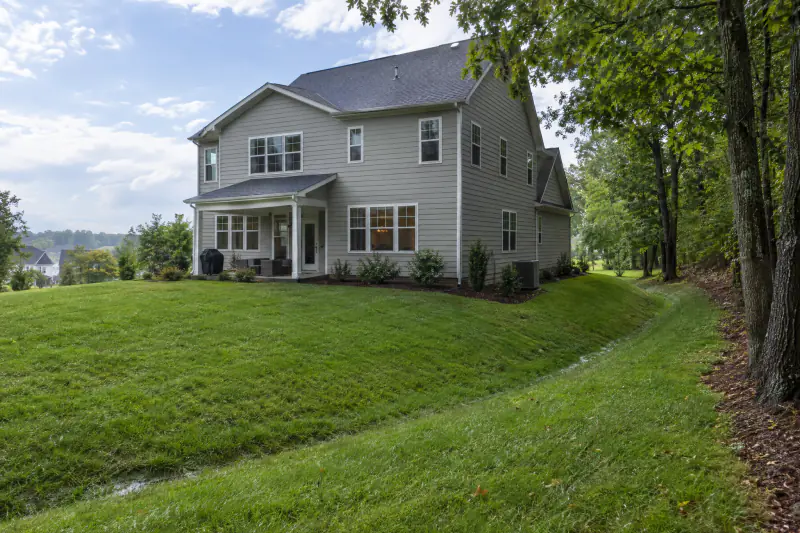
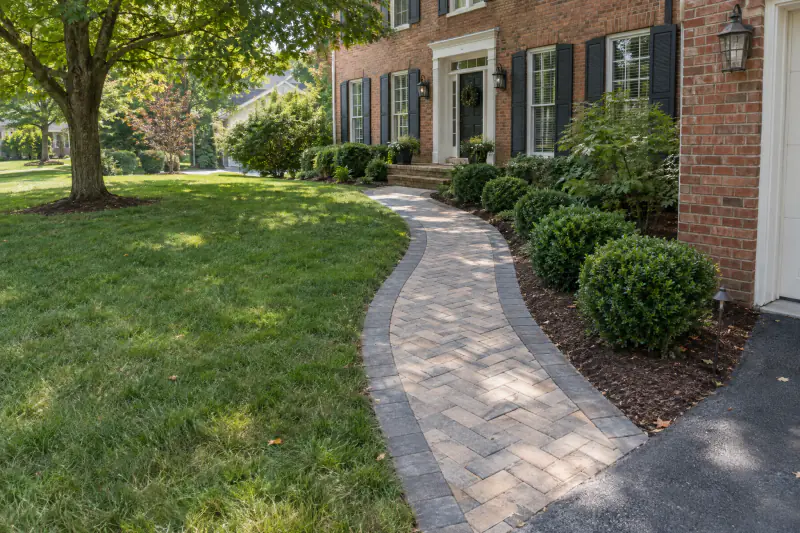
Across all of it, clay is the constant, and the drainage plan for the base is the part of the quote to read most carefully. If water stands on the lawn now, that question comes before any surface, and we address it through yard drainage and regrading or, where there is a larger problem, the fixes in why Northern Virginia backyards stay wet. A turf area is also commonly framed by a paver walkway or a patio, and building both at once avoids cutting a finished edge twice. We work in all of these counties and cities and nowhere else; the full list is on our service areas page, and the lawn and landscape pillar shows how turf, sod, overseeding and planting fit together. For the full lawn-versus-no-lawn decision, including seed, our sod vs. seed guide is the place to start.
Frequently asked questions
Is artificial turf worth it in Northern Virginia?
It is worth it where natural grass has no fair chance: deep shade under mature trees, dog runs, play areas, small walled townhome yards and putting greens. In those places it replaces an annual cycle of reseeding and mud with a surface that stays usable. It is rarely worth it on a large, open, sunny lawn, where tall fescue grows well for a fraction of the cost and stays cool in summer. Most good installations are partial, with living lawn kept where it works.
Can artificial turf be installed in summer?
Yes. Turf is one of the few lawn projects that can go in any month the ground is workable, because nothing has to root. Summer installation has one practical advantage: warm turf is pliable and lays flat with fewer wrinkles. The base work is hot, heavy labor in July, and a rinse before the walkthrough shows you what the surface temperature will be on a sunny afternoon, which is useful to know before you plan a barefoot yard.
Does artificial turf need a permit in Fairfax or Loudoun County?
A residential turf installation over a stone base generally does not require a building permit in our experience, but it can raise two other questions. Some jurisdictions may count synthetic turf toward impervious or lot-coverage limits, which matters most on small lots and near streams, so check with your county. And any drainage outlet connected to a storm system is a county matter. HOA approval is a separate and more common requirement.
How do you clean dog urine from artificial turf?
Rinse the area with a hose every week or two in warm weather, and apply an enzyme cleaner made for pet turf to the spots the dog favors about monthly from May through September. Odor that persists after that usually means the base holds water or the infill is plain sand, and the fix is drainage or a zeolite-based infill rather than more cleaner. Solid waste lifts off with a bag or scoop, and the spot is rinsed.
Will artificial turf kill my trees?
It can harm them if the installation excavates through the main feeding roots or seals the ground so that water and air cannot reach them. Near a mature oak or maple we keep excavation shallow, avoid cutting roots larger than a thumb, use a permeable turf and base, and accept a thinner base rather than damage the tree. Where roots are too dense to work around, a shade bed or mulched path is the better answer for both the yard and the tree.
What is the difference between pet turf and regular landscape turf?
Pet turf has a shorter, denser fiber that is easier to clean, a fully permeable backing rather than one with drainage holes, and it is installed over a more open-graded stone base with an odor-controlling infill such as zeolite. Landscape turf is longer, softer and more lawn-like, with a thatch layer for realism, and is usually set over a denser base with sand infill. Using landscape turf for a dog yard is the most common reason a turf installation ends up smelling.
Can I install artificial turf myself?
A small, flat, rectangular area with good access and a sloped exit for water is within reach of a capable homeowner who rents a plate compactor and follows the base method carefully. The jobs that go wrong are the ones that skip the fabric, under-compact the stone, leave the base flat on clay or pin seams instead of gluing them. Pet areas, putting greens, sloped yards and anything that needs a drainage outlet are better left to a crew that builds bases for a living.
Book the work
Put the plan in writing with a crew that builds this every week.
One visit to measure and talk through options, then a written scope and price. No pressure, no vague numbers. Ask about the Heroes Discount if you serve.
Sources and further reading
Published June 4, 2026. Reviewed and updated October 9, 2026.