Key takeaways
- Clay is why water lingers, but a second cause is why it arrived: settled grading, compacted subsoil, roof water, a seasonal water table or runoff from next door.
- Watch one storm and check the yard at 24 and 72 hours. Gone in a day means a surface fix; still spongy after three days means water is in the soil.
- Roof water is usually the largest single input and the cheapest to fix. Buried downspout lines come before any trench through the lawn.
- Match the tool to the cause: re-grading and swales for surface water, catch basins for enclosed low spots, French drains for perched water, dry wells only as a last resort.
- As of 2026, single fixes in Northern Virginia typically run from a few hundred dollars per downspout to $10,000 for a long French drain; whole-yard projects can reach $20,000 or more.
On this page
- Why does a Northern Virginia backyard stay wet for days after rain?
- What does clay soil actually do to rainwater?
- Why are newer subdivisions in Ashburn, Bristow and South Riding so often the wettest?
- Which symptom points to which cause?
- How can you tell if your yard is graded toward the house?
- How much of the problem is coming off the roof?
- Is it a high water table, a spring or the neighbor's runoff?
- How do you diagnose a wet yard yourself in one rainstorm?
- Which fix matches which cause?
- What should you not do to a wet backyard?
- How much does it cost to fix a wet backyard in Northern Virginia?
- What should a yard drainage quote include?
- How do wet-yard causes differ across Fairfax, Loudoun, Prince William and Arlington?
- Frequently asked questions
Why does a Northern Virginia backyard stay wet for days after rain?
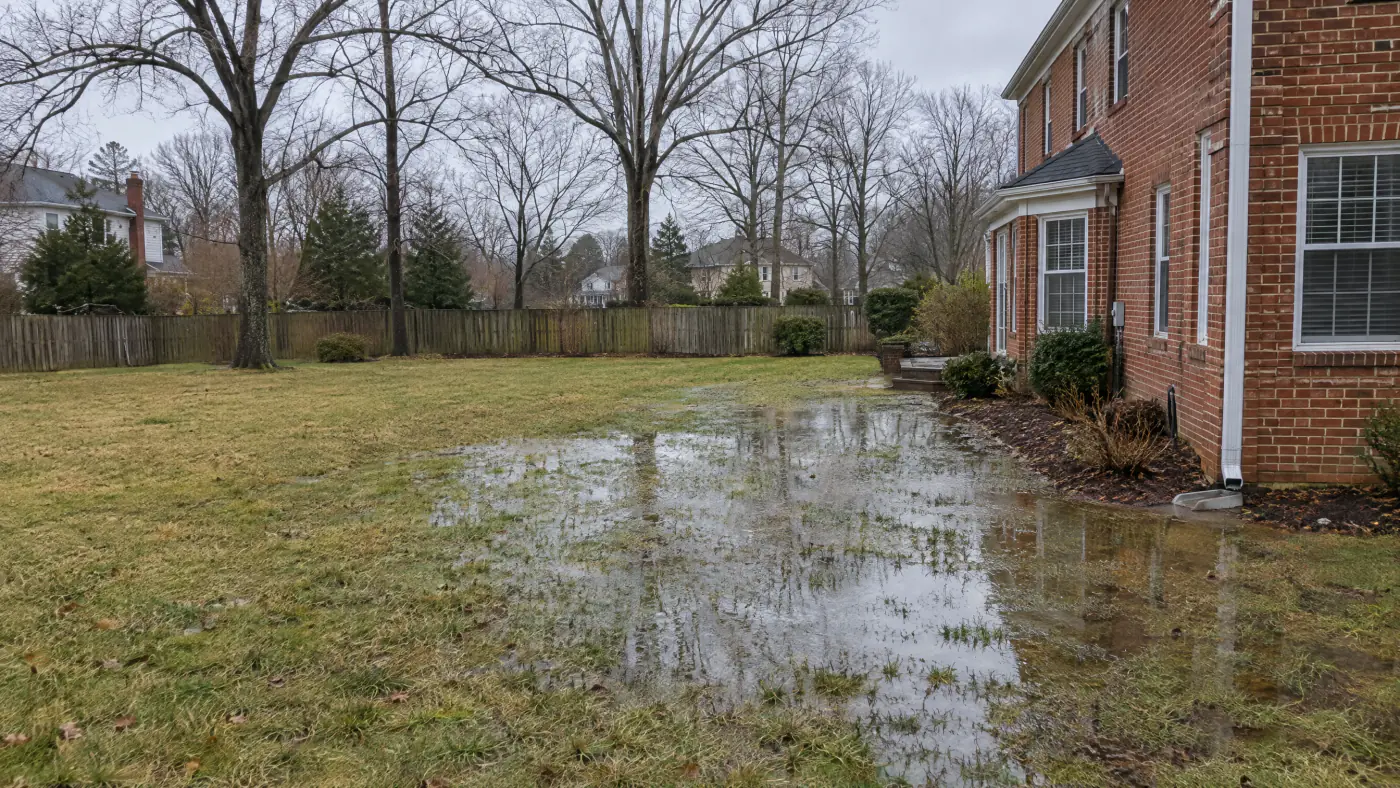
Because the water has nowhere to go. Nearly every yard in Northern Virginia sits on dense clay that absorbs rain at a fraction of the rate it falls, so a storm that would soak into sandy ground elsewhere sits on top of ours or perches in the top few inches of soil. That is the baseline. On top of it, most wet backyards have at least one added cause: subsoil compacted during construction, grading that settled toward the house, downspouts dumping roof water beside the foundation, a seasonal high water table, or runoff arriving from a neighbor's lot. The clay is the reason the water lingers. The second cause is the reason it arrived, and that is the one you fix.
We spend a lot of January walking wet yards, because winter is when the pattern is easiest to read. Leaves are down, the grass is dormant, and a cold rain sits for days where a July storm would evaporate by noon. This guide follows the order we use on a site visit: first find out where the water comes from, then match the cause to the one fix that solves it. If you want the short version of the services involved, our water management page lays them out. What follows is the longer version, including the mistakes we would rather you not pay for.
What does clay soil actually do to rainwater?
Clay holds water instead of passing it through. The particles are so small and packed so tightly that water moves through them slowly, often a small fraction of an inch per hour once the surface is saturated, where a sandy loam might take several inches in the same hour. Northern Virginia receives roughly 40 to 42 inches of precipitation a year, and a good share of it arrives in summer thunderstorms that drop an inch or more in under an hour. Clay cannot take water at that rate, so the excess runs across the surface to the lowest spot it can find and waits there.
The second property matters just as much. Once clay is wet, it stays wet, because the same tight structure that blocks water from entering blocks it from leaving. A lawn that puddles after a storm and drains by morning has a surface problem. A lawn that stays spongy for four or five days is holding water in the soil itself, usually in a thin perched layer where loose topsoil meets the dense clay below. Virginia Cooperative Extension soil publications describe this layering across much of the Piedmont, and it is exactly what we find when we push a probe into a wet lawn in Reston or Centreville: six inches of soft soil, then a hard layer the water cannot cross.
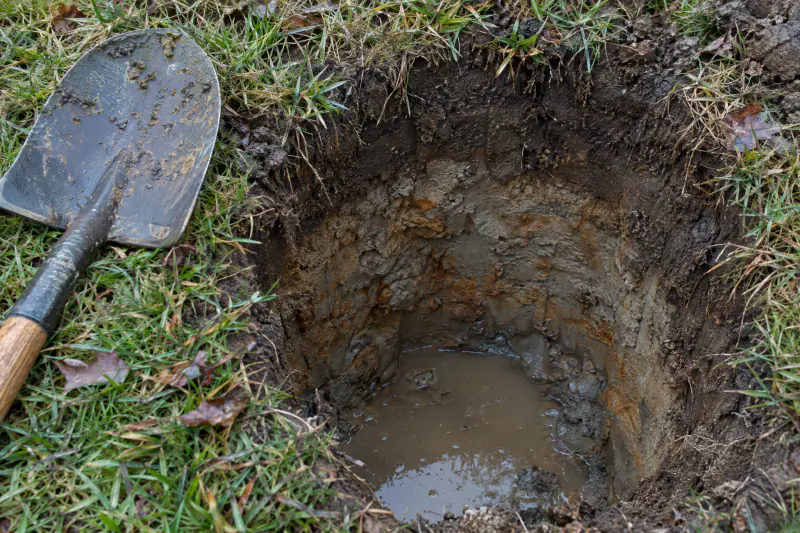
The color of that layer is a clue in itself. Soil that spends weeks saturated loses its red-brown tint and turns gray or blotchy with rust-colored streaks. If a shovel turns up gray clay a foot down, the spot has been wet for a long time, whatever the grass above it looks like in August.
Why are newer subdivisions in Ashburn, Bristow and South Riding so often the wettest?
Because the soil under them was rebuilt by machines. When a subdivision is graded, the original topsoil is stripped and stockpiled, the subsoil is cut and filled to engineered elevations, and heavy equipment drives over it for months. Clay compacted under a loaded dump truck can end up denser than the undisturbed ground ever was, and water moves through it even more slowly. A few inches of topsoil are spread back over that compacted layer, sod is rolled out, and the lot looks finished. The first wet spring tells a different story.
We see the result across the communities built from the 1990s onward, from Ashburn and South Riding to Bristow, Gainesville and the newer parts of Woodbridge. Backyards are small, fences stop air movement, and the rear lot line is often a shared low point with a recorded drainage easement running through it. Two or three yards drain toward that same strip, and it stays wet from November to May. Older neighborhoods in Vienna, Annandale and Burke have a different problem, decades of settlement in the backfill around the foundation, which we cover below.
Compacted subsoil has no cheap fix. Core aeration helps the top three inches, and it is worth doing every September with aeration and overseeding, but it does not reach the compacted layer. What works is giving the perched water somewhere to go, either a French drain cut through the hard layer, or a surface reshaped so water leaves before it soaks in.
Which symptom points to which cause?
The pattern of wetness usually names the cause before any digging starts.
| What you see | Most likely cause | Fix that matches |
|---|---|---|
| Puddles form in the same low spot and drain within a day | Negative or flat grading | Re-grading, a swale, or a catch basin at the true low point |
| Lawn stays spongy for three or more days with no visible puddle | Perched water on clay or compacted subsoil | French drain cut below the perched layer, piped to an outlet |
| Wettest ground is within 10 feet of the house, worst below a downspout | Roof water dumped at the foundation | Buried solid downspout lines to a pop-up emitter or daylight |
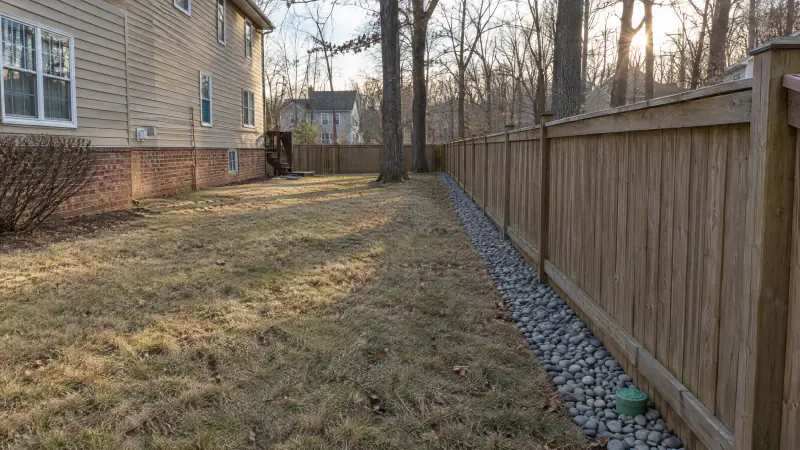
| A strip along the rear or side fence is wet most of the winter | Neighbor runoff or a drainage easement low point | Swale or interceptor drain along the lot line, easement kept open |
| Water seeps from the ground on a slope, even in dry weeks | Seasonal high water table or a spring | Curtain drain across the slope above the wet area |
| Water sheets across a patio or driveway toward a door | Hard surfaces shedding onto a flat yard | Channel drain and solid pipe, with grading at the edge |
Many yards have two causes at once. Fix the one that delivers the most water first.
How can you tell if your yard is graded toward the house?
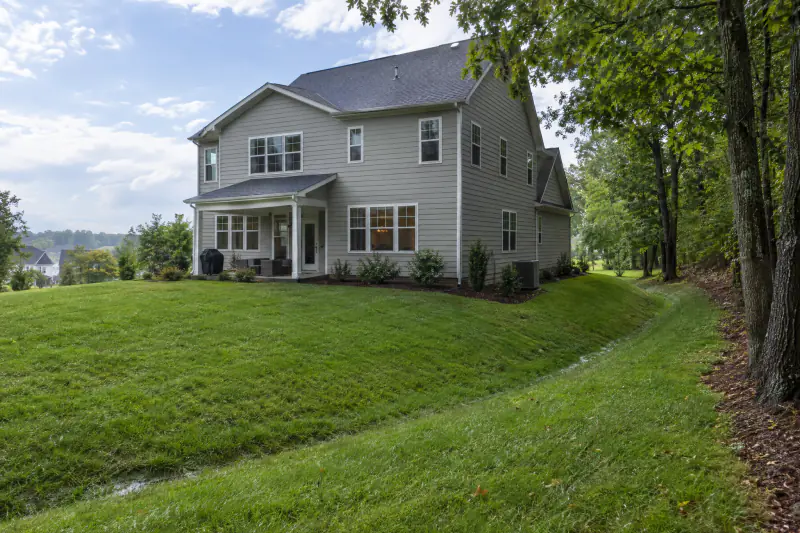
Measure it, because the eye is unreliable on a lawn. The standard most builders and inspectors work to is a fall of about 6 inches over the first 10 feet away from the foundation, roughly a 5 percent slope. You can check it with a 10-foot straight board, a 4-foot level and a tape: set one end of the board at the foundation, lift the far end until the level reads flat, and measure the gap under it. Anything under 3 inches is marginal in clay. A gap that closes, meaning the ground rises as it leaves the house, is negative grading, and water from every storm is pooling against the wall.
Negative grading is rarely original. Foundations are dug wider than the walls, and the gap is backfilled with loose soil that settles for years. Mulch beds get built up against the siding, which hides the slope and traps water behind the mulch. Patios and walks are poured level or pitched the wrong way. In a brick colonial from the 1970s in Springfield or Oakton, we often find 2 to 4 inches of settlement along the whole back wall, with the lowest point right at a basement window well.
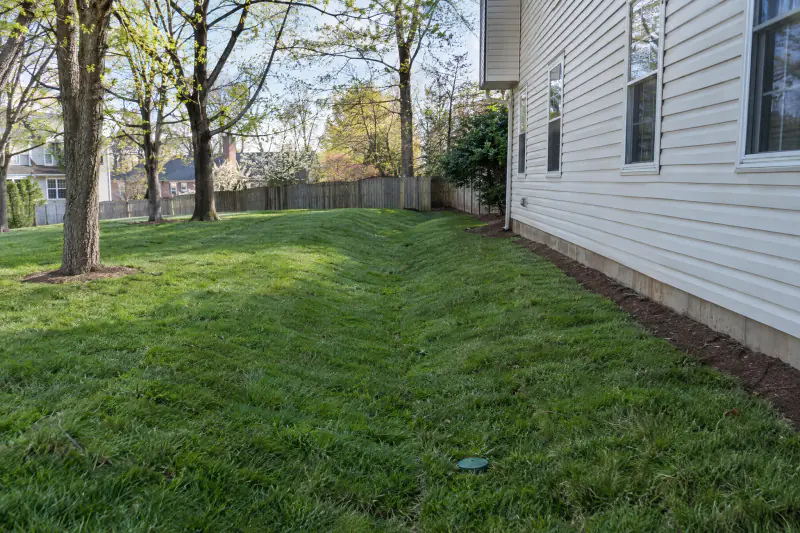
The fix is re-grading: cutting high ground, adding compacted fill where the soil dropped, and keeping at least 6 inches between finished soil and the bottom of the siding. When the lot is too tight to rebuild the slope, a shallow swale or a catch basin a few feet out from the wall does the same job in less space. Water that cannot flow away has to be collected, and either method beats hoping the clay will absorb it.
How much of the problem is coming off the roof?
Often most of it. A roof is a large collector, and a single inch of rain on 1,000 square feet of it produces roughly 620 gallons. A typical two-story colonial with 1,800 to 2,400 square feet of roof sheds 1,100 to 1,500 gallons per inch of rain, and the gutters concentrate every drop at four to six downspouts. If those end at splash blocks, each corner of the house receives a few hundred gallons in a single storm, dropped onto the loosest soil on the property, the backfill beside the foundation. On clay, that water does not soak away. It runs along the wall, pools in the low spots, and keeps the first 10 feet of the backyard wet long after the rest has dried.
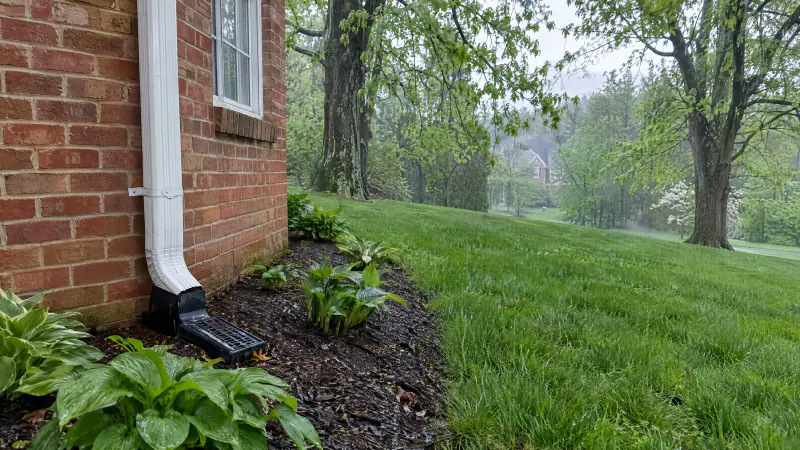
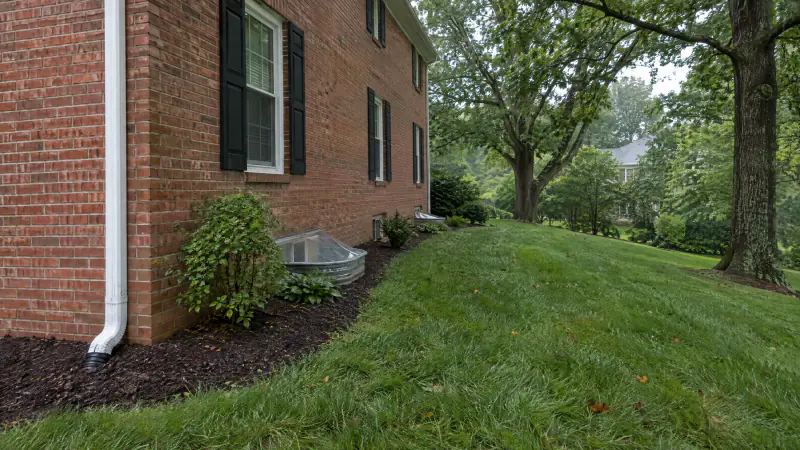
This is the first thing we check on any wet-yard visit, and it is the cheapest cause to fix. Stand outside during a hard rain and watch each downspout. If a stream pours onto the ground, shoots past the splash block, or the flexible extension has been kicked aside for mowing, the roof is feeding the problem. Buried downspout lines carry that water in solid pipe to a point at least 10 feet from the house where the ground keeps falling away. We go through pipe types, outlets and the roof-area math in our article on where gutter water should actually go. Sump pump discharge belongs in the same conversation, because a pump that empties beside the house is just a downspout that runs on electricity.
Is it a high water table, a spring or the neighbor's runoff?
Those three look alike from the surface and need different fixes, so it pays to tell them apart. A seasonal high water table is groundwater that rises into the root zone in the wettest months, usually late winter and early spring, and drops in summer. It is common on flatter lots near streams in Lorton and Woodbridge and in the low ground of older farm parcels in Loudoun. The sign is wetness that follows the season rather than any single storm: the yard is soft from February into May no matter what the gutters do. A dry well cannot help here, because there is nowhere below for the water to go. A French drain set deep enough to lower the water level, running to an outlet, can.
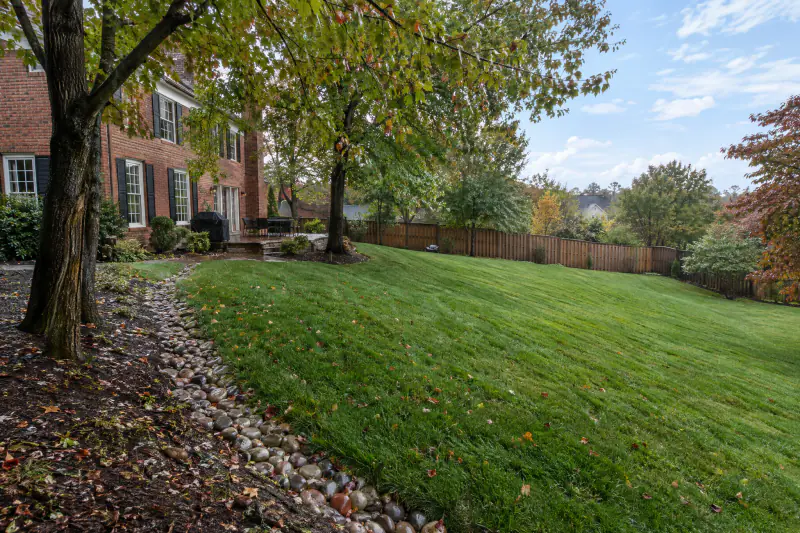
A spring or seep shows up as a spot that stays wet in a dry August, often on a slope, sometimes with rushes or sedges volunteering in the lawn. Water is moving sideways through the ground from higher land and surfacing where the clay forces it up. The fix is a curtain drain, which is a French drain run across the slope above the wet area to catch the water before it reaches your yard.
Neighbor runoff is surface water, and it arrives during and right after a storm, often as a visible sheet or a small channel across the lot line. Northern Virginia counties generally do not allow a property owner to redirect concentrated runoff onto someone else, but they also do not require an uphill neighbor to absorb what nature sends downhill. A grassed swale along the line that steers the flow around the house toward a lawful outlet is the usual answer, and it keeps the peace better than a berm that sends the water back.
How do you diagnose a wet yard yourself in one rainstorm?
One heavy rain and a notebook will tell you most of what a contractor needs to know.
Watch the downspouts first
Go outside during the heaviest part of the storm and look at every downspout and the sump discharge. Note which ones overflow, pour onto the ground, or empty within 10 feet of the wall. Photograph each one.
Map where water flows and where it stops
Walk the lot line and the back of the house. Mark with a flag or a phone photo where water is moving across the surface and where it is collecting. Note anything arriving from the neighbor's side.
Check again at 24 hours
Puddles that are gone the next morning point to a grading problem. Puddles still standing are either at a true low point with no exit or sitting over compacted clay.
Check the spongy areas at 72 hours
Three days after the rain, walk the lawn in flat shoes. Ground that still gives underfoot with no standing water is holding water in the soil, which points to a French drain rather than grading.
Dig one test hole
In the wettest spot, dig 12 to 18 inches with a spade. Note the depth where the soil turns hard or gray and whether water seeps into the hole. Fill the hole with water and time how long it takes to drop.
Find the lowest point on the lot
Stand at the street and at the rear lot line and work out which way the whole property falls. Every fix needs an outlet lower than the problem, and this tells you whether one exists.
Which fix matches which cause?
Six tools cover almost every wet backyard in the region. The skill is choosing the right one, in the right order.
Re-grading
Reshapes the surface so water falls away from the house and toward an outlet. Right for settled backfill, flat yards and negative slope. It cannot clog and mows like any lawn, which is why it comes first on our list.
Swales
Broad, shallow grassed channels that intercept runoff and steer it around the house or along a lot line. Right for neighbor runoff and for lots too tight to re-grade fully. A swale needs only a few inches of fall to work.
Catch basins and channel drains
A grated box at a true low point, or a slotted trench across pavement, collects surface water and sends it through solid pipe. Right for enclosed puddles and for patios and driveways that shed toward a door. Needs an outlet at the pipe end.
French drains
A fabric-lined trench of washed stone with perforated pipe that collects water held in the soil. Right for spongy ground, perched water and seeps. In clay it is a transport system, so the outlet matters as much as the trench.
Buried downspout lines
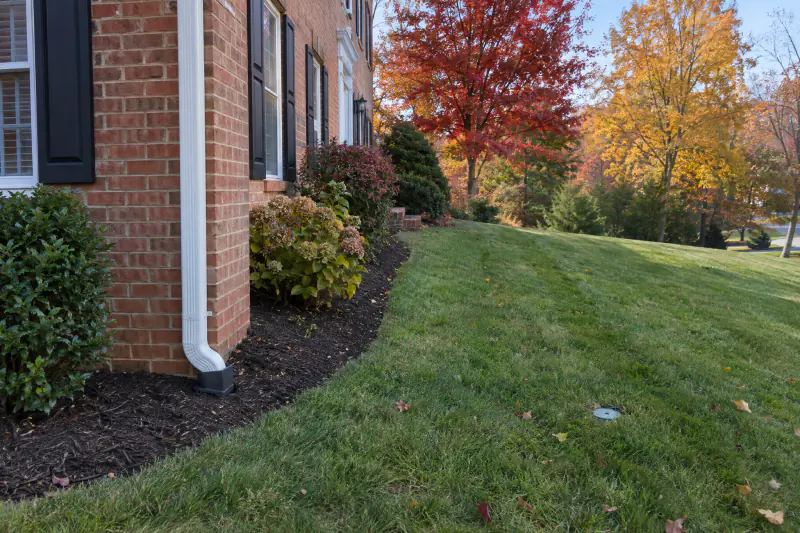
Solid pipe from each downspout and the sump discharge to an emitter or daylight at least 10 feet from the house. Right whenever roof water is part of the problem, which is nearly always, and usually the cheapest item on this list.
Dry wells
A buried chamber in stone that stores runoff and releases it slowly. In clay it empties slowly, so it suits modest volumes on lots with no downhill outlet, always with an overflow. We reach for it last, not first.
What should you not do to a wet backyard?
Do not bury the siding. The most common homeowner fix is a load of topsoil dumped against the house to force a slope, and it invites rot and insects that cost more than the drainage ever would. Keep soil and mulch at least 6 inches below the bottom of siding or wood framing, and lower the grade farther out if you cannot raise it at the wall.
Do not tie downspouts into a French drain. Roof water arrives in a burst, and perforated pipe pushes that burst straight back into the soil you are trying to dry. Roof water travels in solid pipe to its own outlet, always.
Do not install a dry well in clay without an overflow, and do not expect it to solve a perched-water problem. A dry well in soil that cannot absorb is a bucket, and a full bucket does nothing. Do not spread sand on clay in the hope of loosening it; a thin layer of sand over clay behaves more like mortar than loam. Do not plant your way out of standing water with wet-tolerant shrubs while the grade still sends water to the foundation. Plants are a finishing touch after the water is handled, not a substitute for handling it. And do not build a patio over a wet spot and hope the base will fix it; our article on why patios fail on clay explains what happens next.
Finally, do not send the water to the neighbor, the street or the sanitary sewer. Counties across the region restrict all three, recorded drainage easements must stay open, and curb cuts and storm drain connections typically need approval. And do not let anyone dig without a Virginia 811 locate. The marking is required by state law, it costs nothing, and a nicked gas or fiber line turns a drainage job into something much worse.
How much does it cost to fix a wet backyard in Northern Virginia?
It depends almost entirely on which cause you have, which is why diagnosis comes first. As of 2026, typical Northern Virginia market planning ranges for the individual fixes look like this. These are regional figures, not our prices and not a quote.
- Buried downspout lines: roughly $400 to $1,500 per downspout, or $2,500 to $7,500 for a whole house.
- Re-grading one or two sides of a house: roughly $1,500 to $6,000.
- A swale shaped across a backyard: roughly $1,000 to $4,000 including seed or sod.
- Catch basin with a piped run to an outlet: roughly $1,500 to $5,000.
- French drain: roughly $30 to $90 per linear foot, with most yard drains between $2,500 and $10,000.
- Dry well with overflow: roughly $2,000 to $6,000.
A whole-yard project that combines grading, downspout lines and a drain commonly lands between $5,000 and $20,000, and larger lots or lots with no natural outlet can go higher. What moves the number: how far the outlet is from the problem, whether a machine can reach the backyard through the gate, how much clay has to be hauled away, crossings under walks or patios, tree roots, and how much lawn has to be restored with sod rather than seed. Winter work sometimes saves on restoration, because seed and sod would wait for spring in any case.
Our cost guide puts these numbers beside the other outdoor projects they usually precede. For a figure that reflects your levels and your outlet, the only honest answer is a written on-site estimate. Request one here or call (571) 200-9600.
What should a yard drainage quote include?
Use this list to compare proposals. A quote that cannot answer these questions has skipped the diagnosis.
- The specific cause the work addresses, stated in plain words, with the evidence for it.
- Elevation readings showing the fall from the wet area to the outlet.
- The outlet itself: where water ends up, and why that spot is lower and lawful.
- Pipe type and size, and whether roof water and groundwater are kept in separate lines.
- Filter fabric and washed stone specified for any French drain, not just gravel.
- Finished grade at the foundation and the clearance kept below the siding.
- Virginia 811 locate, private utility marking, and a check of the plat for easements.
- Haul-off of excess clay, and how disturbed lawn will be restored, with seed or sod.
- A water test at the end, with you watching the outlet.
How do wet-yard causes differ across Fairfax, Loudoun, Prince William and Arlington?
The clay is everywhere, but the second cause changes with where you live. In the newer subdivisions of eastern Loudoun and western Prince William, from Ashburn and South Riding to Gainesville, Haymarket and Bristow, compacted subsoil and shared easement low points are the usual story, and buried downspout lines plus a rear-yard swale or drain solve most of them. Leesburg and the corridor from Chantilly through Manassas and Gainesville sit over the red clay and shallow rock of the Triassic basin, and the Loudoun Valley around Purcellville has shallow rock of its own, so trenches hit stone and outlets have to be planned around it. Parts of eastern Fairfax County and Alexandria sit on marine clay, which shrinks and swells with moisture, so anything that changes water content beside a foundation deserves extra care; Fairfax County publishes maps of those areas.
Older lots inside the Beltway in Arlington, Falls Church and the McLean and Vienna parts of Fairfax County are more often a grading and roof-water problem: fifty years of settled backfill, mature oaks whose roots have lifted walks, and downspouts that were never extended. Along the Potomac and the Occoquan in Lorton, Woodbridge and Dumfries, seasonal high water tables are more common and dry wells almost never make sense. Manassas and Manassas Park mix all of it, with older cores and newer edges.
Rules vary too. Land-disturbance thresholds that trigger a grading permit differ by county, so check with yours before large re-grading, and HOAs from Reston to Brambleton commonly review changes to grade and visible drainage hardware. We work on residential properties throughout these jurisdictions; our service areas page lists every county, city and town. If water is also reaching the basement, our article on exterior fixes for a wet basement picks up where this one ends, and the French drain vs. catch basin guide settles the most common either-or question.
Frequently asked questions
Why is my backyard still wet a week after it rained?
Water that lingers a full week is almost always held in the soil, not on it. In Northern Virginia that usually means a perched layer where topsoil meets dense or compacted clay, or a seasonal high water table in late winter. Grading alone will not reach it. A French drain cut below the wet layer and piped to a lower outlet is the fix, after roof water has been taken out of the equation.
Does aerating a lawn fix a drainage problem?
Not on its own. Core aeration opens the top two or three inches of soil and helps grass roots, water and air move through the surface, which is why we recommend it every September. It does not reach subsoil compacted by construction equipment or change the slope of the yard. Think of aeration as lawn health work and drainage as water-routing work; a wet yard usually needs both, in that order reversed.
Will adding topsoil fix a yard that slopes toward the house?
Only if there is room to add it. Soil and mulch should stay roughly 6 inches below the bottom of the siding, and many settled yards have already lost that clearance. Where there is room, compacted fill topped with topsoil can rebuild a 6-inch fall over 10 feet. Where there is not, the ground farther from the house has to come down instead, or a swale or basin has to collect the water a few feet out.
Can I fix a wet backyard in winter?
Usually, yes. Northern Virginia ground rarely freezes deep for long, so grading, trenching and pipe work continue through most winters, and the wet pattern is easiest to see when the grass is dormant. The one thing that waits is lawn restoration. Sod and seed establish far better in spring or fall, so winter drainage work is often finished with straw or temporary cover and seeded when the soil warms.
Is a wet backyard the uphill neighbor's responsibility?
Generally not, unless they have redirected or concentrated water onto you, for example by piping downspouts across the line or building a berm. Natural runoff flowing downhill is usually yours to manage on your side. Most counties do restrict discharging concentrated flow onto another lot, so if a neighbor's pipe empties at your fence, a polite conversation and a call to the county are the first steps. A swale along the line handles the rest.
Do I need a permit to regrade my backyard in Fairfax or Loudoun County?
It depends on how much ground is disturbed. Fairfax, Loudoun, Prince William and Arlington each regulate land disturbance above a set area, and the thresholds differ, so a small regrade beside the house usually does not need a permit while a whole-lot regrade might. Work inside a recorded drainage easement, near a stream buffer, or tying into a storm drain almost always needs approval. Check with your county before large earthwork, and with your HOA.
What grass or plants will grow in a wet backyard?
Tall fescue tolerates short wet spells but thins out in soil that stays saturated for weeks, which is why wet spots go mossy and bare. Moisture-tolerant natives such as river birch, inkberry, winterberry holly and sedges can live in a damp corner, and a rain garden can hold modest runoff. None of them should be asked to fix water that is reaching the foundation. Solve the grade and roof water first, then plant for the conditions that remain.
Book the work
Put the plan in writing with a crew that builds this every week.
One visit to measure and talk through options, then a written scope and price. No pressure, no vague numbers. Ask about the Heroes Discount if you serve.
Sources and further reading
- Virginia Cooperative Extension, soil and home drainage publications
- Fairfax County Land Development Services: grading, drainage and marine clay resources
- Loudoun County government: building and development
- Virginia 811 (Miss Utility): call before you dig
- NOAA National Centers for Environmental Information: U.S. Climate Normals
Published January 22, 2026. Reviewed and updated October 9, 2026.