Key takeaways
- In Northern Virginia the shady, north-facing deck is where wood suffers most and where capped composite or PVC earns its price, because the boards stay damp for days after rain.
- On a west-facing deck with no shade, dark composite can be too hot for bare feet by mid-afternoon in July. Choose a light color, PVC, or plan shade.
- Pressure-treated pine, cedar, capped composite and PVC each need their own fasteners and gaps. Getting those wrong fails a deck faster than the weather does.
- The pressure-treated frame under every deck lasts roughly 20 to 30 years when flashed and ventilated. Composite boards often outlast it, so frame age shapes the decision.
- Over 25 years a wood deck is often re-stained ten times and re-decked once. Composite usually costs more on day one and less to own, but wood is still right for some homes.
On this page
- Which decking holds up to Northern Virginia weather the longest?
- What does humidity do to a deck on a north-facing wall?
- How hot does composite decking get in a Northern Virginia July?
- Pressure-treated pine vs. cedar vs. capped composite vs. PVC: how do they behave here?
- Which fastener system is right for each material?
- Why do expansion gaps matter more in Northern Virginia than in milder climates?
- Why does the frame decide how long any deck lasts?
- What does a Northern Virginia deck maintenance calendar look like?
- What do 10 and 25 years of deck ownership cost in Northern Virginia?
- How do 10 and 25 year costs compare on a 300 square foot deck?
- Does composite decking help when you sell a Northern Virginia home?
- Which homeowners should still choose wood?
- How do these choices play out across Fairfax, Loudoun, Prince William and Arlington?
- Frequently asked questions
Which decking holds up to Northern Virginia weather the longest?
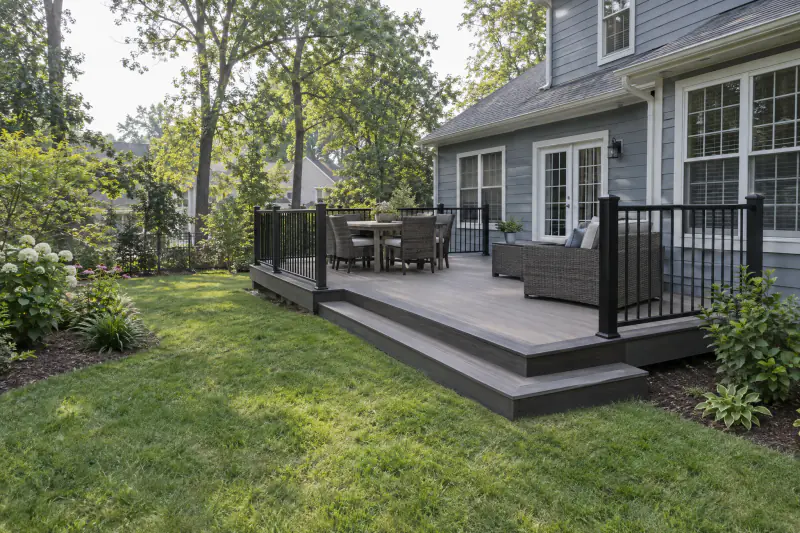
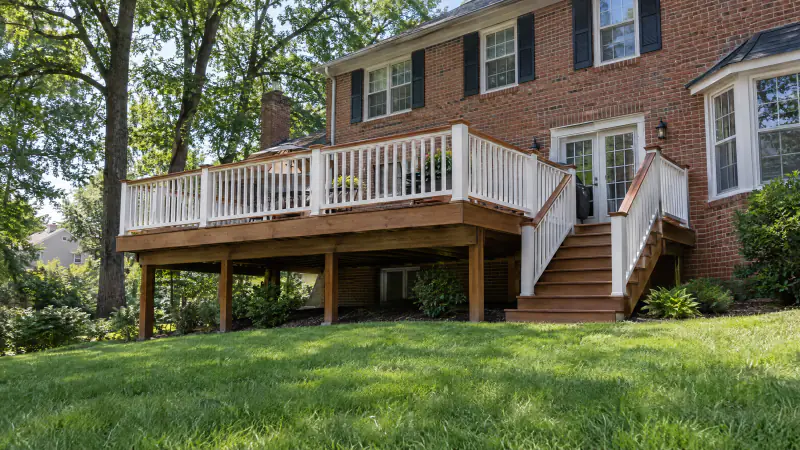
Capped composite and cellular PVC hold up best against what this climate throws at a deck, which is moisture more than anything else, and well-maintained pressure-treated pine holds up well enough that it is still the most common decking in the region. The honest answer depends on which side of the house the deck faces. Northern Virginia summers run humid for months, dew points often sit in the 60s and 70s from June into September, and a north-facing deck under oaks can stay damp for days after a storm. That is where wood checks, cups and grows mildew, and where a capped board simply needs a wash. On a south or west-facing deck in full sun, the problem reverses: a dark composite can be painfully hot by three in the afternoon, and a light-colored wood board stays walkable.
Our composite vs. wood decking guide already covers the basic trade-offs: price, upkeep, splinters, color. This article goes further into the weather itself. We look at how humidity and mildew behave on different materials, how hot each one gets, how pressure-treated pine, cedar, capped composite and PVC differ as products, which fasteners and gaps each needs, why the frame matters more than the boards, what a maintenance calendar looks like, and what 10 and 25 years of ownership cost as planning ranges. We end with the homeowners who should still choose wood, because some should.
What does humidity do to a deck on a north-facing wall?
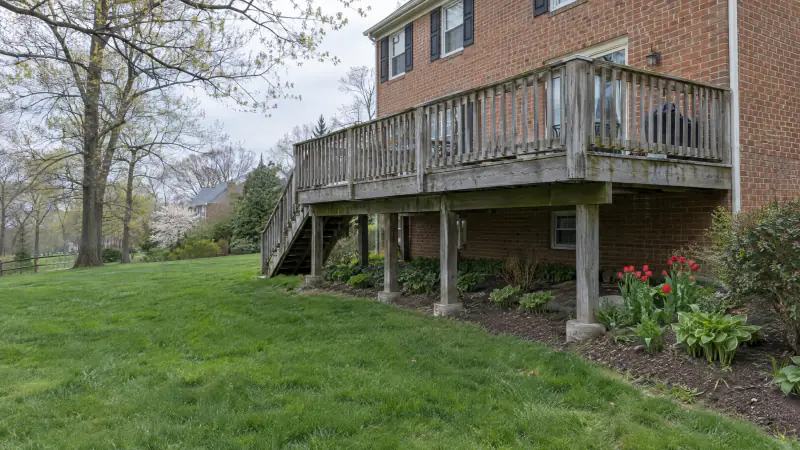
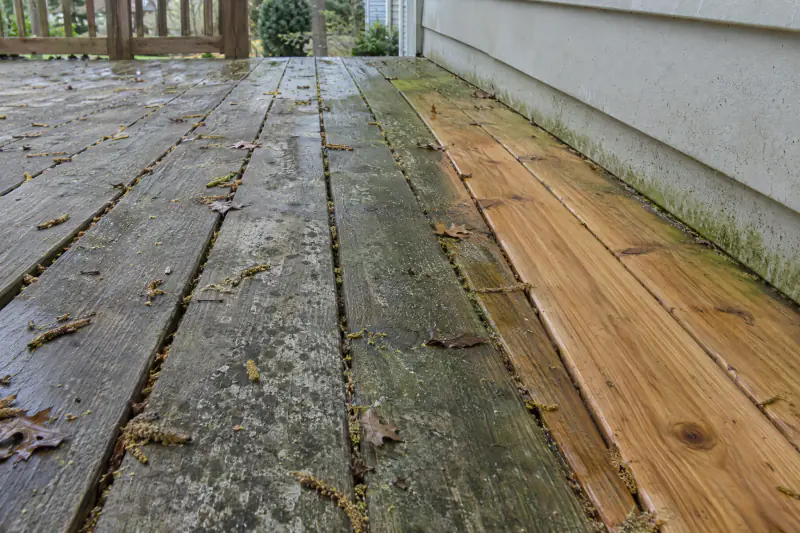
It keeps the boards wet long enough for fungus to move in. Mildew and mold are not picky about the surface. They need moisture, warmth and food, and a shaded deck in July supplies all three: rain and dew that do not dry off until noon, 70-degree nights, and a steady deposit of pollen, leaf fragments and bird droppings that serve as a meal. Pressure-treated pine is preserved against decay fungi, but the surface mildew that turns a deck gray and slippery is a different organism and the treatment does little to stop it. Once mildew establishes, it holds water against the wood, and the wood begins to check and soften at the joints and stair treads.
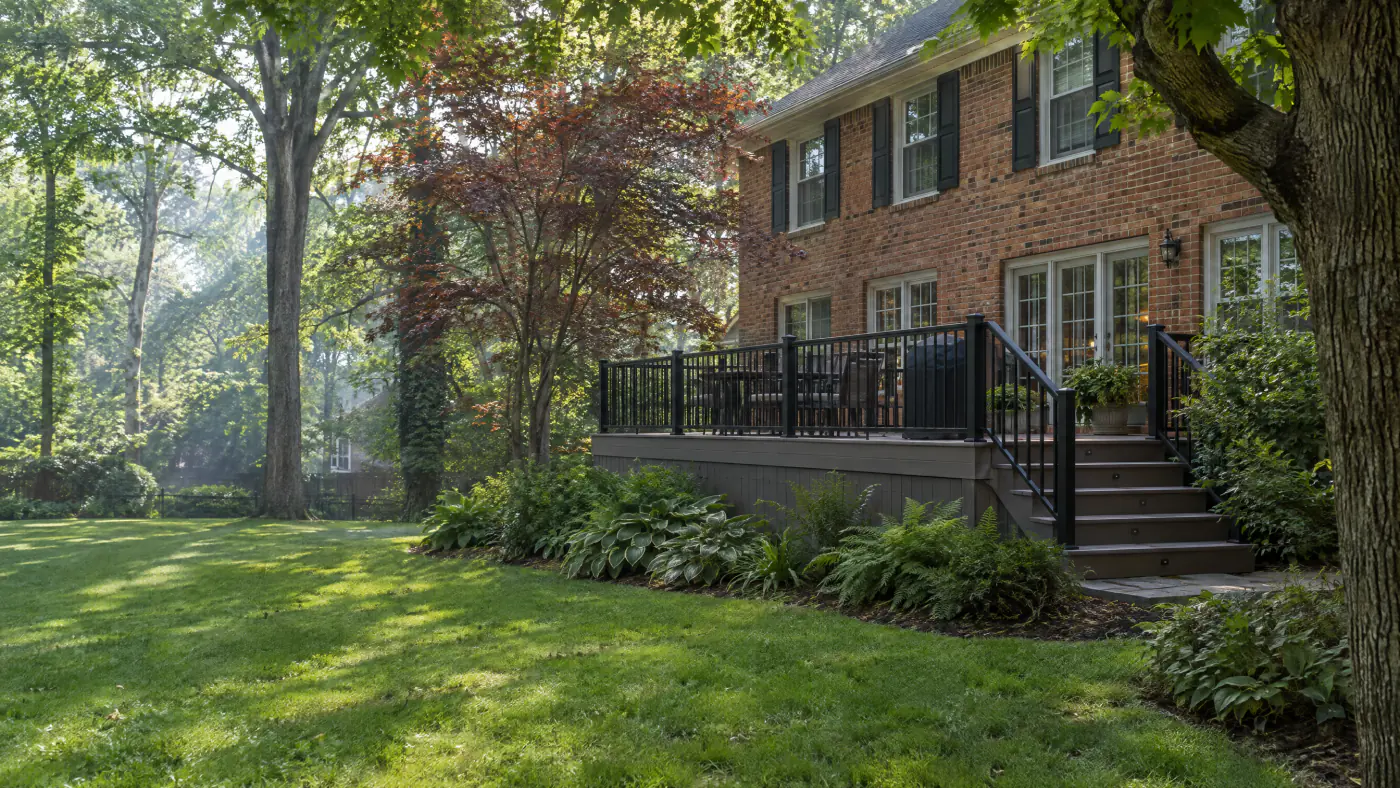
Capped composite and PVC do not feed the fungus, but the dirt on top of them does. A shaded composite deck still grows a gray-green film in the gaps and along the house wall each summer. The difference is what happens next. On composite the film sits on the cap and comes off with a soft brush and a mild cleaner. On wood it penetrates, and removing it means stripping and refinishing, which is the work described on our deck cleaning and staining page.
Cedar sits between the two. Its natural extractives resist decay better than untreated pine, and it dries faster than pressure-treated boards because it is lighter and less dense, but it still grays and mildews in shade without a finish. Whatever the material, a north-facing deck needs airflow. Boards set too tight, skirting with no vents and a low frame over wet clay turn the whole deck into a terrarium. We leave the manufacturer's clearance under composite decks and keep gaps open on wood ones for exactly that reason.
How hot does composite decking get in a Northern Virginia July?
Hot enough that a dark board in full afternoon sun can be uncomfortable or unsafe for bare feet, and the darker the color, the worse it gets. Composite boards are denser than wood and absorb more energy, and a charcoal or deep brown cap in direct sun on a 95-degree day can reach a surface temperature far above the air temperature by mid-afternoon, hot enough to burn bare feet. A pale wood board on the same deck is noticeably cooler to the touch, and a light gray or sand-colored composite lands in between. Manufacturers such as Trex and TimberTech now sell lighter palettes and some products designed to reflect more heat, and cellular PVC in pale colors often runs a little cooler than composite of the same shade, but no board is cool in that sun.
Orientation decides how much this matters. On an east-facing deck the sun is gone by early afternoon and surface heat is a non-issue. A north-facing deck barely sees direct sun. South and west-facing decks in open subdivisions in Ashburn, Chantilly, Bristow and Gainesville, where the trees are still young, take the full brunt from one o'clock until sunset in July and August, which is exactly when people want to use them.
We handle it three ways. First, we look at full-size samples outdoors in the actual spot, in the afternoon, and touch them, which tells you more than any brochure. Second, we steer sunny decks toward lighter colors. Third, where the deck is the main outdoor room, we talk about shade from a pergola or covered porch, because shade solves the heat problem for any material and makes the deck usable in the hours it would otherwise be empty.
Pressure-treated pine vs. cedar vs. capped composite vs. PVC: how do they behave here?
The four decking materials we install most, compared on the things Northern Virginia weather actually tests.
| Pressure-treated pine | Western red cedar | Capped composite | Cellular PVC | |
|---|---|---|---|---|
| Damp, shaded decks | Mildews and softens at joints without regular finishing | Resists decay better than pine, still grays and mildews | Surface film only, washes off | Surface film only, no wood fiber to hold water |
| Full afternoon sun | Checks and cups; stays cooler underfoot | Stable; stays cooler underfoot | Dark colors get very hot; fades slightly first year | Light colors often a little cooler than composite |
| Freeze-thaw and movement | Shrinks as it dries, then moves with moisture | Moves less than pine | Expands and contracts along its length with temperature | Expands and contracts with temperature |
| Fasteners | Hot-dip galvanized or stainless; treatment corrodes plain steel | Stainless to avoid black tannin streaks | Hidden clips in grooved boards, color-matched screws at edges | Hidden clips or color-matched screws; stainless near pools |
| Finish needed | Clean and stain every 2 to 3 years | Clean and finish every 2 to 3 years to hold color | None; wash once or twice a year | None; wash once or twice a year |
| Typical board life here | 15 to 20 years with care | 15 to 25 years with care | 25 years or more | 25 years or more |
Lifespans are typical expectations for Northern Virginia exposure and care, not promises. All four sit on the same pressure-treated frame.
Which fastener system is right for each material?
The one the material was designed for, and in this climate that is not a detail to leave to whoever has screws in the truck. Pressure-treated pine is preserved with copper-based chemicals, and copper corrodes ordinary steel. Every screw, nail, hanger and bolt touching treated lumber needs to be hot-dip galvanized or stainless steel, and the hanger nails need to match the hangers. Bright or electroplated fasteners rust through in a few wet seasons, which is the hidden reason old decks sag at the ledger and stairs. Face screws on wood decking should be a coated deck screw driven just flush, not sunk, so water does not pool in the hole.
Cedar wants stainless. Its tannins react with galvanized coatings and bleed black streaks around every screw head, which ruins the one thing you paid extra for, the look. Stainless costs more per box and is cheap per deck.
Capped composite and PVC are built around hidden fastener systems. Grooved boards are held by clips screwed into the joist, which also set the side gap, usually about three sixteenths to a quarter inch depending on the product. Square-edge boards at the perimeter, on stairs and at breaker boards get color-matched screws, often with plugs cut from the same board. Screws made for composite have a reverse thread or a cutting head so the cap does not mushroom around them; ordinary wood screws leave a crater. Near a pool or hot tub, stainless clips and screws are the right call. The installation details on our composite and PVC decks page show how the clips go in; the point here is that each material has one right answer and several wrong ones.
Why do expansion gaps matter more in Northern Virginia than in milder climates?
Because the boards here see nearly a 100-degree swing between a January night and a July afternoon, and the materials move in opposite ways. Wood moves with moisture. Pressure-treated pine arrives wet from the treatment plant, shrinks across its width as it dries over the first summer, then swells and shrinks a little with every humid stretch and dry spell after that. That is why new treated decking is laid tight or nearly tight: the gap opens on its own as the boards dry. Lay it with a wide gap on a wet day and you end up with half-inch openings that catch chair legs.
Composite and PVC move with temperature, mainly along their length. A 16-foot board can change length by a noticeable fraction of an inch between winter and summer. Side gaps are fixed by the clips; end gaps, where boards meet each other, the house, a breaker board or a picture-frame border, must be set from the manufacturer's temperature chart for the day. Fascia and stair risers need their own gaps and a fastening pattern that lets the board move rather than bow. Boards also need a gap at the house wall and at posts so expansion has somewhere to go.
Freeze-thaw adds a slower stress. Water that sits in a tight joint or a screw hole freezes and expands, lifting fibers on wood and working fasteners loose on any material. The fix is the same for all four decking types: gaps that drain, boards crowned and screwed so water runs off, and a frame that sheds water rather than holding it. A deck built that way in Leesburg sees the same winters as one in Woodbridge and comes through them the same way.
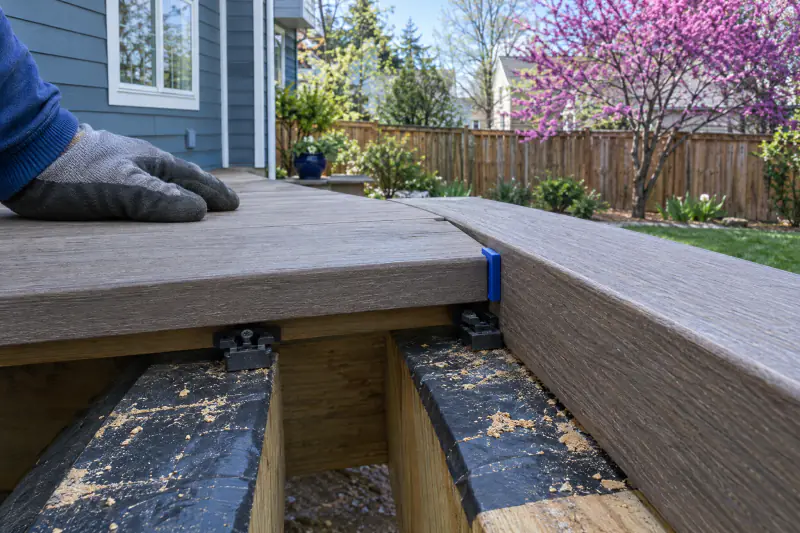
Why does the frame decide how long any deck lasts?
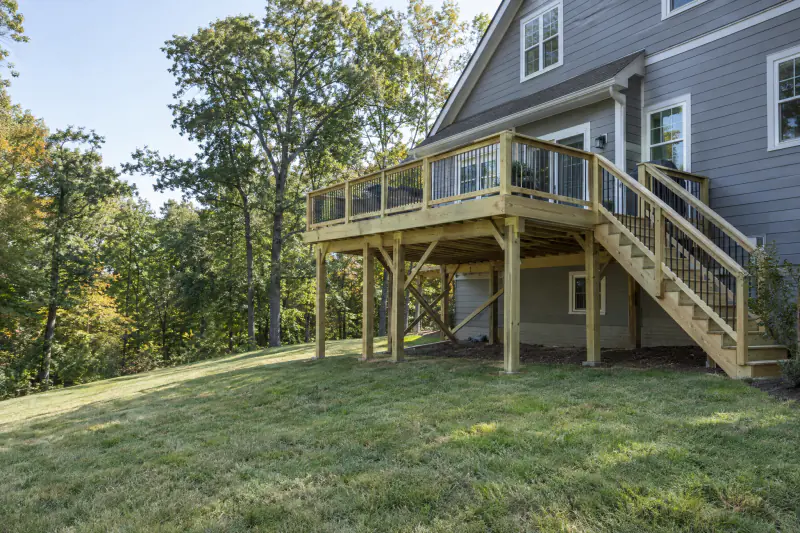
Because every deck sits on the same pressure-treated frame, and that frame has its own lifespan that the decking cannot extend. Posts, beams, joists and the ledger are treated southern pine in nearly every deck built in Northern Virginia, under wood and composite alike. Flashed properly at the ledger, kept off the soil on footings and metal post bases, and given airflow underneath, that frame typically lasts 20 to 30 years here. Nailed to the house without flashing, with posts buried in clay and joist tops left to soak, it can be done in 12.
This changes the composite decision. Manufacturers rate capped composite and PVC boards for decades of service, which means the boards will very likely outlast the joists they sit on. Putting a long-lived surface on a frame that is already 18 years old is the most common mistake we see in resurfacing, and we explain how to judge that in our article on whether to repair or replace an aging deck. On a new build the answer is to make the frame last as long as the boards: structural screws instead of nails at the ledger, flashing that laps over it, galvanized hangers with the right nails, a drip edge of joist tape across every joist top so the wood under the fasteners stays dry, and clearance to the ground.
Joist tape deserves a sentence. It is a self-adhesive membrane applied along the top of each joist before the decking goes on. Water that drains through the deck gaps lands on tape instead of bare wood, and the screw holes, which are where joists rot first, stay sealed. We recommend it under composite, where the boards will be in place for 25 years and nobody wants to pull them up to sister a joist at year 15. The framing and footing requirements themselves are covered under custom deck building.
What does a Northern Virginia deck maintenance calendar look like?
The same year, for wood and for composite. The wood column is where the ownership cost comes from.
Early April: the first look
Walk the deck after the last hard freeze. On wood, probe stair treads, board ends and the ledger area for soft spots and check for lifted fasteners. On composite, look for clips that have backed out and boards that have crept at the ends.
Early May: wash after pollen
Once oak and pine pollen drop, wash the deck. Wood gets a deck cleaner and a brightener at low pressure; composite gets a mild soap or composite cleaner and a soft brush. High-pressure washing scars both. Clear every gap so water can drain.
Late May into June: finish wood
Stain or seal wood decking in a stretch of dry days with temperatures in the product's range. Horizontal surfaces here usually need it every two to three years, railings less often. Composite skips this step entirely, which is the whole point of buying it.
Summer: watch the hot side
Move planters and rugs occasionally so composite does not discolor beneath them, wipe grease spills on any material before they set, and keep an eye on dark composite surface temperatures if children use the deck barefoot.
October: leaves off, gaps clear
Oak and maple leaves left in the gaps hold water through winter. Blow or sweep the deck after leaf fall, clear the gaps again and check that downspouts near the frame still discharge away from the footings.
Before the first hard freeze: one last pass
Store cushions, shovel with plastic rather than metal, and use only the deicer your decking maker allows: Trex accepts calcium chloride or rock salt rinsed off in spring, TimberTech asks for calcium chloride and no rock salt, and wood would rather have none. Then let the deck sit until April.
What do 10 and 25 years of deck ownership cost in Northern Virginia?
Over ten years the gap between wood and composite is still wide. Over twenty-five it often closes or reverses, provided the frame lasts. As typical Northern Virginia market planning ranges as of 2026, not quotes, a new pressure-treated deck runs about $45 to $80 per square foot installed and a capped composite or PVC deck about $75 to $140, including the frame, railings and one stair. Cedar decking lands between the two. Cleaning and staining a wood deck typically costs $2 to $5 per square foot each cycle, and in this climate the floor needs it about every two to three years. A professional composite wash often runs $200 to $500.
Put those on a 300 square foot deck and the arithmetic looks like this. Wood: roughly $13,500 to $24,000 to build, plus three to five staining cycles in the first decade at $600 to $1,500 each. Composite: roughly $22,500 to $42,000 to build, plus washing that many homeowners do themselves with a hose and a brush. By year 25 the wood deck has usually been stained eight to twelve times and has had its boards replaced once, since 15 to 20 years is the typical life of treated decking here, while the composite boards are often still in service and the question has become the frame. The table below lays out the ranges.
What moves these numbers more than the material:
- Whether you stain the deck yourself or hire it out, which can halve or double the wood column
- Exposure: a shaded wood deck needs more frequent cleaning and fails sooner
- Railing choice, which can rival the decking in cost on any deck
- Deck height and stairs, which add framing and railing footage
- Frame condition at year 20, which can add a resurfacing or a rebuild to either column
The site-wide cost guide has ranges for every deck and porch type. For your deck, in your exposure, with your railing, the only reliable figure is a written on-site estimate.
How do 10 and 25 year costs compare on a 300 square foot deck?
Illustrative planning ranges for Northern Virginia as of 2026, assuming hired maintenance and a frame that lasts the period. Round numbers, not quotes.
| Pressure-treated pine | Capped composite | Cellular PVC | |
|---|---|---|---|
| Installed, year one | $13,500 to $24,000 | $22,500 to $42,000 | $27,000 to $42,000 |
| Upkeep, years 1 to 10 | $1,800 to $7,500 (3 to 5 stain cycles) | $0 to $2,500 (washing) | $0 to $2,500 (washing) |
| 10-year total | $15,000 to $31,500 | $22,500 to $44,500 | $27,000 to $44,500 |
| Upkeep, years 11 to 25 | $3,000 to $10,500 in staining, plus re-decking once at $10,500 to $21,000 | $1,000 to $4,000 in washing | $1,000 to $4,000 in washing |
| 25-year total | $29,000 to $63,000 | $23,500 to $48,500 | $28,000 to $48,500 |
| Frame risk by year 25 | Likely needs repairs or replacement | Likely needs repairs; boards may outlast it | Likely needs repairs; boards may outlast it |
Doing the staining yourself can cut the wood upkeep figures sharply. A frame that needs rebuilding at year 20 adds to every column.
Does composite decking help when you sell a Northern Virginia home?
It helps in the way that any well-kept, obviously low-maintenance feature helps: it removes an objection. A buyer walking onto a gray, splintered wood deck in Burke or Herndon mentally adds a weekend of work or a staining bill, and sometimes a replacement. A buyer walking onto a clean composite deck adds nothing. Listings in this market routinely call out composite decking by name, which tells you agents think it matters, but we are not going to quote a return-on-investment percentage, because the ones in circulation are national averages that say little about a specific house in Vienna or Lorton.
What we can say from the inspection side is that the frame matters more at resale than the boards. Home inspectors go underneath. A composite deck on an unflashed, nailed ledger is a repair item in the inspection report no matter how good the boards look, and a stained wood deck on a properly built, permitted frame passes without comment. Permit history counts too; we cover that in our guide to deck permits in Northern Virginia.
If you are deciding on material with a sale a few years out, a freshly cleaned and stained wood deck photographs as well as composite and costs far less to get there. If the sale is a decade or more away, the composite deck will still look like the day it was built when the photographer arrives, and the wood deck will have needed four rounds of staining to say the same. Resale is a reason to keep the deck in good condition. It is rarely a reason by itself to pick one material over the other.
Which homeowners should still choose wood?
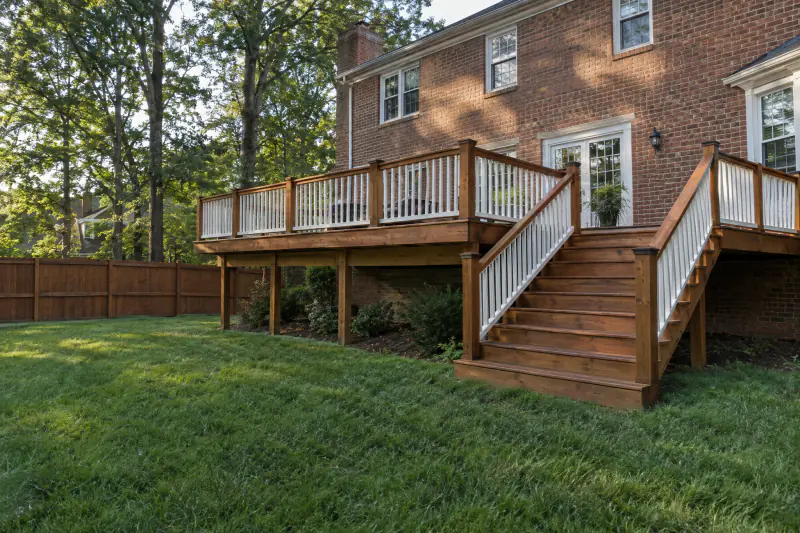
Quite a few, and we build wood decks for them without any sense that they are settling. Wood is the right call when the budget is fixed and composite would mean a smaller deck or a cheaper railing. A generous, well-framed pressure-treated deck beats a cramped composite one every time, and the frame underneath is identical. It is also right when you plan to sell within about five years, since the composite premium will not have paid for itself in skipped staining by then.
Choose wood if you actually enjoy maintaining it. Some homeowners in Great Falls, Clifton and Purcellville with large wooded lots treat the spring staining as part of the yard's rhythm, and a cared-for cedar or pine deck has a warmth composite does not match. Choose it if you want to change the color later, since stain can go from natural to dark brown to gray over the years and composite is the color you bought. Choose it in a historic district or a community whose guidelines favor natural materials; parts of Alexandria and older sections of Falls Church and Arlington sometimes fall here, and the HOA or review board, not us, has the final word.
Wood also makes sense as a bridge. If the deck will become a screened porch in a few years, or if an aging frame has perhaps eight years left and you do not want to rebuild yet, inexpensive treated decking now and a full rebuild later can be the more sensible sequence than composite on a frame that will not match its lifespan. Our maintenance guide lays out what keeping a wood deck in good order actually involves, and our article on deck staining in Northern Virginia humidity covers the narrow weather window that makes it work. If you read those and still want wood, you will be happy with it.
How do these choices play out across Fairfax, Loudoun, Prince William and Arlington?
The tree cover decides more than the county line. In the established neighborhoods of Fairfax County, from McLean and Vienna to Oakton, Burke and Annandale, decks sit under mature oaks and maples that drop pollen in April, catkins in May and leaves in October, and shade the deck all summer. These are mildew decks. Wood there needs faithful cleaning and staining, and composite or PVC earns its price quickly. The same is true on wooded lots in Reston, Great Falls and Clifton, and along the older streets of Arlington, Falls Church and Alexandria, where north-facing townhouse decks can stay damp for a week after a storm.
In newer communities across Loudoun and Prince William, including Ashburn, South Riding, Aldie, Gainesville, Haymarket and Bristow, the trees are young and the decks bake. These are heat decks. The decision there is less about rot and more about color and shade: a light-toned composite, a pale PVC, or treated pine in a light stain, with a pergola or roof planned for the west side. Leesburg and Purcellville in western Loudoun run a few degrees cooler and a few days later in spring, which helps a little with both problems and changes the staining window by a week or two.
Permits do not depend on the material. A new deck needs a building permit everywhere we work, and HOAs commonly ask for the board and railing color by name, so pick it before the application goes in. We build wood, composite and PVC decks in Fairfax, Loudoun, Prince William and Arlington counties and the cities of Alexandria, Fairfax, Falls Church, Manassas and Manassas Park; our service areas page lists every community. For the full material line-up and how we choose, start at decks and porches, and for the colors and railings that pair with each board, see designing a deck in winter.
Frequently asked questions
Does composite decking grow mold or mildew in Virginia humidity?
The board itself does not feed mildew, but the pollen, leaf litter and dirt that settle on it do, so a shaded composite deck in Northern Virginia grows a gray-green film most summers just as wood does. The difference is that the film sits on the cap and comes off with a soft brush, a mild cleaner and a hose, while on wood it works into the grain and has to be stripped and refinished.
Is cedar decking a good choice for Northern Virginia?
It can be, with the same upkeep as pine. Western red cedar resists decay naturally, moves less than pressure-treated pine and stays cooler than dark composite, but it is softer, dents under furniture, grays quickly without a finish and costs more. Use stainless fasteners to avoid black streaks. It suits homeowners who want real wood and accept staining every two to three years.
Which composite color stays coolest in the sun?
The lightest one you can live with. Pale grays, sand and driftwood tones absorb far less heat than charcoal, espresso or deep red boards, and cellular PVC in a light color often runs a little cooler still. Some manufacturers offer heat-reflecting lines. Test full boards in the actual spot on a sunny afternoon and touch them, because a sample in a showroom tells you nothing about July.
Can I put composite decking on my old wood deck frame?
Only if the frame will last as long as the new boards. The joists must be sound with no rot at the ledger, beam ends or post bases, spaced no more than 16 inches apart for straight runs, properly flashed and attached to the house with bolts or structural screws. An 18-year-old frame under 25-year boards is a poor match. We evaluate the frame before recommending it either way.
How often does a wood deck need staining in Northern Virginia?
The floor usually every two to three years, railings and vertical surfaces less often, with shaded decks at the short end of that range. The work has to happen in a stretch of dry days with temperatures in the product's range, which here means late spring or early fall. Water-based and penetrating oil finishes behave differently in our humidity, so match the product to the exposure.
Does PVC decking expand more than composite?
Both move with temperature along their length, and both manufacturers publish gap charts keyed to the installation-day temperature that must be followed. The practical point is the same for either: end gaps, breaker boards, fascia and the gap at the house wall have to be set for the day's temperature, or the boards buckle in summer or open up in winter. The clips handle the side gaps automatically.
Is composite decking worth it on a small townhouse deck?
Often yes, because the premium is small in dollars on a 120 square foot deck and townhouse decks in Northern Virginia are frequently shaded by the neighbors and face north or east, which is where wood struggles most. The railing can cost as much as the boards on a small deck, so decide on both together. If the deck is in full sun, pick a light color.
Should I use joist tape under composite decking?
We recommend it. Joist tape is a self-adhesive membrane laid along the top of each joist so water draining through the gaps lands on the tape rather than bare wood, and the screw and clip holes stay sealed. It costs little during a new build and helps the frame last closer to the 25 years or more the boards are expected to serve, which is the whole premise of buying composite.
Book the work
Put the plan in writing with a crew that builds this every week.
One visit to measure and talk through options, then a written scope and price. No pressure, no vague numbers. Ask about the Heroes Discount if you serve.
Sources and further reading
- Trex: composite decking installation guides and care instructions
- TimberTech: composite and PVC decking technical literature
- American Wood Council: Prescriptive Residential Wood Deck Construction Guide (DCA 6)
- Virginia Cooperative Extension publications on wood decay and outdoor wood care
- NOAA National Centers for Environmental Information: U.S. Climate Normals
Published January 29, 2026. Reviewed and updated October 9, 2026.