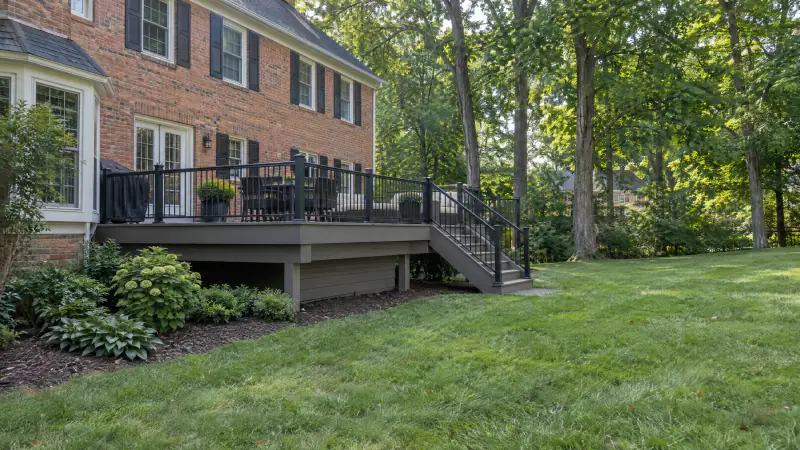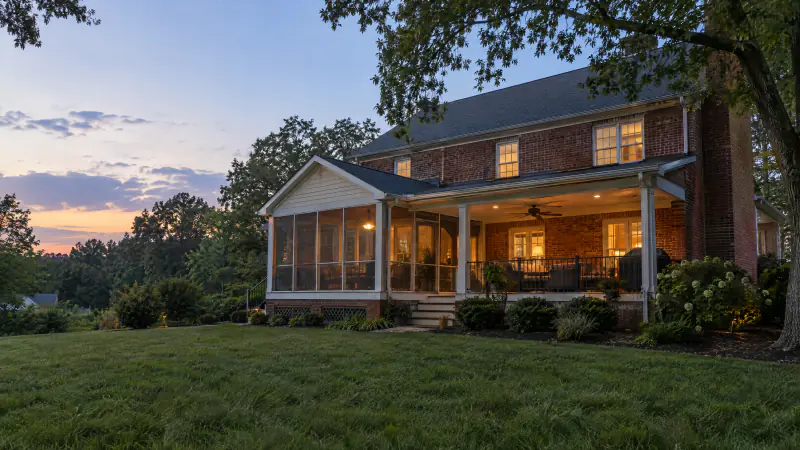
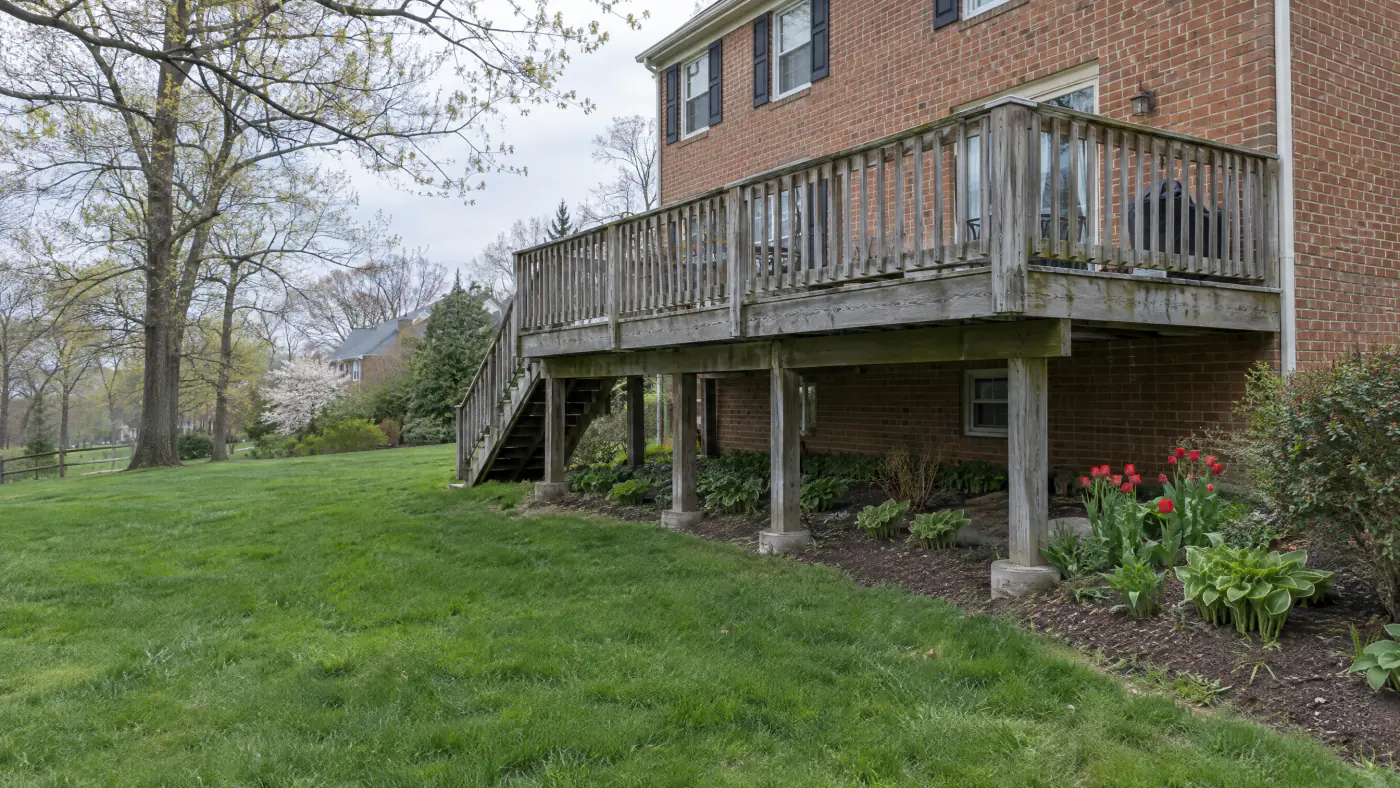
Key takeaways
- Judge the frame, not the boards. If the ledger, footings, posts, beam and joists are sound, resurfacing with new decking and rails usually makes sense. Two or more structural failures point to replacement.
- Inspect in April, after freeze-thaw has done its work and before the deck fills with furniture. Bring a screwdriver, a flashlight and a tape measure, and get underneath.
- Composite on an old frame is sound only when the joists are rot-free, no more than 16 inches apart, reasonably flat and young enough to outlast 25-year boards.
- Decks built before the early 2000s often have nailed ledgers, no flashing and no lateral ties. Those are repairs, not reasons to panic, but they change the scope.
- As 2026 Northern Virginia planning ranges, repairs run from a few hundred dollars to several thousand, resurfacing about $35 to $70 per square foot and a new deck $45 to $140 depending on material.
On this page
- Should you repair, resurface or replace an aging deck?
- Why is April the month to inspect a Northern Virginia deck?
- How do you inspect a deck for rot and corroded fasteners?
- Which deck problems mean repair, resurface or replace?
- Why does the ledger decide more than anything else?
- What do footings, posts and beams tell you?
- How do joists and hardware fail, and can they be fixed?
- When is composite on an old frame sound, and when is it a mistake?
- Which code changes catch decks built in the 1980s and 1990s?
- What do deck repair, resurfacing and replacement cost in Northern Virginia in 2026?
- What are the signs a deck should be replaced rather than resurfaced?
- How long does each option take, and when should you book it?
- What do aging decks look like across Fairfax, Loudoun, Prince William and Arlington?
- Frequently asked questions
Should you repair, resurface or replace an aging deck?
Resurface it if the frame is sound and only the boards and rails are tired. Repair it if the frame has one or two specific, fixable problems. Replace it if the ledger, the footings or several joists have failed, or if the repairs would add up to most of the cost of a new deck. That is the whole framework, and the rest of this article is about how to tell which case you have, because from the top of the deck all three look the same: gray boards, a wobbly rail, a stair that bounces.
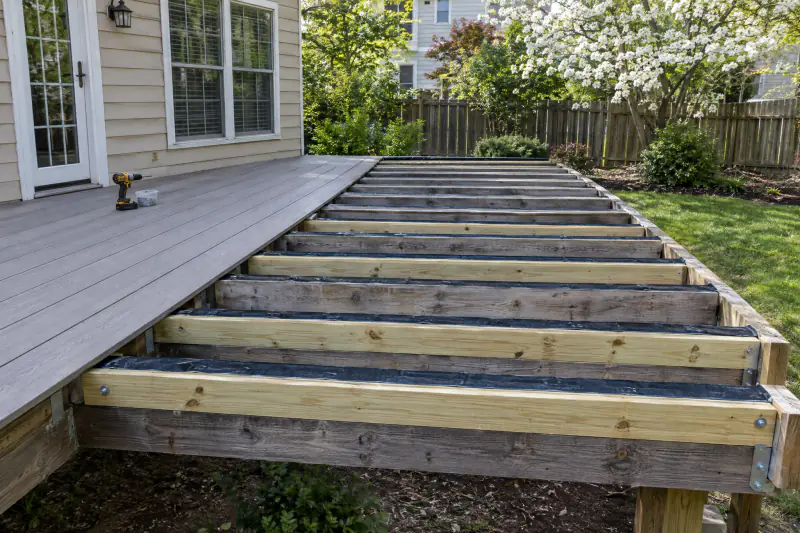
The reason the frame decides is cost structure. On a new deck, the footings, posts, beam, joists and ledger are roughly half the price, and they are also the half that takes the permit and the inspections. If those parts have another 10 or 15 years in them, replacing only the decking and railing buys a deck that looks and feels new for a fraction of the money. If they do not, new boards on a failing frame are the most expensive way to own a bad deck.
We do this evaluation at the start of every deck repair and resurfacing project, and we tell homeowners the honest answer even when it is the expensive one. What follows is the inspection we do, component by component, the table we use to sort the findings, the specific question of putting composite on an old frame, the code changes that catch decks built in the 1980s and 1990s, and what each option costs in Northern Virginia as of 2026. We also explain why we want to do this in April.
Why is April the month to inspect a Northern Virginia deck?
Because the deck has just finished its hardest season and has not yet started its busiest. Freeze-thaw cycles from December through March work on every weak point: water in a check freezes and widens it, a footing that was marginal heaves and settles, a loose guard post works looser as the wood swells and shrinks. By early April the damage from the winter is done and visible, the wood is still damp enough that rot is soft to the touch rather than dry and deceptively firm, and the deck is still empty. Once the furniture, the grill and the planters come out in May, half of the surface is covered and nobody wants to move it.
April also leaves time to act. A repair found now can be scheduled for May. A resurfacing can be done in June. A replacement, which needs a county permit and HOA approval, can be drawn and submitted in April and built by midsummer; the lead times are in our guide to deck permits in Northern Virginia. The same inspection in August finds the same problems with no season left to fix them, and a deck that fails in July fails with people on it.
There is a practical reason too. Pollen. From late March into early May, oak and pine pollen coats every surface in Fairfax, Loudoun and Prince William counties, and the first warm weekend is when homeowners wash the deck and notice what is under the yellow film. If you are going to clean the deck anyway, inspect it first, while the dirt and the water stains still show you where the problems are. A deck that only needs cleaning and staining is a different project, covered in our article on deck staining in Northern Virginia humidity.
How do you inspect a deck for rot and corroded fasteners?
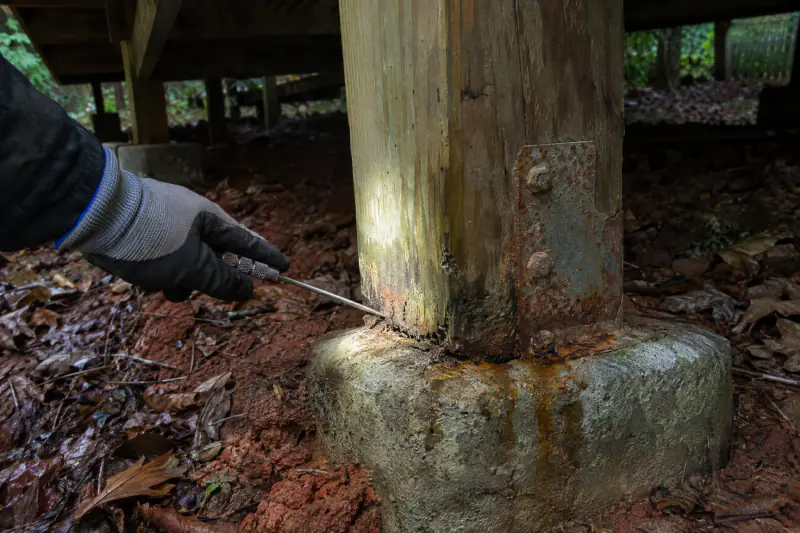
From the house outward and from the ground up, with a flashlight, a flat screwdriver or awl, a tape measure and a level. Get underneath; that is where decks fail.
Ledger and flashing
Look at the board bolted to the house. Count the fasteners: bolts or structural screws in a staggered pattern are right; nails are wrong. Look for metal flashing lapped over the top of the ledger from behind the siding. Probe the house band board above and below the ledger, and the ledger itself, especially near the ends and around downspouts.
Footings and posts
Each post should stand on a concrete footing with a metal base, not in the soil. Probe the bottom six inches of every post, where water and dirt sit. Check for posts that lean, have split, or have been notched. Lay a level on the beam to see whether a footing has heaved or settled over the winter.
Beam
Find the beam the joists rest on. Look for splices that do not land over a post, for a beam that is only nailed to the side of the posts instead of bearing on top of them or sitting in a saddle, for checks that run through, and for crushing or dark staining where the joists sit.
Joists
Probe the top edge of every joist you can reach, particularly where the deck boards cross them and at the ends in the hangers. Rot starts at the top, under the boards, where water sits in each screw hole. Measure the spacing between joists; 16 inches on center or closer matters later for composite.
Hardware
Look at the hangers, their nails, the post bases and the bolts. Surface rust is cosmetic; flaking, pitting or hangers with missing nails are not. Older galvanized hardware against treated lumber from the early 2000s onward corrodes faster than its builders expected.
Guards and stairs
Push hard on the top rail at every post. Measure the guard height from the deck surface and the gap between balusters. On the stairs, measure each riser, probe the stringers where they meet the ground, and check that the bottom landing is solid. Then, last, look at the boards.
Which deck problems mean repair, resurface or replace?
Sort what the inspection found, component by component. One column usually dominates, and that is your answer.
| Component | Repair if | Resurface if | Replace if |
|---|---|---|---|
| Ledger and flashing | Bolted but unflashed; band board still sound | Bolted, flashed, band board firm | Nailed, no flashing, band board soft or deck pulling from house |
| Footings and posts | One post base soft or one footing heaved | All posts on footings, firm, plumb | Posts in soil, several soft bases, footings shallow or missing |
| Beam | A splice off a post, fixable with a new post | Bearing properly, no decay | Split, decayed, nailed to post sides, or undersized for span |
| Joists | One to three with top-edge rot, can be sistered | Sound, flat, spaced 16 inches or less for composite | Widespread rot, 24-inch spacing with composite planned, sagging |
| Hardware | Isolated corroded hangers or missing nails | Hangers and bolts intact, surface rust only | Flaking, pitted hardware throughout |
| Guards and stairs | Loose posts, uneven risers, soft stringer feet | Will be replaced with the surface anyway | Only if the frame they attach to fails |
| Surface boards | A few cupped or soft boards | Worn, gray, splintered boards over a sound frame | Never the reason by themselves |
Two or more findings in the replace column usually make a new deck the better value, even if each one could be fixed on its own.
Why does the ledger decide more than anything else?
Because it carries about half the deck and it is the connection most likely to have been built wrong. A ledger is the board fastened to the house that the joists hang from. When it is bolted to the house's band board with half-inch lag screws or structural screws in a staggered pattern, flashed so that water running down the wall goes over it rather than behind it, and tied back into the floor framing with lateral connectors, it will outlast the boards. When it is nailed through the siding with no flashing, water gets behind it every time it rains, the band board rots in the dark, and the nails lose their grip in wood that is turning to sponge. Ledger separation is the way decks collapse, usually with a crowd on them.
The inspection is simple and the result is often decisive. If the band board behind the ledger is firm when probed and the ledger is bolted, the deck has a future. If the band board is soft, the deck is a replacement, and the house wall needs repair before any new deck goes on it. Flashing missing on an otherwise sound and bolted ledger is a repair: we open the siding above the ledger, install flashing that laps over it, add any missing fasteners and lateral ties, and close it up. That work is often done as part of a resurfacing, and it is the single most valuable repair a deck can get.
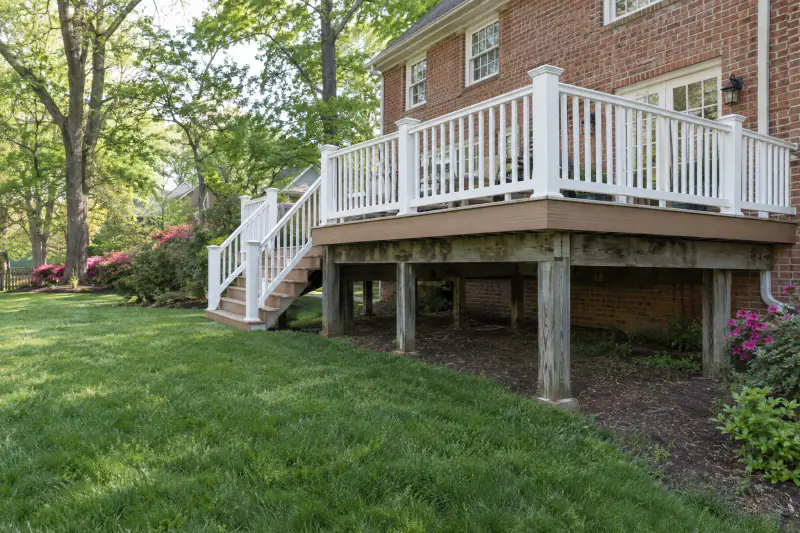
Brick is the special case. A ledger cannot be fastened to brick veneer, and decks on older brick colonials in Vienna, Annandale and Springfield were sometimes hung from it anyway. That is not a repair. The honest fix is a freestanding frame with its own beam and posts next to the house, which the custom deck building page describes, and it is usually built as part of a replacement rather than a repair.
What do footings, posts and beams tell you?
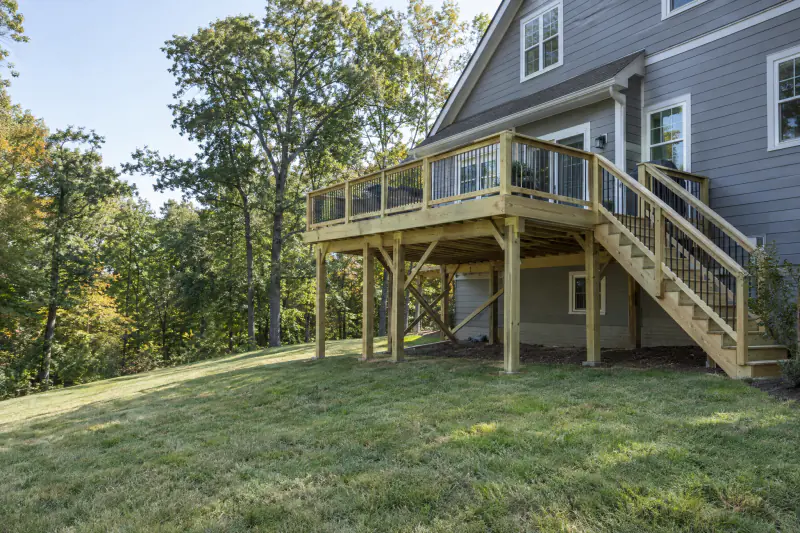
Whether the deck is standing on the ground or in it. Footings in Northern Virginia need to reach below frost depth, roughly 24 inches, and bear on undisturbed soil, and posts need to stand on top of them in a metal base that keeps the end grain out of water. Decks that were built with posts set directly in holes, or on precast pier blocks sitting on the lawn, or on footings dug a foot deep, show it every spring: the level on the beam reads differently than it did in October, a stair stringer has pulled away, a guard post leans. Post rot at the base is the companion problem. A six-by-six that stands in damp clay or in a cup of water on top of a footing with no base loses its bottom six inches to decay within a decade or two, even when it is treated.
One bad post or one heaved footing is a repair. We shore the deck, cut out the post, pour or extend the footing, set a new post on a base and reconnect the beam. Several bad posts, or footings that are shallow everywhere, tip the decision toward replacement, because by the time every post is replaced on a proper footing the frame has been rebuilt from the ground up, with the old beam and joists in between.
The beam is checked for three things: that it bears on top of the posts or in proper saddles rather than being nailed to their sides, that any splice lands over a post, and that it is not decayed or split through. A beam nailed to the sides of the posts, common on older decks, relies entirely on the fasteners, which are the parts that corrode. That condition can sometimes be repaired with new hardware and post caps, but combined with a short footing or a soft post it becomes one more entry in the replace column.
How do joists and hardware fail, and can they be fixed?
Joists fail from the top down, as the callout above describes, and from the ends in, where they sit in hangers and the end grain soaks. Both are repairable when they are limited. A joist with top-edge rot can be sistered: a new treated joist of the same depth is bolted alongside it, bearing on the beam and in a new hanger at the ledger, so the load has a sound path even if the old joist is left in place. Joist tape over the tops, applied before the new decking goes on, stops the problem from restarting. We also add blocking where the new guard posts will bolt and where a picture-frame border or a breaker board in composite needs support. Once a third or more of the joists need sistering, the economics flip and a new frame is cheaper.
Hardware is the quiet one. Joist hangers, post bases, bolts and nails on decks built from the early 2000s onward sit against lumber preserved with copper-based chemicals that are harder on steel than the older treatment was. Builders who used the old hardware and bright nails on the new lumber left decks that look fine and are quietly losing their connections. Flaking, pitted hangers, nails that have thinned to wire, and bolts that leave rust tears down a post are all signs. Replacing hangers one at a time while the deck is shored is routine work on a resurfacing; replacing all of them on a frame that also needs sistering and a ledger repair is a replacement wearing a different name.
Guards and stairs are almost always rebuilt as part of a resurfacing rather than repaired on their own, because the new decking changes the surface they attach to. New guard posts are bolted through blocking, rails are brought to current height and baluster spacing, and stairs are cut with even risers and a proper landing. Those are described on the repair and resurfacing page and are not where the decision gets made.
When is composite on an old frame sound, and when is it a mistake?
It is sound when the frame will last as long as the boards, is spaced closely enough to support them, and is flat enough to lay them on. It is a mistake when any of those is missing, and the most common mistake in resurfacing is skipping the first one. Manufacturers such as Trex and TimberTech rate capped composite and PVC boards for decades of service. Putting them on a 20-year-old treated frame means the boards will be in perfect condition when the joists under them need replacing, and the only way to replace joists is to take the boards off again. We generally advise composite on an existing frame when the frame is well under 15 years old, properly built, and passes the probe test on top as well as below. Beyond that, treated decking is the better match, or the frame is replaced and composite goes on new joists.
Spacing is the hard rule. Composite and PVC are less stiff than lumber, and most products require joists at 16 inches on center for straight runs, 12 inches for diagonal patterns, and closer on stairs. Many older decks were framed at 24 inches, which was fine for two-by-six wood decking and gives composite a bouncy, spongy feel and eventual sag. The fix is to add a joist between each pair, which is real work on an existing deck and may not be possible where the beam and ledger were sized for the old spacing. Our composite and PVC decks page explains the spacing requirement; the point here is that it has to be measured before anyone quotes a resurfacing.
Flatness is the third test. Composite follows the joists exactly and will show every crown and dip in the surface. Old joists that have twisted or settled can sometimes be planed or shimmed; a frame that has racked cannot. How the materials themselves behave in this climate, and why a shaded deck pushes toward composite, is covered in composite vs. wood decking for Northern Virginia weather.
Which code changes catch decks built in the 1980s and 1990s?
Mostly the ones about connections and guards, and they matter because structural repairs generally have to meet current code even when the rest of the deck was legal when built. A deck from 1992 that is left alone is a deck from 1992. A deck from 1992 that gets a new ledger connection, new posts or a rebuilt stair gets those parts built to the Virginia Residential Code in force now, and the county may ask for a permit and inspection to prove it. Your county decides where the line between repair and new work falls, and we check before the old boards come off.
The changes that most often surface on an older deck: the ledger must be bolted or fastened with structural screws, not nails, and flashed; lateral load connections tying the deck to the house floor framing are now expected; guards on decks more than 30 inches above grade must be at least 36 inches high with openings a 4-inch sphere cannot pass through, which catches the 32-inch rails and wide baluster gaps on many older decks; stairs need even risers no taller than 8 1/4 inches, treads at least 9 inches deep, and a graspable handrail on runs of four or more risers; and posts belong on footings in metal bases rather than in the ground. Hot tubs and roofs are their own category; a frame that is being evaluated for one of those needs engineering, not a repair list.
None of these conditions means a deck is unsafe today, and none of them forces a replacement by itself. They mean that a resurfacing which includes new guards and stairs, which is nearly all of them, will bring those parts to current standards, and that a ledger or post repair will do the same. That is a feature. The deck you end up with is safer than the one you started with, and the record shows it. For what a new deck is held to from the ground up, the decks and porches pillar sets it out.
What do deck repair, resurfacing and replacement cost in Northern Virginia in 2026?
As typical Northern Virginia market planning ranges as of 2026, not quotes: individual repairs run from a few hundred dollars for a flashing fix or a single post to several thousand for a ledger rebuild, with a stair rebuild commonly between $1,500 and $6,000 and railing replacement about $60 to $150 per linear foot. Resurfacing a sound frame with new decking, guards and stairs typically costs $35 to $70 per square foot, with composite at the upper part of that range and treated pine at the lower. A new deck runs about $45 to $80 per square foot in pressure-treated wood and $75 to $140 in composite or PVC, including the frame, railings and a stair, so a mid-sized replacement commonly lands between $15,000 and $50,000.
The way we use those numbers is a simple comparison. Add up the repairs the frame needs and the resurfacing on top of them, and set that against a new deck of the same size in the same material. When the repair-plus-resurface figure passes roughly 60 to 70 percent of the replacement figure, replacement is usually the better value, because you get new footings, a new frame sized for composite, a current-code ledger and a fresh 25-year clock on everything, not just the boards. Below that threshold, resurfacing is the sensible spend, and it is often half the price or less.
What moves each number:
- Decking and railing material, which can double the resurfacing figure on its own
- How many joists need sistering or adding for composite spacing
- Deck height, which affects shoring, access, stair length and railing footage
- Whether the ledger and house wall need repair before anything else
- Disposal of old material, and whether a permit and drawings are required
Our 2026 deck building cost guide goes deeper on the replacement side, and the cost guide places decks beside porches and patios. The figure that matters is a written on-site estimate that follows an inspection of the frame, with repair and replacement priced side by side when the call is close.
What are the signs a deck should be replaced rather than resurfaced?
Any two of these together, and we will usually recommend a new deck. Any one of the first three, and we will recommend it strongly.
- The ledger is nailed, unflashed, and the house band board behind it is soft when probed.
- A gap has opened between the deck and the house, or the deck has visibly dropped at the wall.
- Posts stand in the soil, or several post bases are soft, or the footings are shallow throughout.
- More than a third of the joists have top-edge rot or are spaced at 24 inches with composite planned.
- The beam is split, decayed or nailed to the sides of the posts and the posts are also suspect.
- Hangers and bolts are flaking and pitted across the whole frame, not just in one wet corner.
- The deck was hung from brick veneer, which cannot carry a ledger under any code.
- You want a roof, a hot tub or a larger footprint, which the old frame was never sized for.
- The frame is more than about 20 years old and you want composite boards that will outlast it.
How long does each option take, and when should you book it?
Repairs are days, resurfacing is about a week, and replacement is a season, because of the permit rather than the build. A ledger flashing repair, a post replacement or a stair rebuild is typically a one- to three-day job once scheduled, and in spring the schedule is the constraint; an April inspection that produces a short repair list can usually be done in May. A full resurfacing with new decking, guards and stairs commonly takes two to seven days on site depending on size, height, material and how much framing turns up once the old boards are off, and whether the county requires a permit for the railing and structural parts, which varies by jurisdiction.
Replacement follows the new-deck timeline: drawings and an estimate, HOA architectural review where there is one, the county building permit, then footing, framing and final inspections around one to three weeks of construction. Submitted in April, a replacement is realistically a June or July deck in a normal year, later if the HOA meets monthly and the submission misses a cutoff. That is why the April inspection matters so much: it is the last month in which a replacement can still be a summer deck.
Spring is also when every deck crew in Northern Virginia is booking, so a decision made in April gets a better slot than the same decision made in June. If the deck is sound and only needs cleaning and a finish, that is a different schedule entirely and belongs to deck cleaning and staining, which waits for a stretch of dry days in late spring. Where each step sits in our process is laid out on the how it works page. And if you would rather check the deck in the off-season, our winter deck inspection checklist covers what can be seen in December and what should wait for the thaw.
What do aging decks look like across Fairfax, Loudoun, Prince William and Arlington?
Different ages, different failures. The large stock of decks built in the 1980s and 1990s sits in Fairfax County: Burke, Springfield, Centreville, Herndon, Reston, Oakton and Annandale are full of colonials and split-levels with original pressure-treated decks that are now 25 to 40 years old. These are the decks where we find nailed ledgers, posts in soil, 24-inch joist spacing and 32-inch guards. Many are at or past the end of their frame life, and the honest answer is more often replacement than homeowners hope. Shaded, humid lots in Great Falls, McLean, Clifton and Vienna accelerate all of it; a north-facing deck under oaks ages faster than the same deck in the sun.
Loudoun and Prince William decks are younger. In Ashburn, South Riding, Leesburg, Gainesville, Bristow and Woodbridge, many decks went up in the late 1990s and 2000s, on the first generation of copper-based treated lumber, with hardware that is now showing the corrosion that era is known for. These frames are often structurally sound and good candidates for resurfacing, with hangers and bolts replaced as part of the job. Walkout basements in those communities mean tall decks, where a loose guard post is a more serious finding than it would be two feet off the ground.
Arlington, Alexandria and Falls Church have the oldest houses and the smallest decks, often on brick, often hung from the veneer. Those are the decks where a repair quote should be treated with suspicion, because the right answer is usually a freestanding frame. The independent cities of Fairfax, Manassas and Manassas Park each decide for themselves whether a repair needs a permit, as do the counties, and we confirm before starting. We inspect and repair decks in all of these jurisdictions and nowhere else; our service areas page lists the communities, and our composite vs. wood guide helps with the material choice once the frame has passed.
Frequently asked questions
How do I know if my deck is unsafe right now?
Keep people off it and call for an evaluation if the railing moves when pushed, a gap has opened between the deck and the house, the deck has dropped at the wall, posts are soft at the base, hardware is visibly rusted through or the stairs bounce. Those conditions can fail suddenly under a crowd. Gray boards, splinters and a cupped tread are ugly but are not emergencies.
Can a deck ledger be repaired without rebuilding the deck?
Often, if the house band board behind it is still sound. We shore the deck, open the siding above the ledger, add flashing that laps over it, replace nails with structural screws or bolts in a staggered pattern, add lateral connectors and close it up. If the band board is soft, the house wall needs repair and the deck frame is generally replaced rather than reattached.
Is it worth resurfacing a deck with pressure-treated wood instead of composite?
Yes, when the frame is older or when the budget is tight. Treated decking costs less, does not require 16-inch joist spacing, and its 15 to 20 year life matches an older frame better than 25-year composite does. It needs cleaning and staining every two to three years. On a young, well-built frame, composite is the better long-term match.
Do I need a permit to resurface my deck in Northern Virginia?
It depends on the scope and the jurisdiction. Replacing boards with similar material on an unchanged frame is often treated as repair, while new joists, ledger work, posts, footings or a full rebuild generally need a permit and inspections. Railing and stair rules vary. We check with the county covering your address before the old boards come off.
How long should a pressure-treated deck frame last?
About 20 to 30 years in Northern Virginia when it was bolted and flashed at the ledger, set on footings with metal post bases and given airflow underneath. Frames with nailed ledgers, posts in soil or constant shade can be done in 12 to 15. The boards usually wear out first, which is why a frame inspection decides whether resurfacing is worthwhile.
What happens if rot turns up after the old decking is removed?
We stop, photograph it and show you before continuing. Limited rot in one or two joist tops is sistered as part of the job and repriced openly. Widespread rot across the joist tops or at the ledger changes the project from a resurfacing to a replacement, and we would rather have that conversation at that moment than cover it with new boards.
Can you add a roof or screened porch to an old deck instead of replacing it?
Rarely without new structure. A roof adds dead load and snow load the original footings and posts were not sized for, so most older decks need new or enlarged footings and new roof posts even when the floor frame is reused. If a porch is the goal, have the frame evaluated for that specific load and expect the answer to involve new footings.
Book the work
Put the plan in writing with a crew that builds this every week.
One visit to measure and talk through options, then a written scope and price. No pressure, no vague numbers. Ask about the Heroes Discount if you serve.
Sources and further reading
- American Wood Council: Prescriptive Residential Wood Deck Construction Guide (DCA 6)
- Fairfax County Land Development Services: residential deck permits and typical deck details
- Virginia Department of Housing and Community Development: Virginia Residential Code
- Simpson Strong-Tie: deck connector and corrosion guidance
- Virginia Cooperative Extension: wood decay and treated lumber publications
Published April 2, 2026. Reviewed and updated October 9, 2026.