Key takeaways
- Wash hard surfaces after the pine pollen stops, which in most of Northern Virginia means early to mid-May. Washing in mid-April is undone within a week.
- Broom-finished concrete, concrete pavers and most natural stone can take pressure. Vinyl siding, wood decking, asphalt shingles, soft mortar and window seals never should.
- A rotating surface cleaner, a pre-treatment and a post-treatment matter more than raw PSI. Water alone leaves algae roots in the pores and stripes on the slab.
- Rust, oil and red clay are three different stains that need three different cleaners. Pressure spreads them, it does not remove them.
- As of 2026, typical Northern Virginia market ranges run about $150 to $400 for a two-car driveway and $300 to $800 for a driveway, walk, stoop and patio together.
On this page
- When should you pressure wash in Northern Virginia after pollen season?
- Which surfaces can take pressure, and which never should?
- What should you never pressure wash, and why?
- How much pressure and which nozzle should be used on concrete?
- Surface cleaner or wand: why does the tool matter more than the machine?
- How do you remove rust, oil and red clay stains from concrete?
- What does a proper driveway and walkway wash look like, step by step?
- Can you pressure wash a wood deck, a fence or a composite deck?
- Should you seal concrete or pavers after pressure washing?
- What is the spring exterior cleaning checklist for a Northern Virginia home?
- Where does the wash water go, and why does it matter here?
- How much does pressure washing cost in Northern Virginia in 2026?
- What is different about pressure washing in Fairfax, Loudoun, Prince William and Arlington?
- Frequently asked questions
When should you pressure wash in Northern Virginia after pollen season?
Wash once the pine pollen has finished, which in most of Northern Virginia means the first or second week of May. Oak pollen usually peaks in the second half of April and the heavy yellow pine pollen typically follows it into early May, so a driveway washed on April 15 is coated again by April 20. Early May is also when humidity has not yet climbed, the days are long and dry enough for concrete to dry fully, and the growth that darkened the slab over winter has not had a warm summer to spread. That is the week we point homeowners toward for pressure washing.
Pollen itself does not hurt concrete, pavers or stone. The problem is what it does once it gets wet. Pollen is organic matter, and when a spring rain glues it into the pores of a porous surface it becomes food for the algae and mildew that were already living there. By June a slab that was merely yellow in April is green at the shaded end and black in the low spots. Washing after pollen removes the film and the feed at the same time.
There is a second reason to wait. The spring order of work on a Northern Virginia property runs from the top down and from cleaning toward sealing: house first, then flatwork, then anything that gets stain or sealer. Pollen on wet deck boards or on pavers about to be sealed is an adhesion failure waiting to happen. Our 2026 yard calendar puts the wash in early May for exactly that reason, with staining and sealing behind it.
Which surfaces can take pressure, and which never should?
Pressure is a tool for hard, dense materials. Everything else on the property is cleaned with chemistry and a rinse.
| Surface | Pressure washing? | Typical approach | What goes wrong with too much |
|---|---|---|---|
| Broom-finished concrete | Yes | Surface cleaner at full working pressure after a pre-treatment | Etched lines from a narrow tip, stripes from a hand-swept wand |
| Stamped or colored concrete | Carefully | Lower pressure, wide tip, more dwell time for the cleaner | Lifted sealer, faded color, loosened aggregate |
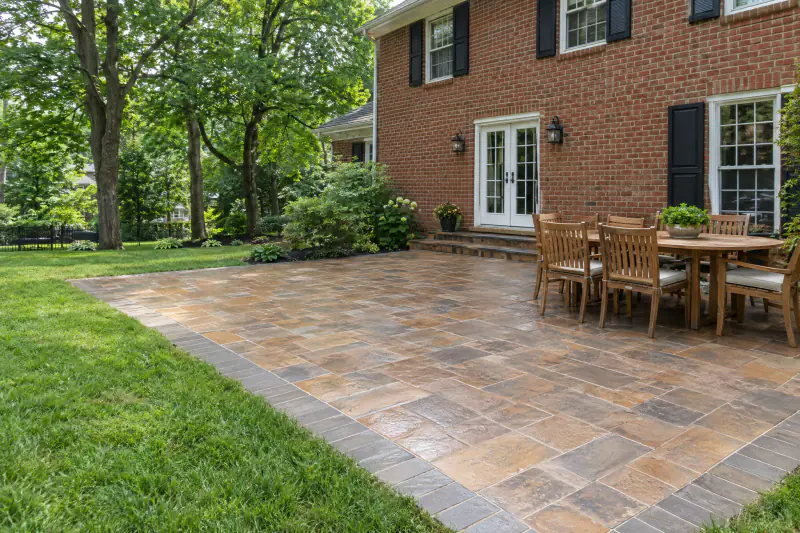
| Concrete pavers | Moderate | Surface cleaner at reduced pressure, wand angled across the joints | Joint sand blasted out, pavers shift at the edges |
| Flagstone and natural stone | Carefully | Test spot first, low to moderate pressure, cleaner does the work | Layered stone flakes, mortar between stones breaks out |
| Brick walls and steps | Low only | Soft wash mix, gentle rinse, pressure kept off the joints | Soft mortar erodes, faces of old brick spall |
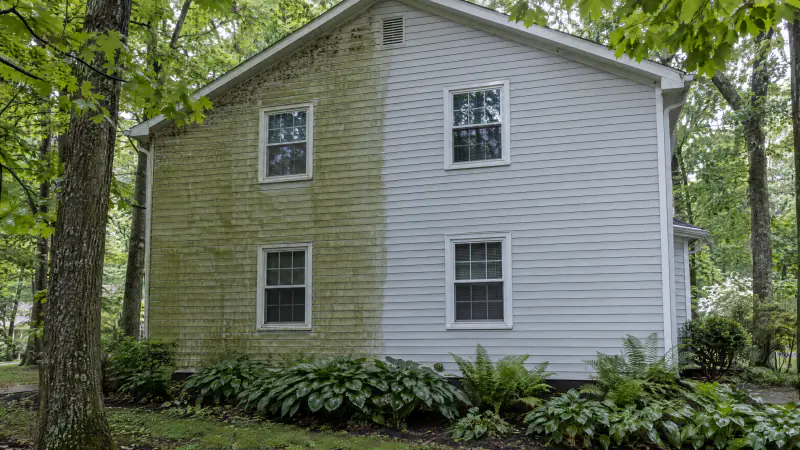
| Vinyl, aluminum and fiber cement siding | Never at high pressure | Soft wash from the ground, rinsed top down | Water behind the laps, streaked oxidation, broken J-channel |
| Wood decks and fences | Never at high pressure | Wood cleaner, low pressure along the grain, brightener | Fuzzy raised grain, gouges, wand marks under the stain |
| Asphalt shingle roofs | Never | Low-pressure roof soft wash only | Protective granules stripped, shingle life shortened |
| Windows and door glass | Never directly | Rinsed gently with the house wash | Insulated glass seals fail and fog, water behind frames |
| Asphalt driveways | Never | Cleaner and a garden-hose rinse | Binder loosens, aggregate washes out, surface ravels |
Every surface gets a test area first. Age and condition change the answer more than the material does.
What should you never pressure wash, and why?
Five things on a typical Northern Virginia home should never see high pressure, and each fails in its own way. Vinyl siding is designed to shed rain falling downward. A pressure washer aimed up from the ground drives water behind the laps, into the housewrap and sometimes into the sheathing, where it stays. On older vinyl that has chalked, pressure also cuts clean streaks into the oxidation that cannot be undone. Siding is a soft washing job, full stop.
Wood decking is the second. Pressure-treated pine and cedar are soft, and a close wand tears the spring growth out of the grain, leaving a fuzzy surface and dark wand marks that show straight through any stain applied afterward. Asphalt shingles are the third. The colored granules on a shingle are its sun protection, and pressure washes them into the gutters by the pound. Shingle manufacturers warn against it directly, so check your roof maker's care guidance before anyone puts a wand near the roof.
Mortar joints are the fourth, and this one catches people in older neighborhoods. Brick laid before the middle of the last century in parts of Alexandria, Arlington and Falls Church often sits in soft lime mortar that a pressure washer carves out in seconds, and repointing costs far more than cleaning saved. The fifth is window glass and the seals around it. Pressure at the edge of an insulated glass unit can break the seal, and the window fogs permanently between the panes. Add electrical outlets, light fixtures, air conditioner condenser fins, dryer and soffit vents, and any painted surface on a home built before 1978 where the paint may contain lead. Our pressure washing vs. soft washing guide sorts the whole house by method if you want the short version.
How much pressure and which nozzle should be used on concrete?
Sound, broom-finished concrete is commonly cleaned somewhere around 2,500 to 3,000 psi with a surface cleaner, and that figure matters less than people think. Pressure at the machine is not pressure at the slab. Distance, nozzle angle and flow all change what the surface feels. A homeowner-grade machine rated at 2,000 psi with a narrow tip held two inches off the concrete will etch it. A professional machine rated far higher, running a wide tip under a surface cleaner at the right height, will not.
Nozzles are color coded by spray angle. The red zero-degree tip is a cutting tool and has no place on any surface around a house. Yellow is 15 degrees and is used sparingly for stubborn spots on concrete only. Green at 25 degrees and white at 40 degrees do most general rinsing, and the black low-pressure tip is for applying cleaner. Under a surface cleaner the nozzles are usually 25-degree tips set at a fixed height, which is the whole point of the tool.
Flow, measured in gallons per minute, does more of the actual cleaning than pressure does. More water carries more loosened dirt off the slab, which is why professional machines are built around flow and why a driveway rinsed with a low-flow machine looks clean while wet and blotchy once dry. Concrete that is new, flaking from past de-icing salt, or showing exposed aggregate gets less pressure, a wider tip and more reliance on the cleaner. The same machine, run differently, is how one crew handles every surface listed in the table above.
Surface cleaner or wand: why does the tool matter more than the machine?
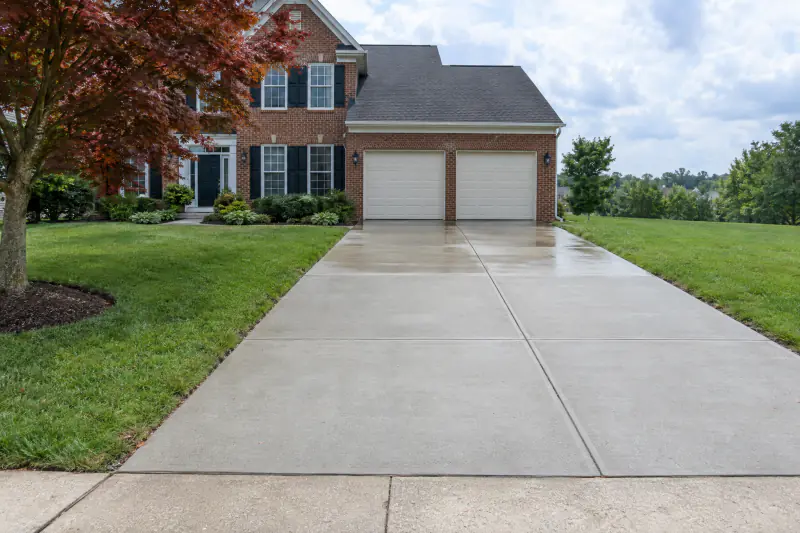
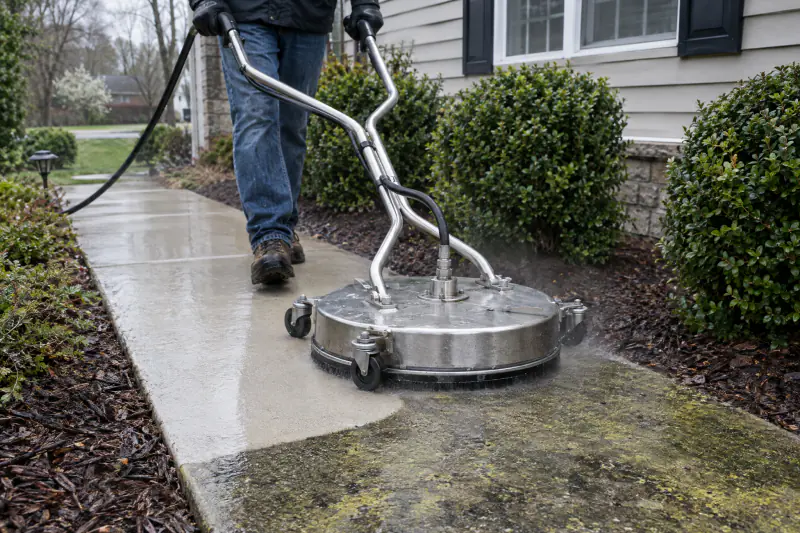
Because the tool decides whether the driveway looks evenly clean or like a zebra. A surface cleaner is a flat hood, usually 16 to 24 inches across, with a spinning bar underneath that carries two or more nozzles. The hood keeps the nozzles at one constant height and the bar spins them hundreds of times a minute, so every square inch of concrete receives the same pressure from the same distance. Pushed in overlapping passes, it leaves no start and stop marks, no arcs, and no lines where the operator's arm got tired.
A wand is a single nozzle at the end of a human arm, and arms change height and angle constantly. Each sweep cleans a stripe that is brightest in the middle and fades at the edges, and the next sweep never overlaps the last one exactly. The result is the familiar pattern of pale and dark curves that shows up a week later once the slab dries completely. Wand marks on concrete are permanent in the sense that only another full cleaning evens them out, and on stamped concrete they can be permanent in the real sense if the tip was close enough to cut the sealer.
The wand still has a job. Steps, risers, the edges against the garage slab, the strip beside a planting bed and tight corners under a railing all need a wand at reduced pressure and a wide tip. Done well, the wand work finishes what the surface cleaner cannot reach and matches it in color. The order matters too: pre-treat, surface clean, detail the edges, rinse the whole slab toward the lawn, then post-treat. A crew that arrives with only a wand for a two-car driveway is telling you how the driveway will look.
How do you remove rust, oil and red clay stains from concrete?
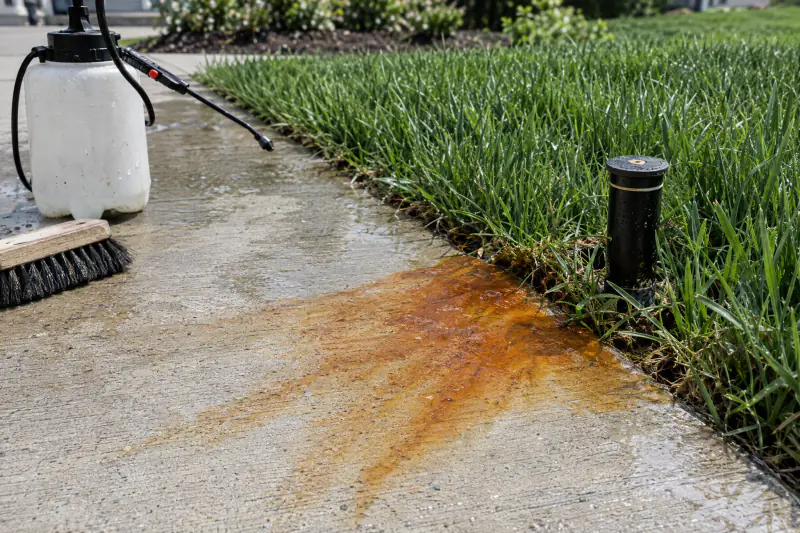
Each one is a different chemistry, and pressure alone treats none of them. Rust is the orange fan that spreads from a sprinkler head, a metal chair leg, a planter or a spilled handful of lawn fertilizer with iron in it. It is iron oxide bonded into the top layer of the concrete. An acid-based rust remover, often built around oxalic acid or a similar compound, dissolves the bond so the stain can be rinsed. Chlorine bleach, the base of most algae treatments, does not remove rust and can darken it, so rust spots are treated separately before the general wash. Irrigation water drawn from wells in western Loudoun and parts of Prince William often carries enough iron to stain a walk a little more every season.
Oil is the opposite. It is a grease stain and needs a degreaser, hot water where available, and time. Fresh drips from a car respond well. Oil that has soaked into a driveway over years leaves a shadow that lightens with each treatment but rarely vanishes, and a poultice that draws the oil up over a day or two does more than any amount of pressure. Tire marks and the black ring under a grill are the same family.
Red clay is Northern Virginia's own stain. Subsoil tracked onto concrete from a new lawn, a construction lot or a bare slope leaves an orange tint that looks like rust because, in part, it is: the color comes from iron in the clay. It responds to the same acid-based cleaners, applied carefully and rinsed well. Leaf and acorn tannin stains, the brown shadows under where a pile sat over winter, are organic and lift with the oxidizing cleaner used for algae. The black specks that look like flicked tar are artillery fungus from mulch, and no cleaner removes them fully. Knowing which stain is which before the machine starts is most of the job.
What does a proper driveway and walkway wash look like, step by step?
The machine runs for less than half the visit. The rest is preparation, chemistry and rinsing.
Walk the surfaces and pick the method
We identify each material, note cracks, flaking, old sealer and every stain, locate the spigot and look at where the rinse water will run. Anything that should not take pressure is marked for a soft wash or left alone.
Protect what is nearby
Vehicles leave the driveway, doormats and planters move, outlets and low-voltage lights are covered or avoided, garage and basement door thresholds are checked, and the beds and lawn along the edges are soaked with water.
Treat the stains first
Rust, clay, oil and tannin spots each get their own cleaner and their own dwell time while the rest of the slab is being prepared, so the general wash does not spread them.
Pre-treat the whole slab
A cleaning solution goes on the concrete and sits for several minutes without drying. This is what kills the algae and mildew. The machine only removes what is already dead.
Surface clean, then detail
Overlapping passes with the surface cleaner cover the open slab. Edges, steps, risers and corners are finished with a wand at reduced pressure and a wide tip so the color matches.
Rinse, post-treat and check dry
Loosened dirt is rinsed off the slab toward the lawn, a light post-treatment goes on to kill what remains, plants are rinsed again, and the concrete is checked as it dries for missed spots.
Can you pressure wash a wood deck, a fence or a composite deck?
Only in the loosest sense of the words. Wood is cleaned with a wood cleaner, a rinse at low pressure with a wide tip held well off the boards and moved with the grain, and then a brightener. The machine supplies a controlled rinse, not force. Any crew that cleans your driveway and then turns the same setup on the deck is about to raise the grain on every board. If you are planning to stain this year, the cleaning is step one of a longer sequence that needs dry wood, and we cover the whole timeline in our guide to deck cleaning and staining in Northern Virginia humidity. The service itself is described on our deck and fence cleaning and staining page.
Fences follow the same rule, with one practical difference: vertical boards shed water and gray more slowly than deck floors, so a fence often needs a gentler wash and less frequent staining. Picket and privacy fences along a street collect the most pollen and the most road grime, and both come off with the cleaner, not the pressure.
Composite and PVC decking is a different material and a different risk. The outer cap on capped composite boards can be scuffed or dulled by a close, narrow spray, and the board manufacturers publish care instructions that usually come down to a suitable cleaner, a soft brush and a low-pressure rinse. Composite is never stained or sealed. It is cleaned, and pollen film, grill grease and the mildew that grows in the texture of the boards all come off that way. If the deck has gone gray and splintery underneath the dirt, cleaning will not bring it back, and the real question becomes repair or replacement.
Should you seal concrete or pavers after pressure washing?
For plain concrete, sealing is optional but worthwhile where salt and freeze-thaw have already started to flake the surface. A penetrating sealer, typically a silane or siloxane product, soaks into the top of the slab and reduces how much water and dissolved de-icing salt it absorbs, without leaving a film that can peel or turn slick. It goes on clean, fully dry concrete, which in May means a day or two after the wash, with surface temperatures above about 50 degrees and no rain in the forecast for a day. Film-forming acrylic sealers give a darker, wet look and are more common on stamped and colored concrete, where they also protect the color. Check the product's temperature and dry-time guidance, because it varies.
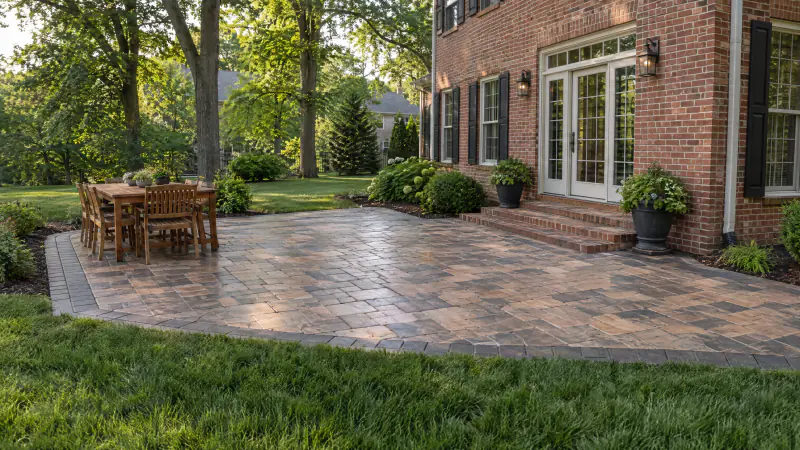
For pavers, washing is only the first half of the job. A surface cleaner at moderate pressure will take out failed joint sand along with the algae, and that is intentional, because the joints have to be refilled with polymeric sand before any sealer goes down. Sealing pavers with empty or dirty joints locks in the problem. The full sequence of cleaning, treating efflorescence, drying, re-sanding and sealing is its own project, described on our paver cleaning and sealing page and in detail in our paver cleaning and sealing guide.
Two cautions apply to both. Never seal a surface that is still damp, because trapped moisture turns many sealers cloudy white. And never seal over efflorescence, the white mineral haze that rises out of concrete and pavers, because it will keep rising underneath the sealer. If a slab or patio shows that haze after washing, it needs a dedicated efflorescence cleaner and another dry period first.
What is the spring exterior cleaning checklist for a Northern Virginia home?
Work through it in this order once the pollen stops, roughly the first two weeks of May.
- Confirm the pollen is finished: two rains with no new yellow ring on the driveway.
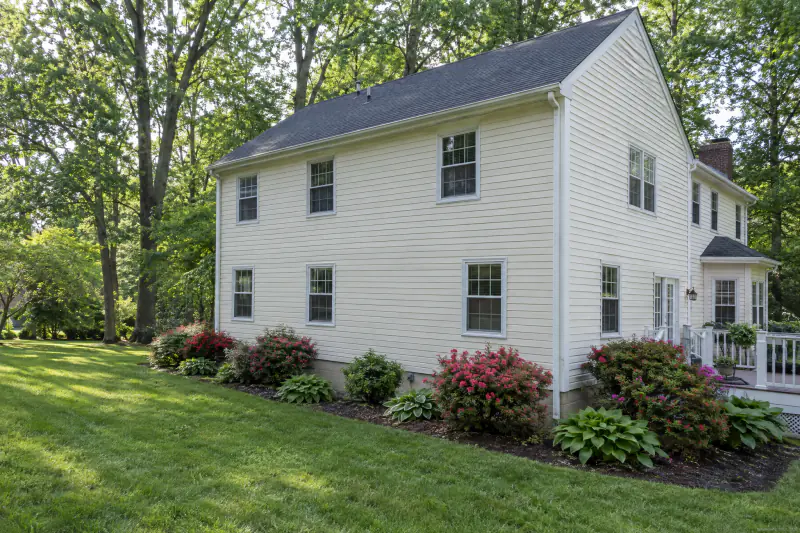
- Soft wash the siding, trim, soffits and gutter faces first so runoff lands on uncleaned flatwork.
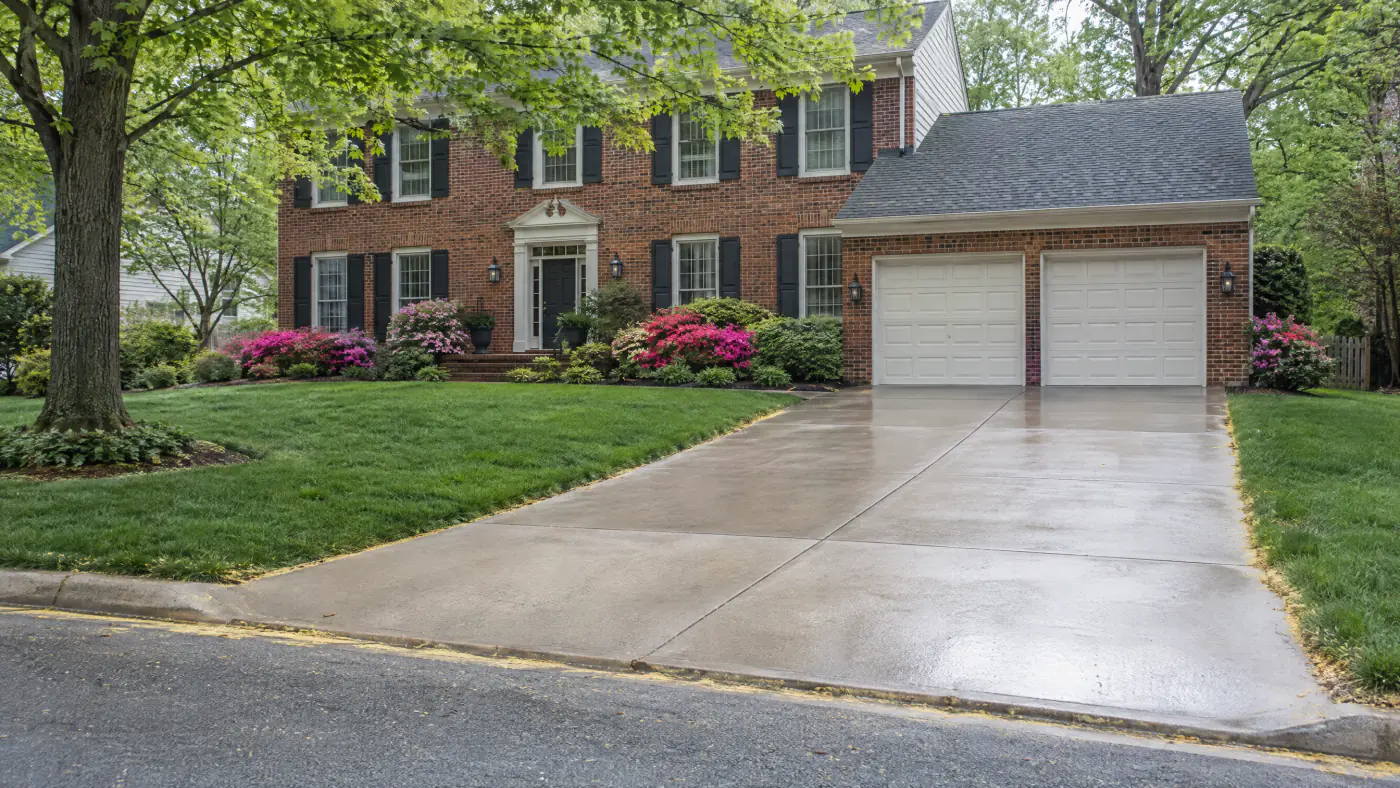
- Pressure wash the driveway, front walk, stoop and steps with a surface cleaner and pre-treatment.
- Treat rust, oil, clay and tannin stains individually before the general wash.
- Clean the concrete or stone patio and pool deck, keeping pressure off mortar and flagstone edges.
- Clean pavers at moderate pressure and schedule re-sanding and sealing once they are dry.
- Wash the wood deck and fence with a cleaner at low pressure and let them dry for staining.
- Rinse plants and lawn edges again after every cleaner, and keep wash water out of the storm drain.
- Photograph any flaking concrete, settled pavers or rotted boards the cleaning revealed for repair planning.
Where does the wash water go, and why does it matter here?
Into the nearest storm drain, and from there into a stream, untreated. Storm sewers in Fairfax, Loudoun, Prince William and Arlington are separate from the sanitary sewer that serves the house, and they discharge to local creeks that feed the Potomac River and the Chesapeake Bay. Fairfax County's stormwater program, like the others in the region, treats anything other than rain entering those drains as an illicit discharge, and the Environmental Protection Agency's guidance on nonpoint source pollution describes runoff from driveways and other paved household surfaces as a source. Degreaser, bleach solution and the sediment off a driveway all count.
The practical fix is simple and part of how we work. Rinse water is directed onto the lawn and planting beds where the soil filters it, not down the apron to the curb. Cleaners are used at the mildest strength that works and given time to break down. Oil-stain treatment is done with absorbents and a poultice where possible so the oil is picked up, not flushed. On a sloped driveway in a townhome community in Reston or Centreville, where the only low point is the street, we use less water, work in sections and catch what we can at the curb.
Wash water also tells you something about the property. If it pools against the garage slab, runs toward a basement window well or sits in the same low spot for an hour, the concrete has a drainage problem that no cleaning will fix, and the algae will be back in that spot first. A yard drainage solution or a downspout discharge line addresses the cause, and the wash lasts longer for it.
How much does pressure washing cost in Northern Virginia in 2026?
As of 2026, typical Northern Virginia market planning ranges run about $150 to $400 to pressure wash a two-car concrete driveway, and roughly $300 to $800 when the front walk, stoop, steps and a concrete patio are added in the same visit. A large pool deck or a long three-car driveway can push past that. Stain treatment is often priced on top: a handful of rust or oil spots might add a modest amount, while a driveway covered in red clay or old oil can add considerably more. These are market ranges, not myYardPros prices, and they are deliberately wide.
What moves the number is square footage first, then how heavy the growth is, then stains, then access. A shaded north-side walk that has gone black takes more pre-treatment and more time than a sunny driveway that is merely dusty. Steep driveways, many steps, long hose runs from the only spigot and tight pool enclosures all slow the work. Bundling the flatwork with a soft wash of the house in one visit is usually less than two separate trips, because the setup, plant protection and rinsing happen once. Sealing concrete afterward is a separate line, as is paver re-sanding and sealing.
We measure the surfaces, look at the stains and check the drainage before we put a number on paper. For a figure on your home, request a written on-site estimate or call (571) 200-9600. Our cost guide lists the ranges for related work such as paver sealing and deck staining if you are planning the whole spring at once.
What is different about pressure washing in Fairfax, Loudoun, Prince William and Arlington?
The dirt is different from one neighborhood to the next, and so is the concrete under it. In newer subdivisions in Ashburn, South Riding, Gainesville and Bristow the topsoil was stripped during construction, and the red clay subsoil that remains tracks onto every driveway and walk as an orange stain that needs an acid-based cleaner. In the older, heavily treed neighborhoods of Burke, Springfield, Annandale, Vienna and Oakton the problem is shade. Mature oaks and maples keep the north side of a slab damp from April to November, and those walks go black rather than yellow. Reston, Herndon, Sterling and Centreville townhome communities often share long runs of concrete with a single low point, which shapes where wash water can go.
Closer in, Arlington, Alexandria and Falls Church have more brick walks, brick stoops and older mortar, and the city of Manassas has its share of both. There the job is as much about what we keep the pressure off as what we clean. Older concrete anywhere in the region that has seen decades of de-icing salt tends to flake at the surface, and it gets a wider tip and a lighter touch. Homeowners associations across Fairfax and Loudoun counties send spring inspection notices about green siding and dark driveways, and a May wash usually resolves them in one visit. No permit is needed for exterior cleaning anywhere in our area.
We pressure wash driveways, walks, patios and pool decks for homes across Fairfax, Loudoun, Prince William and Arlington counties and the cities of Alexandria, Fairfax, Falls Church, Manassas and Manassas Park. The full list of communities is on our service areas page. If you are not sure whether your siding or roof should be part of the same visit, our guide to removing green streaks from siding and roofs explains how the house itself is handled.
Frequently asked questions
Can you pressure wash during pollen season instead of waiting?
You can, but the result lasts only until the next windy day. From mid-April to early May, oak and pine pollen settle on a clean driveway within hours and glue down with the next rain. If a sale, a party or an HOA deadline forces an April wash, plan on a quick rinse in May. Otherwise, waiting two or three weeks buys a result that lasts the season.
Does pollen damage concrete, pavers or siding if it is left?
Not directly. Pollen is inert on a dry surface and rinses off with rain. The harm comes indirectly: wet pollen feeds the algae and mildew already living in porous concrete, paver joints and siding texture, so a pollen-coated surface greens faster through summer. Clearing it in May, with a cleaner that kills the growth underneath, is what keeps the surface light into fall.
How long after pressure washing can concrete be sealed?
Usually one to two days of dry weather, longer in shade or after heavy rain. The concrete must be dry through its top layer, not just on the surface, or the sealer traps moisture and turns cloudy. Most sealers also want surface temperatures above about 50 degrees and no rain for roughly 24 hours after application. Check the product's own guidance, since cure times vary.
Will pressure washing remove the black specks that look like tar on my siding and car?
Usually not. Those specks are artillery fungus, which grows in wood mulch and fires sticky spore masses several feet onto nearby light-colored surfaces. They bond hard and resist both pressure and most cleaners. Some lighten with careful hand work while fresh. The lasting fix is replacing wood mulch near the house with stone, bark nuggets or another material the fungus does not colonize.
How much water does a pressure washing visit use?
Professional machines commonly run about 4 to 8 gallons per minute, so a two to three hour visit for a driveway, walk and patio can use several hundred gallons. That is comparable to a few loads of laundry and a long shower each day for a week. The water comes from your outdoor spigot, so make sure it is turned on and the hose bib is not leaking before the visit.
Can a brick house or brick walkway be pressure washed?
Brick faces can take moderate pressure, but the mortar between them often cannot, especially on homes built before the middle of the last century where soft lime mortar is common. We treat brick as a soft wash surface: a cleaning solution for the algae, a longer dwell, and a gentle rinse that stays off the joints. White mineral deposits on brick are a separate issue needing a different cleaner.
Will pressure washing make my pool deck or front steps less slippery?
Yes, when the growth is actually killed rather than rinsed. The slick film on a shaded pool deck or north-facing step is algae living in the pores of the concrete. A pre-treatment and post-treatment remove it and slow its return, and the surface stays grippy for a season or more. Water alone leaves the roots, and the slickness comes back within weeks in humid weather.
Book the work
Put the plan in writing with a crew that builds this every week.
One visit to measure and talk through options, then a written scope and price. No pressure, no vague numbers. Ask about the Heroes Discount if you serve.
Sources and further reading
- U.S. Environmental Protection Agency: nonpoint source pollution and household sources
- Fairfax County Department of Public Works and Environmental Services: stormwater management
- Virginia Cooperative Extension publications on home grounds and landscape care
- Asphalt Roofing Manufacturers Association: algae discoloration and cleaning of asphalt shingle roofs
- NOAA National Centers for Environmental Information: U.S. Climate Normals
Published April 9, 2026. Reviewed and updated October 9, 2026.