Key takeaways
- Green film on siding is algae, black roof streaks are the cyanobacterium Gloeocapsa magma, and black speckling near trim is mildew. All are alive, and all are killed by solution, not force.
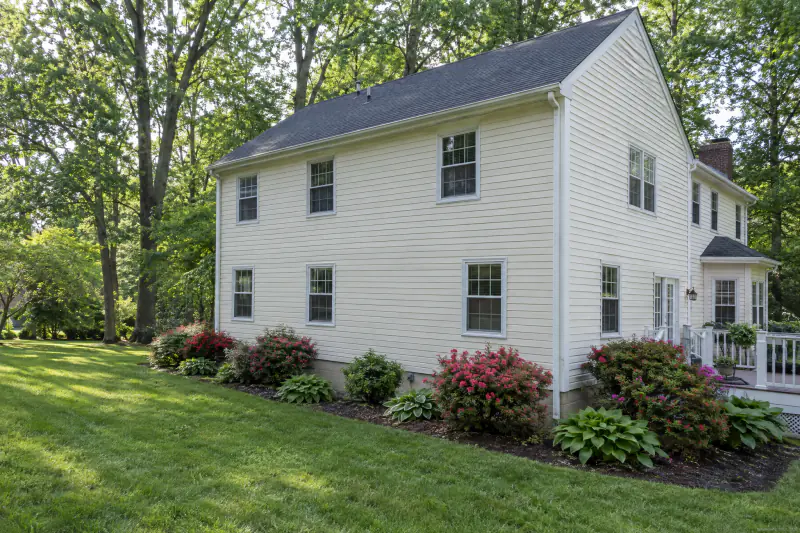
- North-facing walls and roofs under oaks in Reston, Burke and Springfield grow them fastest because they stay damp longest and get the least ultraviolet light.
- A soft wash is a diluted sodium hypochlorite solution with a surfactant, applied at low pressure, left to work for several minutes and rinsed. Plants are soaked before and after.
- Roofs are never pressure washed. Shingle manufacturers publish low-pressure cleaning guidance, and following it keeps the granules on the roof.
- As of 2026, typical Northern Virginia market ranges are about $350 to $900 for a house wash and $500 to $1,500 or more for a roof. Siding stays clean one to two years.
On this page
- Soft washing or pressure washing: which one removes green streaks from siding and roofs?
- What are the green and black streaks actually made of?
- How do you tell algae, mildew, lichen and moss apart?
- Why do north-facing and tree-shaded walls in Reston, Burke and Springfield grow them fastest?
- What is in a soft wash solution, and how does it work?
- How are plants, pets and the property protected during a soft wash?
- How is a roof washed without ignoring the shingle manufacturer's guidance?
- How long does a soft wash last on siding and on a roof?
- What should you check before booking a soft wash?
- How much does soft washing cost in Northern Virginia in 2026?
- Where in Fairfax, Loudoun, Prince William and Arlington do streaks grow fastest?
- Can you soft wash your own house?
- Frequently asked questions
Soft washing or pressure washing: which one removes green streaks from siding and roofs?
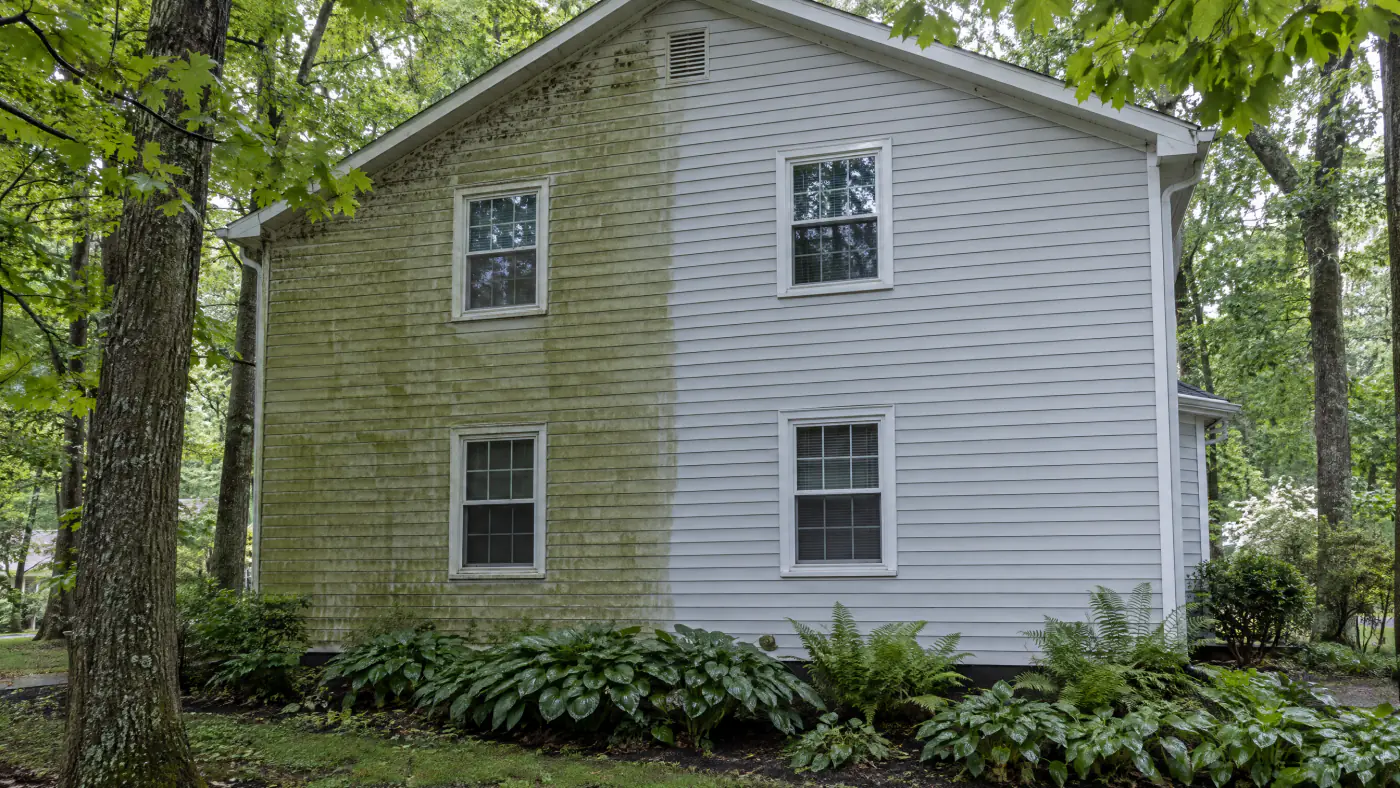
Soft washing, and it is not close. The green on your siding and the black streaks on your roof are living organisms rooted in the texture of the surface, and a pressure washer removes the part you can see while leaving the part that grows back. A soft wash puts a diluted cleaning solution on the surface, lets it kill the growth where it lives, and rinses the residue away at roughly garden-hose pressure. The wall is cleaner the same day and stays clean far longer, because nothing is left alive in the pores.
Pressure washing is the right tool for a different problem. Hard, dense flatwork such as a concrete driveway can take thousands of psi and benefits from it. Siding, stucco, painted trim and asphalt shingles cannot. We cover the flatwork side of that line in our guide to pressure washing after pollen season, and our comparison of pressure washing vs. soft washing sorts the whole property by method. This article goes deeper into the house itself: what the growth is, why some Northern Virginia homes get it so much faster than others, and how a soft wash is actually done.
One idea runs through all of it. Every streak and film on a house is a biology problem with a moisture cause. Treat the biology with the right chemistry and the surface comes clean. Understand the moisture and you can slow it coming back.
What are the green and black streaks actually made of?
Four different organisms, and it helps to know which one you are looking at. The green film on siding, fences and shaded brick is algae, a simple plant-like growth that needs only moisture, a little light and the dust and pollen that collect on any outdoor surface. It spreads as a thin, even sheet and feels slightly slick when wet. It is harmless to vinyl and fiber cement in the short term but holds moisture against the wall and against paint, and on a stoop or step it is a slip hazard.
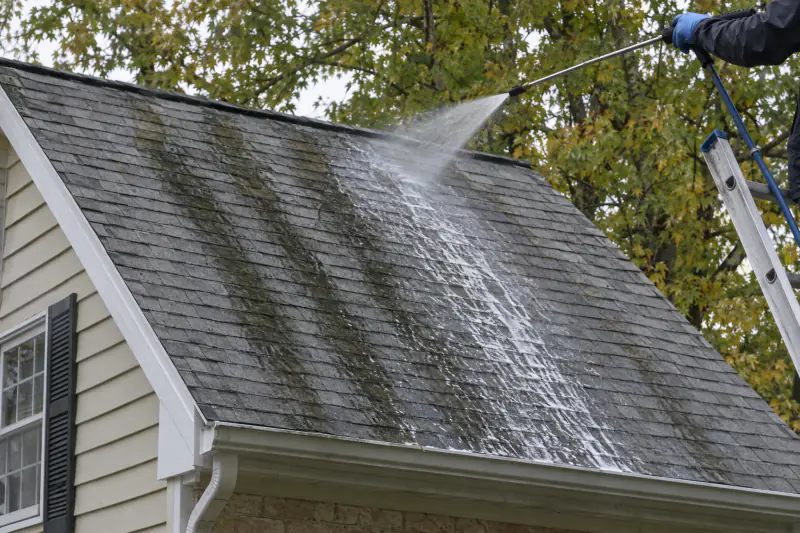
The dark streaks that run down the slope of an asphalt shingle roof are usually a cyanobacterium commonly identified as Gloeocapsa magma. It builds a dark outer sheath to protect itself from ultraviolet light, which is why the streaks are black rather than green, and it is commonly described as feeding in part on the limestone filler in the shingles themselves. It spreads downhill with every rain, so the streaks start near the ridge or below a tree and widen toward the gutter. It is rarely a structural problem on its own, but the dark surface absorbs more heat and it keeps shingles damp longer.
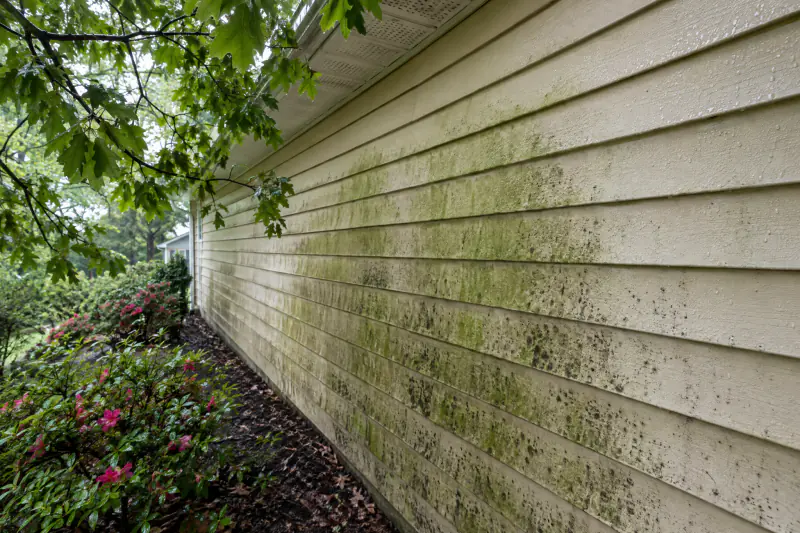
Mildew is a fungus. It shows up as black or gray speckling under soffits, around window frames, behind downspouts and on the shaded side of painted trim, anywhere water lingers and air does not move. The Centers for Disease Control and Prevention and the Environmental Protection Agency both describe outdoor mold and mildew growth as a sign of a persistent moisture source, and that is the useful way to read it on a house. Lichen is the last one: a partnership of a fungus and an alga that forms pale green, gray or orange crusty patches on shingles and north-facing masonry. It anchors itself with root-like structures that pull granules and surface grains with them if the lichen is scraped off by force. Moss sometimes joins it on the shadiest roofs, holding water like a sponge and lifting shingle edges as it thickens.
How do you tell algae, mildew, lichen and moss apart?
Where it grows and how it looks usually gives the answer before any testing.
| Growth | Where it shows on a home | What it looks like | How a soft wash handles it | Typical return |
|---|---|---|---|---|
| Green algae | Shaded siding, fences, brick, stoops, north-side anything | Thin green or gray-green film, slick when wet | Mild solution, short dwell, gentle rinse, gone same day | One to two years on siding |
| Gloeocapsa magma | Asphalt shingle roofs, worst on north and tree-shaded slopes | Black vertical streaks widening downslope | Stronger roof solution, no pressure, clears as it works | Often several years after treatment |
| Mildew | Under soffits, around frames, behind downspouts, painted trim | Black or gray speckles and blotches in sheltered spots | Solution and dwell, rinsed with the house wash | Returns where the moisture source remains |
| Lichen | Shingles, north-facing masonry, stone caps and chimneys | Crusty pale green, gray or orange patches | Treated, then left to die and weather off over weeks | Slow, often years, if the surface stays treated |
| Moss | Deep-shade roof slopes, stone steps, damp brick | Soft green cushions that hold water | Treated and never scraped, loosens over weeks to months | Returns in heavy shade unless trimmed back |
Chalky white residue on old vinyl or aluminum is oxidation of the siding itself, not growth, and washing does not remove it.
Why do north-facing and tree-shaded walls in Reston, Burke and Springfield grow them fastest?
Because they stay wet longest and get the least ultraviolet light, and those two conditions are what algae and cyanobacteria want. A wall facing south in Northern Virginia dries within an hour or two of sunrise most mornings. A wall facing north under a mature oak canopy can stay damp until noon, collect dew again by evening and never see direct sun at all. Growth that needs moisture for a few hours a day on a sunny wall gets it around the clock on a shaded one.
Tree cover adds more than shade. Oaks, maples and tulip poplars drip for hours after a rain, shed pollen in April, and drop a fine organic dust all season that settles into siding texture and shingle granules as food. Branches that overhang a roof slope also keep air from moving across it, so the surface dries even more slowly. That is why the worst roof streaks on a street are almost always on the house with the biggest tree, on the slope under it.
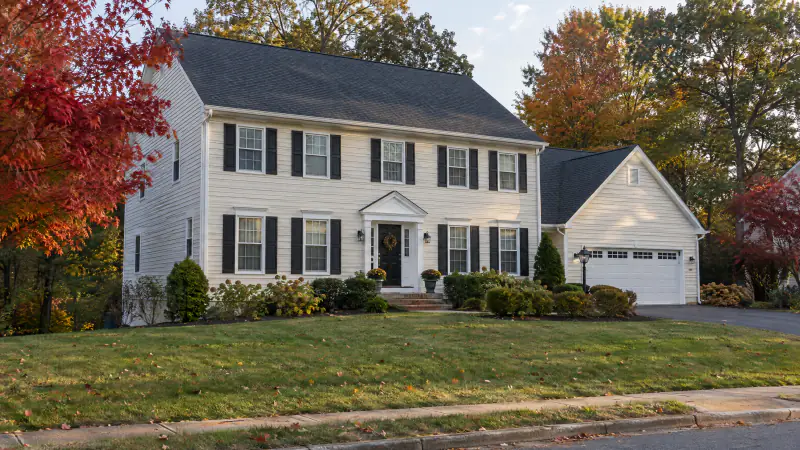
The neighborhoods we named are not an accident. Reston was planned around wooded common land, and much of it was built in the 1960s and 1970s, so the trees are now large and the houses sit among them. Burke, Springfield, Annandale and West Springfield were built in the same decades on lots that kept their oaks, and forty-year-old trees now shade walls that were sunny when the siding went on. Great Falls, Clifton and Oakton add larger wooded lots. Newer subdivisions in Ashburn, South Riding and Bristow still have small trees and sunny walls, and their siding takes longer to turn, though their north walls are catching up. Wherever you live, the siding on the shady side of a Northern Virginia home is competing with a humid climate and a maturing canopy, and it needs help about every one to two years to win.
What is in a soft wash solution, and how does it work?
The working ingredient is sodium hypochlorite, the same active compound as household bleach, diluted with water and blended with a surfactant. The hypochlorite does the killing. It oxidizes the cell walls of algae, cyanobacteria, mildew and lichen on contact and keeps working for several minutes afterward. The surfactant is a soap-like agent that makes the solution cling to a vertical wall or a sloped roof instead of running straight off, spreads it evenly over the surface, and helps the dead growth and dirt rinse away cleanly. Some blends add a scent to mask the bleach smell. None of it is exotic, and the skill is in the strength, the dwell and the rinse rather than the recipe.
Strength changes with the surface. A house-wash mix for vinyl, fiber cement or painted siding is mild, commonly around one percent hypochlorite at the wall, which is strong enough to kill algae in a few minutes and weak enough to be rinsed off plants without harm. A roof mix is several times stronger because the cyanobacteria and lichen on shingles are tougher and the solution has to work on a dark, textured surface. Stucco and synthetic stucco get the lightest application and the gentlest rinse. We adjust by what we see, and we test a small area first on anything unusual.
Dwell is the time the solution sits on the surface working, typically five to fifteen minutes, and the rule is that it must never dry on the wall. Drying leaves residue and can spot glass or dull metal, so on a hot or breezy afternoon the wall is misted to keep it wet. The rinse that follows is low pressure and thorough, from the top of the wall down, including windows, doors, light fixtures and the gutter faces. Hypochlorite breaks down fairly quickly in sunlight and in contact with organic matter, which is part of why a well-rinsed house wash leaves little behind. Our exterior cleaning page summarizes how we match chemistry to each surface across the whole property.
How are plants, pets and the property protected during a soft wash?
Most of the care in a soft wash is spent on what is not being washed.
Walk the landscaping first
We note vegetable beds, fish ponds, young plantings, delicate perennials and anything the homeowner is attached to, then plan where solution and rinse water will travel and where runoff from gutters and downspouts will land.
Soak before anything goes on
Shrubs, groundcover, lawn edges and the soil beneath them are saturated with plain water. A plant full of water takes up very little of what lands on its leaves, and wet soil dilutes anything that reaches the roots.
Cover or divert where it matters
Sensitive plants directly under the work are covered briefly. Downspouts that discharge into beds are redirected or bagged during a roof wash so concentrated runoff does not pour onto one spot.
Keep the mix as mild as the surface allows
Siding gets the weakest solution that still kills the growth. Stronger roof mixes are applied only where needed and in a controlled fan, not sprayed into the air.
Rinse the plants as much as the house
During the work, plants near the wall are misted repeatedly. Afterward, everything within reach of overspray or runoff gets a long, heavy rinse to dilute whatever landed.
Pets and people stay inside until it dries
Windows are closed, pets are kept indoors, and furniture, grills and cushions are moved or covered. Surfaces are safe to use once rinsed and drying, usually within an hour or two.
How is a roof washed without ignoring the shingle manufacturer's guidance?
By following it. The Asphalt Roofing Manufacturers Association publishes cleaning guidance for algae on asphalt shingles, and the major shingle makers publish similar care guidance. The method it describes is a household bleach solution gently applied to the roof, left to sit for about 15 to 20 minutes, and rinsed gently with water, with explicit warnings against power washing and against scrubbing or brushing. That is a soft wash. Check your own roof's manufacturer guidance, because the specifics and any coverage conditions vary by product, and keep the paperwork if the roof is newer.
In practice the work looks like this. The gutters and downspouts are checked so we know where runoff will go, and downspouts that discharge into planting beds are diverted or bagged for the duration. The solution is applied in a fan from a ladder or the roof edge, working across the slope so the mix flows down with gravity rather than being pushed. Foot traffic on the shingles is kept to the minimum needed, and never on a hot afternoon when the asphalt is soft. The streaks begin fading within minutes and most are gone by the time the roof dries. Nothing is scrubbed. The roof is rinsed lightly where needed and the gutters are flushed so concentrated solution does not sit in them.
Lichen and moss are the exception to the same-day result. They die when treated, but they are physically attached, and prying them off takes granules with them. They dry, turn pale and loosen over the following weeks, and rain and wind carry them off over a month or two. A second light treatment later in the season sometimes helps on a heavily colonized slope. Two things slow regrowth afterward: trimming branches back so the slope gets sun and air, and the copper or zinc content in algae-resistant shingles or in a metal strip along the ridge, which washes down the slope in trace amounts with each rain. Neither replaces washing, but both stretch the interval.
How long does a soft wash last on siding and on a roof?
Siding typically stays clean for one to two years in Northern Virginia, and a treated roof often stays streak-free for several years. The difference comes from the organisms. Algae on siding recolonizes from airborne spores and from the pollen and dust that settle every spring, so even a perfectly rinsed wall starts over from the environment around it. The cyanobacteria on a roof are slower to establish, and the stronger roof mix leaves the surface hostile to them for longer.
Within those ranges, three things move the interval. Shade is the first and biggest. A north wall under an oak might need attention every spring while the south wall of the same house goes three years. Moisture sources are the second: a downspout that splashes the wall, a sprinkler head that wets the siding every morning, a leaking gutter seam or a window air conditioner dripping onto a stoop will regrow a green patch in a single summer regardless of how well the wall was washed. Fixing those, often with a downspout discharge line or a sprinkler adjustment, is the cheapest way to extend a wash. The third is the quality of the wash itself. Growth that was killed and rinsed comes back slowly. Growth that was merely knocked off with water comes back within months.
The practical schedule most homes settle into is a full house wash every one to two years, timed right after pollen in May or in early fall, with the roof treated every few years as streaks reappear. We do not sell recurring plans, so each visit is scheduled when the house needs it, and the north wall is the gauge.
What should you check before booking a soft wash?
Ten minutes around the house tells you what to mention when you call.
- Walk the north side and note where green film starts and how high it reaches.
- Look up at the soffits and around window frames for black mildew speckling.
- Stand across the street and look for dark streaks on the roof slopes, especially under trees.
- Check for loose siding panels, open seams, failed caulk or peeling paint that water could enter.
- Note any sprinkler heads, downspouts or leaking gutters that wet the siding regularly.
- Identify vegetable gardens, ponds, new plantings and anything else that needs extra protection.
- Confirm the outdoor spigot works and that gates, vehicles and furniture can be moved.
- Read any HOA notice closely so the wash covers everything it asks for in one visit.
How much does soft washing cost in Northern Virginia in 2026?
As of 2026, a soft-wash house wash on a typical single-family home in Northern Virginia falls in a market planning range of about $350 to $900, and a roof soft wash commonly runs $500 to $1,500 or more. Large homes, three-story rear elevations on walkout lots and steep or complex roofs sit at the top of those ranges or above them. Townhomes with two exposed walls usually sit below. These are typical market figures, not myYardPros prices, and they are intentionally wide.
The factors that move the number are square footage of wall and roof, the number of stories and whether the rear of the house drops to a walkout basement, roof pitch and safe access, how heavy the growth is and whether lichen or moss needs a stronger treatment and a follow-up, how much landscaping sits against the house and has to be protected, and the surface itself. Stucco, synthetic stucco and chalky old siding are washed more slowly. Gutter faces with black tiger stripes need a separate cleaner and hand work, which is often an add-on. Washing the house and the flatwork in the same visit is usually less than two trips, because setup and plant protection happen once.
Every quote we write follows a site visit, because the north wall and the roof slope under the trees decide the work. Request a written on-site estimate or call (571) 200-9600, and see our cost guide for the ranges on related cleaning and sealing work.
Where in Fairfax, Loudoun, Prince William and Arlington do streaks grow fastest?
Anywhere the canopy closed over the house. In Fairfax County that means Reston, Burke, Springfield, Annandale, Vienna, Oakton, Great Falls and Clifton, where the trees are decades older than the siding and the north walls go green by June. Arlington and the city of Falls Church have the same mature canopy on smaller lots, often with brick below and siding or shingle above, so the wash is a mix of methods. Alexandria adds older painted wood and brick with soft mortar that need the gentlest handling. Loudoun County splits in two: Leesburg, Purcellville and the older parts of Sterling and Herndon are shaded enough to grow algae quickly, while Ashburn, Brambleton and South Riding are still sunny and mostly fight roof streaks on the north slope. In Prince William County, Woodbridge, Lorton and Dumfries along the Potomac run humid and shaded, and Gainesville, Haymarket and Bristow are newer and slower to turn. Manassas and Manassas Park sit in between.
Homeowners associations are a local factor of their own. Many communities across Fairfax and Loudoun inspect in spring and send notices about green siding and streaked roofs, and a soft wash timed for May after the pollen resolves most of them in one visit. No permit is needed for exterior cleaning. Storm drains throughout the region flow untreated to local streams, which is why we rinse onto lawn and beds and keep the mix as mild as the surface allows.
We soft wash siding, roofs, stucco, brick and trim across Fairfax, Loudoun, Prince William and Arlington counties and the cities of Alexandria, Fairfax, Falls Church, Manassas and Manassas Park. Every community we cover is listed on our service areas page.
Can you soft wash your own house?
A single-story wall at ground level, yes, with care. A two-story house and any roof, we would not recommend it. The hazards are not the ones people expect. The solution is a bleach product: it bleaches clothing on contact, irritates skin and eyes, and must never be combined with ammonia-based cleaners or acids, which release toxic gas. A garden sprayer will not reach a second story, so the temptation is to climb, and a ladder on wet ground beside a wall running with slippery solution is where most injuries on this kind of job happen. Overspray drifts onto cars, patio furniture and the neighbor's plants on any breezy day.
The results also tend to disappoint. Consumer products sold as siding cleaners are often too weak to kill the growth, so the green returns in weeks, while household bleach mixed strong enough to work and sprayed without a surfactant runs off the wall before it can act and lands in the beds at full strength. Plants brown along the foundation, the wall is only partly clean, and the roof streaks are untouched because they are out of reach.
If you do a ground-level wall yourself, soak the plants first, keep the mix mild, never let it dry on the siding, rinse from the top down and rinse the plants again when you are done. Leave the upper walls, the roof and anything stucco or painted to a crew with the equipment to apply solution from the ground and the experience to read the surface. The how it works page explains what to expect from the first call to the walkthrough, and a pressure washing visit for the driveway and walks can be scheduled the same day.
Frequently asked questions
Are the black streaks on my roof damaging the shingles?
Slowly, and mostly indirectly. The cyanobacteria are commonly described as feeding on the limestone filler in the shingle, they hold moisture against it, and the dark surface runs hotter in summer. On their own they rarely cause a leak. Lichen and moss are more damaging, because they lift shingle edges and pull granules when they are removed by force. Treating all of them early is simpler and cheaper than waiting.
Will a soft wash remove lichen and moss from the roof in one visit?
It kills them in one visit, but it does not remove them that day. Lichen and moss are physically anchored to the shingles, and scraping or pressure washing them off takes granules too. After treatment they dry, fade and loosen over several weeks, and rain and wind carry them away over a month or two. Heavily colonized slopes sometimes get a second light treatment later in the season.
Does the bleach solution harm gutters, aluminum, copper or painted metal?
Not when it is rinsed properly and never allowed to dry. Sodium hypochlorite can dull or discolor bare aluminum, copper and brass if it sits, so light fixtures, railings, gutters and window hardware are rinsed as part of the wash. Painted aluminum siding and gutters handle a mild house mix well. We cover or avoid anything delicate and keep the stronger roof mix away from metal flashing where practical.
Is soft washing safe for painted wood trim and stained wood near the siding?
Sound painted trim is fine with a mild mix and a short dwell, and that is how it is normally cleaned with the house. Peeling or chalking paint will not be fixed by washing and can loosen further, so we note it beforehand. Stained wood such as a deck, a pergola or a cedar fence is kept out of the house-wash solution, because hypochlorite can lighten a semi-transparent stain. Wood gets its own cleaner.
How soon after a soft wash can I paint the house?
Once the siding is fully dry and well rinsed, usually one to three days in mild, dry weather and longer on shaded walls. Paint and primer manufacturers typically call for a clean, mildew-free surface with no chalk, dust or residue, and a soft wash provides the first two. Any remaining chalk on old paint still has to be removed by hand, and bare spots need priming before the topcoat.
Can roof washing cause leaks or water in the attic?
Not on a sound roof, because the solution is applied at low pressure and runs down the slope the way rain does. Problems arise when shingles are already cracked, flashing is lifted or a roof vent is damaged, so those are noted during the walkaround and the homeowner is told before any solution goes on. Water is never driven up under the shingle edges, which is exactly what a pressure washer would do.
Do algae-resistant shingles still need to be washed?
Eventually, in most Northern Virginia settings. Algae-resistant shingles carry copper-bearing granules that slow the cyanobacteria for years, but heavy shade, overhanging branches and a damp north slope can overcome them over time, and lichen and moss are less affected. When streaks do appear, the same low-pressure method applies. The resistance usually means a longer interval between washes, not no washing at all.
Book the work
Put the plan in writing with a crew that builds this every week.
One visit to measure and talk through options, then a written scope and price. No pressure, no vague numbers. Ask about the Heroes Discount if you serve.
Sources and further reading
- Asphalt Roofing Manufacturers Association: algae discoloration and cleaning of asphalt shingle roofs
- Centers for Disease Control and Prevention: mold and moisture basics
- U.S. Environmental Protection Agency: mold and moisture
- Polymeric Exterior Products Association (formerly the Vinyl Siding Institute): vinyl siding care
- Virginia Cooperative Extension publications on home grounds and plant care
Published April 23, 2026. Reviewed and updated October 9, 2026.