Key takeaways
- An inch of rain yields about 0.62 gallons per square foot of roof, so a 2,000-square-foot roof sheds roughly 1,250 gallons per inch, concentrated at four to six downspouts.
- Gutter water belongs at least 10 feet from the foundation, on ground that keeps falling away, on your own lot, in a closed pipe, never in a French drain or the sanitary sewer.
- Use 4-inch solid smooth-wall PVC with sealed joints, a cleanout at every downspout, and a slope of at least 1/8 inch per foot. Single-wall corrugated pipe fills most failed lines.
- Pop-up emitters suit flat suburban lots, daylight outlets are best where the yard falls away, and dry wells in clay are a last resort that needs an overflow.
- As of 2026, Northern Virginia planning ranges run roughly $400 to $1,500 per downspout and $2,500 to $7,500 for a whole house, usually the cheapest permanent drainage fix.
On this page
- How much water does your roof shed in a Northern Virginia storm?
- How many gallons does each downspout carry?
- Where should gutter water actually go?
- Splash blocks, extensions or buried lines: which does your house need?
- Pop-up emitter, daylight, dry well, catch basin or curb: which outlet fits your lot?
- Solid PVC or corrugated: which pipe belongs underground?
- Where should the sump pump discharge line go?
- How is a buried downspout line built properly?
- Do buried downspout lines freeze in Northern Virginia winters?
- How do buried downspout lines fail?
- How much does downspout drainage cost in Northern Virginia in 2026?
- What should a downspout drainage quote list?
- Where does gutter water cause the most trouble in Fairfax, Loudoun, Prince William and Arlington?
- Frequently asked questions
How much water does your roof shed in a Northern Virginia storm?
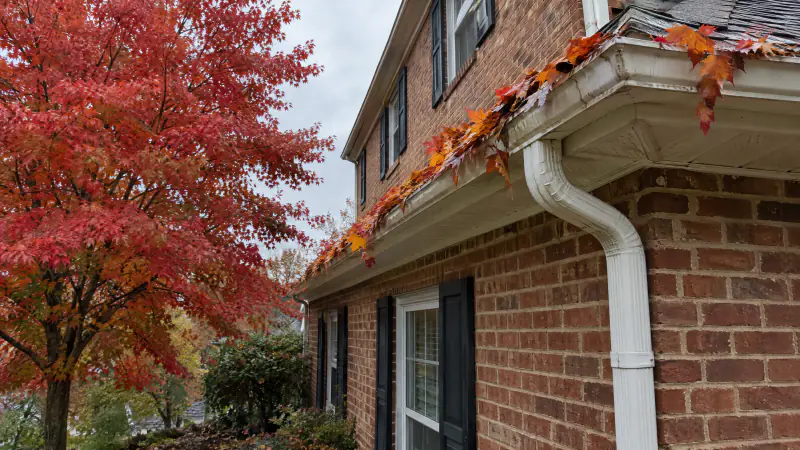
More than most people guess. One inch of rain falling on one square foot of roof produces about 0.62 gallons, so an inch on 1,000 square feet of roof produces roughly 620 gallons. A typical Northern Virginia two-story colonial has a roof footprint of 1,200 to 2,000 square feet, which means a single 1-inch storm sends 750 to 1,250 gallons through the gutters. That is the plan area of the roof, measured as if from above; the pitch does not change how much rain lands on it. Gutters collect all of it and deliver it to four to six downspouts, so each downspout handles the rain from 300 to 600 square feet of roof, roughly 200 to 375 gallons per inch, concentrated at one spot beside the foundation.
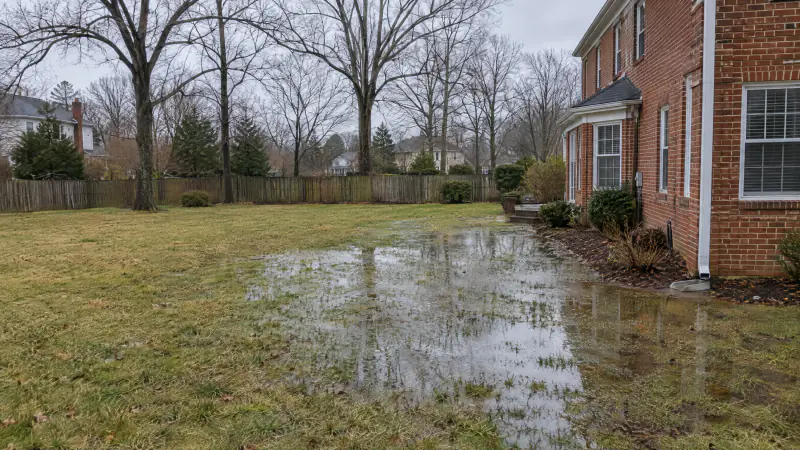
Now scale that to the storms we actually get. Northern Virginia receives roughly 40 to 42 inches of precipitation a year, much of it in summer thunderstorms that drop an inch in under an hour. Days with 2 inches arrive several times in most years, and 3 inches or more at least occasionally, when the remains of a tropical system pass through. On a 2-inch day, one downspout serving a 600-square-foot roof section delivers around 750 gallons, about 15 bathtubs, onto the loosest soil on the property. On clay, that water does not soak in. It runs along the wall, fills the backfill, and either finds the basement or spreads into the lawn, which is why the first question in any wet-yard or wet-basement diagnosis is what the downspouts are doing. Our downspout drainage service exists for this one problem, and this article explains where the water should go instead.
How many gallons does each downspout carry?
Roof area is the plan footprint served by one downspout. Multiply by rainfall to see what each outlet has to handle.
| Roof area served by one downspout | 1 inch of rain | 2 inches of rain | 3 inches of rain |
|---|---|---|---|
| 400 sq. ft. | about 250 gallons | about 500 gallons | about 750 gallons |
| 600 sq. ft. | about 375 gallons | about 750 gallons | about 1,120 gallons |
| 800 sq. ft. | about 500 gallons | about 1,000 gallons | about 1,500 gallons |
| 1,000 sq. ft. | about 625 gallons | about 1,250 gallons | about 1,870 gallons |
| Whole roof, 2,000 sq. ft. | about 1,250 gallons | about 2,500 gallons | about 3,740 gallons |
Based on 0.62 gallons per square foot per inch of rain. Gutter overflow in a cloudburst means some of this never reaches the downspout at all.
Where should gutter water actually go?
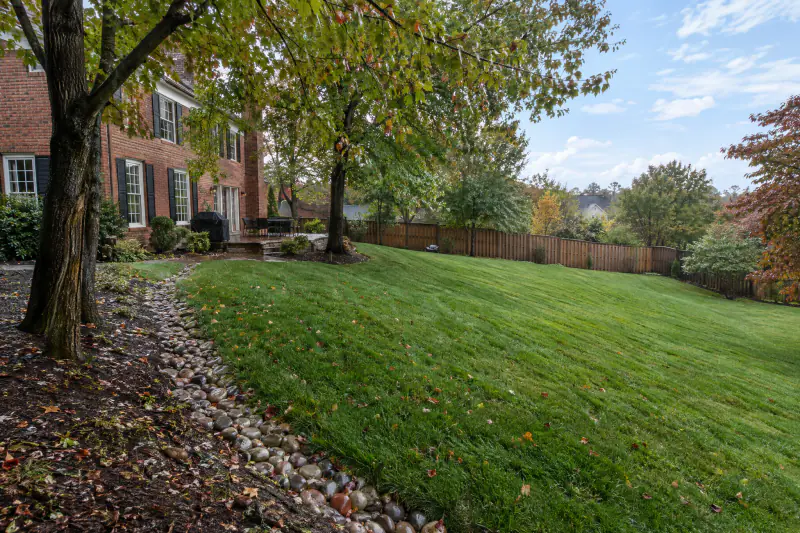
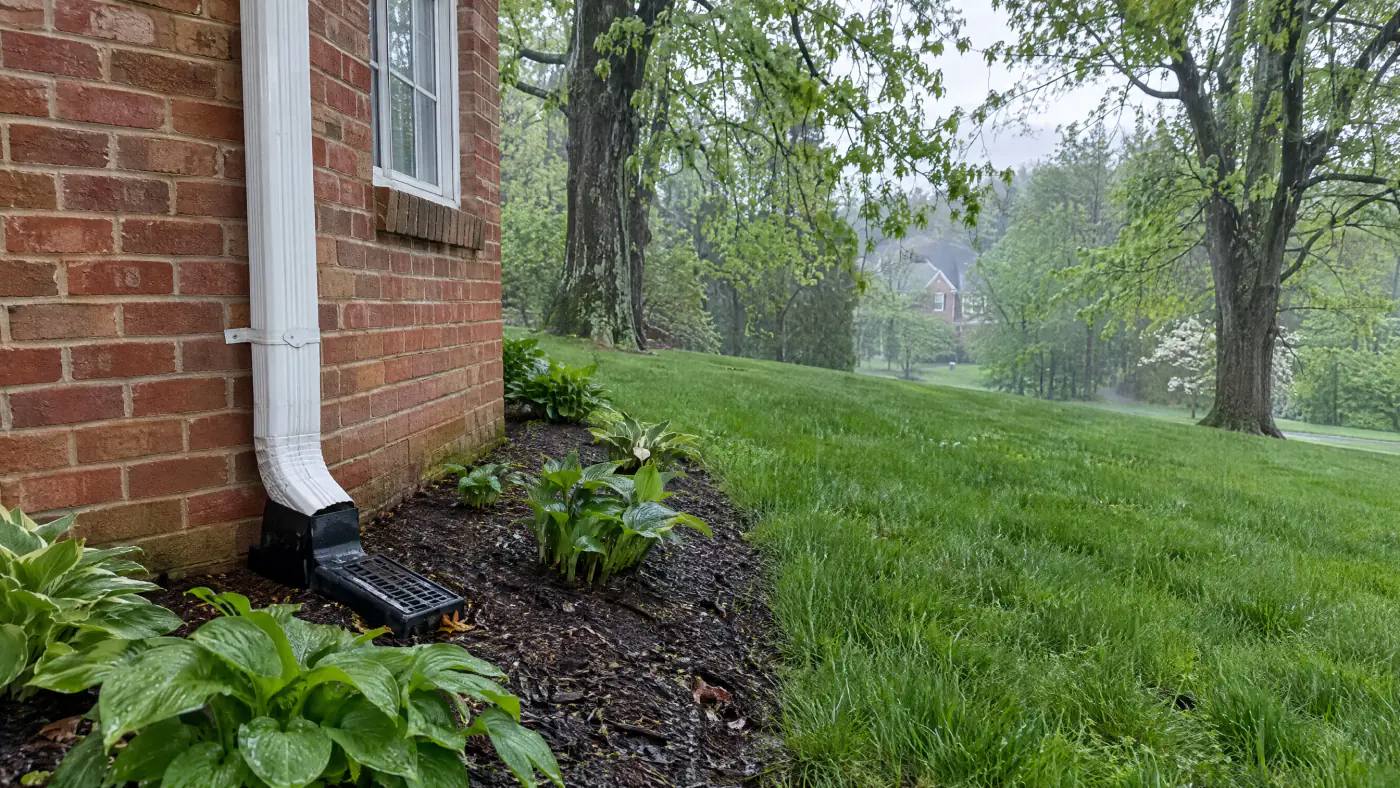
At least 10 feet from the foundation, onto ground that keeps falling away, on your own property. Each part of that sentence matters. Ten feet gets the water past the backfill zone, the loose soil around the foundation that settles for years and holds water against the wall. Ground that keeps falling away means the water will not pool at the outlet and creep back; a pop-up emitter set in a low spot is a small pond that refills every storm. Your own property means not the neighbor's lot, not a public sidewalk where it freezes, and not the sanitary sewer, which is generally prohibited across the region.
Where the water should not go is the longer list. Not into a French drain, because perforated pipe pushes the surge back into the soil. Not into the sump pit by way of a window well or an old foundation drain, which is how many older homes in Springfield and Annandale ended up with sump pumps that run through every storm. Not under a deck or patio, where it sits unseen against the house. And not onto a slope above a retaining wall, where it adds water pressure behind the wall and shortens its life. If you are not sure where your downspouts drain today, the next heavy rain will tell you; our article on why Northern Virginia backyards stay wet shows how to read that storm.
The ideal is water that leaves the roof, travels in a closed pipe, and emerges where it can spread out and move on, and that is what a buried line to a well-placed outlet does. The water management page describes how this fits beside grading and groundwater fixes.
Splash blocks, extensions or buried lines: which does your house need?
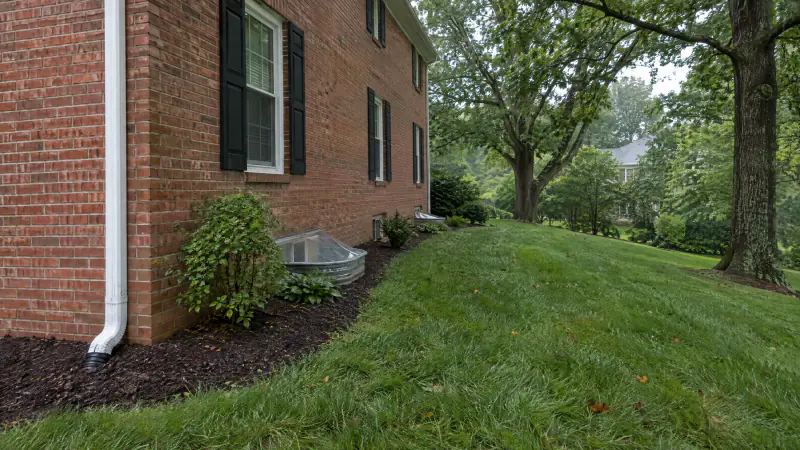
Splash blocks for a house whose grade already works, extensions for a temporary fix, and buried lines for everything else, which in Northern Virginia clay means most houses. A splash block spreads the stream a foot or two from the wall and relies on the surface slope to do the rest. On a lot with a true 6-inch fall over the first 10 feet and soil that absorbs, that is adequate. On clay with settled backfill, the water runs off the block and straight back to the wall, and the block itself usually ends up tilted toward the house within a few seasons.
Above-ground extensions, the rigid or flexible pipes that carry water 4 to 10 feet across the lawn, do move water past the backfill, and they are the right first move when a basement is wet this week and a permanent fix is weeks away. Their problems are practical. They are in the way of mowing, they get disconnected and never reattached, they crush under a wheelbarrow, and flexible corrugated extensions fill with debris because their ridges hold it. We treat them as a test: if a month of extensions dries the basement corner, a buried line in the same direction will solve the problem permanently.
A buried line is solid pipe from the downspout to an outlet, with a cleanout at the top and a proper discharge at the bottom. It disappears, it mows over, it handles the full flow of a 2-inch storm, and it is usually the least expensive permanent drainage improvement a home can make. The sections below cover the pipe, the outlet, the build and the ways it can fail, because a buried line built badly is harder to diagnose than a splash block that is obviously not working.
Pop-up emitter, daylight, dry well, catch basin or curb: which outlet fits your lot?
The outlet is where buried lines succeed or fail. Each option suits a different shape of yard.
- Pop-up emitter
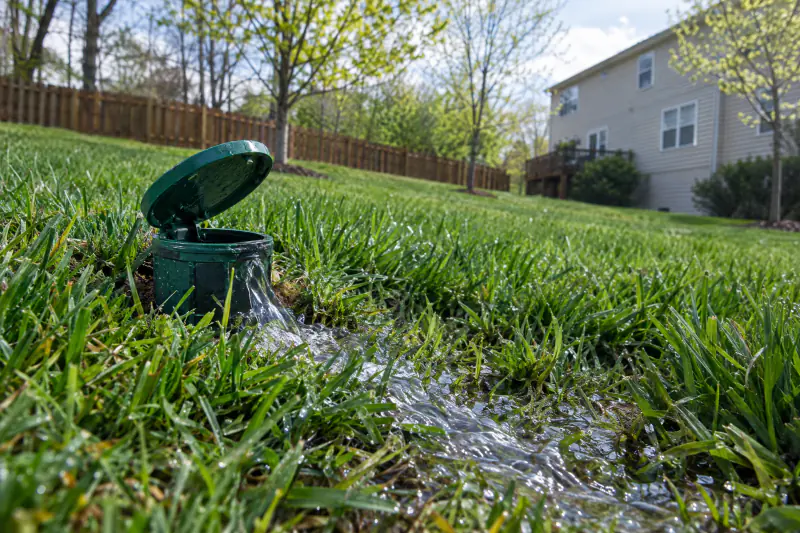
- A spring-loaded cap flush with the lawn, at least 10 feet from the house where the grade keeps falling. Flow lifts it and it closes when the pipe empties. Needs a couple of inches of fall below it so the pipe drains dry. The default on flat suburban lots.
- Daylight outlet
- The pipe emerges from a slope or bank with a screen on the end. No moving parts, nothing to freeze shut, and you can watch it work. Needs a lot that falls to a woods line, a swale or a lower lawn, which is common in Great Falls, Clifton and western Loudoun.
- Dry well
- A buried chamber in stone that stores a storm and releases it slowly. In clay it releases very slowly, so it suits a single downspout on a lot with no fall at all, sized conservatively with an overflow. We use it when nothing else will work.
- Catch basin or yard drain
- Where the downspout line joins a larger surface drainage system, it can enter a basin that is itself piped onward. Useful when grading and downspouts are fixed in the same project, and the basin gives a second cleanout point.
- Curb or storm drain connection
- Legal in some places and not others. Cutting a curb or tying into a public storm sewer typically needs approval from the county, city or VDOT, depending on who maintains the street, and from the HOA. Where it is allowed, it is the most dependable outlet of all.
Solid PVC or corrugated: which pipe belongs underground?
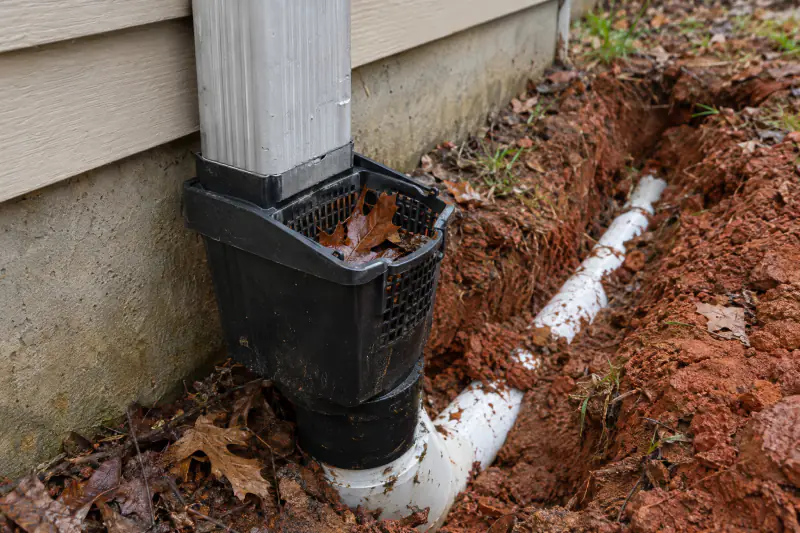
Solid smooth-wall PVC, in 4-inch diameter, for anything that is going to stay in the ground. The common choices are SDR 35 sewer and drain pipe or Schedule 40, joined with glued or gasketed fittings so the line cannot leak water back into the soil beside the foundation it was meant to protect. Smooth walls let leaves, shingle grit and seed pods flush through to the outlet. Rigid lengths hold the slope they are laid on, so there are no bellies to collect sediment. And a smooth, rigid pipe can be cleaned with a hose jet or a drain snake from the cleanout if it ever does clog, which corrugated pipe cannot survive.
Corrugated pipe comes in two kinds, and the difference matters. Single-wall corrugated, the thin black flexible pipe sold in coils, is ridged inside and out. It is cheap and quick, it follows curves without fittings, and it is the pipe inside most failed downspout lines we dig up: sagging between high spots, ridges packed with grit, walls crushed where a mower or a truck crossed it. Dual-wall corrugated has a smooth interior and a ridged exterior, is much stronger, and is a reasonable choice for longer runs where a few gentle curves save fittings; it is used widely for larger storm drainage. For the short, straight runs of a residential downspout system, 4-inch solid PVC costs little more and gives up nothing.
Two sizing notes. Where two downspouts share a run, or a run collects a large roof section, the shared pipe is sized up or kept short and steep. And the fitting at the top, where a rectangular 2-by-3 or 3-by-4 downspout meets a round 4-inch pipe, is a purpose-made adapter with a cleanout or debris filter, not a downspout jammed into a pipe and sealed with caulk.
Where should the sump pump discharge line go?
Underground to the same kind of outlet as a downspout, with three differences at the house. A sump pump pushes water rather than letting gravity carry it, so its discharge pipe, typically 1.5 inches, runs up and out through the foundation wall and then needs to get past the backfill zone like any other outlet. The first difference is the check valve inside, which stops the lifted water falling back into the pit when the pump stops; it should be there and working before anything outside changes. The second is freeze relief: a fitting at the base of the exterior riser, just above grade, that lets water escape if the buried section freezes solid, so the pump can still discharge instead of running against an ice plug until it burns out. The third is the connection to the buried line, which should be a sealed adapter into solid pipe, pitched so the line drains empty after each pump cycle.
Whether the sump line should share a pipe with a downspout depends on sizing. A typical residential pump can discharge roughly 30 to 60 gallons a minute depending on its size and lift, and it tends to run hardest at the exact moment the roof is filling the same pipe. On a 4-inch run with good slope and a short distance to the outlet, sharing often works. On a long or marginal run, we give the sump its own line, because a pump that cannot discharge is a flooded basement. Where the sump runs constantly even in dry weather, the pit is collecting groundwater, and the long-term answer may be a French drain that lowers the water outside before it reaches the foundation; our article on exterior fixes for water in the basement works through that decision.
How is a buried downspout line built properly?
A whole house takes one to two days. The order below is what separates a 20-year line from a 3-year one.
Measure the roof and the fall
We count downspouts, estimate the roof area each one serves, and shoot elevations from each downspout to candidate outlet points with a laser level. The outlet has to sit lower than the start by at least 1/8 inch per foot of run.
Plan the routes and the outlets
Downspouts are grouped where runs can share a pipe without overloading it, routes avoid tree roots and utilities, and each outlet is placed where the grade keeps falling. You get a sketch before anything is dug.
Call for a Virginia 811 locate
Public utilities are marked before digging, as state law requires. Private lines, meaning irrigation pipe, low-voltage lighting, pet fence wire and gas to a grill, are located with you, because 811 does not mark them.
Cut sod and trench to slope
Sod is cut and set aside. The trench starts 10 to 18 inches deep at the house and follows a continuous fall, checked with the level, to the outlet. Under walks and patios we tunnel or lift and reset pavers rather than cutting pavement where possible.
Set the adapter, pipe and cleanouts
A downspout adapter with a cleanout or debris filter connects the downspout to 4-inch solid PVC. Joints are glued or gasketed. Each run is bedded so it cannot sag and gets a cleanout at the house and at any sharp change of direction.
Finish the outlet and test with a hose
The pop-up emitter, daylight end or basin is installed with fall below it. We run a hose into each downspout, watch the outlet open and flow, then backfill, compact, replace the sod and show you every cleanout.
Do buried downspout lines freeze in Northern Virginia winters?
A properly built line rarely does, because it is empty between storms. Water that enters the pipe during a rain runs out the outlet, and the small amount that clings to the walls drains or evaporates. Our winters bring freeze-thaw cycles rather than months of deep frost, and the ground a foot down rarely freezes hard for long, so a line pitched to drain empty is safe at 10 to 18 inches.
The problems come at the ends. At the top, a winter rain or a snowmelt day can send water into the pipe while the outlet is buried under a foot of snow or capped with ice; a pop-up emitter frozen shut leaves the line full, and if a hard freeze follows, the water in the pipe freezes and the next melt backs up at the downspout. This is why daylight outlets, which cannot freeze shut in the same way, are preferred where the lot allows, and why pop-up emitters should be kept clear of snow and leaves in winter. At the house end, a sump discharge line needs the freeze-relief fitting described above, because a pump will run against an ice plug until it fails.
Lines that do freeze are almost always lines that hold water: a belly, a flat run, an outlet with no fall below it, or an emitter set in a low spot that stays full. Fixing the slope fixes the freezing. If a downspout overflows at the top during a January thaw, the line is either frozen or clogged, and the cleanout is where you find out which. Our pre-winter drainage walkthrough covers the checks that prevent it.
How do buried downspout lines fail?
Most failures are built in on day one. These are the ones we dig up most often.
Crushed corrugated pipe
Thin single-wall pipe laid shallow is flattened by a mower, a wheelbarrow or the first truck that parks on the lawn. The downspout backs up and overflows at the house in the next storm.
Bellies full of silt
A sag between two high spots holds water after every rain. Shingle grit and leaf fragments settle there, the belly fills, and the line slows and then stops. Common in flexible pipe and in rigid pipe laid without a level.
Roots in the joints
Unsealed joints, and perforated pipe used by mistake, leak water into the soil, and tree roots follow the water into the pipe. Maples and willows are the usual culprits. Glued or gasketed joints prevent it.
Emitter buried or set in a low spot
A pop-up emitter under three inches of mulch, or sitting in a dip, holds water, grows a mat of grass roots over the cap, and stops opening. The line behind it stays full.
No cleanout anywhere
A line with no access point cannot be flushed, inspected or snaked. When it clogs, the only diagnosis is digging, and the usual outcome is replacement.
Disconnected at the top
A downspout pushed into a pipe and caulked, or an adapter that was never fastened, separates with frost heave or a bump from a ladder. Water pours out at the wall while the buried line stays dry.
How much does downspout drainage cost in Northern Virginia in 2026?
As of 2026, typical Northern Virginia market planning ranges for buried downspout lines run roughly $400 to $1,500 per downspout, and about $2,500 to $7,500 for a whole house with four to six downspouts. A buried sump pump discharge line typically falls between $800 and $3,000, with the freeze-relief fitting and check valve included. A dry well, where one is needed, adds roughly $2,000 to $6,000. These are regional figures, not our prices and not a quote.
What moves the number:
- Distance to the outlet. The largest driver by far; a 20-foot run and an 80-foot run to the same kind of emitter are very different jobs.
- Pipe material and combined runs. Rigid PVC costs more per foot than corrugated, and shared runs sized up cost more than short individual ones.
- Crossings. Tunneling under a walk, lifting and resetting pavers, or cutting and patching concrete.
- Roots, rock and utilities. Anything that turns machine trenching into hand digging.
- Outlet type. A pop-up emitter is inexpensive; a dry well or an approved curb connection is not.
- Restoration. Replacing cut sod costs little; new sod or seed over long trenches costs more.
This is usually the least expensive permanent drainage improvement a home can make, and it is the one we recommend first, because it removes the largest single source of water before anyone prices a trench through the lawn. Our cost guide sets it beside grading, French drains and the hardscape projects it usually precedes. For a figure based on your roof and your yard's fall, the only reliable path is a written on-site estimate. Request one here or call (571) 200-9600.
What should a downspout drainage quote list?
A proposal that cannot answer these is pricing a trench, not a drainage system.
- Every downspout and the sump discharge, each shown on a sketch with its route and outlet.
- The roof area each run serves, and the pipe size chosen for it.
- Solid 4-inch PVC named as the pipe, with glued or gasketed joints.
- The slope in inches per foot and the elevation of each outlet relative to the house.
- A downspout adapter with cleanout or debris filter at every connection.
- The outlet type at each run, and confirmation it sits on your property or is approved.
- Freeze relief and a check valve on any sump discharge line.
- Virginia 811 locate and private utility marking before digging.
- How crossings under walks, patios or driveways will be handled.
- Backfill, compaction and sod replacement, with a hose test at the end.
Where does gutter water cause the most trouble in Fairfax, Loudoun, Prince William and Arlington?
Everywhere the clay meets a splash block, but the pattern changes with neighborhood age. In the colonials and split-levels of the 1960s to 1980s in Springfield, Burke, Annandale, Reston and Vienna, downspouts often feed old clay tile or thin black corrugated lines that builders buried decades ago and that have long since collapsed, so the first job is finding where the old line goes and abandoning it. Inside the Beltway, in Arlington, Falls Church and Alexandria, lots are small, an outlet 10 feet from the house may be 3 feet from the lot line, and the answer is often a daylight outlet to a side swale or a carefully placed emitter in the front lawn, with the neighbor's grade in mind.
In the newer communities of Ashburn, South Riding, Gainesville, Bristow and Woodbridge, lots are flat, backyards are small and fenced, and the rear lot line often carries a drainage easement that cannot be filled but can receive a properly placed outlet. Builder splash blocks on compacted fill explain a large share of the wet backyards we see there. Along the Potomac in Lorton and Dumfries, and on the larger lots of Great Falls and Clifton, daylight outlets to a wooded slope are often available and are the first choice.
The rules are consistent across the region in outline and different in detail. Burying downspouts on your own lot does not usually need a permit. Discharging to the sanitary sewer is generally prohibited, outlets may not send concentrated flow onto a neighbor or across a public sidewalk, and curb cuts or storm drain connections typically need approval from the county, city or VDOT and from your HOA; check with yours. We build downspout and sump lines on residential properties throughout the counties, cities and towns on our service areas page, and where a line has to pass under a walkway or patio you plan to replace, we install the pipe first so the new paving never has to come up.
Frequently asked questions
How many downspouts does a house need, and does that change the drainage plan?
A common rule for 5-inch gutters is one standard 2-by-3 downspout for every 600 square feet or so of roof, with larger 3-by-4 downspouts handling more. Many Northern Virginia homes have fewer than that, which is why gutters overflow at inside corners in a cloudburst. More downspouts mean smaller flows at each outlet and shorter buried runs, so adding one at an overloaded corner is sometimes part of the drainage plan.
Is it better to bury downspouts or use above-ground extensions?
Burying wins for anything permanent. Extensions move water past the backfill, which is the point, but they get disconnected, crushed and kicked aside, and flexible ones clog. We suggest extensions as a short-term test: if a few weeks of extensions dries a wet corner, a buried line to a proper outlet in the same direction will fix it for good, and it disappears under the lawn.
Can a downspout drain line be connected to a French drain?
No. A French drain uses perforated pipe to collect water from the soil, and roof water arriving in a surge pushes straight back out through those perforations, flooding the trench and the ground around it. Roof water travels in its own solid pipe. The two systems may share a final outlet if it is sized for both, but they never share the perforated run.
Should every downspout get its own buried line?
Not necessarily. Two downspouts on the same side of a house are often joined into one 4-inch run, which keeps trenching down, as long as the shared pipe has good slope and a short path to the outlet. What we avoid is one long, shallow run collecting the whole roof. The sketch in your quote should show which downspouts combine and why the pipe can handle the combined flow.
Where should a sump pump discharge?
Into a buried solid line to an outlet at least 10 feet from the house where the grade keeps falling, with a check valve inside and a freeze-relief fitting at the base of the exterior riser. It should not discharge beside the foundation, where the water returns to the pit, and it should not go into the sanitary sewer, which is generally prohibited. If the pump runs constantly in dry weather, the real fix may be exterior drainage.
Can I run my downspouts to the street or a storm drain in Fairfax County?
Sometimes, but not without approval. Cutting a curb or connecting to a public storm sewer typically requires permission from the county, the city, or VDOT, depending on who maintains the street, and HOAs often have their own rules. Where the connection is allowed it is the most reliable outlet available. Where it is not, a pop-up emitter or daylight outlet in the front lawn is the usual alternative. Check with your jurisdiction first.
Why does my downspout overflow at the top during heavy rain?
Either the gutter is delivering more water than the downspout opening can take, or the pipe below is blocked. Leaves in the gutter outlet, a clogged debris filter, a crushed or silted buried line, or an emitter frozen or buried under mulch all back water up to the top. Clear the gutter outlet first, then open the cleanout and run a hose. If water backs up at the cleanout, the problem is downstream.
Book the work
Put the plan in writing with a crew that builds this every week.
One visit to measure and talk through options, then a written scope and price. No pressure, no vague numbers. Ask about the Heroes Discount if you serve.
Sources and further reading
- Virginia Cooperative Extension, home drainage and stormwater publications
- NOAA National Centers for Environmental Information: U.S. Climate Normals
- Virginia 811 (Miss Utility): call before you dig
- Fairfax County Land Development Services: drainage and stormwater on residential lots
- Arlington County government: stormwater and drainage
Published March 26, 2026. Reviewed and updated October 9, 2026.