Key takeaways
- Where the water appears, when, and how much rain it takes point to the cause. A wall that weeps only in cloudbursts is roof water; a floor that seeps days later is groundwater.
- Roof runoff and settled grading cause most basement water in Northern Virginia. Burying downspouts and rebuilding the slope at the foundation solve many cases on their own.
- Exterior fixes stop water before it reaches the wall. Interior systems collect it after it arrives. Each is right for different houses, and the exterior work is usually tried first.
- Saturated clay pushes water through a foundation by pressure. A French drain or curtain drain lowers that water table so the pressure never builds.
- Late August and early September are the time to act: the soil is dry enough to dig, the fall rains have not started, and the lawn can be repaired in the September seeding window.
On this page
- Why does water get into a Northern Virginia basement, and where should you start?
- How do you read the symptoms: where, when and after how much rain?
- What does each symptom usually point to?
- Are your grading and downspouts the real problem?
- What about window wells, patios and walks pitched toward the house?
- Why does saturated clay push water through a foundation wall?
- Exterior drainage or an interior system: which is right for your house?
- How do the exterior and interior options compare?
- Where should the sump pump discharge go?
- In what order should you try the fixes?
- What should you ask a drainage contractor?
- What do exterior basement drainage fixes cost in Northern Virginia?
- Why is late summer the time to do this?
- What is different about basements in Fairfax, Loudoun, Prince William and Arlington?
- Frequently asked questions
Why does water get into a Northern Virginia basement, and where should you start?
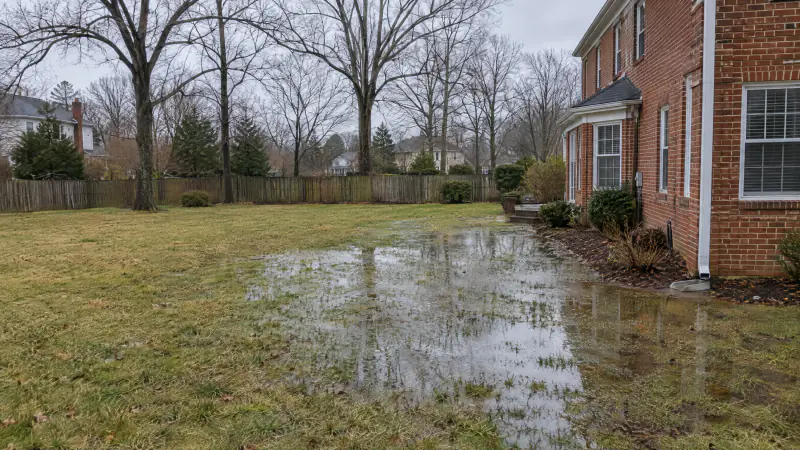
Water gets into most basements here because more of it arrives at the foundation than the clay around it can carry away, and the place to start is outside, with the cheapest sources first. The roof is the biggest one. One inch of rain on 1,000 square feet of roof is roughly 620 gallons, and the gutters deliver all of it to four or five downspouts at the corners of the house. If those downspouts end at a splash block, that water lands in the loose backfill beside the wall, the one place on the lot that was dug out and never compacted. Clay below and around the backfill holds it there. Add a lawn that has settled toward the house over twenty years and a patio pitched the wrong way, and the basement wall is standing in a bathtub every time it storms.
Interior systems, the perimeter drains and sump pumps advertised everywhere, do not change any of that. They catch water after it has passed through or under the wall and pump it back out. They have their place, and we describe it below, but they are a way of living with the problem rather than removing it. The exterior fixes remove it, and most of them cost less.
So the order is: read the symptoms, confirm the source with a hose or a storm, correct the roof water and the grading, then deal with saturated soil with a French drain if the first two steps leave water behind. Only after that is an interior system worth discussing. This article is the long version of that sequence. The short version lives on our French drain installation page and in the water management overview.
How do you read the symptoms: where, when and after how much rain?
Three questions sort nearly every wet basement: where the water shows up, how soon after rain it appears, and how much rain it takes. Keep a note on your phone for a month. The pattern is usually clear by the third storm.
Where. Water coming through the wall partway up, often as a damp stain or a trickle below a window, is almost always surface or roof water arriving at that spot from outside. Look directly above it: a downspout, a window well, a patio edge, a hose bib. Water at the cove joint, where the floor slab meets the wall, or rising through floor cracks, is groundwater under pressure. The soil around and under the footing is saturated and the water is taking the easiest path, which is the joint. A damp patch in the middle of the floor with no wall involvement points to a high water table or a plumbing issue rather than drainage.
When. Water that appears during the storm or within an hour is roof runoff or surface flow; it moved fast because it traveled over the ground or through loose backfill. Water that shows up the next day, or two days later, after the puddles outside are gone, is moving through the soil. That is the slow seep of a saturated clay lot, and it needs a different fix than a downspout extension.
How much. If only the two-inch cloudbursts cause trouble, the system is close to working and the fix may be small: a longer discharge line, a cleaned gutter, a regraded corner. If a steady half inch is enough, something is actively directing water at the wall. If the basement is damp during a wet week with no single big storm, the water table is rising and the soil itself is the issue. Our article on why Northern Virginia backyards stay wet explains the clay behind that third pattern.
What does each symptom usually point to?
Typical patterns we see on Northern Virginia homes. A house can have more than one.
| What you see | When it appears | Likely exterior cause | First fix to try |
|---|---|---|---|
| Damp stain or trickle on the wall below a window | During or just after rain | Window well filling, or a downspout above it | Clear the well drain, cover it, move the downspout outlet |
| Wet corner of the basement, always the same corner | During heavy rain | Downspout releasing at that corner | Bury the downspout to an outlet 10 feet or more away |
| Water along a whole wall at floor level | Hours after rain starts | Grade sloping toward the house on that side | Rebuild the slope: about 6 inches of fall in 10 feet |
| Seepage at the cove joint, floor to wall | A day or more after rain | Saturated clay, water table rising against the footing | French drain or curtain drain to lower the water table |
| Sump pump running constantly for days | Wet weeks, not single storms | Groundwater plus roof water feeding the same soil | Separate roof water first, then address groundwater |
| Water under a basement door or walkout | During rain | Patio, walk or areaway pitched toward the door | Channel drain across the threshold, repitch the surface |
| Efflorescence and musty smell, no visible water | Always, worse in summer | Chronic damp soil against the wall | Grading and downspouts, then monitor humidity |
Cracks in poured or block walls let water through faster but are rarely the source; the water reaching the crack is.
Are your grading and downspouts the real problem?
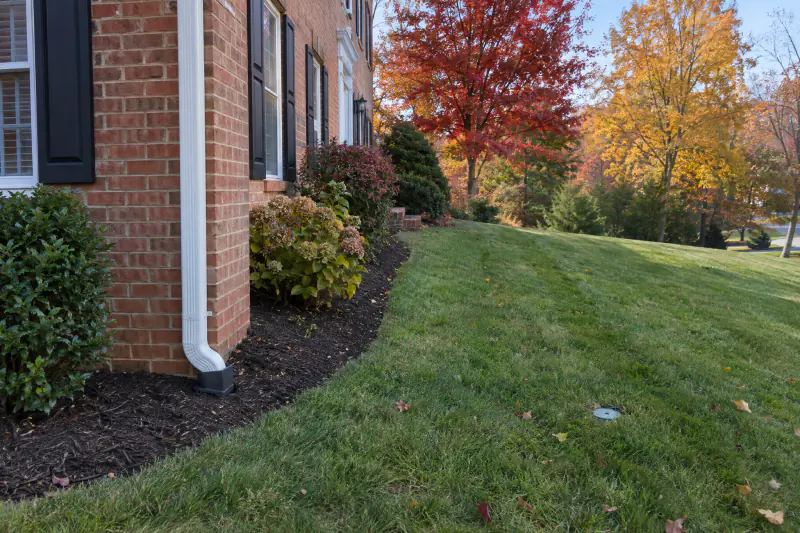
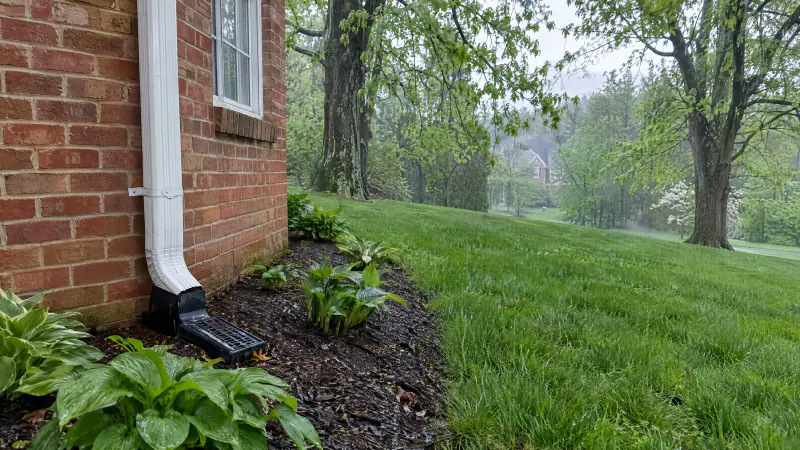
Usually, yes, and the test is easy: on the next dry day, run a hose into each gutter for fifteen minutes and watch where the water goes. If a downspout ends in a splash block or a short flexible extension that someone moved for the mower, the water is sinking into the backfill within three feet of the wall. The fix is a buried solid line to an outlet at least ten feet from the house, farther on flat lots, ending at a pop-up emitter or daylight where the ground keeps falling away. We lay out how those lines are built, with cleanouts and a measured slope, on the downspout drainage page, and in where your gutters should actually send the water.
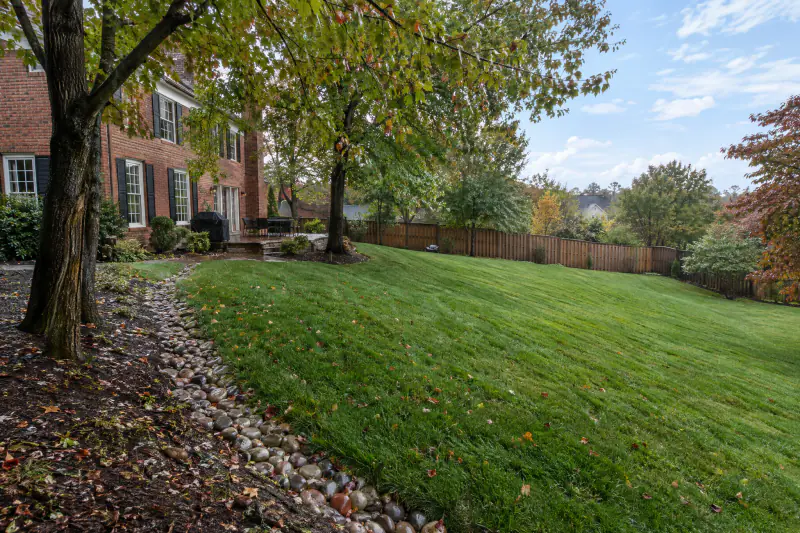
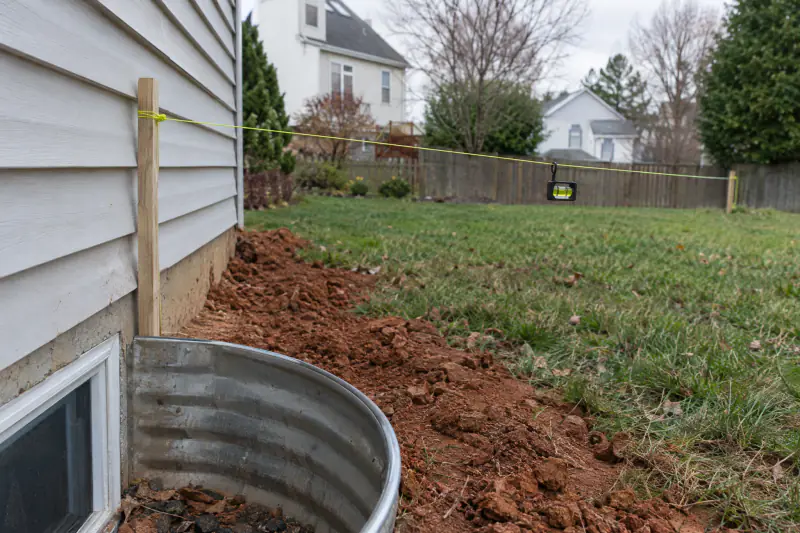
Grading is the slower failure. Builders backfill the foundation trench with whatever came out of it, and that loose soil settles for years. A yard that sloped away when the house was new ends up flat or tilting toward the wall, and every storm leaves a shallow trough along the foundation that holds water against the block. The standard to check against is about 6 inches of fall over the first 10 feet. Stretch a string from the base of the wall to a stake ten feet out, level it, and measure the drop. Less than a few inches, or a rise, and the grade needs rebuilding with compacted fill and topsoil, keeping the soil several inches below the siding or the top of the foundation so framing stays dry.
Mulch is not fill. Heaping bark against the house to fake a slope holds moisture against the wall and invites insects. Where a walkway, a bed edge or a neighbor's property line leaves no room to raise the soil, the answer is to lower the ground farther out, or to put a shallow swale or a catch basin a few feet from the house so the water has a path that is not the wall. Those options are described on our yard drainage page.
What about window wells, patios and walks pitched toward the house?
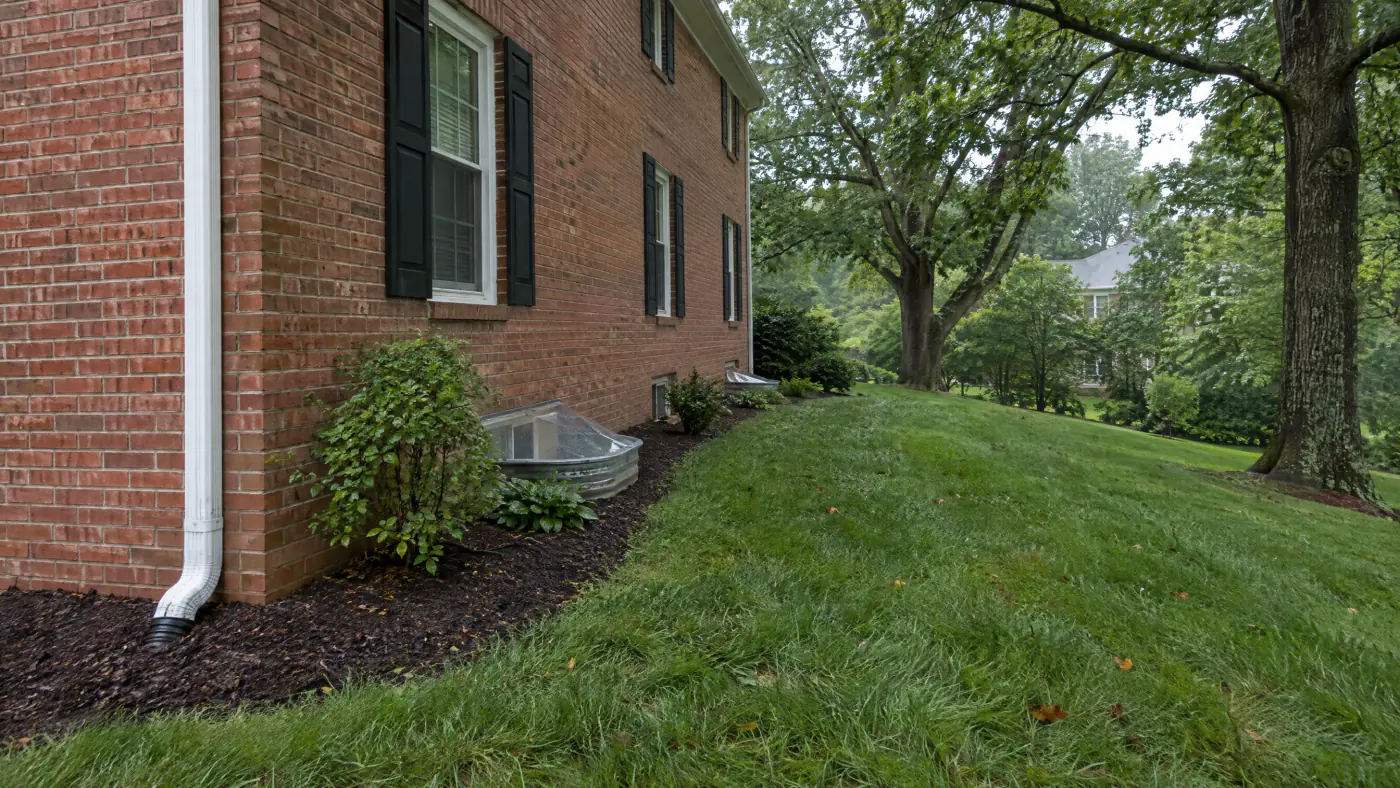
Window wells are small, forgettable and responsible for a surprising share of the water stains below basement windows. A well is a steel or plastic bucket set against the foundation, open at the top. Rain falls into it, and roof water from an overflowing gutter above it pours in. At the bottom there should be a drain: either a bed of gravel over a pipe that connects to the footing drain, or a dry sump of gravel that lets water soak away. On clay, the dry sump fills and stays full. Leaves and mulch cover the gravel and seal it. The well becomes an aquarium pressed against a window that was never meant to hold back water.
The fixes, in order: remove the debris and dig the gravel out to find whether a drain exists; replace clogged gravel with clean stone over fabric; fit a clear cover so rain and leaves stay out; and make sure no downspout or gutter corner discharges above it. If the well has no drain and fills repeatedly, a small drain line from the well out to the yard drainage system is a modest job while other digging is under way.
Patios, walks and stoops are the hard surfaces that pitch the wrong way. Concrete slabs settle toward the house because the backfill under the house side settles most. A patio that was poured level, or that has sunk an inch at the wall, delivers every drop that lands on it straight to the foundation. Look for the stain line on the wall just above the slab and a gap between slab and wall. Options range from a channel drain cut across the slab at the wall, to mudjacking or foam lifting the slab back to pitch, to replacing a failed concrete patio with pavers on a properly pitched base that sheds water away by design. Sealing the joint at the wall with caulk helps for a season, but it is not the fix.
Why does saturated clay push water through a foundation wall?
Because water in saturated soil has weight, and that weight becomes pressure against anything that holds it back, including a basement wall. Engineers call it hydrostatic pressure. When the clay around a foundation is full of water, every foot of water depth above a point adds pressure at that point, and the wall and floor slab are the weakest surfaces available. Water forces its way through block cores, through hairline cracks in poured concrete, and above all through the cove joint, where the floor slab simply sits on the footing with no seal at all. That is why the slow seep arrives a day after the rain. The ground is draining toward the lowest open space, and your basement is it.
Northern Virginia clay makes this worse in two ways. It drains so slowly that a wet October can leave the soil saturated into December, so the pressure never fully releases between storms. And parts of eastern Fairfax County, Alexandria and areas along the Potomac have shrink-swell marine clay that expands when wet and contracts when dry, which works on walls and slabs season after season. Anyone considering excavation near a foundation in those areas should ask about the soil before a shovel goes in.
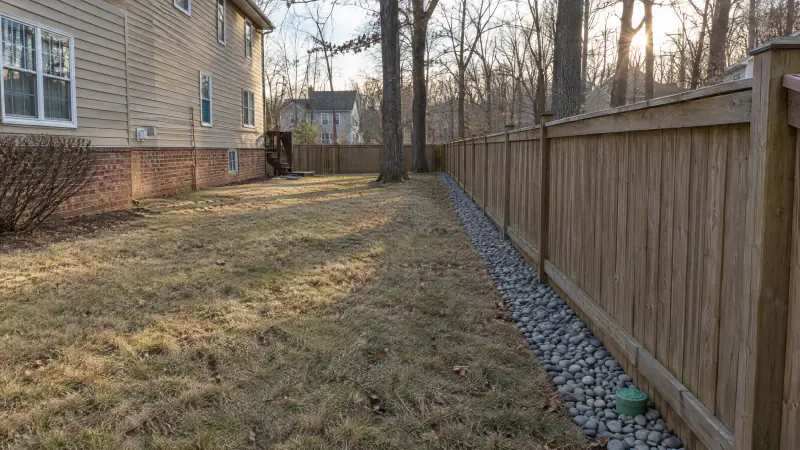
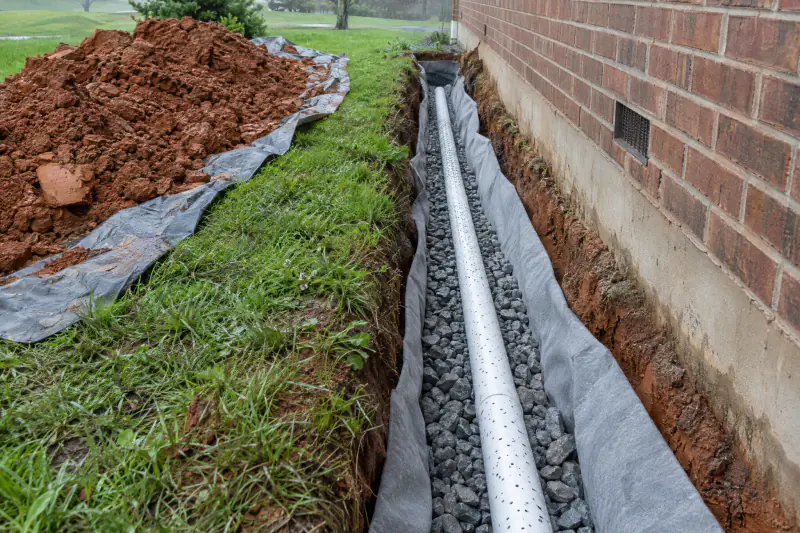
The exterior cure is to lower the water table beside the wall so the pressure never builds. That is what a French drain does: a fabric-lined trench of washed stone with a perforated pipe, set a few feet out from the foundation and well above the footing so the excavation never undermines it, sloped to an outlet. Water moving through the soil toward the house meets the trench first, drops into the pipe and leaves. On sloping lots, a curtain drain across the uphill side intercepts water seeping downhill before it reaches the backfill at all. How that trench is built, and the ways it fails when it is built badly, are the subject of French drain installation in Northern Virginia clay.
Exterior drainage or an interior system: which is right for your house?
Exterior drainage is right when the water can be intercepted before it reaches the wall, which is most houses. An interior system is right when it cannot be, or when the house is already built so close to a property line, a driveway or a mature tree that exterior work is impractical. The two are not competitors so much as answers to different conditions, and the mistake is choosing the interior option first because it was the one somebody quoted.
Exterior work covers downspout lines, regrading, window well drains, repitched hard surfaces and French or curtain drains. It stops water at the source, keeps the wall and the backfill drier year round, reduces humidity and efflorescence inside, and leaves the basement untouched. Its limits: it needs a lower place for the water to go, it needs room to dig, and it cannot help with water rising from a high water table under the slab.
Interior systems cut a channel in the slab around the perimeter, lay a perforated pipe in stone at the footing, and route it to a sump basin with a pump. Water that arrives at the cove joint is collected and pumped out before it crosses the floor. Done well, with a sealed basin, a battery backup and a discharge line that goes somewhere sensible, they are reliable. Their limits: the wall itself stays wet because the water still passes through it, the pump is a mechanical device that fails in the storm that knocks the power out, and the discharge has to be managed outside or it simply recirculates. On a finished basement the work means removing flooring and drywall along every wall.
The honest combination for a bad case is both: exterior work to take away the roof water and most of the groundwater, and an interior system as the backstop for what remains. The combination is almost always cheaper than it sounds, because the exterior work shrinks the interior scope. Full exterior membrane waterproofing, which means excavating to the footing, applying a membrane and installing a new footing drain, is the most complete exterior fix and the most expensive, and it is usually reserved for houses with failed walls or no other route.
How do the exterior and interior options compare?
What each fix does, when it fits, and what it leaves undone.
| Approach | What it does | Best when | What it does not do |
|---|---|---|---|
| Buried downspout lines | Carries roof water 10 feet or more from the house in solid pipe | Wet spots line up with downspouts; nearly every house | Does not lower groundwater already in the soil |
| Regrading at the foundation | Rebuilds about 6 inches of fall in 10 feet with compacted soil | Soil is flat or tilts toward the wall | Cannot fix water arriving through the ground |
| Window well drains and covers | Keeps rain and leaves out, gives the well an outlet | Stains sit below basement windows | Does nothing for other walls |
| Channel drain or repitched slab | Intercepts sheet flow off patios and walks at the wall | Hard surfaces pitch toward a door or wall | Needs an outlet; does not address soil water |
| French drain or curtain drain | Lowers the water table beside or uphill of the house | Seepage arrives a day after rain, at the cove joint | Does not stop a high water table under the slab |
| Exterior membrane and footing drain | Seals the wall and drains at the footing after excavation | Failed walls, chronic leaks, major renovation | Costly, disruptive, limited by access and trees |
| Interior perimeter drain and sump | Collects water at the footing inside and pumps it out | No exterior access, high water table, finished walls | Wall stays wet; relies on a pump and power |
Where should the sump pump discharge go?
At least ten feet from the house, onto ground that keeps falling away, through a buried line with freeze relief at the house, and never into the sanitary sewer. The most common sump problem we see is a discharge pipe that pokes out of the wall and empties two feet from the foundation. The pump lifts the water out, the water sinks straight back into the backfill, and the pump lifts it again. On a wet week a pump can cycle every few minutes doing exactly nothing except wearing itself out and running up the electric bill. Homeowners read that as a groundwater problem. It is a plumbing problem with a thirty-foot solution.
A proper discharge line is solid pipe, sized for the pump, buried below the lawn on a continuous slope to a pop-up emitter, a catch basin or daylight. At the house, an air gap or a freeze-relief fitting lets the pump still discharge at the wall if the buried section ices up in a January cold snap, which prevents the pump from dead-heading against a frozen line. Sump water generally should not be tied into a downspout line unless that pipe is sized for both and the sump connection has its own relief, because a cloudburst fills the roof line at the moment the pump most needs it empty.
Two more things worth doing while the pump is on your mind. Fit a check valve on the riser if there is none, so the water in the pipe does not fall back into the basin and trigger the pump again. And consider a battery or water-powered backup pump. The storms that flood basements in Northern Virginia, the tropical remnants in September and the squall lines in July, are the same storms that take the power down. A sump system without backup is a system that stops working when it matters. The buried line itself is one of the least expensive drainage jobs on a house, and the downspout and sump discharge page describes how it is built.
In what order should you try the fixes?
Cheapest and most likely first. Stop when the basement stays dry through a few hard storms.
Clean the gutters and watch them in rain
Overflowing gutters dump roof water right at the wall and imitate every other problem. Clear them, check that the downspouts run freely, and stand outside during a storm to see where water actually falls. Note any gutter corner that pours over.
Get the downspouts and sump discharge away from the house
Extend or bury every downspout to an outlet 10 feet or more from the foundation, farther on flat lots. Run the sump discharge the same way with freeze relief at the house. For many homes this step alone ends the problem.
Rebuild the grade on the wet side
Strip the sod, add and compact clean fill, top with soil, and restore about 6 inches of fall in the first 10 feet while keeping soil clear of siding. Reseed in September or lay sod. Do window wells and their covers at the same time.
Fix the hard surfaces that pitch inward
Lift, repitch or replace the slab, or cut a channel drain across it at the wall and pipe it to the yard system. Walkouts and basement doors get a channel drain at the threshold.
Lower the water table with a French or curtain drain
If seepage still arrives a day after rain, a fabric-lined stone trench with perforated pipe, set a few feet out from the wall or across the uphill side, carries soil water to an outlet before it reaches the backfill.
Add an interior system only for what is left
If water still reaches the cove joint, or the house sits on a high water table, an interior perimeter drain and sump with battery backup collects what the exterior work could not. The exterior work makes that system smaller and less busy.
What should you ask a drainage contractor?
Questions that separate a diagnosis from a sales call.
- Did you look at the outside of the house before recommending anything inside?
- Where exactly will the water go, and have you confirmed that outlet sits lower than the house?
- What is the measured fall from the foundation to that outlet, in inches?
- Will you request Virginia 811 marking before any digging, and who locates private lines?
- Is the pipe smooth-wall solid for roof water and perforated with fabric and washed stone for soil water?
- Where are the cleanouts, and how will I flush the lines after leaf season?
- What happens to the excavated clay and how will the lawn be restored?
- Which parts of this plan could be done later if the first steps solve the problem?
What do exterior basement drainage fixes cost in Northern Virginia?
As of 2026, typical Northern Virginia market ranges for the exterior fixes described here run from a few hundred dollars for a single buried downspout to five figures for excavation at the footing. Regional planning figures, not our prices, and they overlap because the jobs overlap. Burying downspouts commonly runs $400 to $1,500 per downspout, or $2,500 to $7,500 for a whole house with four to six of them. A buried sump discharge line typically falls between $800 and $3,000. Regrading one or two sides of a house with compacted fill, topsoil and lawn restoration generally runs $1,500 to $6,000. A window well drain or cover is a small item, often a few hundred dollars each when done with other work.
A yard or foundation-side French drain with fabric, washed stone and rigid perforated pipe typically prices at $30 to $90 per linear foot, with most residential projects totaling $2,500 to $10,000 depending on length, depth and the distance to the outlet. A channel drain across a patio or walk, piped to an outlet, is commonly $2,000 to $6,000. Full exterior membrane waterproofing with excavation to the footing and a new footing drain is a different scale of work and, as a broad planning range, often runs well into five figures for a typical house, with access and wall condition driving most of it. Interior perimeter systems with a sump are also commonly five-figure projects on a full basement, more with finished walls to remove and replace.
What moves the number: the distance to a usable outlet, machine access versus hand digging behind a fence or between houses, the volume of clay to haul away, crossings under walks and driveways, tree roots, the type of outlet, and how much lawn or bed has to be restored. The sequence above exists partly to protect the budget: the cheapest items come first and often make the expensive ones unnecessary. The cost guide has ranges for the rest of the yard, and for a figure based on your house, the only reliable number is a written estimate after someone has shot the levels on site; our how it works page explains that visit.
Why is late summer the time to do this?
Because the ground is dry enough to work, the fall rains have not started, and the lawn you disturb can be repaired in the one seeding window Northern Virginia gives you. By late August the clay has usually dried and firmed after the July heat, so trenches hold their shape and machines do not rut the yard. Spoil comes out as dry blocks instead of mud. The outlet can be dug and tested with a hose before any weather arrives to test it for you.
Then September comes. It is often one of the wetter months here, and it brings the remnants of tropical systems that can drop several inches in a day on ground that has had no time to absorb it. A basement that was merely damp in July can take on real water in that kind of storm. Work finished in late August is in place for it. Work that starts in mid-October happens in the rain, on saturated clay, with the seeding window closing.
The lawn is the other reason. Drainage work tears up turf, and the best time to put tall fescue seed down is from the last week of August through September, as our fall lawn renovation plan lays out. Trench lines and regraded strips that are seeded in September knit in before the leaves fall. Do the same work in November and you are looking at mud until April. Finally, leaf season arrives in October, and it is the moment buried lines clog. New lines with cleanouts go in now, so the first flush after leaf fall is a ten-minute job rather than a discovery.
What is different about basements in Fairfax, Loudoun, Prince William and Arlington?
The houses, the soil and the lot shapes differ across the region, and the wet basement looks different in each. In the newer communities of Loudoun County, from Ashburn and Brambleton to South Riding and Aldie, and in Prince William around Gainesville, Bristow and Haymarket, basements are mostly poured concrete, lots are graded tightly, and the trouble usually comes from builder-grade downspout lines in thin corrugated pipe that have collapsed or clogged, plus drainage easements along the rear lot lines that fill in storms. In older Fairfax County neighborhoods such as Vienna, Annandale, Springfield and Burke, block foundations from the 1960s and 1970s sit in thirty years of settled backfill, and regrading plus a foundation-side French drain is the common prescription. Arlington, Alexandria and Falls Church add tight lots, mature tree roots and, in some areas, marine clay that calls for caution with any excavation near the wall. Reston, Great Falls and McLean add slope, which can mean a curtain drain uphill of the house solves more than anything beside it.
Rules are similar across jurisdictions, with details that vary. Burying downspouts and regrading on your own lot do not usually require a permit, but disturbing land beyond a threshold area can, and the threshold differs by county and city. Discharge may not be aimed at a neighbor, may not enter the sanitary sewer, and generally needs approval to reach a curb or public storm drain. Recorded drainage easements must stay open. Fairfax County, Loudoun County and Prince William County each publish homeowner guidance on drainage complaints and stormwater; those pages are worth reading before you call anyone.
We do this work in Fairfax, Loudoun, Prince William and Arlington counties and the cities of Alexandria, Fairfax, Falls Church, Manassas and Manassas Park, and nowhere else. The full list is on our service areas page. If leaf season is already on your mind, our guide to gutters, downspouts and buried lines in leaf season picks up where this one ends.
Frequently asked questions
Why does my basement only leak during very heavy rain?
Because the house's drainage is nearly adequate and fails only when volume spikes. In a cloudburst the gutters overflow at the valleys, short downspout extensions are overwhelmed, and the backfill beside the wall fills faster than the clay can drain it. The fix is usually modest: clean gutters, bury the downspouts to an outlet 10 feet or more away, and correct any flat spot in the grade on the side that leaks.
Can I fix a wet basement without digging inside?
Often, yes. If the water enters through or near the wall after rain, exterior work such as burying downspouts, rebuilding the slope at the foundation, draining window wells and installing a French drain a few feet from the wall can stop it at the source. Interior systems become necessary mainly when the water table rises under the slab or there is no exterior access to the wet side of the house.
How far from the foundation should a French drain be?
A foundation-side yard drain usually sits two to four feet out from the wall and no deeper than the bottom of the footing, so the trench never removes the soil that supports the foundation. It intercepts water moving toward the house through the ground. A drain placed right against the wall at footing depth is a different, far larger job that belongs with exterior waterproofing.
Does a sump pump mean I have a drainage problem outside?
Not by itself. Many Northern Virginia homes were built with a sump as standard. A pump that runs briefly after storms is doing its job. A pump that cycles every few minutes for days, especially with its discharge emptying beside the house, is usually recirculating the same water, and extending the discharge line and burying the downspouts often cuts its run time dramatically.
Should I seal the cracks in my basement wall?
Sealing helps with a single crack that drips, and epoxy or urethane injection is a reasonable repair for poured walls. But a crack is the path, not the source. If the soil outside stays saturated, water finds the next crack or the cove joint. Address the roof water, grading and groundwater outside first, then seal what remains, and the repair is far more likely to hold.
Is it worth fixing drainage before finishing a basement?
Yes, and in our view it is the single best time to do it. Once drywall and flooring go in, every leak costs far more and interior drains require tearing the finish out. Correct the exterior causes, watch the basement through a wet season, and only then finish. Many homeowners also add a sump with battery backup during the finishing work as insurance against the storm that takes out the power.
Do I need a permit for exterior drainage work in Fairfax or Loudoun County?
Usually not for burying downspouts, regrading a few feet along a wall or installing a short French drain on your own lot, but it varies. Larger land disturbance can require a grading permit, connections to the curb or a storm drain need approval, and work near streams or in a floodplain has its own rules. Check with your county or city, and with your HOA, before major digging.
Book the work
Put the plan in writing with a crew that builds this every week.
One visit to measure and talk through options, then a written scope and price. No pressure, no vague numbers. Ask about the Heroes Discount if you serve.
Sources and further reading
- Fairfax County Department of Public Works and Environmental Services: stormwater and drainage
- Loudoun County Government: building and development
- Virginia 811 (Miss Utility): call before you dig
- Virginia Cooperative Extension: soils, drainage and home landscape publications
- NOAA National Centers for Environmental Information: U.S. Climate Normals
Published August 20, 2026. Reviewed and updated October 9, 2026.