Key takeaways
- In clay the surrounding soil absorbs almost nothing, so a French drain only works if the trench cuts below the wet layer and the pipe falls continuously to a real outlet.
- A proper build has non-woven filter fabric lining the trench, washed angular stone, rigid perforated pipe laid holes down, cleanouts, and solid pipe to the discharge point.
- The minimum slope is about 1 percent, 1/8 inch per foot, checked with a level along the whole run. A single flat section or belly silts up from the first storm.
- Most failures trace to five faults: no fabric, no outlet, corrugated pipe, flat or reversed slope, or downspouts tied into the perforated run.
- As of 2026, Northern Virginia planning ranges run roughly $30 to $90 per linear foot, with most yard drains between $2,500 and $10,000 before any pump.
On this page
- What is a French drain, and what does it actually do in clay soil?
- How is a proper French drain built, layer by layer?
- What does each layer do, and what happens when it is skipped?
- Should the perforations face up or down?
- Why does clay change the French drain design?
- What does the installation sequence look like?
- Why do French drains fail, and how quickly?
- How can you tell an existing drain is failing before the lawn tells you?
- Where can a French drain discharge in Northern Virginia?
- How much does a French drain cost in Northern Virginia in 2026?
- How do you judge a French drain quote?
- How do soil, rock and rules change a French drain in Fairfax, Loudoun, Prince William and Arlington?
- Frequently asked questions
What is a French drain, and what does it actually do in clay soil?
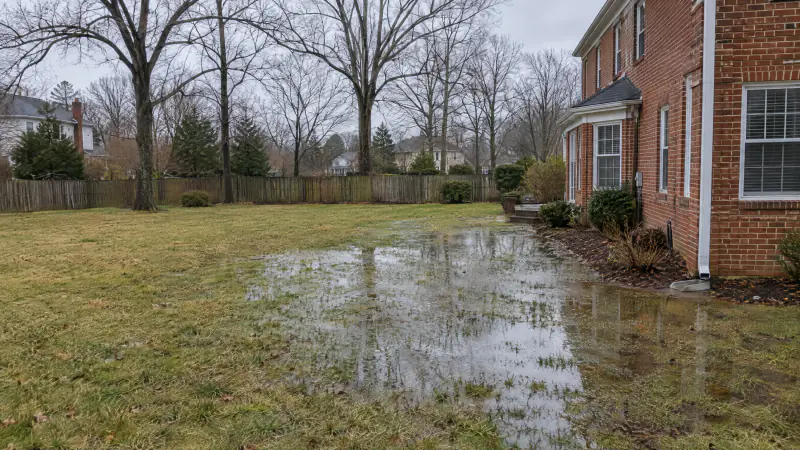
A French drain is a trench filled with washed stone around a perforated pipe, lined with filter fabric, that collects water moving through the soil and carries it downhill to an outlet. In sandy ground the stone also lets water soak away. In Northern Virginia clay it does not. The clay around the trench absorbs almost nothing, so the drain's only job is to collect the water held in the soil and move it somewhere lower. That single fact drives every design decision we make: the trench has to cut below the layer holding the water, the pipe has to fall continuously, and the outlet has to exist and sit lower than the problem. A French drain with no outlet in clay is a long, expensive bathtub.
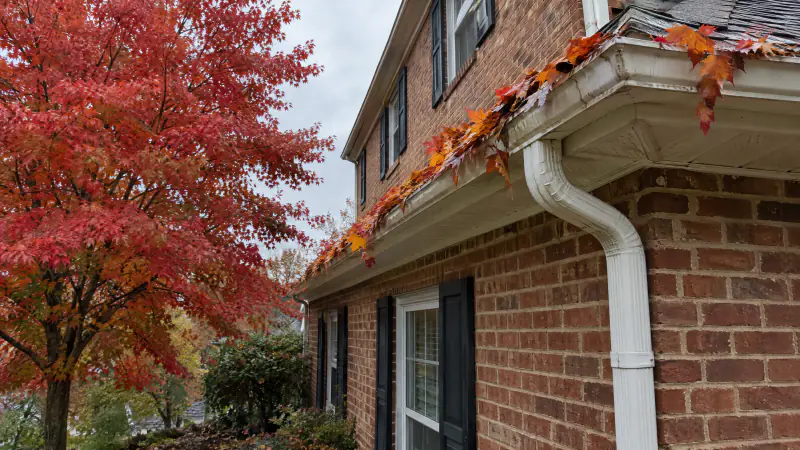
It also helps to know what a French drain is not. It is not the tool for water running across the surface, which wants grading or a catch basin, and it is not the tool for roof water, which travels in solid pipe. Our French drain vs. catch basin guide draws that line, and our article on why Northern Virginia backyards stay wet walks through the diagnosis that comes before any trench. This article assumes the diagnosis is done and the answer is a French drain. From here on, the question is how it should be built, and how to spot one that was not.
How is a proper French drain built, layer by layer?
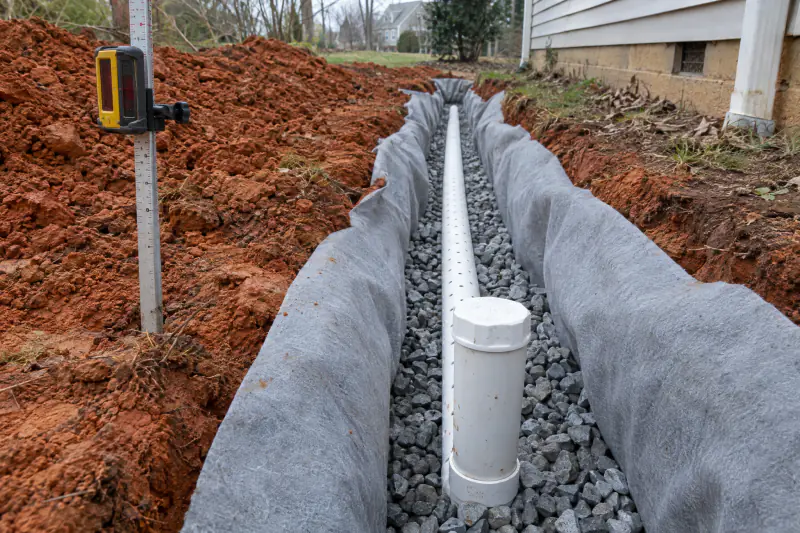
From the bottom up: a trench cut to a continuous slope, non-woven filter fabric lining the trench, a bed of washed stone, perforated pipe laid on the stone, more washed stone over and around the pipe, the fabric folded closed over the top, and then either topsoil and turf or exposed decorative stone at the surface. A cleanout rises to grade at the upper end and at any change of direction, and the pipe exits the far end into an outlet. Every one of those pieces is doing a job, and the next sections explain each one.
The dimensions that matter most are the trench and the slope. For a yard drain in Northern Virginia we typically cut 10 to 12 inches wide and 18 to 24 inches deep, enough to pass through the topsoil and into the clay that is holding the water. Drains intercepting a slope, or relieving a foundation wall, go deeper. Slope is the number most often skipped: the pipe needs a steady fall of at least 1 percent, about 1/8 inch per foot, and we prefer more where the yard allows it. On a 60-foot run that minimum means the outlet end sits at least 7 to 8 inches lower than the start. We shoot it with a laser level and check the pipe invert every few feet as it goes in, because a single flat section or a belly holds water and collects silt from the first storm on.
One rule shapes everything else: the fabric separates stone from clay, and nothing else does. Without it, the first wet season carries fine clay particles into the stone, and within a few years the trench is a solid, slow mass. With it, the stone stays open for decades.
What does each layer do, and what happens when it is skipped?
Every part of a French drain exists because clay punishes its absence.
| Layer | What we use | Why it matters | What happens when it is skipped |
|---|---|---|---|
| Trench | 10 to 12 in. wide, 18 to 24 in. deep for a yard drain, cut to a continuous slope | Reaches below the perched water and gives the pipe a steady fall | A shallow or flat trench sits above the water and holds it in bellies |
| Filter fabric | Non-woven geotextile lining the whole trench, folded over the top | Keeps clay fines out of the stone and pipe | Clay migrates into the stone and the drain silts solid within a few years |
| Stone | Washed, angular 3/4 in. stone, commonly sold as number 57 | Open voids carry water freely to the pipe; washed stone brings no fines of its own | Unwashed gravel or pea gravel packs tight and carries its own silt |
| Pipe | 4 in. rigid perforated PVC, perforations down, on a stone bed | Holds its grade, sheds silt, can be snaked or jetted | Corrugated pipe sags, traps sediment in its ridges and tears when cleaned |
| Cleanouts | Capped risers at the head of the run and at bends | Lets the line be flushed and inspected without digging | A clogged drain has to be excavated to find the problem |
| Outlet | Daylight, pop-up emitter, catch basin or sump basin, lower than the trench | Gives collected water a lawful place to go | Water fills the trench and seeps back into the clay it came from |
Dimensions are typical practice for residential yard drains; foundation-side and curtain drains differ.
Should the perforations face up or down?
Down, for a French drain in clay, and the reason is the water level inside the trench. Water enters the stone from the soil and collects at the bottom of the trench first, rising as more arrives. With the perforations at the bottom of the pipe, water enters as soon as it covers the lowest holes, and the pipe starts carrying it away while the water level in the trench is still an inch or two above the fabric. With the perforations facing up, the trench has to fill to the top of the pipe before any water gets in, which leaves about 4 inches of standing water in the stone after every storm, right where fine silt settles out. Pipe manufacturers' installation literature commonly shows dual-row perforated pipe installed with the holes at the bottom for this reason, and that is how we lay it.
The worry people have is that water will leak out of the holes once it is in the pipe. It cannot go anywhere useful, because the pipe sits on stone that is already full of water at that level, and water moves toward the lowest point available, which is the outlet. The only time perforated pipe belongs holes up is when it is meant to disperse water into soil, as in a septic leach field, which is the opposite of what a drain in clay is for.
Two related details. We do not rely on pipe that comes pre-wrapped in a thin fabric sock as the only filter, because a sock pressed against clay blinds over quickly, and the trench lining is what does the real work. And we never wrap stone in woven landscape fabric, which passes water poorly. The non-woven type lets water through and holds silt back.
Why does clay change the French drain design?
Because clay removes the margin for error. In well-draining soil a drain can be a little flat, a little shallow or a little short of an outlet and still work, because the surrounding ground absorbs what the pipe cannot carry. In the clay of Fairfax, Loudoun and Prince William the soil contributes nothing, and four design changes follow.
First, depth is set by the water, not by a rule of thumb. The trench has to cut below the layer holding the water, which we find with a probe and an auger before pricing. In many subdivisions built on compacted fill, that layer is 8 to 14 inches down, so a 20-inch trench clears it. On a lot with a seasonal water table, the drain may need to be 30 inches or deeper to lower the water enough to matter. Second, the outlet is the project. We confirm fall to an outlet with a level before anything else, because if the lowest lawful point on the lot is not several inches below the bottom of the planned trench, the drain needs a sump basin and pump, which changes the cost and the maintenance.
Third, placement goes uphill of the problem where possible. A curtain drain across a slope above the wet area intercepts water before it arrives, which works better than a trench through the middle of a soggy lawn. Fourth, the stone and fabric are not optional. Clay fines are so small that only the fabric stops them, and washed stone is the only stone that does not bring its own.
Eastern Fairfax County and parts of Alexandria add a fifth consideration: marine clay, which shrinks and swells as its moisture changes. Deep trenches near a foundation in those areas deserve a cautious design and sometimes an engineer's opinion, because a drain that dries soil unevenly beside a footing can cause the movement it was meant to prevent.
What does the installation sequence look like?
Most yard drains take one to four days once utilities are marked. The order matters more than the speed.
Levels and layout
We shoot elevations from the wet area to the outlet with a laser level, confirm there is enough fall, then paint the route on the lawn. Virginia 811 marks public utilities before any digging, and we locate private lines such as irrigation, lighting and pet fence wire with you.
Trench to grade
A mini excavator or trencher cuts the trench where access allows; behind a narrow gate it is hand work. The bottom is checked for slope every few feet. Spoil goes onto tarps or straight into a trailer, because excavated clay is hauled off, not put back.
Line with fabric
Non-woven geotextile is laid into the trench with enough excess on each side to fold over the top later. Overlaps run at least a foot in the direction of flow, and the fabric is held in place with stone as it is placed.
Bed and lay the pipe
Two to four inches of washed stone go in first and are leveled to the slope. Rigid perforated pipe is laid perforations down, joints coupled, with cleanouts at the head and at bends. We re-check the invert with the level before covering.
Stone, fold and finish
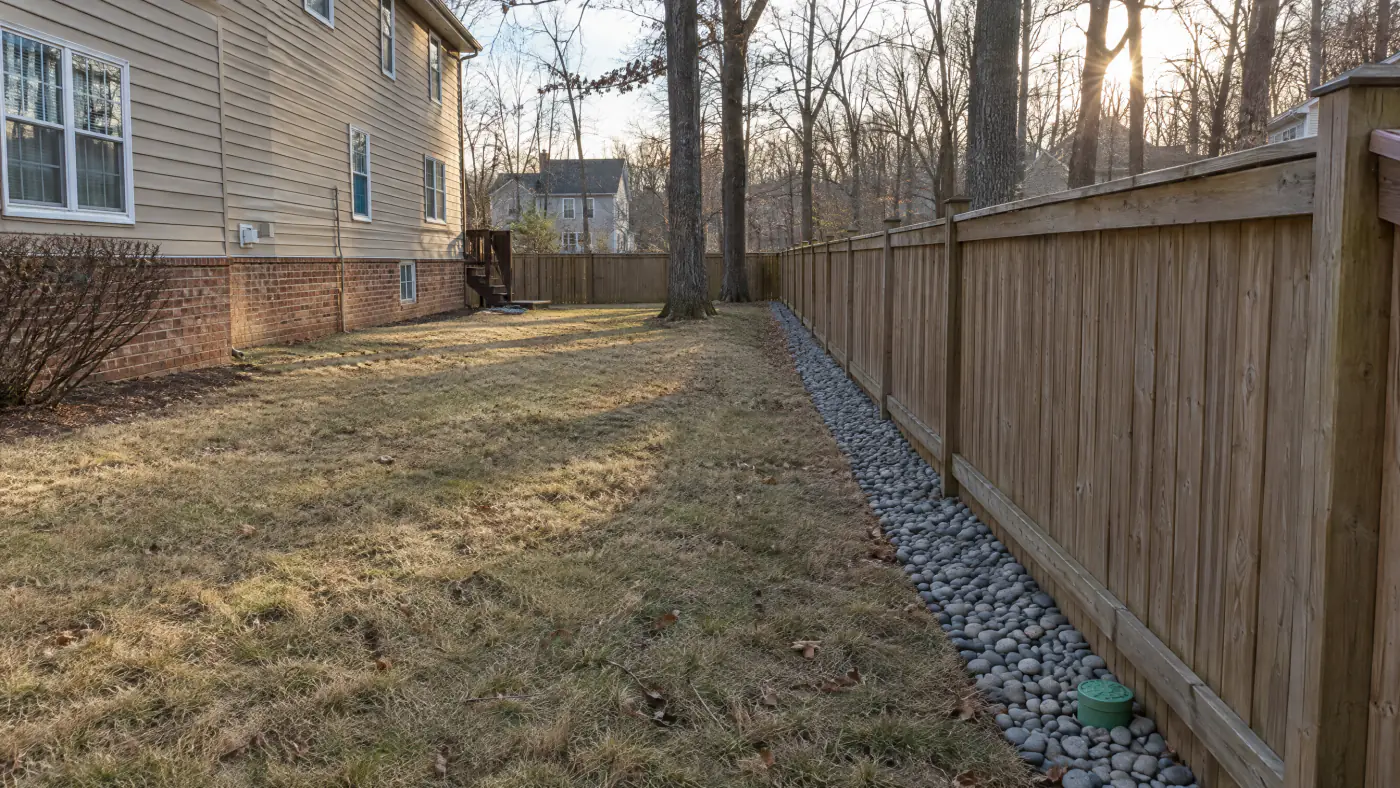
Stone is placed to within a few inches of grade, the fabric is folded closed over it, and the surface is finished with topsoil and sod or seed, or with decorative stone where the drain doubles as a dry creek edge.
Connect the outlet and test
The pipe runs solid, not perforated, from the end of the trench to the outlet. We run a hose at the cleanout and watch water arrive, then walk you through the cleanouts and the outlet so you know what to check each spring.
Why do French drains fail, and how quickly?
Five faults account for nearly every failed drain we open, and most of them show up within two to five years. No fabric is the most common: the trench was dug, filled with gravel and pipe, and buried, and clay has been migrating into the stone since the first storm. These drains slow down in a year or two and stop within five. No outlet is next, and it fails immediately; the drain fills, the water has nowhere to go, and the lawn is wet again as soon as the trench is full. We find pipes that end in the ground, pipes that end at a dry well that is itself full, and pipes that rise at the end because nobody checked the fall.
Corrugated pipe is the third. Thin flexible pipe is cheap and fast to lay, and it sags between the high spots in the trench bottom, forming bellies that hold water and sediment. Within a few seasons each belly is a plug. Flat or reversed slope is the fourth, and it can happen with good materials if the installer trusted an eye instead of a level. The fifth is a drain asked to do a job it was never meant for: downspouts tied into it, which flood the trench with roof water and push it back into the soil, or a trench cut too shallow, so the drain sits above the water it was meant to collect.
Two of the five can sometimes be fixed without rebuilding. A missing outlet can be added if there is fall, and a mis-sloped section can be re-laid. Silted stone and mud-filled corrugated pipe mean the run comes out and goes back in properly. If you are weighing repair against replacement on an existing drain, the test is simple: open it in two places and look at the stone.
How can you tell an existing drain is failing before the lawn tells you?
These signs show up a season or two before the yard goes fully wet again.
Water sitting at the cleanout
Lift the cap after a heavy rain. Water standing at or near grade in the riser means the run downstream is blocked or the outlet is not taking it.
Weak flow at the outlet
During a long rain the outlet of a working drain runs steadily. A trickle, or nothing, while the lawn above is soaked means the trench is not collecting or the pipe is choked.
A greener stripe over the trench
Lush growth directly above the drain line in July means the trench is holding water instead of moving it, and the roots above are drinking from it.
Orange silt at the emitter
Fine orange sediment around a pop-up emitter or at a daylight outlet is clay passing through the system, which means the fabric is missing or torn.
Settling along the line
A soft, sinking trench surface often means fine material is washing out of the stone and into the pipe or outlet, usually from an unlined section.
Where can a French drain discharge in Northern Virginia?
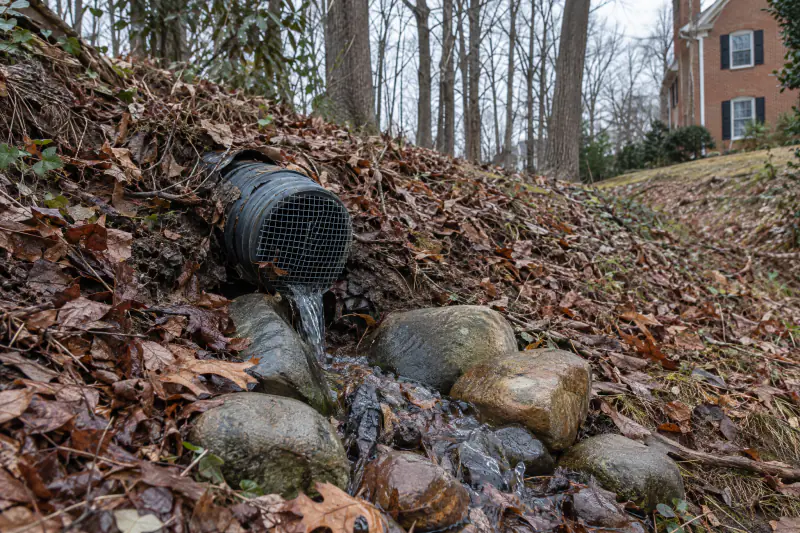
At the lowest lawful point on your own property, and the options rank by reliability. Daylight is best: the pipe emerges from a slope with a rodent screen on the end, has no moving parts, and can be watched working. Lots that fall to a rear woods line in Great Falls, Clifton or western Loudoun often have it. A pop-up emitter is the usual choice on a flatter suburban lot. The solid pipe ends at a spring-loaded cap set flush in the lawn at least 10 feet from the house where the ground keeps falling away; flow lifts the cap and it closes when the pipe empties. It needs a few inches of fall below the emitter to drain fully, or it holds water and freezes.
A catch basin can serve as an outlet where a drain joins a larger surface system and the basin itself is piped onward. A dry well is the weakest outlet in clay, because it depends on the surrounding soil to absorb what the drain delivers; where it is the only option, we size it conservatively and give it an overflow to daylight. On a lot with no fall at all, a sump basin at the low end collects the water and a pump lifts it to an emitter or another lawful discharge point. That adds a pump to maintain and electricity to run, which is why we try every gravity option first.
What is generally not allowed: discharging onto a neighbor's lot, into the sanitary sewer, or across a public sidewalk. Tying into a curb or a storm drain typically needs approval from the county, city or VDOT, depending on who maintains the street, and HOAs often have rules about visible outlets. Roof water from buried downspout lines can share an outlet with a French drain as long as it arrives in its own solid pipe and the outlet is sized for both.
How much does a French drain cost in Northern Virginia in 2026?
As of 2026, typical Northern Virginia market planning ranges for a yard French drain built with fabric, washed stone and rigid perforated pipe run roughly $30 to $90 per linear foot installed, and most residential projects fall between $2,500 and $10,000. Curtain drains on slopes and foundation-side drains sit at the upper end or above it, and a sump basin with a pump at the outlet typically adds $1,500 to $4,000. These are regional figures, not our prices and not a quote.
What moves the number, in rough order of weight:
- Length and depth. A 40-foot drain at 20 inches and an 80-foot drain at 30 inches are different projects, and the deeper one hauls away far more clay per foot.
- Access. A mini excavator through a 6-foot gate versus a crew with shovels behind a 4-foot gate can double the labor.
- Distance to the outlet. The solid pipe run from the trench to daylight or an emitter is often as long as the drain itself.
- Spoil removal. Excavated clay does not go back; it is loaded and hauled, and disposal is priced by the load.
- Obstacles. Tree roots, buried utilities, a patio or walk to tunnel under, and rock in the western part of the region.
- Restoration. Sod costs more than seed, and a decorative stone surface costs more than either.
Quotes that come in far under these ranges usually leave something out, and the sections above tell you what to ask about. For a number based on your levels and your outlet, the only reliable path is a written on-site estimate. Our cost guide places French drains beside the other drainage and hardscape projects, and you can request an estimate or call (571) 200-9600 when you are ready.
How do you judge a French drain quote?
A good proposal answers all of these without being asked.
- The depth of the trench, and the reason for it: which layer the drain cuts below.
- The slope of the pipe in inches per foot, and the elevation of the outlet relative to the trench.
- Non-woven filter fabric lining the full trench, named as such rather than as landscape fabric.
- Washed angular stone with its size stated, rather than gravel.
- Rigid perforated PVC pipe, perforations down, with solid pipe from the trench to the outlet.
- Cleanouts at the head of the run and at bends, shown on a sketch.
- The outlet type and location, with confirmation it sits on your property or is approved.
- Roof water kept in separate solid lines, never tied into the perforated run.
- Virginia 811 locate, private utility marking, spoil haul-off and lawn restoration included.
- A water test at completion with you present.
How do soil, rock and rules change a French drain in Fairfax, Loudoun, Prince William and Arlington?
The soil, the rock and the rules. Across the subdivisions of eastern Loudoun and western Prince William, from Ashburn, South Riding and Aldie to Gainesville, Haymarket and Bristow, drains usually cut through compacted construction fill into a perched layer a foot or so down, and the outlet is often a rear drainage easement that has to stay open and cannot be filled. In western Loudoun around Leesburg and Purcellville, and across parts of Manassas and Chantilly, red soils over shallow bedrock are common, and a trench that hits rock at 14 inches changes the plan on the spot; we budget for it when the probe tells us to.
Inside the Beltway, in Arlington, Falls Church, Alexandria and the McLean and Vienna parts of Fairfax County, lots are older and tighter, trees are larger, and the drain often has to be hand dug around roots and the utility services of a house built in the 1950s. Eastern Fairfax County and Alexandria add marine clay, which Fairfax County maps, so deep excavation near a foundation there is handled cautiously. Along the Potomac in Lorton, Woodbridge and Dumfries, seasonal water tables run high, and drains go deeper and need a dependable outlet.
A yard French drain does not usually require a building permit, but check with your county: larger land-disturbing projects can trigger a grading permit, work near a stream or wetland may fall inside a protected buffer, and HOAs across the region review visible outlets and changes to grade. Water that is reaching a basement is a related but different project, covered in our article on exterior fixes for water in the basement, and if the real problem turns out to be surface water, yard drainage is the page to read. We install drains throughout the counties and cities listed on our service areas page.
Frequently asked questions
How deep should a French drain be in clay soil?
Deep enough to cut below the layer holding the water, which is the only honest answer. For most Northern Virginia yard drains that means 18 to 24 inches, because the perched layer over compacted clay usually sits 8 to 14 inches down. Curtain drains on slopes and drains lowering a seasonal water table often go 30 inches or more. Depth is also limited by the outlet, since the pipe has to keep falling the whole way there.
How long does a French drain last in Northern Virginia?
A drain built with non-woven fabric, washed stone and rigid perforated pipe on a measured slope can work for decades, and the cleanouts let it be flushed if leaves or grit ever reach it. Drains built without fabric, with unwashed gravel, or with corrugated pipe commonly slow within a year or two and fail within five in clay, because fines pack the stone and sediment settles in the pipe bellies.
Can a French drain be installed without an outlet?
Not usefully, in clay. A trench with no outlet is a storage tank, and once the stone is full the water has nowhere to go but back into the soil it came from. Where a lot has no downhill point, the options are a dry well with an overflow for small volumes, or a sump basin and pump at the low end of the drain that lifts water to a lawful discharge point. Both add cost and maintenance, which is why we confirm fall before pricing.
Is corrugated pipe ever acceptable for a French drain?
We do not use it for buried yard drains in clay. Single-wall corrugated pipe sags between high spots in the trench, its ridges trap sediment, and cleaning tools tear it. It is cheaper and faster to lay, which is why it appears in so many failed drains we open. Rigid perforated PVC holds its grade, sheds silt and can be snaked or jetted from a cleanout, and the material difference is a small share of the project cost.
Can I connect my sump pump or downspouts to a French drain?
No. Both deliver water in bursts, and perforated pipe pushes that burst out into the stone and the surrounding clay, flooding the trench you built to dry the soil. Roof water and sump discharge travel in their own solid pipe to an outlet. They may share the final outlet with a French drain if it is sized for all of them and each line arrives solid. Keeping the systems separate is one of the first things we check on a quote.
Does a French drain need a permit in Fairfax or Loudoun County?
A yard drain on your own lot usually does not need a building permit, but it depends on scope and location. Each county regulates land disturbance above a set area, so a long, deep drain with significant grading may need a permit, and work near streams, wetlands or inside a recorded drainage easement often needs approval. Tying into a curb or storm drain generally does too. Check with your county and your HOA before the trench is cut.
Will a French drain dry out a wet basement?
Sometimes, when the water is coming from saturated soil beside the wall. A drain set a few feet out from the foundation, below the level where water enters but above the footing, can lower the soil water and relieve the pressure. It does not help when the water is roof runoff pooling at the wall, which needs downspout lines and grading, or when water is rising through the floor slab, which usually calls for an interior system.
Book the work
Put the plan in writing with a crew that builds this every week.
One visit to measure and talk through options, then a written scope and price. No pressure, no vague numbers. Ask about the Heroes Discount if you serve.
Sources and further reading
- Virginia Cooperative Extension, soil and drainage publications
- Virginia 811 (Miss Utility): call before you dig
- Fairfax County Land Development Services: grading permits and marine clay information
- Prince William County government: land development and permits
- Advanced Drainage Systems: drainage pipe technical literature
Published February 26, 2026. Reviewed and updated October 9, 2026.