Key takeaways
- As typical 2026 Northern Virginia market ranges, asphalt runs roughly $6 to $12 per sq ft, poured concrete $8 to $18, interlocking pavers $25 to $45 and permeable pavers $30 to $55.
- Asphalt commonly lasts 15 to 25 years with sealing, concrete 25 to 40, and a paver driveway on a proper base for decades, with individual units replaced as needed.
- Freeze-thaw and deicing salt attack poured concrete hardest, soften asphalt least, and barely affect pavers rated for paving, which are denser and stronger than a slab.
- A driveway needs 8 to 12 in. of compacted base on clay, about twice a patio, plus a curb or heavy edge restraint, because tires push outward far harder than feet.
- Permeable pavers on clay need an underdrain. The apron at the street usually needs a right-of-way permit from VDOT or the city, and most HOAs review driveway material and color.
On this page
- Paver, asphalt or concrete: which driveway is right for a Northern Virginia home?
- How do paver, asphalt and concrete driveways compare?
- How much does each driveway cost in Northern Virginia in 2026?
- How long does each driveway last in Northern Virginia?
- How do pavers, asphalt and concrete handle freeze-thaw and deicing salt?
- Which driveway is easiest to repair?
- Why does a driveway need a deeper base than a patio?
- Are permeable pavers worth it for stormwater on Northern Virginia clay?
- Which driveway looks best, and what do buyers actually think?
- Which driveway is easiest to plow and shovel?
- What do HOAs, VDOT and the county say about a new driveway?
- What is different in Fairfax, Loudoun, Prince William, Arlington and Alexandria?
- How do you decide between pavers, asphalt and concrete?
- Frequently asked questions
Paver, asphalt or concrete: which driveway is right for a Northern Virginia home?
Asphalt is the cheapest driveway to install, poured concrete lasts longer but cracks on clay, and interlocking pavers cost the most up front and are the only one of the three you can repair without a visible patch. That is the honest short version. As of 2026, typical Northern Virginia market ranges run roughly $6 to $12 per square foot for asphalt, $8 to $18 for concrete and $25 to $45 for pavers, so a two-car driveway of 700 sq ft spans anywhere from about $4,000 to over $30,000 depending on the surface. Those are planning ranges, not our prices, and we install pavers only, so for asphalt and concrete you should get written quotes from contractors who pour them.
Which one is right depends on how long you plan to stay, how much you care about the look from the street, how your soil behaves, and whether you want a surface that can be opened and closed for a future gas line, drain or repair. Northern Virginia clay moves. It swells when wet, shrinks when dry and heaves when frozen. A rigid slab can only respond to that by cracking. Asphalt bends a little, then ruts and crumbles at the edges. A paver driveway is a flexible pavement of thousands of units that move slightly and settle back, and the one that has settled can be lifted and relaid.
The rest of this article goes through cost, lifespan, freeze-thaw and salt, repairability, appearance, the base each one needs, permeable options for stormwater, HOA and permit rules, snow removal and what buyers think, one at a time. Where we have a stake, we say so. Our paver driveway page describes what we build; this is the comparison we would want before choosing.
How do paver, asphalt and concrete driveways compare?
A side-by-side view for Northern Virginia conditions. Cost figures are typical 2026 market planning ranges, not myYardPros prices.
| Interlocking pavers | Asphalt | Poured concrete | |
|---|---|---|---|
| Installed cost per sq ft, 2026 | About $25 to $45, permeable $30 to $55 | Roughly $6 to $12 | Roughly $8 to $18 |
| Typical service life | Decades, units replaced as needed | About 15 to 25 years with sealing | About 25 to 40 years |
| Freeze-thaw on clay | Flexes, joints absorb movement | Flexes, then ruts and cracks | Cracks and heaves at joints |
| Deicing salt | Tolerated by paving-rated units, follow maker's guidance | Little effect on the asphalt itself | Surface scaling, worst in the first winters |
| Repairs | Lift, fix base, relay same units | Patch or overlay, patch stays visible | Patch never matches, panel replacement |
| Base under the surface | 8 to 12 in. compacted aggregate, curb or restraint | Typically 6 to 8 in. stone under 2 to 3 in. asphalt | Typically 4 in. stone under a 4 to 6 in. slab |
| Time before driving on it | Right after compaction, longer with polymeric sand | A day or two, soft in heat for weeks | About 7 days, full strength in 28 |
| Appearance | Patterns, colors, borders | Uniform black, fades to gray | Broom finish, stamped or exposed aggregate |
| Snow removal | Shovel, blower, rubber-edged plow | Any method | Any method, avoid metal gouges |
Lifespans assume a properly built base. On a thin base every one of the three fails early.
How much does each driveway cost in Northern Virginia in 2026?
As of 2026, typical Northern Virginia market ranges put asphalt at roughly $6 to $12 per square foot installed, poured concrete at roughly $8 to $18, interlocking concrete pavers at about $25 to $45 and permeable pavers at about $30 to $55. For a common two-car driveway of 600 to 1,000 sq ft, that works out to roughly $4,000 to $12,000 for asphalt, $5,000 to $18,000 for concrete, and $15,000 to $50,000 for pavers. These are planning ranges, not myYardPros prices, and we do not install asphalt or poured concrete, so treat those two figures as what we see in the market rather than something we can quote.
Every one of those ranges moves with the same things. Demolition and disposal of the old surface, which is heavier and slower for a reinforced slab than for asphalt. Excavation depth and how much clay has to be replaced where it is soft. Base thickness. Edge detail, from a plain asphalt edge to a concrete curb to a paver soldier course. Drainage, including a channel drain at the garage if the drive slopes toward the house. Apron requirements at the street. For pavers, pattern and border add cutting time; for concrete, stamping and color add a lot; for asphalt, a second lift or a thicker section adds a little.
Then there is the cost after installation. Asphalt is commonly sealcoated every three to five years and usually needs an overlay or replacement at the end of its life, so its 20-year cost is higher than the first invoice. Concrete has little upkeep until it cracks, and then repairs are patches. Pavers can be cleaned, re-sanded and sealed at about $1.50 to $4 per square foot when you choose to, and a settled area is relaid rather than replaced. Our cost guide lines these up with every other exterior project, and for the patio version of the same arithmetic see how much a paver patio costs. A site visit and a written estimate is the only way to turn any of this into a real number for your lot.
How long does each driveway last in Northern Virginia?
With a proper base, asphalt commonly lasts about 15 to 25 years, poured concrete about 25 to 40 years, and a paver driveway for decades, because worn or damaged units are replaced one at a time rather than the whole surface reaching an end date. Those are typical figures for residential driveways in our climate, and the base matters more than the material. Any of the three laid over loose fill or saturated clay will fail in a fraction of that time.
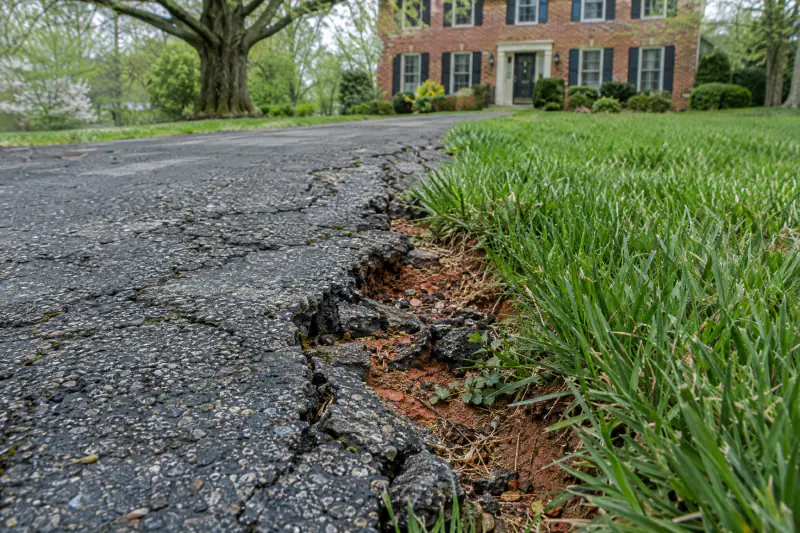
Asphalt ages from the top and the edges. Sun oxidizes the binder, the surface turns gray and brittle, and water gets into the cracks and freezes. Sealcoating every few years slows that down. Edges crumble first because asphalt has no edge restraint of its own. By year 15 to 20, most asphalt driveways in Northern Virginia have been patched a few times and are ready for an overlay or a tear-out.
Concrete ages from the joints and the surface. Control joints are cut so the slab cracks where you want it to, but clay movement, tree roots and freeze-thaw open cracks across panels too. Surface scaling from salt and freezing takes the top layer off in flakes. A well-built concrete driveway in Vienna or Burke can look good for 30 years; one poured on wet clay in a new subdivision can tilt at the joints in five. Pavers age differently. The surface can fade slightly over many years and joint sand needs topping up, but there is no slab to crack. A properly built base keeps the units level, and when something does settle, the fix is local. For which pavers handle our winters best, see choosing pavers for freeze-thaw.
How do pavers, asphalt and concrete handle freeze-thaw and deicing salt?
Freeze-thaw hurts poured concrete most, asphalt in a slower way, and paving-rated pavers least. Northern Virginia winters bring dozens of freeze-thaw cycles, and water that gets into a surface expands by about 9 percent when it freezes. Poured concrete driveways are typically mixed to around 3,000 to 4,000 psi and absorb water readily unless sealed. Concrete pavers made to the paving standard are pressed at the factory to an average compressive strength of at least 8,000 psi with water absorption of 5 percent or less, which is why they shrug off cycles that scale a slab. Asphalt does not spall, but water in its cracks freezes and widens them, and the surface softens and ruts in July heat.
Salt makes it worse for concrete. Deicers do not attack concrete chemically so much as increase the number of freeze-thaw cycles at the surface, and a slab in its first winter is most vulnerable. The result is scaling: the top layer flakes off and exposes the aggregate. Many concrete contractors tell homeowners to avoid deicers entirely for the first year. Asphalt is largely indifferent to rock salt. Pavers tolerate ordinary rock salt well, though manufacturers commonly advise sparing use, avoiding deicers with magnesium chloride or ammonium compounds, and waiting through the first winter where possible. Follow the guidance for your specific product.
The joints matter too. Paver joints filled with polymeric sand resist washout and ice better than plain sand. Where salt and plowing are regular, choosing a paver with a chamfered edge and keeping joints full keeps the surface tight. We cover deicers, plowing and winter care for pavers in snow, salt and pavers. Whatever the surface, the biggest freeze-thaw risk is water under it, which is a drainage problem, not a material one.
Which driveway is easiest to repair?
Pavers are easiest to repair invisibly, asphalt is easiest to repair cheaply, and concrete is the hardest to repair at all. When a paver driveway settles over a trench or an oil stain will not lift, the affected units are pulled, the base is corrected or the stained paver swapped, and the same units go back. A few hours later it looks like it did on day one. That matters more than it sounds. Northern Virginia yards get opened up for gas lines, sump discharge, irrigation and lighting, and a driveway you can close back up without a scar saves a lot over 20 years.
Asphalt repairs are inexpensive and visible. Cracks are filled with hot or cold sealant, holes are patched, and the whole surface can be overlaid with a new lift when it gets tired, as long as the base is sound. The patches never match the surrounding color and the overlay raises the surface, which can create a lip at the garage and the street. Concrete repairs are the problem child. A patch in a broom-finished slab is always a different color and texture, a cracked panel can be sawn out and repoured, and a tilted panel can sometimes be lifted by injecting material under it, but none of those blends in. Stamped and colored concrete is worse, because the color and pattern cannot be reproduced in a small area. That is the same reason we compare pavers and stamped concrete the way we do for patios.
Edge damage follows the same ranking. Asphalt edges crumble and get patched. Concrete edges chip and stay chipped. Paver edges are held by a curb or heavy-duty restraint, and if a snowplow catches a border unit, that unit is replaced.
Why does a driveway need a deeper base than a patio?
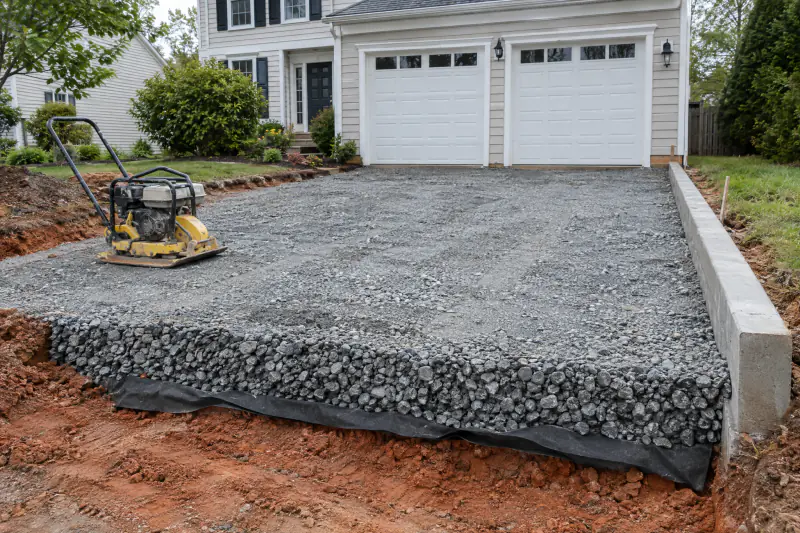
A driveway carries wheel loads that are concentrated and moving, so it needs about twice the base a patio does. A person standing on a patio puts a few pounds per square inch on the surface. A car tire puts its share of a 4,000 lb vehicle through a contact patch the size of a hand, and a delivery truck multiplies that. Turning tires also drag the surface sideways. On a patio in Northern Virginia we excavate 7 to 9 in. and compact 4 to 6 in. of aggregate. On a paver driveway we excavate 12 to 16 in., lay geotextile over the clay, and compact 8 to 12 in. of dense-graded aggregate in lifts, with more where the subgrade is soft or wet.
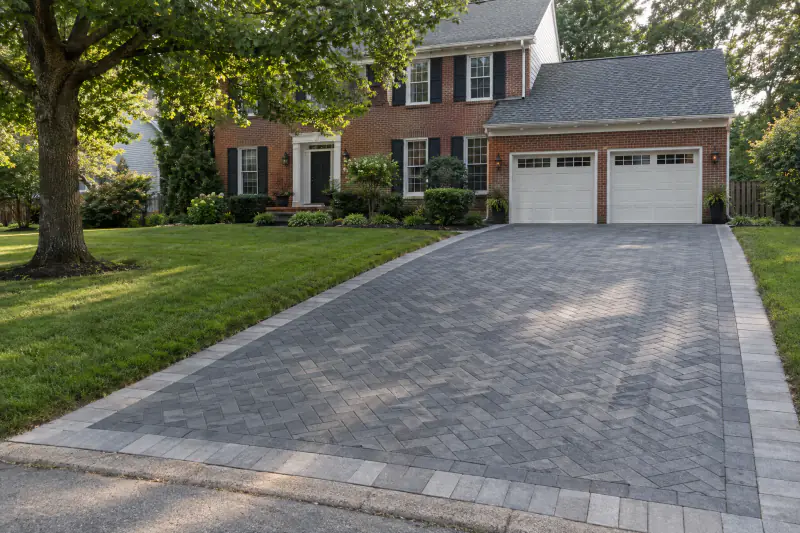
The pavers are thicker too, about 3 1/8 in. (80 mm) instead of the 2 3/8 in. (60 mm) used on patios, and they are laid in herringbone, which locks each unit against its neighbors in both directions so tires cannot creep them. The perimeter is held by a concrete curb or a heavy-duty restraint, because the outward push from a turning car is many times what a patio edge sees. The surface pitches about 1 to 2 percent toward the street or a drain, never toward the garage.
Asphalt and concrete need more than they usually get, too. A typical residential asphalt section is 2 to 3 in. of asphalt over 6 to 8 in. of compacted stone; many failed driveways we remove had half of that. A concrete driveway is usually a 4 in. slab, 5 to 6 in. where trucks park, over about 4 in. of stone, with reinforcement and control joints. The thin part of all three systems is the clay underneath, and that is why geotextile, soft-spot replacement and drainage before the base are the parts of a driveway bid worth reading twice. The cheapest bid in any material is almost always thin where you cannot see it. The process we follow for every hardscape is on our hardscaping page.
Are permeable pavers worth it for stormwater on Northern Virginia clay?
Permeable pavers are worth it when runoff from your driveway is a problem you already have, when your lot is tight against impervious-cover limits, or when you want the driveway to hold rain instead of sending it to the garage, the lawn or the street. They are not worth it as a way to make clay absorb water, because clay will not. A permeable paver system uses units with wider joints filled with small clean stone, over an open-graded stone base with no fines, so rain falls through the joints and into the base, which stores it. On sandy soil that water soaks away. On Northern Virginia clay it mostly does not, so the system needs an underdrain: a perforated pipe in the base that carries stored water to an outlet.
Built that way, a permeable driveway behaves like a buried detention tank with a driveway on top. Peak runoff drops, the garage stops flooding, and puddles disappear. The base is usually deeper than a standard paver driveway, which is why permeable pavers run about $30 to $55 per square foot as a typical 2026 market range. Maintenance is simple but real: the joints have to stay free of sediment, which means occasional vacuuming or sweeping and not dumping mulch or soil on the drive.
Whether a permeable driveway counts as pervious for lot coverage, or earns stormwater credit, depends on the jurisdiction. Fairfax County, Loudoun County and Arlington County each have their own stormwater rules, and Chesapeake Bay Resource Protection Areas near streams add limits. Ask the county before you count on a credit. If the real problem is water reaching the house, a drainage plan may solve it for less than a permeable driveway, and the two are often combined.
Which driveway looks best, and what do buyers actually think?
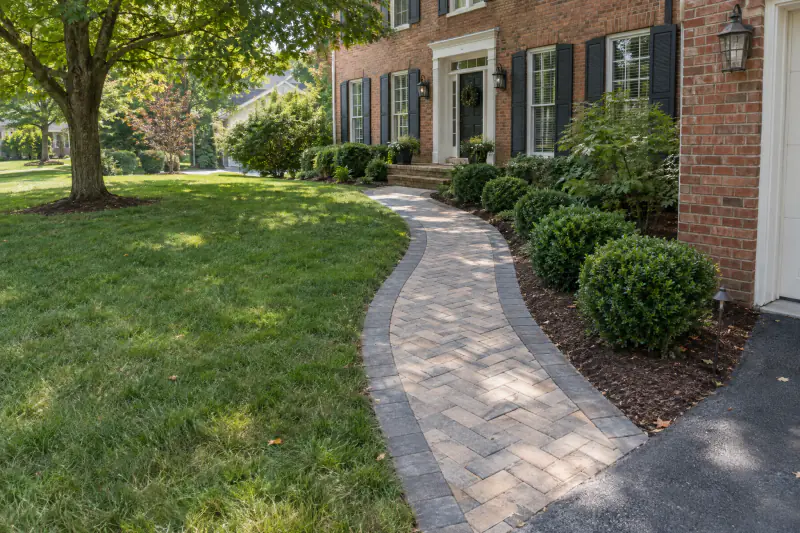
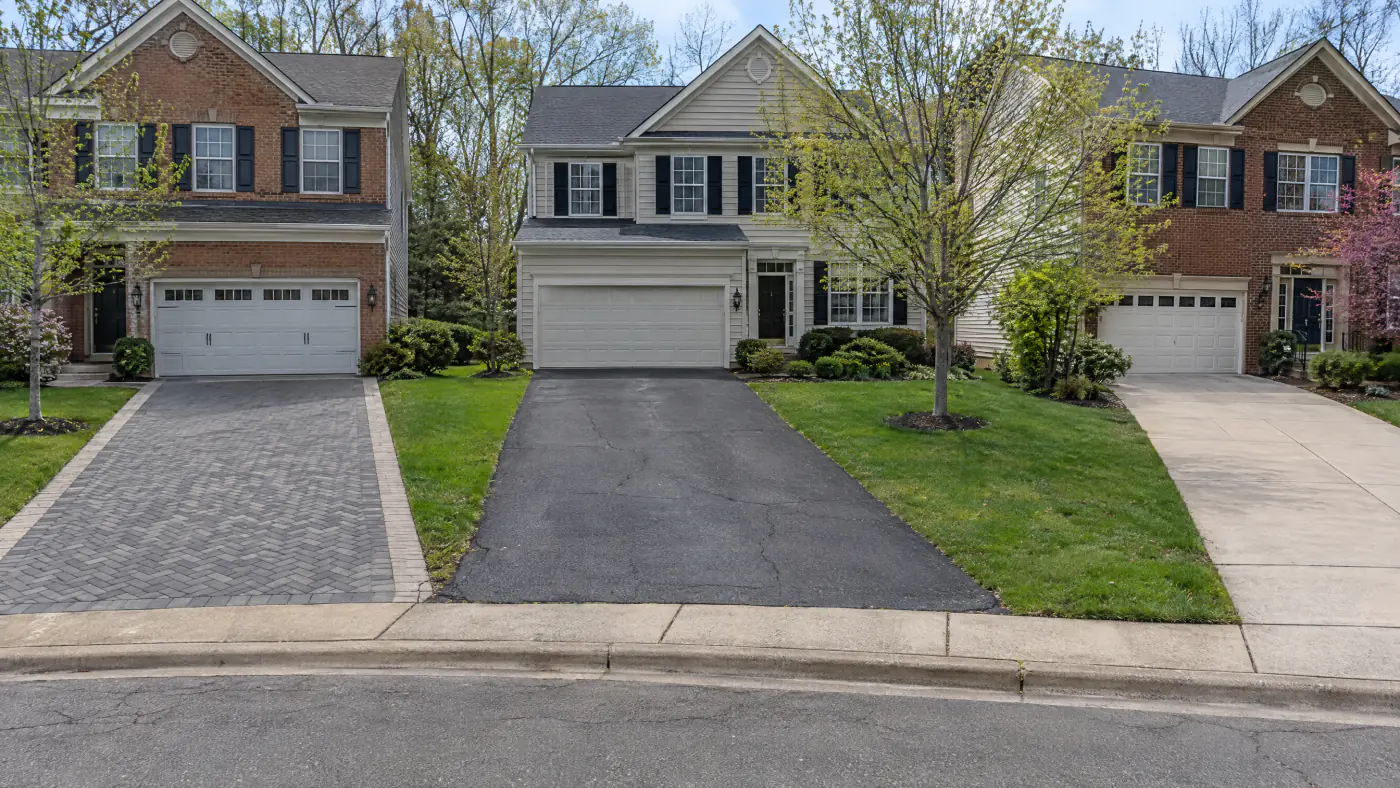
Pavers offer the most control over appearance, concrete the most finishes, and asphalt the least. A paver driveway can match the brick on a Georgian in McLean, pick up the gray of a stone-front colonial in Ashburn, or run a plain charcoal herringbone with a light border that reads as crisp and modern. Patterns, borders, aprons and bands let the drive relate to the front walk and the entry. Concrete can be broom-finished, exposed-aggregate or stamped and colored, and it looks clean when new; its weakness is that cracks and patches show on a plain surface. Asphalt is black, then gray, and looks best right after sealing.
On resale, we will not give you a number, because we do not have an honest one and we would be wary of anyone who does. What we can say from the properties we work on is that buyers respond to condition and coherence. A level driveway with no cracks, no puddles and clean edges shows well in any material. A cracked, heaved or crumbling driveway raises questions about what else was neglected, and it shows up in inspection reports. A paver driveway that matches the walkway and the front steps makes the whole front of the house look finished, and in neighborhoods where pavers are common, such as parts of Great Falls, Oakton and Leesburg, an asphalt drive can look like the exception.
Color fade is the appearance question people ask most. Concrete pavers lose a little surface color over many years, and a cleaning and sealing keeps them rich. Stamped concrete depends entirely on its sealer, and when it wears through the color goes with it. Asphalt fades fastest and is restored by sealing. Our paver cleaning and sealing page covers what keeps a paver drive looking new.
Which driveway is easiest to plow and shovel?
All three can be shoveled, blown and plowed, and the differences are in the details. A smooth concrete or asphalt surface clears easily with any shovel or blade. Asphalt is forgiving of metal edges. Concrete takes gouges from a steel plow blade run hard, and salt used to clear it causes scaling in the early years. Pavers with a chamfered edge shovel and snow-blow like any other surface; the one rule for plowing is a rubber or polyurethane blade edge, or plow shoes set to ride slightly above the surface, so the blade does not catch a unit. If a plow does catch a border paver, the repair is one paver.
Ice is a drainage problem before it is a surface problem. Any driveway that holds water in a low spot will hold ice there in January. The 1 to 2 percent pitch to the street or a drain, with no low panel at the garage door, matters more than the material. Permeable pavers have an edge here: with no standing water on the surface, there is less to freeze, and the stored water in the base is below the surface.
For deicers, the ranking is simple. Asphalt does not care. Pavers tolerate ordinary rock salt, and most manufacturers advise sparing use and avoiding products with magnesium chloride. Poured concrete is the one to protect, especially in its first winter. Sand gives traction on all three without chemical risk. The details of what to spread and what to avoid on pavers are in snow, salt and pavers, and the same guidance appears in our maintenance guide.
What do HOAs, VDOT and the county say about a new driveway?
Three sets of rules touch a driveway in Northern Virginia, and the one at the street surprises people most. The apron where your driveway meets the road usually sits in the public right-of-way. In Fairfax, Loudoun and Prince William counties most residential streets are maintained by VDOT, so work on the apron generally needs a VDOT land use permit, and VDOT and some localities have rules about apron material and dimensions. Arlington County and the cities of Alexandria, Falls Church, Fairfax and Manassas maintain their own streets and issue their own right-of-way permits. Check which applies before planning pavers to the curb.
On your own lot, replacing a driveway in the same footprint typically needs no building permit. Widening it, adding a parking pad or a turnaround, or changing where it meets the street can raise zoning questions about front-yard coverage, impervious area and setbacks, and some jurisdictions limit how much of a front yard may be paved. Townhome lots in Sterling, Centreville and Woodbridge often have the tightest coverage limits. The county zoning office can answer in a phone call.
HOAs are the third layer. Most associations treat the driveway as a visible exterior element and require architectural approval for a change in material or color, and some restrict pavers, colors or borders to a palette. Submitting a plan with a sample and a photo of a similar driveway in the community usually goes smoothly. Our guide to HOA approval for exterior projects covers the application. Virginia 811 marks public utilities before any excavation; private lines such as irrigation and lighting are located separately.
What is different in Fairfax, Loudoun, Prince William, Arlington and Alexandria?
Driveways behave differently across Northern Virginia because the soil and the street rules change, even though the materials do not. In newer communities in Ashburn, South Riding, Bristow and Gainesville, lots were mass-graded and the driveway often sits on fill. Concrete driveways there tilt at the joints when the fill settles, and asphalt ruts. Any replacement, in any material, needs the soft spots dug out and the base compacted properly. Access is good and lots are wide, which helps the cost.
In the older neighborhoods of Arlington, Alexandria, Falls Church, Vienna and Annandale, driveways are narrow, often shared, and shaded by mature oaks whose roots lift slabs. Pavers handle roots better than a slab because a lifted section can be relaid, and we route the base around major roots where we can. Right-of-way work in these cities goes to the city, not VDOT, and lot coverage rules are tight on small lots. In Fairfax County, mapped problem soils, including marine clays near Lorton, Springfield and Mount Vernon, make base depth and drainage even more important, and the county's stormwater rules influence whether a permeable driveway earns credit.
Loudoun County has pockets of shrink-swell soil, particularly in the eastern county, where driveways move seasonally; a flexible paver system suits those lots better than a rigid slab. In Prince William, along the Potomac in Woodbridge and Dumfries, high water tables mean a permeable base needs a dependable outlet. Western Loudoun around Leesburg and Purcellville adds steeper, longer driveways where a retaining wall sometimes holds the edge. All of the localities we cover are listed under service areas.
How do you decide between pavers, asphalt and concrete?
Answer these and the choice usually makes itself.
- How long do you plan to stay? Under five years favors asphalt; longer favors concrete or pavers.
- Does the driveway tilt, crack or crumble now? If yes, the base must be rebuilt in any material.
- Will the yard be opened later for gas, drains, irrigation or lighting? Pavers close back up without a scar.
- Does water run toward the garage or pool at the street? Fix the pitch, and consider permeable pavers.
- Does your HOA allow the material and color you want, and does the apron need a VDOT or city permit?
- Is the front walk being replaced too? Matching walk and driveway usually costs less done together.
- Will you use deicers heavily? Concrete suffers most, so plan to protect it or choose otherwise.
- Have you compared bids on base depth and compaction, not just the surface and the total?
Frequently asked questions
Is a paver driveway really worth three times the cost of asphalt?
It depends on how long you will own the house and what you value. Over 20 years, asphalt is usually sealed several times and replaced once, which narrows the gap. Pavers add a repairable surface, a look that can match the house, and no end-of-life replacement. If you plan to move within a few years, asphalt or concrete is the sensible financial choice. If you plan to stay, pavers often are.
Which driveway surface handles Northern Virginia clay best?
A flexible surface on a deep compacted base. Pavers are built for that: individual units over 8 to 12 in. of compacted stone with geotextile between the stone and the clay. Asphalt is also flexible but has no edge restraint and softens in heat. Poured concrete is rigid, so clay movement shows up as cracks and tilted panels. In every material, replacing soft clay and compacting the base matters more than the surface.
How soon can I drive on a new driveway?
Pavers can carry a car as soon as the surface is compacted, though polymeric joint sand needs a day or two to set, depending on the product and weather. Asphalt can usually be driven on within a day or two but stays soft in summer heat for weeks, so avoid parking in the same spot or turning the wheels while stopped. Concrete should cure about seven days before vehicles and reaches design strength at about 28 days.
Can I put pavers only on the apron or a border and keep the asphalt?
Yes. A paver apron at the garage, a border along both edges, or a band across the drive is a common way to add definition without replacing the whole surface. The paver sections need their own compacted base and edge restraint and must meet the asphalt at the same height. It is also a reasonable first phase if you plan to replace the full driveway later.
Do permeable pavers reduce my stormwater or impervious area for the county?
Sometimes, and only if the jurisdiction recognizes them. Fairfax, Loudoun, Prince William and Arlington each have their own stormwater and lot-coverage rules, and treatment of permeable pavement varies. On clay the system needs an underdrain to function, and some localities require a design showing that. Ask the county stormwater or zoning office before relying on a credit, and keep the joints clear so the system keeps draining.
Will a snowplow damage a paver driveway?
Not if the plow uses a rubber or polyurethane blade edge, or plow shoes that keep the steel slightly above the surface. Pavers with chamfered edges give the blade nothing to catch. Tell your plow service the driveway is pavers before the first storm. If a border unit is ever caught and chipped, that single paver is replaced, which is the kind of repair concrete and asphalt cannot offer.
What happens to the old driveway when it is replaced?
It is broken up, loaded and hauled to a recycling facility; both asphalt and concrete are routinely crushed and reused as aggregate. Removal and disposal is a real line item that should appear on every bid, with the heaviest cost for thick reinforced concrete. Laying a new surface over a failing old one is rarely a good idea, because the old surface carries the base problem upward.
Book the work
Put the plan in writing with a crew that builds this every week.
One visit to measure and talk through options, then a written scope and price. No pressure, no vague numbers. Ask about the Heroes Discount if you serve.
Sources and further reading
- Concrete Masonry & Hardscapes Association (formerly ICPI): interlocking and permeable pavement guidance
- Fairfax County Land Development Services: permits, zoning and stormwater
- Arlington County government: permits and right-of-way
- NOAA National Centers for Environmental Information: U.S. Climate Normals
- Belgard: paver and permeable paver technical literature
Published March 19, 2026. Reviewed and updated October 9, 2026.