Key takeaways
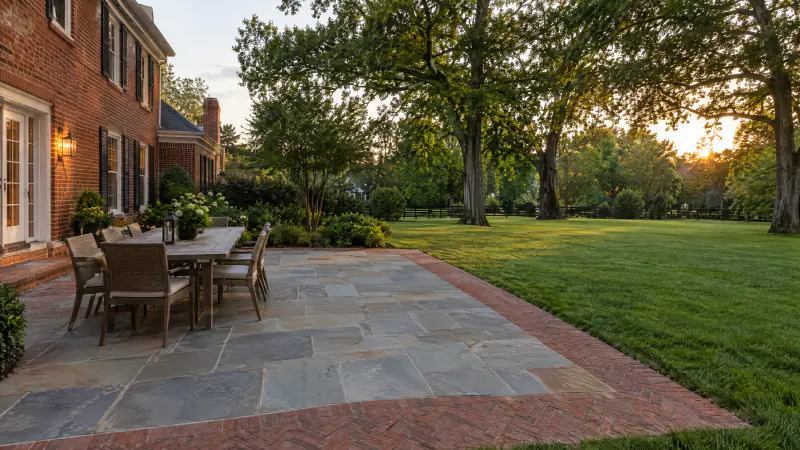
- As of 2026, typical Northern Virginia market ranges run about $20 to $35 per sq ft for concrete pavers and $30 to $55 or more for porcelain and natural stone, installed.
- A simple 300 sq ft concrete paver patio commonly totals $6,000 to $10,500 and a 500 sq ft one $10,000 to $17,500 before steps, walls, lighting or drainage.
- Excavation depth, clay haul-off, access, old slab removal and drainage move the number more than the paver you pick. Small patios cost more per square foot.
- Read every bid for excavation depth, base thickness, compaction method, bedding sand, edge restraint and joint sand. A quote that lists only pavers and labor is hiding something.
- The cheapest bid usually saves money below the surface. On Northern Virginia clay, a thin base is the one shortcut that shows up within three winters.
On this page
- How much does a paver patio cost in Northern Virginia in 2026?
- What are the 2026 planning ranges by paver type?
- How does design complexity change the price per square foot?
- What would a 300 or a 500 square foot patio cost in 2026?
- Worked examples: 300 and 500 square foot patios side by side
- What drives the cost of a paver patio on Northern Virginia clay?
- Where do patio quotes hide cost?
- How do you compare patio bids line by line?
- Why does the cheapest base fail first on clay?
- What do steps, seating walls, lighting and drainage add to a patio budget?
- How do patio costs differ across Fairfax, Loudoun, Prince William and Arlington?
- When is the best time to get patio pricing, and does the season change it?
- How do you turn a planning range into a real number?
- Frequently asked questions
How much does a paver patio cost in Northern Virginia in 2026?
As of 2026, a professionally installed paver patio in Northern Virginia typically costs about $20 to $35 per square foot for concrete pavers and roughly $30 to $55 or more per square foot for porcelain or natural stone. Those are typical market planning ranges for Fairfax, Loudoun, Prince William and Arlington, not myYardPros prices or quotes. A plain 300 sq ft concrete paver patio usually adds up to somewhere between $6,000 and $10,500. A 500 sq ft patio in bluestone or porcelain can reach $27,000 or more once borders, steps and drainage are included.
The spread is wide because two patios of the same size can be very different jobs. One sits behind a double gate on firm, well-drained ground. The other is reached by wheelbarrow through a 36-inch gate, replaces a cracked slab and needs two downspouts rerouted before any stone goes down. The pavers themselves are often less than a third of the total. The rest is excavation, hauling clay away, base stone, compaction, bedding, cutting, edge restraint, joint sand and the hours it takes to do each of those properly.
This article breaks the number down the way we price it: by paver type, by complexity, by size, and then by the items that quietly add or subtract thousands. We also show you how to read a bid line by line, because the cheapest patio quote in Northern Virginia is almost never the cheapest patio. Our paver patio service page covers how we build; this is the money side.
What are the 2026 planning ranges by paver type?
Typical Northern Virginia market ranges as of 2026, installed, for a straightforward rectangular patio on an accessible site. Not myYardPros prices.
| Paver type | Typical installed range per sq ft | What usually sits in that range | What pushes it to the top |
|---|---|---|---|
| Concrete pavers, standard | $20 to $30 | Excavation, 4 to 6 in. compacted base, bedding sand, 60 mm pavers, edge restraint, joint sand | Narrow access, deeper excavation, extra haul-off |
| Concrete pavers, premium or large format | $25 to $35 | Thicker or textured units, multi-size patterns, contrasting border | Inlays, curves, two or more colors |
| Clay brick pavers | $28 to $45 | Kiln-fired brick on the same base system, more cuts per square foot | Herringbone at 45 degrees, matching old house brick |
| Porcelain pavers | $30 to $50 | 2 cm outdoor porcelain on a very flat screed, wet cutting, pedestal or sand-set | Large formats, mitered edges, tight joint spec |
| Natural stone, cut bluestone | $35 to $55 | Thermal or natural-cleft bluestone in a pattern, sorted for thickness | Full-color stone, mortared on a slab, tight pattern |
| Natural stone, irregular flagstone | $35 to $60 or more | Hand-fitted irregular pieces, more waste, more time per square foot | Thick stone, wide joints that need polymeric sand |
Small patios, under about 200 sq ft, often price above these ranges because delivery, setup and equipment cost the same on a small job.
How does design complexity change the price per square foot?
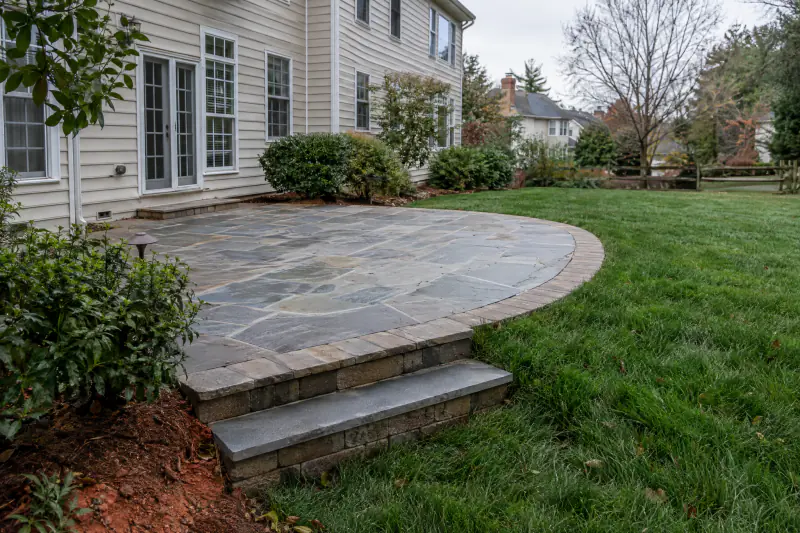
Complexity raises the price mainly through cutting time and waste. A rectangle laid in running bond needs cuts only along two edges. Add a curved edge and every paver on that curve is marked and cut on a wet saw. Add a contrasting border and the field has to be cut to meet it. Add a circle kit or an inlay and the layout itself takes a half day before the first unit is set. On a 300 sq ft patio, a simple shape might take a crew two days to lay. A curved patio with a double border and a circle can take four.
Here is how we think about it, as rough multipliers against the base ranges above:
- Simple rectangle, one color, one pattern: the low end of the range.
- Rectangle with a soldier-course border: add roughly 5 to 10 percent for the border cuts and the second material.
- Curved edges: add roughly 10 to 20 percent on the curved portion, more with small-format pavers.
- Herringbone or multi-size random patterns: more cuts and slower laying; add roughly 10 percent.
- Inlays, circles, two or three colors: often 20 to 30 percent above a plain field of the same material.
Pattern also affects waste. Irregular flagstone can waste 15 to 25 percent of the stone delivered. Large-format porcelain wastes less material but every cut has to be clean, so the labor rate is higher. If you want a specific look at a lower cost, the best lever is usually to keep the shape simple and spend on the border, which is where the eye lands. For a fuller look at which paver suits our winters, see our guide to choosing pavers for freeze-thaw.
What would a 300 or a 500 square foot patio cost in 2026?
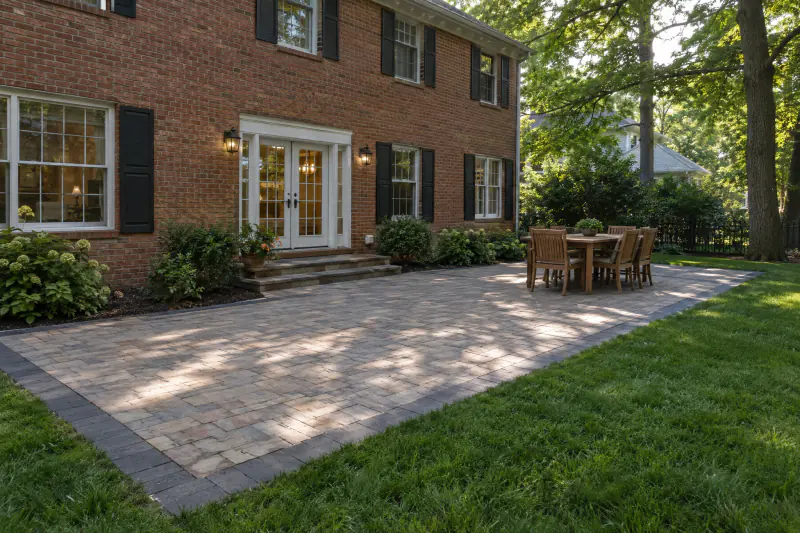
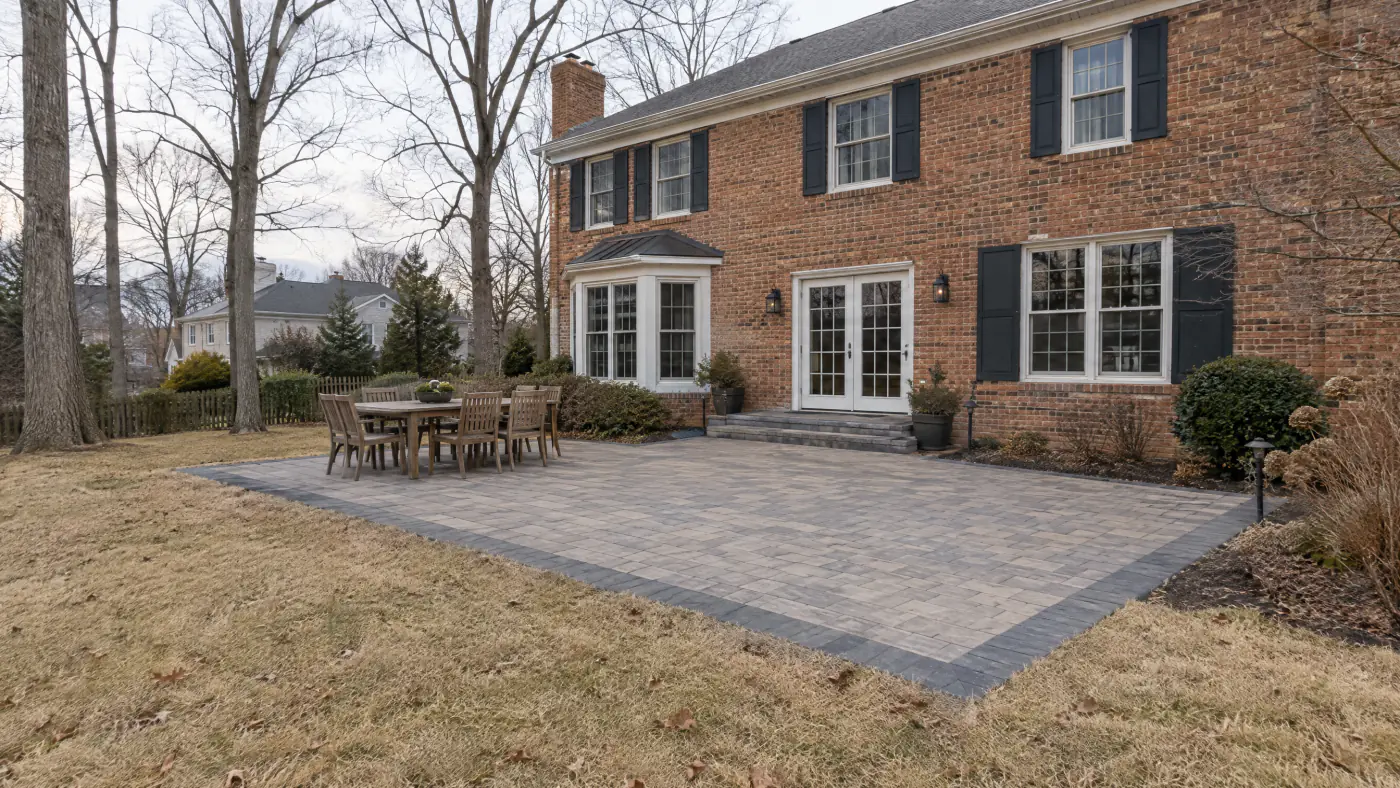
A 300 sq ft patio is about 15 by 20 ft, enough for a dining table and a grill. A 500 sq ft patio is about 20 by 25 ft, which fits dining and a separate seating area. Using the typical 2026 market ranges above, here is how the base numbers stack up for a straightforward rectangle on a site with good access, before any add-ons:
- 300 sq ft, standard concrete pavers: roughly $6,000 to $10,500.
- 300 sq ft, porcelain or cut bluestone: roughly $9,000 to $16,500.
- 500 sq ft, standard concrete pavers: roughly $10,000 to $17,500.
- 500 sq ft, porcelain or cut bluestone: roughly $15,000 to $27,500.
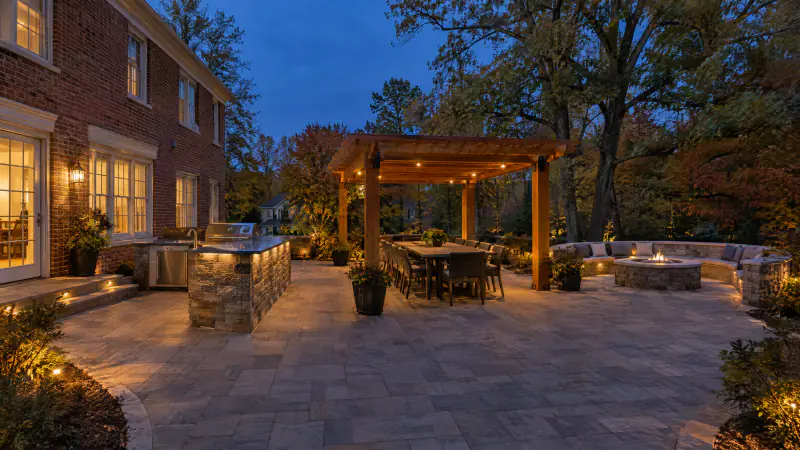
Now the add-ons, which is where most Northern Virginia patios end up. Two downspouts piped under the patio to daylight commonly add $800 to $3,000 as a typical market range. A set of three block steps from a sliding door adds several hundred to more than a thousand dollars per step. A 15 ft seating wall at $100 to $250 per linear foot adds $1,500 to $3,750. Six low-voltage lights at $250 to $450 per fixture add $1,500 to $2,700. Removing a 300 sq ft concrete slab first typically adds $1,500 to $4,000 depending on thickness, reinforcement and how far the pieces have to be carried.
Put together, a 300 sq ft concrete paver patio that replaces a slab, gets two downspout lines, three steps and a short seating wall lands around $12,000 to $22,000 as a planning figure. A 500 sq ft bluestone patio with the same extras and lighting can reach $25,000 to $40,000. These are wide on purpose. They are meant to tell you whether the project fits your budget, not to price it. The table below lays the same examples out side by side.
Worked examples: 300 and 500 square foot patios side by side
Typical Northern Virginia market planning ranges as of 2026. Rounded, wide, and not a quote.
| Scenario | 300 sq ft | 500 sq ft | What is included |
|---|---|---|---|
| Simple rectangle, concrete pavers | $6,000 to $10,500 | $10,000 to $17,500 | Excavation, compacted base, bedding, pavers, edge restraint, joint sand |
| Rectangle with border, concrete pavers | $6,500 to $11,500 | $11,000 to $19,000 | Adds a contrasting soldier course and the cuts to meet it |
| Curved patio, porcelain or bluestone | $10,000 to $18,000 | $16,500 to $30,000 | Premium surface, curved cutting, tighter tolerances |
| Slab removal plus two downspout lines | Add $2,300 to $7,000 | Add $2,800 to $8,500 | Demolition, haul-off, buried pipe to daylight or a dry well |
| Three steps and a 15 ft seating wall | Add $2,500 to $7,000 | Add $2,500 to $7,000 | Block or stone steps on a compacted footing, capped seating wall |
| Six low-voltage lights | Add $1,500 to $2,700 | Add $1,500 to $2,700 | Fixtures, wire, transformer and sleeves placed before the pavers |
A patio under about 200 sq ft, or one reached only by wheelbarrow, commonly prices above the per-square-foot ranges these examples use.
What drives the cost of a paver patio on Northern Virginia clay?
Seven things explain most of the gap between a low bid and a high one on the same drawing. Soil is first. Northern Virginia clay holds water and heaves in freeze-thaw cycles, so a patio here needs 4 to 6 in. of compacted dense-graded aggregate under about 1 in. of bedding sand, and often a geotextile layer between clay and stone. That means excavating 7 to 9 in. below finished grade and hauling the clay away. Each inch of extra depth across 400 sq ft is more than a cubic yard of clay out and a cubic yard of stone in, plus the time to compact it.
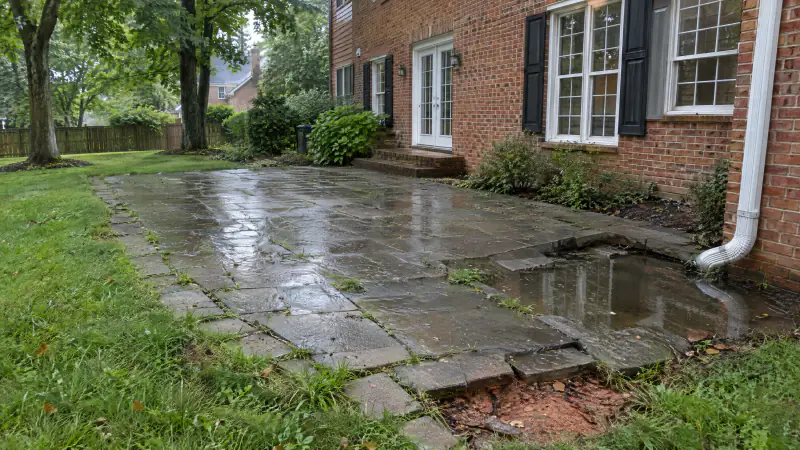
Access is second. A skid steer through a 10 ft side yard moves stone in minutes. A 36-inch gate between townhomes in Herndon or Centreville means wheelbarrows, and wheelbarrow jobs take two to three times longer for the same square footage. Demolition is third. An old slab has to be broken, loaded and disposed of, and a 4 in. slab with wire mesh is a different job from a 6 in. slab with rebar. Drainage is fourth. Downspouts that now dump onto the patio area must be piped under or around it before the base is built, and a low corner may need a drain.
Steps and grade changes are fifth. Every step is a small retaining structure with its own compacted footing. Seating walls, pillars and fire features are sixth, each priced as its own structure. Lighting and utility sleeves are seventh, cheap to place during base work and expensive to add after. Permits rarely move the number for an at-grade patio, since most Northern Virginia jurisdictions do not require a building permit for one, though zoning setbacks, easements and lot-coverage rules can still shape the layout. Check with your county. All of these show up in our wider cost guide, and the only way to pin them down is a written on-site estimate.
How do you compare patio bids line by line?
Lay the bids side by side and check each of these before you compare the totals.
Match the square footage
Confirm every bid uses the same dimensions and the same shape. A 16 by 20 patio and a 15 by 20 patio differ by 20 sq ft, which is enough to make a cheaper bid look better than it is.
Find the excavation depth
Look for a number in inches below finished grade. On Northern Virginia clay, 7 to 9 in. is typical for a pedestrian patio. Anything under about 6 in. total depth should prompt a question.
Find the base thickness and compaction
The bid should state 4 to 6 in. of dense-graded aggregate, compacted in lifts with a plate compactor. If it names the stone, better. If it mentions geotextile over clay, better still.
Check bedding, restraint and joints
You want about 1 in. of concrete sand, edge restraint on every open side, and the joint sand named. Polymeric sand should be either included or a clear option with a price.
List what is excluded
Haul-off, slab removal, downspout rerouting, steps, lawn restoration, permit drawings and HOA paperwork. Write the exclusions under each bid so the totals compare like for like.
Ask about change orders
What happens if the crew finds soft fill, an old patio under the sod or a buried pipe? A fair bid names a unit price for extra excavation and stone rather than leaving it open.
Check license, insurance and the schedule
Ask for the Virginia contractor license number and insurance details, confirm who is on site, and ask how weather delays are handled. Base stone cannot be compacted over saturated clay, so a crew that says it waits for dry ground is telling the truth.
Why does the cheapest base fail first on clay?
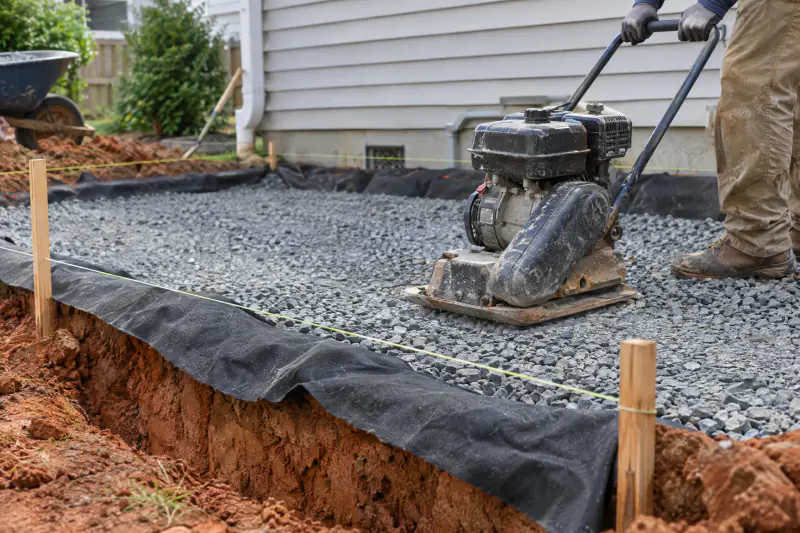
The cheapest base fails first because clay does not forgive thin stone. A paver patio is a flexible pavement. The pavers spread each footstep and each freeze across the base, and the base spreads it across the subgrade. When the base is 2 in. instead of 5, and loosely raked instead of compacted in lifts, the load reaches the clay almost undiluted. Wet clay moves under that load. Frozen clay lifts it. The pavers follow, and by the third winter the patio has a dip near the door, a hump over the old downspout trench and a border that has drifted an inch into the lawn.
It is worth seeing the arithmetic. On a 400 sq ft patio, the difference between a 2 in. and a 5 in. base is roughly 4 cubic yards of stone, plus the same volume of clay excavated and hauled, plus the time to compact two extra lifts. As a typical 2026 market figure that is often $1,200 to $2,500 of the bid. A contractor who skips it can come in that much lower and still make a normal margin. The homeowner finds out in year three, and the fix is not a top-up. Pavers come up, the base is rebuilt, and the pavers go back down, which costs a large share of the original price.
Compaction matters as much as depth. Dense-graded aggregate reaches its strength only when it is placed in lifts of a few inches and run over with a plate compactor until it stops moving. Stone dumped 6 in. deep and compacted once from the top is dense at the surface and loose underneath. We cover every one of these failure modes, and how to inspect a patio while it is being built, in why patios fail on clay. If you have ever wondered why a patio that looked perfect at the final walkthrough is uneven five years later, that article is the answer.
What do steps, seating walls, lighting and drainage add to a patio budget?
Extras are priced as their own structures, and most Northern Virginia patios have at least one. Steps come first, because most sliding doors in colonials and townhomes sit 12 to 24 in. above the yard. Each riser is a small wall on its own compacted footing, with a tread that has to be level and the same height as its neighbors. As a typical 2026 market range, built block or stone steps commonly add several hundred dollars to more than $1,000 each, with wider steps and natural stone at the top.
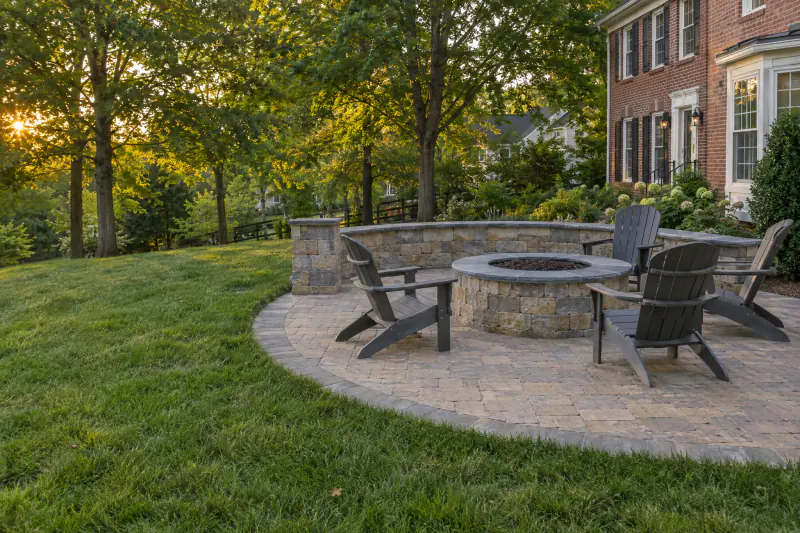
Seating walls, at roughly $100 to $250 per linear foot, do two jobs: they give permanent seating and they finish a patio edge that would otherwise meet lawn or a slope. A short wall of 12 to 18 ft around a fire feature is the most common request, and fire pits and seating walls are usually built with the patio so the footings share the excavation. Where the yard drops away, a low retaining wall may be needed to create the level pad at all, and that is a bigger line item.
Lighting is cheapest when planned with the patio. Sleeves and conduit under the pavers cost little during base work. Low-voltage landscape lighting then runs about $250 to $450 per fixture installed, so a patio with six to eight lights adds roughly $1,500 to $3,600. Drainage is the extra most often skipped and most often regretted. A buried downspout line typically costs $400 to $1,500 per downspout, and a patio that collects roof water will not stay level no matter how deep the base. We plan the full layout of these features in our article on designing an outdoor room.
How do patio costs differ across Fairfax, Loudoun, Prince William and Arlington?
The per-square-foot ranges hold across the region, but the site conditions that move them cluster by area. In newer subdivisions in Ashburn, South Riding, Bristow and Gainesville, lots were graded during construction and the topsoil was stripped, so patios often sit on compacted subsoil that drains poorly. Those jobs more often need geotextile, a downspout line and sometimes a drain, which pushes the total up. Access is usually good, though, with wide side yards and no mature roots.
In older neighborhoods in Arlington, Falls Church, Vienna, McLean and Annandale, the opposite is common. Soil is often better and lots are shaded by mature oaks and maples, but the patio area may be reached through a narrow gate, past a fence and around roots that cannot be cut. Those patios cost more in labor per square foot and sometimes need a smaller excavation near trees. Alexandria and Arlington also have small lots where lot-coverage and setback rules decide the patio footprint, so check with the city or county before you fall in love with a size.
Townhome communities in Herndon, Centreville, Woodbridge and Sterling bring a third pattern: a small patio, often 150 to 250 sq ft, reached only through the house or a 36-inch gate, with an HOA that wants a drawing and a material sample first. Small size and hand carrying put these at the top of the per-square-foot range even when the design is simple. Fairfax County maps problem soils, including marine clays in parts of the eastern county near Lorton and Springfield, and patios on those soils benefit from a deeper base. Every locality we work in is listed under service areas, and HOA timing is covered in our guide to HOA approval for exterior projects.
When is the best time to get patio pricing, and does the season change it?
Winter is the best time to get patio pricing, and the price itself changes less with the season than people expect. Material costs for pavers, stone and aggregate do not drop in January. Labor is the same skilled work in February as in June. What does change is the queue. From April through June, every hardscape crew in Northern Virginia is busy, site visits take longer to schedule, and a start date can be weeks out. In late fall and winter, estimates come faster and a mild dry stretch can put a crew on site within a few weeks.
Winter is also the right season for the paperwork. If your community in Reston, Ashburn or Brambleton requires architectural approval, the application takes weeks, and spring is the busy period for those committees too. Getting the design and the approval done in January and February means the patio is built in March or April and used all summer, rather than approved in May and built in August.
One thing the season does affect is what can be done on a given day. Base stone cannot be compacted over frozen or saturated clay, and polymeric sand has minimum temperature and dry-weather requirements from the manufacturer. A winter build simply waits for the right days. Whether that works for your schedule is covered in can you build a patio or walkway in winter. The broader seasonal rhythm is in our 2026 yard calendar.
How do you turn a planning range into a real number?
You turn a range into a number by having someone measure the site. A site visit for a patio takes under an hour. We measure the area and the door threshold height, check how the ground falls, note where every downspout discharges, look at the gate width and the route a machine would take, and ask how you plan to use the space. From that, we write a scope that states excavation depth, base thickness, bedding, paver, pattern, edge restraint, joint sand, every downspout we are rerouting, every step, and every exclusion. That written scope is the figure we stand behind, and the only one we ask you to compare against other bids.
Bring three things to that visit. A rough budget, so we can size the patio and the extras to it rather than guess. Any photos of patios you like, because the pattern and border decide a lot of the cutting time. And your HOA guidelines if you have them, since color and material approvals are easier when the sample is picked with the rules in hand.
Two more points before you commit. First, a paver patio is not the only surface, and our guide to pavers vs. stamped concrete is an honest comparison if a slab is on your list. Second, plan the drainage and the lawn around the patio at the same time, because the excavation for one often serves the other. When you are ready, request an on-site estimate or call (571) 200-9600 and we will put a number on your yard, not on a range.
Frequently asked questions
Is $25 per square foot a fair price for a paver patio in Northern Virginia?
For a simple concrete paver patio on an accessible site, $25 per sq ft sits inside the typical 2026 market range of about $20 to $35. Whether it is fair depends on what is inside it. At that price you should see excavation to 7 to 9 in., a compacted 4 to 6 in. base, bedding sand, edge restraint and joint sand written into the scope. The same price with a 2 in. base is not a bargain.
Why do small patios cost more per square foot than large ones?
Because delivery, equipment, setup and cleanup cost about the same whether the patio is 150 sq ft or 500. Spread over fewer square feet, those fixed costs raise the rate. Small patios also tend to be in tight spaces with hand carrying and more cuts per square foot. Expect a townhome patio under 200 sq ft to price above the standard planning ranges.
Does removing an old concrete patio add much to the cost?
Usually it adds a noticeable amount. Breaking out a 4 in. slab, loading the pieces and disposing of them commonly adds $1,500 to $4,000 for a 300 sq ft patio as a typical 2026 market range. Thicker slabs, rebar and long carries push that up. Leaving a sound slab in place and laying over it is sometimes possible, but a cracked or tilted slab should come out.
Are porcelain pavers worth the extra cost over concrete pavers?
They can be, for the right homeowner. Porcelain absorbs almost no water, so it resists stains, algae and freeze-thaw well and cleans easily. The surface looks crisp and uniform. The trade-off is cost and installation: porcelain needs a very flat screed and careful wet cutting, and chipped tiles are harder to hide. If low upkeep matters more than budget, it is worth a look.
Do I need a permit for a paver patio in Fairfax or Loudoun County?
In most Northern Virginia jurisdictions a patio built at grade does not need a building permit. Zoning rules still apply: setbacks, easements, floodplains and lot-coverage limits can restrict where the patio goes, and Chesapeake Bay Resource Protection Areas add limits near streams. A patio that includes a wall over about 3 ft, a roof or gas lines changes the answer. Check with your county before finalizing the layout.
How much should I budget for a patio with a fire pit and seating wall?
As a typical 2026 market planning figure, a 400 sq ft concrete paver patio with a built-in wood-burning fire pit and a 15 ft seating wall often lands between roughly $14,000 and $28,000. The patio makes up most of it, the fire pit adds about $2,500 to $7,000, and the wall $1,500 to $3,750. A gas fire feature and its gas line raise the total further.
What is the cheapest way to get a durable paver patio?
Keep the shape a simple rectangle, choose a standard concrete paver in one color, size the patio to what you will really use, and build extras like walls and lighting later with sleeves placed now. Never cut the base depth, compaction or edge restraint to save money. On clay, those three items are what you are paying for, and skipping them costs more within a few winters.
Book the work
Put the plan in writing with a crew that builds this every week.
One visit to measure and talk through options, then a written scope and price. No pressure, no vague numbers. Ask about the Heroes Discount if you serve.
Sources and further reading
- Fairfax County Land Development Services: residential permits and zoning
- Loudoun County Building and Development
- Virginia 811 (Miss Utility): call before you dig
- Concrete Masonry & Hardscapes Association (formerly ICPI): residential paver installation guidance
- Belgard: paver product and installation literature
Published January 15, 2026. Reviewed and updated October 9, 2026.