Key takeaways
- Freeze-thaw damage is water inside a paver expanding as it freezes. The less water a paver absorbs, the less there is to expand, so ask about absorption first.
- Concrete pavers made to ASTM C936, Class SX clay pavers, dense stone such as bluestone and granite, and porcelain all handle Northern Virginia winters on a drained base.
- Travertine and soft, layered stones are the materials to be careful with here. They work in dry, warm climates and can pit and flake after a few wet winters on clay.
- Thickness follows the load: about 2 3/8 in. concrete or 2 cm porcelain for patios, about 3 1/8 in. concrete or vehicular clay for driveways, on a base twice as deep.
- As of 2026, typical Northern Virginia installed ranges run about $20 to $35 per sq ft for concrete pavers and $30 to $55 or more for clay, stone and porcelain, before site factors.
On this page
- Which paver handles Northern Virginia freeze-thaw best: concrete, clay, stone or porcelain?
- How do freeze-thaw cycles and deicing salts attack a paver?
- What should you look for in a concrete paver?
- Are clay brick pavers better than concrete in freeze-thaw?
- Which natural stones survive Northern Virginia winters, and which do not?
- How do the four paver materials compare for freeze-thaw, salt, color and cost?
- Do porcelain pavers belong on pedestals or on a compacted base?
- How thick should pavers be for a patio versus a driveway?
- How do color fading, texture and slip resistance differ between materials?
- Which pavers suit a brick colonial, and which suit a modern home?
- How much do different pavers cost installed in Northern Virginia?
- What should you ask about any paver before it goes on your patio?
- What should paver buyers in Fairfax, Loudoun, Prince William and Arlington know?
- Frequently asked questions
Which paver handles Northern Virginia freeze-thaw best: concrete, clay, stone or porcelain?
All four can last decades through our winters, provided you choose the right grade of each and set it on a drained, compacted base. What separates them is how much water they absorb, how they react to deicing salt, how their color behaves after ten summers, and what they cost. Porcelain absorbs almost nothing and ignores salt. Fired clay pavers rated for severe weathering absorb little and never fade. Concrete pavers made to the ASTM C936 standard are built for freeze-thaw and are the most affordable, but they need their joints kept full and benefit from a cautious hand with salt. Dense natural stone such as bluestone and granite performs well, while travertine and soft, layered stones are the ones we steer homeowners away from on a Northern Virginia patio.
The paver itself is rarely why a patio fails here. Most of the failures we are called to look at are base and drainage problems, which we cover in why patios fail on clay. But the surface is the part you look at every day and the part that salt and ice work on directly, so it is worth choosing deliberately. This guide explains how freeze-thaw and salt attack each material, what the ratings mean, how thick each one needs to be for a patio versus a driveway, how they age, and which ones suit the brick colonials and newer modern homes that make up most of the housing from Arlington to Leesburg. The planning ranges at the end are typical Northern Virginia figures as of 2026.
How do freeze-thaw cycles and deicing salts attack a paver?
Water expands by roughly nine percent when it freezes. If that water is sitting inside the pores of a paver, the ice pushes outward against the material, and when the paver cannot stretch, something gives: a flake pops off the face, an edge crumbles, or a crack opens. One freeze does little. Northern Virginia gives a patio dozens of nights each winter that cross 32 degrees and thaw again by afternoon, and each cycle repeats the push. The damage is cumulative, which is why a paver can look perfect for five winters and start spalling in the sixth. The amount of water inside the paver is the whole story, so absorption, measured as a percentage of the paver's dry weight, is the number that predicts durability.
Deicing salt makes freeze-thaw worse in three ways. It lowers the freezing point of water, so a surface that would have stayed frozen all week instead freezes and thaws every day, multiplying the number of cycles. Brine is drawn deeper into pores than clean water, so the expansion happens farther inside the paver. And some salts react chemically with the cement paste in concrete. Plain rock salt, sodium chloride, is mostly a physical attacker. Magnesium chloride and calcium chloride are more aggressive on concrete because they react with the cement itself, and ammonium-based products sold as fertilizer or ice melt attack concrete outright. We go through each product in detail in snow, salt and pavers.
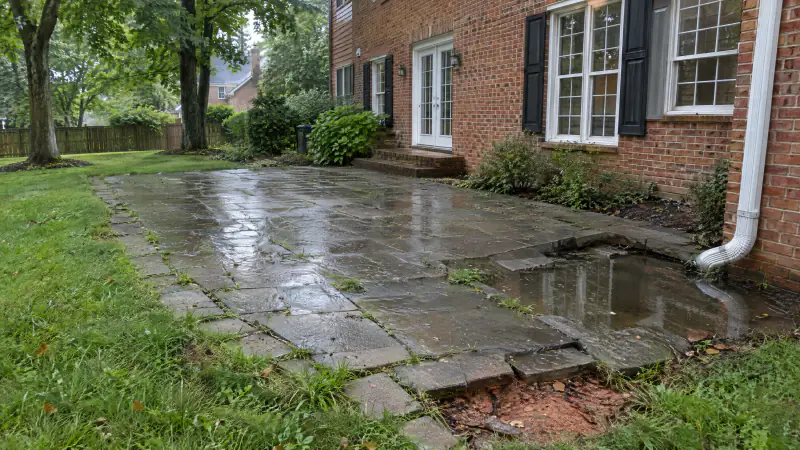
Water under the paver matters as much as water in it. Bedding sand that stays saturated because the base does not drain will freeze into a lens and lift the pavers above it, which is heaving, and the pavers settle unevenly when it thaws. A paver with zero absorption on a waterlogged base still fails. That is why material choice and base construction are one decision, not two.
What should you look for in a concrete paver?
Look for a unit made to ASTM C936, the standard for solid interlocking concrete pavers, which calls for an average compressive strength of about 8,000 psi and an average water absorption of no more than 5 percent, with a freeze-thaw durability test run in a salt solution. Reputable manufacturers such as Belgard, Unilock and Techo-Bloc publish this data on their technical sheets, and any paver sold for Northern Virginia should meet it. Density is what delivers both numbers. A dense, well-compacted concrete paver has fewer and smaller pores, absorbs less water, and resists both ice and salt far better than a lightweight unit of the same thickness.
Efflorescence is the thing that alarms homeowners in the first year and almost never matters. It is the white, chalky haze that rises on new concrete pavers when calcium hydroxide inside the concrete migrates to the surface with moisture and reacts with air. It is cosmetic, it usually weathers away over the first season or two, and it can be removed with an efflorescence cleaner when it does not. It is not a sign of a bad paver, though a paver that keeps producing it for years is one that keeps letting water through.
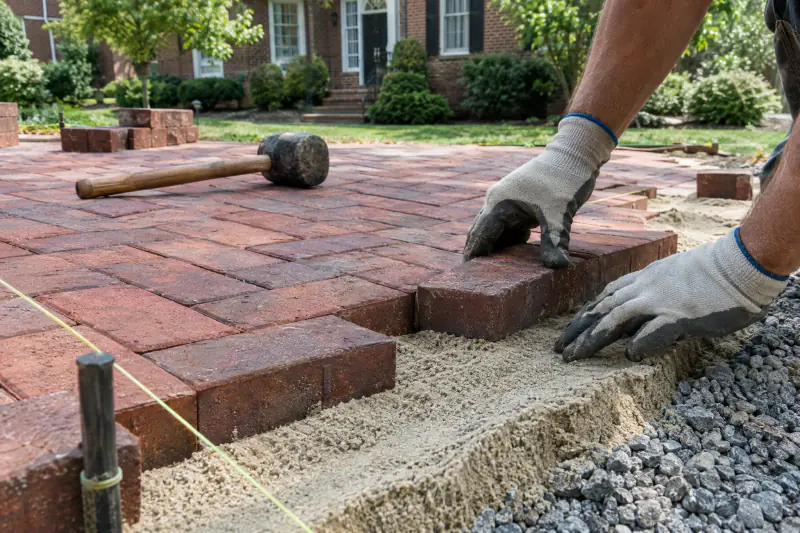
Thickness follows the load. The standard for patios and walkways is about 2 3/8 in., written as 60 mm, on a 4 to 6 in. compacted base. For a paver driveway the unit is about 3 1/8 in., or 80 mm, on 8 to 12 in. of base. Face-mix pavers put a dense, finely graded layer of colored concrete on top of a coarser body, which gives a smoother surface and better stain and salt resistance than a through-mixed paver, while through-mixed units hide chips better because the color runs all the way through. Both are freeze-thaw rated when made to the standard. Sealing is optional with concrete, and sealing a dense paver does more for appearance and stain cleanup than for freeze-thaw survival.
Are clay brick pavers better than concrete in freeze-thaw?
In several ways, yes, and in a few ways they are harder to work with. A clay paver is fired at high temperature until the clay vitrifies, which gives it a dense body with low absorption and a color that is the color of the clay itself, not a pigment. It will look the same in thirty years as it does on the pallet, which no concrete paver can claim. Clay pavers are specified under ASTM C902 for pedestrian and light traffic, and the grade to ask for in Northern Virginia is Class SX, meaning severe exposure, which is the freeze-thaw rating. Vehicular clay pavers fall under ASTM C1272 and are thicker, at least about 2 5/8 in. for sand-set units and commonly 2 3/4 in., compared with roughly 2 1/4 in. for patio units. Clay also shrugs off deicing salt better than concrete because there is no cement paste for the chlorides to react with.
The difficulties are dimensional and aesthetic. Fired clay shrinks slightly and unevenly in the kiln, so clay pavers vary in size more than machine-molded concrete units. They are laid in patterns that forgive that variation, such as herringbone and running bond, with slightly wider joints, and the chamfered edges that make concrete pavers easy to compact are often absent. Some clay pavers are made for mortar setting on a concrete slab rather than sand setting, and using a mortar-set unit on sand gives sharp edges that chip. Ask which setting method the product is made for.
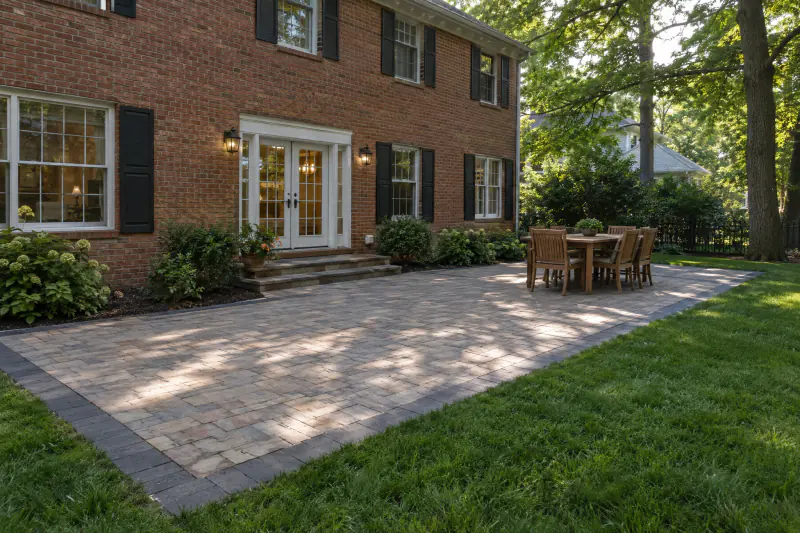
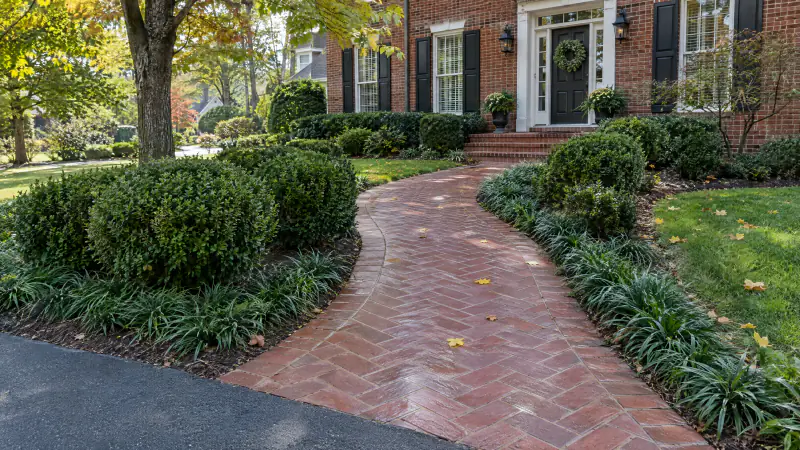
Clay pavers come in the reds, browns and flashed blends that match the brick on a colonial in Vienna or Fairfax City, which is the main reason homeowners choose them, and in a few greys and buffs for other houses. They cost more than standard concrete pavers and less than most natural stone. For a front walkway on a brick house they are, in our view, the best-looking material available, and they last as long as the house does.
Which natural stones survive Northern Virginia winters, and which do not?
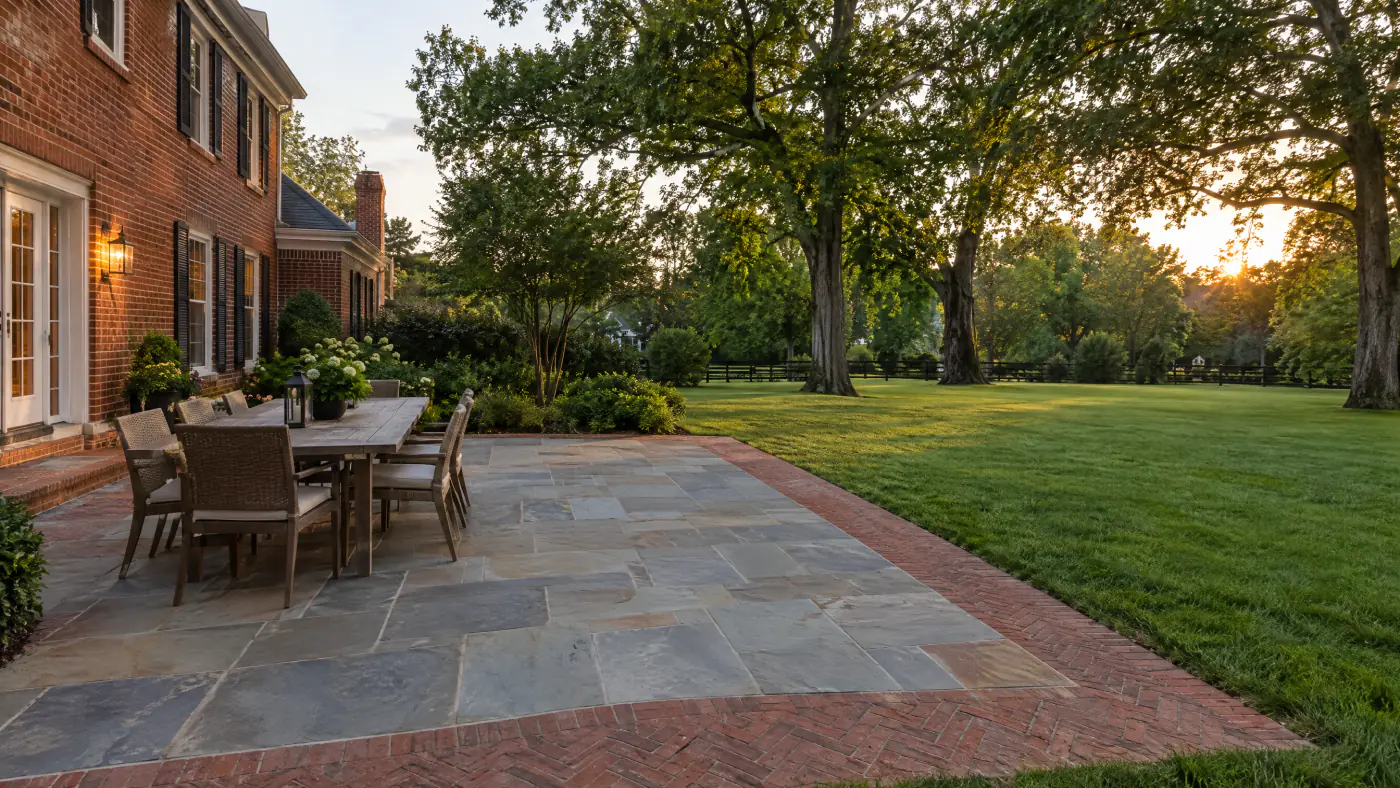
Dense stones with low absorption survive. Pennsylvania and New York bluestone, a dense sandstone, is the standard flagstone for patios and walks across Northern Virginia and handles freeze-thaw and salt well, in both the natural cleft finish, which has a slightly rippled face, and the thermal finish, which is flamed smooth and even. Granite in cobbles, slabs and steps is almost indestructible here and takes any amount of salt. Dense quartzite and some hard limestones also do well. Flagstone is a shape, not a stone, so when a quote says flagstone, ask which stone.
Travertine is the caution. It is a limestone formed around springs, full of natural pits and voids, and it is sold for pool decks and patios across the southern United States where it stays cool underfoot and looks beautiful. In a freeze-thaw climate those pits fill with water and the stone can flake, pit and crumble at the edges after a few wet winters, and the problem is worse on clay that keeps the base damp. Premium dense grades, filled and honed, set on a well-drained base and sealed, can work on a covered or sheltered patio. We do not recommend travertine for an open patio, walk or driveway in Northern Virginia, and we never recommend it where salt will be used.
Layered stones split along their layers when water freezes between them. Some slates and soft, bedded sandstones do this, and bluestone with visible iron banding, sometimes called sap, can flake along those bands too. Buy stone from a supplier who can say where it was quarried and whether it is used outdoors in this climate. Setting method matters as well. Irregular flagstone 1 to 2 in. thick is sand set on a compacted base for patios and paths. Steps and treads are mortar set on a concrete footing. Thin stone under about 1 in. is for mortar on a slab, not for sand, and that distinction is the one most often ignored by quotes that look cheap.
How do the four paver materials compare for freeze-thaw, salt, color and cost?
Typical performance in Northern Virginia for products made to the standards named above and installed on a drained base.
| Concrete pavers | Clay pavers | Natural stone | Porcelain pavers | |
|---|---|---|---|---|
| Water absorption | Up to about 5 percent by standard; dense units lower | Low in Class SX units | Low for bluestone and granite; high for travertine | Under about 0.5 percent |
| Freeze-thaw | Rated when made to ASTM C936 | Rated when Class SX | Dense stone excellent; porous or layered stone risky | Unaffected |
| Deicing salt | Tolerates rock salt; limit magnesium and calcium chloride; none the first winter | Tolerant | Bluestone and granite tolerant; travertine poor | Unaffected |
| Color over time | Pigment can soften with sun and wear; face-mix holds best | Does not fade | Weathers slightly and naturally | Stable |
| Slip when wet | Good on textured faces; algae on shaded sides | Good | Natural cleft good; honed stone slick | Choose a textured R11 face; polished is slick |
| Patio thickness | About 2 3/8 in. (60 mm) | About 2 1/4 in. | About 1 to 2 in. sand set | About 3/4 in. (2 cm) |
| Driveway | About 3 1/8 in. (80 mm) | Vehicular rated, about 2 5/8 to 2 3/4 in. | Granite cobbles or stone on a concrete slab | Usually 3 cm or bonded to concrete; check the maker |
| Relative cost | Lowest | Mid | Mid to highest | Mid to high |
Ratings assume the product grade named in the row. Lower grades of every material exist and are not suited to this climate.
Do porcelain pavers belong on pedestals or on a compacted base?
Both, and the choice depends on what is underneath. Porcelain pavers are dense ceramic tiles about 2 cm thick, fired to an absorption under half a percent, with rectified edges that give very tight, uniform joints. They do not stain, do not absorb salt, do not grow algae readily, and do not fade. On a rooftop deck, over an existing concrete slab, or anywhere the surface must stay removable for access, they are set on adjustable pedestals that lift each corner and leave an open gap below for water. That system is popular on townhome roof decks in Arlington and Alexandria.
On the ground, most manufacturers allow 2 cm porcelain to be set on a compacted aggregate base with a bedding layer for pedestrian use, but the base has to be flatter and more carefully screeded than for concrete pavers, because a thin, rigid tile bridges any hollow and cracks under a point load. Some makers require a thin mortar or a specific bedding product, and some require the tile to be bonded to a concrete slab. For a driveway, 2 cm porcelain is generally not approved; vehicular use calls for 3 cm units or tiles bonded to a reinforced slab, and the manufacturer's instructions govern. Cutting requires a wet saw with a porcelain blade, and the labor to set porcelain properly is higher than for concrete pavers, which is reflected in the installed cost.
Where porcelain earns its price in Northern Virginia is around a pool, on a north-facing patio that stays damp and grows algae on every other material, and on modern homes where a large-format slab with a crisp joint is the look. It is also the only paver we would describe as truly indifferent to salt, which matters on a front walk that gets treated all winter. Our paver patio page describes how we build the base for each of these materials.
How thick should pavers be for a patio versus a driveway?
Patios and walkways carry people and furniture; driveways carry cars that turn, brake and sit in one place for days. The paver and the base both change with that load. For patios and walks, the usual specification in Northern Virginia is a 60 mm concrete paver, about 2 3/8 in., or a 2 1/4 in. clay paver, or 2 cm porcelain, or 1 to 2 in. sand-set stone, over 4 to 6 in. of compacted dense-graded aggregate and about 1 in. of bedding sand. The base goes deeper, toward 6 in. or more, in wet clay and where the patio will carry a heavy outdoor kitchen or a hot tub.
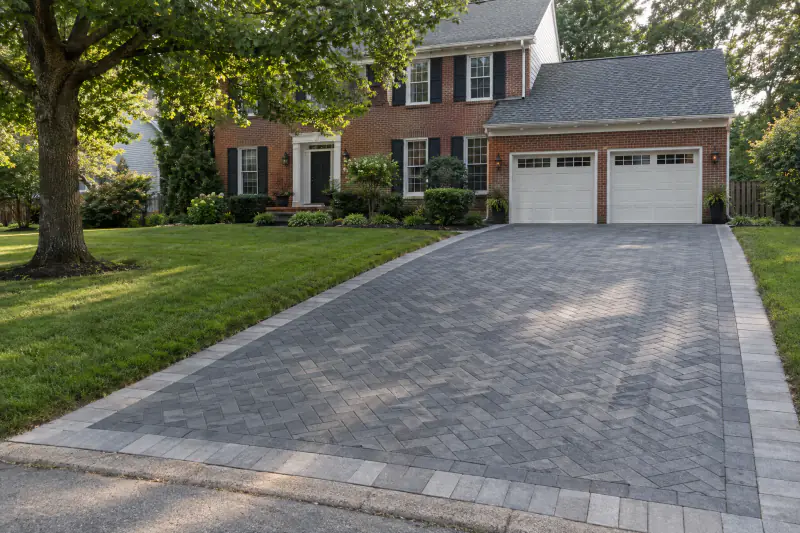
For driveways the paver becomes an 80 mm concrete unit, about 3 1/8 in., or a vehicular-rated clay paver around 2 3/4 in., laid in a herringbone pattern that stops units creeping under tire loads, over 8 to 12 in. of compacted base with geotextile separating the base from the clay. Large-format concrete slabs, the 16 by 24 in. and 24 by 24 in. units popular on modern homes, are patio products only unless the manufacturer rates a thicker version for vehicles, because a wide, thin unit cracks across its middle under a wheel. The same rule applies to porcelain.
Thickness also affects how a paver survives freeze-thaw indirectly. A thicker unit on a deeper base sits farther from the saturated clay below, drains better, and is less likely to be heaved by an ice lens in the bedding. That is one reason a driveway built properly often shows less winter damage than a thin patio built cheaply. Base depth, compaction and drainage are described in detail on our hardscaping pillar page, and they do not change with the paver material.
How do color fading, texture and slip resistance differ between materials?
Color is the quiet difference that shows up after a decade. Concrete pavers are colored with iron oxide pigments mixed into the concrete, and those pigments are stable, but the surface wears. Fine aggregate is exposed as the cement paste erodes, sun lightens the face, and a charcoal paver can read as medium grey after ten summers. Face-mix pavers hold their color best because the top layer is dense and finely graded. Clay pavers do not fade, because the color is the fired clay. Natural stone weathers gently; bluestone's blue-grey can shift toward a softer grey and some pieces develop rust tones where iron is present. Porcelain is fired with the color in a glaze or through the body and does not change.
Texture decides how a paver feels and how it behaves wet. Tumbled concrete pavers have rounded, worn edges and an old-world look that hides chips. Smooth, crisp-edged units look modern and show every mark. Natural cleft bluestone has a fine ripple that grips a wet shoe; honed or polished stone does not. Porcelain comes in slip ratings, and an outdoor patio or pool deck should use a textured face, commonly rated R11, rather than the smooth finish sold for indoors.
In Northern Virginia the slip hazard is rarely the paver itself. It is algae and mildew that grow on any shaded, north-facing surface through our humid summers, and wet leaves in October. A textured surface helps, and so does a yearly wash. Sealing changes slip too: a film-forming gloss sealer on a smooth paver can be slick when wet, while a penetrating sealer changes the surface very little. The details are in our paver cleaning and sealing service and the maintenance guide.
Which pavers suit a brick colonial, and which suit a modern home?
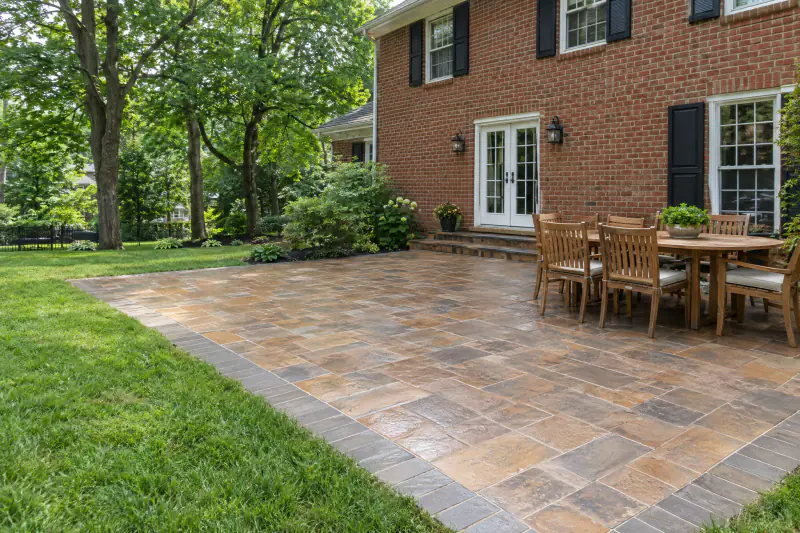
For the brick colonials that fill neighborhoods from Burke and Springfield to McLean and Great Falls, the materials that look right are the ones that were used when the style was invented: clay brick and bluestone. A bluestone field with a clay brick soldier-course border, or a full clay paver walk in herringbone, reads as part of the house rather than an addition. One piece of advice from experience: do not try to match the house brick exactly. Brick from a different kiln in a different decade will always be slightly off, and an almost-match looks like a mistake. Choose a paver that is clearly darker, or clearly in a blended range, and let the border do the tying together. Concrete pavers in a tumbled, blended red-brown also work well on colonials at a lower cost.
Craftsman-style homes with siding and stone water tables, common in the newer sections of Ashburn, Aldie and Haymarket, take tumbled concrete pavers in warm greys and tans, or irregular flagstone for a garden path. Townhomes with small rear yards often do best with one material in a simple pattern, because borders and inlays make a small space busier.
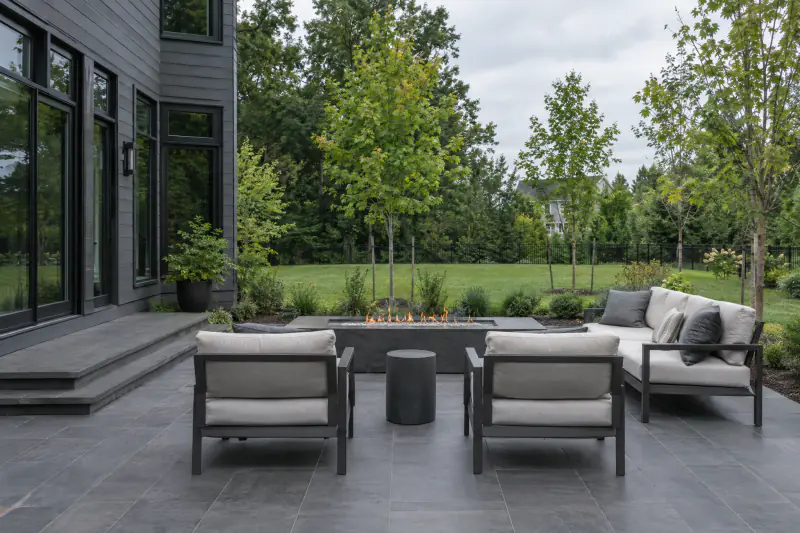
Modern homes, and the many renovated ramblers in Arlington and Falls Church with black windows and flat rooflines, want large-format units with tight joints and linear patterns: 24 by 24 in. concrete slabs, 2 cm porcelain in charcoal, taupe or wood-look finishes, or thermal bluestone in a single large size. The joint is part of the design, so these go down on a perfectly flat base with polymeric sand or a fine jointing compound. Whatever the house, we bring full-size samples and lay them on the ground in your own light before you decide, because a paver that looks grey in a showroom often looks blue or brown in a Northern Virginia backyard.
How much do different pavers cost installed in Northern Virginia?
As of 2026, typical Northern Virginia market planning ranges for an installed patio run about $20 to $35 per square foot for concrete pavers and roughly $30 to $55 or more per square foot for clay, natural stone and porcelain, with clay usually at the lower end of that second band and thermal bluestone and large-format porcelain at the upper end. These are general market ranges, not myYardPros prices. Walkways run a little higher per square foot because they have more edge and more cutting, and driveways run about $25 to $45 per square foot for interlocking concrete pavers because of the thicker unit and much deeper base. Material alone, before any labor or base, commonly runs from a few dollars per square foot for standard concrete pavers through roughly $5 to $12 for clay and $6 to $15 or more for porcelain and bluestone, and premium concrete slabs can cost as much as stone.
What moves the number is mostly below and around the paver rather than the paver itself. Access for equipment, how much clay has to be excavated and hauled, removal of an old slab, curves and borders that add cuts, steps, landings and drainage all change the total, and small projects cost more per square foot. Porcelain adds setting labor and blade wear. Natural stone adds sorting and fitting time, especially irregular flagstone. Clay pavers add a little jointing time because of their size variation. The way those factors stack up for a typical patio is worked through in our guide to paver patio cost in Northern Virginia, and every hardscape range is collected in the cost guide.
Over a twenty-year life the gap between materials narrows. Concrete pavers may want cleaning and sealing every few years to keep their color; clay and porcelain mostly need sweeping and a wash. A written estimate after an on-site visit is the only number that accounts for your access, your soil and the material you have actually chosen.
What should you ask about any paver before it goes on your patio?
Seven questions whose answers should be on the product's technical sheet or in the contractor's scope.
- What is the paver's water absorption, and does it meet ASTM C936 (concrete) or Class SX (clay)?
- Is this unit rated for vehicles, or for patios and walks only?
- For stone: which quarry and which stone, and is it used outdoors in freeze-thaw climates?
- For porcelain: does the maker approve sand setting on a base, and at what flatness?
- Is the paver made for sand setting or for mortar on a slab?
- What does the manufacturer say about deicing salts, especially in the first winter?
- How thick is the paver, and how deep is the compacted base under it for this use?
What should paver buyers in Fairfax, Loudoun, Prince William and Arlington know?
Northern Virginia winters are a true freeze-thaw climate rather than a deep-freeze one, which is harder on pavers. A patio in Minnesota freezes in December and stays frozen; a patio in Fairfax County may freeze and thaw thirty or forty times between December and March, and every one of those cycles tests the paver and the base. Western Loudoun around Leesburg and Purcellville runs a few degrees colder and gets more cycles than Alexandria or Arlington, where pavement and buildings hold heat. Add the clay, which keeps bedding layers damp for days after a thaw, and the result is that a paver sold as freeze-thaw rated for a general market needs to actually meet the standard, not just carry the phrase.
Salt exposure varies with where the paver sits. A front walk in a townhome community in Reston, Centreville or Woodbridge, where the HOA or the homeowner treats ice all winter, sees far more deicer than a backyard patio in Oakton. For those walks, clay or porcelain earn their cost, and for a concrete paver walk a gentle deicer and a textured face are the right pairing. Driveway aprons that meet a salted public street in Fairfax County, Prince William County or the City of Manassas get road salt tracked and splashed onto them all winter, which argues for dense 80 mm units there.
Rules are light for the paver itself and heavier for the project. At-grade patios and walks typically need no building permit, but zoning setbacks, lot coverage limits on smaller lots and Resource Protection Areas near streams can restrict where hard surface goes, so check with your county or city before finalizing a layout. HOAs across Loudoun, Fairfax and Prince William commonly review paver color and pattern, and some communities in Ashburn and Bristow keep an approved list. We work only within the jurisdictions on our service areas page, and our guide to pavers vs. stamped concrete covers the one alternative homeowners most often weigh against all four of these materials.
Frequently asked questions
Do concrete pavers crack in freeze-thaw climates like Northern Virginia?
Properly made concrete pavers do not, as a rule. Units manufactured to ASTM C936 are dense, absorb no more than about 5 percent water and are tested for freeze-thaw durability in a salt solution. The damage people see on older patios here is usually surface flaking from heavy salt use, or heaving and settling caused by a base that held water. A thin, low-grade paver from a discount source is the exception and does flake.
Is travertine a bad choice for a patio in Virginia?
For an open patio, walk or driveway in Northern Virginia, we think so. Travertine is porous, its natural pits fill with water, and repeated freezing can pit and flake the stone within a few winters, especially on damp clay. Dense premium grades on a sheltered, well-drained patio, sealed and kept salt-free, can hold up. If you want the look, honed limestone-look porcelain gives it without the risk.
Can porcelain pavers be used for a driveway?
Only in the thicker 3 cm versions or when bonded to a reinforced concrete slab, and only where the manufacturer approves vehicular use. The common 2 cm porcelain paver is a pedestrian product and will crack under a wheel when set on sand. For most Northern Virginia driveways, 80 mm concrete pavers or vehicular-rated clay pavers on 8 to 12 in. of compacted base are the proven choice.
Why is there a white haze on my new pavers?
That is efflorescence, a chalky calcium deposit that migrates out of new concrete as it cures and reacts with the air. It is cosmetic, it is common on new concrete pavers and some mortar, and it usually weathers away over the first season or two. If it persists, an efflorescence cleaner removes it. Sealing over it locks it in, which is one reason we recommend waiting a season before sealing new concrete pavers.
Which paver is safest to use deicing salt on?
Porcelain, which absorbs almost nothing and does not react with chlorides, followed by fired clay pavers and dense stone such as granite and bluestone. Concrete pavers tolerate plain rock salt in moderation once they are past their first winter, but magnesium chloride and calcium chloride are harder on them, and ammonium-based products damage any concrete. Whatever the paver, the polymeric sand in the joints is the part that salt and plows wear first.
Do clay pavers match the brick on my house?
Not exactly, and they should not try to. Brick from a different kiln and decade will always be slightly off in color and size, and a near-match looks like a mistake. Choose a clay paver that is clearly darker or in a blended range, and use a border or a contrasting field, such as bluestone, to tie the walk to the house. We lay full-size samples on site in daylight so you can judge it before ordering.
How thick should patio pavers be in Northern Virginia?
For patios and walkways, about 2 3/8 in. (60 mm) for concrete pavers, about 2 1/4 in. for clay, 2 cm for porcelain and 1 to 2 in. for sand-set stone, over 4 to 6 in. of compacted base. Driveways move to 3 1/8 in. (80 mm) concrete or vehicular-rated clay on 8 to 12 in. of base. Large thin slabs and 2 cm porcelain are patio-only unless the maker rates them for cars.
Does sealing protect pavers from freeze-thaw damage?
A little, and mostly for the surface. A penetrating sealer reduces how much water the top of a concrete paver absorbs and makes salt and stains easier to rinse off, which helps the face. It does nothing for water under the pavers, which causes heaving, and nothing for a paver that was too porous to begin with. Sealing is optional; a drained base and a quality paver are not.
Book the work
Put the plan in writing with a crew that builds this every week.
One visit to measure and talk through options, then a written scope and price. No pressure, no vague numbers. Ask about the Heroes Discount if you serve.
Sources and further reading
Published July 30, 2026. Reviewed and updated October 9, 2026.