Key takeaways
- Read three things before choosing a fix: the grade as a percentage, where the water arrives from, and what sits uphill that a failure would undermine.
- Slopes under about 25 percent can usually be regraded or planted. Between 25 and 50 percent, planting with erosion blankets and small terraces works. Above 50 percent, plan on a wall.
- A wall is unavoidable when you need flat ground, when a driveway, pool or house sits close above the slope, or when the grade is simply too steep for roots to hold.
- Every option needs drainage. Clay slopes fail from water, not from the weight of the soil, so the pipe and stone behind a wall matter more than the block in front of it.
- As of 2026, typical Northern Virginia planning ranges run from a few thousand dollars for regrading and planting to $50 to $150 per square foot of face for a wall.
On this page
- Which fix is right for an eroding slope: a wall, regrading or planting?
- How do you read a slope before choosing a fix?
- Retaining wall, regrading or planting: how do the three options compare?
- When is regrading enough to stop erosion?
- Can plants and erosion blankets hold a Northern Virginia slope?
- Should you terrace a steep slope instead of building one tall wall?
- When is a retaining wall unavoidable?
- How do we take a slope from survey to stable ground?
- Why does every slope solution need drainage behind it?
- What do summer thunderstorms do to a clay slope in Northern Virginia?
- How much do slope and erosion fixes cost in Northern Virginia?
- What should you check before hiring anyone for an eroding slope?
- What matters on slopes in Fairfax, Loudoun, Prince William and Arlington?
- Frequently asked questions
Which fix is right for an eroding slope: a wall, regrading or planting?
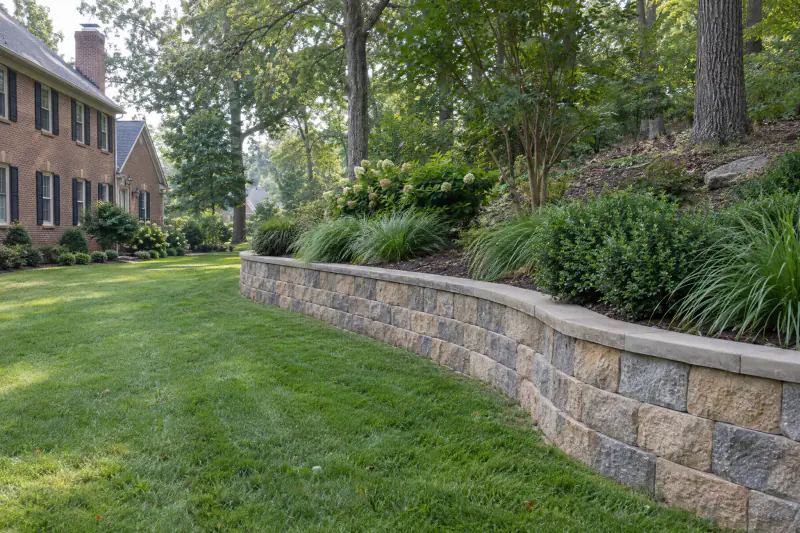
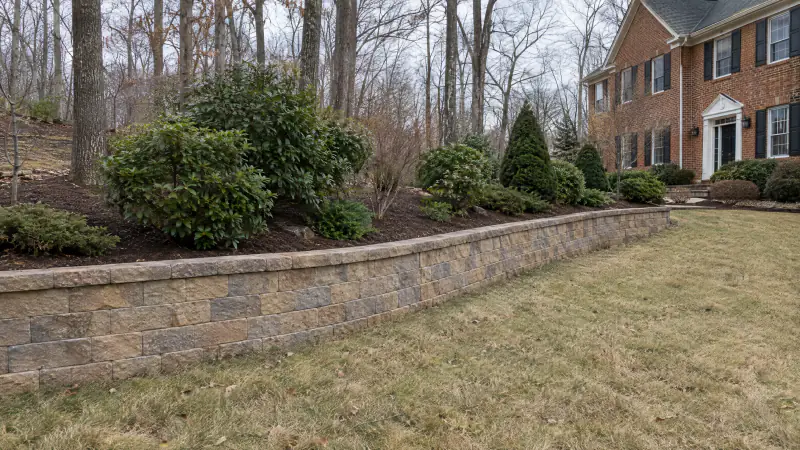
It depends on the grade, the water and what sits uphill, and in our experience most eroding slopes in Northern Virginia need less than a retaining wall. Slopes under about 25 percent can usually be regraded into a gentler shape or planted with deep-rooted groundcover and held with an erosion blanket while the roots take hold. Slopes between roughly 25 and 50 percent respond to planting combined with small terraces or a single low wall at the toe. Above about 50 percent, or wherever a driveway, pool, patio or house sits close to the top of the bank, a retaining wall with proper drainage is the honest answer, because nothing with roots holds that grade through a wet winter.
The reason we lead with the grade and not the product is that each fix solves a different problem. Regrading changes where water goes. Planting changes how fast soil moves once water is on it. A wall changes the geometry entirely, creating flat ground above and below. Choosing a wall for a problem that was really a downspout dumping onto the bank is the most common expensive mistake we see, and choosing plants for a bank that is too steep for them is the second.
The rest of this guide walks through how we read a slope, compares the three approaches honestly, explains terracing, drainage and what summer storms do to clay, and ends with the planning ranges that apply across hardscaping and drainage work in this region as of 2026.
How do you read a slope before choosing a fix?
We measure three things on every sloped property: grade, water source and uphill load. Grade is rise over run, expressed as a percentage. Lay a 4 ft level on the slope, lift the downhill end until the bubble centers, and measure the gap with a tape. A 12 in. gap over 4 ft is 25 percent. A 24 in. gap is 50 percent, which engineers write as 2:1, meaning two feet of horizontal run for every foot of rise. A 3:1 slope is about 33 percent and is roughly the steepest bank most people can mow safely. A 2:1 slope is about the limit for planted stabilization in clay, and anything steeper than that wants structure.
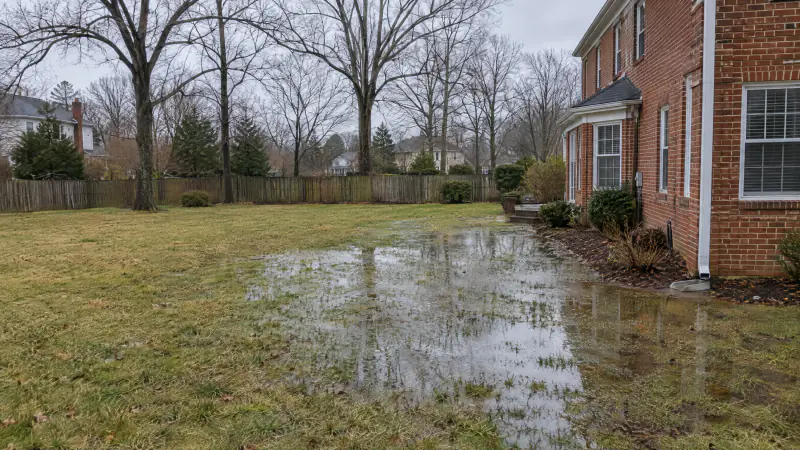
Water source is the second reading, and it is the one homeowners skip. Stand on the slope during a hard rain, or look at the evidence afterward. Water arriving from a downspout, a driveway, a neighbor's lot or a swale that was filled in by a previous owner concentrates into a stream, and a stream cuts rills no matter what you plant. Sheet flow from a lawn above is gentler and easier to hold. If the water comes from a roof, the fix often starts with a buried downspout line, not with the slope at all.
Uphill load is the third. Soil engineers call anything heavy near the top of a slope a surcharge. A driveway, a pool, a shed, a patio or the house itself within a few feet of the crest means a slope failure takes that structure with it. Surcharge is the single factor that most often turns a planting job into a wall job, and it is the factor that most often triggers a permit and an engineer, as we explain in our guide to retaining wall permits and engineering in Northern Virginia.
Retaining wall, regrading or planting: how do the three options compare?
Typical fits for Northern Virginia clay slopes. Many properties end up with a combination.
| Retaining wall | Regrading | Planting and blankets | |
|---|---|---|---|
| Best grade range | Above about 50 percent, or any grade with a structure close uphill | Under about 25 percent, where there is room to spread the slope out | Up to about 50 percent on stable soil, with blankets while roots establish |
| What it solves | Creates flat ground, holds a cut, carries surcharge | Redirects water, removes concentrated flow, fixes grade toward the house | Stops surface soil from moving, slows water, adds roots to clay |
| What it does not solve | Water arriving from above, unless drainage is designed in | A slope that is too steep to flatten within the property | Concentrated streams, surcharge loads, grades beyond root strength |
| Disruption | Excavation, machine access, drainage stone, one to three weeks | Machine grading, haul-off or fill, lawn restoration, a few days | Light soil prep, two seasons of watering before it is self-sustaining |
| Drainage needed | Always: stone column, perforated pipe, outlet | Swale or pipe to carry redirected water to an outlet | Diversion of any concentrated flow before planting |
| Typical service life | Decades with working drainage | Decades if water is managed and the lawn holds | Indefinite once established, with weeding the first two years |
| Permit likelihood | Generally above about 3 ft of retained soil, or with surcharge; check your county | Possible if a large area is disturbed or an RPA is involved | Rarely, unless in a protected area |
Grade thresholds are rules of thumb for clay soils. Rock, sand and groundwater move them in either direction.
When is regrading enough to stop erosion?
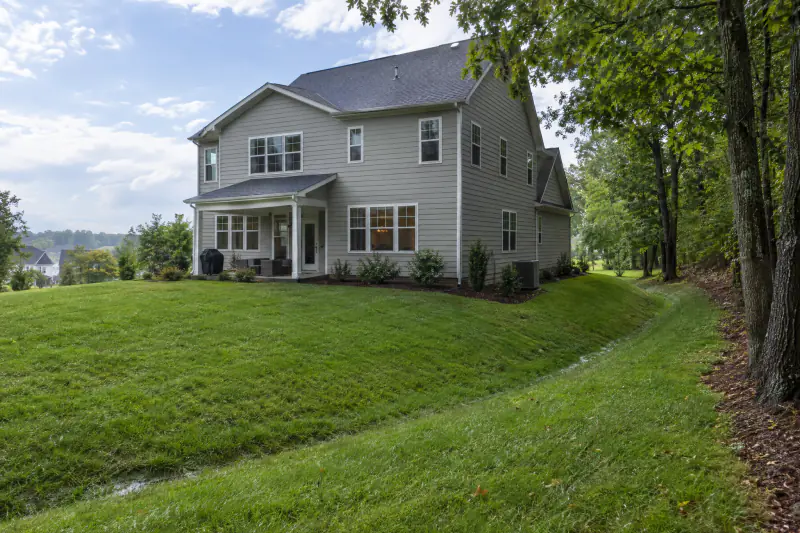
Regrading is enough when the slope is gentle, there is room to spread it out, and the real problem is where water is being sent rather than how steep the ground is. The standard we aim for near a foundation is a fall of about 6 in. over the first 10 ft, which is a 5 percent grade, and a shaped lawn at that pitch sheds a thunderstorm without cutting into itself. Farther from the house, a slope can be feathered out to 4:1 or 5:1, about 20 to 25 percent, so that tall fescue holds it and a mower can cross it. This is the same work our yard and foundation drainage service does when a backyard stays wet, and the two problems are usually the same problem seen from different sides.
Regrading in clay has rules. Fill that is pushed over the edge of a bank without compaction slides off in the first wet season, so new fill goes down in thin lifts and is compacted. Topsoil that was scraped away years ago has to be replaced, because clay subsoil will not grow a lawn thick enough to hold itself. A swale, which is a shallow grassed channel, is often built across the top of a slope to catch sheet flow and carry it sideways to an outlet so it never runs down the face at all. Where a swale would cross a path or patio, a catch basin and pipe take over.
Regrading fails when it tries to do a wall's job. If flattening the slope to 4:1 would mean pushing soil onto the neighbor's lot, against a fence, or into a tree's root zone, there is not enough room, and the next step is either terracing or a wall. It also fails when the lawn on top is never established, so regrading in Northern Virginia is best finished by early fall, in time for the September seeding window.
Can plants and erosion blankets hold a Northern Virginia slope?
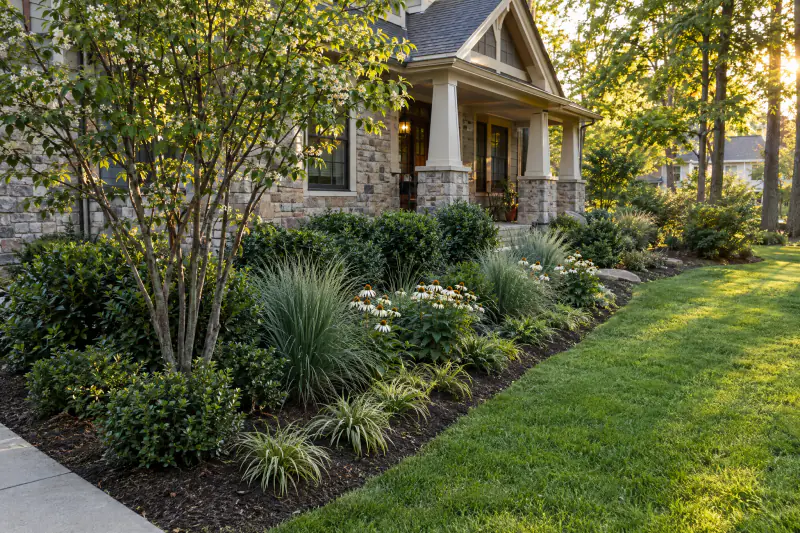
Yes, up to about a 2:1 grade on stable clay, provided concentrated water is diverted first and the soil is held by a blanket while roots establish. Plants work in two ways. Their canopy breaks the force of rain so droplets do not blast soil loose, and their roots bind the top foot or two of soil into a mat. Tall fescue alone, mowed, does this on gentle grades. On steeper banks we use plants chosen for deep, fibrous roots and for tolerating heavy clay and dry summers: switchgrass and little bluestem among the warm-season grasses, and shrubs such as Virginia sweetspire, inkberry holly, low-growing fragrant sumac and spreading junipers. Groundcovers like liriope and creeping phlox fill between them. Virginia Cooperative Extension publishes plant lists for slopes and for clay, and we lean on native species because they are already adapted to July heat and February saturation.
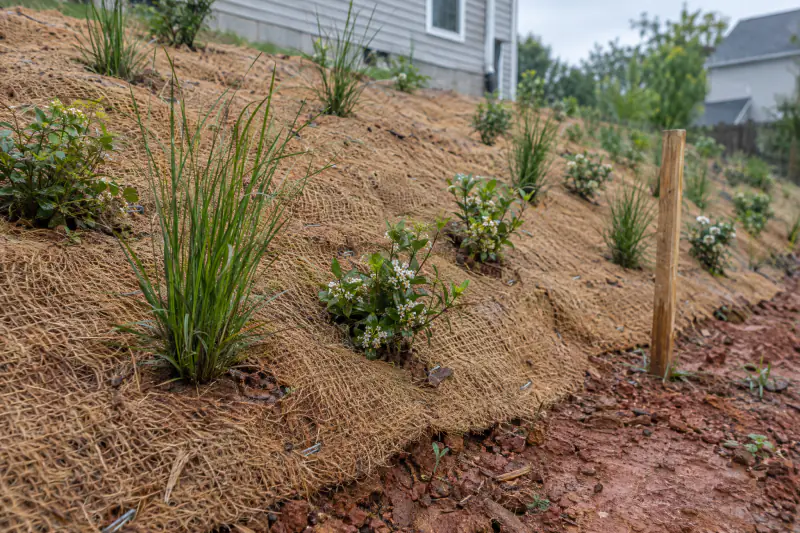
The blanket is what makes planting possible in the first two seasons. A biodegradable erosion control blanket of straw or coconut coir, pinned with wire staples on roughly a 2 to 3 ft grid, holds the soil, seed and mulch in place through storms while the plants are small. Plugs and shrubs are planted through slits in the blanket. On clay we prefer coir on anything over 3:1 because it is typically rated to last two to three years, long enough for shrubs to take over, where straw blankets break down in about one season. Loose mulch by itself is not erosion control; it floats off a bank in the first downpour, which is why the blanket goes over it, not under it.
Planting needs water the first summer and weeding the first two years, and it needs the slope to be reasonably stable to begin with. Our landscape design and installation service handles the plant selection and the blanket work, and fall is the best time for it, as we cover in fall planting and landscape installation in Northern Virginia.
Should you terrace a steep slope instead of building one tall wall?
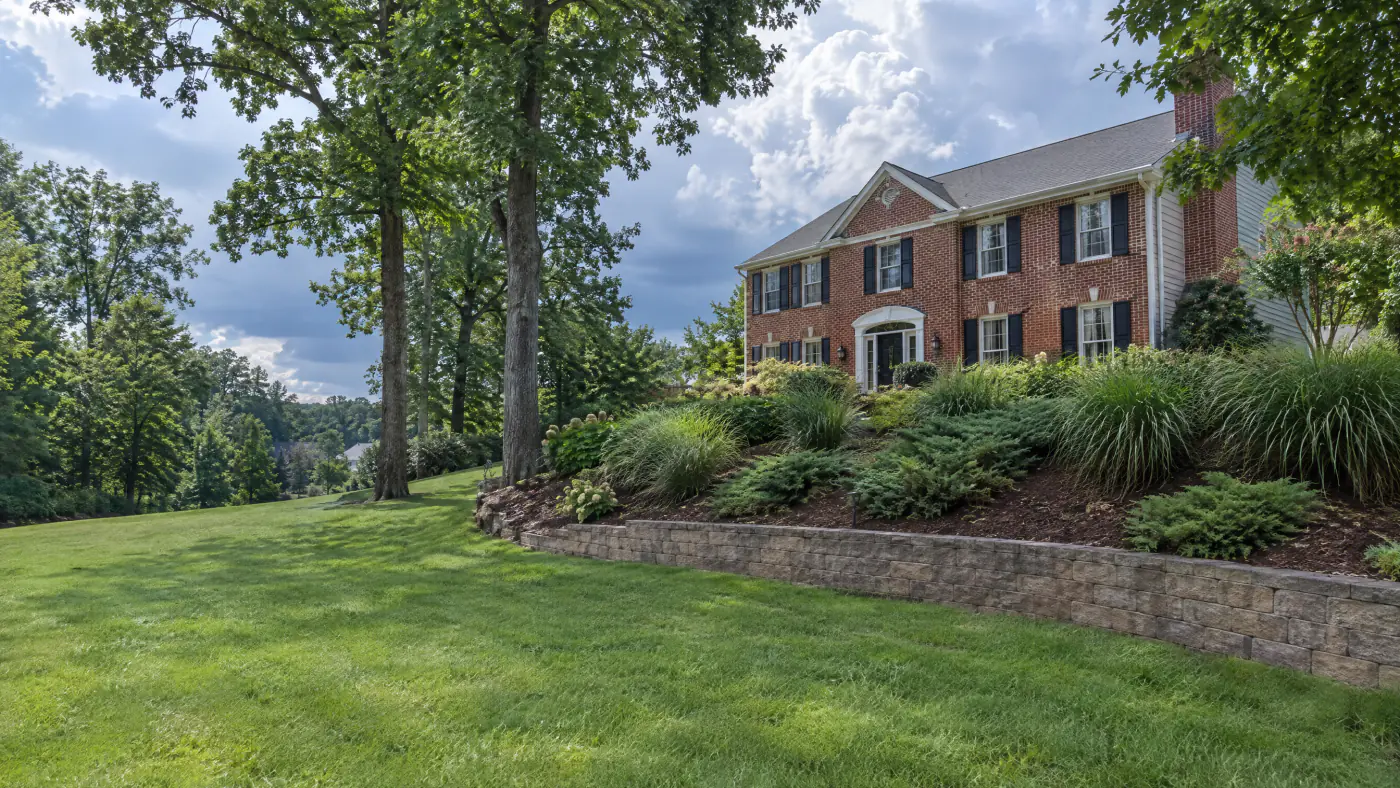
Often, yes. Terracing replaces one tall wall with two or three shorter ones, each holding back less soil, with level planting beds or lawn between them. It has three advantages in a residential yard. Each wall is lower, so it may fall under the height that triggers a permit and an engineer, though you must check with your county because some jurisdictions treat closely spaced tiers as one wall. The beds between tiers are usable, and plants on them add roots to the slope. And the look is softer than a single face of block, which matters on a lot in Great Falls or Clifton where a 6 ft wall would dominate the yard.
Terracing has rules of its own, and the most important one is spacing. If the upper wall sits within the zone that the lower wall is holding up, it adds surcharge to the lower wall and the two have to be designed together. A common rule of thumb is to separate tiers by at least twice the height of the lower wall, so a 3 ft lower wall wants about 6 ft of level ground before the next one rises. On a short, steep bank that spacing may not exist, and then one engineered wall is the better choice.
Every tier still needs its own drainage stone and perforated pipe, and the beds between tiers need to be graded to drain sideways to an outlet rather than pooling against the next wall up. Built that way, terraces turn an unusable bank into the most planted part of the property. Built as a stack of block with clay packed behind it, they fail one tier at a time from the bottom up.
How do we take a slope from survey to stable ground?
The sequence is the same whether the answer turns out to be a swale, a planted bank or a wall.
Trace the water
We walk the slope during or after rain, follow every rill uphill to its source, and check downspouts, sump outlets, driveway edges and neighboring grades. Concentrated flow gets redirected before any other work, often with a buried downspout line or a swale.
Measure grade and load
We measure the slope percentage at several points with a level and tape, probe for soft clay and groundwater, and note anything within about 10 ft of the crest that would count as surcharge. That reading decides whether plants, terraces or a wall are on the table.
Settle rules and drawings
You get a written scope with the chosen approach, dimensions, drainage route and outlet. Wall heights, HOA review, any RPA or land disturbance questions and the permit or engineering a wall needs are handled before excavation. Virginia 811 marks utilities.
Build drainage and structure
Swales are shaped, pipe is laid on a steady fall to a tested outlet, and any wall goes up on its compacted pad with drainage stone and fabric behind it. Fill is placed in thin compacted lifts rather than dumped.
Stabilize the surface
Exposed soil is seeded or planted, blanketed and pinned, or sodded on gentler grades. We time this step for fall or spring where possible, water in the plants, and show you the drain outlets so they stay clear of mulch and leaves.
Why does every slope solution need drainage behind it?
Because clay slopes fail from water pressure, not from the weight of dry soil. Northern Virginia clay absorbs rain slowly and releases it even more slowly, so after a wet week the soil behind a wall or inside a bank is saturated, and saturated soil pushes outward with far more force than dry soil does. It also weighs more, loses its internal friction and, in winter, expands as it freezes. A wall with clay packed directly behind it is being shoved from behind by a wet, heavy, expanding mass every time it rains. That is why it bulges in the middle and tips forward at the top within a few years.
Drainage gives that water an easier path. Behind a wall it is the column of clean stone and the perforated pipe at the base, wrapped in filter fabric so clay fines cannot clog it, running to an outlet that actually discharges somewhere. On a regraded slope it is the swale across the top and the catch basin at the low point. Under a planted bank where water is trapped in the ground rather than running over it, it may be a French drain cut across the slope to intercept the seep. The decision between a French drain and a surface drain is one we explain in our French drain vs. catch basin guide, and on slopes the answer is often both.
The outlet is the part that gets forgotten. A pipe that ends in more clay, or in the neighbor's yard, or under a pile of mulch that will be buried by next fall's leaves, is not drainage. We daylight pipes at a visible, protected point and show homeowners where it is so it stays clear.
What do summer thunderstorms do to a clay slope in Northern Virginia?
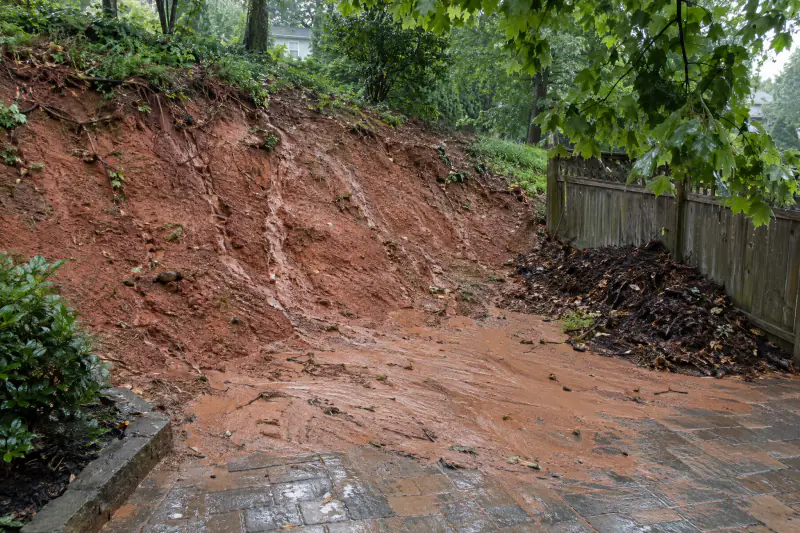
They do most of a year's erosion in a few afternoons. July and August storms here routinely drop an inch or more of rain in under an hour, and NOAA's climate normals for the region put the summer months among the wettest of the year. Clay cannot take water in at anything close to that rate, so nearly all of it becomes runoff within the first few minutes. On a bare slope that runoff starts as a sheet, then gathers into fingers, and the fingers cut rills. Each storm deepens the rills from the last one, and by September a bank that looked fine in May has channels you can lose a boot in and a fan of silt across the patio or lawn below.
Bare soil is the problem more than the grade. A slope with a full fescue cover or an established shrub layer loses a small fraction of the soil a bare slope loses in the same storm, because the plants absorb the impact and slow the water. That is the entire argument for getting cover established quickly on any disturbed slope and for never leaving a graded bank bare through a summer. It is also why we schedule regrading and wall work so that the exposed soil is blanketed or seeded before the next storm cycle, not left for the lawn to find its own way.
Summer storms also reveal the water sources we talked about earlier. If you want to know where to start on your slope, the fifteen minutes after a thunderstorm are the best diagnostic you will get. Photograph the rills and the silt fans. They map the fix.
How much do slope and erosion fixes cost in Northern Virginia?
As of 2026, typical Northern Virginia market planning ranges, not myYardPros prices, look like this. Regrading one or two sides of a house commonly runs about $1,500 to $6,000, and whole-yard regrading with swales, catch basins and lawn restoration from roughly $5,000 to $20,000 or more. A French drain intercepting a seep across a slope runs about $30 to $90 per linear foot. Planting a bank with soil preparation, a pinned erosion blanket, seed and plugs or small shrubs commonly runs from around $2,000 for a modest slope to $10,000 or more for a dense installation with larger stock, and larger plants or a long bank push it higher. Retaining walls are priced by the square foot of exposed face: segmental block about $50 to $100 and natural stone roughly $70 to $150 or more, so a 30 ft wall 3 ft high lands in a wide band around $4,500 to $13,000. Terracing two or three tiers usually costs more in total than one wall of the same combined height because each tier has its own base, drainage and cap, though it can avoid engineering fees.
What moves the number most on a slope is access. A mini excavator reaching the bank through a wide side yard works several times faster than a crew with wheelbarrows behind a fence. After that: how much clay has to be hauled away or how much fill brought in, the length of pipe to a usable outlet, whether an old timber wall has to come out first, engineering and permit fees on taller walls, and lawn or planting restoration afterward. Rock, which shows up on lots in Great Falls and along the Potomac, changes everything.
Our cost guide collects the ranges for every related service in one place. A slope is the one project where a range from a web page is least useful, because two banks of the same height can be a planting job and a fully engineered wall. Only a written estimate after someone has stood on the slope with a level is a number worth planning around.
What should you check before hiring anyone for an eroding slope?
Eight questions that separate a slope specialist from someone selling block.
- Did they walk uphill to find where the water comes from before proposing a fix?
- Did they measure the grade with a level, or guess it by eye?
- Did they ask what sits within about 10 ft of the top of the slope?
- Does the proposal show a drainage route and a specific outlet, not just a wall?
- For a wall over about 3 ft, who is handling the permit and engineered drawings?
- How will exposed soil be protected from the first storm after the work?
- Is Virginia 811 marking written into the schedule before any excavation?
- If plants are proposed, are they species that tolerate clay, drought and the grade?
What matters on slopes in Fairfax, Loudoun, Prince William and Arlington?
Three local layers sit on top of the physics: soils, protected areas and permits. Soil first. Much of Loudoun and western Fairfax, from Ashburn and South Riding out to Leesburg and Purcellville, sits on dense red clay that saturates in winter and bakes hard in August, the worst combination for a bare slope. Parts of southern Fairfax County around Lorton and the Mount Vernon area have mapped marine clay, a soil known for slope movement, and Fairfax County publishes problem soil maps and may ask for a soils report before approving a wall there. Great Falls, McLean and the river side of Arlington trade clay for rock and steep natural grades, where excavation is slower and terraces often make more sense than one deep cut. Clifton, Haymarket and Gainesville in Prince William County mix clay with rolling topography and older farm grading that has long since stopped draining the way it was meant to.
Protected areas second. Along streams and the Potomac, Chesapeake Bay Resource Protection Areas limit what can be cleared, graded or built within a buffer, and some jurisdictions add review for disturbance on steep slopes over a set percentage. A land disturbance permit may be required when a project exposes more than a threshold area of soil; the thresholds and the rules differ, so check with your county or city before planning a large regrading job.
Permits third. Fairfax County, Loudoun County, Prince William County, Arlington County and the cities of Alexandria, Fairfax, Falls Church, Manassas and Manassas Park each run their own building department, and the rule that walls over about 3 ft of retained soil need a permit and usually engineered drawings is common to most of them, with variations for surcharge and terraces. HOAs in planned communities add a review of wall material and color. We work in all of these jurisdictions and nowhere else; the full list is on our service areas page.
Frequently asked questions
How steep can a slope be before it needs a retaining wall?
On Northern Virginia clay, planted stabilization generally stops working somewhere around a 2:1 grade, which is 50 percent, or two feet of run for each foot of rise. Steeper than that, roots cannot hold saturated soil through winter. Below that threshold, the deciding factor is usually what sits uphill: a driveway, pool or house near the crest calls for a wall at much gentler grades.
Does regrading a yard require a permit in Northern Virginia?
Small regrading around a house typically does not need a building permit, but it can trigger other rules. Disturbing more than a threshold area of soil may require a land disturbance permit, and work inside a Chesapeake Bay Resource Protection Area or on mapped steep slopes is reviewed in several jurisdictions. The thresholds vary by county and city, so confirm with the local land development office before a large grading project.
What are the best plants for holding a slope in Virginia clay?
Deep-rooted natives that tolerate heavy clay, summer drought and winter saturation. Warm-season grasses such as switchgrass and little bluestem, shrubs such as Virginia sweetspire, inkberry holly, low fragrant sumac and spreading junipers, and groundcovers like liriope and creeping phlox between them. Virginia Cooperative Extension publishes slope and clay plant lists. Whatever the mix, the bank needs a pinned erosion blanket until the roots take over.
How long does a planted slope take to become stable?
Plan on two growing seasons. A pinned coir blanket does the holding in the first year while plugs and small shrubs root, and by the end of the second summer most native grasses and shrubs have enough root mass to hold a 3:1 bank on their own. The first summer needs regular watering and both years need weeding, because weeds on a bank compete with the plants you want and shade out seed.
Can a timber retaining wall on a slope be repaired instead of replaced?
Rarely. Landscape timber and railroad tie walls rot from the back, where soil contact keeps the wood damp, so a wall that looks tired from the front is usually worse behind. They were also commonly built without drainage stone. The dependable fix is to remove the timbers, add the drainage that was missing and rebuild in segmental block or stone, which also gives the opportunity to correct the grade above it.
Why does my slope wash out even though the grass looks fine?
Because concentrated water overwhelms turf. A lawn holds sheet flow well, but a downspout, sump discharge, driveway edge or neighbor's runoff that funnels into one stream cuts through grass as easily as through bare soil. Walk uphill from the washout during a rain and you will usually find the source. Redirecting it with a buried pipe or a swale often solves the slope without touching the slope.
Is terracing cheaper than one tall retaining wall?
Not usually in total, though it can be in fees. Each terrace tier needs its own leveling pad, drainage stone, pipe and cap, so two 3 ft walls generally cost more than one 6 ft wall of the same length. What terracing can save is engineering and permit cost, if each tier falls under the local height trigger and the tiers are spaced far enough apart not to load each other. Confirm with your county before counting on that.
Book the work
Put the plan in writing with a crew that builds this every week.
One visit to measure and talk through options, then a written scope and price. No pressure, no vague numbers. Ask about the Heroes Discount if you serve.
Sources and further reading
- Virginia Cooperative Extension, publications on slope planting, native plants and erosion control
- Virginia 811 (Miss Utility): call before you dig
- Fairfax County Land Development Services: permits, problem soils and Resource Protection Areas
- Loudoun County Building and Development
- NOAA National Centers for Environmental Information: U.S. Climate Normals
Published July 23, 2026. Reviewed and updated October 9, 2026.