Key takeaways
- Tall fescue sod roots most reliably in Northern Virginia from September through November, then from March through May. Summer sod survives only with watering once or twice a day.
- Preparation decides the result: old turf stripped, clay loosened, compost worked in, grade set an inch below walks and sloped away from the house.
- Sod is laid the day it arrives in staggered rows with joints butted tight, run across slopes, trimmed with a knife and rolled, then soaked within the hour.
- The first two weeks are about moisture, the third about deeper roots, and the fourth about a first mow at 3.5 to 4 inches when a corner resists a tug.
- As of 2026, professionally installed tall fescue sod in Northern Virginia typically runs $2 to $4 per square foot including removal and soil preparation.
On this page
- When is the best time to lay sod in Northern Virginia?
- Why does tall fescue sod dominate Northern Virginia?
- How do spring, fall and summer sod installations compare?
- How should the soil be prepared before sod goes down?
- How is sod laid properly?
- How should new sod be watered in the first month?
- How can you tell if sod is rooting, and when do you mow?
- Why does new sod fail?
- How much does sod installation cost per square foot in Northern Virginia in 2026?
- What is different about sod in Fairfax, Loudoun, Prince William, Arlington and Alexandria?
- Should you sod or seed this spring?
- Frequently asked questions
When is the best time to lay sod in Northern Virginia?
The best time to lay tall fescue sod in Northern Virginia is September through November, and the second-best is March through May. Both windows give the sod what it needs to root: soil that is not frozen, air that is not hot, and enough rain that the homeowner's watering is a supplement rather than a lifeline. Summer installation works only with watering once or twice a day for the first two weeks and carries a real risk of brown patch disease. Winter installation is possible when the ground is not frozen, but rooting is slow and the sod simply sits until spring.
Fall edges out spring for one reason: time. Sod laid in late September has roughly eight months of mild weather to root before the July heat tests it. Sod laid in late April has about ten weeks. Both can succeed on well-prepared soil, but the spring lawn needs closer attention through its first summer, and the window closes fast. Sod laid in the last week of May is, for practical purposes, summer sod.
This article is written for the spring window that opens this month. It covers why tall fescue is the grass, how the soil is prepared on our clay, how the sod is laid, how it is watered for the first thirty days, how to tell it is rooting, and why it sometimes does not. For the fall-versus-spring decision in a wider sense, including seed, see our sod vs. seed guide, and for how the installation itself is scoped, our sod installation and lawn renovation service page.
Why does tall fescue sod dominate Northern Virginia?
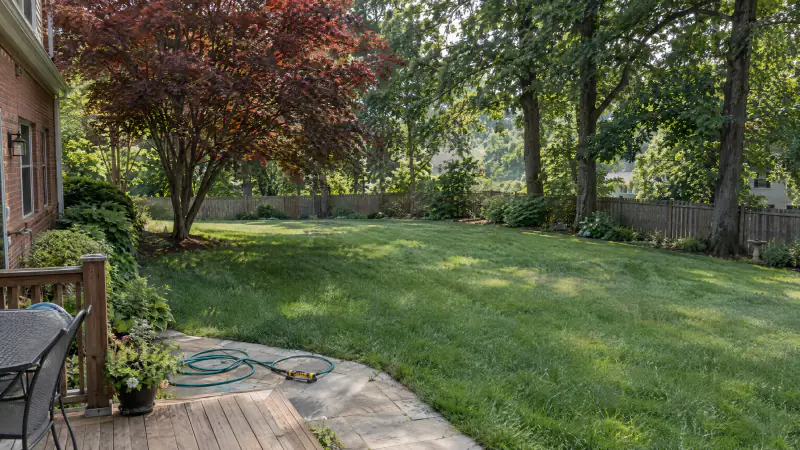
Tall fescue dominates because it is the cool-season grass that tolerates our summers best, and Northern Virginia is cool-season country. We sit in the transition zone, too hot in July for Kentucky bluegrass to stay comfortable and too cold from November to April for bermuda or zoysia to stay green. Turf-type tall fescue has deeper roots than other cool-season grasses, stays green roughly ten months of the year, handles moderate shade and recovers from wear. It is what nearly every sod farm serving Fairfax, Loudoun and Prince William grows, and it is what Virginia Cooperative Extension recommends for most home lawns in this region.
The sod you receive is usually not pure fescue. Farms blend several improved turf-type tall fescue varieties with a small share of Kentucky bluegrass, often around ten percent, because bluegrass spreads by rhizomes and helps the sod hold together on the harvester and knit at the seams. Fescue grows in bunches and does not spread, which is why a sodded lawn still benefits from aeration and overseeding every fall or two once it thins.
The alternatives have narrow uses. Zoysia sod handles heat and traffic well and needs less water, but it is tan from the first frost until May, it is slow to repair, and it creeps into beds. Bermuda is a sunny, hot-site grass that most homeowners here regret in a mixed landscape. In deep shade, no sod works, and the honest options are a shade bed or artificial turf. The point of choosing fescue is not that it is perfect. It is that it is the one grass that is at least acceptable in every season this climate throws at it.
How do spring, fall and summer sod installations compare?
Typical conditions for a Northern Virginia yard. Western Loudoun runs about a week behind in spring and ahead in fall.
| Factor | Spring (March to May) | Fall (September to November) | Summer (June to August) |
|---|---|---|---|
| Soil and air | Cool soil warming, mild air, frequent rain | Warm soil, cooling air, moderate rain | Hot soil, hot humid air, thunderstorms |
| Rooting speed | Moderate, faster as soil warms | Fast in September, slowing by November | Fast if kept wet, but stressed |
| Watering demand | Daily for two weeks, often helped by rain | Daily for two weeks, then tapering | Once or twice daily for two or more weeks |
| Disease risk | Low | Low | High: brown patch on warm wet nights |
| Weed pressure | Crabgrass germinates from April; sod shades it | Low | High, but sod is dense |
| Time before first summer test | About ten weeks | About eight months | Immediate |
| Our view | Good, go early | Best | Only when the lawn cannot wait |
Sod farms harvest year-round when fields are not frozen, so availability is rarely the limit. Soil condition and water are.
How should the soil be prepared before sod goes down?
Soil preparation is most of the job, and it has five parts: remove the old lawn, test the soil, loosen and amend the clay, set the grade, and firm the surface. The sod itself is the last hour of a two-day project.
Remove, do not bury. Existing turf and weeds are cut out with a sod cutter and hauled away. Tilling the old lawn under leaves a decaying layer that heats up, blocks root contact and grows back as weeds through the seams. Herbicide alone, without removal, leaves dead thatch that does the same thing. Sprinkler heads are flagged before any machine runs.
Test before you amend. A routine soil test through Virginia Cooperative Extension, run by the Virginia Tech soil testing laboratory, reports pH and nutrients for a modest fee and takes a couple of weeks, so it belongs in February or early March for a spring job. Most Northern Virginia clay is acidic, and tall fescue prefers a pH in the low to mid 6s. The test tells us how much lime, if any, to work in. It also tells us whether phosphorus is needed. Virginia restricts phosphorus fertilizer on established lawns, but starter fertilizer for a new lawn is permitted where the soil test supports it, and that is the only way we use it.
Loosen and amend the whole area. The clay is tilled or ripped to a depth of four to six inches, and one to two inches of screened compost is worked into it. On a builder lot in Ashburn, Bristow or Haymarket, where the topsoil was scraped off and the lawn sits on compacted subsoil, this is the step that was never done the first time, and it is why the first lawn failed. On a lot where drainage is the problem, with water standing for more than a day after rain, amending will not fix it and the honest sequence is drainage and regrading first. We explain the clay behind that in why Northern Virginia backyards stay wet.
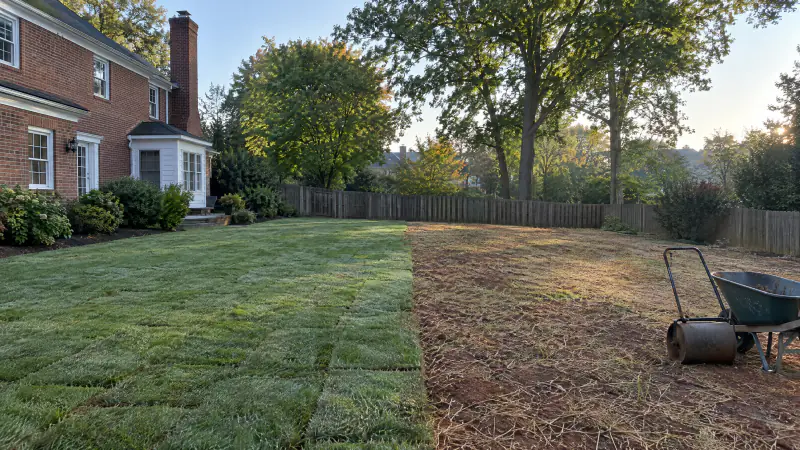
Set the grade. The surface is raked smooth with a fall away from the foundation, ideally about six inches of drop in the first ten feet where the lot allows it, and finished about an inch below walks, patio edges and driveway so the sod sits flush rather than proud. Low spots are filled and humps are cut now, because a bump under sod becomes a scalped spot for the life of the lawn.
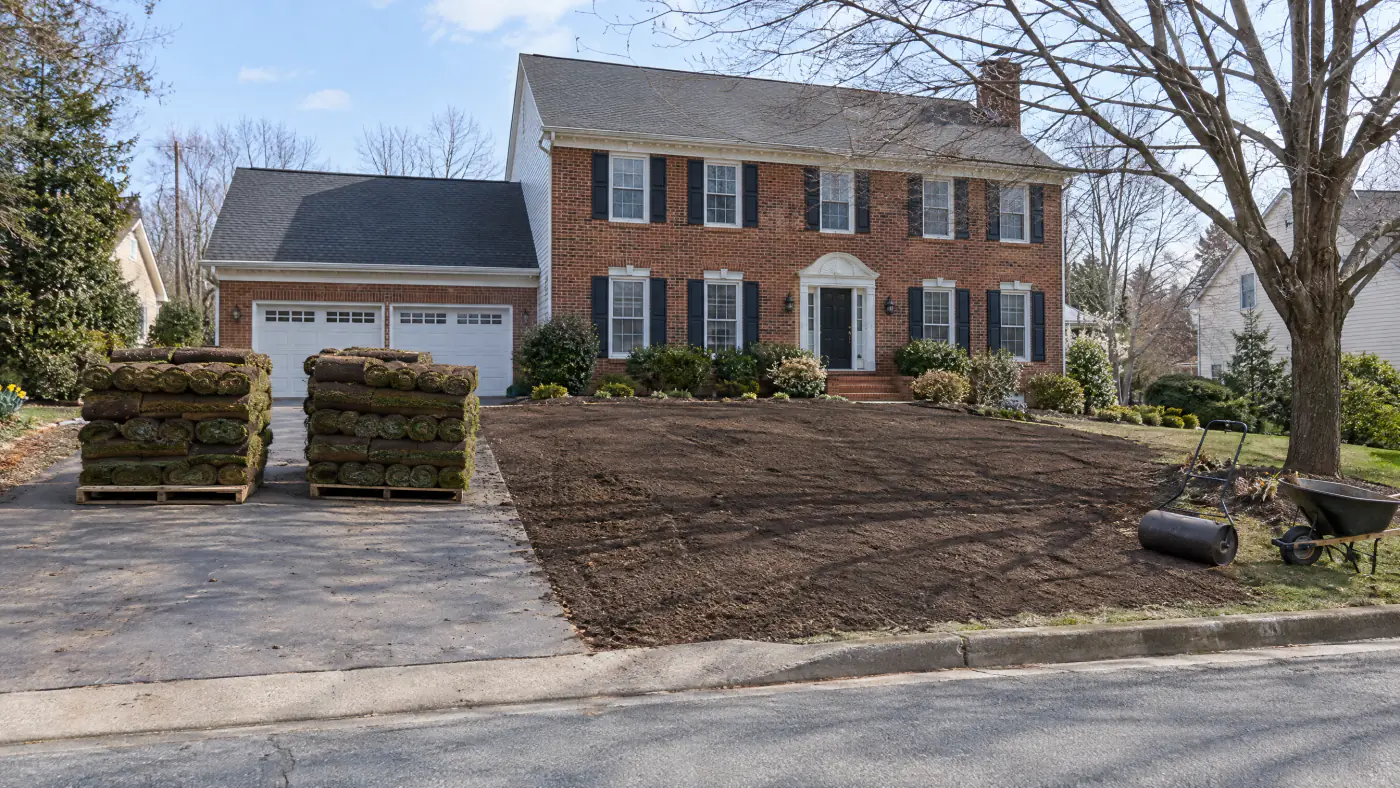
Firm the surface. A light pass with a roller or a thorough watering settles the loosened soil so it does not sink unevenly under the sod. The soil should be moist, not muddy, when the sod arrives. A yard prepared this way looks like a seedbed on a farm, dark, level and crumbly, and that is exactly the look you want to see the morning of delivery.
How is sod laid properly?
Sod is perishable. The technique is simple, but every step exists because of what happens to a roll that sits on a pallet or a seam that is left open.
Lay it the day it arrives
Sod is cut at the farm the day before or the morning of delivery. On a warm day a stacked pallet heats from the inside within hours and the center rolls yellow. The soil is prepared and lightly moistened before the truck comes, and laying starts immediately.
Start from a straight edge
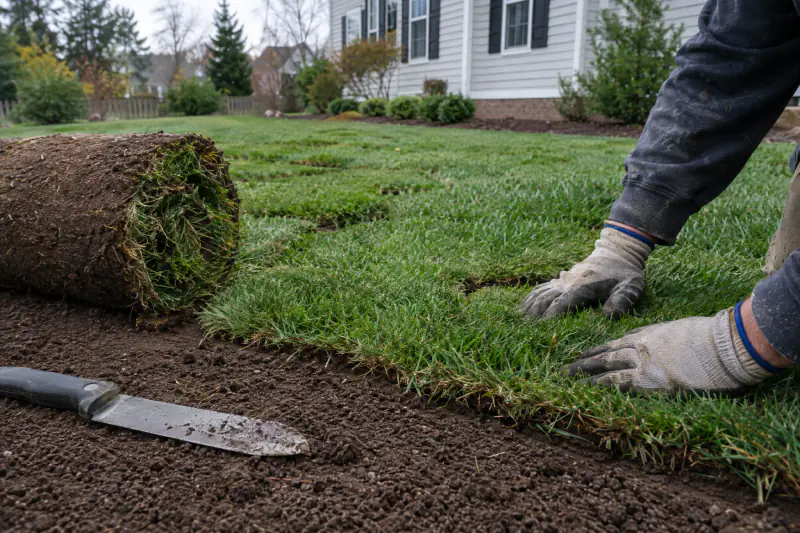
The first row runs along the longest straight line, usually the driveway or front walk, so the pattern stays square. Rolls are unrolled rather than dragged, and each is pressed down so the backing sits fully on the soil.
Stagger the joints
Each row starts with a half roll so end joints fall mid-roll in the row before, like brickwork. Continuous joints running across the lawn dry out first and show for months. Staggered joints disappear within weeks.
Butt tight, never overlap
Edges are pushed firmly together with no gap and no overlap. A gap dries into a brown line and invites crabgrass. An overlap leaves a ridge that the mower scalps. Rolls are not stretched to close a gap, because stretched sod shrinks as it dries.
Run across slopes and trim with a knife
On a slope, rows run across the fall, not up and down, so water cannot channel along a joint. Steep banks get biodegradable pins. Curves at beds and around sprinkler heads are cut with a sod knife, not torn, and small scraps are avoided at edges because they dry out and lift.
Roll, then water within the hour
A water-filled roller, about a third full, presses the sod into the soil and removes air pockets without compacting the bed. The lawn is then soaked until water has reached the soil beneath, usually a quarter to half an inch, before the crew leaves.
How should new sod be watered in the first month?
New sod is watered to keep the sod and the top inch of soil beneath it moist for two weeks, then deeper and less often as roots take hold, reaching a normal schedule of about an inch a week by the end of the first month. The schedule below is typical for spring in Northern Virginia. Rain counts, heat shortens the intervals, and the corner test overrides the calendar.
Day one. Soak the lawn right after rolling until the soil under the sod is wet, which usually means a quarter to half an inch of water applied slowly enough not to run off the clay. Check the corners farthest from the sprinkler.
Days two through fourteen. Water once a day, and twice a day in a warm, windy or sunny spell, in the early morning and again in early afternoon. The goal is never to let the sod dry out, even for one hot afternoon, because the roots that are forming are a fraction of an inch long and die the moment the backing dries. Avoid evening watering where you can; sod that goes into the night wet is sod that invites disease.
Days fifteen through twenty-one. Once the corner test shows roots, water every other day, longer each time, so moisture reaches two to three inches down and the roots follow it. This is the week the lawn starts to root deeply instead of sitting on the surface, and it is the week most homeowners either stop watering too soon or keep watering too often.
Days twenty-two through thirty. Water two or three times a week, about a third of an inch each time, and then settle into roughly an inch a week including rain. A tuna can on the lawn tells you how long a sprinkler takes to deliver that. From here on, deep and infrequent is the rule for tall fescue, and we lay out the summer version of it in keeping tall fescue alive through a Northern Virginia summer.
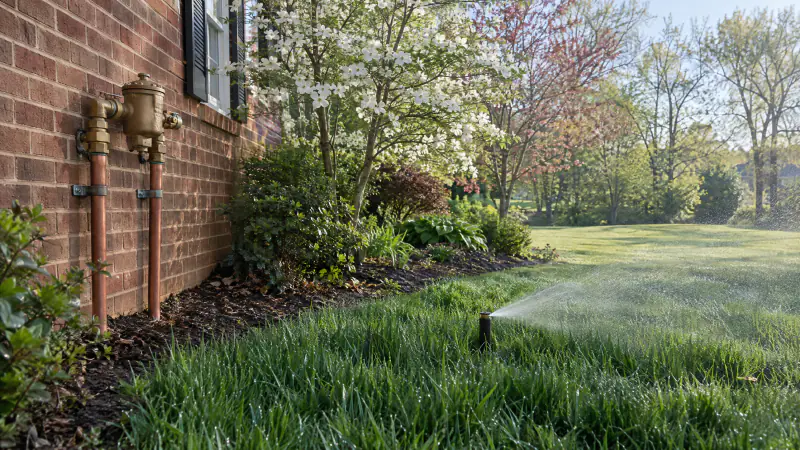
A sprinkler system makes this month far easier, and an existing one should be started up and checked before the sod goes down, not after. Our spring sprinkler start-up checklist covers that. If you are watering by hose, two or three oscillating sprinklers on an inexpensive timer cover a typical front yard, and the main job is moving them so no strip is missed. Uneven coverage shows up as a pale stripe within a week.
How can you tell if sod is rooting, and when do you mow?
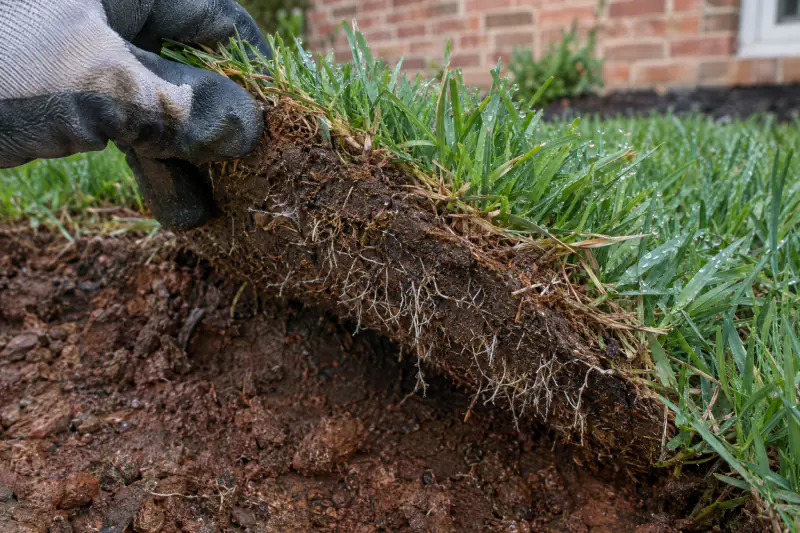
Sod is rooting when a corner resists a gentle tug, when white roots are visible on the underside, and when the color stays even through a warm afternoon. In spring that usually happens between ten days and three weeks after installation, sooner in May than in March. The seams knit a little later, and the faint lines of the rolls can show for a month or more, especially where a joint was slightly open. That is cosmetic. Sod that is pale at the seams but holds firm is fine. Sod that lifts freely after three weeks is not rooting, and the cause is almost always water or soil contact.
The first mow comes when the grass reaches about four to four and a half inches, typically two to three weeks after installation, and only after the tug test passes. Set the mower high, at 3.5 to 4 inches, use a sharp blade, mow when the surface is dry, and avoid tight turns on the new turf. A dull blade tears seedlings and leaves a white cast on the lawn; sharp blades cut clean. Never remove more than a third of the blade height in one mow. Bag the first couple of cuts if the clippings are heavy, then return to mulching. Keep the mower off the lawn on wet days through the first month, because the tires rut soft soil and a rut under sod lasts for years.
Foot traffic follows the same logic. Stay off new sod for the first two weeks apart from moving sprinklers, allow light use in weeks three and four, and let children and dogs back on it after about a month. Fertilizer is handled by the soil test and the starter application at installation; adding more in the first month pushes blade growth the roots cannot support. If the sod went down in March, a light feeding in May is reasonable, and then nothing until fall. That later care is the homeowner's job or a lawn service's, since our work ends with the installation and the written watering plan.
Why does new sod fail?
Nine causes behind nearly every failed sod lawn we are asked to look at, roughly in order of how often we see them.
- It dried out once in the first two weeks, usually on a single hot, windy afternoon.
- It was laid over the old lawn or over hard, unloosened clay, so roots never left the backing.
- The pallet sat in the sun for a day before laying, and the center rolls arrived already yellow.
- Gaps were left at the joints or rolls were stretched to close them, and the edges browned.
- Low spots were not graded, so sections sat in standing water and rotted from below.
- It went down in June or July and brown patch spread through wet, warm nights.
- Watering was heavy once a day instead of frequent and light, and the top inch kept drying.
- Deep shade under oaks or maples, where no tall fescue will persist, was sodded anyway.
- The first mow was too low or with a dull blade, and the stressed sod never recovered.
How much does sod installation cost per square foot in Northern Virginia in 2026?
As of 2026, professionally installed tall fescue sod in Northern Virginia typically costs about $2 to $4 per square foot, including removal of the old lawn, soil preparation and the sod itself. A 5,000 square foot lawn therefore often falls between $10,000 and $20,000. Small areas cost more per square foot, often $4 to $6 for a few hundred square feet, because the equipment, delivery and setup are the same whether the lawn is large or small. The sod alone, delivered on pallets, is a fraction of the total, commonly well under a dollar per square foot; the rest is the removal, the compost, the grading and the labor. These are general market ranges, not myYardPros prices.
What moves the number: how much old lawn and debris must be cut out and hauled away; whether soil has to be brought in to fill low areas or hauled out to correct grade; the quantity of compost and any lime; access, since a narrow gate means smaller machines and more wheelbarrow work; slopes, tree roots and the amount of trimming around beds and sprinkler heads; and distance from the sod farm, which affects delivery. Irrigation repairs and drainage work are priced separately.
For comparison, full renovation by seed with the same soil preparation commonly runs $0.50 to $1.50 per square foot, and simple aeration and overseeding of a lawn that is still mostly grass is a few hundred dollars for a typical suburban lot. Sod costs several times what seed does because you are buying a year of growth from a farm. Whether that is worth it depends on the season, the slope and how soon you need the lawn, which is the decision our sod vs. seed guide and the cost guide walk through. For a figure that fits your yard, the only reliable number is a written estimate after a site visit.
What is different about sod in Fairfax, Loudoun, Prince William, Arlington and Alexandria?
The grass is the same across Northern Virginia; the soil, the shade and the water are not. In the newer communities of eastern Loudoun and western Prince William, including Ashburn, Aldie, South Riding, Gainesville, Haymarket and Bristow, the typical lot has an inch or two of topsoil over subsoil compacted by construction equipment. Sod on those lots succeeds only after the tilling and compost described above, and it is where we spend the most time on preparation. In western Loudoun around Leesburg and Purcellville, lots are larger, soils are rockier and many homes are on wells, so a 10,000 square foot sod lawn needs a realistic conversation about how it will be watered for a month.
Older Fairfax County neighborhoods in Vienna, McLean, Burke, Springfield and Annandale usually have better native topsoil but far more shade. The front lawn under a mature willow oak or red maple is the most common place we are asked to sod and the most common place we advise against it. Fescue sod will look good for a season in heavy shade and then thin, and the money is better spent on a shade bed. Reston and Great Falls add slope, where rows run across the fall and steep banks are pinned.
Arlington County, Alexandria and Falls Church bring small lots, tight access and street trees. A rowhouse front lawn of 300 square feet is hand work from start to finish, and the per-square-foot cost reflects that, but the job is finished in a morning. Public water from Fairfax Water, Loudoun Water, Prince William County Service Authority and the Arlington and Alexandria utilities makes watering easy but adds to the bill for a month; that cost is worth budgeting for a large lawn. Rules on watering are rare here outside a drought declaration, but check with your county if one is in effect. We install sod across all of these jurisdictions and nowhere else; our service areas page lists each one, and the lawn and landscape pillar explains how sod fits with our other lawn work.
Should you sod or seed this spring?
In spring, sod. Tall fescue seed sown in March or April germinates well enough, but the seedlings reach July with shallow roots and most of them do not survive their first summer, which is why we treat spring seeding as a repair tactic rather than a way to build a lawn. Spring is also crabgrass preventer season, and the pre-emergent that stops crabgrass stops fescue seed just as well. Sod sidesteps both problems. It arrives with a year of root already grown, it shades out the crabgrass seed in the soil beneath it, and it needs ten weeks of attention rather than a full season of hoping.
If the lawn is still mostly grass and only thin, neither is the answer this month. Keep it alive through the summer, mow it high, and plan a fall aeration and overseeding, which we lay out week by week in the fall lawn renovation plan. If the lawn is mostly weeds or bare clay and you can live with it until September, seeding then will cost a fraction of sod and give a comparable lawn by next spring. We revisit the whole decision at the start of the fall window in sod or seed this fall.
If the lawn is bare now and you want it green by May, that is the spring sod job this article describes. Order the soil test this week, strip and prepare the yard as soon as the clay is dry enough to work, schedule the sod for a cool stretch in April, and plan to be home, or have an irrigation controller set, for the first two weeks. Done in that order, spring sod in Northern Virginia roots well and goes into its first summer with a fair chance.
Frequently asked questions
Can sod be laid in March in Northern Virginia?
Yes, as soon as the ground has thawed and dried enough to be graded without smearing the clay. Sod farms harvest whenever fields are not frozen. March sod roots slowly at first because the soil is cold, then speeds up through April. The advantage of going early is that the lawn gets the longest possible run of mild weather before summer. The risk is a late hard freeze, which sod tolerates far better than seedlings do.
How long after laying sod can I walk on it?
Stay off it for about two weeks apart from moving sprinklers, then allow light foot traffic in weeks three and four once a corner resists a tug. Normal use by children and dogs is usually fine after about a month in spring. Walking on sod before it roots shifts the rolls, opens joints and presses footprints into the soft soil beneath, all of which show for the rest of the season.
Should I put topsoil down before sod?
Only if the existing soil is too low or too poor to amend. Most Northern Virginia clay is better loosened and mixed with one to two inches of compost than buried under a thin layer of purchased topsoil, which often creates a loose layer over a hard one that roots will not cross. Where fill is needed to correct grade, it should be blended into the existing soil rather than spread on top like icing.
Do I need a soil test before sodding?
It is a small cost that answers two questions you would otherwise guess at: how much lime the acidic clay needs, and whether phosphorus is justified. A routine test through Virginia Cooperative Extension, processed by the Virginia Tech soil testing laboratory, takes a couple of weeks and costs a modest fee. Send it in February for a spring job. Without it, lime and fertilizer are applied blind, and on lots that drain toward a stream that is a pollution problem as well as a waste.
Why are there lines in my new sod?
The seams between rolls show until the grass knits across them, which can take a month or more. Faint lines on a lawn that holds firm when tugged are cosmetic and fade with mowing. Brown lines mean the joints were left slightly open or the edges dried out, and they usually close on their own once the roots are established and the lawn is mowed a few times. Wide gaps can be filled with a little soil and seed in fall.
Does new sod need fertilizer?
Starter fertilizer is applied at installation where the soil test supports it, and that carries the sod through its first month. Adding more in the first few weeks forces blade growth the new roots cannot sustain. For spring sod, a light feeding in May is reasonable, then nothing until September. Virginia restricts phosphorus on established lawns, so later feeding should follow the soil test and the product label.
Is it better to sod or seed a shady yard?
Neither works in deep shade. Tall fescue tolerates light to moderate shade, roughly four or more hours of direct sun, and fails under a dense mature canopy whatever form it is planted in. Sod lasts a season there and then thins; seed often never fills in. For shaded areas, the honest options are a shade planting bed, a mulched woodland floor, or artificial turf where a usable surface is required.
Book the work
Put the plan in writing with a crew that builds this every week.
One visit to measure and talk through options, then a written scope and price. No pressure, no vague numbers. Ask about the Heroes Discount if you serve.
Sources and further reading
Published March 12, 2026. Reviewed and updated October 9, 2026.