Key takeaways
- A weather-based controller adjusts run times from local evapotranspiration data, while a soil-moisture controller waits for the ground itself to dry. Both skip the cycles a clock timer never would.
- The EPA WaterSense label on a controller means it passed an independent test of how well it schedules water. Not every app-connected controller carries it.
- Realistic savings depend on how wasteful the old schedule was. Lawns that were overwatered three days a week on a clock see the largest drop; well-managed systems see less.
- Summer gallons in Fairfax and Loudoun often cost more than winter gallons because of peak-use and tiered rate structures, so the savings land in the months that hurt most.
- The controller is only one of three fixes. Cycle-and-soak programming for clay and pressure-regulated heads often save as much water as the controller itself.
On this page
- How does a smart irrigation controller actually decide when to water?
- Weather-based or soil-moisture sensor: which type fits a Northern Virginia yard?
- How do the three controller types compare?
- What does the EPA WaterSense label mean on a controller?
- How much water can a smart controller realistically save?
- Why does summer watering cost more per gallon in Fairfax and Loudoun?
- What is cycle-and-soak, and why does clay soil need it?
- Why do pressure-regulated heads and nozzles matter as much as the controller?
- Should you retrofit the controller or replace the whole system?
- What happens during a controller upgrade visit?
- What does a smart controller upgrade cost in Northern Virginia?
- How do you know if an upgrade will pay for itself?
- What is different about irrigation systems in Fairfax, Loudoun, Prince William and Arlington?
- Frequently asked questions
How does a smart irrigation controller actually decide when to water?
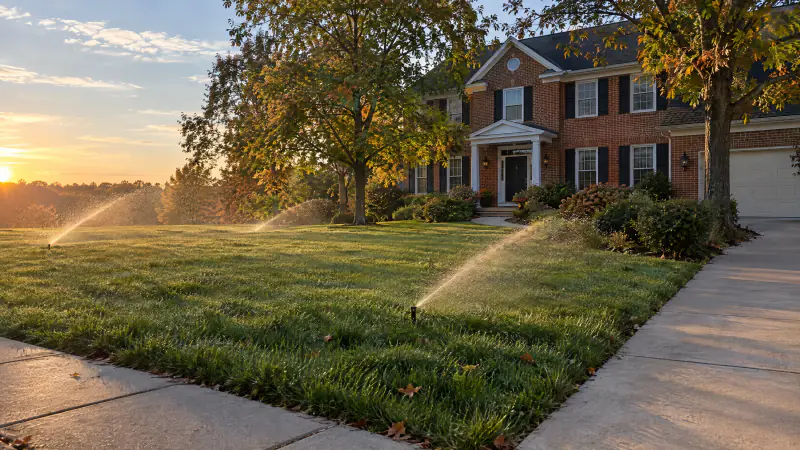
A smart controller replaces the fixed clock in your garage with a schedule that changes every day based on what the weather and the soil are doing. The old timer runs zone three for twenty minutes on Tuesday, Thursday and Saturday whether it rained on Monday or not. A weather-based controller pulls local weather data, calculates how much water the lawn lost to heat, sun and wind since the last cycle, and runs only long enough to put that amount back. A soil-moisture controller does something simpler: it reads a probe in the ground and refuses to water until the soil has dried to a level you set.
The number behind the weather-based type is evapotranspiration, usually shortened to ET. It is an estimate of the water a reference crop loses to evaporation and plant use over a day. On a cloudy, 72-degree day in late May, ET in Northern Virginia might be a tenth of an inch. On a 95-degree July afternoon with a breeze, it can be a quarter inch or more. The controller adds up the daily ET, subtracts rainfall it knows about, and triggers a cycle when the deficit reaches the allowed depletion for that zone. Spring and fall run times shrink on their own. July run times grow. Nobody has to remember to adjust the dial.
What makes this work on a Northern Virginia lawn is the setup, not the box. The controller has to know each zone's soil type, slope, sun exposure, plant type, head type and application rate. Get those inputs wrong and a very expensive controller will water a shaded fescue slope on clay exactly as if it were a sunny sandy flat. We explain how the setup is done, zone by zone, on our irrigation upgrades page; this article goes deeper into what the controller does with those inputs and what it means for a summer water bill.
Weather-based or soil-moisture sensor: which type fits a Northern Virginia yard?
For most lawns here, a weather-based controller with a rain and freeze sensor is the practical choice, and a soil-moisture sensor is the better tool for a few specific situations. Weather-based units are easier to live with. They need no probe in the ground, they work from the day they are programmed, and they handle the thing Northern Virginia weather does most often in summer, which is to dump an inch of rain in forty minutes from a thunderstorm and then go dry for ten days. A good ET controller skips the next two or three cycles after that storm and ramps back up as the deficit grows. Because the weather data may come from a station miles away, a physical rain sensor on the gutter edge is a sensible addition that reacts to rain that actually fell on your roof.
Soil-moisture controllers measure rather than estimate. A buried sensor reports actual water content in the root zone, and the controller holds every scheduled cycle until the reading drops below the threshold. On a heavy clay lot that stays wet for days after rain, this can be the more accurate approach, because clay holds water far longer than a weather model assumes. The trade-offs are real, though. The sensor has to sit in a representative spot, in the root zone, away from heads and low spots. One sensor usually governs the whole system, so a shaded back lawn and a sunny front slope get the same decision. Sensors also need to be located before anyone aerates in September, or a tine finds the wire.
If your yard has one dominant condition, say a flat, full-sun fescue lawn on uniform clay, a soil sensor can be excellent. If it has a mix of sun, shade, slope and beds, which describes most lots from Herndon to Haymarket, a weather-based controller with per-zone settings and a rain sensor is usually the stronger fit. Some controllers accept both inputs, and that combination is hard to beat.
How do the three controller types compare?
What each type does with a typical Northern Virginia summer week: a thunderstorm Monday night, then heat through the weekend.
| Clock timer | Weather-based (ET) controller | Soil-moisture controller | |
|---|---|---|---|
| Decides by | Days and minutes you entered | Daily evapotranspiration and rainfall data | Measured water content in the root zone |
| After Monday's storm | Runs Tuesday as scheduled | Skips until the deficit rebuilds | Holds until the probe reads dry |
| During a July heat wave | Same minutes as April | Run times grow automatically | Cycles more often as soil dries |
| Handles zones differently | Only by the minutes you set | Yes, from per-zone soil, slope, sun and head data | Usually one sensor governs all zones |
| Needs in the ground | Nothing | Nothing; a rain sensor on the gutter is optional | A buried probe, placed before aeration |
| Reports and alerts | None | Phone app, run history, flow alerts on some models | Moisture readings; app on newer units |
| Typical fit | Budget systems with an attentive owner | Most mixed sun and shade lots | Uniform lawns, especially on heavy clay |
Many current controllers accept a rain sensor, a freeze sensor, a flow meter and a soil sensor at once; the categories describe what drives the schedule.
What does the EPA WaterSense label mean on a controller?
WaterSense is a voluntary labeling program run by the U.S. Environmental Protection Agency, and on an irrigation controller the label means the product passed an independent test of its scheduling performance, not just a marketing review. The EPA publishes a specification for weather-based irrigation controllers that checks whether the device, left to its own logic, applies water close to what the landscape actually needs over a test period without large overwatering or underwatering. Laboratories accredited under the program run the test, and only models that pass may carry the label. A separate WaterSense specification covers soil-moisture-based controllers, and another covers spray sprinkler bodies with built-in pressure regulation, which we come back to below.
The practical point is that the label separates true weather-based scheduling from controllers that are simply timers with a phone app. An app is a convenience. The ability to shorten Wednesday's cycle because Tuesday was cool and cloudy is a water saving, and that is what the test measures. When we specify a controller, we look for the label as a baseline and then for the features that matter on the specific property: enough stations for the zone count, a rain sensor input, a flow meter input if the system is large, and a local weather source the homeowner can see in the app.
WaterSense also publishes homeowner guidance on outdoor water use, and it is worth reading because it frames the problem honestly. Nationally, the EPA estimates that outdoor use accounts for roughly 30 percent of household water on average, and a much larger share in summer in neighborhoods with irrigation systems. That is where the Fairfax or Loudoun summer bill comes from, and where a better schedule earns its keep. Brands such as Rain Bird, Hunter and Rachio all offer labeled models; we mention them only as examples of the category, and the right unit depends on your wiring, zone count and Wi-Fi signal.
How much water can a smart controller realistically save?
Honest answer: it depends almost entirely on how much the old schedule was wasting, and the right way to estimate your own savings is to look at the gap between your winter and summer bills. The EPA has published an estimate that replacing a standard clock timer with a WaterSense labeled controller can save an average home up to about 15,000 gallons a year, which is a national figure and assumes typical overwatering on the old timer. A Northern Virginia lawn that was running three days a week, twenty minutes a zone, rain or shine, from May through September is a strong candidate to see that kind of drop. A system that was already being adjusted monthly by an attentive owner will see much less, because there is less to save.
Here is a rough way to think about it. A quarter-acre lot in South Riding or Centreville might have about 6,000 square feet of irrigated lawn. Applying one inch of water to that area takes roughly 3,700 gallons. A clock schedule that puts down an inch and a half every week from May through September delivers something like 120,000 gallons over the season. Tall fescue in this climate usually needs about an inch to an inch and a half a week in summer, rain included, and far less in May and September. If rain supplies a third of that and the controller skips the cycles after storms, the saving can be tens of thousands of gallons across the season. If the lawn was already underwatered, the controller may actually add water in July, and the lawn will look better for it.
Two cautions. First, a controller cannot fix a leaking valve, a broken lateral or a head that waters the sidewalk; those gallons leave the system no matter how smart the schedule is, which is why the upgrade visit starts with an audit. Second, the first season with a smart controller is partly a learning period. Expect to adjust a zone or two after watching the lawn through its first July. We cover the day-to-day of summer lawn care in keeping tall fescue alive through a Northern Virginia summer, and the controller settings are a large part of that story.
Why does summer watering cost more per gallon in Fairfax and Loudoun?
Because most water utilities in the region price higher summer use at a higher rate, so the gallons an irrigation system adds in July are often the most expensive gallons of the year. The structures vary by utility and change from year to year, so we describe them in general terms only and you should read your own bill and your utility's current rate schedule for the specifics. Fairfax Water, which serves most of Fairfax County and sells water to several neighboring systems, has used a peak-use charge: usage in the summer billing periods above a baseline derived from the customer's winter use is billed at an additional rate. Loudoun Water has used an increasing-block structure, where each successive tier of quarterly consumption carries a higher price. Other providers in the area, including Prince William Water (formerly the Prince William County Service Authority), Arlington County, the City of Manassas and the private utility that serves Alexandria, each set their own schedules.
Put those two facts together and the smart controller argument gets clearer. The water a weather-based schedule skips after a thunderstorm, or trims from a mild September, is almost always water that would have been billed in the highest tier or on top of the peak baseline. The same is true of the water saved by pressure-regulated heads that stop misting into the wind. This is why we suggest that homeowners who want to know what an upgrade is worth pull up the last two summers of bills before the site visit. The difference between the winter quarter and the hottest summer quarter is roughly the number you are working to shrink. For the broader picture of what water work costs, see the cost guide.
What is cycle-and-soak, and why does clay soil need it?
Cycle-and-soak splits a zone's run time into several short cycles with rest periods between them, so water soaks into the ground instead of running off it, and on Northern Virginia clay it is the single most useful programming feature a controller has. Clay accepts water slowly. A typical spray zone applies water at a rate of about an inch and a half an hour or more, while compacted clay on a builder-grade lot may absorb a small fraction of that. Run a twenty-minute cycle straight through and the first few minutes soak in; the rest sheets across the surface, collects at the low corner, runs down the driveway, or pools against the foundation. The controller counted it as applied. The roots never saw it.
Split the same twenty minutes into four five-minute cycles with twenty or thirty minutes of soak between them and the water goes where it was aimed. The lawn gets deeper, less frequent watering, which is what tall fescue roots want in summer. The sidewalk stays dry. The low corner stops growing moss. Most smart controllers do this automatically once the zone is told its soil is clay and its slope is more than flat; some let you set the cycle and soak lengths by hand. A basic timer can imitate it, clumsily, by stacking several short start times, which is a trick we sometimes use on older systems that are not yet ready for replacement. On the graded front lawns common in Ashburn, Brambleton and Gainesville, soak cycles are also the cure for the brown arc at the top of a slope: the water was applied evenly, it just moved downhill before it could soak in. If a zone still ponds after soak cycles are added, the problem is drainage rather than scheduling, and our yard drainage page describes how a low spot is corrected.
Why do pressure-regulated heads and nozzles matter as much as the controller?
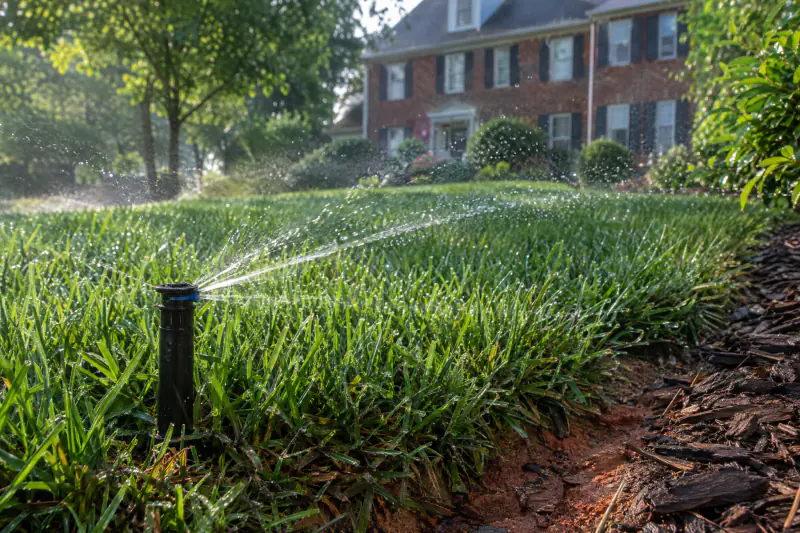
Because a perfect schedule still wastes water if the heads turn it into fog, and in Northern Virginia neighborhoods with strong municipal pressure, that is extremely common. Spray heads are designed to work at about 30 psi. Rotors generally want something in the 45 psi range. Many homes here see 70 psi or more at the hose bib, and a system installed without regulation delivers that straight to the nozzle. The result is misting: the stream breaks into droplets so fine they hang in the air, drift with the breeze, and evaporate before they land. On a breezy afternoon a quarter of a zone's water can leave the yard this way.
Pressure-regulated spray bodies have a small regulator built into the stem that holds the nozzle at its design pressure no matter what the main delivers. The EPA WaterSense program has a specification for these bodies, and labeled models are widely available from the major manufacturers. Swapping a zone's spray bodies for regulated ones is a straightforward retrofit, since the lateral pipe and the nozzle stay the same. Where the whole system runs high, a regulator at the zone valve or at the point of connection does the same job for every head downstream.
Nozzles are the other half. Rotary nozzles replace the fixed fan of a traditional spray with several slowly rotating streams. They apply water at roughly a third to half the rate of a fixed spray, which means the clay can keep up, and they hold their pattern far better in wind. Converting a spray zone to rotary nozzles usually requires lengthening the run time, because less water is going down per minute, and a smart controller handles that once it is told the new application rate. In our experience, a zone with regulated bodies and rotary nozzles on a cycle-and-soak schedule is where the water savings become visible on the lawn, not just on the bill. Pressure is one of the first things checked at spring start-up, and it is a good moment to plan the retrofit.
Should you retrofit the controller or replace the whole system?
Retrofit, in most cases, as long as the pipe and valves below ground are sound. Nearly every residential sprinkler system installed in the last few decades runs its valves on 24-volt wiring, and a new controller connects to the same wires the old timer used. A rain sensor, a flow meter and in some cases a soil sensor can be added to that controller. Pressure-regulated bodies and rotary nozzles install on the existing laterals. Bed zones can be converted from spray to drip with a filter and regulator at the valve. None of that requires trenching, and most of it can be done in a day or two.
Replacement makes more sense when the problems are in the ground. Brittle poly pipe that splits at a new place each spring, valves that have been replaced piecemeal and no longer match, wiring that was spliced underground without waterproof connectors, or a layout that never fit the yard because beds, a patio or a walkway were added after the system went in. A system with three or four of those issues is a candidate for a new sprinkler system installation, and our article on installing a sprinkler system in Northern Virginia walks through what a new design includes. A new system can still reuse a recent smart controller, so the controller is rarely the wasted purchase.
There is a middle path we often recommend: fix the leaks first, upgrade the controller second, and stage the head and nozzle retrofits one or two zones at a time, starting with the zones that face the street or sit on slopes. The controller delivers savings immediately across every zone. The head work compounds it where overspray and runoff are worst. Staging the field work keeps the budget predictable and lets you see the result of each step on the lawn and the bill. The water management pillar describes how the pieces fit together with drainage, which matters because a yard that stays wet with the system off needs a different fix altogether.
What happens during a controller upgrade visit?
A typical half-day to full-day visit on a six-zone suburban system, in the order the work is done.
Audit every zone with the old controller
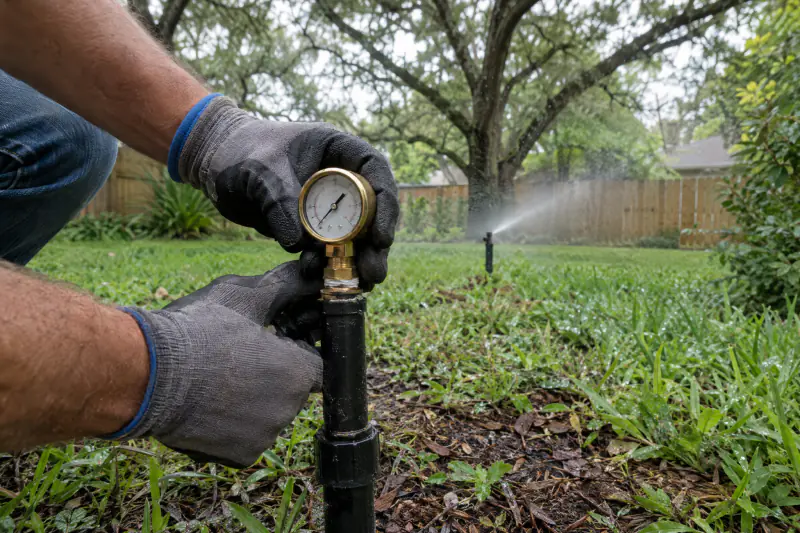
Each zone is run and watched. Pressure is measured at a head with a gauge, coverage gaps and overspray are flagged in the lawn, sunken or tilted heads are noted, and the existing program is recorded so the before and after can be compared.
Check the Wi-Fi signal at the mounting spot
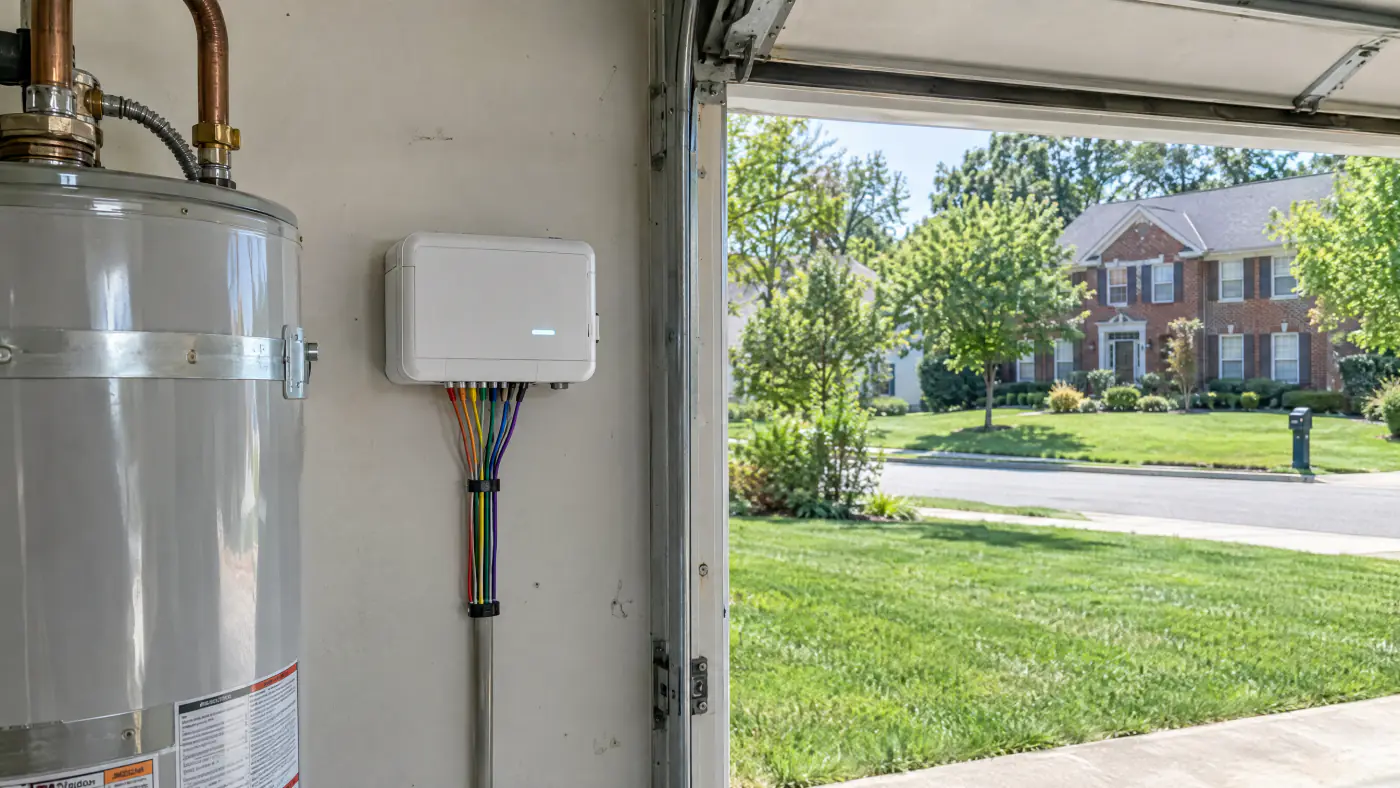
Most controllers live in the garage, which is often the weakest corner of a home network. A signal test decides whether the controller goes in the same place, moves, or needs a range extender. Doing this before choosing a model avoids a return trip.
Label and transfer the zone wires
The old timer comes off, each station wire is tagged with its zone and what it waters, and the wires land on the new controller. The common wire, the master valve or pump start lead if present, and the sensor terminals are connected and tested.
Mount and connect the sensors
A rain and freeze sensor goes on a gutter edge or eave where it sees open sky and is not under a tree. A flow meter, when specified, is plumbed on the main after the backflow preventer. A soil sensor is buried in the root zone of a representative lawn area.
Enter the real data for each zone
Soil type, slope, sun exposure, plant type, head type and measured application rate go into the controller for every zone. This is the step that turns a smart controller into a smart schedule, and it takes longer than the wiring.
Program, run, and walk through the app
Cycle-and-soak is enabled where it is needed, watering days are set to match any local restrictions, and each zone is run from the app to confirm it responds. The homeowner sees how to skip a day, run a zone by hand and read the water use report.
What does a smart controller upgrade cost in Northern Virginia?
As of 2026, typical Northern Virginia market ranges for a smart controller supplied, installed and programmed run roughly $300 to $800 for a residential system, with the controller itself accounting for a little under half of that on most jobs. Treat them as regional planning numbers rather than our prices; they move with the items below. Adding a wired rain and freeze sensor at the same visit is often $100 to $250 more. A flow meter adds several hundred dollars on systems large enough to justify one. A soil-moisture sensor and its wiring typically fall somewhere between the two.
The field work that multiplies the savings is priced per zone. Replacing spray bodies with pressure-regulated ones and fitting rotary nozzles commonly runs $150 to $500 per zone depending on head count and how many heads need to be dug out and raised. Converting a bed zone from spray to drip, with a filter and regulator at the valve, often falls between $400 and $1,200. A full audit with a written, prioritized list is sometimes offered as its own small line item and sometimes folded into the first visit.
What moves the number: the zone count, whether the controller needs a new location or a Wi-Fi extender, the condition of the existing wiring and valves, how many heads need raising or replacing, bed size for drip conversions, and whether a flow meter or soil sensor is specified. A small number of water utilities around the country offer rebates on WaterSense labeled controllers; whether yours does changes from year to year, so it is worth a quick check of your utility's website before buying. What we can say with confidence is that on a system that has been overwatering on a clock, the controller is usually the cheapest water-saving change available, and the payback often shows on the first full summer of bills. For a figure based on your own system, the only reliable route is a written estimate after an on-site audit; how it works explains what that visit looks like.
How do you know if an upgrade will pay for itself?
Seven things to look at before the site visit. Three or more and the controller is very likely worth it.
- Your summer water bill is more than double your winter bill with the same household.
- The controller still shows the schedule someone set two or more summers ago.
- Sprinklers have run during or right after a measurable rain in the last year.
- You can see fog hanging over the spray heads on a calm morning.
- Water runs down the driveway or gutter line before a zone finishes.
- The lawn has a brown arc at the top of a slope and moss or mushrooms at the bottom.
- You travel in summer and cannot adjust watering when the weather changes.
What is different about irrigation systems in Fairfax, Loudoun, Prince William and Arlington?
The water, the soil and the age of the systems all differ across the region, and they change what an upgrade should focus on. In Loudoun County, especially the newer communities from Ashburn and Brambleton out to South Riding and Aldie, most systems are builder-installed, run on clock timers, and sit on lawns laid over compacted subsoil with very little topsoil. Cycle-and-soak and pressure regulation do a great deal there. In older Fairfax County neighborhoods such as Vienna, Burke, Oakton and Annandale, systems tend to be decades old with mechanical timers, mixed head types and heads swallowed by shrubs that grew up around them, so the audit often finds as much saving in head adjustment as in the controller. Arlington and Alexandria lots are smaller and shaded by mature trees, which means fewer zones and a strong case for drip in the beds. Prince William County communities around Gainesville, Haymarket and Woodbridge mostly resemble Loudoun's newer lots. Homes on private wells in Great Falls, Clifton and western Loudoun near Purcellville pay for pumping rather than water, and there the audit's pressure and flow numbers decide what the system can run at once.
Retrofits rarely need a permit, but a backflow replacement usually does, and HOAs in planned communities sometimes ask about visible equipment such as a controller mounted on an exterior wall. Freeze matters as well: the rain and freeze sensor pauses the system on cold nights in October, but it does not replace the fall blow-out, which is covered in our guide to sprinkler winterization in Northern Virginia. We do this work throughout Fairfax, Loudoun, Prince William and Arlington counties and the cities of Alexandria, Fairfax, Falls Church, Manassas and Manassas Park; the service areas page lists every community.
Frequently asked questions
Will a smart controller work with my existing sprinkler wiring?
Almost always. Residential irrigation valves run on 24-volt wiring, and a new controller lands on the same station wires the old timer used. The things to confirm before buying are the number of stations, whether the system has a master valve or pump relay that needs its own terminal, and whether a usable Wi-Fi signal reaches the spot where the controller will hang, usually the garage.
Does a smart controller need Wi-Fi to work?
Most weather-based models need an internet connection to receive weather data and to let you use the app, and they fall back to a stored schedule if the connection drops. A wired rain sensor and a soil sensor keep working without Wi-Fi. If the garage signal is weak, the fix is usually a small range extender or relocating the controller, both of which are checked during the audit.
What is evapotranspiration and why does the controller care?
Evapotranspiration, or ET, is the daily water loss from soil evaporation and plant use, expressed as a depth like rainfall. A weather-based controller adds up ET each day, subtracts rain, and waters when the running deficit reaches the limit set for a zone. In a Northern Virginia summer, ET can be a quarter inch a day during heat waves and a fraction of that in cloudy spring weeks.
Can a smart controller tell me if a sprinkler line is broken?
Only if it has a flow meter. The meter measures gallons per minute on the main line, and the controller learns the normal flow for each zone. A reading far above normal usually means a broken head or lateral, and far below usually means a stuck or failed valve. Controllers with that feature can shut the zone off and send an alert, which is useful for homeowners who travel.
Should I still have a rain sensor if the controller uses weather data?
Yes, in our view. Weather data may come from a station miles away, and summer thunderstorms here are extremely local. A rain sensor on your own gutter edge is a physical shutoff that reacts to rain that actually fell on your roof. Most also include a freeze cutoff. It is an inexpensive addition and it covers the gaps in the forecast-based logic.
How often should the lawn be watered on clay soil in summer?
Deeply and infrequently. For established tall fescue, two or three watering days a week in summer is a common starting point, with each zone split into short cycles so clay can absorb each pass. Early morning is the right time. A weather-based controller will stretch the interval in mild weeks and shorten it in heat, and Virginia Cooperative Extension guidance on lawn watering is a good reference for the totals.
Are there watering restrictions in Fairfax or Loudoun County?
Not as a routine rule in most years, but utilities and counties issue voluntary and sometimes mandatory restrictions during droughts, often limiting watering to certain days or hours. Smart controllers let you set allowed days so the schedule stays within those limits. Check your water provider's website for current guidance, since the rules come from the utility rather than from a single countywide ordinance.
Book the work
Put the plan in writing with a crew that builds this every week.
One visit to measure and talk through options, then a written scope and price. No pressure, no vague numbers. Ask about the Heroes Discount if you serve.
Sources and further reading
Published June 18, 2026. Reviewed and updated October 9, 2026.