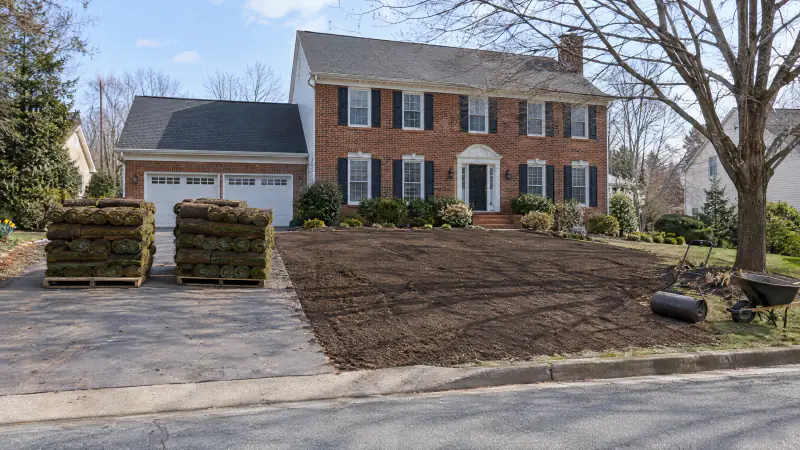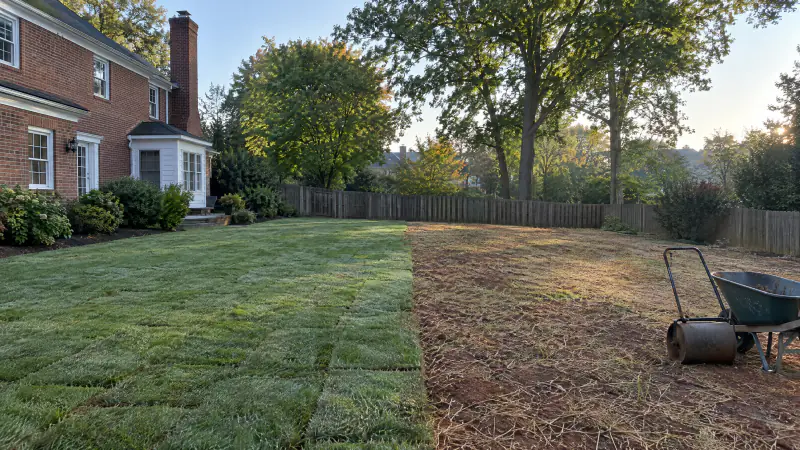
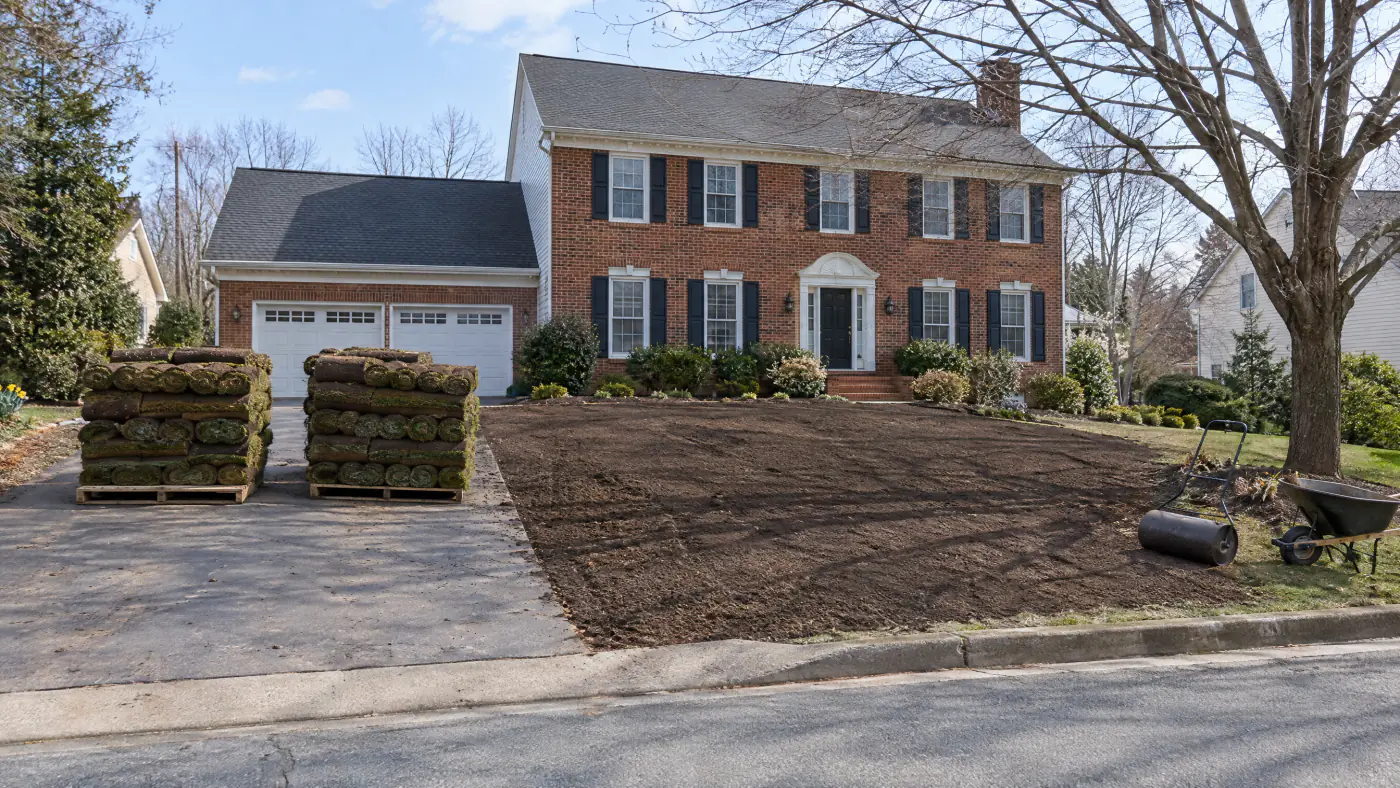
Key takeaways
- Laying sod is within reach of a capable homeowner on a modest, fairly level lawn. The hard parts are the soil work before it arrives and the watering for a month after.
- Virginia Cooperative Extension says to till and amend to 4 to 6 inches, clear stones over 1.5 inches, and never lay sod over grass. On compacted clay, that is a rental-machine weekend.
- Sod is perishable. Extension says install it within eight hours of harvest, and a pallet holds roughly 450 to 700 square feet, so delivery day needs helpers and a plan.
- As typical Northern Virginia ranges for 2026, DIY materials and rentals for 3,000 square feet run about $2,700 to $6,700, against $2 to $4 per square foot installed. Not myYardPros prices.
- Call 811 at least three working days before digging, and remember private lines, like pet fences and shed feeds, are not marked. Ask the county before regrading anything large.
On this page
- Should you lay sod yourself or hire a crew in Northern Virginia?
- How do you decide in five questions whether this is a DIY job?
- What do you sort out before you dig: 811, private lines and county rules?
- When is the right time to lay sod in Northern Virginia, and is November too late?
- Which sod should you order: tall fescue, bluegrass blend, zoysia or bermuda?
- How do you prepare compacted Northern Virginia clay for sod?
- How do you measure and order sod, and why does delivery day matter?
- How much sod, compost and hauling does a lawn this size mean?
- What tools do you need, and what do rentals cost?
- How do you lay sod so the seams disappear?
- How do you water new sod for the first 30 days, and when is the first mow?
- Where do DIY sod jobs fail, and how do you avoid it?
- How much does DIY sod cost compared with hiring a crew in Northern Virginia in 2026?
- What does a 3,000 square foot lawn cost both ways?
- Which parts are worth hiring out even if you do the rest yourself?
- How does a DIY sod job differ across Fairfax, Loudoun, Prince William and Arlington?
- Frequently asked questions
Should you lay sod yourself or hire a crew in Northern Virginia?
For a modest, fairly level lawn with workable soil, laying sod yourself is a reasonable project, and we will say so plainly. For a large yard, a slope, a lot of compacted builder clay or a spot that stays wet, a crew earns its price. What decides it is rarely the laying. It is the soil preparation before the sod arrives, the eight-hour clock once it does, and the thirty days of watering after.
We are writing this on November 12, so it also answers this week's question: is it too late? Often not, but it is late. Figures credited to Virginia Cooperative Extension, Virginia 811 or Fairfax County come from those sources. Dollar figures are planning ranges, and the rest is our own practice on Northern Virginia lots. If you decide to hand it over, our sod installation and lawn renovation page shows how we run the job, and our sod timing and prep article covers the crew side.
How do you decide in five questions whether this is a DIY job?
Answer these honestly before you order a pallet. Two or more answers in the right-hand column usually mean the job, or at least part of it, belongs to a crew.
| Question | DIY is realistic when | Hire, or hire part of it, when |
|---|---|---|
| 1. How big and how level is the lawn? | A few thousand square feet or less, gentle grade, a clear wheelbarrow path. | It is much larger, steep, terraced, or behind a narrow gate with stairs. |
| 2. What is under the old lawn? | Soil crumbles when moist, no standing water after rain, no fill needed. | Bare compacted clay, ponding water, low spots, or soil to truck in or out. |
| 3. Do you know what is buried? | You have called 811 and know where sprinkler, pet-fence and shed lines run. | There is an irrigation system or lighting with no plan to show where lines run. |
| 4. Can you handle delivery day? | Two or three helpers are ready, and the bed is finished the day before. | It is just you, a long carry and rain in the forecast. |
| 5. Can you water for 30 days? | Someone is home daily to move sprinklers and check corners. | You travel, the pressure is weak, or hoses will not reach the corners. |
The thresholds are our rule of thumb for Northern Virginia lots, not a published standard. A yes to all five usually means DIY will go well.
What do you sort out before you dig: 811, private lines and county rules?
Three things come before any machine touches the yard: a call to Virginia 811, a plan for the lines 811 will not mark, and a check on whether the county has a view. Virginia 811 tells homeowners they must contact it "at least 3 working days prior to excavation," and its homeowner page lists landscaping among the projects that need a call. A working day excludes Saturdays, Sundays and legal holidays, and the service is free. The Code of Virginia (section 56-265.15:1) exempts some activities, including hand digging by an owner or occupant, but 811 tells homeowners to call for all digging projects, and a rented sod cutter or tiller is machine work. We would call every time.
811 does not mark private lines. By its own account, the line from your house to the water meter, the sewer line from your house to the main, lines to a detached garage or shed, invisible pet fences, and propane and satellite lines are private and will not be marked. Its page does not mention sprinkler systems or low-voltage lighting, so we treat those as private and unmarked too. A tiller worked to the 4 to 6 inch depth Extension calls for can reach shallow lines. Flag every sprinkler head, find the valve box, and hand dig test holes along suspected runs.
On the county side, Fairfax County's Land Development Services lists individual home landscaping among exempt minor activities, along with land disturbance under 2,500 square feet. It says land-disturbing activity equaling or exceeding 2,500 square feet is regulated, and warns owners that accepting fill without an approved grading plan can be a violation. It also says the exemptions are very specific and may need staff interpretation, and that the area counted includes a 10-foot work zone around the project and a 10-foot-wide access path. Swapping an old lawn for sod sounds like individual home landscaping, but on a large lawn, ask the county's Engineer of the Day before you start instead of assuming. Regrading a yard or trucking in fill is a different conversation. If your lot backs to a stream, check for a Resource Protection Area: Fairfax says native vegetation may not be removed to create lawns, and existing lawns may not be expanded without approval. Other jurisdictions have their own rules, so confirm yours, and read your HOA covenants before changing lawn or bed lines.
When is the right time to lay sod in Northern Virginia, and is November too late?
The right time is fall or spring for cool-season grass, and mid-November is the late edge of the fall window. Virginia Cooperative Extension's sod guide (publication 418-040) puts ideal timing in the primary growing season: fall or spring for cool-season grasses. It adds that sod can go down almost any time if the soil is not frozen and irrigation is available, but late-season installations risk drying out if roots have not developed before cold weather. Dormant sod still needs moisture, including in dry winter spells.
In practice, a lawn laid this week on well-prepared soil can succeed, but it has only a few weeks to root, and you will be watering in short days when a hose can freeze overnight. If the clay is wet, a hard freeze is forecast or you cannot be home to water, waiting for March is usually the better call. Clay tilled while wet smears and bakes into clods, so we wait until it crumbles when squeezed.
Extension also recommends submitting a soil test about a month before you prepare the soil, so lime and fertilizer can be applied first. For a March install, we would sample in January, since Extension's soil sampling publication says the lab can take longer in early spring. Our sod or seed decision guide and the sod vs. seed guide cover when seed in the right season is the smarter choice.
Which sod should you order: tall fescue, bluegrass blend, zoysia or bermuda?
For most Northern Virginia lawns, order a tall fescue blend. Extension's sod guide calls tall fescue and Kentucky bluegrass mixtures the most popular sod system in Virginia, typically 85 to 90 percent tall fescue and 10 to 15 percent bluegrass by weight. Tall fescue blends are moderately drought and shade tolerant and adapted to a wide range of soils, but Extension says they are not well suited to heavy traffic.
The warm-season options have narrower fits. Extension describes bermudagrass as aggressive, drought and traffic tolerant, needing full sun, and turning straw-colored at the first frost; it places the grass in the south central Piedmont and Coastal Plain. Zoysiagrass grows slowly, so its sod usually costs more. Neither is a casual choice for a mixed lawn. In deep shade under oaks or maples, no sod fixes the light, and Extension notes that fine-leaf fescue, the most shade-tolerant cool-season option, had no Virginia sod production when the guide was last revised.
Ask any supplier whether the sod is netted, and whether it is VCIA-certified, since Extension says each load of certified sod should come with a certification label. For the seed side of the choice, see our best grass seed for Northern Virginia article.
How do you prepare compacted Northern Virginia clay for sod?
You prepare it in six moves: test, strip, loosen and amend, grade, firm and moisten. Extension's sod guide says to till, grade, smooth and firm the soil before installation, and calls inadequate preparation one of the most common mistakes. This is where DIY jobs are won or lost, and it is most of the labor.
Test. Extension's soil sampling publication (452-129) says to sample lawns to 4 inches deep, excluding thatch, taking 10 or more subsamples from each uniform area and mixing them into one composite. Submit it through the Virginia Tech Soil Testing Laboratory at soiltest.vt.edu or your local Extension office. Samples are usually analyzed within a week of receipt, and the report covers soil pH and nutrients with recommendations for lime and fertilizer.
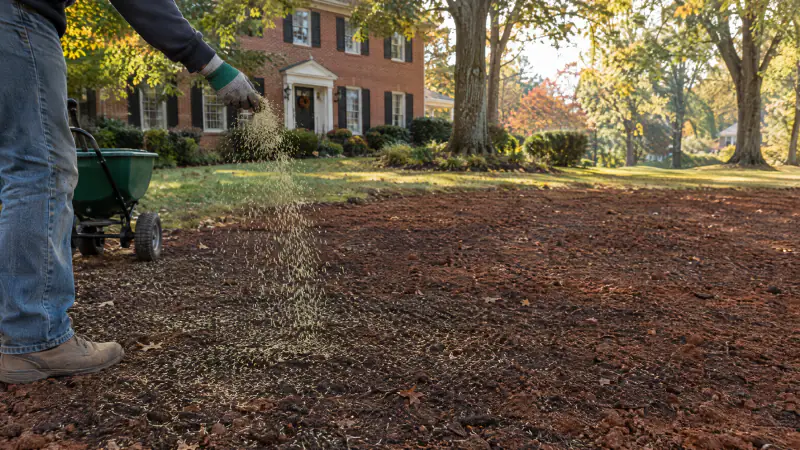
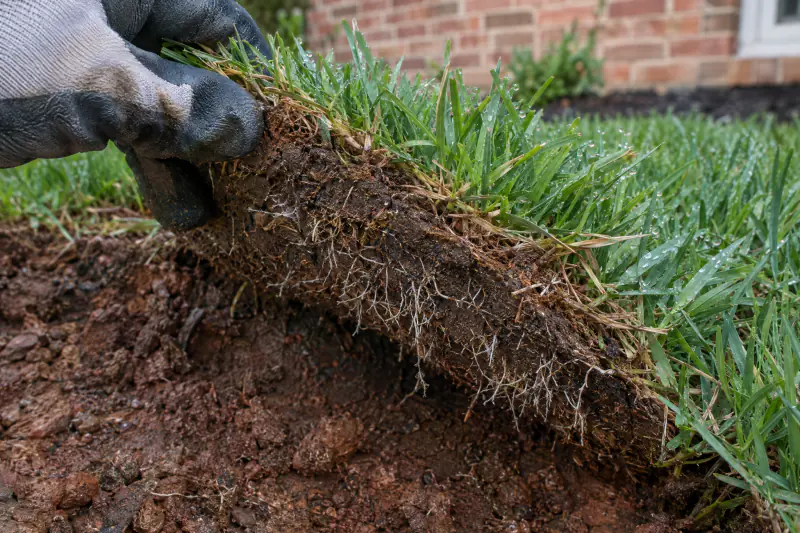
Strip. Extension says not to lay sod over grass, debris or rocks. Rent a sod cutter, cut the old lawn into strips, roll them and haul them off. Tilling old turf under leaves a decomposing layer that blocks root contact. The volume surprises people; the quantities table below puts numbers on it.
Loosen and amend. Extension says to incorporate soil-test amendments to a depth of 4 to 6 inches, and to rake or drag until smooth, removing debris and stones larger than 1.5 inches. On Northern Virginia clay we also work in compost, usually one to two inches on stripped builder-grade soil. That is our practice, not an Extension figure. Till when the clay is moist, never wet, and do not pulverize it to powder.
Grade. Set the finished surface about an inch below walks, driveways and patios so the sod edge sits flush. Slope it away from the house and fill every low spot, because sod over a depression holds water and rots. If water stands on the lawn after rain, sod will not fix it; see our yard drainage solutions page and the article on why Northern Virginia backyards stay wet.
Firm and moisten. Walk the bed, rake it smooth, and rake lightly again just before the sod goes down. Extension notes survival is best on relatively moist, cool soil, and suggests lightly watering about 12 hours ahead if the soil is extremely dry.
How do you measure and order sod, and why does delivery day matter?
You measure in square feet, order by the pallet, and plan delivery around a clock. Break the lawn into rectangles, multiply length by width, and add them up. We add 5 to 10 percent for trimming around curves and beds, since a short order on the day leaves a gap you cannot fill. Extension's guide says standard roll pallets, about 10 square feet per roll, hold roughly 450 to 700 square feet.
Weight is the surprise. The same guide gives dry sod at about 20 to 25 pounds per square yard and wet sod at 30 to 40. Working it through, a single pallet is roughly 1,000 to 3,000 pounds. The guide lists a half-ton pickup as carrying only about 25 to 50 square yards, no more than the smallest pallet, so beyond patching, we would buy delivery. It also says to ask what each service costs, such as pallet charges, and to call as far ahead as possible.
The clock is the real constraint. Extension says sod is perishable and should be installed within eight hours of harvest, and shaded if it must wait. Extension also warns about drying and heat build-up when sod is in transit on hot days, so keep pallets out of the sun. Stage them on the driveway, not on your prepared soil. Ask the supplier when the sod was cut and when the truck arrives, and if the lawn is more than your crew can lay in a few hours, ask about two deliveries.
How much sod, compost and hauling does a lawn this size mean?
Extension's pallet and weight figures, plus our own volume arithmetic, show why a sod job is heavier than it looks.
| Lawn size | Pallets (with 10 percent extra) | Sod weight with extra, dry to wet | Old turf to haul (1 to 1.5 in.) | Compost at 1 to 2 in. |
|---|---|---|---|---|
| 500 sq ft | 1 to 2 | about 0.6 to 1.2 tons | 1.5 to 2.3 cubic yards | 1.5 to 3 cubic yards |
| 1,000 sq ft | 2 to 3 | about 1.2 to 2.4 tons | 3 to 5 cubic yards | 3 to 6 cubic yards |
| 3,000 sq ft | 5 to 8 | about 3.7 to 7.3 tons | 9 to 14 cubic yards | 9 to 19 cubic yards |
| 5,000 sq ft | 8 to 13 | about 6.1 to 12.2 tons | 15 to 23 cubic yards | 15 to 31 cubic yards |
Pallets assume 450 to 700 sq ft each. Weights use Extension publication 418-040 (20 to 25 lb per sq yd dry, 30 to 40 wet), so the range runs from 20 to 40 lb, applied to the area plus 10 percent. Old turf assumes a strip 1 to 1.5 in. thick, which is our assumption. One inch of material over 1,000 sq ft is about 3.1 cubic yards, and a wheelbarrow holds only a few cubic feet.
What tools do you need, and what do rentals cost?
Most of the list is cheap. Two machines, a roller and a lot of wheelbarrow trips make the job physical.
| Tool | What it does | Planning cost |
|---|---|---|
| Sod cutter | Slices old turf into strips you can roll up and remove. | About $90 to $170 per day to rent |
| Rear-tine tiller | Loosens clay and mixes in compost, lime and starter fertilizer to 4 to 6 inches. | About $80 to $150 per day to rent |
| Water-filled lawn roller | Presses roots into soil and removes air pockets after the sod is laid. | About $15 to $40 per day to rent |
| Wheelbarrows or a garden cart, plus plywood | Moves compost and sod without compacting the prepared bed. | Own or buy; plywood sheets can be scrap |
| Sod knife, flat shovel, landscape rake, string line | Trims curves, smooths soil, keeps the first row straight. | About $60 to $150 to buy the set |
| Sprinklers and a hose timer | Covers the whole lawn evenly for the first month. | About $20 to $60 per sprinkler, $20 to $50 for a timer |
Typical Northern Virginia planning ranges as of 2026, not myYardPros prices. Counters differ on deposits, delivery and damage fees, so confirm before you plan the weekend.
How do you lay sod so the seams disappear?
The laying is the easy part when the bed is ready. This is the order, following Extension where it speaks.
Rake and moisten just before you start
Rake the surface lightly right before the first roll. Extension says survival is best on relatively moist, cool soil.
Start along a straight line
Run the first row along a driveway, sidewalk or stretched string, as Extension advises. A crooked first row shows in every row after it.
Stagger the seams like brickwork
Offset each row so end joints do not line up, and push pieces tightly together because sod can shrink. Never stretch a roll to close a gap.
Keep your weight off the bed
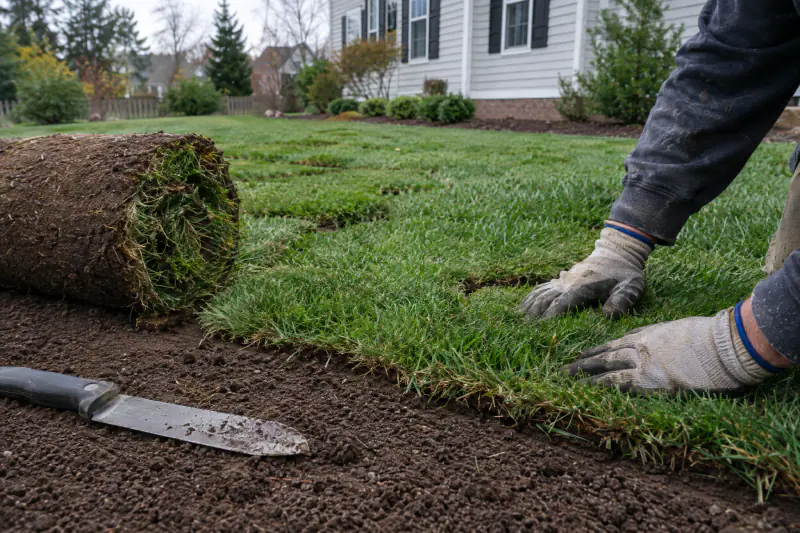
Extension suggests wheelbarrows or plywood over heavy traffic areas to minimize compaction. Work from laid sod, not from the soil ahead of you.
Trim curves with a knife and avoid slivers
Cut around beds and sprinkler heads with a sod knife. On slopes, run rows across the fall. Avoid thin strips along edges, which dry out first.
Roll it
Extension recommends a heavy hand roller to press roots into the soil, remove air pockets and improve soil-to-sod contact.
Water as you go
Extension says to irrigate thoroughly right after installation, and on large areas to start watering as each section is laid.
How do you water new sod for the first 30 days, and when is the first mow?
You keep it moist until it roots, then water deeper and less often. Extension's sod guide says to irrigate thoroughly immediately after installation and keep the sod moist until significant rooting occurs. In hot weather, above 80 degrees, it calls for daily watering until the sod is well rooted. At about seven days, gently tug a corner: there should be some resistance and visible new roots. Then shift to a deep and infrequent schedule, wetting the soil 3 to 4 inches at each watering.
In the cool, short days of fall or early spring, our practice is lighter. In week one we keep the sod and the top of the soil damp every day, with a second pass if it is windy or sunny. When the tug test passes, usually in the second or third week, we stretch to every other day with longer cycles, and by week four we are on a normal deep schedule. Rain counts. To learn what a sprinkler delivers, set out tuna cans and time how long they take to fill, and check the corners and the strip beside a wall, which dry first. Avoid evening cycles, since sod that stays wet overnight invites disease. In November, do not leave a sprinkler running into a freeze, and drain hoses at dusk.
Extension's sod guide says to begin mowing once the sod is rooted and the soil is dry enough to support the weight of you and the mower. Its rule is never to remove more than one-third of the existing green tissue at once, and it gives 2 to 3 inches as the home-lawn height for tall fescue and Kentucky bluegrass sod. We set the mower at the top of that range for the first cuts, with a sharp blade, on a dry surface. We keep foot traffic minimal for two weeks and light after that. A few years on, aeration and overseeding keep a fescue lawn thick, and sprinkler system installation takes the daily watering off your plate.
Where do DIY sod jobs fail, and how do you avoid it?
Most failures trace to one of these mistakes, nearly all made before or just after the laying.
- It dried out once in the first week, usually on a warm, windy afternoon when watering waited until after work.
- It was laid over old grass, weeds or stones, which Extension says not to do, so roots never reached soil.
- Clay was tilled wet and dried into clods, or tilled only an inch or two so roots hit hard subsoil.
- Pallets sat in the sun or overnight, though Extension says to install within eight hours of harvest.
- Seams were left open or rolls stretched to close them, and the edges shrank back into brown lines.
- Low spots were not filled, so water sat on the sod over clay and the roots rotted.
- It went into deep shade under oaks or maples, where tall fescue thins no matter how well you prepare.
- The first mow was too low, with a dull blade, on wet soil, or before the sod had rooted.
- The sprinkler watered the middle and nobody checked the corners and the strip along the wall.
- Late-season sod met cold weather before it had rooted, a risk Extension names for late-season installations.
How much does DIY sod cost compared with hiring a crew in Northern Virginia in 2026?
DIY usually costs a good deal less in cash than hiring, and far more in labor. As a typical Northern Virginia market range as of 2026, professionally installed tall fescue sod runs about $2 to $4 per square foot, including removal of the old lawn, soil preparation and the sod, and small areas of a few hundred square feet can run $4 to $6 because setup and delivery do not shrink with the lawn. Sod alone, delivered, is commonly around $0.50 to $1.00 per square foot. A crew's price covers the rest: removal, compost, grading, labor and equipment. These are general market ranges, not myYardPros prices.
What moves the number on either route: how much old turf must come out, whether soil is needed for low spots or must be hauled off, how much compost and lime the test calls for, access, slope, tree roots, and how far the sod travels. Drainage and irrigation repairs are priced separately. A full seed renovation with similar soil preparation commonly runs $0.50 to $1.50 per square foot, and our cost guide collects the other ranges we publish.
The table below works through a 3,000 square foot lawn. The honest read is that DIY saves a few thousand dollars if everything goes right, and the savings shrink fast if a pallet is wasted or a lawn is redone. For a firm number on your yard, a site visit is the only way: request one at Get an Estimate.
What does a 3,000 square foot lawn cost both ways?
These are planning ranges for a typical flat lawn with workable soil, built from the quantities above.
| Line item | DIY planning range | Included in a crew price |
|---|---|---|
| Sod, 3,150 to 3,300 sq ft | $1,600 to $3,300 | Yes |
| Sod delivery | $75 to $250 | Yes |
| Compost, 9 to 19 cubic yards, delivered | $350 to $1,300 | Yes |
| Sod cutter, tiller and roller rentals | $200 to $500 | Yes |
| Hauling or disposing of old turf | $300 to $800 | Yes |
| Soil test, lime and starter fertilizer | $100 to $300 | Yes |
| Sprinklers, hoses and timer | $50 to $200 | Usually your sprinklers |
| Your labor | Several people for 2 to 4 days, plus daily watering for weeks | Crew labor and schedule |
| Total | About $2,700 to $6,700 | About $6,000 to $12,000 at $2 to $4 per sq ft |
Add drainage, regrading and irrigation separately. The crew column is a typical market range, not a myYardPros quote.
Which parts are worth hiring out even if you do the rest yourself?
You do not have to choose all or nothing. These are the jobs we would hand off first.
Grading and drainage correction
If water ponds, runs toward the house or has nowhere to go, fix that before sod. A new lawn will not cure it.
Stripping and hauling
Cutting and hauling 9 to 14 cubic yards of old turf is among the heaviest labor on a 3,000 square foot lawn. Many homeowners hire out just this.
Irrigation work
Heads may need raising or relocating, and zones may not cover new edges. A buried sprinkler line is a reason to call a pro, not to guess.
Slopes, steps and tight access
Steep banks need pinning, steps need hand-cut pieces, and gated side yards mean carrying every roll.
Delivery day crew
If the eight-hour clock worries you, hire help for the day, or have a pro do prep and laying while you handle the watering.
How does a DIY sod job differ across Fairfax, Loudoun, Prince William and Arlington?
The grass and the Extension rules are the same everywhere in our area. The lot is what changes. In Ashburn, South Riding, Aldie, Gainesville, Haymarket and Bristow, newer subdivisions often mean thin topsoil over compacted subsoil, so tilling and compost decide the result more than the sod does. In Leesburg and Purcellville, larger lots turn a modest-sounding lawn into a dozen pallets and a long watering job, so check your hose reach honestly.
Older neighborhoods in Vienna, McLean, Oakton, Burke and Springfield often have more mature trees and more shade; the lawn under a mature oak is a common place people want sod and a common place it thins. Many lots in Reston and Great Falls add slope. In Arlington, Alexandria and Falls Church, small lots can make a few hundred square feet of front lawn a realistic DIY job, though tight access means carrying every roll.
Land-disturbance thresholds, Resource Protection Area rules and HOA approval differ by county and city, including Manassas and Manassas Park, so confirm yours before regrading. Our service areas page lists where we work, and a call to (571) 200-9600 starts a conversation about prep, laying or the whole job.
Frequently asked questions
Can I lay sod over my existing lawn?
No. Virginia Cooperative Extension says not to lay sod over grass, debris or rocks. New roots must reach loosened soil, and old turf underneath blocks them as it decomposes. Strip the old lawn with a sod cutter, loosen and amend the soil to 4 to 6 inches, then grade and firm it.
How long can sod sit on the pallet before I lay it?
Extension says sod is perishable and should be installed within eight hours of harvest. If you cannot lay it promptly, shade the pallet. Ask your supplier when the sod was cut and when the truck arrives, and ask about two deliveries for a large lawn.
How many square feet does a pallet of sod cover?
Extension's sod guide says standard roll pallets, with rolls of about 10 square feet, hold roughly 450 to 700 square feet. Coverage varies by grower, so confirm with your supplier. We order 5 to 10 percent extra for trimming around curves and beds.
Do I need to call 811 to lay sod?
Virginia 811 tells homeowners to contact it at least 3 working days before any digging project, and lists landscaping among them. The Code of Virginia exempts some activities, including hand digging by an owner or occupant, but a rented tiller is machine work, so call anyway. It is free, and it does not mark private lines such as pet fences.
Is it too late to lay sod in mid-November in Northern Virginia?
Not necessarily, but it is late. Extension says sod can go down almost any time if the soil is not frozen and irrigation is available, but late installations risk drying out if roots do not develop before cold weather. If the soil is wet or a hard freeze is coming, we usually suggest waiting until March.
How often should I water new sod?
Extension says to water thoroughly right after installation and keep the sod moist until it roots, daily in hot weather above 80 degrees. At about seven days, tug a corner: there should be resistance and visible roots. Then move to deep, infrequent watering, wetting the soil 3 to 4 inches each time.
When can I mow new sod, and how high?
Mow once the sod has rooted and the soil can support the mower. Extension's sod guide says never to remove more than one-third of the green tissue at once and gives 2 to 3 inches as the home-lawn height for tall fescue sod. Use a sharp blade and mow when the surface is dry.
Is DIY sod cheaper than hiring a crew?
Usually in cash, yes. As typical Northern Virginia planning ranges for 2026, a 3,000 square foot DIY lawn runs roughly $2,700 to $6,700 for sod, compost, rentals, hauling and supplies, against about $2 to $4 per square foot installed by a crew. The savings depend on the soil, the weather and your time. These are not myYardPros prices.
Book the work
Put the plan in writing with a crew that builds this every week.
One visit to measure and talk through options, then a written scope and price. No pressure, no vague numbers. Ask about the Heroes Discount if you serve.
Sources and further reading
- Virginia Cooperative Extension, Sod Source Selection, Installation, Maintenance, and Producers in Virginia, publication 418-040 (SPES-815P)
- Virginia Cooperative Extension, Soil Sampling for Residential Areas, publication 452-129 (SPES-725P)
- Virginia 811, Homeowners FAQ
- Virginia 811, Private Utilities Explained
- Fairfax County Land Development Services, Land Disturbance 101
- Fairfax County Land Development Services, FAQs: Resource Protection Areas
Published November 12, 2026. Reviewed and updated November 13, 2026.