Key takeaways
- A sump pump should discharge into a buried solid line that ends at least 10 feet from the house on ground that keeps falling away, on your own lot.
- Never into the sanitary sewer. Fairfax County calls unpermitted sump pump connections illegal, and Loudoun Water says sump systems should not connect to public sanitary lines.
- Freeze protection is slope plus an escape route: a line that drains empty between cycles and a freeze relief fitting at the base of the exterior riser.
- Pump output and roof water peak at the same moment, so a sump line shares a downspout pipe only when the run is 4 inch, short and well pitched.
- As of 2026, a buried sump discharge line in Northern Virginia typically falls between $800 and $3,000; a permitted storm sewer connection costs more.
On this page
- Where should a sump pump discharge in Northern Virginia?
- Why can't a sump pump discharge into the sanitary sewer?
- How far from the foundation should the discharge line end?
- Daylight, pop-up emitter, storm drain, curb or dry well: which outlet fits your lot?
- How do the sump discharge outlets compare?
- What size pipe, how much slope, and do you need a check valve?
- How do you keep a sump pump discharge line from freezing?
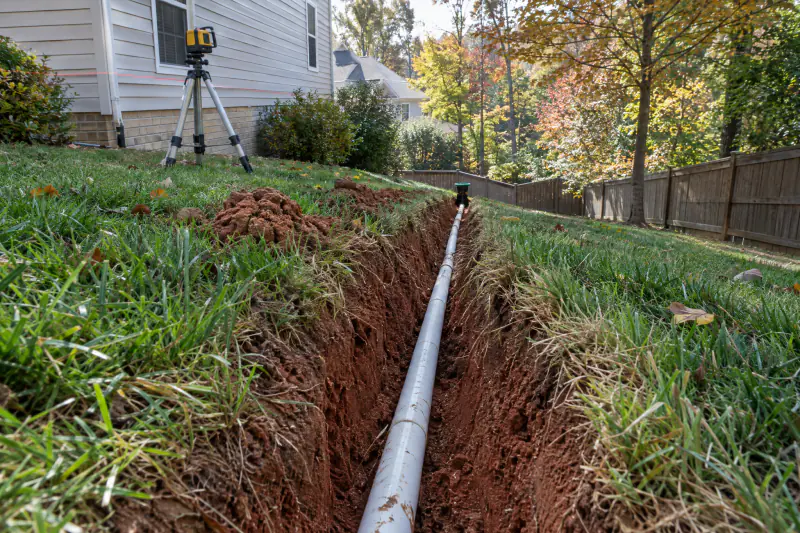
- How is a buried sump pump discharge line built properly?
- Can a sump pump discharge onto a neighbor's property or the sidewalk?
- Should the sump line share a pipe with the downspout drain line?
- How much does a sump pump discharge line cost in Northern Virginia in 2026?
- What should a sump pump discharge line quote include?
- How do sump discharge rules differ across Fairfax, Loudoun, Prince William and Arlington?
- Frequently asked questions
Where should a sump pump discharge in Northern Virginia?
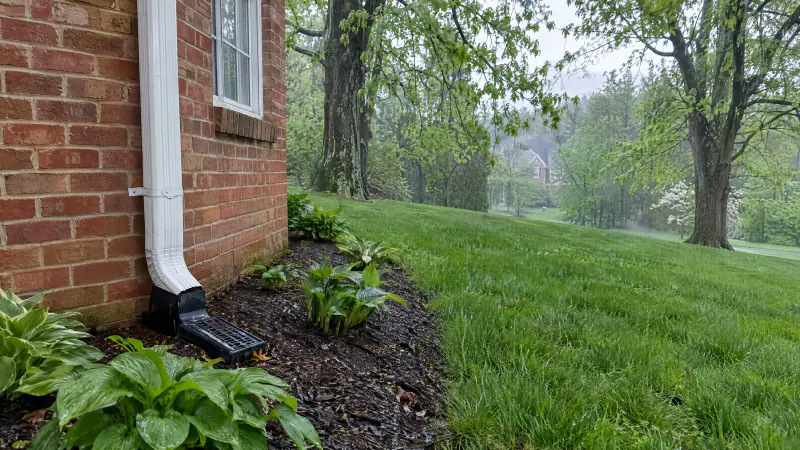
Into a buried solid pipe that ends at least 10 feet from the foundation, on ground that keeps falling away, on your own property, and never into the sanitary sewer. That sentence covers most of what goes wrong with sump discharge on Northern Virginia lots. The pump lifts the water out of the pit. The discharge line drops it onto the loose backfill beside the wall, the clay refuses to absorb it, and it runs back down to the footing drain and into the same pit. On a wet March night in Springfield or Ashburn, that loop can repeat every few minutes until the motor gives out.
The fix is not a bigger pump. It is a better outlet. Below we cover how far and how deep the line should run, what pipe and slope it needs, how to keep it from freezing, the fittings that protect the pump, why discharging toward a neighbor invites a complaint, and how the sump line fits with your downspout drain lines. If the pump is not the problem, start with exterior fixes for water in the basement.
Why can't a sump pump discharge into the sanitary sewer?
Because the sanitary system is sized for wastewater, not storms, and every clear-water connection raises the risk of raw sewage backing up into someone's basement. Fairfax County's wastewater division states it plainly: installing unpermitted plumbing connections such as sump pumps, downspouts, French drains and other flood control systems to your sanitary sewer is illegal, and the extra water can overload the system and overflow sewage into streams, streets or basements. Loudoun Water publishes the same rule. Sump pump systems should not be connected to public sanitary sewer lines, and the utility cites Section 1101.3 of the International Plumbing Code, which applies in Loudoun County through Virginia's statewide building code and reads: storm water shall not be drained into sewers intended for sewage only.
The practical point: if your sump pump discharges into a floor drain, a laundry standpipe, a utility sink, or a pipe that disappears into the slab, assume it reaches the sanitary sewer and plan to reroute it outside. Loudoun Water and other utilities in the region run inflow and infiltration programs that look for these connections. Outside, in a line you own, the water has nowhere to back up to.
How far from the foundation should the discharge line end?
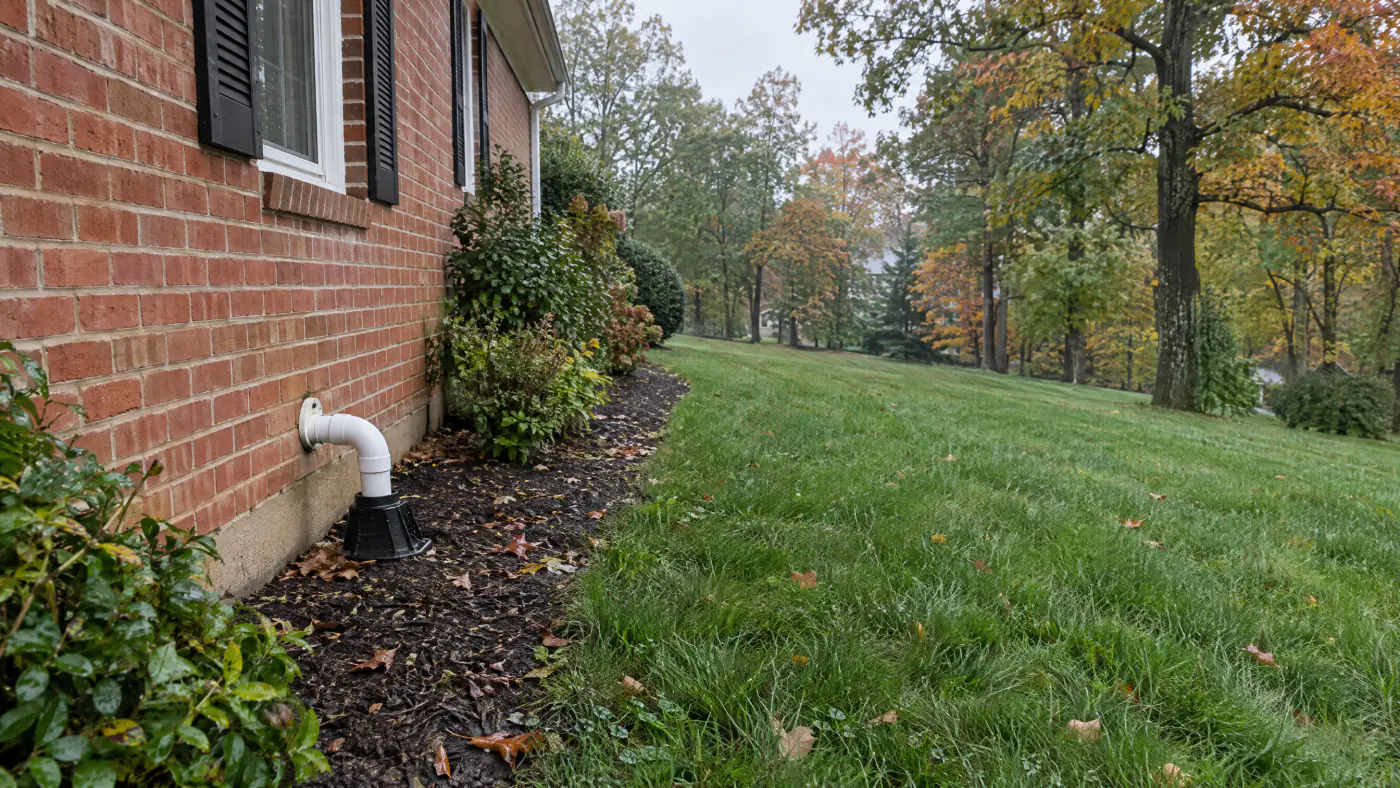
At least 10 feet, and farther if the first 10 feet do not fall away. Ten feet gets water past the backfill zone, the band of disturbed soil around the foundation that settles for years and holds water against the wall. Ten feet also appears in official guidance, though measured from a different line. Arlington County says a sump pump that cannot connect to a storm sewer should discharge in the yard approximately 10 feet from the edge of the property, meaning the lot line rather than the house, to allow some natural spreading and infiltration. On a small lot both distances have to be met at once. The Northern Virginia Soil and Water Conservation District, writing for Fairfax County homeowners, says a 5 percent grade should ideally be maintained for ten feet around the home. Loudoun Water puts it simply: the drain line should carry the water far enough from the foundation wall that it does not re-enter the foundation drain.
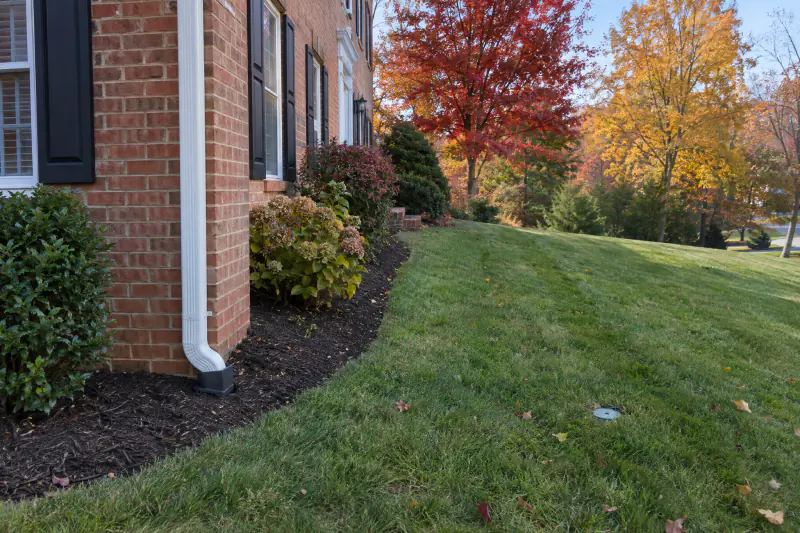
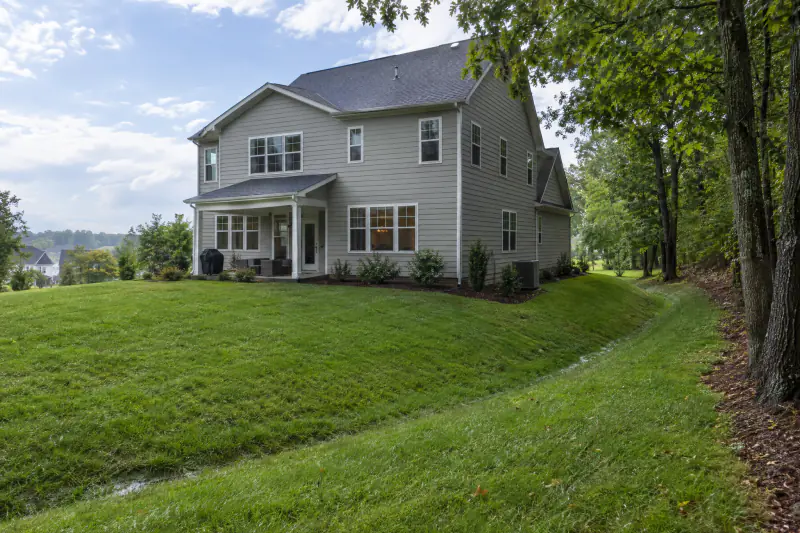
Distance alone does not finish the job. The ground at the outlet has to keep falling, because water released on a flat spot pools and, on clay, creeps back toward the house. We check this with a laser level: the outlet sits lower than the exit point, and the ground beyond it keeps dropping. On a lot that slopes toward the house, that often means running the line around the side to the front yard, and 40 extra feet of pipe is cheaper than a pump that never stops. Where no part of the lot falls away, the outlet becomes a yard drainage problem in its own right.
Daylight, pop-up emitter, storm drain, curb or dry well: which outlet fits your lot?
The right outlet depends on how much fall the lot has and what the county allows.
- Daylight outlet
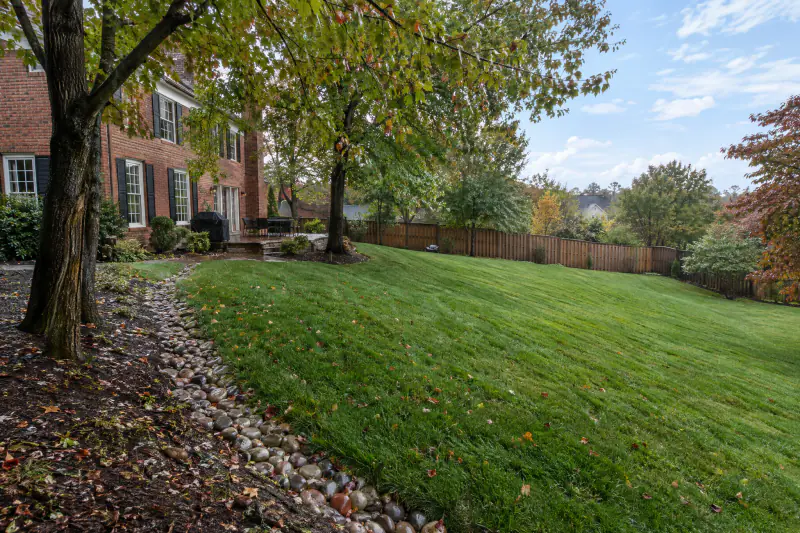
- The pipe emerges from a slope or bank with a rodent screen. Nothing to freeze shut and you can watch it work. Needs a lot that falls to a woods line or lower lawn, common in Great Falls, Clifton and western Loudoun.
- Pop-up emitter
- A spring-loaded cap flush with the lawn that lifts under flow and closes when the pipe empties. The default on flat lots in Ashburn, South Riding and Bristow. Needs a few inches of fall below it and must be kept clear of snow.
- Storm sewer connection
- Arlington requires new sump pumps to connect to the storm sewer when one is present, through a sketch, a right of way permit and a privately maintained pipe. Other counties handle it case by case.
- Dry well
- A buried chamber in stone that stores the discharge and lets it soak away. On clay it soaks slowly, so it suits a pump that runs rarely and always needs an overflow. See our comparison of <a href="/blog/dry-well-vs-french-drain-vs-catch-basin/">dry wells, French drains and catch basins</a>.
How do the sump discharge outlets compare?
| Outlet | Needs from the lot | Winter behavior | Permission |
|---|---|---|---|
| Daylight to a slope | Several feet of fall to a bank or woods on your land | Best; an open end cannot freeze shut | None on your own land; check easements |
| Pop-up emitter | A few inches of fall past a point 10 ft from the house | Good if the line drains empty; keep the cap clear | None; keep it off the neighbor's side |
| Storm sewer tie-in | A public storm drain within reach | Excellent; nothing exposed | Permit and sketch; required in Arlington where a sewer exists |
| Curb and gutter | No storm sewer adjacent; sidewalk and curb present; gutter slope over 1 percent; no bike lane; 25 mph street | Ice on the sidewalk is the risk | Arlington allows under listed conditions; ask elsewhere |
| Dry well with overflow | Soil that perks, 10 ft or more from the house | Fine once buried; the overflow must drain | None for a small well; grading rules above 2,500 sq ft |
What size pipe, how much slope, and do you need a check valve?
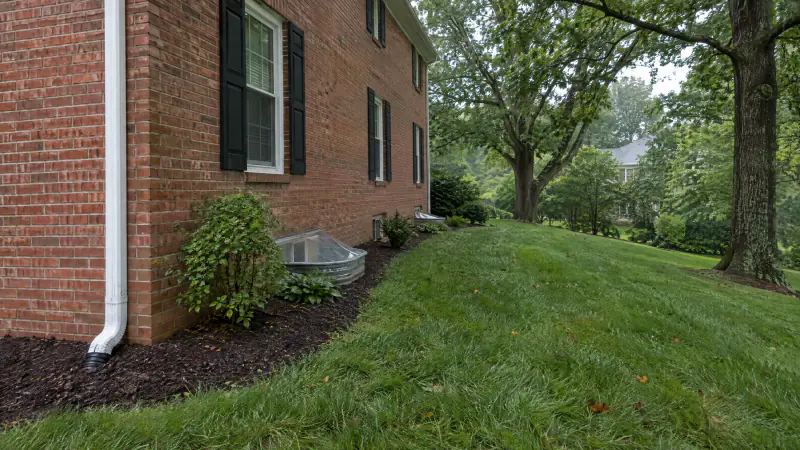
Inside the house the pump dictates the size. Most residential pumps have a 1.25 or 1.5 inch discharge tapping, and the riser through the wall should be at least that size. Outside, once gravity takes over, we move the water into 4 inch solid smooth-wall PVC, the same pipe we use for buried downspout lines. A 1.5 inch buried line full of water freezes solid in a cold snap. A 4 inch line on a slope empties between cycles, has capacity to spare if a downspout joins it, and can be cleaned with a hose jet from a cleanout.
Slope keeps the line alive. We lay the buried run at a minimum of 1/8 inch per foot, roughly 1 percent, and check it with a laser level before backfilling. Slope percent is the fall divided by the length of the run, times 100, so a line that drops 1 foot over 50 feet runs at 2 percent. The slope must never flatten or reverse. A belly holds a few gallons after every cycle, those gallons freeze in January, and the plug grows until the pump is working against a closed pipe. Joints are glued or gasketed so the line cannot leak back into the backfill.
The check valve sits in the riser above the pump and stops the lifted water falling back into the pit at shutoff. Without one the pump short-cycles and wears out early. The International Plumbing Code, Section 1113.1.4, requires a check valve on sump discharge piping, including in one- and two-family dwellings, and the same section says the discharge pipe must be at least the size of the pump tapping. Interior plumbing is a licensed plumber's work; we build everything from the wall out and meet the riser at a sealed fitting.
How do you keep a sump pump discharge line from freezing?
By making sure there is nothing in it to freeze, and by giving the water an escape route if something freezes anyway. Footings here go to about 24 inches, but a drainage line does not need to be that deep. It needs to drain completely empty after every pump cycle, because an empty pipe cannot hold ice. Continuous slope matters more than depth, and a line pitched to drain dry is safe at 10 to 18 inches on most lots.
Sump lines freeze at the ends and the flat spots. At the house, an above-ground extension hose fills on every cycle and freezes in a single cold night; the black corrugated hoses sold as sump extensions are the most common frozen line we see. In the middle, a belly holds water. At the outlet, a pop-up emitter buried under snow leaves the whole line full. Clearing it after a snowfall belongs on the winter list in our maintenance guide.
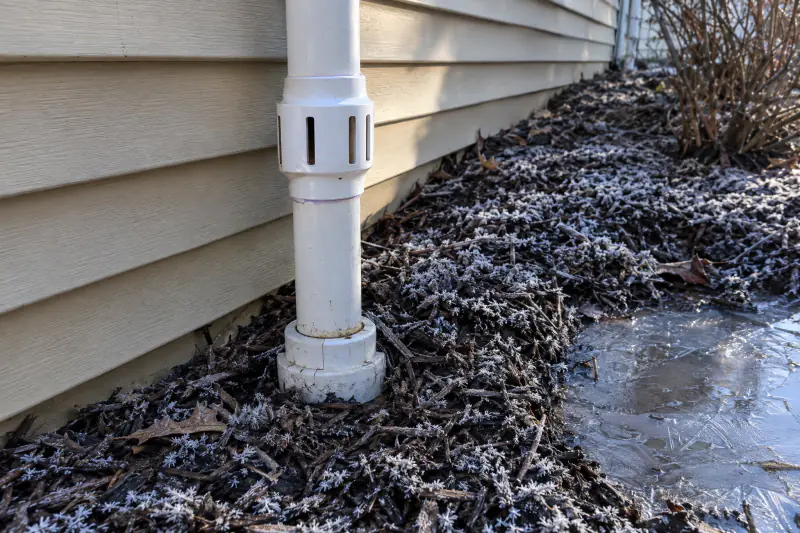
The escape route is a freeze relief fitting, sometimes called an air gap or ice guard: a short slotted section in the vertical riser just above grade. In normal operation water passes straight through. If the buried line freezes solid, pressure builds and water exits through the slots onto the ground instead of trapping the pump against an ice plug. It is a poor outlet but a temporary one, and it keeps the pump from running until it burns out. Every sump line we build gets one.
How is a buried sump pump discharge line built properly?
The sequence we follow from the pit to the outlet.
Watch the pump and read the lot
We time a cycle, confirm the check valve holds, measure the riser, and shoot elevations from the exit point to every possible outlet. The outlet must sit lower than the exit by at least 1/8 inch per foot.
Pick the outlet and draw the route
Daylight where the lot falls, an emitter where it is flat, a storm sewer where the county wants one. The route avoids roots, easements and the neighbor's side.
Call Virginia 811 and mark private lines
Public utilities are located before any trench is cut, as state law requires. Irrigation pipe, lighting wire and gas to a grill are private and are located with you.
Set the riser, relief fitting and adapter
The exterior riser is kept short, the freeze relief fitting goes just above grade, and the riser drops into a sealed adapter with a cleanout where it meets the 4 inch buried pipe.
Trench, lay and check the slope
Solid PVC goes on a firm bed at a steady fall, joints glued or gasketed, every section checked with the level before it is covered. Walk crossings are tunneled or the pavers lifted and reset.
Finish the outlet and test with water
A screened daylight end or an emitter with fall below it, backfilled in lifts and sodded. We run a hose through the cleanout, then watch one pump cycle to confirm the line drains empty.
Can a sump pump discharge onto a neighbor's property or the sidewalk?
It should not, and in Arlington it must not. Concentrated flow from a pipe is different from rain on a lawn. A sump line that empties toward the lot line sends hundreds of gallons a day across it in a wet month and on a slope can reach the neighbor's foundation. Arlington County's property drainage page says sump pump discharge must not result in concentrated flow to an off-site owner's property and must not discharge to the sidewalk, street, stormwater planters or pervious driveways. The county's brochure adds that concentrated flow should not be discharged at a neighbor's property line or toward the public sidewalk even if located 10 feet away, and that under Arlington County Code Chapter 17-6 the discharge must not create a safety hazard or nuisance in the public right of way. Ice on a sidewalk in January is exactly that hazard.
Fairfax County treats drainage directed from gutters, downspouts or other private systems onto neighboring properties as a civil matter between the owners, which means the county will not resolve it for you. Prince William County's drainage page asks homeowners to consider the impact on the neighbor's property. Check your plat too. Newer communities in Loudoun and Prince William commonly carry a drainage easement along the rear lot line; you may not fill it, but an outlet that releases into that swale on your side of the line is often the best outlet the lot has.
Should the sump line share a pipe with the downspout drain line?
Only when the shared run is 4 inch, short, well pitched, and has capacity to spare, because the pump and the roof peak at the same time. Published pump curves for common 1/3 and 1/2 horsepower residential sump pumps land roughly between 30 and 60 gallons a minute at a 10-foot lift, and output drops as the lift increases. A single downspout serving 600 square feet of roof delivers about 375 gallons per inch of rain, and gutters surge well above average in the heaviest minutes of a cloudburst, exactly when the pump runs hardest. A 4 inch smooth-wall pipe at 1 percent can carry both from one or two downspouts, but a long shallow run collecting the whole roof plus a pump is asking for a backup at the lowest adapter.
Our usual practice is a dedicated sump line where the route is short, and a shared line only where a downspout run already passes the sump exit with fall to spare. Where they join, the sump enters through a wye pointed downstream, never a tee. The sump never joins a line whose only outlet is a dry well, because a pump can fill one in minutes. And neither the sump nor a downspout ever enters a French drain; perforated pipe pushes the surge back into the soil. Our article on where gutter water should go covers the roof-side math.
How much does a sump pump discharge line cost in Northern Virginia in 2026?
As of 2026, typical Northern Virginia market planning ranges for a buried sump pump discharge line run roughly $800 to $3,000, including the freeze relief fitting, a sealed adapter with cleanout, 4 inch solid PVC to a pop-up emitter or daylight outlet, and sod repair. A permitted connection to a public storm sewer or a curb outlet, where allowed, usually costs well above that range, because it adds a sketch, a right of way permit, and cutting and restoring street or sidewalk; that street work varies so much from block to block that we do not publish a planning figure for it. A dry well added as the outlet typically adds $2,000 to $6,000. These are regional figures, not our prices and not a quote.
What moves the number:
- Distance to the outlet. A 15-foot run to an emitter and a 90-foot run around the house are different jobs.
- Crossings. Tunneling under a walk, lifting pavers, or cutting a driveway.
- Rock, roots and utilities. Leesburg and the corridor from Chantilly to Gainesville sit on shallow rock.
- Permits. A storm sewer or curb connection needs a sketch and a right of way permit.
The number that matters is the one a tape and a level produce on your lot. A short visit tells us where the fall is and what the county allows, and the estimate comes from that.
What should a sump pump discharge line quote include?
If a proposal is missing several of these, it was written from the driveway.
- A sketch showing the exit point, the route, the outlet and the distance from the house.
- Elevation readings showing the fall from the riser to the outlet, in inches.
- The outlet type, and confirmation it sits on your property or carries a permit.
- A freeze relief fitting at the base of the exterior riser, named as a line item.
- A check valve confirmed working, or flagged for a plumber if it is not.
- Solid 4 inch PVC with glued or gasketed joints, and a cleanout at the adapter.
- Virginia 811 locate and private utility marking before any digging.
- Backfill in lifts, sod replacement and a hose test with the pump running.
How do sump discharge rules differ across Fairfax, Loudoun, Prince William and Arlington?
The sanitary sewer rule is the same everywhere; the storm sewer rule and the neighbor rule vary. In Fairfax County, the wastewater division says unpermitted sump pump connections to the sanitary sewer are illegal, public works treats runoff onto a neighbor as a civil matter, and the Northern Virginia Soil and Water Conservation District publishes homeowner drainage guidance. In Springfield, Burke, Annandale, Reston and Vienna we most often find lines that never got past the splash block. In Loudoun County, Loudoun Water publishes the no-sanitary rule and the far-enough-from-the-foundation rule, and the county takes stormwater reports through its LEx request system. The flat, fenced backyards of Ashburn, South Riding, Brambleton and Sterling usually call for a pop-up emitter in the rear lawn, placed with the recorded easement in mind, while larger lots around Leesburg and Purcellville often have a daylight outlet and shallow rock.
In Prince William County, Prince William Water, formerly the Prince William County Service Authority, runs the sanitary sewer, the county drainage page tells homeowners to consider the neighbor when choosing an outlet, and homeowners maintain the drainage systems they install. Gainesville, Bristow, Haymarket and Woodbridge mix compacted subdivision clay with shared rear swales. Arlington County is the most specific: new sump pumps connect to the storm sewer where one exists, otherwise discharge in the yard about 10 feet from the edge of the property, meaning the lot line, no discharge to sidewalks or streets, and a right of way permit for any connection. Small lots in Arlington, Falls Church and Alexandria make the 10-foot rule a design problem. Rules as published in 2026 can change, so confirm before connecting to anything public. See our service areas and the water management pillar.
Frequently asked questions
Where should a sump pump discharge line end?
At least 10 feet from the foundation, on ground that keeps falling away, on your own property. Arlington asks for about 10 feet from the property line as well, and Fairfax guidance recommends a 5 percent grade for the first 10 feet around the house. The outlet is a daylight end on a slope, a pop-up emitter in the lawn, or a permitted storm sewer connection. Never the sanitary sewer, the neighbor's lot or the sidewalk.
Is it illegal to connect a sump pump to the sanitary sewer in Virginia?
In Northern Virginia, yes in practice. Fairfax County's wastewater division states that unpermitted connections of sump pumps, downspouts and French drains to the sanitary sewer are illegal. Loudoun Water says sump systems should not connect to public sanitary lines and cites the adopted plumbing code. If your pump drains into a floor drain or an unknown pipe, have a plumber trace it.
How deep should a sump pump discharge line be buried?
Usually 10 to 18 inches to the top of the pipe, deep enough to be safe from mowers, and sloped so it drains empty between cycles. It does not need to reach the roughly 24-inch frost depth used for footings. An empty pipe cannot freeze; a pipe with a belly or a flat run holds water and will.
Why does my sump pump discharge line freeze every winter?
Because water is sitting in it between cycles. The usual causes are an above-ground extension hose, a flat or sagging section of buried pipe, a pop-up emitter buried under snow, or a line too small to drain quickly. The fix is a buried 4 inch line on continuous slope to an outlet that stays open, plus a freeze relief fitting on the riser just above grade.
Can my sump pump discharge onto my neighbor's yard or the street?
It should not, and in Arlington the county code says the discharge must not create a hazard or nuisance in the public right of way or concentrated flow onto another property. Fairfax treats water sent onto a neighbor as a civil matter between owners, which leaves you exposed to a complaint. Keep the outlet on your lot and re-route it if it ices a sidewalk or ponds next door.
Does a sump pump discharge line need a permit in Northern Virginia?
A buried line to an outlet on your own lot generally does not; Arlington notes that minor changes such as modifying a downspout discharge usually need no permit. A connection to a public storm sewer or a curb outlet does need a permit and a sketch, and disturbing more than 2,500 square feet requires a permit in Fairfax County, according to the conservation district. Confirm with your county first.
Book the work
Put the plan in writing with a crew that builds this every week.
One visit to measure and talk through options, then a written scope and price. No pressure, no vague numbers. Ask about the Heroes Discount if you serve.
Sources and further reading
- Loudoun Water: Sump Pumps (sanitary sewer prohibition and plumbing code Section 1101.3)
- Fairfax County Wastewater Management: Preventing Backups and Overflows
- Arlington County: Property Drainage (sump pump and downspout discharge rules)
- Arlington County: Be a Good Neighbor with your Sump Pump (brochure, County Code Chapter 17-6)
- Northern Virginia Soil and Water Conservation District (Fairfax County): Gutters and Downspouts
- Fairfax County Stormwater: Storm Drainage System (private drainage and neighboring properties)
Published October 1, 2026. Reviewed and updated October 22, 2026.