Key takeaways
- Cupping is a moisture imbalance: the top of the board dries and shrinks while the underside stays wet. Splintering is a failed finish and sun. A soft spot is decay, the one that matters.
- Serious decay happens only when wood moisture stays above the fiber saturation point, about 30 percent. Humid air alone will not do it; rain held in joints, fastener holes and shaded end grain will.
- Do the screwdriver test on a dry day: probe board ends, fastener holes and joist crossings, then the joist tops under every soft spot. Firm wood resists the blade; decayed wood takes it.
- Replace a few boards when the frame is sound. Resurface when most boards are gone and the frame passes the probe. A soft joist means the board was never the problem.
- As typical Northern Virginia market planning ranges as of 2026, board replacement runs about $20 to $60 per board, resurfacing $35 to $70 per square foot, a new deck $45 to $140.
On this page
- What do cupping, splintering and soft spots on a deck actually mean?
- Why do Northern Virginia summers and north-facing shade wreck deck boards?
- Which deck board symptom points to which cause?
- Why do deck boards cup, and can a cupped board be saved?
- Why do deck boards splinter and check, and when is it only cosmetic?
- How do you do the screwdriver probe test on a deck?
- What is under a soft spot, and how far has the rot gone?
- When is replacing a few deck boards enough?
- When does resurfacing on a sound frame make sense, and what about composite?
- When is the frame the problem rather than the boards?
- Replace boards, resurface or rebuild: how do you decide?
- What does fixing cupped, splintered or soft deck boards cost in Northern Virginia in 2026?
- How do deck board problems differ across Fairfax, Loudoun, Prince William and Arlington?
- Frequently asked questions
What do cupping, splintering and soft spots on a deck actually mean?
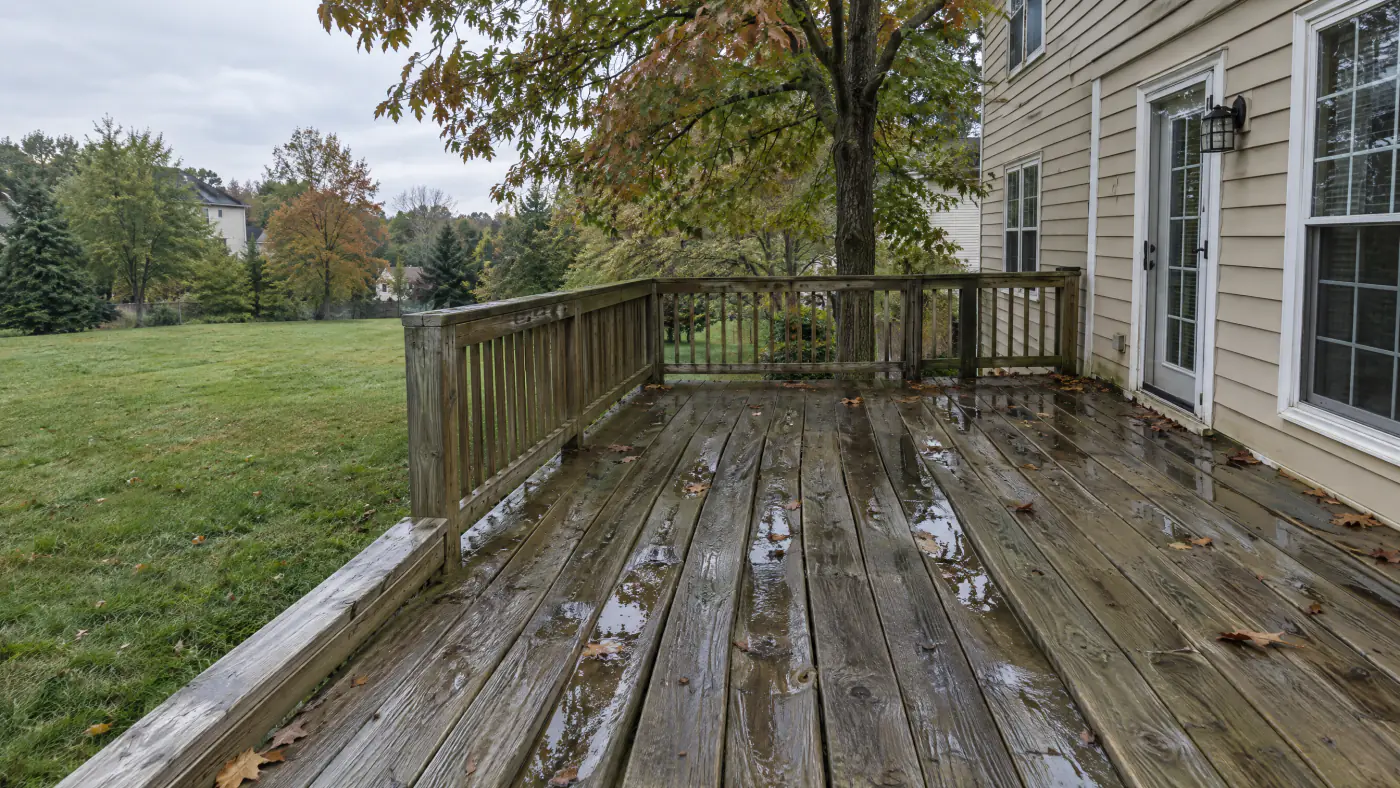
Three different things. A cupped board has dried unevenly: the top face lost moisture to sun and air while the underside stayed damp, so the board curled and its edges rose. A splintering board has lost its finish and its surface fibers to ultraviolet light and wetting cycles; it is rough and gray, but it may be perfectly strong. A soft spot is decay: fungi have eaten the wood where water sat long enough. The first two are about comfort and appearance. The third is a structural question.
In Northern Virginia all three show up on the same deck, for one reason. Our summers are long, humid and stormy, our winters freeze and thaw again and again, and many decks sit on the north side of a house under oaks and maples that keep the surface shaded and wet. What follows is how to tell the symptoms apart, how to do the screwdriver probe test, when to replace boards, when to resurface, when the frame is the problem and what each option costs in 2026. Our deck repair and resurfacing page covers how we do the work; this is how we decide what the work should be.
Why do Northern Virginia summers and north-facing shade wreck deck boards?
Because they keep wood above the moisture level where decay fungi can live. The USDA Forest Products Laboratory's Wood Handbook puts it plainly: serious decay occurs only when the moisture content of wood is above the fiber saturation point, which averages about 30 percent. Fully air-dried wood usually sits at or below 20 percent, which the handbook calls a reasonable margin of safety against fungal damage. It also notes that water vapor in humid air will not by itself wet wood enough to support significant decay, though it does permit mold.
A deck here gets plenty. A summer thunderstorm can drop an inch of rain in an hour, and every place the deck holds water can climb past 30 percent and stay there: the trough of a cupped board, every fastener hole, the end grain at board ends, the top edge of each joist under the boards, and the gap behind an unflashed ledger. On a north-facing deck under a canopy in Vienna or Oakton they stay wet for days after each storm. Cleaning and a penetrating finish are the defense, timed to the dry windows in our article on deck staining in Northern Virginia humidity.
Which deck board symptom points to which cause?
Read the surface, then confirm with a screwdriver. Most decks show three or four of these at once.
| What you see or feel | What is usually happening | What it calls for |
|---|---|---|
| Boards curled at the edges, water sitting in the middle | Cupping: dry top, wet underside, poor airflow below | Improve ventilation, flip and refasten sound boards, replace the worst |
| Gray, rough surface, raised grain, splinters | Finish failed; UV and wetting breaking down surface fibers | Clean, sand lightly, apply penetrating finish |
| One board spongy near a screw or at the end | Decay in the board, started at the fastener hole or end grain | Replace the board; probe the joist beneath first |
| Several boards in one area give underfoot | Decay in joist tops or a beam, not just the boards | Open the area, sister or replace framing, then resurface |
| Screw heads proud, rust streaks, boards loose | Fasteners corroding or pulling from wood that has moved for years | Refasten with coated or stainless screws; soft holes mean a new board |
| Dark, damp stripe along the house, boards soft at the ledger end | Water behind the ledger: flashing missing or failed | Stop. Have the ledger and the house band board probed first |
The last two rows are frame problems wearing a board problem's clothes. They decide the project.
Why do deck boards cup, and can a cupped board be saved?
Boards cup because the two faces are at different moisture contents. Wood shrinks as it dries and swells as it wets, mostly across the grain. When the top of a board bakes in afternoon sun while the underside, shaded by the deck and sitting over damp soil, stays far wetter, the top shrinks and the bottom does not, and the edges rise. On a low deck with solid skirting and no air moving, the cupping worsens every summer. TimberTech's guidance for its own boards specifies a minimum ground clearance of 1.5 inches for airflow, and the principle applies with more force to wood.
Fasteners are the other half. A cupped board that still probes firm can sometimes be unscrewed, flipped and refastened with two screws per joist, which flattens it for a few years. A board cupped far enough to pool a quarter inch of water is holding exactly the water that starts decay, and it is cheaper to replace than to nurse. Before we replace it we fix what cupped it: open solid skirting to a lattice, correct the grade under the deck, and extend any downspout that ends beneath the frame. The decks and porches pillar covers how we frame new decks for airflow and drainage.
Why do deck boards splinter and check, and when is it only cosmetic?
Splintering is what sun and water do to unprotected wood. Ultraviolet light breaks down the lignin that binds the surface fibers, rain washes the loosened fibers away, and the grain stands up and tears. A finish is a sacrificial layer that takes that abuse instead of the wood. None of that is structural by itself. A 20-year-old treated board can be gray, rough and checked and still carry a crowd, which is why the screwdriver matters more than the eye.
The test is depth and location. Raised grain and shallow checks on a board that probes firm everywhere are a cleaning, sanding and finishing problem: a light sanding takes the splinters off, a brightener opens the grain, and a penetrating finish in a dry window restores the sacrificial layer, which is the job our deck cleaning and staining service does. Checks become serious when they reach a fastener, because the screw then sits in a split that funnels water into the board and the joist, or when the end of the board crumbles rather than splintering cleanly. Soft end grain is decay, not weather, and no finish reverses it.
How do you do the screwdriver probe test on a deck?
A flat-blade screwdriver or an awl, a flashlight, a dry afternoon and 30 minutes. Probe where water sits.
Pick a dry day and calibrate on sound wood
Wait for two dry days so surface dampness does not fool you. Push the blade firmly into a board you know is sound. Firm treated pine resists, dents slightly and springs the blade back.
Probe every board end
End grain soaks up water fastest, so ends decay first. Press the blade into the end of each board where it meets the rim or the house, and into stair tread ends. Wood that takes the blade easily is decayed.
Probe beside fasteners and at joist crossings
Push the blade into the wood beside a dozen screws in the shadiest part of the deck. Soft wood around a screw means water has run down that hole for years, and the joist below is next.
Get underneath and probe the joist tops
With a flashlight, probe the top edge of each joist you can reach, especially under the soft spots found above and near the house. From below, a joist can look fine and be gone on top.
Probe the ledger, the posts and the stair feet
Press the blade into the house band board above and below the ledger, into the bottom six inches of every post, and into the stringer where it meets the ground. Soft wood here is a frame problem.
Mark, photograph and count
Chalk every soft spot and photograph it with something for scale. Count soft boards, soft joists and soft frame points separately. Those three numbers decide whether you replace boards, resurface or rebuild.
What is under a soft spot, and how far has the rot gone?
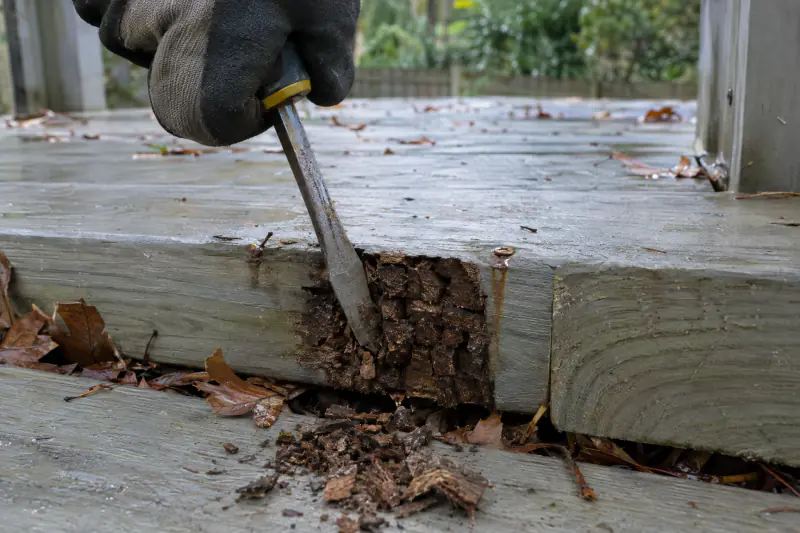
Fungi, and often more than the board. The Wood Handbook describes two kinds of decay. Brown rot removes the cellulose and leaves the wood browner, cracked across the grain into cube-like pieces, shrunken and easily crushed to powder. White rot removes both lignin and cellulose, bleaches the wood, keeps its shape longer and often feels spongy. Brown rot is what we find most on softwood decking, and the handbook notes it causes greater strength loss early in decay than white rot does. The term dry rot is a misnomer; the wood had to be wet.
A soft spot in one board, with firm wood on either side and a firm joist underneath, is a board replacement. A soft spot that spans two or three boards in a line is a joist: water that ran down the fastener holes collected on the top edge of that joist, under the boards, and the joist decayed along its top inch while its sides still look clean from below. A soft area that bounces or dips can be a beam or a post, and that is a frame repair before any board is touched. Our deck repair or replace guide lays out the full frame inspection from ledger to footings.
When is replacing a few deck boards enough?
When the three counts from the probe test are small and the frame count is zero. A deck with a handful of soft, cupped or badly checked boards over firm joists, with a dry ledger, firm posts and tight stairs, is a board replacement job, the most common repair we do in October. The soft boards come out, the joist tops under them are probed and, if firm, covered with self-adhesive joist tape so the new screws do not reopen the water path, and new boards go in, matched to the thickness of the old ones.
Fasteners are not a place to save. The American Wood Council's deck guide requires that screws, bolts, nuts, washers and nails used with preservative-treated wood be hot-dipped galvanized, stainless steel, silicon bronze or copper, with connectors galvanized or stainless, because preservatives that contain copper, such as ACQ and copper azole, attack unprotected metal; the same guide keeps even aluminum flashing out of contact with that lumber. We use coated screws rated for treated lumber or stainless, two per joist. Board replacement has a limit: when a third or more of the boards are soft or badly cupped, blending them approaches the cost of a new surface, and the remaining boards are the same age as the ones that failed. Our winter deck inspection checklist covers what a December look under the deck adds.
When does resurfacing on a sound frame make sense, and what about composite?
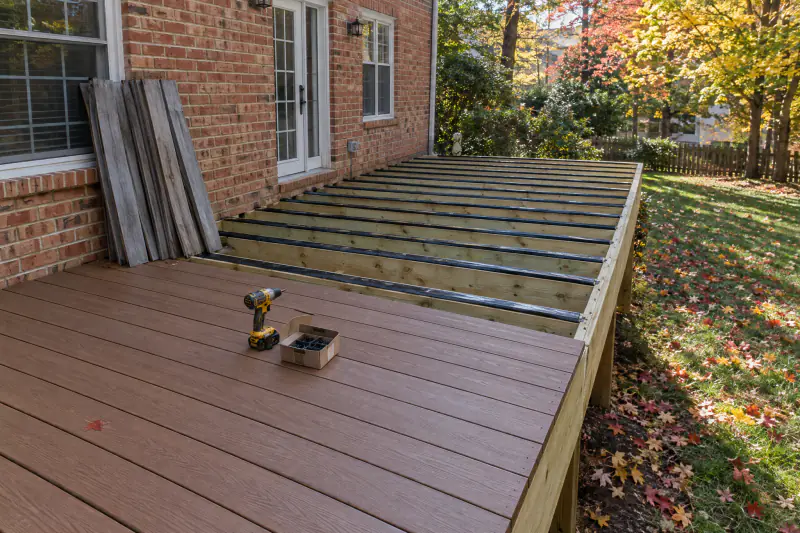
Resurfacing makes sense when the boards are done and the frame is not. The old decking and railing come off, every joist top is probed, weak joists are sistered, tape goes on, and new decking and guards go down. It is the right answer for many 15- to 25-year-old treated decks in Burke, Springfield, Reston and Herndon. The condition is that the frame passes the probe everywhere that matters, including the joist tops, which can only be checked once a few boards are up.
Composite changes the rules of the frame. Capped composite and PVC boards such as Trex or TimberTech resist cupping, splintering and decay, but they are generally less stiff than lumber. Trex's guidance is joists no more than 16 inches on center for standard installations and 12 inches for diagonal boards, and a frame built at 24 inches can be retrofitted by adding a joist between each pair. TimberTech's guidance is the same 16 inches, a minimum of 1.5 inches of ground clearance, and new decking never installed over old boards. The caution is age: composite is expected to outlast a treated frame from the early 2000s, so we advise it on an existing frame only when the frame is well under 15 years old and firm on top as well as below. See our composite and PVC decks page, the composite vs. wood decking guide and our article on composite vs. wood in Northern Virginia weather.
When is the frame the problem rather than the boards?
When the probe finds soft wood anywhere that carries load: the ledger and the band board behind it, the bottom of a post, a beam, a stringer foot or more than a few joist tops. Fairfax County's deck safety guidance tells homeowners to evaluate the deck every year, check that every point where the deck meets the house is secure, look for rot at the posts and rust on hardware, and consider staying off the deck until a professional has inspected it if connections or wood quality look wrong. It also notes that a deck built and inspected to code and maintained properly should last 20 years or more, and that permits are required before building a new deck or replacing an existing one.
Footings tell their own story. The American Wood Council's prescriptive deck guide requires footings to bear on undisturbed soil at least 12 inches below grade or below the frost line, whichever is deeper; in Northern Virginia the frost line is commonly taken as roughly 24 inches, and your county sets the number. The same guide requires a guard on any deck more than 30 inches above grade with openings a 4-inch sphere cannot pass through. One soft post or one unflashed ledger is a repair. Several failures together, a ledger on brick veneer, or a frame at the end of its life are a new deck under a county permit, as our guides to deck permits in Northern Virginia and the Fairfax County deck permit explain; our custom deck building page describes the frame a new deck gets.
Replace boards, resurface or rebuild: how do you decide?
Use the three counts from the probe test. Stop at the first line that describes your deck.
- Soft wood at the ledger, band board, a post base, a beam or a stringer foot: frame repair or rebuild comes first.
- Several joist tops soft, or joists at 24 inches with composite planned: price a new deck beside the resurfacing.
- Frame firm, a third or more of the boards soft, cupped or badly checked: resurface on the existing frame.
- Frame firm, fewer than a third of the boards bad, mostly at ends and in the shaded strip: replace boards, tape the joists, fix the water.
- Frame firm, boards gray and splintery but firm to the probe: clean, sand, brighten and finish. Replace only rough stair treads.
- Boards cupped but firm, deck low and skirted: open the skirting, fix grade and downspouts under the deck, then flip or replace the worst boards.
- Rust streaks and proud screw heads on firm boards: refasten with coated or stainless screws; replace any board whose holes are soft.
- Deck more than about 20 years old and you want composite: probe the joist tops with boards lifted; expect a new frame.
What does fixing cupped, splintered or soft deck boards cost in Northern Virginia in 2026?
As typical Northern Virginia market planning ranges as of 2026, not our prices and not a quote: replacing individual deck boards commonly runs about $20 to $60 per board installed in pressure-treated pine, more in composite, with a minimum on small jobs. Cleaning, sanding and finishing a splintered but sound deck typically runs about $2 to $5 per square foot. Resurfacing a sound frame with new decking, guards and stairs commonly runs $35 to $70 per square foot, composite at the upper part and treated pine at the lower. Sistering or replacing a joist runs roughly $150 to $500 each, refastening and flashing a ledger $1,500 to $5,000, and a new post on a proper footing $800 to $2,500. A new deck runs about $45 to $80 per square foot in treated wood and $75 to $140 in composite or PVC.
What moves each number: how many boards and which ones, since stair treads and borders take longer than field boards; what the joists look like once the boards are up; deck height and the shoring needed beneath it; access; the decking material and whether the railing is replaced with it; and whether the work becomes structural repair that needs a county permit. Add the board replacement or resurfacing to every frame repair the probe found and set the total beside a new deck of the same size; our rule of thumb is that when repairs reach roughly 60 to 70 percent of replacement, a new frame is usually the better value. Our cost guide places deck work beside other projects. A real number comes from a written on-site estimate after the probe test, with findings and photographs attached, or from a call to (571) 200-9600.
How do deck board problems differ across Fairfax, Loudoun, Prince William and Arlington?
Same humidity, different decks. Fairfax County's older subdivisions, in Burke, Springfield, Annandale, Reston, Herndon, Oakton and Vienna, hold many original treated decks from the 1980s and 1990s, where all three symptoms tend to arrive together after 25 to 40 years. Great Falls, McLean and Clifton add deep shade and long, low decks that never dry underneath, so cupping and mildew are the usual complaints even on younger wood. Loudoun and Prince William decks tend to be younger. Ashburn, Brambleton, South Riding, Leesburg, Aldie, Bristow, Gainesville, Haymarket and Woodbridge filled with decks in the late 1990s and 2000s, many of them tall walkout decks that breathe well and cup less. Their problem is more often hardware than wood: rust streaks, loose boards and corroded screws where the fasteners were never matched to copper-based treated lumber, on frames that are otherwise sound and are strong resurfacing candidates.
Arlington, Alexandria and Falls Church tend to have older houses and smaller decks, often on brick and sometimes hung from brick veneer, which the prescriptive guides prohibit. There the soft stripe along the house is the finding that matters, and the right repair is often a freestanding frame. Each county and the cities of Fairfax, Manassas and Manassas Park decide where board replacement ends and permitted structural work begins, and we confirm before the first board comes up. We inspect and repair decks in all of these jurisdictions and nowhere else; our service areas page lists every community, and how it works shows what a deck visit looks like from the probe test to the written findings.
Frequently asked questions
Is a soft spot on my deck dangerous right now?
Treat it as serious until it is probed. A soft board over a firm joist is a breakthrough hazard for one person. A soft area spanning several boards, or one that bounces, can mean a decayed joist or beam, and a soft strip along the house can mean the ledger is failing, which is how decks collapse under a crowd. Keep gatherings off it and have it probed within days.
Can cupped deck boards be flattened without replacing them?
Sometimes. A cupped board that still probes firm can be unscrewed, flipped and refastened with two screws at every joist, which flattens it for a few seasons, and a light sanding takes down mild raised edges. Neither lasts if the underside stays wet, so the real fix is airflow and drainage under the deck. Boards cupped deep enough to hold standing water are better replaced.
How can I tell if the rot is in the board or in the joist underneath?
Lift the board. If the soft spot is confined to one board and the neighbors are firm, it is probably the board. If softness lines up across two or three boards, the joist under that line is suspect. Remove one board and probe the top edge of the joist; decayed joist tops are dark, take the screwdriver easily and often crumble, even when the joist looks sound from below.
Can I put composite decking over my old deck frame?
Only if the frame qualifies. Trex calls for joists no more than 16 inches on center for standard layouts and 12 inches for diagonal patterns; TimberTech gives the same 16 inches for residential decks, at least 1.5 inches of ground clearance, and the old boards fully removed first, and both refer angled layouts to their installation guides. The frame also has to be young and sound enough to outlast boards expected to serve for decades, so we generally advise it on frames well under 15 years old.
Do I need a permit to replace deck boards in Northern Virginia?
Replacing boards like for like on an unchanged frame is generally treated as maintenance, while structural work such as new joists, a ledger repair, new posts or footings, or a full rebuild typically needs a county permit and inspections; Fairfax County states that permits are required before replacing an existing deck. Each jurisdiction draws the line a little differently, so we confirm before structural work begins.
What fasteners should be used to replace deck boards on treated lumber?
Corrosion-resistant ones. The American Wood Council's prescriptive deck guide requires fasteners used with preservative-treated wood to be hot-dipped galvanized, stainless steel, silicon bronze or copper, and connectors to be galvanized or stainless, because copper-based preservatives such as ACQ and copper azole attack unprotected metal. In practice that means coated deck screws rated for treated lumber or stainless screws, two per joist. Rust streaks from old screw heads are what the wrong fastener looks like after 15 years.
Book the work
Put the plan in writing with a crew that builds this every week.
One visit to measure and talk through options, then a written scope and price. No pressure, no vague numbers. Ask about the Heroes Discount if you serve.
Sources and further reading
- USDA Forest Products Laboratory, Wood Handbook (FPL-GTR-282), Chapter 14: Biodeterioration of Wood
- American Wood Council, DCA 6: Prescriptive Residential Wood Deck Construction Guide (2015 IRC)
- Trex Academy: How to Space and Install Deck Joists
- Trex Academy: How to Install a Deck Ledger Board and Attach Flashing
- TimberTech: Decking FAQs, Care and Installation
- Fairfax County: How to Ensure the Safety of Your Decks
Published October 1, 2026. Reviewed and updated October 22, 2026.