Key takeaways
- Match the tool to the water: a catch basin for water on the surface, a French drain for water in the soil, a dry well only for roof water where soil perks.
- Much Northern Virginia clay perks at under 0.5 inch per hour. Arlington's infiltration guidance says that rate calls for an underdrain, which for a dry well means an outlet.
- Run the perc test before anyone digs: a 12-inch hole, soaked overnight, refilled and measured every 10 minutes. Above 0.5 inch per hour a dry well can work; below it, plan an overflow.
- Combinations usually win on clay: a catch basin feeding solid pipe to daylight, or a French drain with a basin at the low point, each ending at a real outlet.
- As of 2026, Northern Virginia planning ranges run roughly $2,000 to $6,000 for a dry well and $2,500 to $10,000 for most French drains; catch basin runs cost less.
On this page
- Dry well, French drain or catch basin: which one fixes your yard?
- How does each drainage fix actually work?
- Why do dry wells fail in Northern Virginia clay?
- How do you do a simple perc test in your own yard?
- What does your perc result mean for a dry well?
- How big does a dry well need to be, and how far from the house?
- When is a French drain the right answer, and when does a catch basin beat it?
- When do combinations win on clay?
- Which fix matches which symptom?
- What should you never do with yard drainage?
- How much do dry wells, French drains and catch basins cost in Northern Virginia in 2026?
- What should a yard drainage quote include?
- How does the choice change across Fairfax, Loudoun, Prince William and Arlington?
- Frequently asked questions
Dry well, French drain or catch basin: which one fixes your yard?
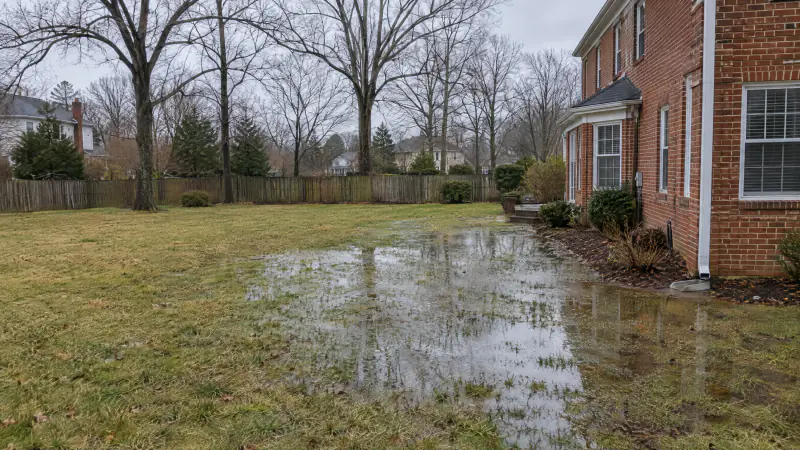
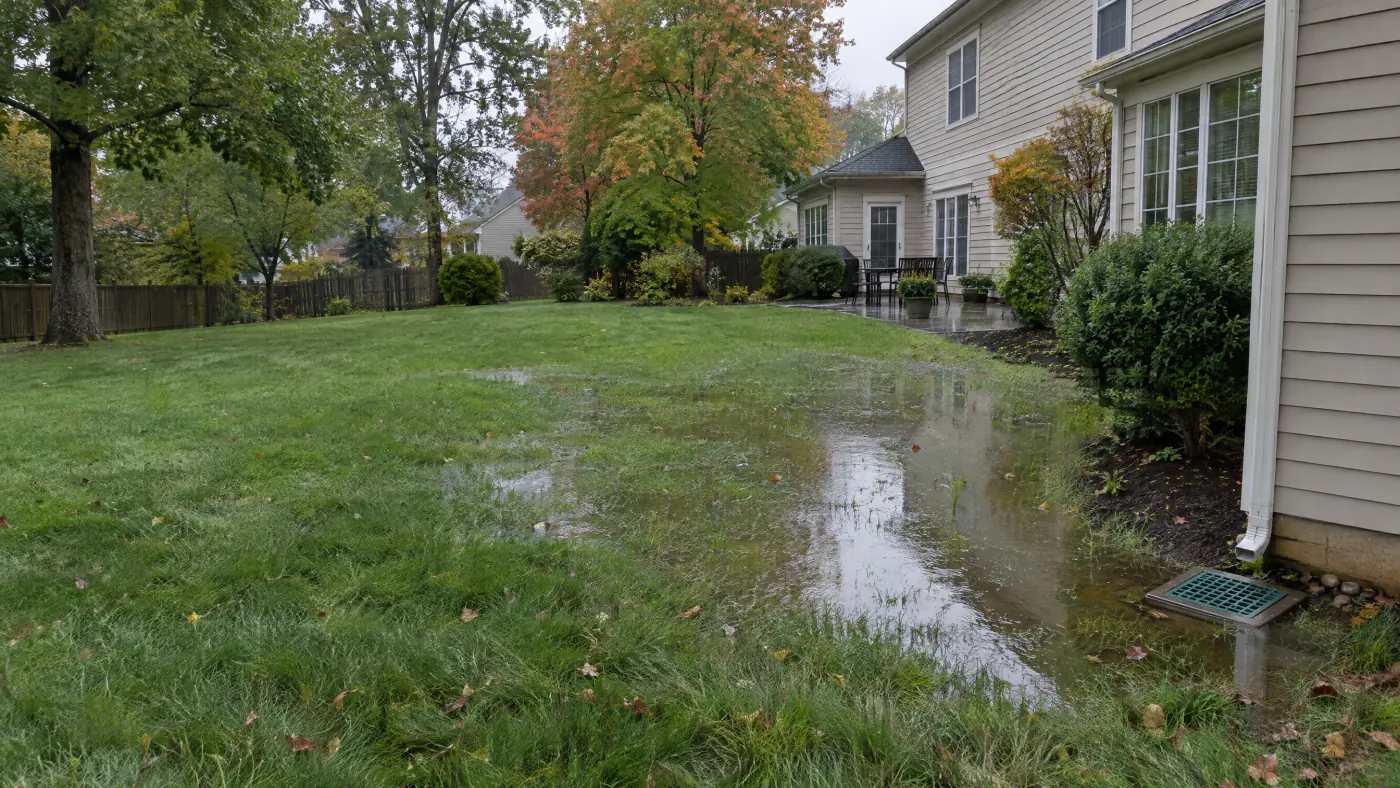
It depends on where the water is. A catch basin collects water standing on the surface and sends it down a solid pipe. A French drain collects water moving through the soil and does the same. A dry well does not move water anywhere; it stores it underground and waits for the soil to absorb it. On Northern Virginia clay, that last step is the problem, which is why most of the failed drainage we see in Fairfax, Loudoun and Prince William is a dry well that filled up or a French drain dug where a catch basin was needed. The right fix follows the water. Puddle that drains in a day: surface, so a basin or regrading. Lawn spongy for three days: soil, so a French drain. Roof water on a flat lot with soil that perks: a dry well, with an overflow.
Below we explain how each one works, why clay defeats dry wells, a percolation test you can run yourself, how to size a dry well, when combinations win, and typical 2026 costs. Our French drain vs. catch basin guide covers the two most common choices, and why Northern Virginia backyards stay wet covers the causes.
How does each drainage fix actually work?
Four tools, each built for a different kind of water.
- Dry well
- A buried chamber, a gravel-filled pit or a plastic unit in stone, that stores a storm for the soil to absorb. The Fairfax conservation district calls it a gravel-filled underground storage area that infiltrates slowly into the ground. Its capacity is storage; its speed is the soil's.
- French drain
- A trench with perforated pipe in washed stone, wrapped in filter fabric, that intercepts water moving through the soil and carries it by gravity to an outlet. It does nothing for water pooling on the surface above it.
- Catch basin
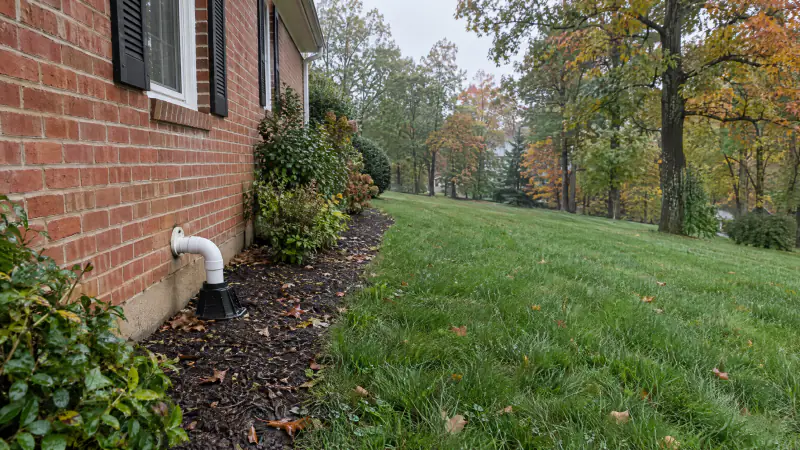
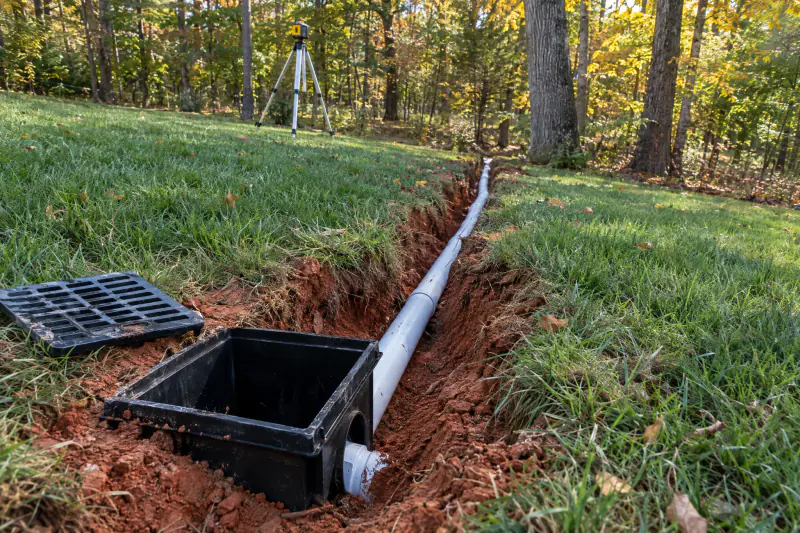
- A grated box set at the true low point of a lawn, bed or paved area, with a sediment sump below the outlet and solid pipe leaving it. Surface water falls in, grit settles, and the pipe carries the rest to an outlet.
- Swale and regrading
- Often the best fix: the surface reshaped so water runs where you want it. Extension guidance puts a swale at a 1 percent minimum slope, away from compacted or high-clay soils, and at least 10 feet from a foundation.
Why do dry wells fail in Northern Virginia clay?
Because a dry well only works as fast as the soil around it accepts water, and our clay accepts it very slowly. The Northern Virginia Soil and Water Conservation District, which advises Fairfax County homeowners, says it directly: a dry well is only a good option if a permeable layer of soil is found within a reasonable depth, and if no such layer exists, a dry well might not be a good solution. The district adds that soil with a poor infiltration rate may need an underdrain, and that high groundwater or shallow bedrock are also problematic. Virginia Cooperative Extension tells homeowners to keep rain gardens and swales out of compacted soils and soils with high clay content, which describes a large share of the lots here. The NDS installation guide for its plastic dry well units says soil should drain at about 1/2 to 2 inches per hour to be well suited. Much of the clay we test in Centreville, Chantilly and Burke runs below that, and the compacted fill under newer subdivisions in Ashburn and Bristow runs lower still.
The arithmetic shows why. A 4 by 4 foot pit with a 16 square foot floor in soil perking at 0.5 inch per hour drains about 5 gallons an hour through the bottom. If that pit stores 170 gallons, it takes well over a day to empty, and the next storm may arrive first. At 0.1 inch per hour, it needs most of a week. Meanwhile silt from the roof coats the stone and fabric, and within a few seasons the well is a buried bucket that overflows in every storm. Lots in Great Falls, Clifton and western Loudoun with loamy or rocky soil often perk well. Measure before you dig.
How do you do a simple perc test in your own yard?
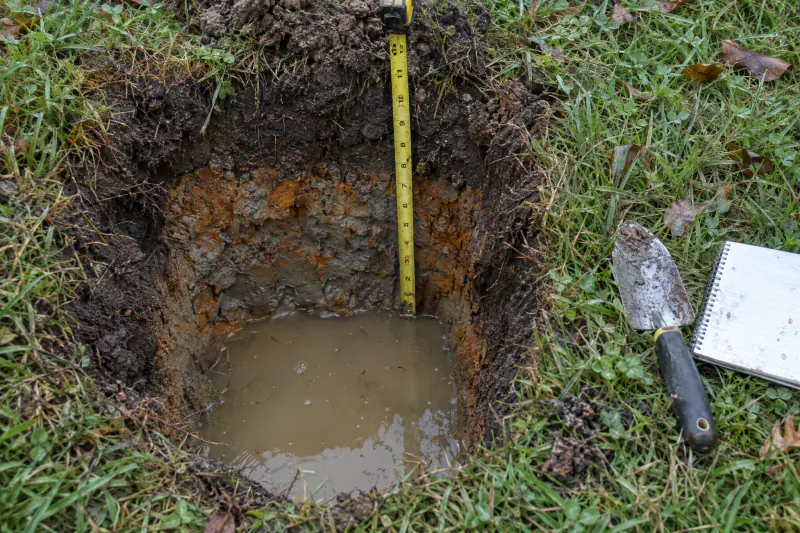
The homeowner infiltration test Arlington County publishes, with a graphic from the Northern Virginia Soil and Water Conservation District.
Dig the hole where the dry well would go
Six to 18 inches wide and at least 12 inches deep, or as deep as the bottom of the planned dry well. Roughen smooth sides with a trowel and clear loose soil from the bottom.
Fill it and soak the soil
Fill the hole with water. If it disappears within 10 minutes you can run the test right away. If water remains after 10 minutes, leave it overnight so the soil saturates. Clay nearly always needs the overnight soak.
Refill and record the time
The next day, refill the hole to a marked level and write down the time. Stand a tape or ruler in the hole so you can read the level against it.
Measure every 10 minutes for an hour
Read the level to the nearest quarter inch at each interval. If it drops slowly, measure every 20 minutes for two hours or every 30 minutes for three. Take at least six readings.
Calculate inches per hour
Divide the total drop in inches by the elapsed time in hours. A 3-inch drop over two hours is 1.5 inches per hour. A quarter inch over three hours is about 0.08.
Read the result
Arlington's guidance: above 0.5 inch per hour, infiltration is adequate for a rain garden, trench or dry well. At 0.5 or less, it needs an underdrain, which for a dry well means an overflow pipe to a real outlet.
What does your perc result mean for a dry well?
| Measured rate | What the soil is doing | Dry well verdict |
|---|---|---|
| 0.5 to 2 inches per hour | Loam or rocky soil; parts of Great Falls, Clifton, western Loudoun | Suitable per NDS and county guidance; still add an overflow |
| 0.1 to 0.5 inch per hour | Typical undisturbed Piedmont clay | Needs an overflow; size for storage, not for soaking |
| Under 0.1 inch per hour | Compacted subdivision fill or marine clay | A holding tank; use a catch basin or French drain to an outlet instead |
| Hole still full after 48 hours | Fairfax guidance: the site is not suitable | Choose a different fix or location |
Fairfax County's homeowner drainage glossary uses a simpler test: dig a 12-inch or deeper hole, fill it, let it sit at least an hour to saturate, and the site is suitable only if the water drains within 48 hours; otherwise choose a different location.
How big does a dry well need to be, and how far from the house?
Size it for the storm it will store, placed at least 10 feet from the foundation. An inch of rain yields about 0.62 gallons per square foot of roof, so a downspout serving 600 square feet delivers roughly 370 gallons per inch. A plastic dry well unit of the common type holds about 50 gallons, so storing that inch takes seven or eight units, or a stone pit with far more volume, because washed stone stores water only in its voids, typically a third or so of the pit. A 4 by 4 by 4 foot stone pit holds roughly 150 to 190 gallons. Most residential dry wells we see were sized for a fraction of one storm and rely on the soil to make up the difference.
Placement rules are consistent across sources. The NDS guide says most installations place the well at least 10 feet from the foundation, and farther where the lot allows; Virginia Cooperative Extension uses the same distance for rain gardens and swales and adds that the bottom should sit at least 2 feet above the seasonal high water table; the Fairfax district says a dry well should not be located next to the foundation and that the sides, not the bottom, get filter fabric. We add a non-woven geotextile because it clogs more slowly in clay, an inspection port, and always an overflow: solid pipe from the top of the chamber to a pop-up emitter or daylight. Fairfax County requires a permit when more than 2,500 square feet is disturbed, which a regrade can approach. Our yard and foundation drainage page covers the build.
When is a French drain the right answer, and when does a catch basin beat it?
A French drain is right when the water is in the soil: a lawn spongy for three or more days after rain, a basement wall that seeps long after the storm, or a seasonal water table that rises every spring. The trench goes below the wet layer, perforated pipe in washed stone wrapped in fabric collects what the soil gives up, and the pipe runs by gravity to daylight or an emitter. On clay this works because it gives the water a faster path than the clay offers. It needs fall, usually at least 1/8 inch per foot, and an outlet lower than the trench. Our article on French drain installation on Northern Virginia clay covers depth, stone and fabric, and the French drain service page describes the build.
A catch basin beats it whenever the water is sitting on top. A puddle in a low corner that is gone within a day is a surface problem; a French drain under it would collect almost nothing, because clay passes water into the trench so slowly that the puddle evaporates first. A basin set at the true low point, with the finish grade sloping 1 to 2 percent toward the grate, takes the puddle in minutes and sends it down solid pipe. Basins also handle sheet flow off a patio toward a door and the shared low spot where three backyards meet in a South Riding or Gainesville cul-de-sac.
When do combinations win on clay?
Most of the time, because a wet yard rarely has one kind of water. The combination we build most often is a catch basin at the low point feeding 4 inch solid pipe to daylight or a pop-up emitter, with the downspouts tied into the same solid line upstream. The basin handles the surface, the pipe handles the roof, and nothing asks the clay to absorb anything. Where the lawn is also spongy, a French drain runs along the wet band and discharges into the same solid line below the basin, through a wye pointed downstream, so the roof surge never enters the perforated pipe. That rule is absolute: roof water and basin water travel in solid pipe, and only soil water enters a perforated one.
A dry well earns a place in exactly one situation: a lot with no fall at all, no daylight, soil that perks above 0.5 inch per hour, and one or two downspouts rather than a sump pump. Even then it gets an overflow to the lowest lawful spot on the lot. Where a lot is flat and perks poorly, the honest combination is regrading to create fall, a basin at the new low point, and a long run of solid pipe to the front yard or a side swale. It costs more than a dry well and it works in year five. Every combination starts with the roof; our downspout drainage page and the article on where gutter water should go cover taking that water out first.
Which fix matches which symptom?
Start with what you see after a storm, then check the timing.
| What you see | Where the water is | Best fit on clay | Avoid |
|---|---|---|---|
| Puddle in a low spot, gone within a day | Surface | Catch basin to solid pipe, or regrading | French drain under the puddle |
| Lawn spongy three or more days, no visible puddle | Soil | French drain below the wet layer to an outlet | Dry well; nowhere for it to drain |
| Downspout floods a bed on a flat lot that perks over 0.5 in. per hour | Roof | Dry well with overflow, 10 ft or more from the house | Dry well with no overflow |
| Water against the foundation after rain | Surface and backfill | Regrade to 5 percent for 10 ft, bury downspouts, basin if a low spot remains | Stone against the wall |
| Sump pump runs constantly | Groundwater | Discharge line far enough out; exterior French drain if the lot allows | Dry well as the sump outlet |
What should you never do with yard drainage?
Never send roof water into a French drain. Perforated pipe pushes the surge back into the soil you are trying to dry and washes fines into the stone. Never build a dry well without an overflow, and never make a dry well the outlet for a sump pump, which can fill one in minutes. Never connect anything new to the foundation drain, the sump pit or the sanitary sewer without tracing where the pipe goes; the sewer connection is illegal in Fairfax County and barred by Loudoun Water. Never set a catch basin anywhere but the true low point measured with a level; 6 inches uphill of the puddle it is a decoration. Never dig without a Virginia 811 locate, and never run a line that ends at the property line, which the Fairfax district calls an unsuitable discharge area.
Two quieter mistakes cost as much. Do not use thin single-wall corrugated pipe for any buried run on clay; it bellies, fills with silt and crushes under the first wheelbarrow. And do not skip the fabric; a French drain or dry well in clay without a filter wrap silts up within a few seasons. Finally, do not assume. The perc test above costs a shovel and a weekend.
How much do dry wells, French drains and catch basins cost in Northern Virginia in 2026?
As of 2026, typical Northern Virginia market planning ranges look like this. A catch basin with a piped run of solid 4 inch PVC to a daylight outlet or pop-up emitter typically runs $1,500 to $5,000, depending mostly on the length of the run. A channel drain across a patio or walk typically runs $1,500 to $4,000. A dry well with stone, fabric, inspection port and an overflow typically runs $2,000 to $6,000. A French drain typically runs $30 to $90 per linear foot, with most yard drains between $2,500 and $10,000; our French drain cost article breaks that down by type. Buried downspout lines, which usually come first, run roughly $400 to $1,500 per downspout. These are regional figures, not our prices and not a quote.
What moves the number:
- Distance to the outlet. The largest factor for every option that uses a pipe.
- Depth and spoil. A French drain cut 30 inches deep in clay produces a lot of material to haul.
- Soil and rock. Shallow rock in Leesburg, Chantilly and the Gainesville corridor turns machine work into hand work.
- Crossings. Walks, patios, driveways and tree roots.
The number that matters is the one produced on your lot with a level, a probe and the perc result in hand. That is what an estimate visit is for, and the cost guide puts these ranges beside the rest of the property.
What should a yard drainage quote include?
Whichever fix is proposed, the paperwork should show the thinking.
- The kind of water being addressed, surface or soil or roof, and the evidence for it.
- A perc test result if a dry well or any infiltration is part of the plan.
- Elevation readings from the wet area to the outlet, in inches of fall.
- The outlet itself, on your property or approved, and the overflow for any dry well.
- Pipe type and size, and confirmation that roof water never enters perforated pipe.
- Washed stone and the specific filter fabric for any French drain or dry well.
- Virginia 811 locate, private utility marking, and a check of the plat for easements.
- Haul-off of spoil, backfill, sod or seed restoration, and a hose test at the end.
How does the choice change across Fairfax, Loudoun, Prince William and Arlington?
In Fairfax County, the Northern Virginia Soil and Water Conservation District publishes the homeowner drainage guide and infiltration test we quote above, and parts of the eastern county toward Alexandria and Lorton sit on marine clay that shrinks and swells, so a dry well near the house is a poor idea there. Older lots in Springfield, Burke, Annandale, Vienna and McLean often have fall to a side or rear swale, which favors a catch basin or French drain to daylight. In Loudoun County, the newer subdivisions of Ashburn, South Riding, Brambleton and Sterling were graded flat on compacted fill, perc tests there often come in under 0.5 inch per hour in our experience, and the rear lot line usually carries a drainage easement that can receive an outlet on your side; lots toward Leesburg and Purcellville perk better but hit rock sooner.
In Prince William County, Gainesville, Bristow, Haymarket and Woodbridge share the compacted-fill pattern, and the county drainage page reminds homeowners that they maintain what they install and should consider the neighbor when choosing an outlet. Arlington County, with Falls Church and Alexandria, has small lots where a 10-foot setback leaves little room for a dry well; Arlington publishes the infiltration test we describe and offers a stormwater utility credit for a dry well connected to a downspout. Rules as published in 2026 can change. See our service areas and the water management overview.
Frequently asked questions
Do dry wells work in clay soil?
Rarely without help. Fairfax County guidance says a dry well is only a good option if a permeable soil layer exists within a reasonable depth, and NDS says soil should drain at about 1/2 to 2 inches per hour. Much of the clay we test in Northern Virginia comes in below 0.5 inch per hour, which Arlington's guidance says calls for an underdrain. Here that means an overflow to a real outlet, or a different fix.
Is a French drain or a dry well better for yard drainage?
They do different jobs. A French drain collects water moving through the soil and carries it away by gravity, which works on clay because it does not depend on absorption. A dry well stores water and depends entirely on absorption. For a spongy lawn or a seeping basement wall, the French drain is the tool. A dry well suits only roof water on a flat lot that perks.
When should I use a catch basin instead of a French drain?
When the water is on the surface. A puddle that forms in a low spot and drains within a day is surface water; a basin at the true low point with solid pipe to an outlet removes it in minutes. A French drain under that puddle collects almost nothing on clay. Use the French drain when the ground stays spongy for days.
How do I test whether my soil will drain for a dry well?
Dig a hole 6 to 18 inches wide and at least 12 inches deep, fill it, and let it soak overnight. Refill it, then measure the drop every 10 minutes for an hour, at least six readings. Divide the drop in inches by the hours. Above 0.5 inch per hour a dry well can work; at or below that, plan an overflow.
How far should a dry well be from the house?
At least 10 feet. The NDS installation guide says most installations sit at least 10 feet from the foundation, Virginia Cooperative Extension uses the same distance for rain gardens and swales, and the Fairfax district says a dry well should not sit next to the foundation. Keep the bottom at least 2 feet above the seasonal high water table and route the overflow away from the house.
Do I need a permit for a dry well, French drain or catch basin in Northern Virginia?
Usually not for a small residential job on your own lot, but Fairfax County requires a permit when more than 2,500 square feet is disturbed, and connections to public storm sewers need approval everywhere. Drainage easements on the plat cannot be filled or blocked. Rules differ by county and change, so confirm before a large regrade or any public connection.
Book the work
Put the plan in writing with a crew that builds this every week.
One visit to measure and talk through options, then a written scope and price. No pressure, no vague numbers. Ask about the Heroes Discount if you serve.
Sources and further reading
- Arlington County: How to Complete a Simple Soil Infiltration Test (graphic courtesy of the Northern Virginia Soil and Water Conservation District)
- Northern Virginia Soil and Water Conservation District (Fairfax County): Control Heavy Runoff, dry wells and infiltration trenches
- Northern Virginia Soil and Water Conservation District (Fairfax County): Drainage glossary and infiltration test
- Virginia Cooperative Extension, SPES-13: Stormwater Management for Homeowners Fact Sheet 5, Rain Gardens
- Virginia Cooperative Extension, SPES-12: Stormwater Management for Homeowners Fact Sheet 4, Grass Swales
- NDS (Advanced Drainage Systems): How to Install a Dry Well
Published October 1, 2026. Reviewed and updated October 22, 2026.