Key takeaways
- A soggy spot means water arrives faster than it leaves. Either something adds water, such as a leak, spring or downspout, or the soil cannot pass it: clay, compaction or a low pocket.
- Timing is the clue. A spot wet for days after rain points to grading and clay. One wet for months or all the time points to a leak, a spring or groundwater.
- Test before you dig: a dry-week test, an irrigation shut-off, a probe rod, a squeeze test for clay and an infiltration test. The source may be far from the wet spot.
- Match the fix to the cause: regrade a low pocket, pipe a broken downspout, repair a leak, drain a seep to daylight. A dry well works only where an infiltration test shows drainage.
- Never plant over an unfound leak, tie a drain into the sanitary sewer or dig without calling 811. Most fixes run about $400 to $10,000 as typical 2026 planning ranges.
On this page
- Why does one spot in my yard stay soggy when the rest dries?
- What are the seven usual causes of a soggy spot?
- What does the timing of the wet spot tell you?
- How do you diagnose a soggy spot yourself in a week?
- How do you tell a leak from rain, a seep or groundwater?
- Why does clay hold water in one spot, and what is perched water?
- Is it a spring or a high water table?
- What if an old drain or downspout line has failed?
- Which fix matches which cause?
- When does a dry well work, and when is a French drain or catch basin better?
- What should you never do about a soggy spot?
- What does fixing a soggy spot cost in Northern Virginia in 2026?
- How do soggy spots differ across Fairfax, Loudoun, Prince William and Arlington?
- Frequently asked questions
Why does one spot in my yard stay soggy when the rest dries?
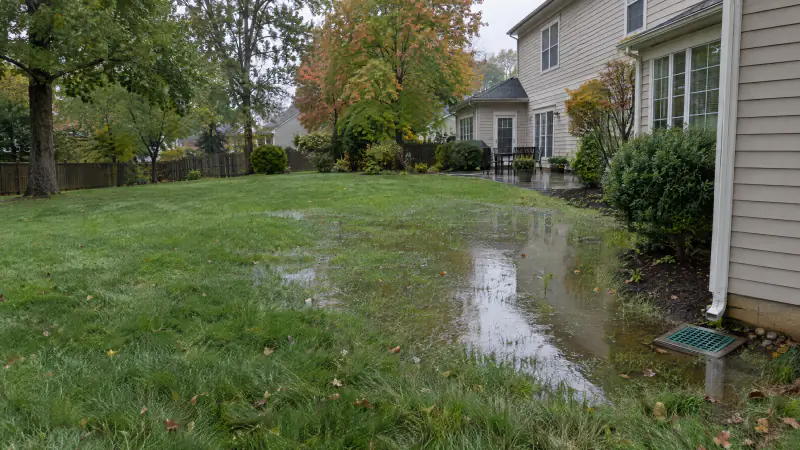
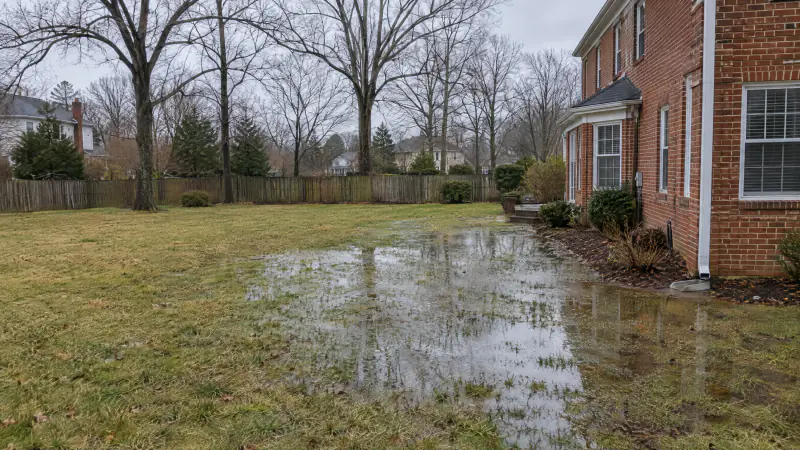
Because water is arriving there faster than it can leave. Either something is adding extra water, such as a leak, a spring or a downspout, or the exit is blocked by clay, compaction, a low pocket with no outlet or an old drain that has failed. A soggy spot is almost never a mystery once you know when it is wet and what sits uphill of it, and a few cheap tests answer most of the questions.
Fairfax County's Northern Virginia Soil and Water Conservation District splits the problem in two. Spots that stay wet for several days after rain or snow point to poor grading, such as low spots or depressions, and poor infiltration, such as compacted soil, high clay content or shallow bedrock. Spots that stay wet for months or all the time point to leaking water pipes, sprinkler systems or outdoor faucets, or to naturally high groundwater or springs. The district adds a warning that matters: the source of the wetness may not be where the water appears on the surface, so investigate carefully.
This article walks through the seven usual causes, a diagnosis you can do over a week, the fix that matches each cause and the mistakes to avoid. It pairs with our guides to why backyards stay wet and to choosing between a dry well, French drain and catch basin.
What are the seven usual causes of a soggy spot?
Most wet spots on Northern Virginia lots come down to one of these, and some have two at once.
Perched water on clay
A tight layer in the soil stops drainage, so the top foot stays saturated while the ground below is drier. It appears after days of rain and clears slowly.
A spring seep or high water table
Groundwater reaches the surface at the foot of a slope or in a low area, often in late winter. It keeps flowing in a dry week.
A leaking irrigation line or hose bib
A cracked pipe, joint, weeping valve or split spigot line feeds the same spot all season, often with clear water and unusually green grass.
A broken downspout line
A buried pipe that crushed, clogged or separated spills roof water underground, so the spot floods early in every storm, often below a downspout.
A low pocket with no outlet
A bowl in the yard collects runoff from the lawn around it with nowhere to send it. Grade, not soil, is the problem.
Compaction
Construction traffic leaves soil packed tight, so rain runs off instead of soaking in. The whole yard dries slowly, worst where the surface sits lowest.
A failed old drain
A French drain silted up, a pipe crushed or a trench settled over the years. The wet line often follows the old drain path.
What does the timing of the wet spot tell you?
Note when it is wet, how fast it appears and what the weather has done. The pattern narrows the field before any digging.
| Pattern | Likely cause | First test |
|---|---|---|
| Wet 2 to 4 days after rain, then dries | Perched water, compaction or a low pocket | Dry-week test, probe rod, squeeze test |
| Floods early in a storm, in a line below a downspout | Broken or clogged downspout line | Run a hose into the downspout |
| Wet all year, even after a dry week | A leak or a spring | Irrigation shut-off test and water meter check |
| Wet in late winter, dry by summer | High water table or a seasonal seep | Note the season and compare in June |
| Wet only after sprinklers run | Irrigation leak or a valve that weeps | Shut-off test during the irrigation season |
| A wet strip along a straight line | Failed old drain or a settled utility trench | Probe along the line, check the plat for easements |
| Wet with sewer odor or flowing water | A sewer or water line leak | Call the utility; do not dig |
These are patterns, not a diagnosis. Many soggy spots have a second contributor, such as a seep that is made worse by compaction.
How do you diagnose a soggy spot yourself in a week?
A week, a tape, a probe rod or long screwdriver, a hose and a notebook. Photograph the spot at the same time each day.
Map it and look uphill
Measure the spot and its distance from the house and property line. Note what sits above it: a downspout, hose bib, slope, neighbor's yard or irrigation head.
Run a dry-week test
Wait five to seven days without rain and check each morning. In cool November evaporation is slow, so damp clay is expected. Running water, or mud in a dry week in summer, points past rain.
Shut off the irrigation
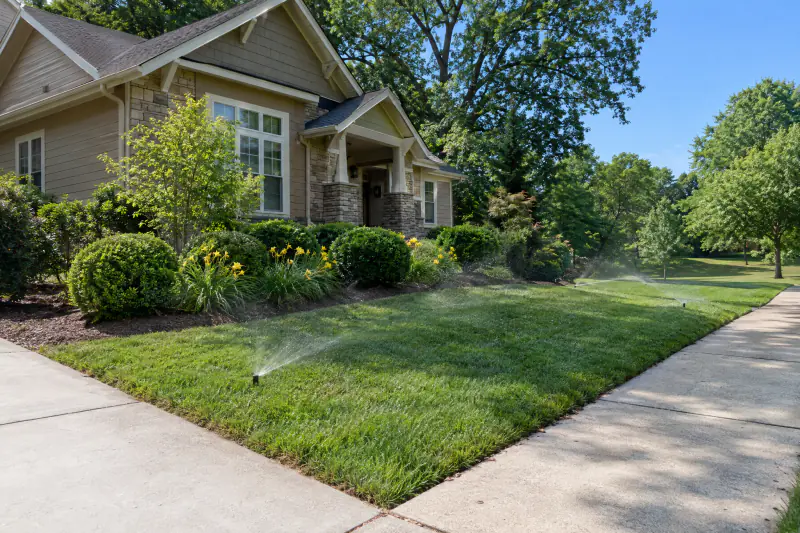
In season, turn off the controller and close the irrigation supply for several days. If the spot dries, the system is feeding it. If the system is already winterized, it is not the cause now, but may have caused a summer spot.
Hose-test the downspouts
Run a hose into the downspout above the spot for ten minutes. If the wet area grows or begins to pool, the buried line below that downspout may be broken or blocked.
Check the water meter
With every tap, appliance and the irrigation system off, read the meter, wait and read it again. EPA WaterSense suggests two hours, and your utility may suggest less. A changed reading means water is going somewhere. Sewer odor or flowing water at the surface is a call to the utility.
Probe and squeeze
Push the rod into the spot and into dry ground nearby, and note where it stops. Squeeze a moist handful: if it forms an easy snake, the clay content is high. Do not force the rod deep, and call Virginia 811 before any digging.
Run an infiltration test
After calling 811, dig a hole 12 inches deep at a dry spot nearby, fill it, let it soak for an hour, refill it and time the drain. Fairfax County's soil district treats drainage within 48 hours as suitable for a rain garden or dry well.
How do you tell a leak from rain, a seep or groundwater?
A leak is steady and indifferent to the weather. Rain-fed spots swell after a storm and shrink in a dry week. A groundwater seep follows the seasons, peaking in late winter. A leak keeps going in July, often with clear water and a stripe of greener grass, and the water meter may move when everything else is off. The district's wet-yard guidance lists leaking pipes, sprinkler systems and outdoor faucets among the causes of a spot that is wet for months or all the time.
Irrigation is the most common leak we are asked about. The EPA's WaterSense program advises looking for areas of the landscape where water pools on the surface, which could signal an underground leak, notes that a valve that does not close completely can seep slowly even when the system is off, and says a system with cracked pipes or broken heads could be losing up to 25,000 gallons of water over a six-month irrigation season. Our irrigation upgrades service covers diagnosis and repair, and the winterization article covers shutting a system down for the season.
Not every leak is yours to repair. The district notes that leaking sewer or water lines are a rare cause of depressions in a yard and that they often show sewer odors or flowing water at the surface. If you smell sewage or see water running, leave the digging to the utility or a licensed plumber. And do not plant over a suspected leak: the district lists replanting with water-tolerant plants as an option for a small wet area, and also warns that the actual source of the wetness may not be where you see it, so investigate carefully. Planting first only hides the cause.
Why does clay hold water in one spot, and what is perched water?
Perched water is rain that sits on a tight layer in the soil instead of draining through it. Fairfax County's soil district explains that a restrictive layer can cause a temporarily perched groundwater table in wet periods, and that the same layer may stop the roots of your plants, so plants may need extra water in dry spells. On Northern Virginia clay that is the story of many lawns: the surface can be saturated in March and cooked by August, with the same dense layer to blame for both. Our article on tall fescue in summer covers the dry half of that cycle.
Compaction deepens the effect. The district observes that the ground around a house is often compacted by building construction, which may reduce infiltration and increase runoff by 2 to 10 times compared with forests or farmland, and that soils high in clay usually have low to very low permeability. Well-drained soils, it says, will not pond and will not remain soggy for long. A yard that stays wet for days after every rain is telling you it is not well drained, however carefully the grade was set.
Organic matter helps. The district calls adding organic matter the most effective way to improve soil structure, and says never to till your soil when it is wet. Organic matter helps a compacted lawn infiltrate, but it will not drain a perched layer a foot down or stop a spring. For those, the answer is moving the water in pipe.
Is it a spring or a high water table?
It is likely a seep if the spot is wet in a dry week and sits at the foot of a slope, beside a retaining wall or in a low corner. Fairfax County's district notes that groundwater tables tend to be at their highest in February and March in Virginia, and that groundwater is generally closest to the surface in the colder months, though wetness can occur throughout the year. It describes poorly drained soils as having groundwater within a few inches of the surface, and lists underground springs among the causes of yard depressions, because the flowing water erodes soil and creates cavities.
That seasonality is a useful diagnostic. A seep that returns every February and is dry by June is likely a high water table. One that runs through a dry summer is more likely a spring or a leak. Photograph the spot monthly if you can, and note the dates. A seep also leaves clues on the slope above it: a green band of vegetation, soft ground that never firms up, or a channel where water has started to cut.
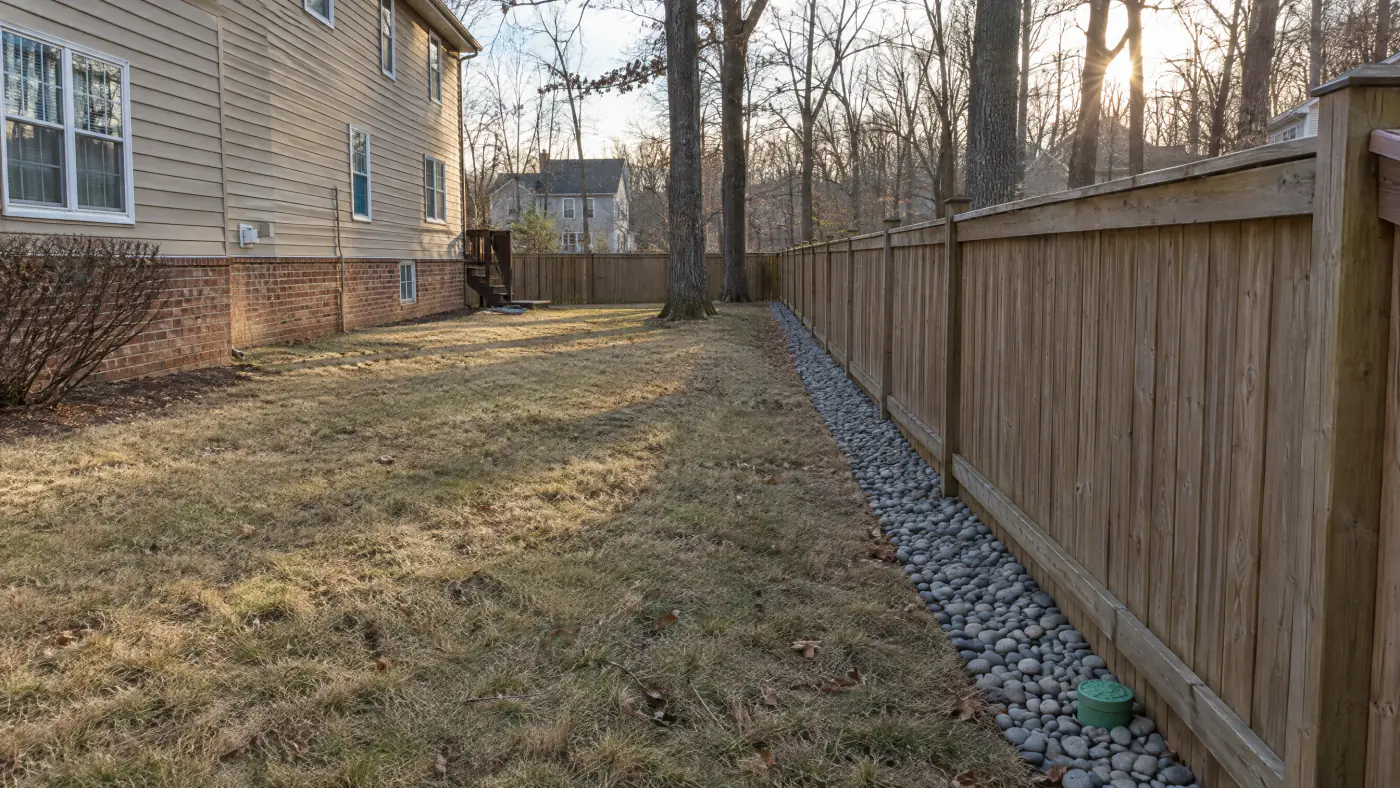
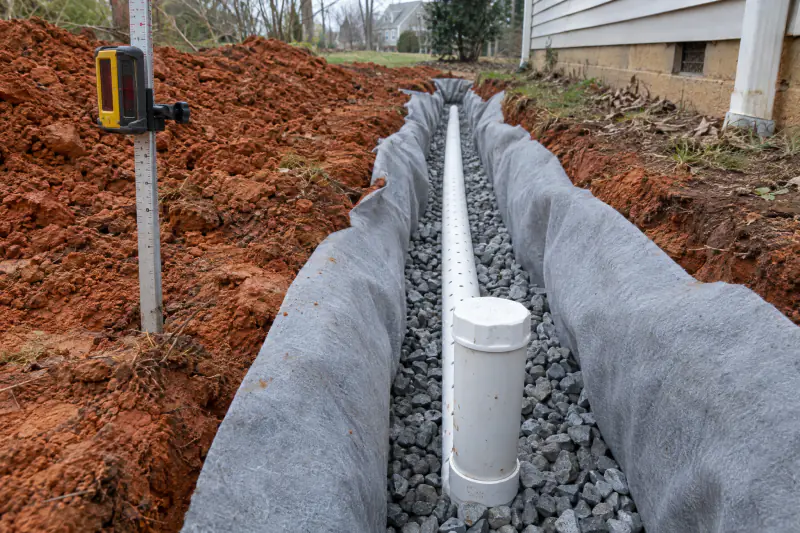
The district's fix is to capture and redirect the water. For yards too flat to drain, it suggests a trench about 2 feet deep with a perforated pipe surrounded by gravel; for springs, a French drain or catch basin can intercept the flow and route it to a suitable outlet. We build those drains to daylight, which means the pipe leaves the yard through an outlet that drains by gravity. For a large wet area, the district says to check first whether it is a wetland or a Resource Protection Area, and we add the Chesapeake Bay rules to that check before any regrading. See our guide to French drains on clay for the build.
What if an old drain or downspout line has failed?
Then the spot is a symptom of something you buried years ago. Corrugated downspout lines crush under mowers and roots, silt up and sag; old French drains clog with fines and roots; utility trenches settle. The district's guidance on yard depressions says that poorly compacted soil around buried drainage, water or sewer lines can settle over several years into a hole or shallow trench, that depressions sometimes develop in utility easements, and that buried brush, stumps or construction debris can rot and leave a void. If the wet line runs straight across the lawn, or the spot sits where a downspout line should be, a failed pipe is the first suspect.
The first step is to find the line. Check your plat for easements, run the hose test on each downspout, and have a contractor locate and camera-inspect any buried line you cannot trace. Our article on leaf season and buried drain lines explains how clogs form. We typically replace a failed line with solid, smooth-wall pipe to a proper outlet, not another run of corrugated.
If the cause is a public pipe, such as a storm or sewer line in an easement, repairs may not be yours to make. The district notes that if a pipe is in an easement, the county or a utility company may be responsible for fixing the damage. In Fairfax County it lists public works for stormwater and sewer lines, the wastewater collection division for a suspected sewer leak, and Fairfax Water for a suspected water leak. Check which utility serves your address.
Which fix matches which cause?
The right fix removes the water source or gives it a legal place to go. Soil fixes alone rarely hold.
| Cause | Fix that lasts | Notes |
|---|---|---|
| Low pocket with no outlet | Fill with clay-rich soil and regrade, or a swale or catch basin piped to an outlet | Works only if the water has somewhere to go |
| Perched water, compaction | Surface drainage plus a French drain to daylight; organic matter and aeration for the lawn | Slow and shallow; does not drain a perched layer |
| Seep or high water table | French drain or catch basin intercepting upslope, piped to daylight | Needs a legal outlet; check wetlands and RPA |
| Leaking irrigation line or hose bib | Repair the fitting, valve or pipe, then let the soil dry | Test after repair; a spot that persists has a second cause |
| Broken downspout line | Replace with solid pipe to a pop-up emitter or daylight outlet | Corrugated lines can crush again |
| Failed old drain | Locate, camera-inspect and replace, or rebuild with fabric and washed stone | Silt and roots are the usual killers |
| Soil that drains in 48 hours | Dry well with an overflow, sized to the runoff | Only after an infiltration test; never next to the foundation |
Our guide to French drains and catch basins compares the two main drain types.
When does a dry well work, and when is a French drain or catch basin better?
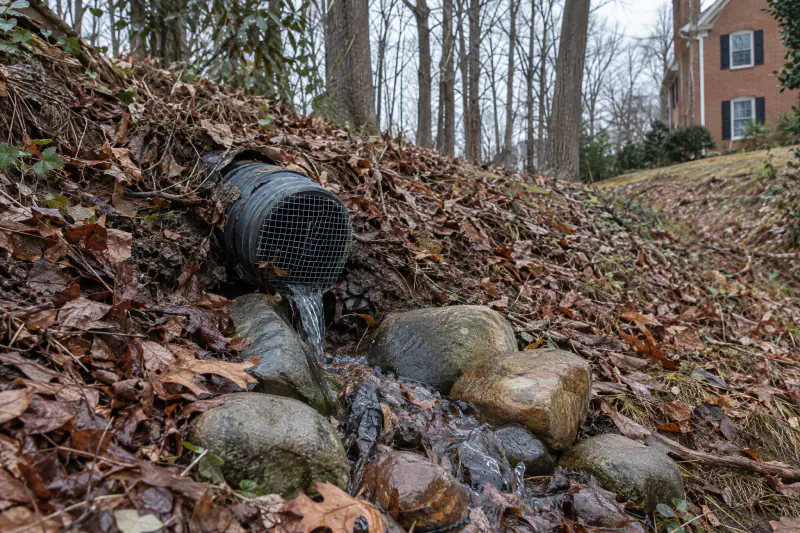
A dry well works only where the soil can take the water, and most Northern Virginia clay cannot. The district describes a dry well as a gravel-filled underground storage area, and says it should only be built where a permeable layer of soil is found within a reasonable depth. It also advises that rain gardens and dry wells should not be placed next to the foundation of the home, and that an infiltration test should come first: a hole 12 inches or deeper, filled to saturate for an hour, then refilled. If it drains within 48 hours the site suits a dry well, though amending the soil is recommended. If not, choose another location, or amend or replace the soil and install an underdrain.
On clay that fails the test, the answer is conveyance. A French drain collects water along a path and carries it to an outlet; the district describes a standard ditch as about 1.5 feet deep and 10 to 12 inches wide, with a pipe of 4 to 6 inches in diameter, lined with fabric and surrounded by gravel. We commonly cut deeper on heavy clay and use solid pipe for the run to daylight. A catch basin is the better tool where water collects in a single low spot: a surface inlet piped to an outlet. Our guide on French drains versus catch basins sets them side by side, and the French drain installation and yard drainage solutions pages describe how we build both.
The outlet is the whole game. The district warns that redirecting runoff without soaking it into the soil can negatively affect neighboring properties, and that discharging it to an unsuitable area simply shifts the problem elsewhere. A drain that ends at a fence line has not solved anything.
What should you never do about a soggy spot?
These mistakes turn a cheap problem into an expensive one.
- Plant water-loving shrubs over a wet spot before you know why it is wet.
- Tie a drain, downspout or sump line into the sanitary sewer or its cleanout. Our sump pump discharge article cites the county and utility rules.
- Dig without calling Virginia 811 first, even for a shallow trench.
- Fill a depression with gravel or rock, which the district says not to use as fill. Use high-clay, low-sand soil in thin, compacted lifts.
- Build a dry well without an infiltration test, or put one next to the foundation.
- Send the water to a neighbor's yard, the street or a fence line with no legal outlet.
- Enter a hole deeper than chest height, or try to repair a public sewer or water line yourself.
- Ignore sewer odor or flowing water at the surface. Call the utility.
What does fixing a soggy spot cost in Northern Virginia in 2026?
It depends almost entirely on the cause, which is why the diagnosis comes first. As typical Northern Virginia market planning ranges as of 2026, not our prices and not a quote: filling and regrading a single low pocket with clay-rich soil, compaction and sod commonly runs roughly $500 to $2,500. Burying a downspout line typically costs $400 to $1,500 per downspout. A swale shaped across a backyard commonly runs $1,000 to $4,000 including seed or sod, and a catch basin with a piped run to an outlet $1,500 to $5,000. A French drain typically costs $30 to $90 per linear foot, with most yard drains between $2,500 and $10,000 (our French drain cost article breaks that down by drain type), and a dry well with an overflow, where the soil allows one, about $2,000 to $6,000.
Irrigation repair is usually the least expensive item: a head, fitting or valve repair commonly costs a few hundred dollars, a cracked zone valve roughly $150 to $450, while replacing a long section of buried line costs more. A camera inspection of a failed buried line commonly runs $150 to $400. A leak in the home's water service line is a plumber's job, and costs vary widely with depth and length.
What moves the number: the distance to a legal outlet, the depth of cut and the volume of clay to haul away, whether a machine can reach the yard through a gate, crossings under walks and patios, tree roots, shallow rock, and how much lawn must be restored with sod rather than seed. Winter work sometimes saves on restoration, since seed and sod wait for spring in any case. Our cost guide puts these ranges beside other projects, and a written on-site estimate is the only number that reflects your yard. Request one here or call (571) 200-9600.
How do soggy spots differ across Fairfax, Loudoun, Prince William and Arlington?
The soil is everywhere clay-heavy; the cause changes with the neighborhood. In our experience, newer subdivisions in Ashburn, South Riding, Aldie, Bristow and Gainesville often have compacted soil and low pockets from mass grading, and a spot that stays wet for days is usually compaction plus a downspout that lands too close. On sloped lots in western Loudoun, in and around Leesburg and Purcellville, we commonly find a seep at the foot of a slope. In older neighborhoods in Vienna, Burke, Springfield, Falls Church and Arlington, we more often find failed drain lines, old downspout runs crushed by roots, and irrigation systems added decades after the house.
Small lots limit the options. In Arlington and Alexandria, a yard may have no room for a swale or a 10-foot extension, so the fix is piped, and the outlet may need a neighbor conversation or a curb connection. In Prince William, Manassas and Manassas Park, the same clay and compaction patterns apply. In Fairfax County, check whether the spot lies in a wetland or a Resource Protection Area, and ask about permits before disturbing a large area. Fairfax County's Land Disturbance 101 page says land-disturbing activities equaling or exceeding 2,500 square feet are regulated and need an approved plan first, with exemptions for minor activities such as individual home landscaping. Other jurisdictions follow their own rules, so confirm with yours.
Wherever you live, the service areas page lists where we work. If you are also seeing water against the house, read our companion piece on water pooling against the foundation, because a soggy spot near a wall belongs in that order of checks. A gutter or catch basin packed with leaves will flood a spot that was fine last month.
Frequently asked questions
Why is there a wet spot in my yard when it has not rained?
Something is adding water. The usual suspects are a leaking irrigation line or hose bib, a broken downspout line, a spring or seep, or a leaking water or sewer pipe. Run the irrigation shut-off test, check the water meter with everything off, and note the season.
How long should a lawn stay wet after heavy rain?
Well-drained soil does not stay soggy for long. On Northern Virginia clay, a day or two is common. Fairfax County's soil district links spots that stay wet for several days to poor grading or poor infiltration, and spots that stay wet for months or all the time to leaks or groundwater. A week of wetness after one rain deserves a diagnosis.
Can a leaking pipe cause a soggy spot in my yard?
Yes. Leaking sprinkler lines, outdoor faucets and water service pipes are among the district's listed causes of spots that stay wet for months. Signs include clear, steady water, greener grass, a water meter that moves with everything off, and sewage odor or flowing water at the surface. Do not plant or fill over it. Find the source first.
Will a French drain fix a soggy spot?
Often, but only when the cause is water moving through shallow soil or collecting in a low area, and only with a legal outlet. A French drain does nothing for a leak, and it will fail if the pipe ends where the water cannot leave.
Does aeration fix a soggy lawn?
It helps compacted soil take in water, and adding organic matter is the most effective way to improve soil structure, according to Fairfax County's soil district. It will not drain a perched layer a foot below the surface, stop a spring or repair a leak.
Can I just install a dry well in the wet spot?
Only if an infiltration test shows the soil drains. Dig a hole 12 inches deep, saturate it for an hour, refill it and see whether it empties within 48 hours. Most clay lots fail that test, and a dry well in clay fills and overflows. Never place one next to the foundation. A French drain to daylight is more reliable.
Should I plant water-loving plants in a wet spot?
Only after you know why it is wet. The district's guidance lists replanting a small wet area with water-tolerant plants, and also warns that the actual source of the wetness may not be where you see it. Plants can hide a leak while it worsens. If the cause is a seep or a low pocket that cannot be drained, native plants can be a good finish.
Book the work
Put the plan in writing with a crew that builds this every week.
One visit to measure and talk through options, then a written scope and price. No pressure, no vague numbers. Ask about the Heroes Discount if you serve.
Sources and further reading
- Northern Virginia Soil and Water Conservation District (Fairfax County): Wet Yard, Solving Drainage Problems
- Northern Virginia Soil and Water Conservation District (Fairfax County): You and Your Land, Soils and Drainage
- Northern Virginia Soil and Water Conservation District (Fairfax County): "Sinkhole" Problems
- Northern Virginia Soil and Water Conservation District (Fairfax County): Control Heavy Runoff, dry wells and French drains
- Northern Virginia Soil and Water Conservation District (Fairfax County): Glossary, infiltration test
- EPA WaterSense: Sprinkler Spruce-Up
Published November 5, 2026. Reviewed and updated November 13, 2026.