Key takeaways
- A DIY French drain suits a short, shallow yard run on your own lot with a clear gravity outlet. It is a poor bet when the outlet needs a pump or a tie-in.
- Find the outlet before you buy anything. A 1 percent slope is the minimum we build to, so a 50 foot run must end about 6 inches lower than it starts.
- Virginia 811 asks for at least 3 working days of notice and marks buried public utility lines. Treat irrigation, lighting and other private lines as yours to find.
- Non-woven fabric, clean washed stone and rigid perforated pipe laid to a measured slope keep a drain working on clay. Skipping any one shortens its life.
- On a 50 foot drain the saving is labor. As of 2026, typical planning ranges are $600 to $1,500 for materials and $1,500 to $3,500 installed.
On this page
- Can you install a French drain yourself, or should you hire it out?
- Decide in five questions: is this a DIY French drain?
- Why does finding the outlet come before you buy a shovel?
- What must you do before you dig: 811, private lines and permits?
- How deep, how wide and how steep should the trench be?
- How much fall does a 25, 50 or 100 foot French drain need?
- How is a French drain built, step by step?
- Which fabric, pipe and stone should you buy, and why?
- How much clay, stone and fabric does a 25, 50 or 100 foot drain involve?
- What tools and rentals does it take, and where does the clay go?
- Should you tie the downspouts into the French drain?
- What goes wrong with a DIY French drain, and how do you avoid it?
- What does a DIY French drain cost compared with hiring a contractor in Northern Virginia in 2026?
- When is hiring a French drain contractor the better call?
- How do clay, HOAs and lot size change a DIY French drain across Fairfax, Loudoun, Prince William and Arlington?
- Frequently asked questions
Can you install a French drain yourself, or should you hire it out?
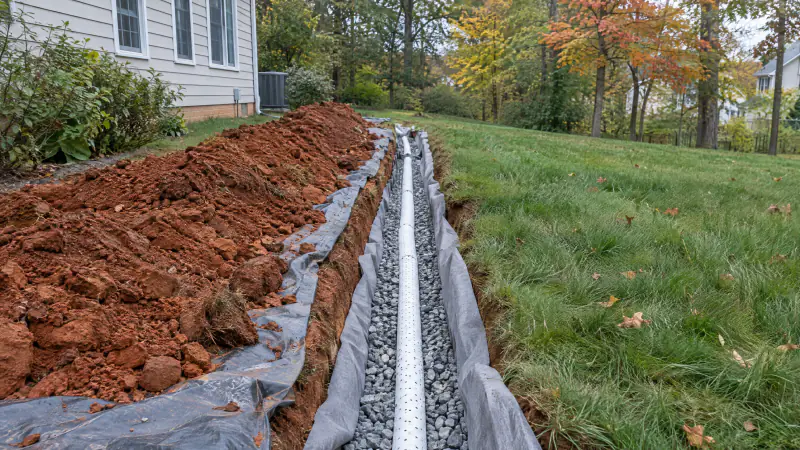
You can do it yourself in one kind of yard: a short, shallow drain on your own lot, with a clear gravity outlet, no utilities in the way and nothing near the foundation. A capable homeowner with a weekend, a level and a rental trencher or mini excavator can build that drain well. Hire it out if the outlet needs a pump or a tie-in to a storm drain, the run is long or deep, the water is pressing against a wall, or you cannot say where the water comes from.
What separates the two is not the digging. It is what you decide before the first shovel: where the water exits, what slope it falls on, and what keeps clay out of the stone. Our French drain installation page shows how we build them, and French drains on Northern Virginia clay goes deep on design.
Decide in five questions: is this a DIY French drain?
Answer each honestly. If you land in the right-hand column on any of the first two, stop and get a site visit.
| The question | DIY is realistic if | Hire if |
|---|---|---|
| 1. Where does the water go? | A lawful gravity outlet on your own lot sits several inches below the trench: a slope, an emitter spot or a daylight pipe | The only exit is a pump, a storm drain tie-in, a neighbor's lot or a dry well on clay |
| 2. How long and how deep? | Roughly 20 to 60 feet, 18 to 24 inches deep, through open lawn | Over about 100 feet, deeper than 30 inches, or along a foundation to the footing |
| 3. What is in the ground? | 811 has marked public lines and you have found your own irrigation and lighting lines | The route is crowded with utilities, roots or rock, or you cannot locate private lines |
| 4. How does the site work? | Open access for a trencher or wheelbarrow and a place for the clay | A townhome yard, a steep slope, hardpan or no room for a pile of clay |
| 5. What if it fails? | The wet area is lawn, far from the house, and a redo is affordable | The water is near a foundation, a basement, a retaining wall or a neighbor |
One answer in the right-hand column is a reason to ask for a professional opinion first.
Why does finding the outlet come before you buy a shovel?
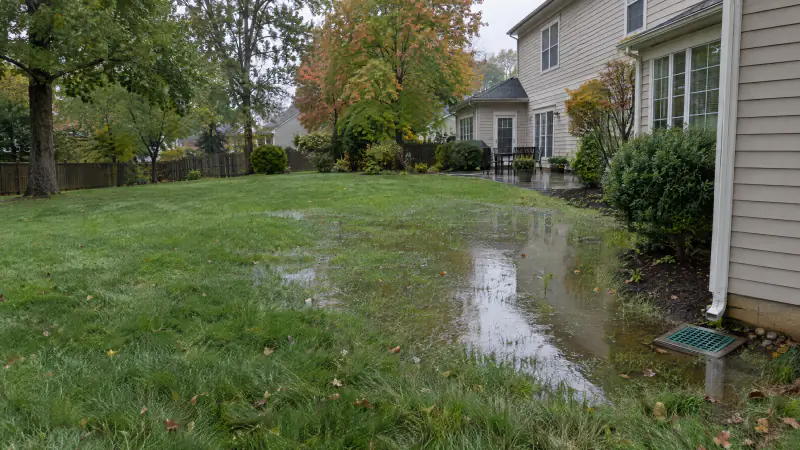
Because a French drain moves water; it does not make it disappear. The Northern Virginia Soil and Water Conservation District in Fairfax County says that whenever you redirect runoff you must send it to a suitable outlet, and that discharging runoff to an unsuitable area just moves the problems downhill. It adds that redirecting runoff without letting it soak in can negatively affect neighboring properties. The outlet is the project. Everything else is a trench.
Find the lowest lawful point on your own lot and confirm it sits below the bottom of the planned trench. Good outlets are daylight at a slope or woods edge with a screened pipe end, and a pop-up emitter in a lawn that keeps falling away from the house. Weak outlets are a dry well, which relies on soil that clay does not provide, and anything you do not own. Our article on dry wells, French drains and catch basins explains why. Never connect a French drain to a sanitary sewer cleanout: Fairfax County's wastewater page says that installing unpermitted connections such as sump pumps, downspouts, French drains and other flood control systems to the sanitary sewer is illegal. Our sump pump discharge article covers the rule, and you should ask the county or your utility before tying into any pipe you did not install.
To check the fall, stretch a string from the high end to the outlet, hang a line level on it and measure from string to ground at both ends. The difference is your total fall. If it will not cover the slope the pipe needs, you need a different route or a pump, and a pump is a reason to hire.
What must you do before you dig: 811, private lines and permits?
Call Virginia 811 first, and wait for the marks. Its homeowner page says to contact it at least 3 working days in advance, that there is no depth below which a call is unnecessary, and that many utilities are buried only a few inches down. Its Dig With Care page says not to dig until you receive a positive response, and to hand dig within 24 inches on either side of the marks where your work will cross a line.
Know what the 811 page describes. It refers to marking the approximate location of buried public utility lines on your property. Treat anything that you or a previous owner installed as yours to find, with a private locator if needed: sprinkler pipe, low-voltage lighting cable, pet fence wire and lines to a shed are the usual ones, and a trencher will cut them before you feel it.
A short yard drain may fall below the permit thresholds, but a larger project can reach one, so confirm with your county. Fairfax County regulates land-disturbing activity of 2,500 square feet or more, counts a 10 foot work zone and a 10 foot access path toward the total, and lists individual home landscaping among exempt minor activities, noting that applying the exemptions generally requires staff guidance. It also requires Resource Protection Area approval for work in that area. Other counties publish their own thresholds, which our French drain cost article lists. An HOA may also review visible outlets.
How deep, how wide and how steep should the trench be?
For a yard drain, plan on a trench 10 to 12 inches wide, 18 to 24 inches deep, with a continuous fall of at least 1 percent. The Fairfax County conservation district describes a standard French drain ditch as about 1.5 feet deep and 10 to 12 inches wide, lined on all sides with landscape fabric. We typically cut 18 to 24 inches so the trench passes through topsoil into the clay holding the water, and go deeper when a probe shows the wet layer lower down.
The Penn State Center for Dirt and Gravel Road Studies says in a 2019 technical bulletin that all underdrains should be installed with at least a 1 percent slope. That is a university road-drainage publication, not a homeowner guide or a Virginia code, so read it as a commonly used minimum rather than a rule for your yard. One percent is about 1/8 inch per foot. ADS and NDS, the pipe makers, say the slope is critical and that without it water will not flow effectively, but they give no figure. On clay, which silts a flat pipe quickly, we treat 1 percent as the floor.
The slope must be constant: a dip holds silt and a rise stops the flow. Measure down from the string line every few feet and re-check the finished bed before the pipe goes in.
How much fall does a 25, 50 or 100 foot French drain need?
Total fall is run length times slope. These figures follow from the 1 percent minimum and a steeper 2 percent for comparison.
| Run length | Fall at 1 percent | Fall at 2 percent | What it means for the outlet |
|---|---|---|---|
| 25 feet | About 3 inches | About 6 inches | Fits almost any lot with a clear low point |
| 50 feet | About 6 inches | About 12 inches | The outlet end must sit at least 6 inches below the start |
| 75 feet | About 9 inches | About 18 inches | On a nearly flat lot you may run out of fall |
| 100 feet | About 12 inches | About 24 inches | A deeper trench at the outlet end, or a different route |
Add the depth at the start to the fall to get the depth at the outlet end, unless the ground itself falls.
How is a French drain built, step by step?
The order is as important as the materials. These are the steps we follow, and a DIY build should follow the same sequence.
Confirm the outlet and the fall
Set stakes and a string line from the wet area to the outlet, measure the total fall, compare it with the table above and settle the route before you buy anything.
Call 811 and locate private lines
Request the locate at least 3 working days ahead, wait for the positive response and hand dig where the route crosses a mark. Find your own irrigation and lighting lines too.
Dig the trench to grade
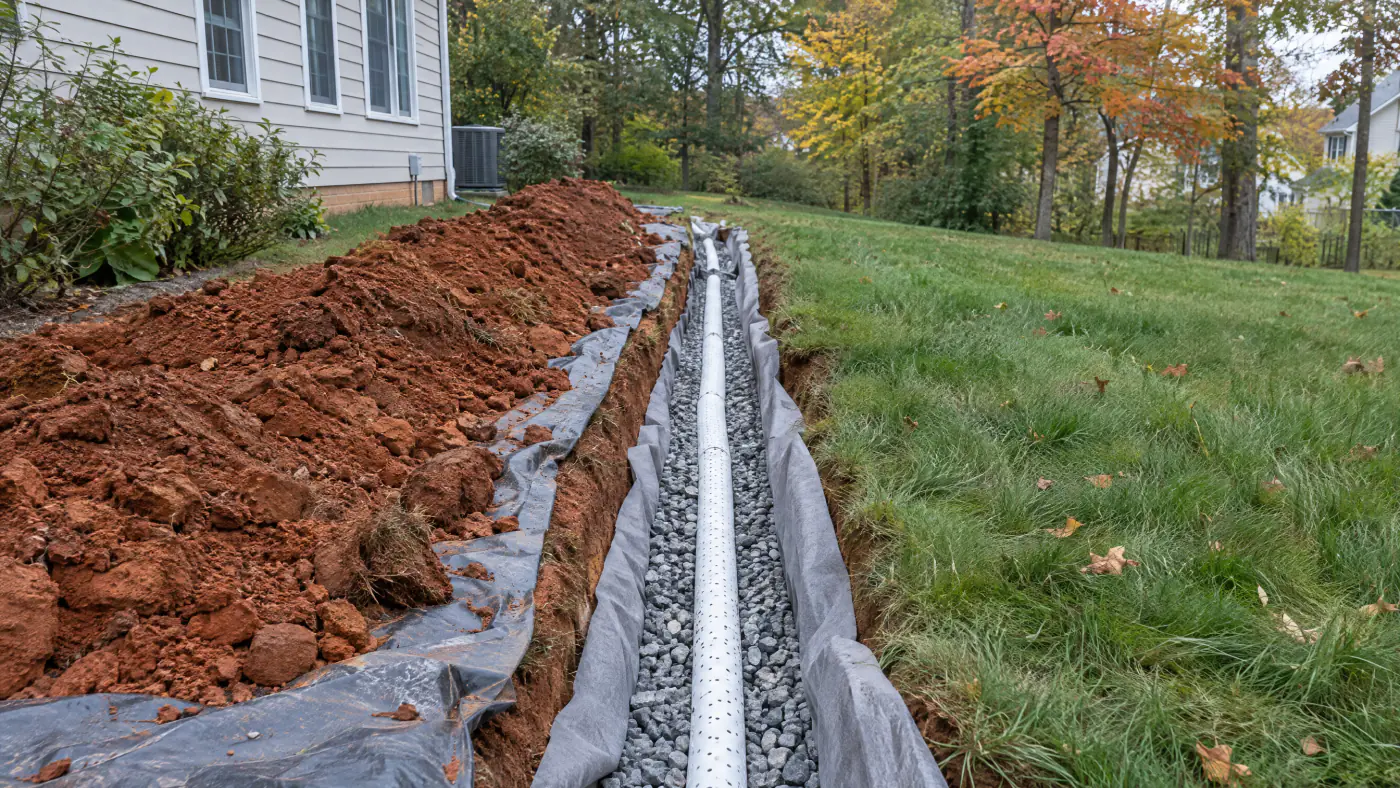
Lift the sod in strips and set it aside. Cut to the string line, check the slope every few feet and keep the clay on a tarp away from the trench edge.
Line it with fabric
Lay non-woven geotextile in the trench with enough excess on each side to fold over the top, and hold it in place with a few shovels of stone.
Bed the pipe and lay it to slope
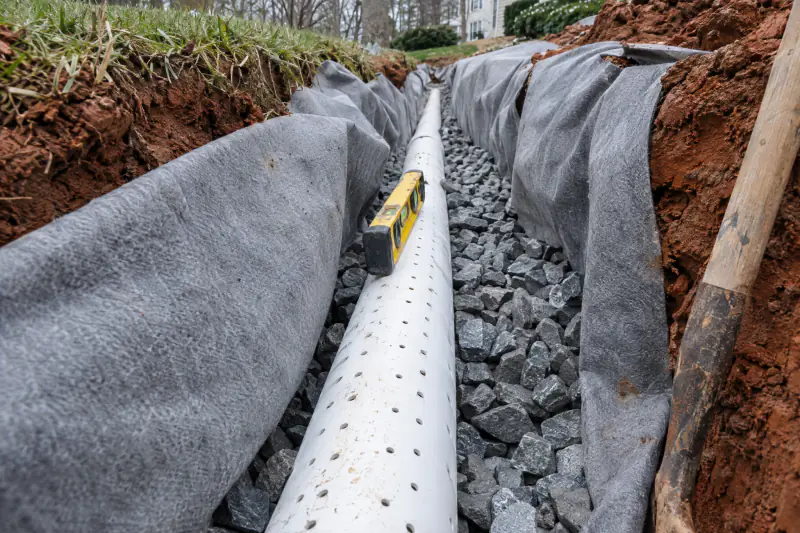
Level 2 to 4 inches of washed stone to the slope, set rigid perforated pipe holes down, couple the joints, add a cleanout at the high end and check the fall again.
Fill, fold and finish
Fill stone around and over the pipe to within a few inches of grade, fold the fabric closed, then add topsoil and sod. Run solid pipe from the trench end to the outlet.
Which fabric, pipe and stone should you buy, and why?
Buy non-woven geotextile, washed angular stone and rigid perforated pipe, because each does a job the cheaper substitute cannot. ADS and NDS say that in clay the key is a high-quality non-woven geotextile that keeps fine clay and silt out, and that backfill should be clean, angular stone from 3/4 to 1.5 inches. The Penn State bulletin agrees from another direction: fabric prevents clogging by blocking fine silt and clay, and clean stone is uniform in size with no fine material.
Four-inch rigid perforated pipe holds its grade under backfill. Thin corrugated pipe is cheaper and easier to coil down a trench, but it sags into bellies that trap silt, so we do not use it on clay. We lay rigid pipe holes down so water enters as soon as it collects at the bottom. Check the maker's sheet for your pipe, since slotted corrugated pipe differs. Skip cheap woven landscape fabric around stone: the sources above specify non-woven geotextile for clay.
Order washed stone by the ton with a weight ticket. A trench 12 inches wide and 24 inches deep needs about 5 feet of fabric just to line the bottom and both sides, so buy a roll 6 feet wide or wider to leave a top overlap. Add a cleanout fitting, couplings, an emitter or screened outlet, and solid pipe to reach it.
How much clay, stone and fabric does a 25, 50 or 100 foot drain involve?
Planning arithmetic for a trench 12 inches wide and 24 inches deep. Check it against your own dimensions.
| Run length | Trench volume in the ground | Washed stone, roughly | Fabric and pipe |
|---|---|---|---|
| 25 feet | About 50 cubic feet, 1.9 cubic yards | About 1.5 cubic yards, 2 tons | About 30 feet of fabric, 25 feet of pipe |
| 50 feet | About 100 cubic feet, 3.7 cubic yards | About 3 cubic yards, 4 to 5 tons | About 55 feet of fabric, 50 feet of pipe |
| 100 feet | About 200 cubic feet, 7.4 cubic yards | About 6 cubic yards, 8 to 9 tons | About 105 feet of fabric, 100 feet of pipe |
| Add for a 40 foot solid outlet line | About 40 cubic feet at 12 inches wide and 12 deep | Backfill is soil, not stone | 40 feet of solid pipe |
Stone fills about four fifths of the trench, since pipe, fabric and a few inches of topsoil take the rest, and it weighs roughly 1.3 to 1.5 tons per cubic yard, so confirm with the supplier and allow a little extra. Loosened clay takes more room than it did in the ground, so plan a bigger pile than the volume suggests.
What tools and rentals does it take, and where does the clay go?
You need a laser or string level, stakes, a tape, shovels, a rake, a wheelbarrow, tarps and a utility knife for the fabric. For the digging, plan to rent a walk-behind trencher or a mini excavator for a day or two, and ask the yard for the price with delivery, fuel and damage coverage. As a planning figure, the machine commonly runs a few hundred dollars a day.
The clay is the surprise. A 50 foot trench holds about 100 cubic feet of soil, roughly 17 to 33 wheelbarrow loads at 3 to 6 cubic feet each, and nearly all of it leaves because the stone replaces it. Keep sod and topsoil to reuse, tarp the rest and decide where it goes before you start: a hauler, a dumpster or a spot on your own lot. Do not pile it on a neighbor's land, near a stream buffer or over the line you just built.
Should you tie the downspouts into the French drain?
Usually not into the perforated line itself. The Fairfax County conservation district notes that downspout and sump pipes can be connected to a French drain, and it can be done. We prefer to keep roof water in its own solid pipe that joins at the outlet, because a roof delivers a lot of water fast. One inch of rain on 1,000 square feet of roof footprint is about 623 gallons if all of it runs off, and a perforated pipe in clay has nowhere to put that surge except back into soil you were trying to dry.
If the wet area is caused by a downspout dumping at the corner of the house, extending or burying the downspout is often the better first fix. Our downspout and sump discharge page and the article on where gutter water should go explain the options, and our guide to a soggy spot that never dries covers diagnosis.
What goes wrong with a DIY French drain, and how do you avoid it?
Five faults account for most of the drains we are asked to replace.
No outlet, or an outlet that fills
A pipe that ends in the ground fills after the first storm. A dry well in clay can overflow. Confirm the exit and its fall first, and give any outlet an overflow path.
No fabric, or the wrong fabric
Without non-woven fabric, clay moves into the stone within a few wet seasons, and woven cloth passes water poorly. Wrap the whole stone envelope in non-woven geotextile.
Flat or reversed slope
A trench that looks level can fall the wrong way, and silt settles in the low spot. Use a laser or string line and check the grade every few feet.
Crushed or sagging pipe
Thin corrugated pipe sags, and any pipe can be crushed by a bucket, backfill or a mower over a shallow run. Use rigid pipe and keep cover over it.
Wrong stone, or a sealed top
Crusher run packs tight and clogs, and soil dumped straight onto stone with no fabric closes the top. Use washed angular stone and fold the fabric over it.
What does a DIY French drain cost compared with hiring a contractor in Northern Virginia in 2026?
As of 2026, materials for a 50 foot yard drain typically run about $600 to $1,500 for a DIY build, and a contractor typically installs a yard drain at about $30 to $70 per linear foot, roughly $1,500 to $3,500 for the same 50 feet. These are typical market planning figures for Fairfax, Loudoun, Prince William and Arlington, not myYardPros prices or quotes. The DIY figure is roughly $150 to $300 for rigid perforated pipe and fittings, $250 to $500 for about 4 to 5 tons of washed stone delivered, $50 to $100 for fabric, $30 to $60 for a cleanout and emitter, and $150 to $350 for a rental day.
The saving is almost entirely labor, perhaps $1,000 to $2,000 on a 50 foot run, in exchange for a weekend or two of hard work and the risk of a mistake. Hauling the clay, sod repair, delivery fees, a second rental day and a cut line add to the DIY side. On the contractor side, a lower price often means a missing outlet, no fabric, thin pipe or no haul-off. Our cost guide lists related drainage ranges, and the French drain versus catch basin guide helps when the cheaper fix is not a drain at all.
What moves the number: the length and depth of the run, distance to the outlet, solid pipe, rock and roots, access, restoration and utility conflicts. A written on-site estimate removes the guesswork. Request an estimate or call (571) 200-9600.
When is hiring a French drain contractor the better call?
Hire when the risk or the physical work is larger than the saving. These situations qualify.
- The only outlet is a storm drain, a curb, a neighbor's lot or a pump.
- The water is against a foundation wall, a basement or a retaining wall.
- The run is longer than about 100 feet or deeper than about 30 inches.
- The route crosses a driveway, a patio, a walkway or an irrigation zone.
- Access is tight, as in a townhome yard, or the slope is steep or rocky.
- You cannot say why the area is wet, or a dry-week test points to a leak.
How do clay, HOAs and lot size change a DIY French drain across Fairfax, Loudoun, Prince William and Arlington?
The design is the same everywhere, but the outlet and the access vary a great deal. Lots in Great Falls, Clifton, Purcellville and western Loudoun more often have a rear slope or woods line where a daylight outlet works, which makes DIY realistic. On the flatter lots of Ashburn, Sterling, South Riding and Herndon the fall to the street can be short, and a pop-up emitter may be the only exit. In Arlington and Alexandria, small lots and shared property lines often leave no lawful place for the water to go, so a catch basin or a professionally designed fix from our yard drainage solutions is the better start.
Townhome communities in Reston, Centreville, Burke and Springfield add HOA rules and tight access, and many HOAs require approval for visible changes, so ask before you dig. Clay is common across Fairfax, Loudoun and Prince William, and lots around Gainesville, Haymarket and Bristow may have compacted fill. Our service areas page lists where we work, and a site visit tells you more than any article, including this one.
Frequently asked questions
Is a DIY French drain realistic for a beginner?
For a short, shallow run with a clear outlet, yes, if you can handle a level, a shovel and a rented machine and have a weekend. The risk is not the digging; it is the outlet, the slope and the fabric. If the outlet is unclear or the water is near the foundation, get a professional opinion first.
What slope does a French drain need?
At least 1 percent, about 1/8 inch of fall per foot of run, so a 50 foot drain falls about 6 inches. Penn State's underdrain bulletin calls for at least 1 percent on all underdrains. On clay we treat that as the floor, use more when the lot allows and keep the slope constant.
Do I need to call 811 for a French drain in my own yard?
Yes. Virginia 811 asks homeowners to contact it at least 3 working days before digging and says there is no depth below which a call is unnecessary. Its homeowner page describes marking buried public utility lines, so treat private lines such as irrigation and lighting as yours to locate, and hand dig within 24 inches on either side of marks.
Should the holes in the pipe face up or down?
On rigid perforated pipe in a clay trench we lay the holes down so water enters as soon as it collects at the bottom. Check the instruction sheet for your pipe, because slotted corrugated pipe works differently, and the maker's guidance governs. Do not rely on a fabric sock as your only filter.
Can I use pea gravel or crusher run instead of washed stone?
Not on clay. ADS and NDS recommend clean, angular stone from 3/4 to 1.5 inches, and Penn State describes clean stone as uniform with no fine material. Crusher run and stone dust contain fines that pack tight and hold water, the opposite of what the drain is for.
Can a downspout connect to a French drain?
It can be done, and the Fairfax County conservation district notes it, but we prefer to keep roof water in its own solid pipe to the outlet. One inch of rain on 1,000 square feet of roof footprint is about 623 gallons if all of it runs off, which can overwhelm a perforated line in clay. Extending the downspout is often the cheaper first fix.
Book the work
Put the plan in writing with a crew that builds this every week.
One visit to measure and talk through options, then a written scope and price. No pressure, no vague numbers. Ask about the Heroes Discount if you serve.
Sources and further reading
- Virginia 811: Homeowners, requesting utility marking before you dig
- Virginia 811: Dig With Care (respect the marks, hand digging within 24 inches)
- Fairfax County Land Development Services: Land Disturbance 101
- Northern Virginia Soil and Water Conservation District (Fairfax County): Control Heavy Runoff
- ADS / NDS: Combat water drainage issues with a French drain
- Penn State Center for Dirt and Gravel Road Studies: Underdrains technical bulletin (slope, fabric, clean stone)
Published November 12, 2026. Reviewed and updated November 13, 2026.