Key takeaways
- Walk the house in a set order: gutters, downspouts, grade at the wall, window wells, patios and walks, sump discharge, low spots and outlets. Each stop has one or two measurements.
- The grade should drop about 6 inches in the first 10 feet from the foundation, with soil kept several inches below siding. A string line and a level check it in minutes.
- Water that stands against a foundation in November freezes in January. Ice expands, heaves soil and slabs, and pries at joints, so the pre-winter goal is simply no standing water near the house.
- Some fixes are quick and belong on a Saturday: extensions, well covers, clearing emitters. Others are construction, and most drainage construction can still happen in a Northern Virginia winter.
- Hand the contractor a list, not a feeling: where water stands, how long, what you measured, and photos from the last rain. It shortens the estimate and improves the design.
On this page
- Why walk the house before winter, and what are you looking for?
- What does freeze-thaw do to standing water near a foundation?
- What is the walkthrough route, stop by stop?
- Stop one: what should you see at the gutters and downspouts?
- Stop two: how do you check the grading slope at the foundation?
- Stop three: what should you check at window wells, patios, walks and steps?
- Stop four: what about the sump discharge and the low spots?
- Quick fix now, or winter-safe construction?
- Which fixes can wait for spring, and which cannot?
- What drainage work can be done in winter in Northern Virginia?
- What goes on the list you hand a contractor?
- What do pre-winter drainage fixes cost in Northern Virginia?
- What differs across Fairfax, Loudoun, Prince William, Arlington and Alexandria?
- Frequently asked questions
Why walk the house before winter, and what are you looking for?
You are looking for one thing: any place where water stands or collects within a few feet of the house, because in two months that water will be ice, and ice near a foundation does slow, expensive damage. Northern Virginia winters are not brutally cold, but they cycle. A typical January here freezes hard for a few nights, thaws to 50 degrees, rains, and freezes again. Each cycle moves water into cracks and joints as liquid and expands it there as ice. Soil heaves, slabs lift, mortar joints open, and the gap between a patio and the wall grows. By March the basement that was dry in October has a new damp corner.
The walkthrough takes about an hour on a typical suburban lot, and the window for it is after the leaves are mostly down and before the ground freezes, which in most of our area means the first half of November, a week or two earlier in western Loudoun. Bring a tape measure, a ball of string, a line level or a four-foot level, your phone for photos, and if you can time it, do it during or right after a rain. Water shows you its path when it is moving. Dry, it only leaves clues.
The route below goes stop by stop, with what to measure at each one, what counts as a problem, and whether the fix is a Saturday job or construction. It assumes nothing about your house beyond the fact that it sits on clay, which is true nearly everywhere from Alexandria to Purcellville. Our yard and foundation drainage page describes the construction side; this article is about what you can see and measure yourself before you call anyone.
What does freeze-thaw do to standing water near a foundation?
It turns a puddle into a wedge. Water expands by roughly nine percent when it freezes, and it does so with enough force to split rock. A film of water that soaked into the joint between a stoop and the house wall, or into the hairline crack at the top of a block foundation, becomes ice overnight, pushes the two surfaces apart by a fraction of a millimeter, and thaws by noon. The water drains a little deeper into the slightly wider gap. The next night it freezes again. Over a winter of several dozen such cycles, which is a normal count for Fairfax or Loudoun, the stoop has moved away from the wall and the crack has grown enough to let water through in spring.
Soil does the same thing on a larger scale. Wet clay that freezes forms ice lenses, layers of ice that grow by drawing more water up from below, and the ground surface rises. That is frost heave, and it is why sidewalks tilt and why a patio corner that sat on saturated backfill is an inch higher in February than in October. When the lens thaws, the soil is wetter and softer than before and settles unevenly. Hardscape laid on it follows. Our paver patios are built on a deep compacted open-graded base for exactly this reason, but a patio of any kind that has water standing beside it in November is going to move.
Walks and driveways add a safety problem. A downspout that releases onto a front walk, or a low spot in a driveway near the garage, becomes a sheet of ice on every cold morning after a thaw. Deicing salt then washes into the lawn edge and bed, and into the concrete, where it accelerates surface scaling. The pre-winter goal is modest and clear: when you finish the walk, there should be no place within ten feet of the house, and no walk or step, where water can sit still long enough to freeze.
What is the walkthrough route, stop by stop?
Start at the front door and walk clockwise around the house. Eight stops, with the measurement or test for each.
Gutters
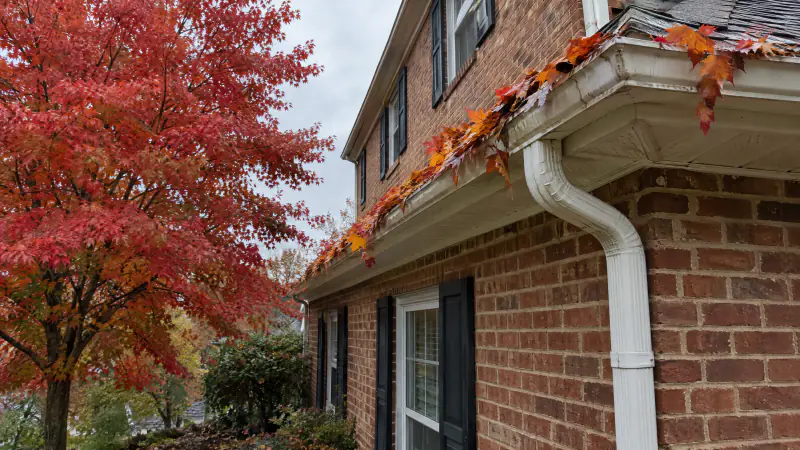
From the ground, look for sagging sections, seams dripping, and leaf debris visible above the lip. During rain, watch every corner and valley for overflow. Overflow at a corner is the most common cause of a wet basement corner below it.
Downspouts
Follow each one to its end. Note whether it ends at a splash block, a flexible extension, or a buried line. Run a hose into any buried line and confirm water appears at the outlet within a minute or two. Time it.
Grade at the foundation
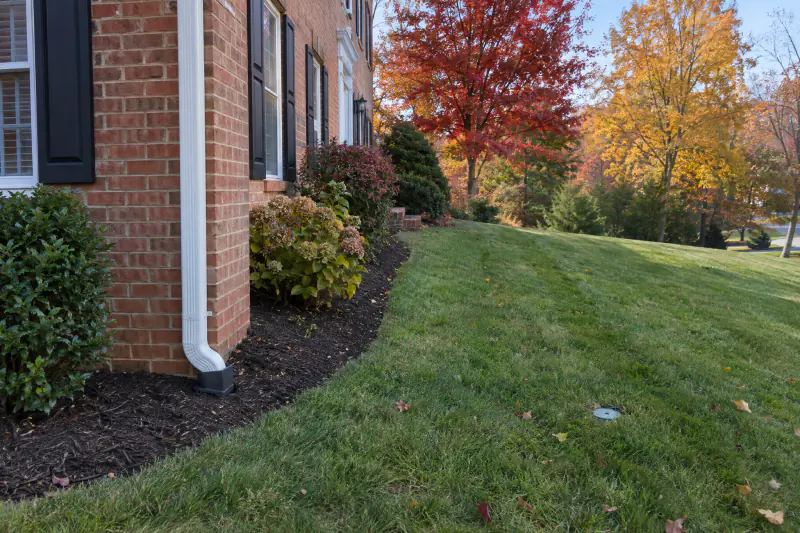
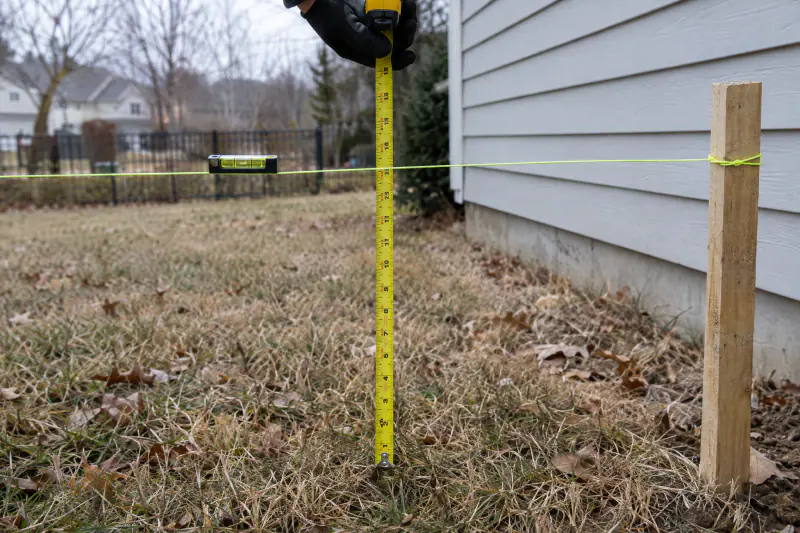
At the center of each wall, stake a string at ground level against the wall, pull it level ten feet out, and measure the drop. The target is about 6 inches. Note any rise, any flat trough along the wall, and whether soil touches the siding.
Window wells
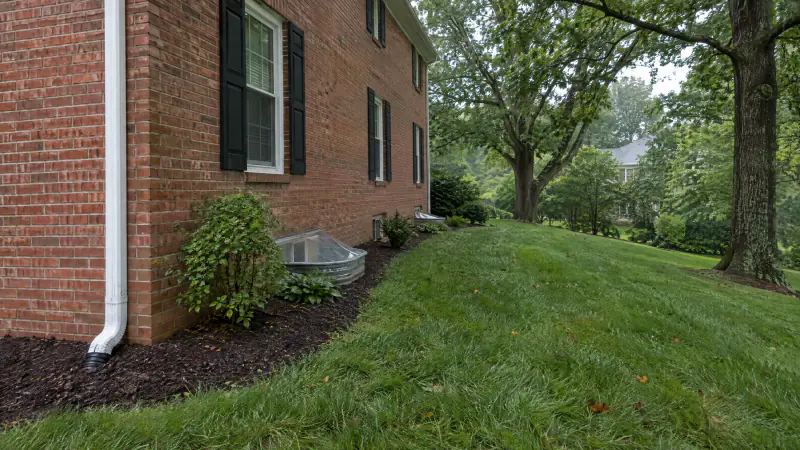
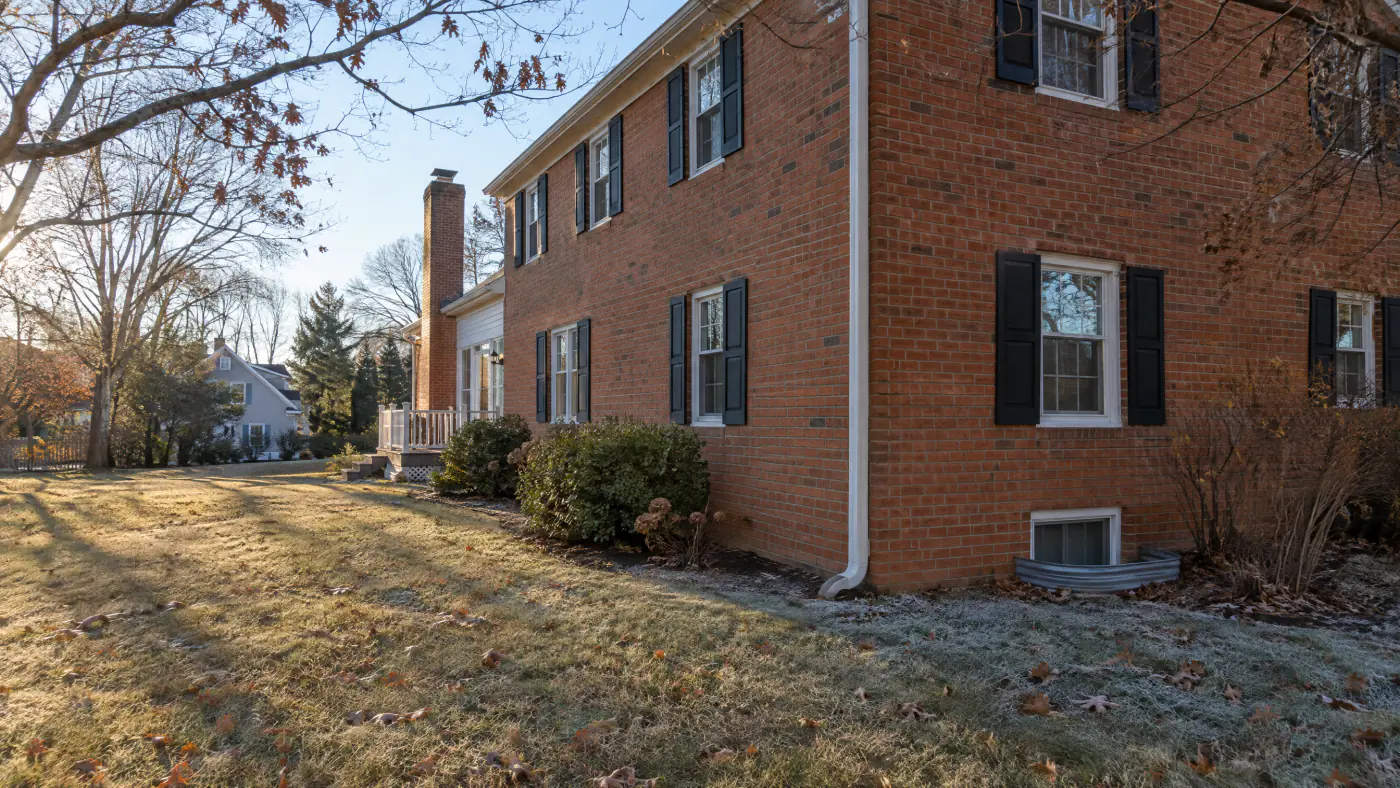
Look in. Debris, standing water, or soil above the bottom of the window frame are all problems. Check whether a cover exists and fits, and whether a downspout or gutter corner sits above the well.
Patios, walks and steps
Lay a four-foot level across the slab toward the house. It should fall away from the wall, roughly a quarter inch per foot. Note gaps at the wall, sunken corners and any spot where water stood after the last rain.
Sump discharge
Find where the pipe leaves the house and where it ends. Pour a bucket down it or run the pump. Water should leave at least 10 feet from the house onto falling ground. Check for a freeze-relief fitting or air gap at the wall.
Low spots and swales
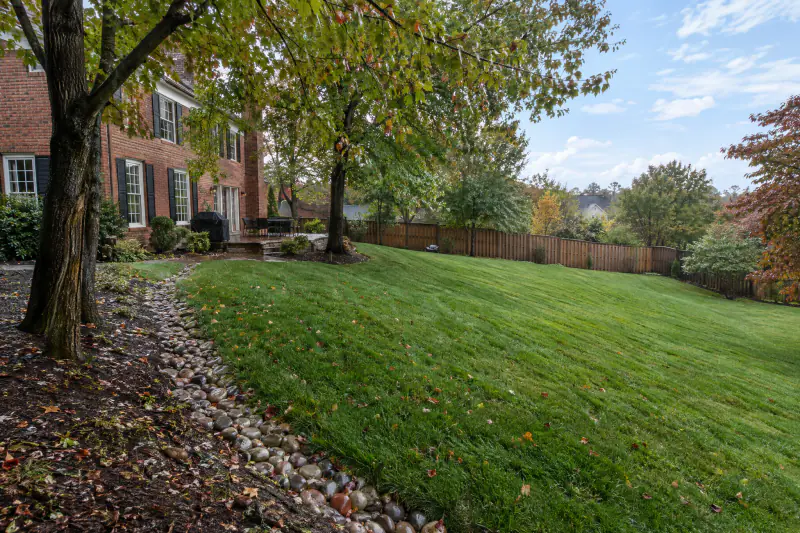
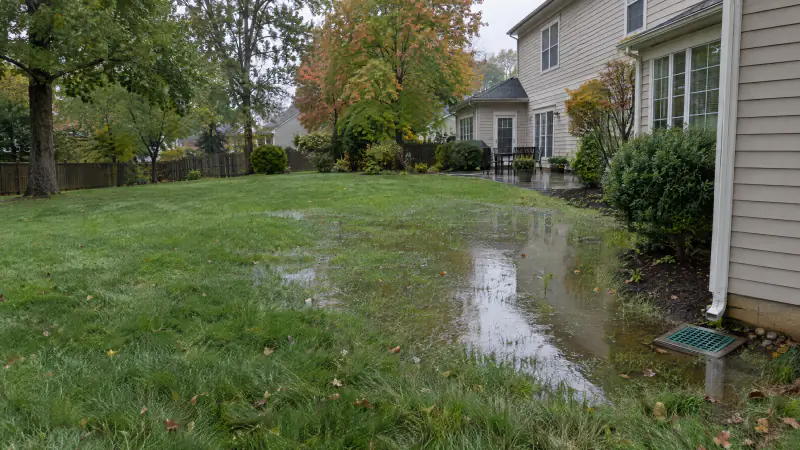
Walk the lawn looking for the places you avoid in boots: moss, bare soil, mower ruts, standing water. Note how far each is from the house and whether the ground beyond it keeps falling or rises.
Outlets and emitters
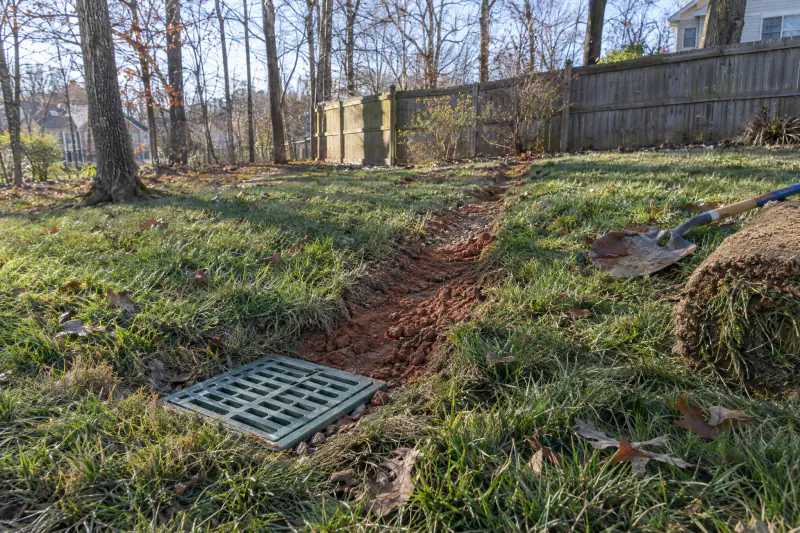
Find every pop-up emitter, catch basin grate and daylight pipe end. Lift the emitter caps, clear grit and grass, check that basin grates are not buried in leaves, and confirm each outlet sits lower than the house.
Stop one: what should you see at the gutters and downspouts?
You should see gutters that hold a slight slope toward the downspouts, no visible debris above the lip, and downspouts that run freely to an outlet well away from the house. In November, after oaks have dropped most of their leaves, a gutter that was cleaned in October is often half full again. The late droppers, especially the white and red oaks that hang on into December, mean a single fall cleaning rarely covers the season. Our leaf season guide explains the two-pass approach and how leaves travel into buried lines.
At the downspouts, the question is where the water ends up. A splash block puts roof water within three feet of the foundation, into the loose backfill that drains worst. A flexible black extension works until someone moves it for the mower. A buried line works only if it is clear and sloped. The hose test tells you: water should appear at the pop-up emitter or daylight outlet quickly and keep flowing at the rate you are putting it in. Water that backs up and overflows at the downspout, or arrives at the outlet as a trickle, means a clog or a sag, and the line needs flushing from its cleanout or jetting.
Also check the connection at the bottom of the downspout. Builder-grade lines often use an unsealed adapter that leaks roof water at the wall before it ever enters the pipe. And look at the gutter itself for ice damage from last winter: a section that pulled away from the fascia under the weight of ice sends water down the wall behind it, which is a roof-water leak that looks like a foundation problem. The downspout drainage page describes what a properly built line includes, from the debris filter at the top to the emitter at the end.
Stop two: how do you check the grading slope at the foundation?
With a string, a stake and a level, at the middle of every wall. Push a stake into the ground against the foundation and tie the string at ground level. Walk it ten feet straight out, pull it taut, and hang a line level on it or lay a long level against it until the string is level. Then measure from the string down to the ground at the far end. That number is your fall over ten feet. The standard most codes and drainage guides use is about 6 inches of drop in the first 10 feet, which is roughly a 5 percent slope. Two inches is marginal. Zero or a rise means every storm leaves water sitting against the wall.
While the string is up, look at the shape of the ground under it. A smooth, steady fall is what you want. A trough along the wall with a hump farther out, which is the classic signature of settled backfill plus years of mulch and edging, holds water at the house even if the overall number looks acceptable. Then look at the wall itself. Soil, mulch and stone should stay several inches below the bottom of the siding, and below the top of the foundation on brick homes, so that wood framing and the sill stay dry and insects have no bridge. If the only way to get 6 inches of fall is to bury the siding, the slope has to be made farther out by lowering the ground, by shaping a shallow swale a few feet from the house, or by adding a catch basin at the low point and piping it away.
Repeat at each wall and write the numbers down. A house with a good fall on three sides and a rise on the fourth tells a contractor exactly where to work, and that precision shortens the estimate. For the reasons the clay here settles the way it does, and what regrading involves, see why Northern Virginia backyards stay wet.
Stop three: what should you check at window wells, patios, walks and steps?
At the window wells, check for three things: debris on the bottom, soil or gravel that has risen to the window frame, and a cover. A well that holds water against a basement window is a window-shaped hole in the foundation, and in winter the standing water freezes against the glass and frame. Scoop out leaves, confirm there is clean gravel at the bottom, and if the well fills in rain and does not drain within an hour or so, the gravel sump is sealed with silt and needs digging out, or the well needs a drain line out to the yard system. A clear polycarbonate cover is cheap and stops most of the problem at the source. Make sure no gutter corner or downspout discharges above the well.
Patios and walks are checked with a level. A slab beside the house should fall away from the wall at roughly a quarter inch per foot, so a four-foot level laid toward the house should show about an inch of drop over its length. Settled concrete frequently tilts the other way. Look for the gap that opens where a sunken slab has pulled away from the foundation; water runs straight down it. Look for the stain or efflorescence line on the wall just above the slab, which marks where water stands. Pavers that have sunk at the house edge show the same thing as a dip you can feel underfoot.
Steps and stoops that have shifted from the wall are both a freeze-thaw symptom and a safety issue, and a walk that puddles at the bottom step is a January ice patch. Quick measures for winter are a bead of exterior sealant in the gap at the wall and clearing the outlet that the walk should drain to. The lasting fix is to lift or repitch the slab, cut a channel drain across it at the wall and pipe it to an outlet, or rebuild the surface on a proper base; our walkways page covers what that involves for front paths. We cover the basement side of all of this in water in the basement: exterior drainage fixes.
Stop four: what about the sump discharge and the low spots?
The sump discharge is the stop people skip, because the pipe leaves the house at an odd corner and nobody has looked at where it ends. Find it. In winter the test is specific: the line has to be able to discharge even if the buried part freezes. That means an air gap or a freeze-relief fitting at the wall, so that if the buried pipe ices up the pump can still push water out at the house rather than dead-heading and burning out. Then follow the line to its end. The outlet should be 10 feet or more from the foundation on ground that keeps falling away, and it should not be a pop-up buried under a foot of leaves. If the pump discharges beside the house, every gallon it lifts comes right back to the basin, and the pump that runs all night in a February thaw is often doing exactly that.
Low spots are the last stop and the broadest. Walk the whole lawn and note the places water stood after the last rain, where moss grows, where the mower rutted in spring. For each, estimate its distance from the house and look at what lies beyond it. A low spot ten feet from the wall with higher ground on the far side is a basin that holds water against your foundation all winter. A low spot with ground that keeps falling beyond it just needs a path, often a shallow swale or a bit of fill. A low spot at the rear lot line in a newer subdivision is often a recorded drainage easement doing its job, and it needs to be kept open, not filled.
Finish at the outlets. Lift every pop-up emitter cap and clear the grit; check that catch basin grates are clear and that the sump below the grate is not full of silt; walk to any daylight pipe end on the slope and make sure it is open and sits above the ground, not buried under leaves or soil. A piped system that cannot discharge is a system that holds water in the pipe to freeze. The French drain and downspout lines we build end at outlets chosen to stay open through winter, and the annual clearing takes minutes if they were built with cleanouts.
Quick fix now, or winter-safe construction?
What to do this weekend versus what to put on the contractor's list, and whether that work can happen before spring.
| Finding | Quick fix before the freeze | Proper fix | Buildable in winter? |
|---|---|---|---|
| Downspout ends at a splash block | Rigid extension to 10 feet, staked down | Buried solid line with cleanout to a pop-up or daylight | Yes, when ground is not frozen or saturated |
| Buried line backs up at the downspout | Flush from cleanout; disconnect and extend above ground | Jet or replace the line, add cleanout, correct the slope | Yes, same conditions |
| Less than 2 inches of fall in 10 feet | Rake soil away from siding; keep water moving | Regrade with compacted fill and topsoil, seed in spring | Yes; seeding waits for March or September |
| Window well holds water | Clear debris, fit a cover, move downspout outlet | Clean stone over fabric, drain line to the yard system | Yes, small excavation |
| Patio or walk tilts toward the house | Seal the gap at the wall, clear the outlet | Lift and repitch, channel drain, or rebuild on a proper base | Partly; mortar and concrete need mild weather |
| Sump discharges beside the house | Temporary surface extension with freeze relief | Buried discharge line with relief fitting to a far outlet | Yes, usually one day |
| Low spot holding water near the wall | Pump or bail after rain; mark it with a flag | Fill and regrade, swale, or catch basin piped to an outlet | Yes, except final seeding |
| Soil or mulch touching the siding | Pull it back to expose several inches of foundation | Lower the grade farther out and rebuild the fall | Yes |
Winter work depends on soil condition, not the calendar. Frozen or waterlogged clay stops grading; a mild dry week in January is fine.
Which fixes can wait for spring, and which cannot?
Anything that leaves water standing against the house cannot wait, and nearly everything else can. The list that should be done before the first hard freeze is short. Every downspout needs to release at least 10 feet from the house, even if the method is a rigid above-ground extension staked to the lawn for the winter. Every buried line that fails the hose test needs to be flushed, or bypassed above ground until it can be fixed. Every window well needs to be cleared and covered. The sump discharge needs freeze relief and a real outlet. Soil and mulch touching siding need to be pulled back. Emitters and grates need to be cleared. Those are Saturday jobs, and they take the standing water away from the foundation even if they look temporary.
Regrading, buried lines, catch basins and French drains are construction, and they can wait a few weeks or months without harm as long as the quick fixes have been done. They can also, in most Northern Virginia winters, be built before spring. The limiting factor is the ground, not the calendar: a trench can be cut and pipe laid any week the clay is neither frozen nor waterlogged, and we get many such weeks between November and March. What waits for spring is the finish: seed does not germinate in cold soil, so a regraded strip is often left with straw or dormant sod until March, or seeded in September for the strongest result.
The one category that should genuinely wait for warmer weather is masonry and concrete. Repitching a slab with a new pour, setting a channel drain in mortar, and rebuilding steps all want air and surface temperatures reliably above freezing for curing. Pavers on a dry-laid base are more forgiving, but polymeric sand has its own minimum temperature. If the patio is the problem, seal the gap at the wall now, keep its outlet clear, and schedule the rebuild for the first mild stretch. Our maintenance guide keeps a seasonal version of this list.
What drainage work can be done in winter in Northern Virginia?
Most of it. Our winters freeze the top few inches of clay for days at a time, not months, and between cold snaps there are long mild stretches when the ground is workable. Trenching for downspout lines, sump discharge lines and French drains proceeds in those windows. So does setting catch basins and running solid pipe to an outlet, as long as the trench bottom is firm and the pipe can be bedded and backfilled with material that is not frozen in lumps. Regrading can be done when the soil is dry enough to compact, which in winter often means waiting out the week after a rain or snowmelt.
There are practical advantages to winter drainage work. The lawn is dormant, so trenching and machine traffic do less visible harm, and the restoration happens in spring when seed takes. Beds are bare, so pipe routes through them are simple. Trees are leafless, so the crew can see the gutters, the roof lines and where water comes off them. Crews are also less booked than in April and May, which tends to mean a shorter wait between the estimate and the start. We describe the full process, from site visit to walkthrough, on how it works.
The things that stop winter work are frozen ground deep enough to resist a bucket, saturated clay that will not hold a trench wall or take compaction, and snow cover that hides the grade. None of those last long here. Western Loudoun around Purcellville and Leesburg sees more frozen days than Arlington or Alexandria, so schedules out there lean toward the mild weeks more carefully. If a patio or walkway rebuild is part of the plan, can you build a patio or walkway in winter covers the hardscape side of the same question. The honest rule we work by: drainage first, in any workable week, and the lawn and masonry when the weather allows.
What goes on the list you hand a contractor?
Bring this to the estimate. Specific observations get you a specific design.
- Photos from the last heavy rain showing where water stood or ran, with the time after the rain started.
- The measured fall over 10 feet at the middle of each wall, and any trough or rise you found.
- Each downspout: where it ends, and whether its buried line passed the hose test and how long water took to appear.
- Each window well: drains, holds water, covered or not, any downspout above it.
- Patios and walks: which way the level showed them falling and any gap at the wall.
- The sump discharge route, its outlet, and whether there is freeze relief at the house.
- Low spots with distance from the house and whether the ground beyond them rises or falls.
- Location of every emitter, grate and daylight outlet, and which ones were buried or clogged.
- Known private lines: irrigation, lighting wire, invisible fence, gas to a grill, so they can be located.
- Your plat, marked with any drainage easement, and your HOA's rules on grading changes.
What do pre-winter drainage fixes cost in Northern Virginia?
As of 2026, typical Northern Virginia market ranges run from almost nothing for the quick fixes to several thousand dollars for the construction items, and the walkthrough is what tells you which side of that line your house sits on. These are planning figures for the regional market, not our prices. The weekend items are cheap: rigid downspout extensions and window well covers are typically tens of dollars each at a hardware store, and clearing emitters and grates costs only time. Having a gutter company clean the gutters and flush the downspouts is commonly a few hundred dollars for a typical two-story house, more with steep roofs or guards.
The construction items follow the ranges on our service pages. Burying a downspout to a proper outlet commonly runs $400 to $1,500 per downspout, or $2,500 to $7,500 for a whole house. A buried sump discharge line with freeze relief typically falls between $800 and $3,000. Regrading one or two sides of a house, with compacted fill, topsoil and lawn restoration, generally runs $1,500 to $6,000. A catch basin with a piped run to an outlet is commonly $1,500 to $5,000, and a channel drain across a patio or driveway $2,000 to $6,000. A French drain prices at roughly $30 to $90 per linear foot, with most residential jobs between $2,500 and $10,000. A drain line for a window well, done while other trenching is open, is often a few hundred dollars.
What moves the number: the distance to an outlet that sits lower than the house, access for a small machine versus hand digging, how much clay has to be hauled off, crossings under walks and driveways, roots and utilities, and the amount of lawn or bed to restore in spring. Winter timing itself rarely changes the price, though it can shorten the wait. The cost guide has ranges across every project type, and the list from the walkthrough is the fastest route to a written estimate that reflects your house rather than an average one.
What differs across Fairfax, Loudoun, Prince William, Arlington and Alexandria?
Timing, soil and house age all shift the walkthrough a little. Western Loudoun, around Leesburg, Purcellville and out toward Aldie, freezes earlier and more often than the inner suburbs, so the walk should happen by early November there and the quick fixes should not wait. Arlington, Alexandria, Falls Church and the close-in parts of Fairfax County such as McLean and Annandale stay a little milder and have more mature tree cover, which means more leaf load in gutters and buried lines, and more roots in any trench. Prince William around Gainesville, Bristow and Woodbridge, and the newer Loudoun communities from Ashburn and Brambleton to South Riding, mostly have younger houses on tightly graded lots with recorded drainage easements along the rear and side lines, and the common findings there are collapsed builder-grade corrugated downspout lines and swales that have been filled or fenced across.
Soil varies more than weather. Dense red clay across most of Loudoun and western Fairfax holds water for days and heaves hard in a freeze. Parts of eastern Fairfax County and Alexandria have shrink-swell marine clay, which moves foundations and slabs seasonally and deserves extra caution with any excavation near a wall. Older neighborhoods in Vienna, Burke and Springfield often have better topsoil but decades of settled backfill, so the grading stop usually finds the most there.
Rules are broadly similar: your own lot's grading and downspout work rarely needs a permit, disturbing land beyond a county-set threshold can, discharge may not be aimed at a neighbor or into the sanitary sewer, and easements stay open. HOAs often review grading changes. Virginia 811 marking is required before any trenching, in any month. We do this work across Fairfax, Loudoun, Prince William and Arlington counties and the cities of Alexandria, Fairfax, Falls Church, Manassas and Manassas Park; the service areas page has the full list. The water management overview explains how the pieces of a drainage plan fit together once the walk has told you which pieces you need.
Frequently asked questions
How much slope should the ground have away from my house?
About 6 inches of fall in the first 10 feet, which is roughly a 5 percent grade, is the common standard. Measure it with a string staked at ground level against the wall, pulled level ten feet out, and a tape from the string to the ground. Where that much fall would bury the siding, make the slope farther out with a swale or lower ground, or add a catch basin at the low point.
Can drainage work really be done in winter in Northern Virginia?
Usually, yes. The ground here freezes a few inches deep for days, not months, and in the mild weeks between cold snaps trenching, pipe, catch basins and regrading all proceed normally. The limits are frozen or saturated clay, which cannot be compacted, and concrete or mortar work, which needs curing temperatures. Seeding of restored areas waits for spring or the following September.
Why does my sump pump run more in a winter thaw?
Because snowmelt and winter rain soak into ground that cannot drain, and because many discharge lines empty beside the house, so the pump recirculates its own water. If the buried discharge has frozen and there is no relief fitting at the wall, the pump may run without moving anything. A discharge line with freeze relief ending 10 feet or more from the house usually cuts winter run time sharply.
Do window wells need covers?
In our view, yes, on any well that has ever held water. A clear polycarbonate cover keeps rain, leaves and snow out of a bucket that sits directly against a basement window. It does not replace a working drain at the bottom of the well, but it reduces what the drain has to handle, and it stops the leaf mat that seals the gravel sump in the first place.
Should downspouts be disconnected from buried lines in winter?
Only if the line fails the hose test and cannot be cleared before the freeze. A clear, properly sloped buried line empties after each rain and holds nothing to freeze, so it is safer than a surface extension that ices over. A clogged line, though, backs water up to the downspout and freezes there, and a temporary above-ground extension is the better winter choice until it is repaired.
What is the quickest way to stop water pooling beside a foundation before winter?
Get the roof water out of that area first. Extend the downspouts feeding it to at least 10 feet, rake any soil or mulch away from the siding, and dig a shallow trench with a hoe from the puddle to lower ground so it drains after rain. None of that is permanent, but it removes the standing water that freeze-thaw works on. Then put regrading or a buried line on the list for a mild week.
Do I need a permit to regrade around my house in Fairfax or Loudoun County?
Usually not for a few feet of fill along a wall or a small swale, but every county and city sets a land-disturbance threshold above which a grading permit applies, and the thresholds differ. Work in a recorded drainage easement, near a stream buffer, or that changes where water leaves your lot can need approval. Check with your jurisdiction and your HOA before anything larger than spot repairs.
Book the work
Put the plan in writing with a crew that builds this every week.
One visit to measure and talk through options, then a written scope and price. No pressure, no vague numbers. Ask about the Heroes Discount if you serve.
Sources and further reading
- Fairfax County Department of Public Works and Environmental Services: stormwater and drainage
- Prince William County Government: public works and stormwater
- Virginia 811 (Miss Utility): call before you dig
- Virginia Cooperative Extension: home landscape and soils publications
- NOAA National Centers for Environmental Information: U.S. Climate Normals
Published November 12, 2026. Reviewed and updated October 22, 2026.